Questions
Answers
Our trusted network of 1stDibs sellers answer common questions
How do you pronounce Thonet chair?
1 Answer
Michael Thonet is a German-Austrian furniture maker who designed the famed bentwood chair in 1830. His last name, Thonet, is pronounced “TOE-net,” but it’s commonly mispronounced “tho-NAY.” Shop a collection of vintage and modern Michael Thonet pieces on 1stDibs.
1stDibs ExpertApril 5, 2022
Related Questions
- What is a Thonet chair?1 Answer
- How do I know if my chair is Thonet?1 Answer
- What is a Thonet-style chair?1 Answer
- What was significant about the Thonet chair?1 Answer
- Are Thonet chairs marked?1 Answer
Shop for Thonet Armchairs on 1stDibs
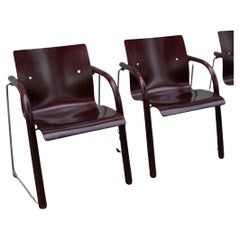
Set of 2 THONET S320 Stacking Chairs designed by Ulrich Boehme
Wulf Schneider
By Ulrich Bohme, Thonet
Located in Schwerin, MV
Set of 2 Thonet S 320 Armchairs in stained reddish-brown plywood and chrome plated Steel, Germany, 1980s
A striking set of four original Thonet S 320 armc...
Category
Vintage 1980s German Post-Modern Armchairs
Materials
Chrome
$474 Sale Price / set
33% Off
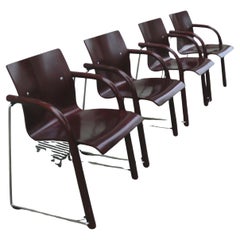
Set of 4 THONET S320 Stacking Chairs designed by Ulrich Boehme
Wulf Schneider
By Ulrich Bohme, Thonet
Located in Schwerin, MV
Set of 4 Thonet S 320 Armchairs in stained reddish-brown plywood and chrome plated Steel, Germany, 1980s
A striking set of four original Thonet S 320 armc...
Category
Vintage 1980s German Post-Modern Armchairs
Materials
Chrome
$949 Sale Price / set
33% Off
G80 Deck Chair - Thonet, 1930s by Hans Luckhardt
By Thonet, Hans
Wassili Luckhardt
Located in Praha, CZ
- Good condition.
- wooden parts refreshed
- new textile
- marked by manufacturer
Category
Vintage 1930s French Mid-Century Modern Armchairs
Materials
Wood, Textile

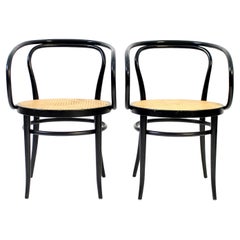
Pair of Thonet armchairs, model 209, ca 2000
By Thonet
Located in Uppsala, SE
Pair of armchairs, model 209 (also called Wiener Stuhl), made by Thonet, one of which is marked. Legendary Swiss architect Le Corbusier was fascinated with this model and used it in ...
Category
Vintage 1930s Austrian Bauhaus Armchairs
Materials
Rattan, Bentwood
$2,254 / set
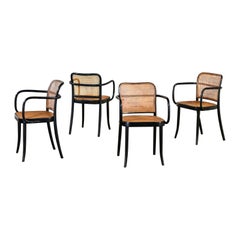
4 Black Bentwood
Cane Josef Hoffman Prague 811 Armchairs for Stendig by Thonet
By Stendig Co., Josef Hoffmann, Thonet
Located in Topeka, KS
Iconic vintage Bauhaus black painted bentwood & cane Josef Hoffman Prague 811 armchairs imported by Stendig for Thonet, a set of 4. Beautiful condition, keeping in mind that these are vintage and not new so will have signs of use and wear even if it has been refinished or restored. Specifically, there have been a few small repairs in the caning of all chairs and one chair seat has been replaced completely. It has been replaced with sheet cane and not individually woven. Please see photos, zoom in for details, and see long description as they are part of the condition report. We attempt to portray any imperfections. Circa, Early to Mid-20th Century.
Much like a fine wine or the Mona Lisa, some things just get better with age… That’s just a fact! Including these iconic vintage black painted bentwood & cane Josef Hoffman Prague 811 armchairs by Stendig for Thonet! Talk about the ability to withstand the hands of time!! This Josef Hoffman 811 chair was originally designed in 1925 but remains a current and fabulous design that is highly sought after today. This set of 4 is comprised of beautiful black painted bentwood frames bearing slender rounded arms, slightly flared legs, and marvelous natural cane seats AND backs!! SPECTACULAR!!! Can’t you just SEE these beauties surrounding your kitchen table, breakfast nook, game table, or simply used as extra seating in the family room? We certainly can! Just the right touch of Bauhaus magnificence to any room and they’re sure to complement your home with their classic, historical excellence, whatever your style whether its Bauhaus, Art Deco, Mid-Century Modern, or Modern!!
Josef Hoffman was one of Austria's most important architects and designers and was central to the development of art and design in Vienna. He grew up with three sisters and was nicknamed Pepo. His father was the town mayor and a successful businessman. He was a founding member of the Vienna Secession, a radical anti-historicist movement, and together with Koloman Moser created the Wiener Werkstatte cooperative workshop. A highly individualistic architect and designer, Hoffmann's work combined the simplicity of craft production with a refined aesthetic ornament. Between 1901 and 1905, he designed four villas in Vienna and a sanatorium in Brussels that was called “Stoclet House”, for which he developed a “cubistic” language of form, with an emphasis on straight, unadorned lines. In 1905, he established the Kunstschau with painter Gustav Klimt and, two years later, founded the Deutscher Werkbund. Hoffmann worked well into his 80s, continuing to use the geometric motifs that influenced the art deco style of the 1920s. In 1928 his work appeared in the Art in Industry exhibition held at Macy’s in New York City, where it exerted a strong influence on American designer Donald Deskey. Hoffmann is one of the seminal figures in the modern decorative arts movement of the first half of the 20th century.
Stendig was totally the brainchild and passion of Charles W. Stendig. You cannot write or talk about Stendig without explaining Charles. He was a pioneer of import goods in the mid-century. After serving in WWII as a paratrooper, he studied business with emphasis on international trade at NYU and City College of New York. Afterward first working for Raymor, another pioneering distribution company, for about two years, departing to start his own business: Stendig. He opened his first showroom in 1956 in midtown Manhattan. He is credited for sparking America’s interest in furniture from Finland, Switzerland, Italy, and Czechoslovakia. He imported from the likes of Thonet, Asko, and De Sede; and from iconic designers including Le Corbusier, Josef Hoffmann, Eero Aarnio, Tapio Wirkkala, Marcel Breuer, Jonathan De Pas, Donato D’Urbino, Paolo Lomazzi, Carlo Mollino, Carlo Scarpa, and Pier Giacomo Castiglioni to name just a few. By the late 1960’s, Stendig had showrooms in Chicago, Los Angeles and San Francisco with a large headquarters in NYC. They were exciting and good times but short lived. The business was a challenge and when an offer was made by Burlington Industries to purchase, Charles agreed. He stayed on till 1976 to oversee and then retired. I have searched the internet to no avail to find out if a Stendig division is still in operation. But I can only find the Stendig Calendar, the only calendar in MoMA’s collection, which was designed for Stendig by Mossimo Vignelli, still offered. But I am having a hard time deciding who is creating and offering it. I do know Burlington Industries was bankrupt by 2001, purchased in 2003, merged with Cone Mills in 2004 and subsequently into ITG or International Textile Group. But the Stendig name reins as an icon of high style mid-century offerings.
Thonet was founded by Michael Thonet. Michael was born in 1796 and was apprenticed by his father to a cabinetmaker. Shortly after he married, Michael opened his one-man cabinetmaking shop creating furniture and cabinetry in the traditional manner by carving the needed parts and then joining them together. In 1830 he began experimenting with bending wood into curved shapes and thus began a successful furniture company that has remained continually in operation for nearly 200 years. Thonet’s early work was very Biedermeier in style and not made for the common man. Gradually his designs became more Art Nouveau. In 1951 his chairs for the Crystal Palace at the London World’s Fair won a prize medal and by the late 1950s he began to make his first “consumer” chair. In 1875, a year before Michael’s death, Thonet’s five factories made 620,000 chairs. Then in 1876 after his death the company became Gebruder Thonet. But all was not roses. In 1869 the Thonet patents lapsed and by 1893 there were 52 bentwood companies in Europe. However, Thonet persevered. They branched out. They merged. They added designs by Le Corbusier and Breuer and alternative materials such as tubular chrome in place of bentwood to their offerings. Business boomed and waned through the years and there was even a Thonet revival, so to speak, beginning in the 1940s on into the mid-20th century. Till today, in the 21st century, Thonet is still a furniture company to be reckoned with almost 200 years later.
We are in love with this iconic set of 4 Prague 811 chairs...
Category
Early 20th Century Czech Bauhaus Armchairs
Materials
Cane, Bentwood, Paint
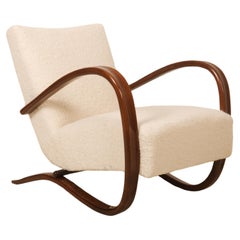
Art Deco Thonet H269 Armchair by Jindrich Halabala Bouclé Fabric
By Jindřich Halabala, Thonet
Located in Vienna, AT
Beech bentwood walnut stained armchair made by Thonet in the 1930s.
Excellent restored with seat springs upholstered with noblis creme boucé fabric.
Another fabric and wood finish on...
Category
Vintage 1930s Czech Art Deco Armchairs
Materials
Beech, Bentwood