Questions
Answers
Our trusted network of 1stDibs sellers answer common questions
How can you tell if art is Japanese or Chinese?
1 Answer
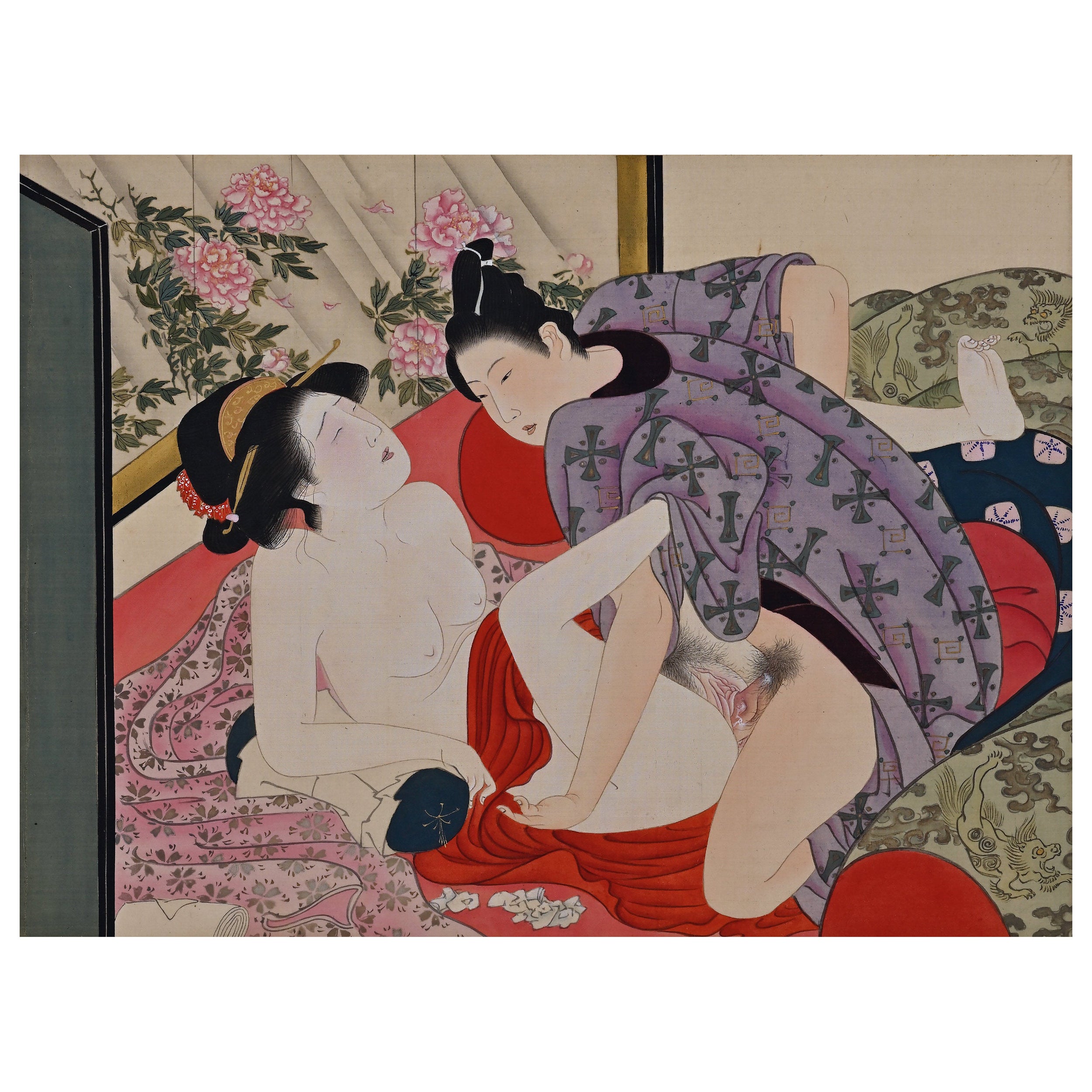
To tell if art is Japanese or Chinese, study the piece's characteristics. With paintings, Chinese artists often use more color and tend to fill their entire canvases, while Japanese artists often include more negative space and choose subtler colors. There are also differences between the brushstrokes typical of traditional Chinese and Japanese art. In Japanese paintings, brushstrokes are often short and sharp. On the other hand, Chinese paintings often display longer, more fluid brushstrokes. Learning about the defining features of various art forms and periods and looking at examples of pieces made by Japanese and Chinese artists can help you learn to spot subtle differences. Explore a diverse assortment of Japanese and Chinese art on 1stDibs.
1stDibs ExpertOctober 15, 2024
Related Questions
- How can I tell the difference between Chinese and Japanese cloisonné?1 Answer
- How can I tell if my Japanese pottery is antique?1 Answer
- How can you tell if Japanese pearls are real?1 Answer
- How can I tell if my Chinese furniture is antique?1 Answer
- Is jade Japanese or Chinese?1 Answer
Shop for Japanese Paintings on 1stDibs
Vintage Japanese Watercolor Painting of Two Geisha, Signed, Late 20th Century
Located in Chatham, ON
Vintage watercolor painting of two Geisha under an umbrella - watercolor over graphite with gold gilt border - signed upper right (unidentified artist/maker...
Category
Late 20th Century Japanese Japonisme Paintings and Screens
Materials
Paint, Paper
Japonaise Painting in a Wood Frame, Representing a Woman, Japan, XX Century
Located in Auribeau sur Siagne, FR
This is an genuine painting, of a woman, with green and orange colors. It has been made in Japan, during the XX Century. It is signed.
Category
20th Century Japanese Chinese Export Paintings
Materials
Wood, Paint
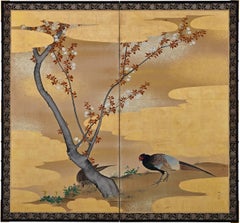
Early 19th Century Japanese Screen. Cherry Blossom
Pheasants by Mori Tetsuzan
Located in Kyoto, JP
Mori Tetsuzan (1775-1841)
Pheasants and Cherry Blossoms
Two-fold Japanese screen. Ink, color, gofun, gold and silver on paper.
A two-fold Japanese bir...
Category
Antique Early 19th Century Japanese Edo Paintings and Screens
Materials
Gold Leaf
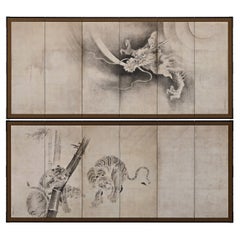
17th Century Japanese Screen Pair. Tiger
Dragon by Kaiho Yusetsu
Located in Kyoto, JP
Kaiho Yusetsu (1598-1677)
Tiger and Dragon
Early Edo Period, Circa 1650
A Pair of Six-fold Japanese Screens. Ink and slight color on paper.
Dimensions:
Each screen: H. 171 cm x W. 380 cm (67.5’’ x 149.5’’)
In this pair of early Edo period Japanese screens a group of tigers prowl in a bamboo grove whipped with fierce wind, while a dragon claws through clouds and mist. The dragon embodies elemental qualities - looming out of the mist, the coils of its body disappearing in the clouds. The dragon is calling for rain, symbolizing spring which is considered the fountain of life. On the other side, the tigers calls for the wind, symbolizing autumn which is considered the end of life. Tigers were familiar motifs within Japanese art from ancient times though the animals were imaginary to the people in the 17th century. While dragons and tigers are usually associated as sacred and ferocious, in this painting, both animals have rather amusing expressions. The tigers appear to glare at the dragon with cat-like eyes, and the look on the swirling dragon’s face appears almost affectionate - lending a playful flair to an otherwise magnificent theme.
The tiger and dragon are cosmological symbols of the balancing forces in the world. Screens such as this were originally meant to express the fluctuating nature of the world. For Japanese in the early Edo period, they likely suggested the powers of the cosmos. In Japan the tiger and dragon motif was originally absorbed into the circles of Zen monasteries before spreading into the secular world. The theme especially appealed to the military classes with the Kano school, the official painters to the Shogun and the samurai, being the leading contributors. The painter of this pair of screens, Kaiho Yusetsu (1598-1677), was closely patronized by the third Shogun Tokugawa Iemitsu. In his later years he worked with Kano school artists...
Category
Antique Mid-17th Century Japanese Edo Paintings and Screens
Materials
Silk, Wood, Paper
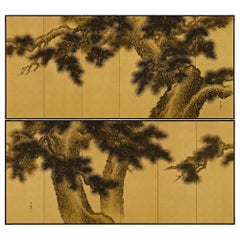
Early 20th Century Japanese Screen Pair - Ink Pine Trees on Gold
Located in Kyoto, JP
Imao Keisho (1902-1993)
Pine Trees
Early 20th Century, Circa 1930
Pair of six-panel Japanese screens. Ink on silk and gold leaf.
Dimensions: Each screen H. 67.5” x 148” (172 cm x 376 cm)
A pair of monumental six-panel Japanese pine screens by the renowned Nihonga artist Imao Keisho. Here Keisho entirely removed the background and brought the pine trees to the surface of the painting. This simplification of the elements makes the scene exceptionally direct and compelling and injects a very modern...
Category
Early 20th Century Japanese Showa Paintings and Screens
Materials
Gold Leaf
Mashiko Japanese Abstract Expressionist Serigraph, Untitled
Located in Queens, NY
Japanese Abstract Expressionist Serigraph, Signed & Numbered, (MASHIKO)
Category
20th Century Japanese Anglo-Japanese Paintings
Materials
Paper