Questions
Answers
Our trusted network of 1stDibs sellers answer common questions
What is the difference between Picasso and Braque?
1 Answer
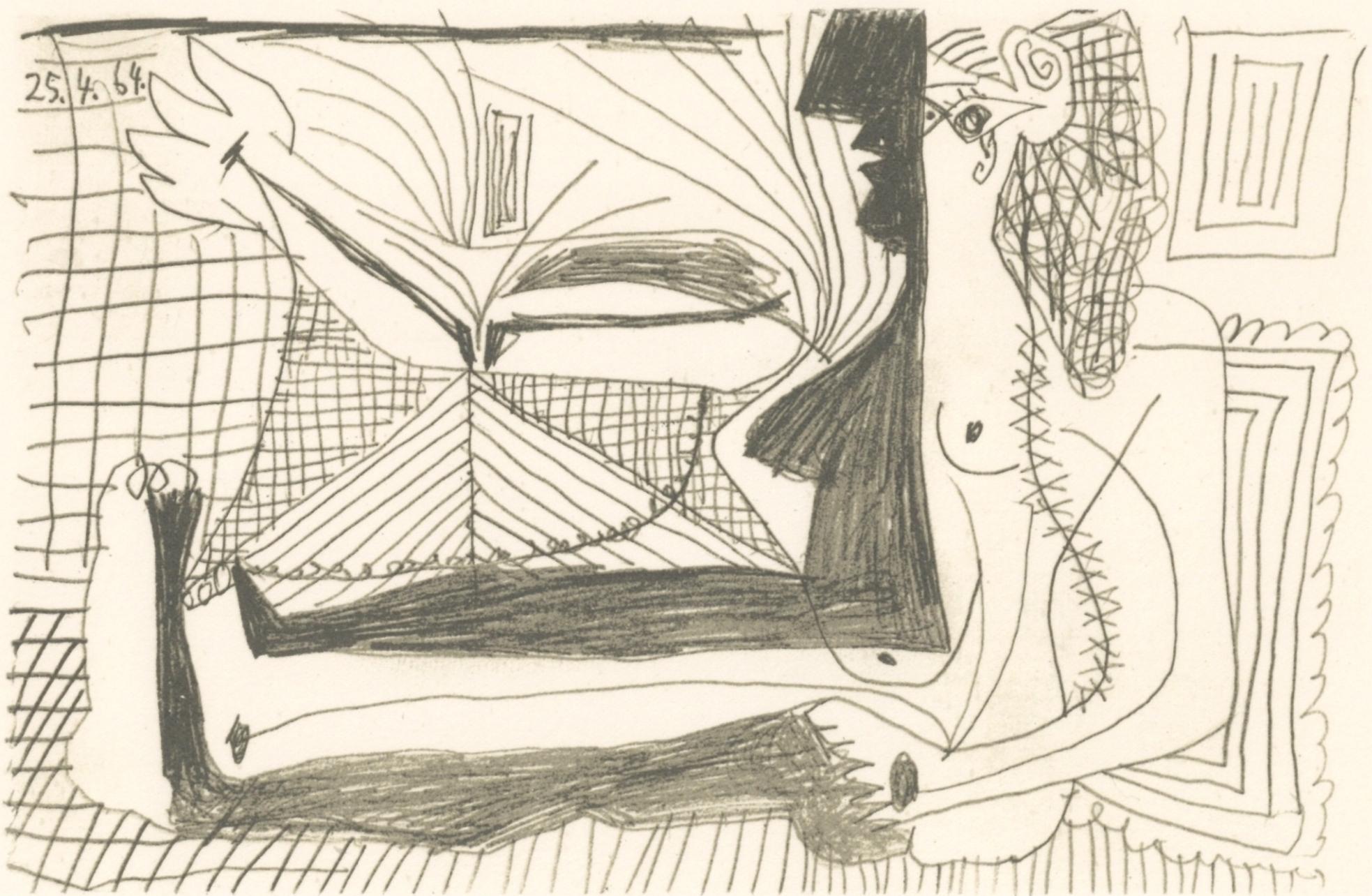
The difference between Picasso and Braque is one of style. The artists both pioneered the Cubist art movement, yet their approaches to Cubism differed. Georges Braque sought to create symmetry and balance in his compositions, while Pablo Picasso focused on subverting norms by breaking his subjects down into their most basic shapes. On 1stDibs, shop a selection of Cubist art from Pablo Picasso, Georges Braque and other artists.
1stDibs ExpertAugust 26, 2024
Related Questions
- What is the difference between Matisse and Picasso?1 Answer
- What is Georges Braque known for?1 Answer
- Was Georges Braque a Surrealist?1 Answer
- What is the difference between a chest and a trunk?1 Answer
- What is the difference between a pergola and a pagoda?1 Answer
Shop for Cubist Art on 1stDibs
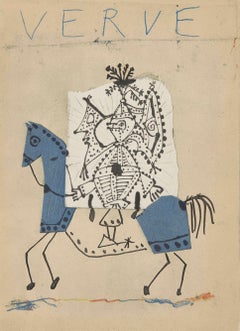
Pablo Picasso, The Blue Rider, from Verve, Revue Artistique, 1951
Located in Southampton, NY
This exquisite lithograph by Pablo Picasso (1881–1973), titled Le cavalier bleu (The Blue Rider), from Verve, Revue Artistique et Litteraire, Vol. VII, No. 25–26, originates from the...
Category
1950s Cubist Abstract Prints
Materials
Lithograph
$1,036 Sale Price
20% Off
Free Shipping
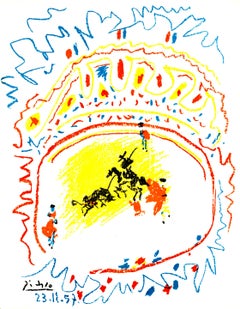
Pablo Picasso, The Little Bullfight, from XXe siecle, 1970
Located in Southampton, NY
This exquisite lithograph by Pablo Picasso (1881–1973), titled La Petite Corrida (The Little Bullfight), from the album Special issue of the XX Siecle Review, Hommage a Picasso, originates from the 1971 edition published by Tudor Publishing Co., New York, in collaboration with Societe Internationale d'Art XXe siecle, Paris, under the direction of Gualtieri di San Lazzaro, editeur, Paris, and printed by Mourlot Freres, Paris. La Petite Corrida reflects Picasso’s lifelong fascination with the bullfight—a subject that symbolized vitality, struggle, and creation throughout his career. Executed with the spontaneity and graphic brilliance characteristic of his late lithographs, the composition captures both movement and ritual, merging ancient spectacle with modern energy.
Executed as a lithograph on velin paper, this work measures 12.5 × 9.75 inches (31.75 × 24.77 cm). Signed in the plate and unnumbered as issued. The edition exemplifies the superb craftsmanship of Mourlot Freres, Paris, the atelier that produced many of Picasso’s greatest lithographic works.
Artwork Details:
Artist: Pablo Picasso (1881–1973)
Title: La Petite Corrida (The Little Bullfight), from the album Hommage a Picasso, 1971
Medium: Lithograph on velin paper
Dimensions: 12.5 × 9.75 inches (31.75 × 24.77 cm)
Inscription: Signed in the plate and unnumbered as issued
Date: 1971
Publisher: Tudor Publishing Co., New York, in collaboration with Societe Internationale d'Art XXe siecle, Paris
Printer: Mourlot Freres, Paris
Catalogue raisonne references: Catalogue de L’oeuvre Grave et Lithographie, Pablo Picasso: Catalogue of the Printed Graphic Work. Editions Kornfeld, 1967, illustration 839. Goeppert, Sebastian, et al. Pablo Picasso, the Illustrated Books: Catalogue Raisonne. Patrick Cramer, 1983, illustration 92. Picasso, Pablo, and Fernand Mourlot. Picasso Lithographs, Translated by Jean Didry, Boston Book and Art Publisher, 1970, illustration 302.
Condition: Well preserved, consistent with age and medium
Provenance: From the album Hommage a Picasso, published 1971 by Tudor Publishing Co. and Societe Internationale d'Art XXe siecle, Paris
About the Publication:
Gualtieri di San Lazzaro’s XXe Siecle (Twentieth Century) was one of the most influential art journals of the modern era, founded in Paris in 1938 as a platform for the greatest painters, sculptors, and writers of the 20th century. San Lazzaro—a visionary editor, critic, and champion of modernism—believed that art and literature should coexist as expressions of a shared human imagination. Under his direction, XXe Siecle became a cultural bridge between Europe and the wider world, publishing special issues devoted to leading figures such as Picasso, Matisse, Chagall, Braque, Calder, Miro, Kandinsky, and Leger. Each edition combined essays by renowned critics and poets with original lithographs printed by the foremost ateliers of Paris, including Mourlot, Arte, and Bellini, creating a uniquely rich dialogue between text and image. Through XXe Siecle, San Lazzaro preserved the creative spirit of the avant-garde during and after World War II, championing freedom of expression and the evolution of abstraction, Surrealism, and modern thought. Over nearly four decades, the journal shaped international taste and defined the intellectual landscape of postwar art publishing. Today, XXe Siecle remains celebrated for its extraordinary synthesis of art, literature, and design—an enduring testament to Gualtieri di San Lazzaro’s belief that the visual arts are the soul of the modern age.
About the Artist:
Pablo Picasso (1881–1973) was a Spanish painter, sculptor, printmaker, and ceramicist whose extraordinary vision revolutionized modern art and defined the visual language of the 20th century. A child prodigy from Malaga, Spain, Picasso’s career spanned more than seven decades and encompassed an astonishing range of styles and innovations—from the melancholic Blue and romantic Rose periods to his pioneering invention of Cubism with Georges Braque, which shattered conventional notions of perspective and form. Influenced by the bold expressiveness of El Greco, the structure of Cezanne, and the vitality of African and Iberian sculpture, Picasso became a central figure of the Paris avant-garde, working in creative dialogue with contemporaries such as Henri Matisse, Alexander Calder, Alberto Giacometti, Salvador Dali, Joan Miro, Wassily Kandinsky, Marcel Duchamp, and Man Ray. His insatiable experimentation extended across painting, drawing, printmaking, ceramics, and sculpture, forever expanding the boundaries of artistic expression. A master of reinvention, Picasso profoundly shaped generations of artists who followed—from Andy Warhol, Roy Lichtenstein, David Hockney, and Jean-Michel Basquiat to Jeff Koons and Banksy—cementing his status as a timeless cultural icon whose works remain among the most sought after worldwide. His landmark painting Les Femmes d’Alger (Version “O”) achieved a record-breaking sale of $179,365,000 at Christie’s, New York, on May 11, 2015, affirming Picasso’s enduring legacy as one of the most influential and valuable artists in history.
Pablo Picasso La Petite Corrida, Picasso Mourlot Freres, Picasso XXe siecle, Picasso Hommage a Picasso, Picasso 1971 lithograph, Picasso velin paper, Picasso bullfight lithograph...
Category
1970s Cubist Figurative Prints
Materials
Lithograph
$1,196 Sale Price
20% Off
Free Shipping
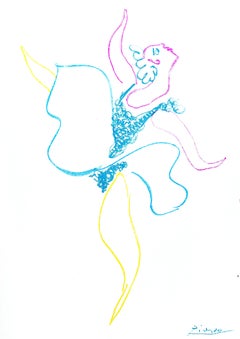
Pablo Picasso, Dancer, from The Ballet, 1954
Located in Southampton, NY
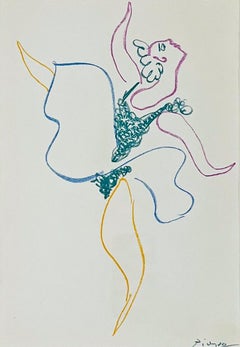
This exquisite lithograph by Pablo Picasso (1881–1973), titled Danseuse (Dancer), from the album Le Ballet (The Ballet), originates from the 1954 edition published by Librairie Hache...
Category
1950s Cubist Figurative Prints
Materials
Lithograph
$1,996 Sale Price
20% Off
Free Shipping
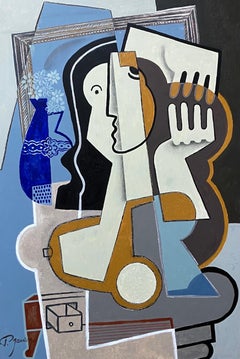
Her Reflection
Located in Los Angeles, CA
Pascal Jarrion was born in 1961 in Perpignan, France, a region known for its Catalan culture as well as its influence on artists before him, including Picasso, Van Gogh, and Maillol....
Category
21st Century and Contemporary Cubist Figurative Paintings
Materials
Oil, Wood Panel
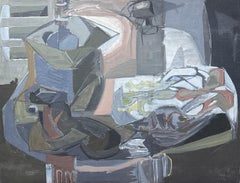
Fine 20th Century French Cubist Still Life Grey Muted Tones Oil Painting
Located in Cirencester, Gloucestershire
The Cubist Still Life
by Laure Noetzin-Azam (French 1929-2024) pupil of André LHOTE
oil on canvas, unframed
canvas: 20 x 25.5 inches
Provenance: all the paintings we have by this art...
Category
Mid-20th Century Cubist Interior Paintings
Materials
Oil
Le Ballet
Located in Washington, DC
Artist: Pablo Picasso
Title: Le Ballet
Medium: Lithograph
Date: 1954
Edition: 10,000
Framed Size: 20 1/4" x 16 3/4"
Sheet Size: 12 1/2" x 8 3/4"
Signature: Signed in the stone
Refere...
Category
1950s Cubist Figurative Prints
Materials
Lithograph