Want more images or videos?
Request additional images or videos from the seller
1 of 7
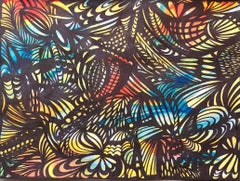
Michael BrennanUntitled, (8)1997
1997
$1,000List Price
About the Item
- Creator:Michael Brennan (1965, British)
- Creation Year:1997
- Dimensions:Height: 17.5 in (44.45 cm)Width: 15.25 in (38.74 cm)
- Medium:
- Movement Style:
- Period:
- Condition:Measurements include frame.
- Gallery Location:Surfside, FL
- Reference Number:1stDibs: LU38211665102
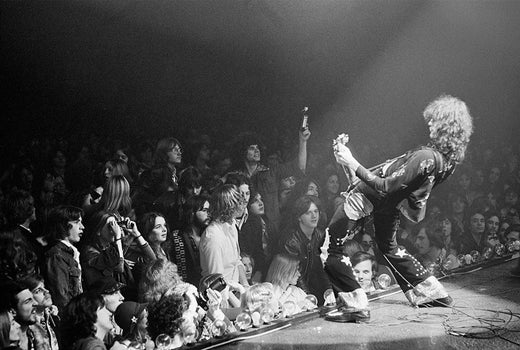
Michael Brennan
Award-winning photographer Michael Brennan’s work covers a wide range of historical events, celebrity portraits, candid’s and world famous athletes. After winning the British News Picture of the Year for his coverage of the death of Donald Campbell in 1967, which was featured in Life magazine, he went on to work for several newspapers and covered important news events as well as capturing images of notable names. He was awarded British Photographer of the Year in 1969. His archive includes images of Led Zeppelin, Freddie Mercury, Mick Jagger, President Jimmy Carter, Princess Diana, John Lennon, and sport legends George Best, Pele, George Foreman, Mike Tyson and Muhammad Ali. His work has been featured in newspapers and magazines world-wide, including Sports Illustrated, Life, Rolling Stone, Stern, The New York Times, The Sunday Times, The Observer, and the Times of London. One of his most iconic portraits of Muhammad Ali is in the collection of the Smithsonian’s National Portrait Gallery.
About the Seller
4.9
Platinum Seller
Premium sellers with a 4.7+ rating and 24-hour response times
Established in 1995
1stDibs seller since 2014
1,843 sales on 1stDibs
Typical response time: 1 hour
Authenticity Guarantee
In the unlikely event there’s an issue with an item’s authenticity, contact us within 1 year for a full refund. DetailsMoney-Back Guarantee
If your item is not as described, is damaged in transit, or does not arrive, contact us within 7 days for a full refund. Details24-Hour Cancellation
You have a 24-hour grace period in which to reconsider your purchase, with no questions asked.Vetted Professional Sellers
Our world-class sellers must adhere to strict standards for service and quality, maintaining the integrity of our listings.Price-Match Guarantee
If you find that a seller listed the same item for a lower price elsewhere, we’ll match it.Trusted Global Delivery
Our best-in-class carrier network provides specialized shipping options worldwide, including custom delivery.You May Also Like
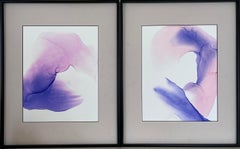
Evening breeze - abstraction art, made in gray and navy blue
By Mila Akopova
Located in Fort Lee, NJ
Interior design paintings. The diptych is made with alcoholic ink on Yupo paper.
Each work is 11 by 14 inches in size, framed (gold) with a styrene face on a double mat board in navy...
Category
2010s Abstract Abstract Paintings
Materials
Paper, Ink
$512 Sale Price
20% Off
H 20 in W 32 in
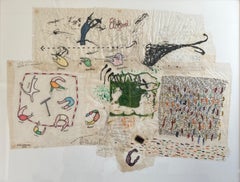
Simon Lewty, Visions of a non-resident
Located in Harkstead, GB
An extraordinary work from an extraordinary mind expressed through unique imagery, poetry and calligraphy.
Simon Lewty (1941-2021)
Visions of a non-resident
Signed and dated 1988 an...
Category
20th Century Abstract Mixed Media
Materials
Crayon, Ink, Acrylic, Tissue Paper
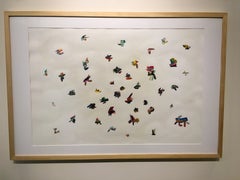
Migration: In Flux Pandemic Collection,
by Peter Healy, Painting, 2020
Located in Oklahoma City, OK
This framed 27" x 37" watercolor painting by Irish artist, Peter Healy is from the 'In Flux' Pandemic Collection. The painting comes vibrantly alive as the...
Category
2010s Abstract Abstract Drawings and Watercolors
Materials
Ink, Watercolor, Paper
$1,088 Sale Price
24% Off
H 27 in W 37 in D 1.5 in
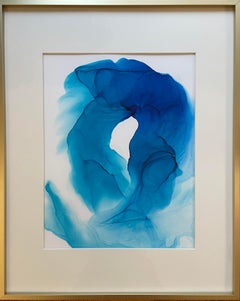
My wave - abstract painting, made in ultramarine blue color
By Mila Akopova
Located in Fort Lee, NJ
Interior design paintings. The work was done with alcohol ink in ultramarine blue color on Yupo paper. The work is 11 by 14 inches in size, framed (gold or black) with a styrene face...
Category
2010s Abstract Abstract Paintings
Materials
Paper, Ink
$304 Sale Price
20% Off
H 20 in W 16 in
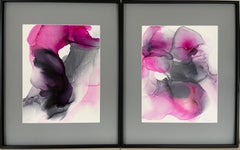
The garden of delights - abstraction art, made in pink, purple, grey color
By Mila Akopova
Located in Fort Lee, NJ
Interior design paintings. The diptych is made with alcoholic ink in pink, purple, fuchsia, grey color on Yupo paper.
Each work is 11 by 14 inches in size, framed (black) with a styr...
Category
2010s Abstract Expressionist Abstract Paintings
Materials
Paper, Ink
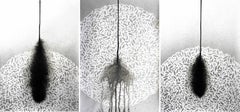
Indian Contemporary Art By Sumit Mehndiratta - Drawing 328
By Sumit Mehndiratta
Located in Paris, IDF
Tryptich
16 x 11 inches each
Sumit Mehndiratta is an Indian artist born in 1986 who lives & works in New Delhi, India. He has pursued Master of Science in International Fashion Mark...
Category
2010s Abstract Abstract Drawings and Watercolors
Materials
Paper, Ink
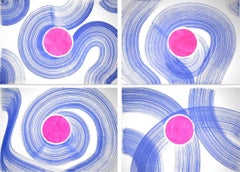
Indian Contemporary Art By Sumit Mehndiratta - Drawing No. 333
By Sumit Mehndiratta
Located in Paris, IDF
Set of 4 drawings
Indian ink & acrylic paint on paper
Sumit Mehndiratta is an Indian artist born in 1986 who lives & works in New Delhi, India. He ...
Category
2010s Abstract Abstract Drawings and Watercolors
Materials
Paper, Ink, Acrylic
Indian Contemporary Art By Sumit Mehndiratta - Drawing No. 338
By Sumit Mehndiratta
Located in Paris, IDF
Indian ink on Archival paper
Sumit Mehndiratta is an Indian artist born in 1986 who lives & works in New Delhi, India. He has pursued Master of Science in International Fashion Mark...
Category
2010s Abstract Abstract Drawings and Watercolors
Materials
Ink, India Ink, Archival Paper
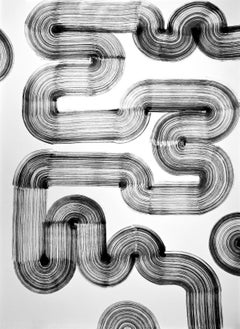
Indian Contemporary Art By Sumit Mehndiratta - Drawing No. 335
By Sumit Mehndiratta
Located in Paris, IDF
Indian ink on Archival paper
Sumit Mehndiratta is an Indian artist born in 1986 who lives & works in New Delhi, India. He has pursued Master of Science in International Fashion Mark...
Category
2010s Abstract Abstract Drawings and Watercolors
Materials
Ink, India Ink, Archival Paper
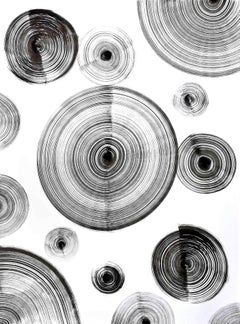
$700
H 30 in W 22 in D 0.04 in
Indian Contemporary Art By Sumit Mehndiratta - Drawing 336
By Sumit Mehndiratta
Located in Paris, IDF
Indian ink on Archival paper
Category
2010s Abstract Abstract Drawings and Watercolors
Materials
Ink, India Ink, Archival Paper
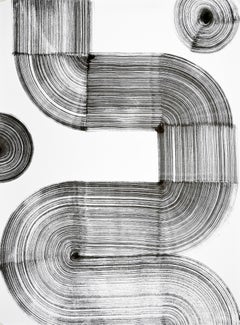
$600
H 30.01 in W 22.01 in
More From This Seller
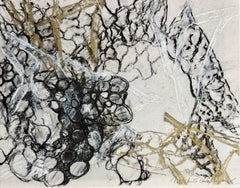
View AllOriginal Drawing Painting Abstract Biomorphic Art Gold Leaf Michele Oka Doner
By Michele Oka Doner
Located in Surfside, FL
This is mixed media. I am not positive of the materials. it is a translucent, vellum, parchment type of paper. with either charcoal or ink and gold leaf (or gold paint) hand signed i...
Category
Early 2000s Abstract Abstract Drawings and Watercolors
Materials
Paper, Charcoal, Ink, Pencil
Veiled Series LX , Abstract Expressionist Organic Drawing Watercolor Painting
By Dorothy Gillespie
Located in Surfside, FL
Dorothy Gillespie (June 29, 1920 – September 30, 2012) was an American artist and sculptor who became known for her large and colorful abstract metal sculptures. Gillespie became best known for the aluminum sculptures she started to produce at the end of the 1970s. She would paint sheets of the metal, cut them into strips and connect the strips together to resemble cascades or starbursts of bright colored ribbon. The New York Times once summarized her work as “topsy-turvy, merrymaking fantasy,” and in another review declared, “The artist’s exuberant sculptures of colorful aluminum strips have earned her an international reputation.Her works are featured at her alma mater (Radford University) in Virginia, where she later returned to teach, as well as in New York (where she was artist in residence for the feminist Women's Interart Center), Wilmington, North Carolina and Florida.
She enrolled both at Radford University near her hometown, and the Maryland Institute College of Art in Baltimore, Maryland. The director of the Maryland Institute, Hans Schuler, helped foster her career in fine art.
On June 5, 1943, aged 23, Gillespie moved to New York City. There she took a job at the B. Altman department store as assistant art director. She also joined the Art Students League where she was exposed to new ideas about techniques, materials, and marketing. She also created works at Atelier 17 printmaking studio, where Stanley William Hayter encouraged to experiment with her own ideas.
She and her husband, Bernard Israel, opened a restaurant and night club in Greenwich Village to support their family. She returned to making art in 1957, and worked at art full-time after they sold the nightclub in the 1970.
In 1977 Gillespie gave her first lecture series at the New School for Social Research, and she would give others there until 1982. She taught at her alma mater as a Visiting Artist (1981-1983) and gave Radford University some of her work to begin its permanent art collection. Gillespie then served as Woodrow Wilson visiting Fellow (1985-1994), visiting many small private colleges to give public lectures and teach young artists. She returned to Radnor University to teach as Distinguished Professor of Art (1997–99).[8] She also hosted a radio program, the Dorothy Gillespie Show on Radio Station WHBI in New York from 1967-1973.
Gillespie began moving away from realism and into the abstraction that marked her career. Gillespie returned to New York City in 1963 to continue her career. She maintained a studio through the 70s and advocate worked towards feminist goals in the art industry, picketing the Whitney Museum, helping to organize the Women's Interart Center, curating exhibitions of women's art, and writing articles raising awareness of her cause. Gillespie numbered among her acquaintances such art-world luminaries as Jackson Pollock, Lee Krasner, Alice Neel, Louise Nevelson and Georgia O’Keeffe. “She had amazing stories that unfortunately are gone,” her son said.
During the 1960s, she built multimedia art installations that made political statements, such as 1965’s “Made in the USA,” that used blinking colored lights, mirrors, shadow boxes, rotating figures and tape recordings to convey a chaotic look at American commercial fads. The floor was strewn with real dollar bills, which visitors assumed were fake.
By the 1980s, Gillespie's work had come to be known internationally. She completed many commissions for sculptures in public places, including Lincoln Center, Rockefeller Center and Walt Disney World Epcot Center in Orlando, Florida. Her work is in many collections across the United States, including the Delaware Museum, the Solomon R. Guggenheim Museum, and the National Museum of Women in the Arts. Her sculptures can also be found in the Frankfurt Museum in Germany and the Tel Aviv Museum in Israel.
Group Shows Conceived and Curated by Dorothy Gillespie
Women's Interart Center, New York, NY 1974 included: Betty Parsons, Elsie Asher, Alice Baber, Minna Citron, Nancy Spero, Seena Donneson, Alice Neel, Natalie Edgar, Dorothy Gillespie, and Anita Steckel...
Category
Early 2000s Abstract Expressionist Abstract Drawings and Watercolors
Materials
Paper, Ink, Watercolor, Permanent Marker
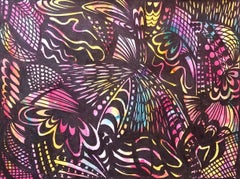
Veiled Series XX , Abstract Expressionist Organic Drawing Watercolor Painting
By Dorothy Gillespie
Located in Surfside, FL
Dorothy Gillespie (June 29, 1920 – September 30, 2012) was an American artist and sculptor who became known for her large and colorful abstract metal sculptures. Gillespie became best known for the aluminum sculptures she started to produce at the end of the 1970s. She would paint sheets of the metal, cut them into strips and connect the strips together to resemble cascades or starbursts of bright colored ribbon. The New York Times once summarized her work as “topsy-turvy, merrymaking fantasy,” and in another review declared, “The artist’s exuberant sculptures of colorful aluminum strips have earned her an international reputation.Her works are featured at her alma mater (Radford University) in Virginia, where she later returned to teach, as well as in New York (where she was artist in residence for the feminist Women's Interart Center), Wilmington, North Carolina and Florida.
She enrolled both at Radford University near her hometown, and the Maryland Institute College of Art in Baltimore, Maryland. The director of the Maryland Institute, Hans Schuler, helped foster her career in fine art.
On June 5, 1943, aged 23, Gillespie moved to New York City. There she took a job at the B. Altman department store as assistant art director. She also joined the Art Students League where she was exposed to new ideas about techniques, materials, and marketing. She also created works at Atelier 17 printmaking studio, where Stanley William Hayter encouraged to experiment with her own ideas.
She and her husband, Bernard Israel, opened a restaurant and night club in Greenwich Village to support their family. She returned to making art in 1957, and worked at art full-time after they sold the nightclub in the 1970.
In 1977 Gillespie gave her first lecture series at the New School for Social Research, and she would give others there until 1982. She taught at her alma mater as a Visiting Artist (1981-1983) and gave Radford University some of her work to begin its permanent art collection. Gillespie then served as Woodrow Wilson visiting Fellow (1985-1994), visiting many small private colleges to give public lectures and teach young artists. She returned to Radnor University to teach as Distinguished Professor of Art (1997–99).[8] She also hosted a radio program, the Dorothy Gillespie Show on Radio Station WHBI in New York from 1967-1973.
Gillespie began moving away from realism and into the abstraction that marked her career. Gillespie returned to New York City in 1963 to continue her career. She maintained a studio through the 70s and advocate worked towards feminist goals in the art industry, picketing the Whitney Museum, helping to organize the Women's Interart Center, curating exhibitions of women's art, and writing articles raising awareness of her cause. Gillespie numbered among her acquaintances such art-world luminaries as Jackson Pollock, Lee Krasner, Alice Neel, Louise Nevelson and Georgia O’Keeffe. “She had amazing stories that unfortunately are gone,” her son said.
During the 1960s, she built multimedia art installations that made political statements, such as 1965’s “Made in the USA,” that used blinking colored lights, mirrors, shadow boxes, rotating figures and tape recordings to convey a chaotic look at American commercial fads. The floor was strewn with real dollar bills, which visitors assumed were fake.
By the 1980s, Gillespie's work had come to be known internationally. She completed many commissions for sculptures in public places, including Lincoln Center, Rockefeller Center and Walt Disney World Epcot Center in Orlando, Florida. Her work is in many collections across the United States, including the Delaware Museum, the Solomon R. Guggenheim Museum, and the National Museum of Women in the Arts. Her sculptures can also be found in the Frankfurt Museum in Germany and the Tel Aviv Museum in Israel.
Group Shows Conceived and Curated by Dorothy Gillespie
Women's Interart Center, New York, NY 1974 included: Betty Parsons, Elsie Asher, Alice Baber, Minna Citron, Nancy Spero, Seena Donneson, Alice Neel, Natalie Edgar, Dorothy Gillespie, and Anita Steckel...
Category
Early 2000s Abstract Expressionist Abstract Drawings and Watercolors
Materials
Paper, Ink, Watercolor, Permanent Marker
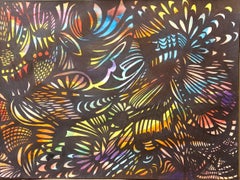
Veiled Series L, Abstract Expressionist Organic Drawing Watercolor Painting
By Dorothy Gillespie
Located in Surfside, FL
Dorothy Gillespie (June 29, 1920 – September 30, 2012) was an American artist and sculptor who became known for her large and colorful abstract metal sculptures. Gillespie became best known for the aluminum sculptures she started to produce at the end of the 1970s. She would paint sheets of the metal, cut them into strips and connect the strips together to resemble cascades or starbursts of bright colored ribbon. The New York Times once summarized her work as “topsy-turvy, merrymaking fantasy,” and in another review declared, “The artist’s exuberant sculptures of colorful aluminum strips have earned her an international reputation.Her works are featured at her alma mater (Radford University) in Virginia, where she later returned to teach, as well as in New York (where she was artist in residence for the feminist Women's Interart Center), Wilmington, North Carolina and Florida.
She enrolled both at Radford University near her hometown, and the Maryland Institute College of Art in Baltimore, Maryland. The director of the Maryland Institute, Hans Schuler, helped foster her career in fine art.
On June 5, 1943, aged 23, Gillespie moved to New York City. There she took a job at the B. Altman department store as assistant art director. She also joined the Art Students League where she was exposed to new ideas about techniques, materials, and marketing. She also created works at Atelier 17 printmaking studio, where Stanley William Hayter encouraged to experiment with her own ideas.
She and her husband, Bernard Israel, opened a restaurant and night club in Greenwich Village to support their family. She returned to making art in 1957, and worked at art full-time after they sold the nightclub in the 1970.
In 1977 Gillespie gave her first lecture series at the New School for Social Research, and she would give others there until 1982. She taught at her alma mater as a Visiting Artist (1981-1983) and gave Radford University some of her work to begin its permanent art collection. Gillespie then served as Woodrow Wilson visiting Fellow (1985-1994), visiting many small private colleges to give public lectures and teach young artists. She returned to Radnor University to teach as Distinguished Professor of Art (1997–99).[8] She also hosted a radio program, the Dorothy Gillespie Show on Radio Station WHBI in New York from 1967-1973.
Gillespie began moving away from realism and into the abstraction that marked her career. Gillespie returned to New York City in 1963 to continue her career. She maintained a studio through the 70s and advocate worked towards feminist goals in the art industry, picketing the Whitney Museum, helping to organize the Women's Interart Center, curating exhibitions of women's art, and writing articles raising awareness of her cause. Gillespie numbered among her acquaintances such art-world luminaries as Jackson Pollock, Lee Krasner, Alice Neel, Louise Nevelson and Georgia O’Keeffe. “She had amazing stories that unfortunately are gone,” her son said.
During the 1960s, she built multimedia art installations that made political statements, such as 1965’s “Made in the USA,” that used blinking colored lights, mirrors, shadow boxes, rotating figures and tape recordings to convey a chaotic look at American commercial fads. The floor was strewn with real dollar bills, which visitors assumed were fake.
By the 1980s, Gillespie's work had come to be known internationally. She completed many commissions for sculptures in public places, including Lincoln Center, Rockefeller Center and Walt Disney World Epcot Center in Orlando, Florida. Her work is in many collections across the United States, including the Delaware Museum, the Solomon R. Guggenheim Museum, and the National Museum of Women in the Arts. Her sculptures can also be found in the Frankfurt Museum in Germany and the Tel Aviv Museum in Israel.
Group Shows Conceived and Curated by Dorothy Gillespie
Women's Interart Center, New York, NY 1974 included: Betty Parsons, Elsie Asher, Alice Baber, Minna Citron, Nancy Spero, Seena Donneson, Alice Neel, Natalie Edgar, Dorothy Gillespie, and Anita Steckel...
Category
Early 2000s Abstract Expressionist Abstract Drawings and Watercolors
Materials
Paper, Ink, Watercolor, Permanent Marker
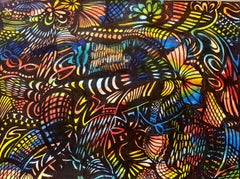
Veiled Series XXX, Abstract Expressionist Organic Drawing Watercolor Painting
By Dorothy Gillespie
Located in Surfside, FL
Dorothy Gillespie (June 29, 1920 – September 30, 2012) was an American artist and sculptor who became known for her large and colorful abstract metal sculptures. Gillespie became best known for the aluminum sculptures she started to produce at the end of the 1970s. She would paint sheets of the metal, cut them into strips and connect the strips together to resemble cascades or starbursts of bright colored ribbon. The New York Times once summarized her work as “topsy-turvy, merrymaking fantasy,” and in another review declared, “The artist’s exuberant sculptures of colorful aluminum strips have earned her an international reputation.Her works are featured at her alma mater (Radford University) in Virginia, where she later returned to teach, as well as in New York (where she was artist in residence for the feminist Women's Interart Center), Wilmington, North Carolina and Florida.
She enrolled both at Radford University near her hometown, and the Maryland Institute College of Art in Baltimore, Maryland. The director of the Maryland Institute, Hans Schuler, helped foster her career in fine art.
On June 5, 1943, aged 23, Gillespie moved to New York City. There she took a job at the B. Altman department store as assistant art director. She also joined the Art Students League where she was exposed to new ideas about techniques, materials, and marketing. She also created works at Atelier 17 printmaking studio, where Stanley William Hayter encouraged to experiment with her own ideas.
She and her husband, Bernard Israel, opened a restaurant and night club in Greenwich Village to support their family. She returned to making art in 1957, and worked at art full-time after they sold the nightclub in the 1970.
In 1977 Gillespie gave her first lecture series at the New School for Social Research, and she would give others there until 1982. She taught at her alma mater as a Visiting Artist (1981-1983) and gave Radford University some of her work to begin its permanent art collection. Gillespie then served as Woodrow Wilson visiting Fellow (1985-1994), visiting many small private colleges to give public lectures and teach young artists. She returned to Radnor University to teach as Distinguished Professor of Art (1997–99).[8] She also hosted a radio program, the Dorothy Gillespie Show on Radio Station WHBI in New York from 1967-1973.
Gillespie began moving away from realism and into the abstraction that marked her career. Gillespie returned to New York City in 1963 to continue her career. She maintained a studio through the 70s and advocate worked towards feminist goals in the art industry, picketing the Whitney Museum, helping to organize the Women's Interart Center, curating exhibitions of women's art, and writing articles raising awareness of her cause. Gillespie numbered among her acquaintances such art-world luminaries as Jackson Pollock, Lee Krasner, Alice Neel, Louise Nevelson and Georgia O’Keeffe. “She had amazing stories that unfortunately are gone,” her son said.
During the 1960s, she built multimedia art installations that made political statements, such as 1965’s “Made in the USA,” that used blinking colored lights, mirrors, shadow boxes, rotating figures and tape recordings to convey a chaotic look at American commercial fads. The floor was strewn with real dollar bills, which visitors assumed were fake.
By the 1980s, Gillespie's work had come to be known internationally. She completed many commissions for sculptures in public places, including Lincoln Center, Rockefeller Center and Walt Disney World Epcot Center in Orlando, Florida. Her work is in many collections across the United States, including the Delaware Museum, the Solomon R. Guggenheim Museum, and the National Museum of Women in the Arts. Her sculptures can also be found in the Frankfurt Museum in Germany and the Tel Aviv Museum in Israel.
Group Shows Conceived and Curated by Dorothy Gillespie
Women's Interart Center, New York, NY 1974 included: Betty Parsons, Elsie Asher, Alice Baber, Minna Citron, Nancy Spero, Seena Donneson, Alice Neel, Natalie Edgar, Dorothy Gillespie, and Anita Steckel...
Category
Early 2000s Abstract Expressionist Abstract Drawings and Watercolors
Materials
Paper, Ink, Watercolor, Permanent Marker
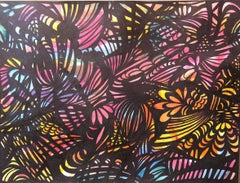
Veiled Series X , Abstract Expressionist Organic Drawing Watercolor Painting
By Dorothy Gillespie
Located in Surfside, FL
Dorothy Gillespie (June 29, 1920 – September 30, 2012) was an American artist and sculptor who became known for her large and colorful abstract metal sculptures. Gillespie became best known for the aluminum sculptures she started to produce at the end of the 1970s. She would paint sheets of the metal, cut them into strips and connect the strips together to resemble cascades or starbursts of bright colored ribbon. The New York Times once summarized her work as “topsy-turvy, merrymaking fantasy,” and in another review declared, “The artist’s exuberant sculptures of colorful aluminum strips have earned her an international reputation.Her works are featured at her alma mater (Radford University) in Virginia, where she later returned to teach, as well as in New York (where she was artist in residence for the feminist Women's Interart Center), Wilmington, North Carolina and Florida.
She enrolled both at Radford University near her hometown, and the Maryland Institute College of Art in Baltimore, Maryland. The director of the Maryland Institute, Hans Schuler, helped foster her career in fine art.
On June 5, 1943, aged 23, Gillespie moved to New York City. There she took a job at the B. Altman department store as assistant art director. She also joined the Art Students League where she was exposed to new ideas about techniques, materials, and marketing. She also created works at Atelier 17 printmaking studio, where Stanley William Hayter encouraged to experiment with her own ideas.
She and her husband, Bernard Israel, opened a restaurant and night club in Greenwich Village to support their family. She returned to making art in 1957, and worked at art full-time after they sold the nightclub in the 1970.
In 1977 Gillespie gave her first lecture series at the New School for Social Research, and she would give others there until 1982. She taught at her alma mater as a Visiting Artist (1981-1983) and gave Radford University some of her work to begin its permanent art collection. Gillespie then served as Woodrow Wilson visiting Fellow (1985-1994), visiting many small private colleges to give public lectures and teach young artists. She returned to Radnor University to teach as Distinguished Professor of Art (1997–99).[8] She also hosted a radio program, the Dorothy Gillespie Show on Radio Station WHBI in New York from 1967-1973.
Gillespie began moving away from realism and into the abstraction that marked her career. Gillespie returned to New York City in 1963 to continue her career. She maintained a studio through the 70s and advocate worked towards feminist goals in the art industry, picketing the Whitney Museum, helping to organize the Women's Interart Center, curating exhibitions of women's art, and writing articles raising awareness of her cause. Gillespie numbered among her acquaintances such art-world luminaries as Jackson Pollock, Lee Krasner, Alice Neel, Louise Nevelson and Georgia O’Keeffe. “She had amazing stories that unfortunately are gone,” her son said.
During the 1960s, she built multimedia art installations that made political statements, such as 1965’s “Made in the USA,” that used blinking colored lights, mirrors, shadow boxes, rotating figures and tape recordings to convey a chaotic look at American commercial fads. The floor was strewn with real dollar bills, which visitors assumed were fake.
By the 1980s, Gillespie's work had come to be known internationally. She completed many commissions for sculptures in public places, including Lincoln Center, Rockefeller Center and Walt Disney World Epcot Center in Orlando, Florida. Her work is in many collections across the United States, including the Delaware Museum, the Solomon R. Guggenheim Museum, and the National Museum of Women in the Arts. Her sculptures can also be found in the Frankfurt Museum in Germany and the Tel Aviv Museum in Israel.
Group Shows Conceived and Curated by Dorothy Gillespie
Women's Interart Center, New York, NY 1974 included: Betty Parsons, Elsie Asher, Alice Baber, Minna Citron, Nancy Spero, Seena Donneson, Alice Neel, Natalie Edgar, Dorothy Gillespie, and Anita Steckel...
Category
Early 2000s Abstract Expressionist Abstract Drawings and Watercolors
Materials
Paper, Ink, Watercolor, Permanent Marker
Still Thinking About These?
All Recently ViewedMore Ways To Browse
The Hunter Watercolor Drawing 20th Century
Shanthi Chandrasekar
Valente Painting
Beaver Painting
Train Depot
Vintage Watercolor Palette
Vintage Watercolour Palette
Painting And Motherwell
Roz Jennings Drawings
Richard Perry
Red Line Drawings
Black Ink Line Drawing
Davis Gray Watercolor
Citron Minna
Infanta Margarita
Sexual Photography
Ray Kass
Vertical Abstract Watercolor