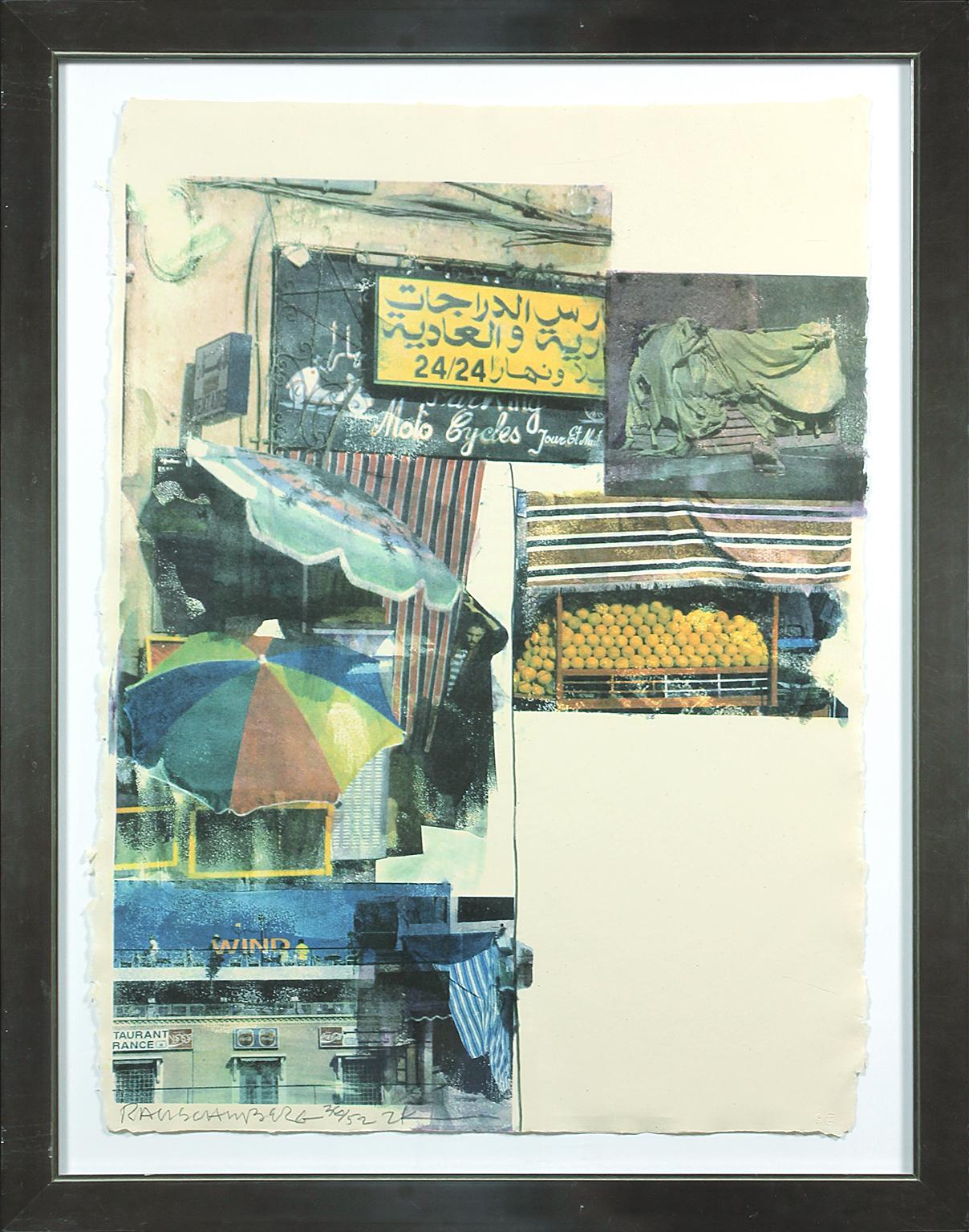
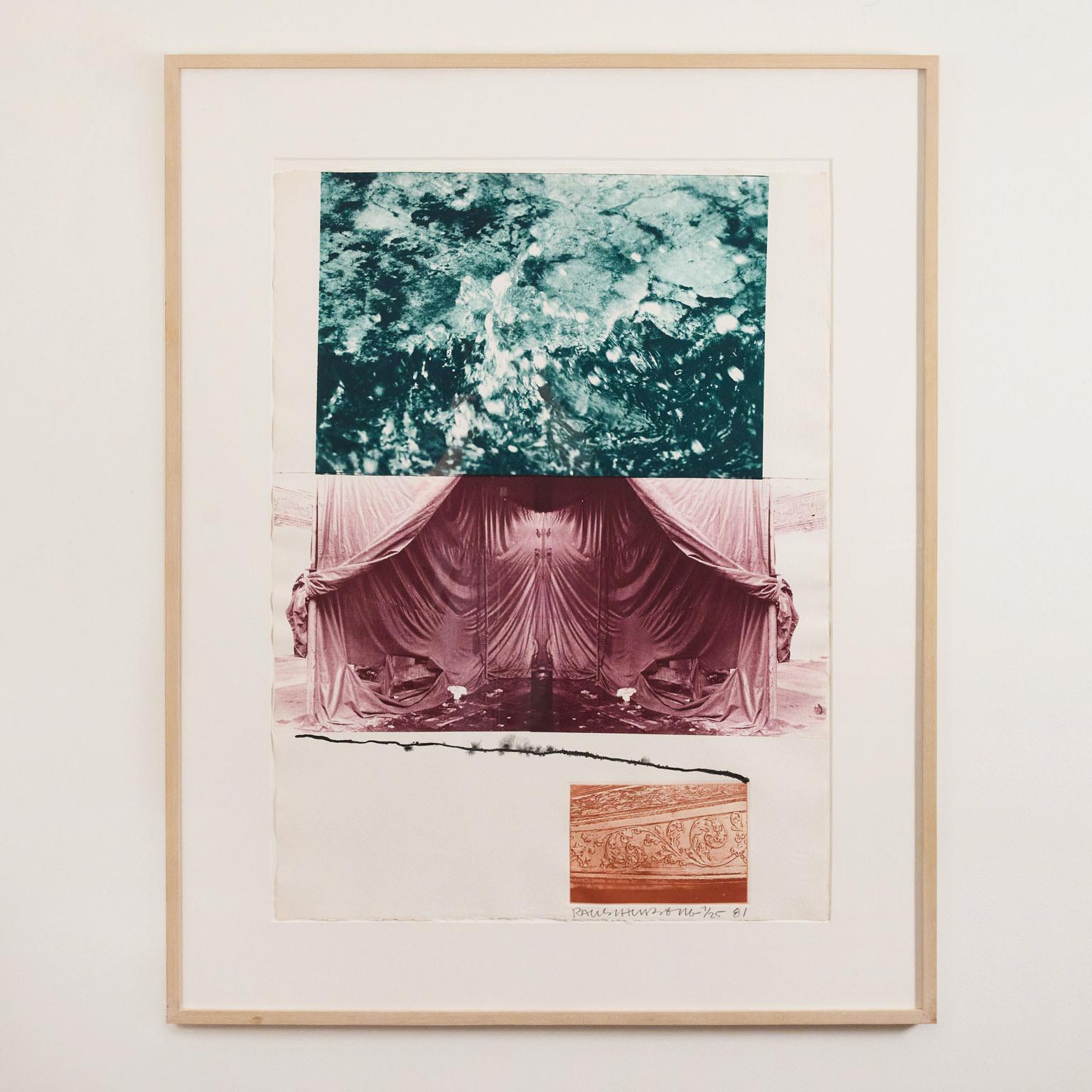
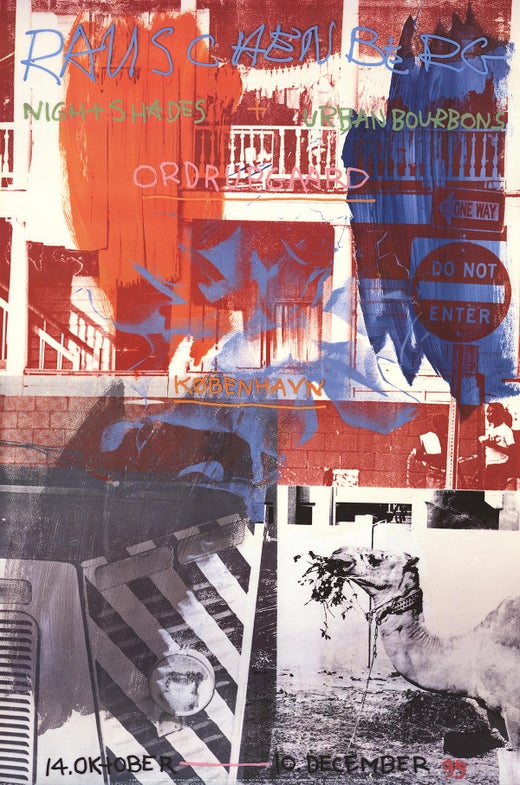
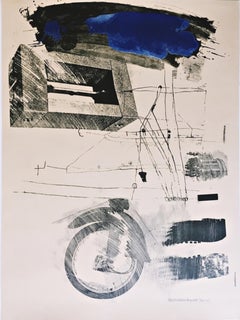
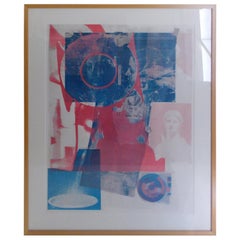
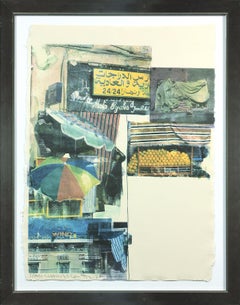
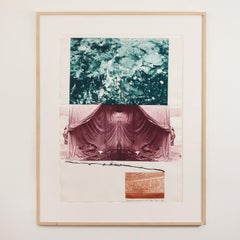
Historic, institutional quality unique Rauschenberg signed work on paper, with storied provenance: a real gem:
Robert Rauschenberg
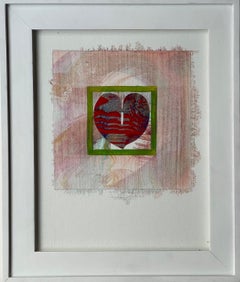
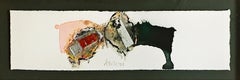
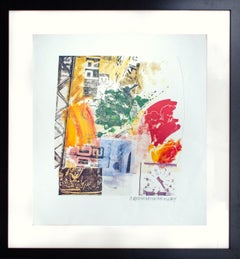
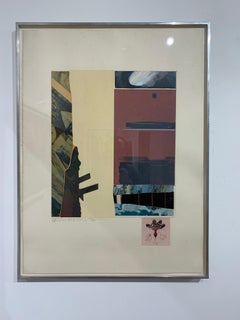
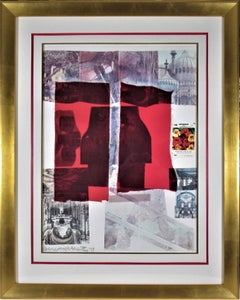
'Snowflake Crime XIX', from the ACE Gallery Collection, 1981
Solvent transfer, acrylic and fabric collage on handmade paper with deckled edges
Signed and dated '81 in permanent marker on the back; bears unique artist inventory number on the back
This is a UNIQUE work of art
Snowflake Crime XIX, from the ACE Gallery Collection
Original work of art, done with solvent transfer, acrylic and fabric collage on handmade paper with deckled edges
Signed and dated '81 in permanent marker on the verso; bears unique artist inventory number
Provenance ACE Gallery art collection, Los Angeles
Rauschenberg Reference No: RR-81.002
Signed and dated '81 by Robert Rauschenberg in permanent marker on the verso; bears unique inventory number
This work is elegantly floated and framed in a museum quality white wood frame under UV plexiglass with a die-cut window in the back to reveal the artist’s signature and inventory number.
Framed
12.75 inches vertical by 12.5 inches horizontal by 2 inches
Artwork
8 inches vertical by 7.5 inches horizontal
Discussion: There are about thirty drawings in the Snowflake Crime group, with each one entirely unique. Visually, they combine cool, icy greens and blues, and feature transferred images that look like older engraved or printed scenes of people and/or architecture, with simple geometric abstract shapes (triangles, bands, rows of circles) laid over/under the transferred imagery, plus small painterly gestures. The series is a textbook example of Rauschenberg's solvent-transfer collage method, where he lifts imagery from mass media and prints and then works into it by hand, deliberately blurring the boundary between photographic/printed source and the artist's own mark.
ACE Gallery:
In the 1960s and 1970s, ACE Gallery was considered one of Los Angeles’ few blue chip galleries, at a time when New York remained the center of the commercial art world. It was founded by the charismatic impresario Douglas Chrismas, who opened his own frame shop and gallery in Vancouver at the age of only 17. In the 1960s, he would bring renowned American artists such as Robert Rauschenberg, Carl Andre, Sol Lewitt, Bruce Nauman and Donald Judd to Canada. The gallery expanded to Los Angeles in 1967 at the sprawling former Virginia Dwan Gallery space in Westwood, exhibiting the work of trailblazing luminaries of the California art scene at the time, like Ed Ruscha, Bruce Nauman, Sam Francis, Robert Irwin, and Michael Heizer, among others. ACE Gallery then expanded to New York, and would soon become known for putting on museum-level exhibitions by emerging and internationally renowned artists. While in New York, the gallery’s presence and prestige was amplified by collaborations with major cultural institutions such as the Guggenheim Museum and the Cartier Foundation (Paris). Under Chrismas' directorship, ACE Gallery even expanded overseas to art world hubs of Paris, Berlin, Beijing and Mexico City. Along the way, however, Chrismas got embroiled in innumerable financial scandals and lawsuits; over the years he was dogged by accusations of theft, embezzlement, and all manner of shady business practices including selling artworks he didn’t own, failing to pay artists, failing to honor agreements with collectors – even failing to pay rent. The ACE Gallery ended up declaring bankruptcy, and Chrismas would soon be accused of bankruptcy fraud. The FBI got involved and Chrismas ended up getting criminally charged. In July, 2024, the 80+ year old Christmas was convicted by a jury of embezzlement, and he was sentenced to two years in prison – a sad coda to a storied career and a pioneering art gallery.
About Robert Rauschenberg:
Robert Rauschenberg imparted a legacy of innovation that continues to engage generations of artists, and although he eluded defining affiliations, his interdisciplinary practice positioned him at the forefront of nearly every artistic movement following Abstract Expressionism.
Rauschenberg’s artistic aspirations arose during his service in the U.S. Navy (1944–45) and continued, with the assistance of the GI Bill, at the Kansas City Art Institute (1947) and then the Académie Julian in Paris (1948). Rauschenberg enrolled in Black Mountain College in 1948, studying form and color theory under Josef Albers. He relocated to New York the following year, where he enrolled at the Art Students League and met fellow student Cy Twombly. To sustain his practice, he produced window displays for Bonwit Teller and Tiffany
Co., New York. In 1951, Rauschenberg received his first solo exhibition of paintings at Betty Parsons Gallery, which coincided with his first group exhibition, held at The Museum of Modern Art, New York, featuring Female Figure (circa 1950). Rauschenberg’s exhibition at Betty Parsons resonated with Jack Tworkov and Leo Castelli, who invited him to participate in The Ninth Street Show in 1951.
Rauschenberg returned to Black Mountain in 1951, instigated by his meeting with John Cage. This return led to the production of his Night Blooming series (1951), in which he integrated dirt and gravel into predominantly black canvases, and then his monochromatic White Painting series (1951) engaged with the perception of light and shadow. In 1952, Rauschenberg traveled to Italy and North Africa with Cy Twombly, taking photographs and creating collage and assemblage-based works comprised of fabric, found images, and small fetish objects. Returning to New York the following spring, Rauschenberg’s work became increasingly conceptual, generating Automobile Tire Print, with John Cage (1953), and Erased de Kooning Drawing (1953). By the end of 1953 he met Jasper Johns and the two became strong supporters of each other’s work and collaborated on window displays.
Rauschenberg continued to produce what he deemed Elemental Sculpture, comprised of discarded materials amassed from his neighborhood, and created a series of Red Paintings (1953–54), applying oil paint on a ground of fabric, newspaper, and canvas, in gestural brushstrokes and drips that echoed Abstract Expressionism. He further developed this series by incorporating objects such as taxidermy, quilts, photographs, shoes, and constructed elements into large tableaus and freestanding structures. The melding of autobiographical items and elements culled from the broader cultural landscape manifested in his first Combines, a term he coined in reference to the intersection of painting and sculpture. In 1962, inspired by a visit to Andy Warhol’s studio, Rauschenberg began to incorporate found imagery through printmaking techniques, such as lithography and silkscreen on canvas, producing paintings such as Skyway (1964) for the New York World’s Fair in 1964.
In 1966 Rauschenberg cofounded, with Robert Whitman and others, Experiments in Art and Technology (E.A.T.) which promoted collaborations between artists and engineers for nonindustrial purposes. The exhibition 9 Evenings: Theatre and Engineering, was the first collaboration between artists, engineers, and scientists. Dedicated to bringing art to communities around the world, he established the Rauschenberg Overseas Culture Interchange (ROCI) in 1984. This included a six-year traveling exhibition organized by the artist, whose works changed at each venue with an addition of works influenced by the country visited.
Developing his philosophy that painting relates to both art and life, Rauschenberg further investigated this dialogue through collaborations with artists, musicians, choreographers, performers, and writers. Throughout his career, he explored the conventional and experimental possibilities of sculpture, painting, drawing, photography, and printmaking, often leading to combinations of media and melded expressions of seriality, abstraction, and representation.
Courtesy of Pace Gallery
More about the legendary ACE gallery, and the sale of some of its art collection from the bankruptcy estate, from where the present work was acquired:
ACE Gallery founder Douglas Chrismas opened his own frame shop and gallery in Vancouver at the age of 17. His gallery became known as a venue where Vancouver artists could show alongside major New Yorkers, and get the feeling of belonging to a bigger scene. In the 60s and early 70s he brought artists such as Robert Rauschenberg, Carl Andre, Sol LeWitt, Bruce Nauman, and Donald Judd to Vancouver, Canada.
The gallery expanded to Los Angeles in 1967 at the former Virginia Dwan Gallery space in Westwood, and then further expanded to New York in 1994. The galleries were noted for doing museum-level exhibitions by up and coming and internationally renowned artists. While in New York the gallery’s presence was amplified by doing exhibitions in conjunction with cultural institutions such as the Guggenheim Museum and the Cartier Foundation (Paris). Under Chrismas' directorship, ACE Gallery has had either offices or galleries in art centers outside of the United States, such as Mexico City, Paris, Berlin. and Beijing.
In 1972, Chrismas mounted Robert Irwin’s installation Room Angle Light Volume at the first ACE/Venice, which opened at 72 Market Street in 1971. In 1977, ACE mounted exhibitions of work by Frank Stella and Robert Motherwell, along with Michael Heizer’s Displaced/Replaced Mass. Installed at ACE/Venice, the Heizer piece required that huge chunks be gouged out of the gallery floor to create recessed areas able to accommodate boulders.
In April 2016, ACE Gallery emerged from a three-year bankruptcy proceeding under the leadership of Sam S. Leslie. In May 2016, founder Douglas Chrismas was terminated from all roles at the gallery.
In July 2021, Douglas Chrismas was arrested by the FBI and charged with embezzlement.
In May 2022, Douglas Chrismas was ordered to repay 14.2 million in ACE art sale profits, which were diverted to personal accounts.
Chrismas is awaiting criminal trial in January, 2023. He faces up to 15 years in prison if convicted.
Controversies
In a 1983 lawsuit in Los Angeles federal court, Rauschenberg sought $500,000 from Chrismas' Flow ACE Gallery; the artist won a $140,000 judgment in the suit in 1984. Eventually the two reconciled their differences and in 1997 Robert Rauschenberg insisted that ACE Gallery New York (in conjunction with the Guggenheim Museum) host his Retrospective.
In 1986, Chrismas pleaded no contest after Canadian real estate developer C. Frederick Stimpson alleged that he had improperly sold work belonging to the collector, among them pieces by Andy Warhol and Rauschenberg. Under the terms of the settlement, Chrismas agreed to pay Stimpson $650,000 over a period of five years. He continues to work with the Stimpson family in handling their art interests.
In 1989, ACE Gallery wanted to borrow a work by Judd along with Carl Andre's 1968 Fall, both owned by Count Giuseppe Panza, for an exhibition devoted to minimal art called The Innovators Entering into the Sculpture. Rather than shipping the two large scale works from Italy, Panza authorized ACE Gallery to refabricate the pieces in Los Angeles. In Panza's collection archives, there is a series of signed certificates signed by Judd that granted Panza broad authority over the works by Judd in his collection. These certificates "authorized Panza and followers to reconstruct work for a variety of reasons," as long as instructions and documentation provided by Judd were followed and either he or his estate was notified. This even included the right to make "temporary exhibition copies, as long as the temporary copy was destroyed after the exhibition; and the right to recreate the work to save expense and difficulty in transportation as long as the original was then destroyed." Miwon Kwon, in her account of site specificity: "One Place After Another," presents the account of ACE Gallery recreating artworks by Donald Judd and Carl Andre without the artists’ permission. Andre and Judd both publicly denounced these recreations as "a gross falsification" and a "forgery," in letters to Art in America, however, the fabrication of the pieces were permitted by Panza Collection in Italy, the owner of the works. Despite the confusion surrounding the Panza refabrications, both Carl Andre and Donald Judd maintained a professional relationship with Douglas Chrismas and ACE Gallery. Andre showcased works at ACE Gallery in 1997, 2002, 2007, 2011 and present day. In 2007, Carl Andre's show entitled "Zinc" was exhibited at ACE Gallery in Beverly Hills. Donald Judd paid a visit to The Innovators Entering into the Sculpture exhibition at ACE Gallery and agreed to keep his sculpture in the exhibition. After the exhibition was over, Chrismas planned to sell the metal used for the re-fabrication of Judd's work for scrap metal but Judd wanted to own the re-fabrication for himself. ACE Gallery then sold the re-fabrication of Donald Judd's work to Donald Judd.
After having consigned more than $4 million worth of art to ACE Gallery to sell in 1997 and 1998, the sculptor Jannis Kounellis filed a lawsuit in Los Angeles Superior Court in 2006, accusing Chrismas of keeping most of the profits of artworks and refusing to return the pieces that did not sell. According to the lawsuit, the primary agreement between Kounellis and Chrismas was oral. Chrismas returned all of Kouenllis' artwork, and did a full accounting of the proceeds from Kounellis' work—minus the expense of exhibiting it. The matter was resolved between the two of them and ACE Gallery still sells and exhibits Kounellis' work today.
By 2006, Chrismas had filed for Chapter 11 bankruptcy protection at least six times since 1982, barring most of his creditors from collecting the money immediately owed to them.