Sam Gilliam
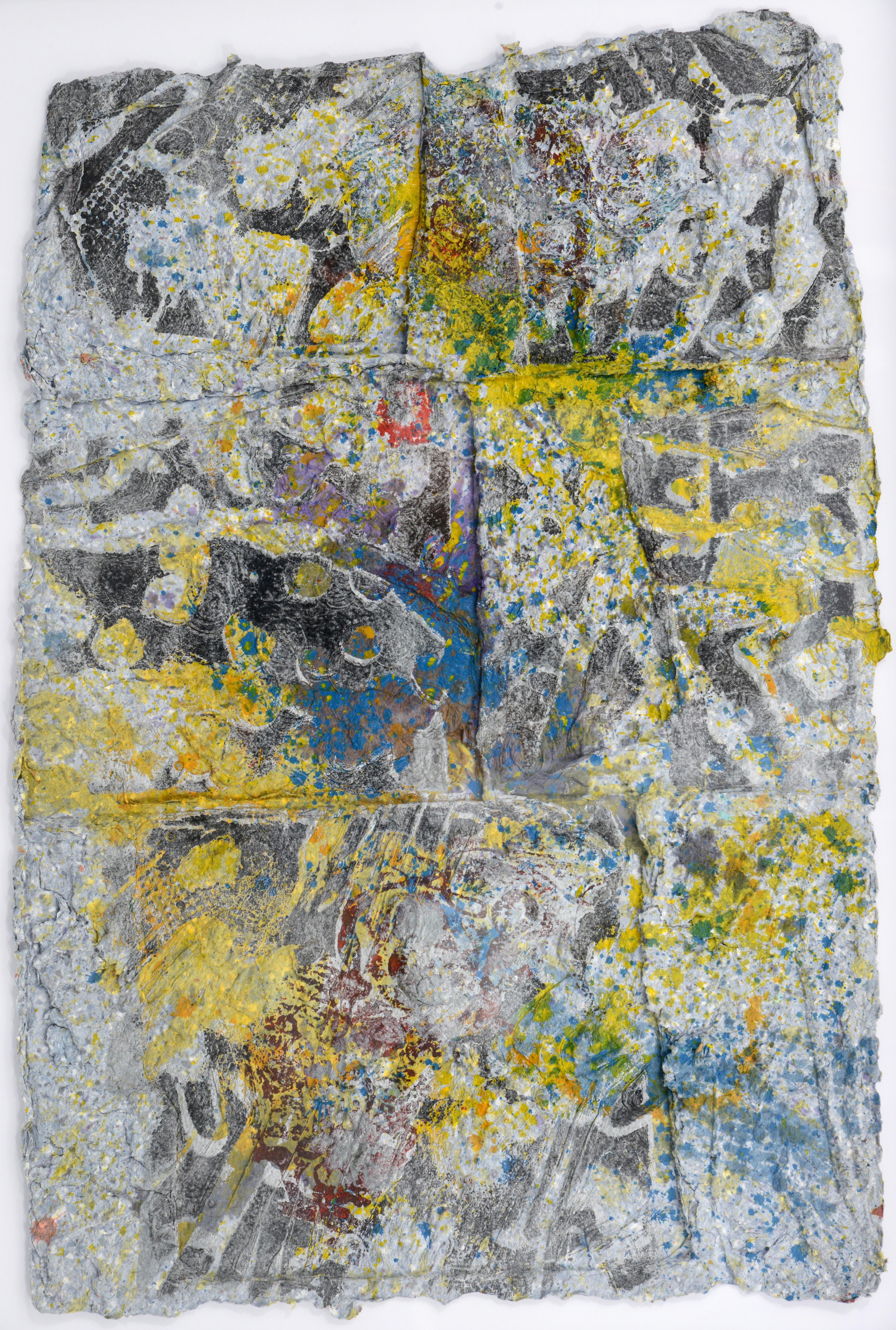
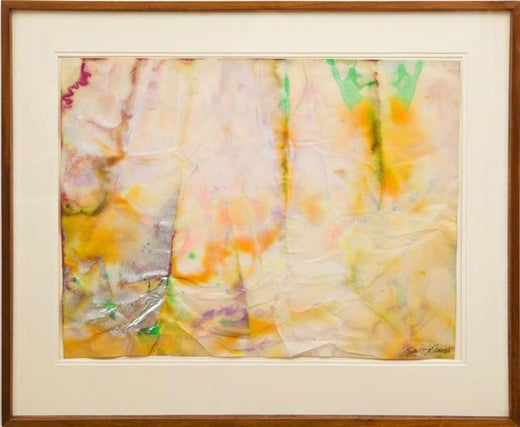
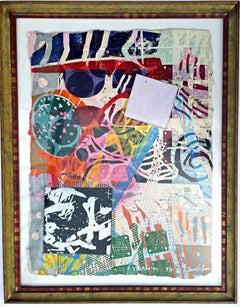
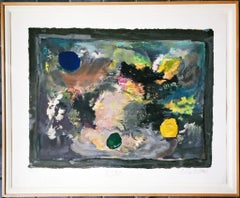
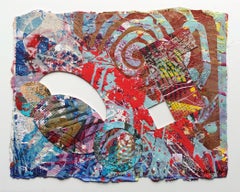
Untitled Abstract Expressionist mixed media painting, Ex-Museum of Modern Art Collection, 1968
Watercolor and Aluminum Paint on Fiberglass Paper. (Framed with Museum of Modern Art Collection Label Verso and Exhibition brochure from the American Embassy Exhibition in Moscow)
18 × 23 1/2 in 45.7 × 59.7 cm
This is a unique work
In a fascinating December, 2024 New York Times feature, art critic Walker Mimms reminds us that in the mid 1960s, the United States government used modern art as an instrument of the Cold War. He writes, "the C.I.A., with the help of institutions like MoMA in New York, deployed modern art as Cold War-era agitprop by financing exhibitions of artists like Willem de Kooning, Jackson Pollock and Mark Rothko that traveled extensively abroad and promoted their subjects as icons of American individualism."
This 1968 Abstract Expressionist painting on paper by pioneering African American artist Sam Gilliam, from the collection of MoMA in New York, was one of them. In fact, it was even exhibited at the American Embassy in Moscow, under the auspices of the Museum of Modern Art and its curator.
Historic late 1960s painting created with watercolor and aluminum paint on fiberglass paper. Hand signed by the artist lower right front, with label from The Museum of Modern Art, NY. , including the museum collection number. Sam Gilliam's works from this era are coveted in the marketplace; especially the present work with such extraordinary provenance and fascinating history: As noted above, this painting was also featured in the exhibition "American Contemporary Art" at the American Embassy in Moscow, curated by Margaret Patter, Associate Curator, Department of Painting and Sculpture, The Museum of Modern Art. Accompanying this work is an undated xerox copy of the exhibition brochure, in both English and Russian. The curator describes this Gilliam work from MOMA's Collection: "One of the consistent themes of Abstract Expressionism was the dual nature of a painting; its existence as symbolic expression and as a physical object made of flat canvas and fluid paint. In granting a dominant role to the artist's intuition, the Abstract Expressionists made a virtue of the accidental splashes and drips of paint which resulted from spontaneous use of paint and accepted these as integral elements of the total expression. Subsequently, a number of painters and sculptors have pursued further one aspect of this duality by concentrating on the physical attributes of their media. Rejecting a preconceived image or one which evolves during the process of painting, these artists have permitted the nature of the medium itself to determine the image. In his untitled watercolor of 1968, Sam Gilliam, a young Negro [sic] artist from Washington, D.C. soaked color in an especially absorbent paper and then folded it several times. The interaction of the materials and the process, rather than the artist's touch and decision, brought about the random blots of color. To contrast with the textural softness and depth, the artist has covered parts of the surface with aluminum paint whose stuff glitter and deliberate lack of formal structure further stress the intrinsic qualities of the paint and paper rather than the artist's participation. This frank emphasis on the physical aspects of the artist's means and activity reflect a diffidence toward self-revelation and the assignment of symbolic values to art, a trend which has become increasingly common in recent American art." (Text also translated into Russian.)
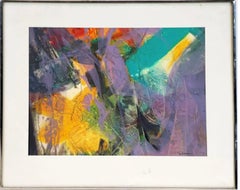
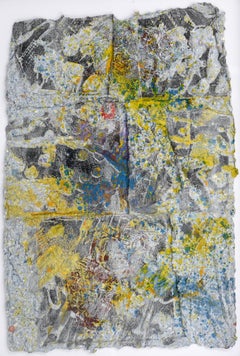
In 2017, this work was featured in the exhibition "The Anxiety of Influence" at Chapter New York Gallery in Manhattan. See attached Installation photos.
Measurements:
18 x 23 1/2 in. (Artwork);
26 x 31 in. (frame).
Exhibition History:
"American Contemporary Art", American Embassy, Moscow, Catalogue Essay by Margaret Patter, Associate Curator, Department of Painting and Sculpture, The Museum of Modern Art, New York (ca. 1970), with reproductions and essay about this work.
"The Anxiety of Influence", curated by Alex Glauber, November 10 – December 22, 2017
In 2017, this work was featured in the exhibition "The Anxiety of Influence" at Chapter New York Gallery in Manhattan. See attached Installation photos.
Exhibition History:
"American Contemporary Art", American Embassy, Moscow, Catalogue Essay by Margaret Patter, Associate Curator, Department of Painting and Sculpture, The Museum of Modern Art, New York (ca. 1970), with reproductions and essay about this work.
"The Anxiety of Influence", curated by Alex Glauber, November 10 – December 22, 2017
Sam Gilliam Biography
Sam Gilliam (b. 1933, d. 2022) is one of the great innovators in postwar American painting. He emerged from the Washington, D.C. scene in the mid-1960s with works that elaborated upon and disrupted the ethos of Color School painting. A series of formal breakthroughs would soon result in his canonical Drape paintings, which expanded upon the tenets of Abstract Expressionism in entirely new ways. Suspending stretcherless lengths of painted canvas from the walls or ceilings of exhibition spaces, Gilliam transformed his medium and the contexts in which it was viewed. For an African American artist in the nation’s capital at the height of the Civil Rights movement, this was not merely an aesthetic proposition; it was a way of defining art’s role in a society undergoing dramatic change. Gilliam subsequently pursued a pioneering course in which experimentation has been the only constant. Inspired by the improvisatory ethos of jazz, his lyrical abstractions continue to take on an increasing variety of forms, moods, and materials.
Gilliam has been the subject of numerous solo exhibitions at institutions worldwide including the Hirshhorn Museum and Sculpture Garden, Washington, D.C. (2022); Kunstmuseum Basel, Switzerland (2018); Phillips Collection, Washington, D.C. (2011); J.B. Speed Memorial Museum, Louisville, KY (1996); Whitney Museum of American Art, Philip Morris Branch, New York, NY (1993); The Studio Museum in Harlem, NY (1982); and Museum of Modern Art, New York, NY (1971), among many other institutions. In 2021, Dia Art Foundation, New York, and the Museum of Fine Arts, Houston made the historic joint acquisition of Gilliam’s important early work, the monumental installation Double Merge (1968), which was on view 2019–2022 at Dia Beacon in New York. Recent group exhibitions include Flight into Egypt: Black Artists and Ancient Egypt, 1876–Now, Metropolitan Museum of Art, New York, NY (2024–2025); Edges of Ailey, Whitney Museum of American Art, New York, NY (2024); Day for Night: New American Realism, organized by the Aïshti Foundation, Palazzo Barberini, Rome, Italy (2024); Abstraction after Modernism: Recent Acquisitions, Menil Collection, Houston, TX (2024); and American Voices and Visions: Modern and Contemporary Art, Smithsonian American Art Museum, Washington, D.C. (2023). His work is included in over fifty permanent collections, including the Musée d’Art Moderne de la Ville de Paris, France; Tate Modern, London, England; Museum of Modern Art, New York, NY; Metropolitan Museum of Art, New York, NY; and Art Institute of Chicago, IL.