1 of 2
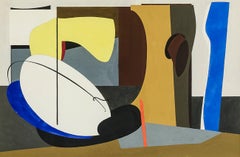
Santos Rene IrizarryModernist Color Blocking Abstract in Gouache, Circa 1960sCirca 1960s
Circa 1960s
Price:$200
$295List Price
About the Item
- Creator:
- Creation Year:Circa 1960s
- Dimensions:Height: 9 in (22.86 cm)Width: 6.5 in (16.51 cm)Depth: 0.01 in (0.26 mm)
- Medium:
- Movement Style:
- Period:
- Condition:Vintage wear.
- Gallery Location:San Francisco, CA
- Reference Number:Seller: 145501stDibs: LU29822252203
Authenticity Guarantee
In the unlikely event there’s an issue with an item’s authenticity, contact us within 1 year for a full refund. DetailsMoney-Back Guarantee
If your item is not as described, is damaged in transit, or does not arrive, contact us within 7 days for a full refund. Details24-Hour Cancellation
You have a 24-hour grace period in which to reconsider your purchase, with no questions asked.Vetted Professional Sellers
Our world-class sellers must adhere to strict standards for service and quality, maintaining the integrity of our listings.Price-Match Guarantee
If you find that a seller listed the same item for a lower price elsewhere, we’ll match it.Trusted Global Delivery
Our best-in-class carrier network provides specialized shipping options worldwide, including custom delivery.You May Also Like
Modern Light Blue, Brown, and Black Geometric Abstract Circle Pattern Painting
By John Little
Located in Houston, TX
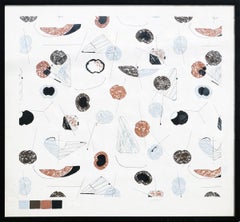
Modern light blue, brown, and black geometric abstract circle pattern painting by textile designer John Little. The work was created as a proposed design for a wallpaper and features the original color codes in the front lower left corner. Currently hung in a solid black frame with a large white margin.
Dimensions Without Frame: H 32.75 in. x W 35.63 in.
Artist Biography: A painter and textile designer, John Little is best known for gestural works filled with boldly explosive color that reflect the influences of his teacher Hans Hofmann and for his involvement in the Abstract Expressionist movement in East Hampton, where he moved in the late 1940s. In East Hampton Little congregated with Jackson Pollock, Lee Krasner, and the other artists who were the leading innovators in the New York School.
John Little was born in Sanford, Alabama. He left home at the age of fourteen to become an artist, and moved to Buffalo, New York, in 1923. After spending a year working as a stevedore on the docks to save money, he enrolled at the Buffalo Fine Arts Academy and developed an interest in singing. In 1927 he moved to New York City where he continued his vocal work and studied operatic literature. He also became involved in textile design, opening his own store in 1920, called John Little Studios: Fabric and Wallpaper Design. He ran the store until 1950.
In 1933 John Little resumed his painting studies at the Art Students League in New York under the guidance of George Grosz (1893-1959). The following year he made his first visit to East Hampton, Long Island, which he would eventually call home. Later in the decade, he traveled to Paris where he became familiar with European modernism. On his return to America, he taught textile design at the Pratt Institute in Brooklyn. He hired Josephine Watkins to work for him; she later became his wife. Little's textile store and teaching job gave him a financial security that was rare during the Depression, and he never found it necessary to find employment with the Works Progress Administration. At the end of the decade, John Little studied with Hans Hofmann (1880-1966) in New York and Provincetown. Little was greatly influenced by Hofmann, particularly by his views on color theory.
In 1942 John Little joined the Navy as an aerial photographer. In the late 1940s he purchased a rundown house on Three Mile Harbor...
Category
Early 20th Century Modern Abstract Drawings and Watercolors
Materials
Paper, Gouache
$1,500
H 34.38 in W 37.25 in D 1.13 in
Modern Grey and Orange Geometric Abstract Leaf Pattern Painting
By John Little
Located in Houston, TX
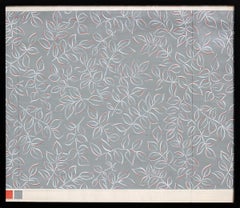
Modern grey and white geometric abstract leaf pattern composition with orange accents by textile designer John Little. The work was created as a proposed design for a wallpaper and features the original color codes in the front lower left corner. Currently hung in a solid black frame with a large white margin.
Dimensions Without Frame: H 27.13 in. x W 31.5 in.
Artist Biography: A painter and textile designer, John Little is best known for gestural works filled with boldly explosive color that reflect the influences of his teacher Hans Hofmann and for his involvement in the Abstract Expressionist movement in East Hampton, where he moved in the late 1940s. In East Hampton Little congregated with Jackson Pollock, Lee Krasner, and the other artists who were the leading innovators in the New York School.
John Little was born in Sanford, Alabama. He left home at the age of fourteen to become an artist, and moved to Buffalo, New York, in 1923. After spending a year working as a stevedore on the docks to save money, he enrolled at the Buffalo Fine Arts Academy and developed an interest in singing. In 1927 he moved to New York City where he continued his vocal work and studied operatic literature. He also became involved in textile design, opening his own store in 1920, called John Little Studios: Fabric and Wallpaper Design. He ran the store until 1950.
In 1933 John Little resumed his painting studies at the Art Students League in New York under the guidance of George Grosz (1893-1959). The following year he made his first visit to East Hampton, Long Island, which he would eventually call home. Later in the decade, he traveled to Paris where he became familiar with European modernism. On his return to America, he taught textile design at the Pratt Institute in Brooklyn. He hired Josephine Watkins to work for him; she later became his wife. Little's textile store and teaching job gave him a financial security that was rare during the Depression, and he never found it necessary to find employment with the Works Progress Administration. At the end of the decade, John Little studied with Hans Hofmann (1880-1966) in New York and Provincetown. Little was greatly influenced by Hofmann, particularly by his views on color theory.
In 1942 John Little joined the Navy as an aerial photographer. In the late 1940s he purchased a rundown house on Three Mile Harbor...
Category
Early 20th Century Modern Abstract Drawings and Watercolors
Materials
Paper, Gouache
$1,200
H 28.63 in W 33.13 in D 1.13 in
Modern Orange, Brown, Yellow, and Black Geometric Abstract Pattern Painting
By John Little
Located in Houston, TX
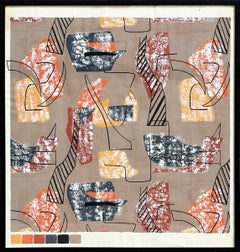
Modern orange, brown, yellow, and black geometric abstract composition by textile designer John Little. The work was created as a proposed design for a wallpaper and features the original color codes in the front lower left corner. Currently hung in a solid black frame with a large white margin.
Dimensions Without Frame: H 35.5 in. x W 33.5 in.
Artist Biography: A painter and textile designer, John Little is best known for gestural works filled with boldly explosive color that reflect the influences of his teacher Hans Hofmann and for his involvement in the Abstract Expressionist movement in East Hampton, where he moved in the late 1940s. In East Hampton Little congregated with Jackson Pollock, Lee Krasner, and the other artists who were the leading innovators in the New York School.
John Little was born in Sanford, Alabama. He left home at the age of fourteen to become an artist, and moved to Buffalo, New York, in 1923. After spending a year working as a stevedore on the docks to save money, he enrolled at the Buffalo Fine Arts Academy and developed an interest in singing. In 1927 he moved to New York City where he continued his vocal work and studied operatic literature. He also became involved in textile design, opening his own store in 1920, called John Little Studios: Fabric and Wallpaper Design. He ran the store until 1950.
In 1933 John Little resumed his painting studies at the Art Students League in New York under the guidance of George Grosz (1893-1959). The following year he made his first visit to East Hampton, Long Island, which he would eventually call home. Later in the decade, he traveled to Paris where he became familiar with European modernism. On his return to America, he taught textile design at the Pratt Institute in Brooklyn. He hired Josephine Watkins to work for him; she later became his wife. Little's textile store and teaching job gave him a financial security that was rare during the Depression, and he never found it necessary to find employment with the Works Progress Administration. At the end of the decade, John Little studied with Hans Hofmann (1880-1966) in New York and Provincetown. Little was greatly influenced by Hofmann, particularly by his views on color theory.
In 1942 John Little joined the Navy as an aerial photographer. In the late 1940s he purchased a rundown house on Three Mile Harbor...
Category
Early 20th Century Modern Abstract Drawings and Watercolors
Materials
Paper, Gouache
$1,950
H 37 in W 35.13 in D 1.13 in
“Abstract in Colors, 1952”
By Jimmy Ernst
Located in Southampton, NY
Original gouache on archival paper by the well known American artist, Jimmy Ernst. Signed lower right and dated 1952. Condition is excellent. Strong, vibrant colors, no issues. Wh...
Category
1950s Modern Abstract Drawings and Watercolors
Materials
Gouache, Archival Paper
Sergey CHEKHONIN (1878 – 1936), theater poster project
Located in Paris, FR
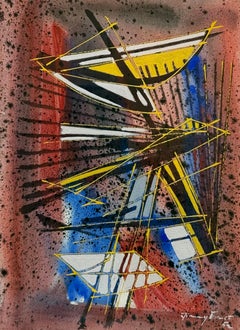
Serge Tchekhonine was a Russian artist who studied applied drawing, ceramics, and pottery in St. Petersburg. He settled in France in 1928, gaining attention for his finely crafted ce...
Category
1930s Modern Abstract Drawings and Watercolors
Materials
Paper, Ink, Watercolor, Gouache
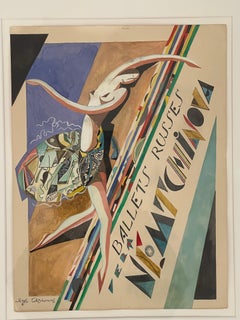
$29,696
H 15.16 in W 10.63 in
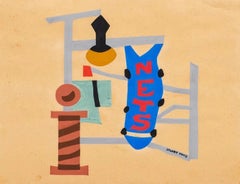
"NY Street Signs" Mid-20th Century WPA 1938 Modernist Abstract Realism Pop Art
By Stuart Davis
Located in New York, NY
"NY Street Signs" Mid-20th Century WPA 1938 Modernist Abstract Realism Pop Art
Stuart Davis (American, 1892-1964) "Street Signs" Modernist gouache and traces of pencil on paper in the proto-pop art style Davis is celebrated for, 1938, signed to lower right, framed. Image: 11 1/4 x 15 1/4 inches. Frame by Bark: 18 1/2 x 22 inches.
LITERATURE: A, Boyajian, M. Rutkowski, Stuart Davis, A Catalogue Raisonne, Vol. 2, New Haven, Connecticut, 2007, vol. II, p. 632, no. 1232, illustrated.
EXHIBITIONS: ACA Galleries, New York American Artists' Congress: Group Exhibition of Paintings and Sculpture, Dec. 3-16, 1939 (SDAB I, 12/3/39, p. 129). Outlines Gallery, Pittsburgh, Stuart Davis, Mar. 3-16, 1946. Coleman Art Gallery, Philadelphia, 5 Prodigal Sons: Former Philadelphia Artists: Ralston Crawford, Stuart Davis, Charles Demuth, Julian Levi, Charles Sheeler, Oct 4 - 30, 1947 (pamphlet), no. 12.
PROVENANCE: The artist; Mr. and Mrs. Frank Bowles, New York, Apr. 3, 1956; thence by descent, Private Collection, New York.
NOTES: According to the Catalogue Raissonne, "the title 'Street Signs' is recorded in the artist's account books...
Category
1930s American Modern Abstract Drawings and Watercolors
Materials
Paper, Gouache, Pencil
$125,000
H 18.5 in W 22 in D 1 in
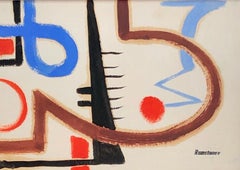
MODERNIST DRAWING New Hope Mid-Century WPA Abstract Non-Objective Jazz Modern
By Ramstonev (Ramsey/Stone/Evans co-operative)
Located in New York, NY
MODERNIST DRAWING New Hope Mid-Century WPA Abstract Non-Objective Jazz Modern. Signed with a "Ramstonev" stamp lower right.
RAMSTONEV Cooperative Art Project (1937-1939). In the late 1930s, Charles Ramsey became close friends with Charles Evans and Louis Stone. He persuaded them to join him teaching his New Hope summer classes in non-objective painting. Soon, a history-making collaboration began. In 1937, meeting in Evans' studio at the rear of Cryer's Hardware store on Main Street in New Hope, a decision was made to establish the Co-Operative Painting Project. They were intrigued by the cooperative ad-lib process by which jazz musicians created their music. Believing this to be the quintessential American contribution to music, they theorized that a similar result might be obtainable with art, a "visual jam session." This particlarly fascinated Ramsey, who was a jazz buff and had a large collection of jazz records.
The objective was to jointly collaborate in the creation of a painting as well as applying collective criticism during its creation. By creating forward movement by general consent, they believed they could produce a higher level of beauty. By consensus it was decided that subject matter would be non-objective. Up to eight people would participate and stop when the painting "felt" finished by common agreement.
These co-operative works were done in several different mediums- the majority in pastel, but some in watercolor, gouache, graphite or cut paper collage. On occasion, the group would create a series, as opposed to a single work, created in steps by three or four artists. One of the occasional participants was famed New Hope poet, Stanley Kunitz. These series could range in number from four to sixteen paintings in each. The first of a series would be very basic and the last a fully finished work.
In the scope of importance among the New Hope Modernist...
Category
1930s American Modern Abstract Drawings and Watercolors
Materials
Paper, Watercolor, Gouache
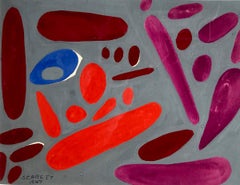
“Floating Forms”
By Rolph Scarlett
Located in Southampton, NY
Mid century modern gouache on paper by the well known Canadian/American artist, Rolph Scarlett. Signed and dated in blue pen lower left, 1947. Condition: Good. Framed in thin black matte painted frame with acid free white mat. Not examined out of frame. Overall framed 14.25 by 17 inches.
ROLPH SCARLETT (1889-1984)
Rolph Scarlett was born 1889 in Guelph, Ontario. His long life as an artist began in his teens as a jewelry designer and fabricator. At the age of fourteen he began to design jewelry professionally, a craft which he continued off and on for the rest of his life.
His desire to learn more about art took him to New York in 1908, when American artists were just beginning to experience strong influences from major modern European artists of the day such as Cezanne and Picasso.
Throughout his long career he produced, oil paintings, many works on paper, unique sculptured jewelry, modernist style industrial and furniture designs. Currently there are over 800 of his designs at the Montreal Museum of Fine Arts Design Collection.
In 1928 he moved to Hollywood, California where he became a very successful stage and set designer. In the mid-1930s he met the director of the Museum of Non-objective Art in New York ( Hilla Rebay). He became her close associate and advisor in organizing and running the museum. He was Chief lecturer at the museum (1939 -1946) teaching the new modernism and abstraction to the new generation of artists in the New York art community. Hilla Rebay would introduce him as “Rolph Scarlett, my great find”. So considerable was her enthusiasm for Scarlett, that she and Solomon Guggenheim bought over sixty of his paintings and monotypes for the museum. After Kandinsky and Bauer, there was more of Scarlett’s work in the collection than any other artists.
He participated in many of the museum exhibitions and galleries and was regularly exhibiting his work in Los Angeles, the San Francisco Art Museum, the Art Institute in Chicago, the Modern Age Gallery in N.Y., the Metropolitan Museum, the Whitney Museum and the Museum of Modern Art. He studied for a time at the Art Student League with William Merrit...
Category
1940s Modern Abstract Drawings and Watercolors
Materials
Paper, Gouache
Untitled
By Charles Houghton Howard
Located in New York, NY
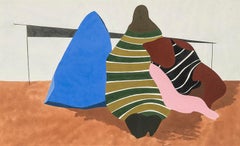
Charles Houghton Howard was born in Montclair, New Jersey, the third of five children in a cultured and educated family with roots going back to the Massachusetts Bay colony. His father, John Galen Howard, was an architect who had trained at M.I.T. and the École des Beaux-Arts in Paris and apprenticed in Boston with Henry Hobson Richardson. In New York, the elder Howard worked for McKim, Mead and White before establishing a successful private practice. Mary Robertson Bradbury Howard, Charles’s mother, had studied art before her marriage. John Galen Howard moved his household to California in 1902 to assume the position of supervising architect of the new University of California campus at Berkeley and to serve as Professor of Architecture and the first Dean of the School of Architecture (established in 1903). The four Howard boys grew up to be artists and all married artists, leaving a combined family legacy of art making in the San Francisco Bay area that endures to this day, most notably in design, murals, and reliefs at the Coit Tower and in buildings on the Berkeley campus.
Charles Howard graduated from the University of California at Berkeley in 1921 as a journalism major and pursued graduate studies in English at Harvard and Columbia Universities before embarking on a two-year trip to Europe. Howard went to Europe as a would-be writer. But a near-religious experience, seeing a picture by Giorgione in a remote town outside of Venice, proved a life-altering epiphany. In his own words, “I cut the tour at once and hurried immediately back to Paris, to begin painting. I have been painting whenever I could ever since” (Charles Howard, “What Concerns Me,” Magazine of Art 39 [February 1946], p. 63). Giorgione’s achievement, in utilizing a structured and rational visual language of art to convey high emotion on canvas, instantly convinced Howard that painting, and not literature, offered the best vehicle to express what he wanted to say. Howard returned to the United States in 1925, confirmed in his intent to become an artist.
Howard settled in New York and supported himself as a painter in the decorating workshop of Louis Bouché and Rudolph Guertler, where he specialized in mural painting. Devoting spare time to his own work, he lived in Greenwich Village and immersed himself in the downtown avant-garde cultural milieu. The late 1920s and early 1930s were the years of Howard’s art apprenticeship. He never pursued formal art instruction, but his keen eye, depth of feeling, and intense commitment to the process of art making, allowed him to assimilate elements of painting intuitively from the wide variety of art that interested him. He found inspiration in the modernist movements of the day, both for their adherence to abstract formal qualities and for the cosmopolitan, international nature of the movements themselves. Influenced deeply by Surrealism, Howard was part of a group of American and European Surrealists clustered around Julien Levy. Levy opened his eponymously-named gallery in 1931, and rose to fame in January 1932, when he organized and hosted Surrealisme, the first ever exhibition of Surrealism in America, which included one work by Howard. Levy remained the preeminent force in advocating for Surrealism in America until he closed his gallery in 1949. Howard’s association with Levy in the early 1930s confirms the artist’s place among the avant-garde community in New York at that time.
In 1933, Howard left New York for London. It is likely that among the factors that led to the move were Howard’s desire to be a part of an international art community, as well as his marriage to English artist, Madge Knight...
Category
20th Century American Modern Abstract Drawings and Watercolors
Materials
Paper, Gouache, Graphite
Untitled
By Charles Houghton Howard
Located in New York, NY
Charles Houghton Howard was born in Montclair, New Jersey, the third of five children in a cultured and educated family with roots going back to the Massachusetts Bay colony. His father, John Galen Howard, was an architect who had trained at M.I.T. and the École des Beaux-Arts in Paris and apprenticed in Boston with Henry Hobson Richardson. In New York, the elder Howard worked for McKim, Mead and White before establishing a successful private practice. Mary Robertson Bradbury Howard, Charles’s mother, had studied art before her marriage. John Galen Howard moved his household to California in 1902 to assume the position of supervising architect of the new University of California campus at Berkeley and to serve as Professor of Architecture and the first Dean of the School of Architecture (established in 1903). The four Howard boys grew up to be artists and all married artists, leaving a combined family legacy of art making in the San Francisco Bay area that endures to this day, most notably in design, murals, and reliefs at the Coit Tower and in buildings on the Berkeley campus.
Charles Howard graduated from the University of California at Berkeley in 1921 as a journalism major and pursued graduate studies in English at Harvard and Columbia Universities before embarking on a two-year trip to Europe. Howard went to Europe as a would-be writer. But a near-religious experience, seeing a picture by Giorgione in a remote town outside of Venice, proved a life-altering epiphany. In his own words, “I cut the tour at once and hurried immediately back to Paris, to begin painting. I have been painting whenever I could ever since” (Charles Howard, “What Concerns Me,” Magazine of Art 39 [February 1946], p. 63). Giorgione’s achievement, in utilizing a structured and rational visual language of art to convey high emotion on canvas, instantly convinced Howard that painting, and not literature, offered the best vehicle to express what he wanted to say. Howard returned to the United States in 1925, confirmed in his intent to become an artist.
Howard settled in New York and supported himself as a painter in the decorating workshop of Louis Bouché and Rudolph Guertler, where he specialized in mural painting. Devoting spare time to his own work, he lived in Greenwich Village and immersed himself in the downtown avant-garde cultural milieu. The late 1920s and early 1930s were the years of Howard’s art apprenticeship. He never pursued formal art instruction, but his keen eye, depth of feeling, and intense commitment to the process of art making, allowed him to assimilate elements of painting intuitively from the wide variety of art that interested him. He found inspiration in the modernist movements of the day, both for their adherence to abstract formal qualities and for the cosmopolitan, international nature of the movements themselves. Influenced deeply by Surrealism, Howard was part of a group of American and European Surrealists clustered around Julien Levy. Levy opened his eponymously-named gallery in 1931, and rose to fame in January 1932, when he organized and hosted Surrealisme, the first ever exhibition of Surrealism in America, which included one work by Howard. Levy remained the preeminent force in advocating for Surrealism in America until he closed his gallery in 1949. Howard’s association with Levy in the early 1930s confirms the artist’s place among the avant-garde community in New York at that time.
In 1933, Howard left New York for London. It is likely that among the factors that led to the move were Howard’s desire to be a part of an international art community, as well as his marriage to English artist, Madge Knight...
Category
20th Century American Modern Abstract Drawings and Watercolors
Materials
Paper, Watercolor, Gouache, Graphite
Recently Viewed
View AllMore Ways To Browse
Alexander Kwiat On Sale
Vincent Brodeur
Vincent Caralto
Vincent Tailhardat
Vintage 1929 Hat
Vintage 1980S Skateboards
Vintage Art Supplies 1940s
Vintage Drakes Cakes
Vintage Erotica Poster
Vintage Kawasaki Motorcycles
Vintage Porsche Race Cars
Vintage Ski Posters Val D Isere
Virginia Shaver
W Dawson
W Hampton Painting
W Hobson
W Hofmann
W Louis Jones