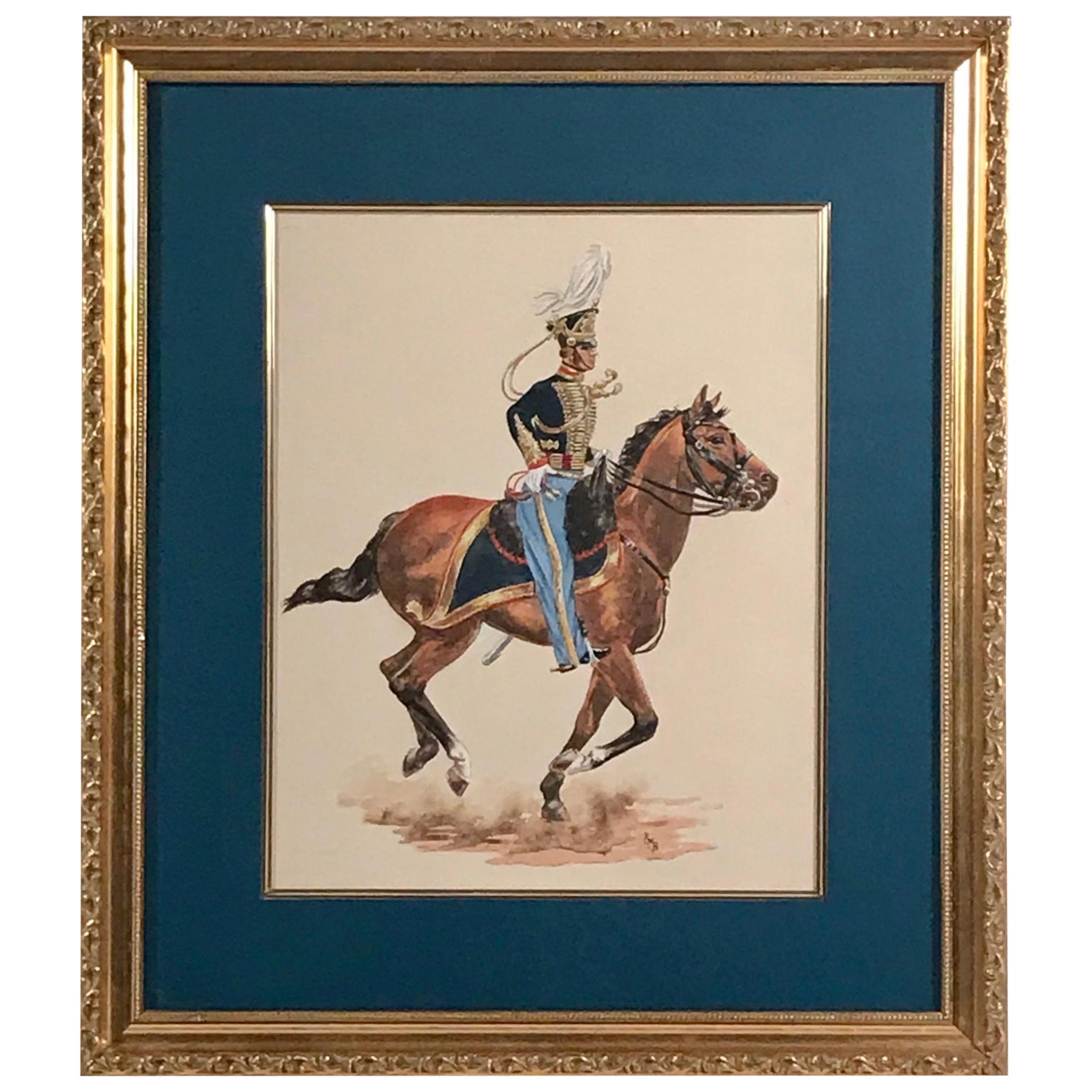
Items Similar to Cavalry Officer on Horse, Watercolor, Mid-19th Century, Framed
Want more images or videos?
Request additional images or videos from the seller
1 of 11
Egron LundgrenCavalry Officer on Horse, Watercolor, Mid-19th Century, Framedca. 1850
ca. 1850
$1,794.09
£1,332.21
€1,500
CA$2,464.81
A$2,679.75
CHF 1,420.80
MX$32,123.36
NOK 18,057.70
SEK 16,543.30
DKK 11,434.81
About the Item
A finely worked watercolour on paper depicts a mounted cavalry officer—formal in bearing and costume—painted with the delicate clarity for which Egron Lundgren is best known. The sheet is signed in ink “E. L.”, mounted acid-free with a passe-partout and presented in a gilded frame, a conservation-minded treatment that preserves the paper support and the subtle luminosity of the washes. Some glass reflections are unfortunately visible in the photos.
Egron Sellif Lundgren was born in Stockholm on 18 December 1815. After initial technical studies, he followed his artistic interests to the Royal Swedish Academy of Fine Arts (enrolling in 1835) and then to Paris, where he copied in the Louvre and took studio training with Léon Cogniet. During the 1840s Lundgren lived for long periods in Italy and Spain, where he turned away from ambitions as a history painter and concentrated on genre scenes and topographical watercolors—subjects that would become his hallmark.
London, India and mature career
From about 1850 Lundgren based himself largely in London, where he worked as a portraitist and illustrator and took commissions recording ceremonial life at court and stage scenes. In 1857–1858 he was commissioned by an English firm to travel to India to document the events of the Indian Rebellion (Sepoy Mutiny). Traveling under the protection of senior British commanders (he spent time attached to Lord Clyde’s forces), he produced hundreds of sketches and watercolours of military scenes, camp life, street subjects and local people—works that significantly broadened his reputation. He was later elected a member of the Royal Watercolour Society.
Lundgren’s technique exemplifies nineteenth-century watercolour mastery: economical pen or pencil drawing combined with transparent, carefully layered washes, attentive handling of costume and facial type, and an eye for telling anecdote. Although he began with ambitions in history painting, his lasting achievement is in genre portraiture, travel scenes and military topography—subjects rendered with documentary sensitivity and pictorial refinement. Many observers praise his ability to retain freshness and immediacy even in finished studio watercolors.
While living in Britain Lundgren exhibited widely and worked for periodicals and patrons in both private and official circles; he also kept publishing and circulating his travel notes and sketches. Later in life he returned to Sweden and published collections of his letters and diaries (compiled as En målares anteckningar), which provide invaluable first-hand testimony about his travels and working methods.
Examples of Lundgren’s watercolors and drawings are held in major public collections in Britain and Sweden and elsewhere. Notable institutional holdings include the British Museum, the Nationalmuseum (Stockholm) and Göteborgs konstmuseum, among other regional collections and repositories that preserve his travel and India material. These holdings reflect both his documentary importance and his status as a leading nineteenth-century watercolorist.
Egron Lundgren is remembered as one of the most accomplished Swedish watercolorists of the nineteenth century—a cosmopolitan artist who combined continental training, wide travels and a practiced eye for social detail. His Indian sketches in particular remain important historical documents as well as works of art, and his diaries and letters have been used by historians and curators to illuminate both his working practice and the wider context of nineteenth-century travel painting.
- Creator:Egron Lundgren (1815 - 1875, Swedish)
- Creation Year:ca. 1850
- Dimensions:Height: 15.56 in (39.5 cm)Width: 12.21 in (31 cm)Depth: 0.79 in (2 cm)
- Medium:
- Period:
- Condition:In a nice condition with good colors.
- Gallery Location:Stockholm, SE
- Reference Number:1stDibs: LU2608216862772
About the Seller
5.0
Gold Seller
Premium sellers maintaining a 4.3+ rating and 24-hour response times
1stDibs seller since 2023
33 sales on 1stDibs
Typical response time: <1 hour
- ShippingRetrieving quote...Shipping from: Stockholm, Sweden
- Return Policy
More From This Seller
View AllImpressionistic Graphite Drawing of Baptista Schreiber, circa 1905-1915
Located in Stockholm, SE
This expressive and atmospheric graphite drawing by Gösta von Hennigs (1866–1941) portrays the celebrated equestrian artist Baptista Schreiber within the charged setting of a circus ...
Category
1910s Impressionist Figurative Drawings and Watercolors
Materials
Graphite, Paper
19th Century Portrait of Gustaf Wilhelm Palm in Pencil and Pastel
Located in Stockholm, SE
Portrait of Gustaf Wilhelm Palm (1810–1890) by Lorenz Frølich (1820-1908)
Signed with monogram and dated May 1849. Pencil and pastel on paper. 29.5 × 21 cm.
This portrait of the Swed...
Category
1840s Naturalistic Portrait Drawings and Watercolors
Materials
Paper, Pastel, Carbon Pencil
Village Dancing Scene, 19th Century Watercolor, English School, Signed
Located in Stockholm, SE
A painted watercolor of joyous village festivity with music playing and dancing people by Walter Goodall, signed and dated 1862. In the foreground, a young girl in a white dress danc...
Category
1860s English School Figurative Drawings and Watercolors
Materials
Paper, Watercolor
$1,578 Sale Price
40% Off
Free Shipping
Study of Two Dancing Children, 19th Century Watercolor on Paper
Located in Stockholm, SE
Study of Two Dancing or Playing Children in Ottoman Costume
Watercolour on paper. Probably executed during the first half of the 19th century.
This delicate study depicts two Ottoman...
Category
19th Century Other Art Style Figurative Drawings and Watercolors
Materials
Watercolor, Paper
Portrait Drawing of a Gypsy Woman on Paper, Signed, 19th Century
Located in Stockholm, SE
A graphite profile portrait drawing of a woman on paper by Johannes Collin (1873-1951), signed “Johannes Collin 98” and titled “Zigenerska”. This early and unusual work by Collin presents his interest in refined drawing and capturing character even at a modest scale. It dates from 1898, a formative moment for the artist when he was studying arts and stands out as a somewhat rare example of his graphic or drawing work rather than his better known small bronzes.
Johannes Collin was born in 1873 in Skåne, south Sweden.
After passing his matriculation at the Cathedral School in Lund in 1892, he studied at university in 1894–96 and then turned to art studies.
From 1899 to 1901 he studied at the Royal Academy of Fine Arts in Stockholm, and from 1903 to 1905 he studied sculpture in Paris.
Collin settled in Lund, Skåne and pursued a career as sculptor and poet. He died in 1951 in Lund.
He was the son of a farmer and raised in the Skåne countryside. Early on he developed a sensitivity to form, figure, and expression, combining his sculptural ambitions with literary leanings (he later published a small volume of poetry).
Collin appears to have had an individualistic personality: he moved in student and artistic circles in Lund, but also kept a modest, sometimes even eccentric public persona. In the mid-1930s, he increasingly turned to poetry and pared back his three-dimensional work.
From his early years, he gradually developed into a sculptor working in bronze and patinated materials. Much of his work consists of small‐scale bronzes with an intensity of expression. One critic (in Kulturens yearbook) wrote of Collin that “the monumental is not in the work’s external dimensions but in the attitude … your small sculptures have an inner monumentality”.
Collin exhibited his works in various venues: for example he took part in the Lund Exhibition (“Lundautställningen”) in 1907.
Internationally, he showed works in Munich in 1909 and 1913, where his efforts were positively reviewed.
A noteworthy retrospective or exhibition was held at the museum Kulturen in Lund, when a donation of Collin’s sculptures...
Category
1890s Other Art Style Portrait Drawings and Watercolors
Materials
Paper, Graphite
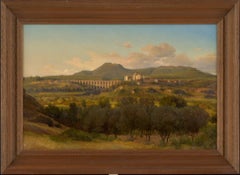
Ariccia Bridge Landscape Painting, Oil on Paper, Circa 1850s
Located in Stockholm, SE
View of the Ariccia Bridge and the Alban Hills
This finely executed plein air landscape depicts the monumental bridge of Ariccia and the town with the surrounding Alban Hills, painted by German landscape artist Joachim Ludwig Heinrich Daniel Bünsow (born 1821 in Kiel, died 1910 in the same city). Executed in oil on paper mounted on cardboard, the work dates from his Italian period between 1853 and 1858. Not signed.
Bünsow received his artistic training at the Royal Danish Academy of Fine Arts in Copenhagen from 1839 to 1848, studying under Johann Ludwig Lund and Christoffer Wilhelm Eckersberg. In 1844, the Copenhagen Art Association acquired his painting "Tellingstedt in Dithmarschen." Following his studies, he traveled to Dresden, where he became associated with the circle around Johan Christian Dahl. A scholarship from the Copenhagen Academy enabled Bünsow to reside in Rome from 1853 to 1858. During this period, his landscapes evolved from the finely toned, naturalistic style of his early work to more atmospheric and idealized compositions, influenced by Louis Gurlitt.
Bünsow's early works from his time in Copenhagen are characterized by fine tonality and naturalistic rendering, reflecting the style of his teacher Christoffer Wilhelm Eckersberg. His Italian landscapes, however, exhibit a more atmospheric and idealized approach, influenced by Louis Gurlitt. Notably, Bünsow produced high-quality drawings during his time in Rome, some of which are preserved in the Kunsthalle zu Kiel.
Historical Context: The Ariccia Bridge
In the early 19th century, the local authorities sought to improve the Appian Way's safety and accessibility. The solution involved constructing bridges to span the Ariccia valley and adjacent ravines. In 1843, Pope Gregory XVI commissioned a six-arched bridge to address the elevation differences. Following his death in 1846, Pope Pius IX continued the project, entrusting architect Ireneo Aleandri with the design and Giuseppe Bertolini with the execution.
Completed in 1854, the bridge stands as a significant 19th-century engineering achievement. Featuring three tiers of elegant neoclassical arches inspired by Roman art, it measures 59 meters in height and 312 meters in length. Travertine columns at both ends commemorate the Roman milestones...
Category
1850s Other Art Style Landscape Paintings
Materials
Oil, Cardboard, Paper
You May Also Like
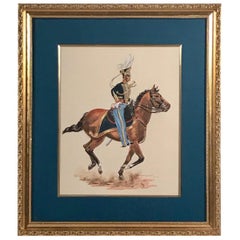
Watercolor Painting of Cavalry Soldier on Galloping Horse, Monogramed
Located in Vero Beach, FL
Watercolor painting of cavalry soldier on galloping horse, monogramed.
This watercolor painting is executed in a masterful technique. The finest details and bright colors make this artwork a treasure.
A military cavalry...
Category
Antique Late 19th Century English Victorian Paintings
Materials
Paper
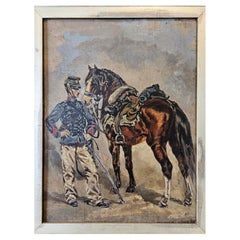
French Impressionist Painting of a Cavalry Officer
Located in Kingsbridge, GB
French Impressionist Painting of a Cavalry Officer. Oil on canvas laid on wooden board. Very good original condition.
The painting has been purchased from a private collection in ...
Category
Early 20th Century French Expressionist Paintings
Materials
Canvas
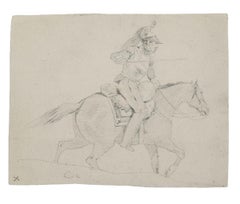
Soldier on Horseback - Pencil Drawing - 19th Century
Located in Roma, IT
"Soldier on Horseback" is a pencil drawing on ivory-colored paper by Anonymous Artist of 19th Century.
In very good conditions.
Sheet dimensio...
Category
19th Century Modern Animal Drawings and Watercolors
Materials
Pencil
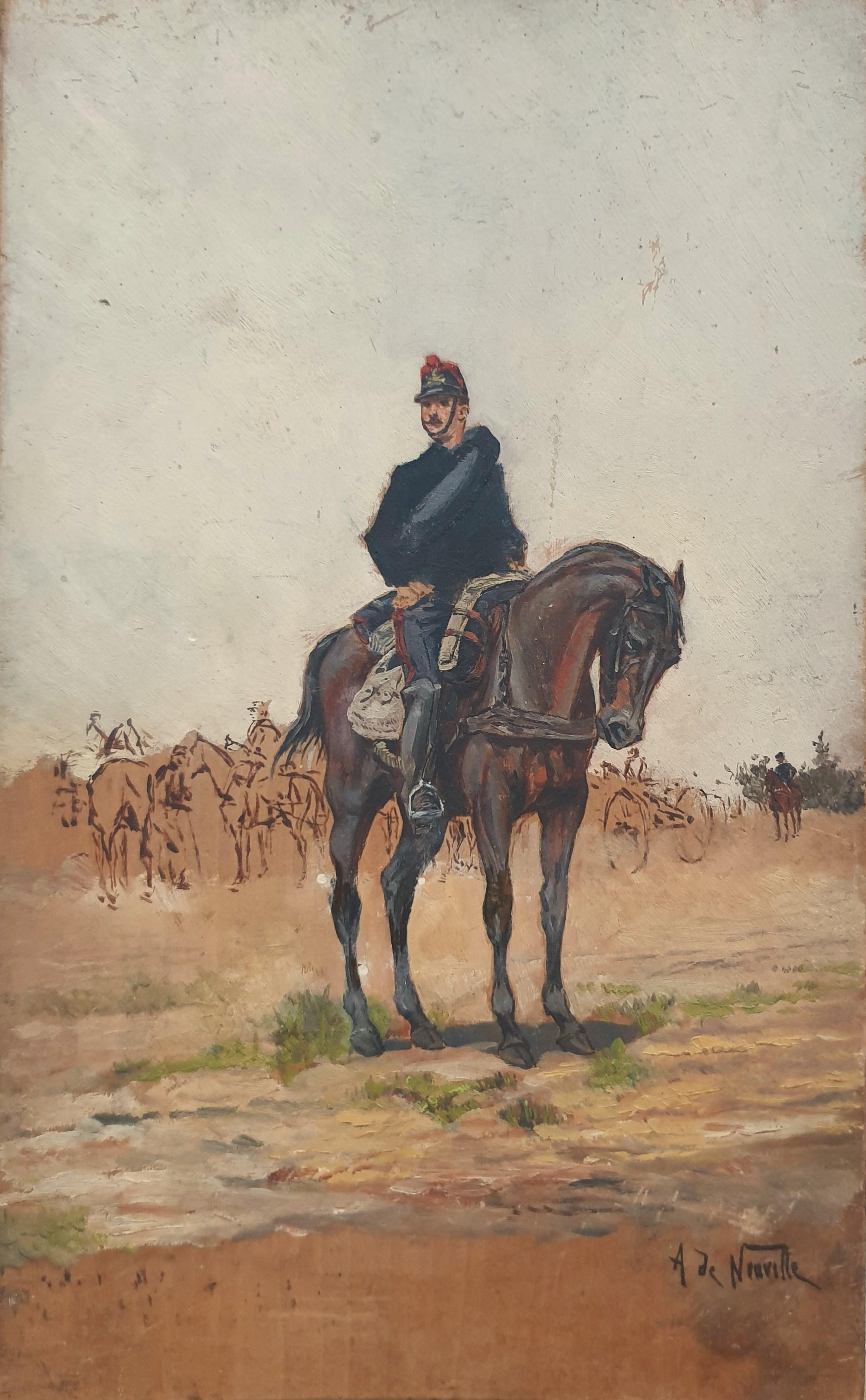
Military french painting 1870 war soldier horse Sketch 19th
Located in PARIS, FR
Alphonse de NEUVILLE
Saint-Omer, 1835 - Paris, 1885
Oil on wood panel
14.5 x 24 cm
Signed lower right
Alphonse de Neuville painted french soldier...
Category
1870s French School Figurative Paintings
Materials
Oil
$861 Sale Price
20% Off
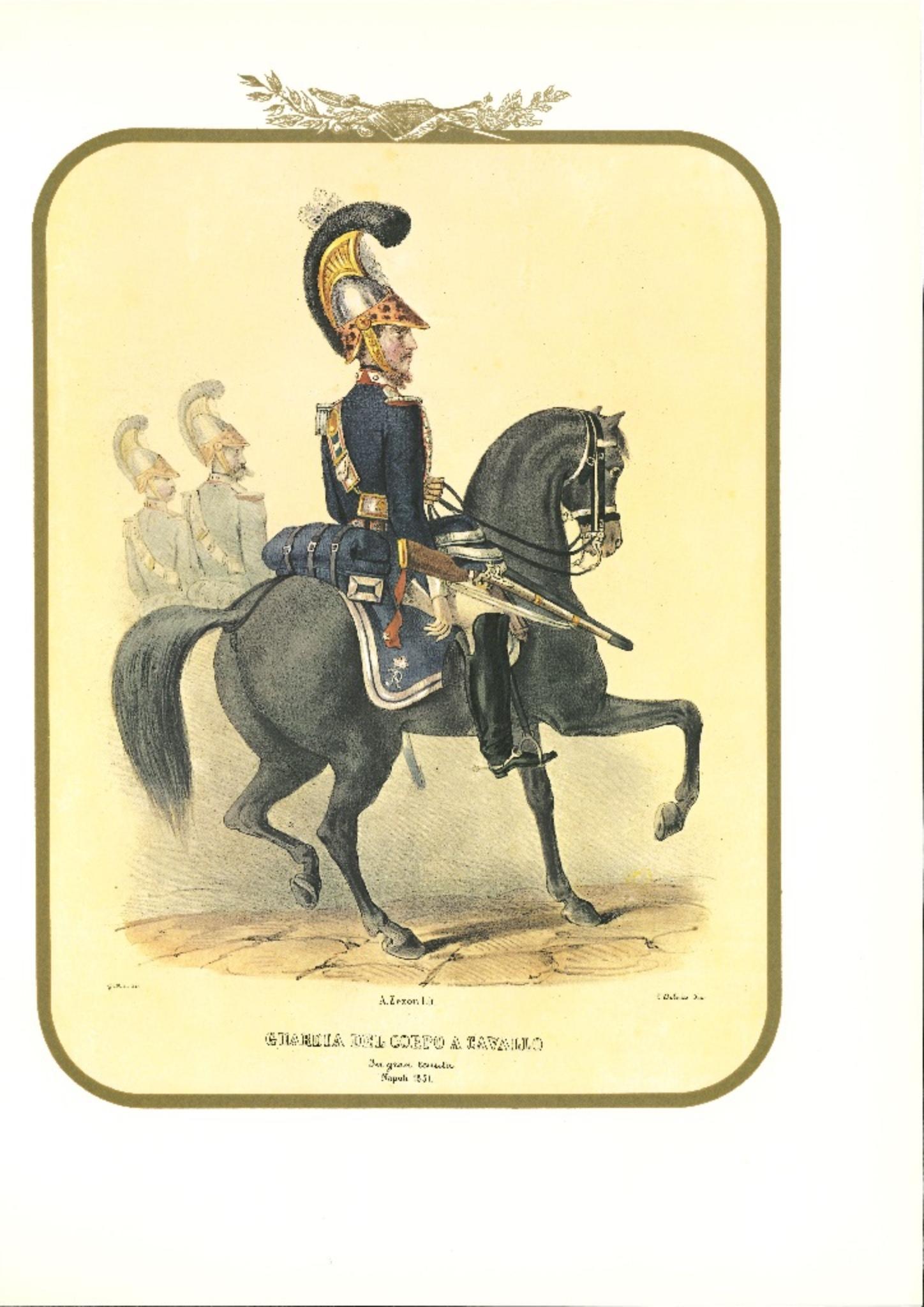
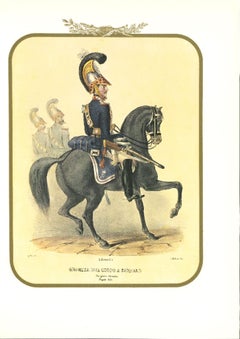
Bodyguard on Horseback - Original Lithograph by Antonio Zezon - 1851
By Antonio Zezon
Located in Roma, IT
Bodyguard on Horseback is a lithograph by Antonio Zezon. Naples 1851.
Interesting colored lithograph which describes a Bodyguard on Horseback marching alongside other guards who can...
Category
1850s Modern Figurative Prints
Materials
Lithograph
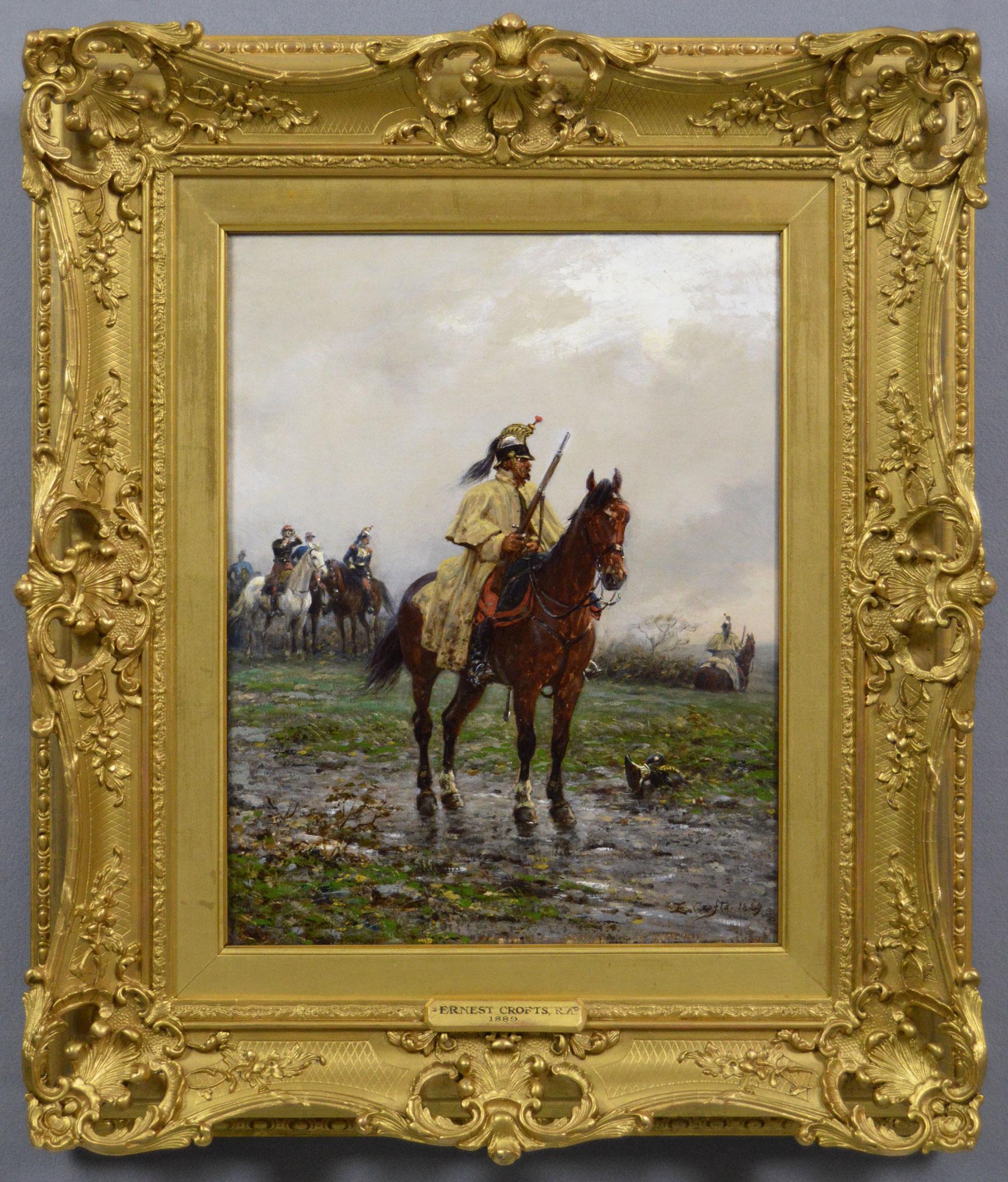
19th Century historical military oil painting of a French Cuirassier on a horse
By Ernest Crofts
Located in Nr Broadway, Worcestershire
Ernest Crofts
British, (1847-1911)
The Search Party
Oil on canvas, signed & dated 1889
Image size: 17.5 inches x 13.5 inches
Size including frame: 27 inches x 23 inches
An excellen...
Category
19th Century Figurative Paintings
Materials
Canvas, Oil