English School Animal Drawings and Watercolors
to
4
1
Overall Width
to
Overall Height
to
5
1
1
573
298
56
54
41
35
33
26
21
18
16
15
2
1
5
2
2
1
1
1
1
1
1
1
1
1
1
1
1
1
1
2
2
2
1
1
1
1
4
3
2
Style: English School
1930
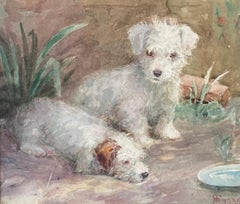
s English Dog Painting Wire Fox Terrier Puppies Waiting to be Fed Signed
Located in Cirencester, Gloucestershire
'Waiting for Supper'
Wire Fox terrier puppies
English School, indistinctly signed with monogram
dated 1936
watercolour painting on artist paper, framed
Glass covering
framed: 13.5 x ...
Category
Early 20th Century English School Animal Drawings and Watercolors
Materials
Watercolor
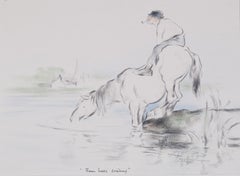
Farm Horse Drinking
Located in Fairlawn, OH
Farm Horse Drunking
Charcoal and pastel on artist's board, c. 1920
Signed lower right in pencil (see photo)
Titled in ink lower center, as are all the illustration for At the Farm (s...
Category
1920s English School Animal Drawings and Watercolors
Materials
Chalk
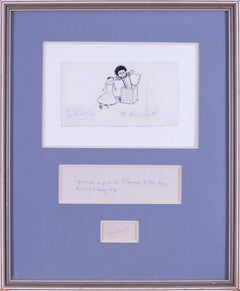
British illustration by EH Shephard, illustrator for Winnie the Pooh
Located in Petworth, West Sussex
Ernest Howard Shephard (British, 1879 – 1976)
The land of the lost toys – ‘Oh that’s you is it’
Inscribed with title (lower edge), and further inscribed ...
Category
20th Century English School Animal Drawings and Watercolors
Materials
Paper, Ink, Pen
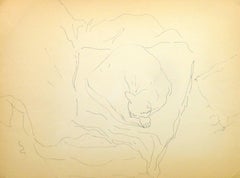
Crouching Leopard drawing by British 20th Century artist Elsie Marian Henderson
Located in Petworth, West Sussex
Elsie Marian Henderson (British, 1880-1967)
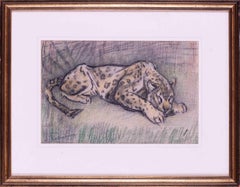
Crouching Leopard
Charcoal and pastel on paper
8 x 12.1/8 in. (20.3 x 30.8 cm.)
Provenance: The estate of the artist
Sally Hunter Fine Art, London
Elsie Marian Henderson was born in Eastbourne in Sussex and with the encouragement of her mother, a keen amateur painter, she attended the South Kensington Schools before studying at the Slade School of Fine Art between 1903 and 1905. She continued her art education in Paris and in 1916, after returning to London she enrolled at the Chelsea Polytechnic, where she was taught lithography by the artist Francis Ernest Jackson...
Category
20th Century English School Animal Drawings and Watercolors
Materials
Paper, Charcoal, Pastel
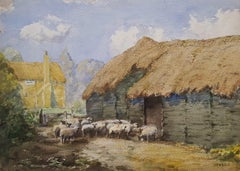
In Cambridgeshire /// British English Sheep Farm Cottage Village Watercolor Art
By John Arthur Dees
Located in Saint Augustine, FL
Artist: John Arthur Dees (English, 1876-1959)
Title: "In Cambridgeshire"
*Signed by Dees lower right
Circa: 1915
Medium: Original Watercolor on paper
Framing: Recently beautifully fr...
Category
1910s English School Animal Drawings and Watercolors
Materials
Watercolor
Related Items
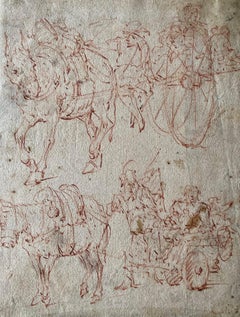
Flemish Old Master, Study of Donkey Carriage, 17th Century, Sanguine Drawing
Located in Greven, DE
This drawing shows several studies of a donkey with a carriage. Its style is close to Flemish 17th century artists. On the passepartout one reads "Mathias Scheyer/ Jacob Weyer", both...
Category
17th Century English School Animal Drawings and Watercolors
Materials
Chalk, Handmade Paper

$861 Sale Price
20% Off
H 7.13 in W 5.52 in
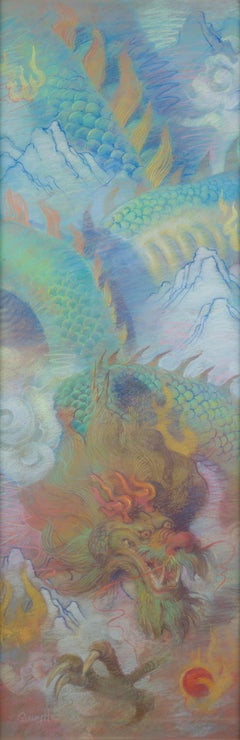
"Dragon, " Original Pastel Drawing
By Quang Ho
Located in Denver, CO
"Dragon," by Quang Ho, is a secondary market work with one previous owner. It is signed and dated (1988) on the lower left. The painting comes with it's original frame (measures 50 x...
Category
20th Century English School Animal Drawings and Watercolors
Materials
Paper, Pastel
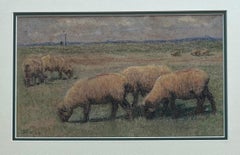
Impressionist scene of sheep grazing in an open pasture
Located in Harkstead, GB
A really atmospheric impressionistic image of sheep grazing in an open pasture with wonderful effects of light and shade.
John Robert Keitley Duff (1862-1938)
Sheep grazing
Signed w...
Category
Early 20th Century English School Animal Drawings and Watercolors
Materials
Paper, Pastel
$218 Sale Price
20% Off
H 7 in W 12 in D 1 in
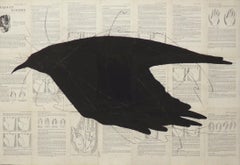
Raven Reads the Lines: Chalk Drawing of Black Bird on Vintage Book Pages
Located in Hudson, NY
Raven Reads the Lines (Chalk Drawing of Black Bird on Vintage Book Pages) by Louise Laplante
chalk on vintage collaged book pages.
Artwork measures ...
Category
2010s English School Animal Drawings and Watercolors
Materials
Paper, Chalk
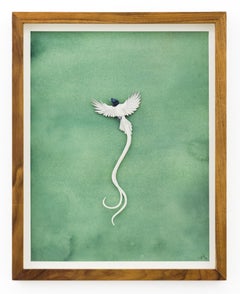
"Indian Paradise Flycatcher" Delicate Miniature Bird in Watercolor Layered Paper
Located in Philadelphia, PA
"Indian Paradise Flycatcher" is an original piece by Nayan and Venus made from watercolor on layered hand-cut paper. This piece measures 11.75”h x 9.5”w x 1"d framed, and is shipped ...
Category
21st Century and Contemporary English School Animal Drawings and Watercolors
Materials
Paper, Watercolor
$650
H 11.75 in W 9.5 in D 1 in
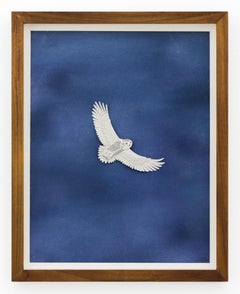
"Snowy Owl" Delicate Paper and Watercolor Assemblage
Located in Philadelphia, PA
"Snowy Owl" is an original piece by Nayan and Venus made from watercolor on layered hand-cut paper. This piece measuures 11.75”h x 9.5”w x 1"d framed, and is...
Category
21st Century and Contemporary English School Animal Drawings and Watercolors
Materials
Paper, Watercolor
$650
H 11.75 in W 9.5 in D 1 in
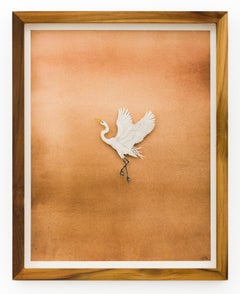
"Egret" Small ScaleHand-Cut and Layered Watercolor of Bird
Located in Philadelphia, PA
"Egret" is an original piece by Nayan and Venus made from watercolor on layered hand-cut paper. This piece measures 11.75”h x 9.5”w x 1"d framed, and is shipped in the featured woode...
Category
21st Century and Contemporary English School Animal Drawings and Watercolors
Materials
Paper, Watercolor
$650
H 11.75 in W 9.5 in D 1 in
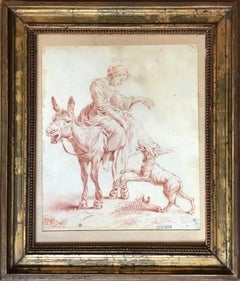
Sanguine drawing "Shepherdess on a Donkey" by Nicolaes Berchem
By Nicolaes Berchem
Located in New York, NY
Provenance: Mercedes von Dietrichtein, Buenos Aires. Alexander von Dietrichstein. By descendants Morritz von Diestrichstein.
Nicolaes Pieterszoon Berchem (1 October 1620 – 18 February 1683) was a highly esteemed and prolific Dutch Golden Age painter of pastoral landscapes, populated with mythological or biblical figures, but also of a number of allegories and genre pieces.
He was a member of the second generation of "Dutch Italianate landscape" painters. These were artists who travelled to Italy, or aspired to, in order to soak up the romanticism of the country, bringing home sketchbooks full of drawings of classical ruins and pastoral imagery. His paintings, of which he produced an immense number, (Hofstede de Groot claimed around 850, although many are misattributed), were in great demand, as were his 80 etchings and 500 drawings. His landscapes, painted in the Italian style of idealized rural scenes, with hills, mountains, cliffs and trees in a golden dawn...
Category
17th Century English School Animal Drawings and Watercolors
Materials
Paper, Chalk
$5,000
H 9.06 in W 7.49 in D 0.4 in
Pen
Ink Drawing - Cat in Sweet Slumber
Located in Houston, TX
Charming pen and ink drawing a cat curled on a armchair and peacefully sleeping, circa 1970.
Original artwork on paper displayed on a white mat with a gold border. Archival plastic...
Category
1970s English School Animal Drawings and Watercolors
Materials
Ink, Paper, Pen
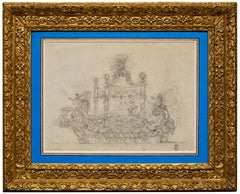
A dazzling Venetian Regatta Boat Study attributed to Alessandra Mauro
Located in PARIS, FR
This stunning Baroque study depicts a regatta boat, a type of vessel developed in eighteenth-century Venice for the regattas organized by the Serenissima during visits by royalty and princes. We propose to link this drawing to the work of Alessandro Mauro, an artist who specialized in this type of composition, as illustrated by a drawing from him at the Metropolitan Museum.
1. Description of the boat
The greatest decorative fantasy reigns in this preparatory study, which blends mythological and exotic elements with references to ancient Egypt. Our drawing is probably an initial thought, destined to be refined and clarified later in pen and ink (as evidenced by the ink stain in the lower right). A quadriga of seahorses guided by Neptune stands at the stern of the boat, shown well above the waterline (perhaps to outline its empty volume). One of the seahorses is ridden by a newt, while Amphitrite lies at the feet of the sea god.
The center of the boat is occupied by a vast baldachin resting on four atlantes and surmounted by a figure riding an animal (a dragon?). Three figures sit beneath the canopy, one of them on a griffin-shaped seat. This allusion to Egyptian antiquity echoes the winged sun (sometimes a symbol of the god Horus, as in the temple of Edfu in Egypt) that adorns the sides of the promontory on which this baldachin rests.
Another flag-bearer figure crouches at the stern of the boat on a raised seat, on the reverse of which is a crowned mermaid whose arm, extended backwards, rests on a mascaron decorated with a radiant face (Helios?) and whose torso surmounts an elephant's head. The heads of the rowers and their oars are sketched all along the boat, whose sides are embellished with elongated naiads.
2. The Venetian regatta boats
An exhibition held in 2013 at the Ca' Rezzonico (the Venetian eighteenth-century museum) paid tribute to these regatta boats through studies and prints depicting them. The regattas organized by the Serenissima in honor of visiting princes and sovereigns were among the most spectacular ceremonies in Venice. Some important artists of the 18th century contributed to the creation of these extravagant boats which were given exotic names such as bissona, malgarota or peota.
The specialists in this field were Andrea Urbani and the brothers Alessandro and Romualdo Mauro. They were born into a family of theater decorators in Piedmont, but little is known about their detailed biography. Alessandro was the architect of the Dresden opera house and of the St. Samuel Theater in Venice (in collaboration with his brother Romualdo), but also worked as stagehand and set designer in Vienna, Rome and Turin. A drawing produced around 1737 from the Metropolitan Museum (7th photo in the gallery) bears witness to his activity as a regatta boat designer.
This drawing is a much more elaborate version than the one presented here, having been entirely reworked in brown ink. However, a figure at the bow of the boat, executed solely in black chalk, still bears witness to a technique similar to that of our drawing.
It is difficult to know whether the boat depicted in our drawing was a project for an actual boat or whether it remained in the planning stage, but the front of our boat (Neptune and the quadriga of seahorses ridden by a newt) bears several similarities to that of a parade boat depicted in the print published by Michele Marieschi entitled Regatta on the Grand Canal, between the Foscari and Balbi Palaces (last photo in the gallery). This print is dated 1741, which could confirm that our work dates from around 1740.
The area between Neptune and the quadriga that precedes him on this strange paddle-boat appears to be partially submerged, confirming that the waterline of our boat was probably intended to be much lower than the one shown in our drawing.
The Correr Museum’s collection holds one of the most important collection of engravings and drawings devoted to these specifically Venetian Baroque productions. These boats were intended to last the duration of a festival. Today, they are only documented by preparatory drawings or prints that testify to the sumptuousness of their decoration. This taste for regatta boats lasted throughout the Venetian eighteenth century, and the conception of regatta boats also attracted great masters such as Giambattista Tiepolo, Francesco Guardi or Giambattista Piranesi...
Category
Mid-18th Century English School Animal Drawings and Watercolors
Materials
Chalk
$4,607
H 15.75 in W 19.25 in
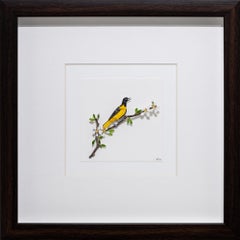
Baltimore Oriole
Located in Philadelphia, PA
"Baltimore Oriole" is an original watercolor and layered hand-cut paper artwork by Nayan and Vaishali measuring 10.25”h x 10.25”w framed
.
Vaishali ...
Category
21st Century and Contemporary English School Animal Drawings and Watercolors
Materials
Watercolor, Paper
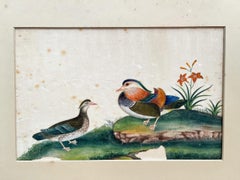
Two Mandarin Ducks, Circle of Sunqua, Gouache on Pith Paper, Qing Dynasty
By Sunqua
Located in Stockholm, SE
Circle of Sunqua (active 1830-1870)
Two Mandarin Ducks
pith paper (rice paper)
gouache
c.1830-1870 China
Also close to: Chincqua, Lam Qua, Youqua.
Compare ...
Category
19th Century English School Animal Drawings and Watercolors
Materials
Gouache, Rice Paper
$1,136
H 7.49 in W 11.82 in
Previously Available Items
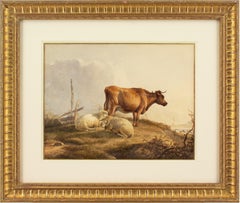
Thomas Sidney Cooper RA, Cow
Sheep In A Landscape
Located in Cheltenham, GB
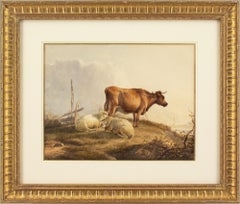
This charming mid-19th-century watercolour by British artist Thomas Sidney Cooper RA (1803-1902) depicts two sheep and a cow in a landscape. Cooper was a distinguished British painte...
Category
1850s English School Animal Drawings and Watercolors
Materials
Paper, Watercolor
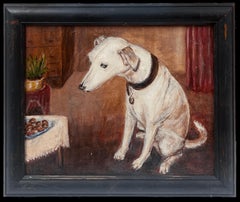
Antique English Dog Painting Jack Russell Terrier interior room setting
Located in Cirencester, Gloucestershire
'Temptation!'
English School, early 20th century
watercolour painting, framed with glass covered
framed: 10 x 12 inches
board: 8 x 10 inches
Provenance: private collection, UK
Condit...
Category
Early 20th Century English School Animal Drawings and Watercolors
Materials
Watercolor
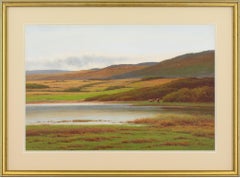
Joseph Knight, Moorland Landscape With Cattle
Located in Cheltenham, GB
This late 19th-century gouache by British artist Joseph Knight (1837-1909) depicts a gentle moorland landscape with cattle. Knight was primarily known for his naturalistic depictions of North Wales.
Raised amid the hurried industrious streets of Chorlton-Upon-Medlock in Manchester, Knight was obliged to pursue a career at one of its many cotton mills. His father, also Joseph Knight, was a mill engineer and would’ve expected his son to follow suit. It appears he was sent to work at the age of four - unthinkable today, but not uncommon in the 1840s.
In around 1841, Knight was involved in an accident, which resulted in the loss of his right arm. This probably coincided with him being sent, together with his siblings, to stay with relatives, Thomas and Jane Knight, also of Chorlton. Evidently, following this, he undertook a change of direction, taking the first steps on a path to artistry.
During the mid to late 19th century, landscape paintings grew in popularity partly due to the desires of a new middle-class buyer but also as a tonic for increasing urbanisation. And perhaps there’s no better example of an artist who understood the restorative qualities of nature than Joseph Knight.
In his early teens, he gained employment at a photography studio, primarily assisting with portraiture. With a keen eye for composition, his skills flourished and were met with much approval from staff and customers alike. It was here that he first met with Mr. Henry Crowley who was so taken by the boy’s aptitude that he encouraged him to seek a career as a painter. Crowley funded his education, enrolling him at the Manchester Academy of Fine Arts, where the emphasis was on honing one’s draughtsmanship in a strict environment via diligent study and life drawing.
With his technique now evolved, commissions were forthcoming - both as a painter and photographer. In the 1861 census, now married, he records his occupation as ‘Photographic artist and painter in oil’. It’s plausible that he was involved in adding tints to photographic portraits during this period while also working as a painter.
As recognition of his development, in 1868, he was elected as a full member of the Manchester Academy of Fine Arts, and a year later debuted at London’s Royal Academy with ‘Evening, Near Quimper, Brittany’ and ‘Breton Peasants’. It was around this time that he came to the attention of several of his younger contemporaries who viewed his naturalistic approach as altogether fresher and entirely modern. In a quiet rebellion against their formulaic training, they undertook to paint directly from nature, ‘en plein air’, without the rigour of academic constraints. The group, which included Joshua Anderson Hague...
Category
1890s English School Animal Drawings and Watercolors
Materials
Paper, Gouache
Thomas Sidney Cooper RA, Cow
Sheep In A Landscape
Located in Cheltenham, GB
This charming mid-19th-century watercolour by British artist Thomas Sidney Cooper RA (1803-1902) depicts two sheep and a cow in a landscape. Cooper was a distinguished British painte...
Category
1850s English School Animal Drawings and Watercolors
Materials
Paper, Watercolor
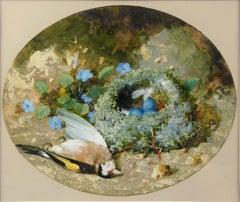
Still life with dead goldfinch - The mystic blue transcends death -
Located in Berlin, DE
William Cruickshank (1848-1922). Still Life with a Dead Goldfinch and Nest. Watercolour and gouache on buff paper, 21 x 24.5 cm (visible size), 40 x 42 cm (frame), signed W Cruickshank on the left. Framed behind glass in a passpartout.
About the artwork
The painting has an atmosphere of melancholy beauty. The clutch of eggs, recalling the wonderfully mysterious blue of Romanticism, the matching blue flowers and the goldfinch with its black, yellow and red plumage show nature in all its beauty, and yet the goldfinch is dead. It lies on its back, its head bent backwards in an unnatural way, its claws lifeless and one wing outstretched in a last effort. This makes the scene a natura morta, a still life that spreads the melancholy silence of an eternal moment. Yet there is also an inherent movement in the picture, enhanced by the streaky application of paint.
A movement that here signifies the intertwining of life and death: death, which the goldfinch has met in mid-life, before it has been able to hatch its offspring, while at the same time the mysterious blue eggs that have not hatched point to a higher life after death. Finally, the goldfinch feeding on the thorny thistles traditionally represents Christ and his redemptive sacrificial death. The goldfinch is depicted in a similar way in Carel Fabritius' famous painting The Thistle Finch (1654), in the Mauritshuis in The Hague. The bird is alive, but chained and thus prevented from flying.
In this tradition, Cruickshanks' painting is a memento mori that is immediately appealing to today's viewer - a meditative image of life and death that also contains an affirmation of life in all the beauty of creation. In order to enhance the readability of this pictorial sense, the objects depicted are tilted into the plane so that the individual elements of the picture can be more easily related to one another, but without destroying the sense of space.
Cruickshank, who specialised in this type of painting, combined the emblematics of the Baroque with the imagery of Romanticism and a style borrowed from landscape painting. Cruickshank's mastery of materials is evident in his fusion of watercolour and gouache, in which the more intense colours of gouache concretise the motif from an indeterminate, moving colour space. The painted objects have the aesthetic quality of fine painting, although, as in the case of the nest, they are formed by a virtuoso structure of blotches.
Selected bibliography
Algernon Graves: The Royal Academy of Arts. A complete dictionary of contributors and their work from its foundation in 1769 to 1904, vol. 2: Carroll to Dyer, London 1905.
Leo R. Schidlof: The miniature in Europe. In the 16th, 17th, 18th, and 19th centuries, vol. 1: A - L, Graz 1964.
Jeremy Maas: Victorian painters, London 1996.
Daphne Foskett: A Dictionary of British miniature...
Category
1890s English School Animal Drawings and Watercolors
Materials
Watercolor, Gouache
English School animal drawings and watercolors for sale on 1stDibs.
Find a wide variety of authentic English School animal drawings and watercolors available for sale on 1stDibs. Works in this style were very popular during the 20th Century, but contemporary artists have continued to produce works inspired by this movement. If you’re looking to add animal drawings and watercolors created in this style to introduce contrast in an otherwise neutral space in your home, the works available on 1stDibs include elements of purple and other colors. Many Pop art paintings were created by popular artists on 1stDibs, including Edmund Blampied, and John Sergeant. Frequently made by artists working with Charcoal, and Paper and other materials, all of these pieces for sale are unique and have attracted attention over the years. Not every interior allows for large English School animal drawings and watercolors, so small editions measuring 7 inches across are also available. Prices for animal drawings and watercolors made by famous or emerging artists can differ depending on medium, time period and other attributes. On 1stDibs, the price for these items starts at $534 and tops out at $2,400, while the average work sells for $964.
Still Thinking About These?
All Recently ViewedMore Ways To Browse
Joy Adamson
Larry Pirnie
Olof Rudbeck
Papalotes Francisco Toledo
Pollyanna Pickering
Sascha Maurer
Scott Kelley
Todd Murphy Artist
Todd Murphy Paintings
Vintage Chalk Dog
Watercolor Blue Heron
Used Boarding Ladder
Used Cherry Pickers
Van Gogh In The Vineyard
Venice Gondola Boat
Venice Painting Peter
Vernon Ward Painting
Vintage Bermuda Travel Posters