Items Similar to “San Pedro Harbor California”
Want more images or videos?
Request additional images or videos from the seller
1 of 11
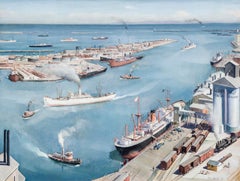
Emil Kosa Jr.“San Pedro Harbor California”Circa 1935
Circa 1935
$2,800
£2,114.75
€2,442.86
CA$3,944.80
A$4,224.88
CHF 2,271.27
MX$51,313.68
NOK 28,698.58
SEK 26,275.69
DKK 18,252.65
About the Item
Original watercolor on archival paper of the harbor in San Pedro California by the well known American artist, Emil Kosa Jr. Signed lower left. Circa 1935. Condition is excellent. Overall framed measurements are 23 by 29 inches. Provenance: A California collector.
Emil Kosa, Jr., N.A. (1903-1968) Born: Paris, France; Studied: Academy of Fine Arts (Prague), Ecole des Beaux Arts (Paris), Chouinard Art Institute (Los Angeles); Member: National Academy of Design, American Watercolor Society, California Water Color Society, Philadelphia Water Color Club, New York Water Color Club. Emil Kosa, Jr. received art instruction and music lessons at a very early age. When he was in his late teens, he had to decide between being a professional musician or artist. He chose art, but his family and instructors believed he could have been a famous musician had he chosen that occupation.
In the 1920s, he moved to California, but returned to France several times to continue his art education. He received traditional painting instruction from Pierre Laurens and studied non-objective painting with Frank Kupka. After settling in California in 1928, he worked as a mural artist and operated a business with his father that produced decorative art for churches and auditoriums. When that line of work was slow, he took on portrait commissions and sold fine art paintings through local galleries.
In the early 1930s, Kosa became friends with Millard Sheets and with Sheet’s encouragement, began aggressively pursuing a national reputation as a California watercolor artist. He sent up to sixty watercolors every year to museum shows all over America and was among the first California Style watercolorist whose work brought attention to the West Coast watercolor style. He was an active member of the California Water Color Society and served as a president in 1945. Kosa was one of the first of the California watercolorists to be accepted into annual shows in New York City at the National Academy of Design and in the American Watercolor Society shows.
To financially support his family, Kosa worked as a scenic artist in the special effects division at Twentieth Century-Fox Studios for thirty-five years. He produced art for matte shots and was known as a top artist in this field. The motion picture industry acknowledged his contributions and awarded him an Oscar for his special effects work for Cleopatra.
A compulsive painter, Kosa would often paint for three or four hours after dinner each night and spend most of his weekends outdoors, painting with watercolors or oils, Alexander Cowie was his Los Angeles agent and the Macbeth Gallery sold his work in New York City. The Cowie Gallery, located in the Biltmore Hotel, had several one-man shows every year and included his work in all of their group showings.
Through his studio connections, he also produced a large number of commissioned portraits for movie stars, businessmen and politicians. In the 1950s, he was known as the premier portrait painter in Southern California. His official portrait of Earl Warren from this era, is in the collection of the National Portrait Gallery in Washington, D.C.
Kosa is best known for his representational watercolors and oils, but also won awards for pencil drawings and pastels depicting figurative subjects and prints. During the 1940s and through the mid-1960s, he occasionally revisited his interest in non-objective art and produced a body of work which expresses his love for music and experimental art concepts.
- Creator:Emil Kosa Jr. (1903 - 1968, French)
- Creation Year:Circa 1935
- Dimensions:Height: 14.5 in (36.83 cm)Width: 20.5 in (52.07 cm)Depth: 2 in (5.08 cm)
- Medium:
- Movement Style:
- Period:
- Condition:Frame with wear consistent with age.
- Gallery Location:Southampton, NY
- Reference Number:1stDibs: LU14116984972
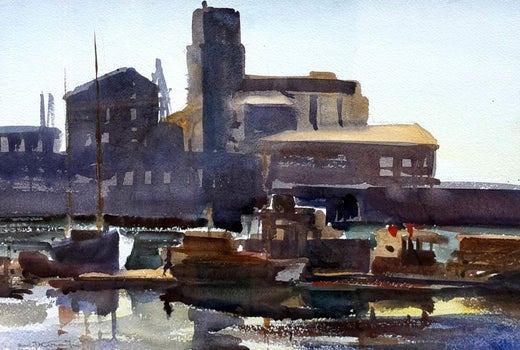
Emil Kosa Jr.
From Papillon - Martin Wolpert Emil Kosa Jr. was born in Paris, France on November 28, 1903. His father was a Czech artist. He moved to the United States with his family at the age of four. Kosa studied at the Prague Academy as a teenager and then at the California Art Institute in Los Angeles in 1927. He returned to Paris later in 1927, and studied under Pierre Laurens at l'École des Beaux-Arts. In 1928, he returned to Los Angeles and studied and later taught at Chouinard and the Otis Art Institutes. Kosa spent the last 35 years of his life working for 20th Century Fox studios as a special effects artist. In 1963 he won an Oscar for his work on Cleopatra. During this time Kosa, along with maintaining a studio-home in LA, decorated churches, theaters, and private homes and continued teaching in Laguna Beach, California. Kosa exhibited at the Los Angeles County Museum of Art in 1940, the Biltmore Salon in Los Angeles in 1941. He also showed his works in many other locals nationally including the Carnegie Institute, the Denver Museum, and the Frye Museum. He won dozens of awards in California and nationally from 1928-1961. He is represented in many museums across the United States including the LACMA, the Santa Barbara Museum, the Boston Museum of Fine Art, and the San Diego Museum. Kosa worked in both watercolor and oil. He painted many portraits including the official portrait of Governor Earl Warren. He also painted landscapes, seascapes, figures, and floral works. The most interesting aspect of Kosa's body of work is that he had several different styles. He is well known and appreciated in the circle of California Plein-Air painters and watercolorists, but he was also painted many symbolist and modernist paintings. In these more expressive works can be seen the influence of his studies in Prague and Paris. Many of his paintings are moody, and somber; a stark contrast to his scenes of California landscapes. He produced a number of abstract works as well, showing the influence of Kupka who he had studied . Kosa JR. died in Los Angeles on the 4th of November 1968.
About the Seller
5.0
Platinum Seller
Premium sellers with a 4.7+ rating and 24-hour response times
Established in 1977
1stDibs seller since 2013
563 sales on 1stDibs
Typical response time: <1 hour
- ShippingRetrieving quote...Shipping from: Southampton, NY
- Return Policy
More From This Seller
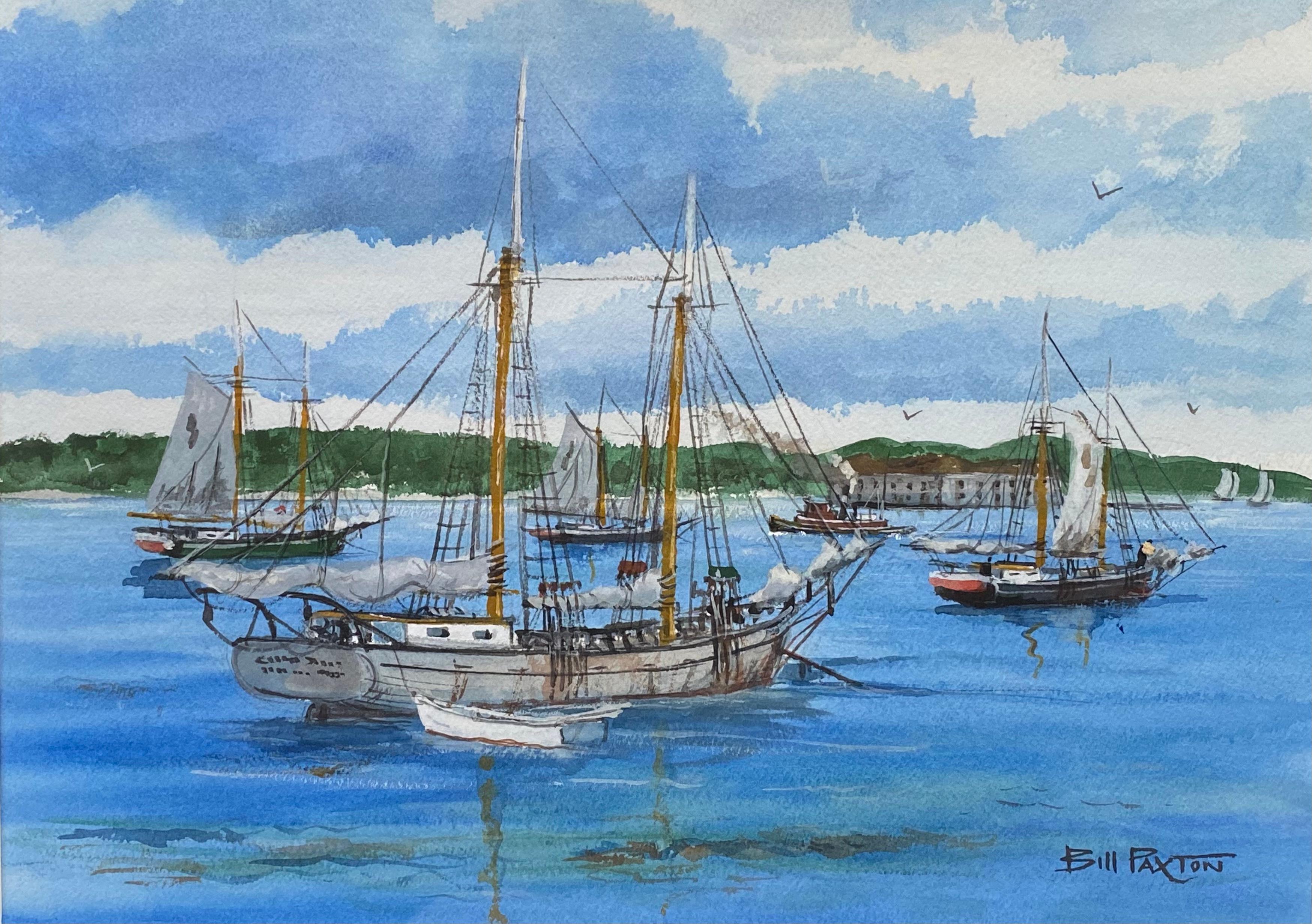
View All“Portland Harbor in 1910”
Located in Southampton, NY
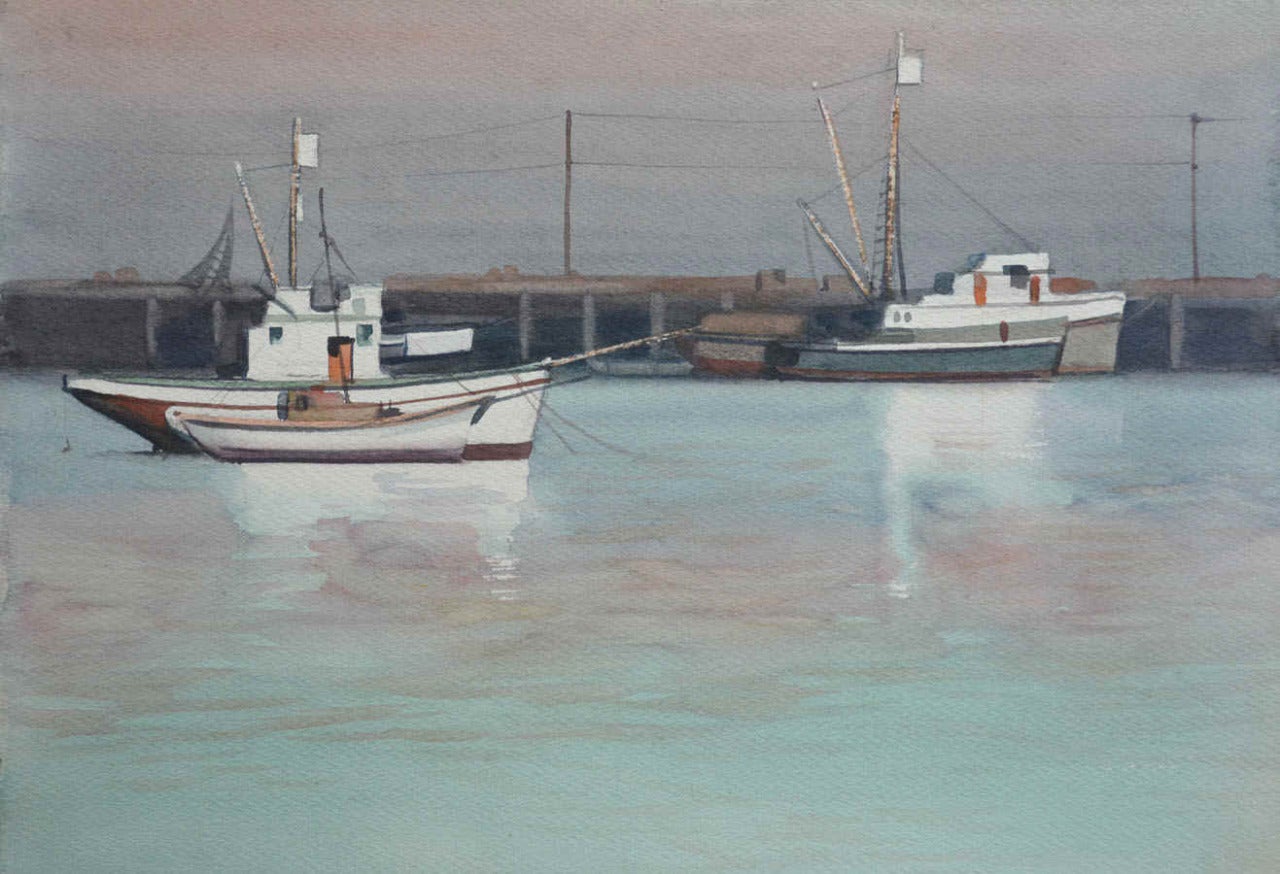
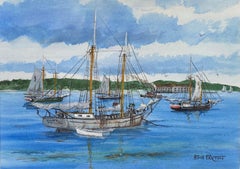
Beautiful watercolor and gouache on archival paper by the well known Maine artist Bill Paxton. The watercolor depicts what Portland harbor in Maine looked like in 1910 with sailing vessels of the era moored in the harbor. Signed lower right by the artist. Titled verso. Circa 1975. Condition is excellent and is finely matted and framed. The artwork is matted and framed in a thin gold leaf custom gallery frame. Overall framed measurements are 17.5 by 21.75 inches. Provenance: Sarasota, Florida estate.
William (Bill) Paxton 1930—2007
William Paxton, born August 5, 1930 in Lewiston, was one of Maine’s top selling artists. He had a passion for painting and from a young age he was known for his talents in sketching. Paxton captured many popular Maine scenes with watercolor, acrylic, and oils. His work also includes historical scenes he referenced in books from as early as the 1920’s, painting locomotives, aircraft, and war scenes. Paxton’s art is sold all over the world.
As a student at Bridgton Academy, he was featured in his yearbook. It states, “When artist Bill picks up his pen, we all stand at attention, for his remarks and pictures are certainly worth mention.” He wanted to pursue a career selling his art, but it was during the time of the Great Depression.
Also in his younger years, Paxton had an interest in skiing and won a medal for Second Highest Ski Jump. From there he went to flying and received a certification for Second-in-Command, to fly alongside the captain in a C-46F type of aircraft. He then joined the Air Force in the 40’s, although his passion and talents for art were constant throughout his life.
Paxton quickly became the front line military sketch...
Category
1970s Academic Landscape Drawings and Watercolors
Materials
Watercolor, Gouache, Archival Paper
$460 Sale Price
20% Off
“Provincetown Harbor”
By John Cuthbert Hare
Located in Southampton, NY
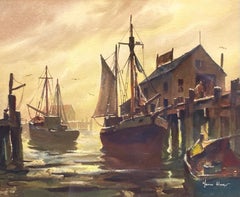
Beautiful original watercolor of Provincetown Harbor in first light by the well known artist John Cuthbert Hare. Signed lower right. Condition is excellent. The watercolor is hou...
Category
1950s Academic Landscape Drawings and Watercolors
Materials
Watercolor, Archival Paper
“Gloucester Dockside”
By John Cuthbert Hare
Located in Southampton, NY
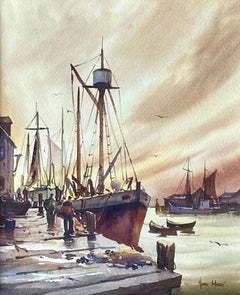
Here for your consideration is a very finely executed watercolor by the New England artist, John Cuthbert Hare of the fishing boats dockside in Gloucester. Condition is excellent. Signed by the artist lower right. Circa 1950. The artwork is framed in custom barn wood with a narrow linen liner. Artwork is under glass. Overall framed measurements are 16.5 by 14.5 inches. Provenance: Massachusetts estate.
New England painter John Cuthbert Hare was born in Brooklyn, New York in 1908 and studied commercial art at the Pratt Institute in New York City and later at the Art Students League also in New York City. He also studied at the Grand Central School of Art in New York followed by employment with the Hearst Newspaper Corporation. For a number of years after his marriage in 1933, Hare and his wife traveled throughout the United States and Europe. Hare was a member of the Provincetown Art Colony, Cape Cod, Massachusetts and was to become known as the "Dean of Cape Cod Artists...
Category
1950s Post-Impressionist Drawings and Watercolor Paintings
Materials
Watercolor, Archival Paper
“The Harbor Puerto Plata, Dominican Republic”
Located in Southampton, NY
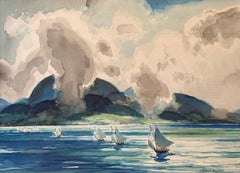
Original watercolor over graphite under drawing of the harbor with sailboats in Puerto Plata, Dominican Republic by the American artist, Wilmot Emerton Heitland. Signed “Heitland” lower right by the artist. Condition is excellent. Circa 1930. Under UV plexiglass. A similar painting of the same harbor done in 1924 by Wilmot Heitland is in the permanent collection of the Art Institute of Chicago. The artwork is housed in a light blue laminate frame with navy blue mat. Overall framed measurements are 25 by 31 inches. Provenance: A Sarasota, Florida estate.
Born 1893 in Wisconsin, Wilmot Emerton Heitland was an illustrator and painter trained at the Pennsylvania Academy of the Fine Arts. For a time, he was president of the American Watercolor Society. He also painted numerous illustrations depicting high society that were published in magazines such as: Collier’s, Women’s Home Companion, Cosmopolitan, and McCall’s, throughout the 20s, 30s, and 40s. Later, Heitland moved on to paint and teach at the Art Club. His paintings can be found in the collections of the Boston Museum of Fine Arts; the Brooklyn Museum; the Art Institute of Chicago; the Philadelphia Museum of Art; and locally at the Museum of Fine Arts, William R. Hough and Co., Stetson College of Law Library, and the Poynter Institute. Heitland moved to St. Petersburg because of the active Art Club here. He had a solo show of his work at the Art Club in 1963, and served as the exhibition chairman in 1964. He died in 1969.
Overview
San Felipe de Puerto Plata is the capital of the Puerto Plata province on the Dominican Republic’s Atlantic north coast. The city is best known for its beaches. Playa Dorada’s lengthy beachfront is backed by resorts and an 18-hole golf course. The city’s old colonial-era center is dominated by the 16th-century Fortaleza San Felipe, a Spanish fortress that now houses historical and military artifacts.
Category
1930s Modern Landscape Drawings and Watercolors
Materials
Watercolor, Archival Paper, Graphite
$2,560 Sale Price
20% Off
“Gloucester Docks”
By Caroline Bell
Located in Southampton, NY
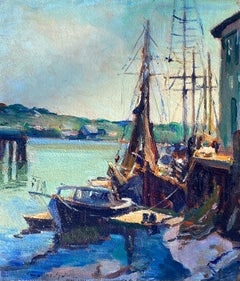
Beautiful oil on fiberboard painting of fishing boats at the docks of Gloucester by the well known North Fork Long Island artist Caroline M. Bell. Circa 1945. Signed lower left by the artist. Condition is very good. Housed in its original silver leaf over wood frame in restored condition. Overall framed measurements are 20 by 18 inches. Provenance: Sarasota, Florida estate.
Biography: Caroline M. Bell (1874 -1870)
Caroline Bell was the leader of a group of artists known as the Peconic Bay...
Category
1940s Post-Impressionist Landscape Paintings
Materials
Oil, Fiberboard
$2,560 Sale Price
20% Off
“Nassau Harbor, Bahamas”
Located in Southampton, NY
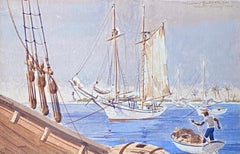
Original watercolor and gouache on archival paper by the American artist, Martin Louis Lindsay. Signed, titled and dated top right. Done in 1944. Condi...
Category
1940s Academic Figurative Drawings and Watercolors
Materials
Watercolor, Gouache, Archival Paper
$1,440 Sale Price
20% Off
You May Also Like
San Pedro Harbor
By Robert McIntosh
Located in West Hollywood, CA
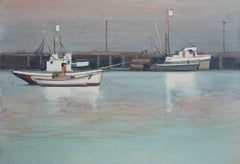
Presenting a rare, early original watercolor by American artist Robert McIntosh(1916-2010)
McIntosh was extremely prolific and exhibited throughout his lifetime, including first prize awarded at the Los Angeles County Museum in 1948.
"The Red Boxcar...
Category
1940s Landscape Drawings and Watercolors
Materials
Watercolor
Price Upon Request
“Harbor Scene”
Located in Warren, NJ
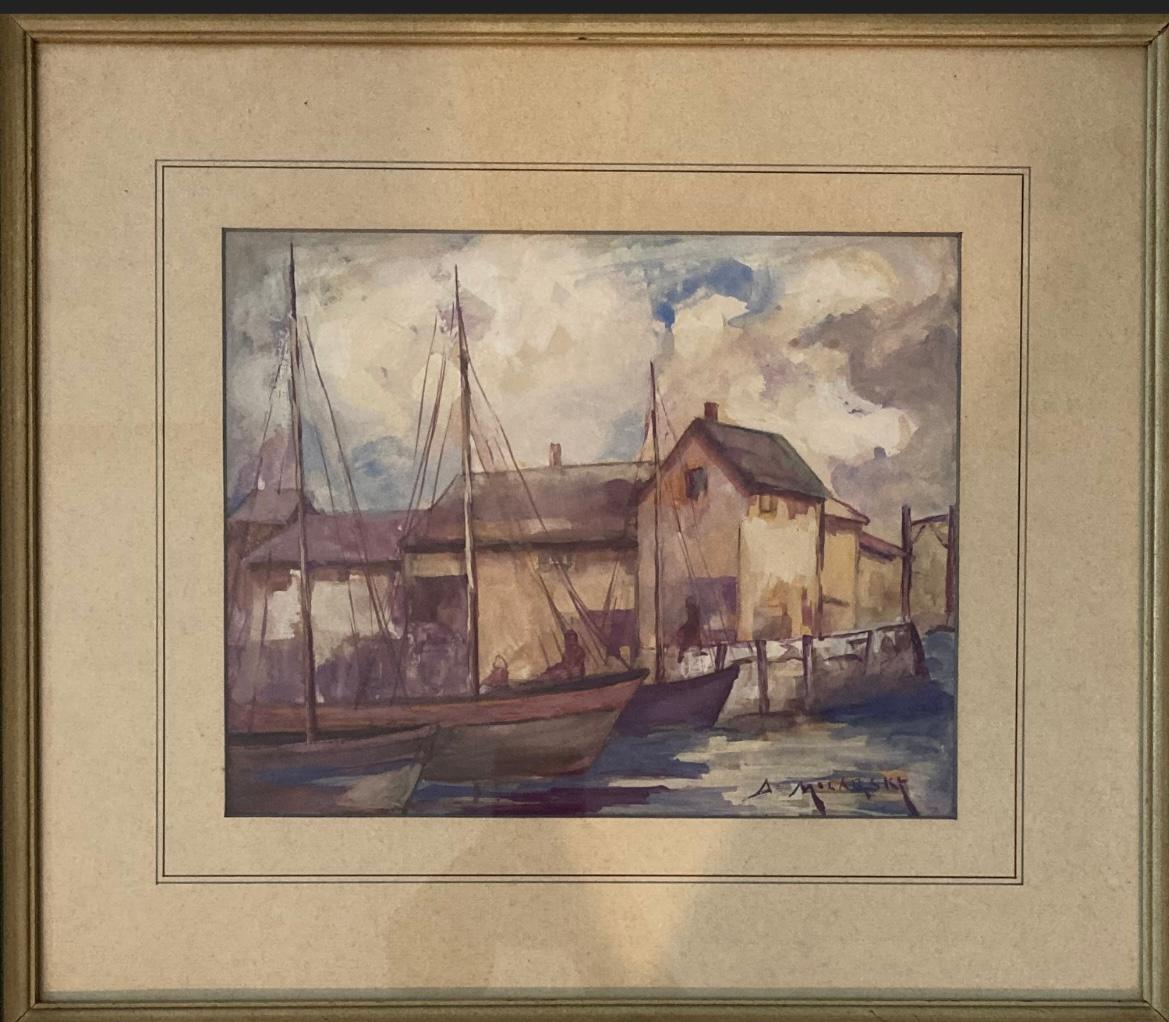
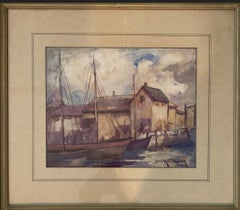
abram molarsky Original painting on board measures 18x16 . In good condition.
Category
20th Century Drawings and Watercolor Paintings
Materials
Watercolor
First Light on the Harbor, Vintage Watercolor
By Ritchie Allen Benson
Located in Soquel, CA
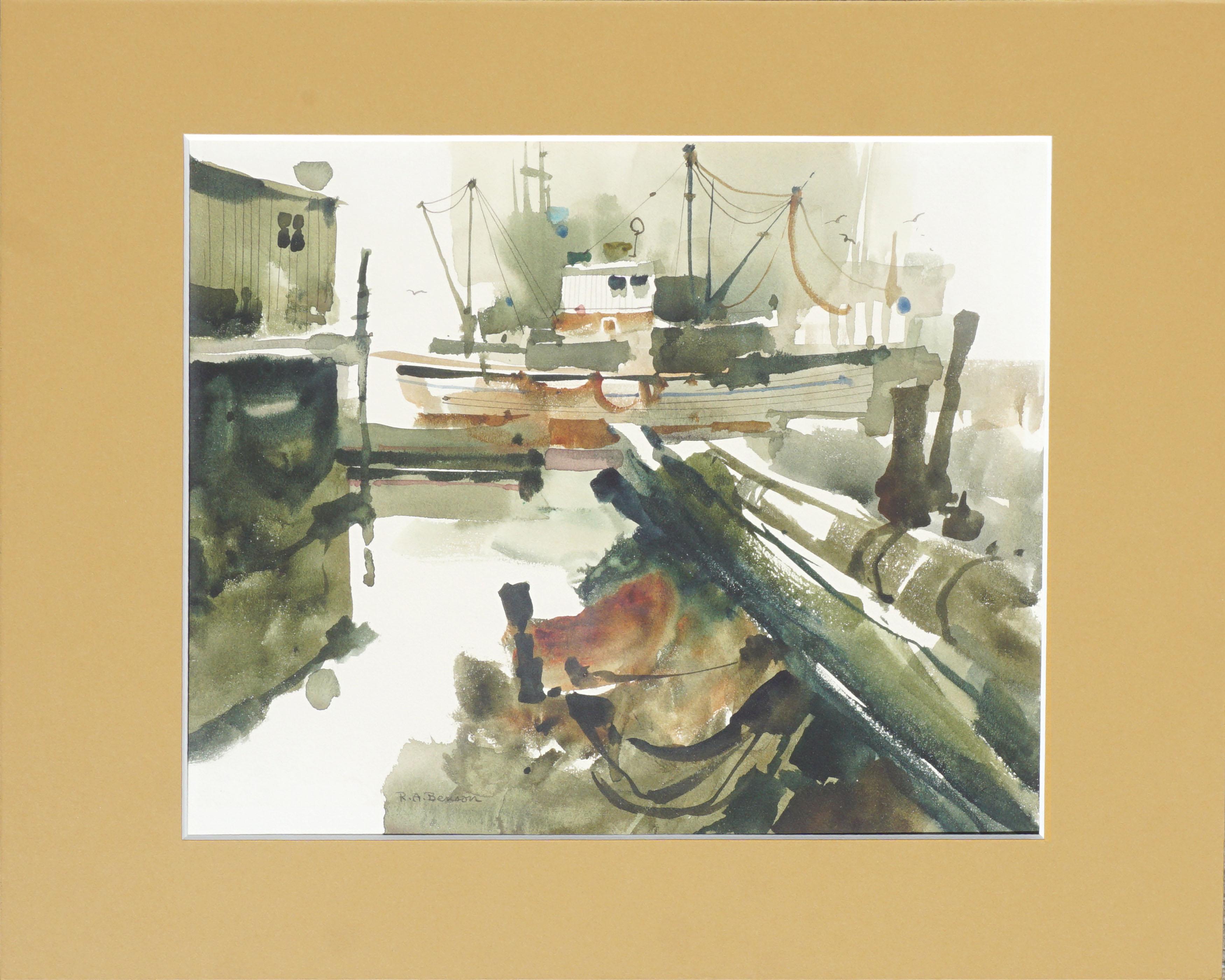
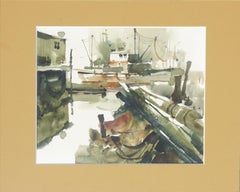
1970's watercolor of boats anchored in a harbor by Ritchie Allen Benson (American, 1941-1996). This piece is signed "R. A. Benson" in the lower center. Image, 7.5"H x 9.38"W.
Ritchie Allen Benson was born in Los Angeles. He studied at the Art Center School (Los Angeles) and was a member of the American Watercolor Society and the California Watercolor Society.
Ritchie Allen Bensen grew up in the Los Angeles area during the World War II era. By the late 1950s, he was studying watercolor painting and by the 1960s was exhibiting on a national level. He spent a great deal of time painting along the California coast and was most interested in producing works which pictured boats and harbor scenes.
His watercolors were sold through the Challis Gallery in Laguna Beach and through art association exhibition sales. Although he continued to paint occasionally in Southern California, most of Bensen's later works were done in Mendocino, California, or farther north in Washington state where he spent a lot of time painting on the beaches...
Category
1970s American Impressionist Landscape Paintings
Materials
Paper, Watercolor
$540 Sale Price
20% Off
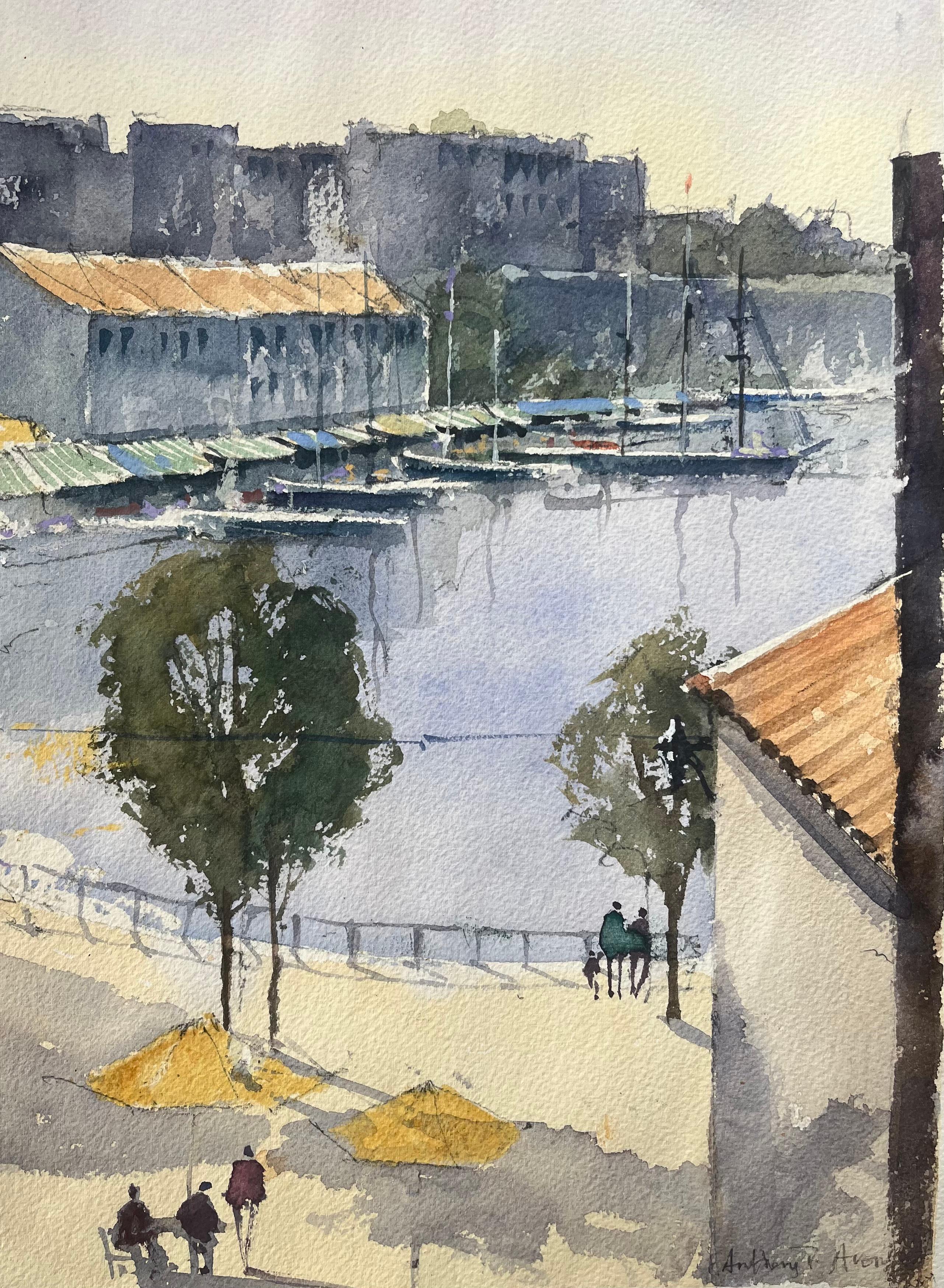
British Impressionist Watercolor of a Harbour Scene with Boats and Figures
Located in Cirencester, Gloucestershire
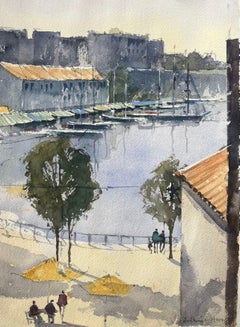
Title: British Impressionist Watercolor of a Harbour Scene with Boats and Figures
by Anthony Avery (British 1946-2023)
Original watercolor on artists paper, unframed
Dimensions: 15.2...
Category
Early 2000s Impressionist Landscape Paintings
Materials
Watercolor
$446 Sale Price
20% Off
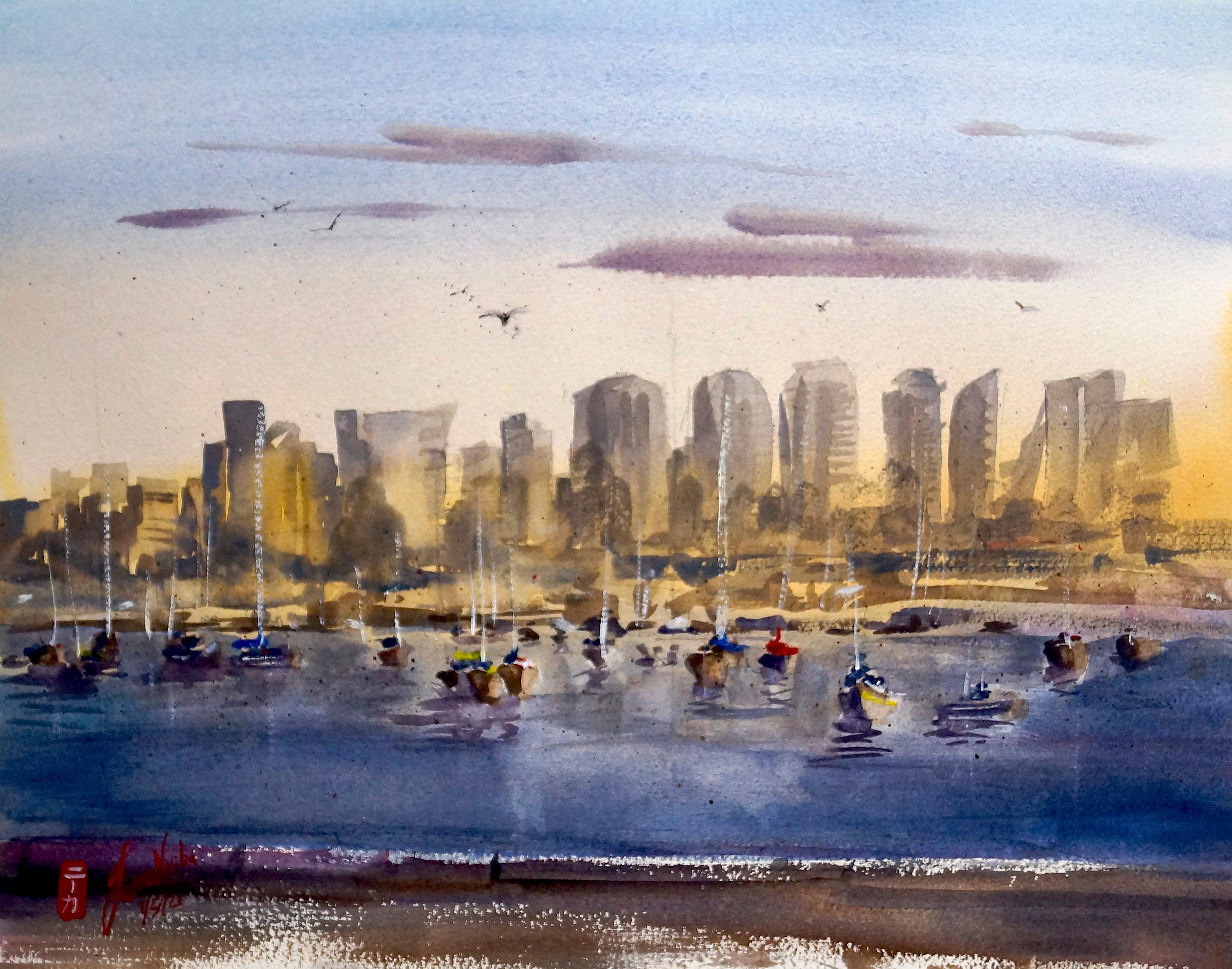
San Diego Bay, Original Painting
Located in San Francisco, CA
Artist Comments
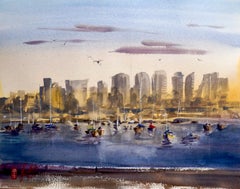
"I wanted to capture the key elements of the bay in a highly impressionistic way, painting almost a la prima," shares artist James Nyika. In this quick but en...
Category
21st Century and Contemporary Abstract Impressionist Drawings and Waterc...
Materials
Watercolor
San Pedro Harbor
By Paul Sample
Located in New York, NY
It is infrequent, to say the least, that a diagnosis of tuberculosis proves fortuitous, but that was the event, in 1921, that set Paul Starrett Sample on the road to becoming a professional artist. (The best source for an overview of Sample’s life and oeuvre remains Paul Sample: Painter of the American Scene, exhib. cat., [Hanover, New Hampshire: Hood Museum of Art, 1988] with a detailed and definitive chronology by Sample scholar, Paula F. Glick, and an essay by Robert L. McGrath. It is the source for this essay unless otherwise indicated.) Sample, born in Louisville, Kentucky, in 1896 to a construction engineer and his wife, spent his childhood moving with his family to the various locations that his father’s work took them. By 1911, the family had landed in Glencoe, Illinois, settling long enough for Paul to graduate from New Trier High School in 1916. Sample enrolled at Dartmouth College, in Hanover, New Hampshire, where his interests were anything but academic. His enthusiasms included the football and basketball teams, boxing, pledging at a fraternity, and learning to play the saxophone. After the United States entered World War I, Sample, to his family’s dismay, signed on for the Naval Reserve, leading directly to a hiatus from Dartmouth. In 1918 and 1919, Sample served in the U.S. Merchant Marine where he earned a third mate’s license and seriously contemplated life as a sailor. Acceding to parental pressure, he returned to Dartmouth, graduating in 1921. Sample’s undergraduate life revolved around sports and a jazz band he formed with his brother, Donald, two years younger and also a Dartmouth student. In November 1933, Sample summarized his life in a letter he wrote introducing himself to Frederick Newlin Price, founder of Ferargil Galleries, who would become his New York art dealer. The artist characterized his undergraduate years as spent “wasting my time intensively.” He told Price that that “I took an art appreciation course and slept thru it every day” (Ferargil Galleries Records, circa 1900–63, Archives of American Art, Smithsonian Institution, available on line).
In 1920, Donald Sample contracted tuberculosis. He went for treatment to the world-famous Trudeau Sanitorium at Saranac Lake, in New York State’s Adirondack Mountains for the prescribed regimen of rest, healthful food, and fresh air. Visiting his brother in 1921, Paul also contracted the disease. Tuberculosis is highly contagious, and had no certain cure before the development of streptomycin in 1946. Even for patients who appeared to have recovered, there was a significant rate of recurrence. Thus, in his letter to Price, Sample avoided the stigma conjured by naming the disease, but wrote “I had a relapse with a bad lung and spent the next four years hospitalized in Saranac Lake.” The stringent physical restrictions imposed by adherence to “the cure” required Sample to cultivate an alternate set of interests. He read voraciously and, at the suggestion of his physician, contacted the husband of a fellow patient for instruction in art. That artist, then living in Saranac, was Jonas Lie (1880–1940), a prominent Norwegian-American painter and an associate academician at the National Academy of Design. Lie had gained renown for his dramatic 1913 series of paintings documenting the construction of the Panama Canal (The Metropolitan Museum of Art, New York; United States Military Academy, West Point, New York). Primarily a landscape artist, Lie had a particular affinity for scenes with water. His paintings, impressionistic, atmospheric, and brushy, never strayed from a realistic rendering of his subject. Sample regarded Lie as a mentor and retained a lifelong reverence for his teacher. Sample’s early paintings very much reflect Lie’s influence.
`
In 1925, “cured,” Sample left Saranac Lake for what proved to be a brief stay in New York City, where his veteran’s benefits financed a commercial art course. The family, however, had moved to California, in the futile hope that the climate would benefit Donald. Sample joined them and after Donald’s death, remained in California, taking classes at the Otis Art Institute in Los Angeles. In Sample’s account to Price, “I couldn’t stomach the practice of painting a lot of High Sierras and desert flowers which seemed to be the only kind of pictures that were sold here so I got a job teaching drawing and painting at the art school of the University of Southern California.” Initially hired as a part-time instructor, Sample progressed to full-time status and ultimately, by the mid-1930s, to the post of Chairman of the Fine Art Department. Sample, however, did not want to wind up as a professor. “Teaching is all right in small doses,” he wrote, “but I have a horror of drifting into being a college professor and nothing more.” At the same time as he taught, Sample began to exhibit his work in a variety of venues at first locally, then nationally. Though he confessed himself “a terrible salesman,” and though occupied with continued learning and teaching, Sample was nonetheless, ambitious. In 1927, he wrote in his diary, “I am eventually going to be a painter and a damned good one. And what is more, I am going to make money at it” (as quoted by Glick, p. 15). In 1928, Sample felt sufficiently solvent to marry his long-time love, Sylvia Howland, who had also been a patient at Saranac Lake. The Howland family were rooted New Englanders and in summertime the Samples regularly traveled East for family reunion vacations.
While the 1930s brought serious hardship to many artists, for Paul Sample it was a decade of success. Buttressed by the financial safety net of his teacher’s salary, he painted realist depictions of the American scene. While his work addressed depression-era conditions with a sympathetic eye, Sample avoided the anger and tinge of bitterness that characterized much contemporary realist art. Beginning in 1930, Sample began to exhibit regularly in juried exhibitions at important national venues, garnering prizes along the way. In 1930, Inner Harbor won an honorable mention in the Annual Exhibition of the Art Institute of Chicago. That same year Sample was also represented in a show at the Albright-Knox Gallery in Buffalo and at the Biennial Exhibition of the Corcoran Gallery of Art, Washington, D.C. In 1931, Dairy Ranch won the second Hallgarten Prize at the Annual Exhibition of the National Academy of Design, in New York. Sample also made his first appearances at the Carnegie Institute, Pittsburgh, and The Pennsylvania Academy of the Fine Arts, Philadelphia. In 1936, Miner’s Resting won the Temple Gold Medal at the Pennsylvania Academy’s Annual Exhibition. Always interested in watercolor, in 1936, Sample began to send works on paper to exhibitions at the Whitney Museum, New York.
While participating in juried exhibitions, Sample also cultivated commercial possibilities. His first New York art dealer was the prestigious Macbeth Gallery in New York, which included his work in a November 1931 exhibition. In 1934, Sample joined the Ferargil Galleries in New York, after Fred Price arranged the sale of Sample’s Church Supper to the Michele and Donald D’Amour Museum of Fine Arts in Springfield, Massachusetts. In 1937, The Metropolitan Museum of Art purchased Sample’s Janitor’s Holiday from the annual exhibition of the National Academy of Design, a notable honor.
As prestigious as this exhibition schedule may have been, by far Sample’s most visible presence in the 1930s and 1940s was the result of his relationship with Henry Luce’s burgeoning publishing empire, Time, Inc. Sample’s first contribution to a Luce publication appears to have been another San Pedro...
Category
20th Century American Modern Landscape Paintings
Materials
Canvas, Oil