Want more images or videos?
Request additional images or videos from the seller
1 of 2
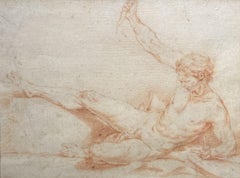
18th Century Italian SchoolThe Allegory of Minerva, Sanguine Chalk Drawing, 18th Century Italian
Price:$3,200
$4,708.64List Price
About the Item
- Creator:18th Century Italian School
- Dimensions:Height: 9.5 in (24.13 cm)Width: 7.5 in (19.05 cm)
- More Editions Sizes:1 of 1Price: $4,709
- Medium:
- Period:
- Framing:Framing Options Available
- Condition:
- Gallery Location:London, GB
- Reference Number:1stDibs: LU52412640732
About the Seller
5.0
Gold Seller
Premium sellers maintaining a 4.3+ rating and 24-hour response times
Established in 2007
1stDibs seller since 2014
86 sales on 1stDibs
Typical response time: 2 hours
Authenticity Guarantee
In the unlikely event there’s an issue with an item’s authenticity, contact us within 1 year for a full refund. DetailsMoney-Back Guarantee
If your item is not as described, is damaged in transit, or does not arrive, contact us within 7 days for a full refund. Details24-Hour Cancellation
You have a 24-hour grace period in which to reconsider your purchase, with no questions asked.Vetted Professional Sellers
Our world-class sellers must adhere to strict standards for service and quality, maintaining the integrity of our listings.Price-Match Guarantee
If you find that a seller listed the same item for a lower price elsewhere, we’ll match it.Trusted Global Delivery
Our best-in-class carrier network provides specialized shipping options worldwide, including custom delivery.You May Also Like
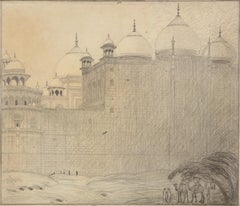
Part of the ring-wall of the Taj Mahal, Agra, India, 1914
Located in Amsterdam, NL
Part of the ring-wall of the Taj Mahal, Agra, India, 1914
Signed with initials and dated bottom right
Black chalk on paper, 45.5 x 53 cm
Literature:
Ernst Braches en J.F. Heijbro...
Category
1910s Art Nouveau Landscape Drawings and Watercolors
Materials
Paper, Chalk
$22,937
Free Shipping
H 17.92 in W 20.87 in D 1.19 in
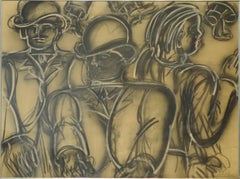
untitled
By Lester Johnson
Located in New York, NY
Lester Johnson untitled charcoal, conte crayon, and spray enamel on board from 1972. Framed.
Category
1970s Other Art Style Figurative Drawings and Watercolors
Materials
Conté, Charcoal, Spray Paint, Board
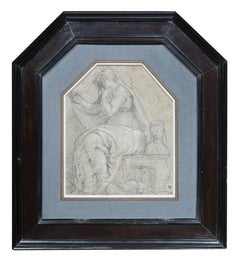
Allegory of Chastity, a drawing attributed to G. Porta with great provenance
Located in PARIS, FR
This magnificent drawing from the Venetian Renaissance intrigues us in many ways. It depicts an allegorical composition whose meaning partly escapes us: a veiled figure seated on a stone bench (which we have identified as Chastity), seems to be turning away from a woman's bust beside her, below which are two rabbits, a traditional allegory of fertility, but also sometimes of lust.
This drawing, executed on blue paper, undoubtedly belongs to the Venetian Renaissance. The inscriptions on the back of the old mounting board indicate the various attributions considered by its last owner, the British painter and art historian Sir Lawrence Gowing. We have retained the attribution to Giuseppe Porta proposed by art historian John Arthur Gere as the most relevant.
We were incredibly fortunate to find a hexagonal frame of a very similar format for this drawing, the upper corners of which were formerly cut (irregularly). This 17th-century Dutch frame comes from an aristocratic collection in Lombardy, and creates a kind of fascinating chase around this Venetian drawing...
Category
16th Century Figurative Drawings and Watercolors
Materials
Chalk
$28,672
H 11 in W 10 in
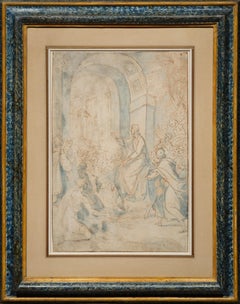
A large drawing by Il Cigoli depicting Christ
s Entry into Jerusalem
Located in PARIS, FR
This large sheet, delicately enhanced with blue ink wash, was created by Lodovico Cardi, known as Il Cigoli, the most prominent painter in Florence at the end of the 16th century. It...
Category
16th Century Old Masters Figurative Drawings and Watercolors
Materials
Paper, Chalk, Ink, Pen
$10,154
H 24.38 in W 19.25 in
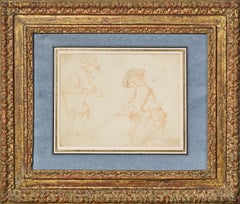
Study for a Hunting Scene, a red chalk sketch attributed to Karel du Jardin
Located in PARIS, FR
We would like to thank Carolina Trupiano Kowalczyk for suggesting this attribution to Karel du Jardin after direct examination of the artwork. Her study of the drawing (in Italian), ...
Category
1650s Old Masters Figurative Drawings and Watercolors
Materials
Chalk, Ink, Laid Paper
$16,128
H 12.63 in W 15.5 in
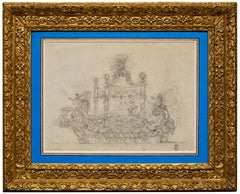
A dazzling Venetian Regatta Boat Study attributed to Alessandra Mauro
Located in PARIS, FR
This stunning Baroque study depicts a regatta boat, a type of vessel developed in eighteenth-century Venice for the regattas organized by the Serenissima during visits by royalty and princes. We propose to link this drawing to the work of Alessandro Mauro, an artist who specialized in this type of composition, as illustrated by a drawing from him at the Metropolitan Museum.
1. Description of the boat
The greatest decorative fantasy reigns in this preparatory study, which blends mythological and exotic elements with references to ancient Egypt. Our drawing is probably an initial thought, destined to be refined and clarified later in pen and ink (as evidenced by the ink stain in the lower right). A quadriga of seahorses guided by Neptune stands at the stern of the boat, shown well above the waterline (perhaps to outline its empty volume). One of the seahorses is ridden by a newt, while Amphitrite lies at the feet of the sea god.
The center of the boat is occupied by a vast baldachin resting on four atlantes and surmounted by a figure riding an animal (a dragon?). Three figures sit beneath the canopy, one of them on a griffin-shaped seat. This allusion to Egyptian antiquity echoes the winged sun (sometimes a symbol of the god Horus, as in the temple of Edfu in Egypt) that adorns the sides of the promontory on which this baldachin rests.
Another flag-bearer figure crouches at the stern of the boat on a raised seat, on the reverse of which is a crowned mermaid whose arm, extended backwards, rests on a mascaron decorated with a radiant face (Helios?) and whose torso surmounts an elephant's head. The heads of the rowers and their oars are sketched all along the boat, whose sides are embellished with elongated naiads.
2. The Venetian regatta boats
An exhibition held in 2013 at the Ca' Rezzonico (the Venetian eighteenth-century museum) paid tribute to these regatta boats through studies and prints depicting them. The regattas organized by the Serenissima in honor of visiting princes and sovereigns were among the most spectacular ceremonies in Venice. Some important artists of the 18th century contributed to the creation of these extravagant boats which were given exotic names such as bissona, malgarota or peota.
The specialists in this field were Andrea Urbani and the brothers Alessandro and Romualdo Mauro. They were born into a family of theater decorators in Piedmont, but little is known about their detailed biography. Alessandro was the architect of the Dresden opera house and of the St. Samuel Theater in Venice (in collaboration with his brother Romualdo), but also worked as stagehand and set designer in Vienna, Rome and Turin. A drawing produced around 1737 from the Metropolitan Museum (7th photo in the gallery) bears witness to his activity as a regatta boat designer.
This drawing is a much more elaborate version than the one presented here, having been entirely reworked in brown ink. However, a figure at the bow of the boat, executed solely in black chalk, still bears witness to a technique similar to that of our drawing.
It is difficult to know whether the boat depicted in our drawing was a project for an actual boat or whether it remained in the planning stage, but the front of our boat (Neptune and the quadriga of seahorses ridden by a newt) bears several similarities to that of a parade boat depicted in the print published by Michele Marieschi entitled Regatta on the Grand Canal, between the Foscari and Balbi Palaces (last photo in the gallery). This print is dated 1741, which could confirm that our work dates from around 1740.
The area between Neptune and the quadriga that precedes him on this strange paddle-boat appears to be partially submerged, confirming that the waterline of our boat was probably intended to be much lower than the one shown in our drawing.
The Correr Museum’s collection holds one of the most important collection of engravings and drawings devoted to these specifically Venetian Baroque productions. These boats were intended to last the duration of a festival. Today, they are only documented by preparatory drawings or prints that testify to the sumptuousness of their decoration. This taste for regatta boats lasted throughout the Venetian eighteenth century, and the conception of regatta boats also attracted great masters such as Giambattista Tiepolo, Francesco Guardi or Giambattista Piranesi...
Category
Mid-18th Century Old Masters Figurative Drawings and Watercolors
Materials
Chalk
$4,599
H 15.75 in W 19.25 in
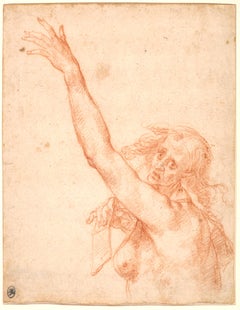
Study of a Fate at mid-body, a red chalk attributed to Giovanni da San Giovanni
Located in PARIS, FR
This spectacular red chalk drawing depicts an elderly woman, her eyes bulging, her hand stretched out towards the sky. This disturbing character, who seems close to dementia, and the elongation of her arm with its Mannerist overtones, plunge us into the Florentine artistic milieu of the first half of the 17th century. The proximity of this drawing to some characters in the fresco in the Pitti Palace representing The Muses, Poets and Philosophers chased from Parnassus, the last masterpiece of Giovanni da San Giovanni, leads us to propose an attribution to this artist and a dating of around 1635-1636.
1. Giovanni da San Giovanni, the painter of contradiction
We take here the title of the monography dedicated to the artist by Anna Banti in 1977, which remains the reference book for this artist. The son of a notary, Giovanni Mannozzi, known as Giovanni da San Giovanni, abandoned his studies to go to Florence at the age of sixteen, where he entered the studio of Matteo Rosselli (1578 - 1650) around 1609 and enrolled in the Academy of Drawing Arts in 1612. Around 1615 he produced his first known works, mainly frescoes for the city's tabernacles. He became famous in Florence for his originality, combining an obsessive application to the study of drawing and the reading of poetry and history with a disheveled appearance. Between 1619 and 1620 he decorated the facade of the Antella Palace in Piazza Santa Croce, a decoration that still partly survives today.
The death of Cosimo II in 1621 put an end to the Florentine building activity and Giovanni da San Giovanni left for Rome to find other sponsors with the painter Francesco Furini...
Category
17th Century Old Masters Nude Drawings and Watercolors
Materials
Chalk
$20,309
H 10 in W 7.75 in
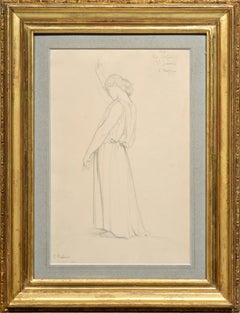
A Study for the Angel of Saint-Severin church in Paris, by Paul Flandrin
Located in PARIS, FR
After the restoration of the Saint-John chapel’s frescoes at the Saint-Severin church in Paris in 2022, the drawing presented here is a moving testimony to their creative process. It...
Category
1840s Old Masters Figurative Drawings and Watercolors
Materials
Chalk
$4,181
H 15 in W 11.38 in
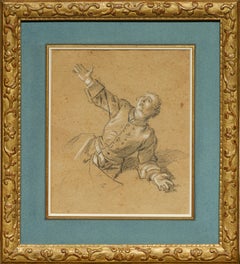
Soldier begging for Mercy a preparatory study by Jean-Marc Nattier (1685 - 1766)
By Jean-Marc Nattier
Located in PARIS, FR
This rare drawing by Nattier is part of a set of preparatory studies executed in 1717 for one of the painter's first commissions, the painting commissioned by Tsar Peter I of Russia ...
Category
1710s Old Masters Figurative Drawings and Watercolors
Materials
Chalk
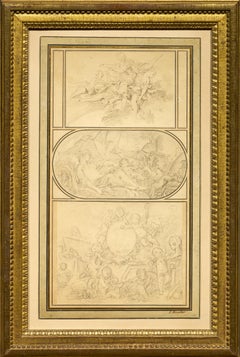
Three drawings by François Boucher in a mounting by Jean-Baptiste Glomy
By François Boucher
Located in PARIS, FR
We would like to thank Juliette Parmentier-Courreau of the Custodia Foundation for her welcome and support during the consultation of Glomy’s Journal des Ouvrages.
This spectacularly large "feuille de desseins ajustés" commissioned by François Boucher from Jean-Baptiste Glomy is emblematic of the painter's art and mastery of rocaille. It is also fully representative of the taste of this period in the field of decorative arts. The largest of these three drawings, placed at the bottom of the composition, is particularly interesting: dating from around 1756, it constitutes a modello (apparently unpublished) for the frontispiece of the "Catalogue des tableaux de Monsieur de Julienne"), preserved in the Morgan Library in New York.
1. François Boucher, the master of French rocaille
The extraordinary career of Francois Boucher was unmatched by his contemporaries in versatility, consistency and output. For many, particularly the writers and collectors who led the revival of interest in the French rococo during the last century, his sensuous beauties and plump cupids represent the French eighteenth century at its most typical. His facility with the brush, even when betraying the occasional superficiality of his art, enabled him to master every aspect of painting – history and mythology, portraiture, landscape, ordinary life and, as part of larger compositions, even still life. He had been trained as an engraver, and the skills of a draftsman, which he imbued in the studio of Jean-Francois Cars (1661 – 1738), stood him in good stead throughout his career; his delightful drawings are one of the most sought-after aspects of his oeuvre.
As a student of Francois Lemoyne (1688 - 1737), he mastered the art of composition. The four years he spent in Italy, from 1727-1731, educated him in the works of the masters, classics and history, that his modest upbringing had denied him.
On his return to Paris in 1734, he gained full membership of the Royal Academy of Painting and Sculpture with his splendid Rinaldo and Armida (Paris, Musée du Louvre). Although, throughout his career, he occasionally painted subjects taken from the Bible, and would always have considered himself first as a history painter, his own repertoire of heroines, seductresses, flirtatious peasant girls and erotic beauties was better suited to a lighter, more decorative subject matter. His mastery of technique and composition enabled him to move from large scale tapestry...
Category
1750s Old Masters Figurative Drawings and Watercolors
Materials
Chalk, Ink
$38,229
H 20.5 in W 11.63 in
More From This Seller
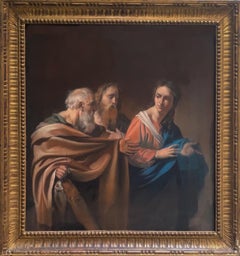
View AllThe Callings of Saints Peter and Andrew
Located in London, GB
The Callings of Saints Peter and Andrew
Robert Edge Pine
1730-1788
Chalk on paper, unsigned
Image size: 15 1/2 x 17 inches (39.5 x 43 cm)
Original frame
Here in Pine’s picture disp...
Category
18th Century English School Figurative Drawings and Watercolors
Materials
Paper, Chalk
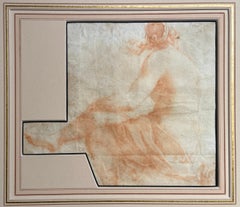
Old Masters Chalk Drawing, 17th Century Italian Sanguine on Paper
Located in London, GB
Sanguine chalk on paper
Image size: 7 x 8 1/2 inches (18 x 22 cm)
Acid free cut-out mount
This 17th century drawing depicts a reclining woman with her back.
The Sanguine chalk that...
Category
17th Century Italian School Figurative Drawings and Watercolors
Materials
Paper, Chalk
The Death of Attis, 18th Century French Red Chalk Drawing, Greek Mythology
Located in London, GB
Red chalk on paper
Image size: 9 x 7 inches (23 x 17.75 cm)
Acid free mount
The Greek god Attis was the spouse of Cybele, the fertility goddess. He was from Phrygia, a kingdom in c...
Category
18th Century French School Figurative Drawings and Watercolors
Materials
Chalk
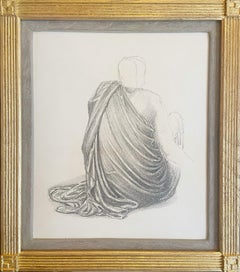
Study for Last Sleep of Arthur in Avalon
Located in London, GB
Graphite on paper
Image size: 7 1/2 x 9 inches (19 x 23 cm)
Carved gilt frame
Literature
Illustrated in Malcolm Bell's 'Sir Edward Burne-Jones, A Record and Review', London, 1899, p.127.
Provenance
Major Charles Sydney Goldman 1958
By descent to his Sons
John and Margaret Monck (John Goldman Monck) 1958-1963
Commander Victor Robert Penryn Monck (Victor Robert Penryn Monk Goldman) 1958-1963
Christie's London (Christie, Manson and Woods) 1963, John Monck and Cmdr Penryn Monck sale 26 April 1963 part lot 71
Sir John Richardson, 2019
Burne-Jones decided that the folds in the drapery in this study were too complex for the final painting and fairly soon after he simplified the draperies.
The work is a drapery study for the seated figures at the centre of Sir Edward Coley Burne-Jones monumental The Sleep of Arthur in Avalon (Museo de Arte de Ponce, Puerto Rico). The artist spent seventeen years working on the complex narrative, even moving his studio to a larger space to accommodate the canvas. Born as a commission from his patron George Howard, 9th Earl of Carlisle, to decorate a wall in his library at Naworth Castle, The Sleep of Arthur in Avalon was left unfinished in Burne-Jones’ studio upon his death. The work was bequeathed to a studio neighbour whose descendants sold it at auction in 1963, where it was purchased by Luis A. Ferré, politician and founder of the Museo de Arte de Ponce.
To his friends and family, Burne-Jones was known for his 'unpainted masterpieces'. Indeed, from his youth he made swift sketches, such as this study, that appeared effortless in contrast to his carefully crafted paintings and allowed him to work out ideas and refine details. He also drew outside of the studio, and his contemporaries remarked at his uncanny ability to do so while fully engaged in other activities. The painter W. Graham...
Category
19th Century Victorian Figurative Drawings and Watercolors
Materials
Graphite
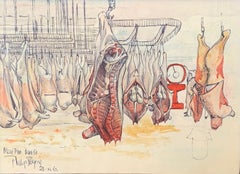
The Abattoir
Located in London, GB
Philip Byrne
20th Century
The Abattoir
Ink on paper, signed bottom left
Image size: 11 1/2 x 8 1/4 inches (29.5 x 21 cm)
Hand made frame
Philip Byrne, an artist who studied at the W...
Category
20th Century Post-War Figurative Drawings and Watercolors
Materials
Paper, Ink, Pen
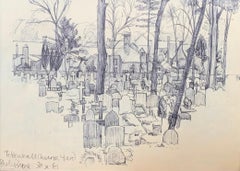
Tettenhall Church Yard
Located in London, GB
Philip Byrne
20th Century
Tettenhall Church Yard
Ink on paper, signed and titled bottom left
Image size: 11 1/2 x 8 1/4 inches (29.5 x 21 cm)
Hand made frame
Philip Byrne, an artist...
Category
20th Century Post-War Figurative Drawings and Watercolors
Materials
Paper, Ink, Pen
Still Thinking About These?
All Recently ViewedMore Ways To Browse
Drawings Italian 18th Century
Francois Perrier
Minerva Painting
Utamaro Woodblock Prints
Dog Pencil Drawing
Painting Chinese Man
Paintings Of Broadway
Polish Jewish Artist
Vintage Sketch Drawing
Charcoal Studies On Paper
Edouard Dufeu
Fairy Drawing
Vintage Vogue Illustrations
E Wilson
Old Master Drawing 16th
Clown Drawing
Encre De Chine
Fashion Drawing Art Deco