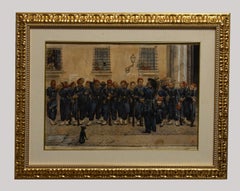
Items Similar to Procession during Holy Week in Seville, Spain
Want more images or videos?
Request additional images or videos from the seller
1 of 9
Egron Sellif LundgrenProcession during Holy Week in Seville, Spain1852
1852
$4,188.25
£3,128.19
€3,500
CA$5,770.08
A$6,288.37
CHF 3,329.96
MX$75,529.95
NOK 42,158.07
SEK 38,760.20
DKK 26,663.94
About the Item
Egron Sellif Lundgren (1815–1875) Sweden
Procession during Holy Week in Seville, Spain
Black ink, pencil, brown and red wash heightened with white on brown paper, 201 x 267 mm.
framed 43 x 48 cm
Literature:
Lady Louisa Tenison, Castile and Andalucia, London 1853, lithograph between pp. 201–202
K. Asplund, Egron Lundgren I. 1815–1859, 1914, Vol. I, p. 143, p. 145, illustrating the lithograph
Cf. Literature:
Marta Jiménez Miranda, The special relationship between text and illustrations in Castilla and Andalucia by Louisa Mary Anne Tenison, University of Córdoba, Spain, 2022, p. 245, fig. 5
Drawn in 1852 during the artist’s stay in Spain between 1849–53. Preparatory drawing for a lithograph in Lady Louisa Tenison’s Castile and Andalucia from 1853. Lady King Tenison (1819–1882) was the wife of the Irish photographer and politician Edward King Tenison. Between 1850 and 1852, King Tenison and his wife travelled in Spain for their artwork. As an early adopter of the calotype photographic process, he aroused suspicion and curiosity due to his bulky equipment and outdoor work. The work was later published as Memories of Spain in 1854, while his wife's 50 lithographs appeared in Castile and Andalucia in 1853. In 1853, he joined the Photographic Society of London, and first displayed his work at the Great Industrial Exhibition in Dublin. The next year, he then helped to found the Dublin Photographic Society.
In the preface of her book Lady King Tenison writes:
“The landscape and architectural drawings are from my own sketches, but the figures are from the pencil of Mr. Egron Lundgren, a Swedish artist now residing in Seville, whose admirable delineations of Spanish life and customs are well known to those who have had the pleasure of visiting his studio.”
Travelers’ books show an evolution of Holy Week as the centuries go by. From the 16th century, when travelers saw penance and the processional steps as an act of faith, until the 18th century, when they began to criticize the most irrational customs and the lack of faith of many participants who sought social prestige through the celebration or to hide immoral behavior. Lady King Tenison writes about the subject of the present work:
“The images or pasos belong to certain religious associations called Cofradias. Founded in days gone by, when faith prompted people to attend them, and look on them with some feelings of reverential awe; but that spirit has passed away, and now they are chiefly supported by the innkeepers and tradesmen of the town, who contribute largely to their funds, not from any devotional zeal, but as a source of profit, and from the knowledge that they attract a crowd of both natives and foreigners, and thus afford them an opportunity of considerably improving their temporal interests.”
In his two-volume book on Egron Lundgren, Karl Asplund writes about the subject (op. cit., p. 143):
“Processionen är som en scenbild ur någon opera à la Carmen; man tycker sig höra orkestermarschen, under vilken hela ensemblen tågar in och uppfyller scenen till en final.”
(“The procession is like a scene from some opera à la Carmen; you think you hear the orchestral march, during which the whole ensemble marches in and fills the stage for a finale.”)
Holy Week in Spain is the annual tribute of the Passion of Jesus Christ celebrated by Catholic religious brotherhoods (Spanish: cofradía) and fraternities that perform penance processions on the streets of almost every Spanish city and town during the last week of Lent, the week immediately before Easter. The processions incorporate different scenes from the Passion of Christ. Every brotherhood carries magnificent Pasos or floats with sculptures that depict different scenes from the gospels related to the Passion of Christ or the Sorrows of the Virgin Mary. Brotherhoods have owned and preserved these Pasos for centuries in some cases. Usually, the Pasos are accompanied by marching bands performing Marchas procesionales, a specific type of composition devoted to the images and fraternities. Since Holy Week coincides with Palm Sunday, the feast also commemorates Jesus’s triumphal entry into Jerusalem. In many Catholic and Episcopal denominations, worship services on Palm Sunday include a procession of the faithful carrying palms, representing the palm branches the crowd scattered in front of Jesus as he rode into Jerusalem.
The celebration of Holy Week regarding popular piety relies almost exclusively on the processions of the brotherhoods or fraternities. These associations have their origins in the Middle Ages, but a number of them were created during the Baroque period. The membership is usually open to any Catholic person, and family tradition is an important element to become a member or “brother” (hermano). Historically, the flagellants are the origin of the current traditions, as they flogged themselves to do penance. Pope Clement VI ordered that flagellants could perform penance only under control of the Church; he decreed Inter sollicitudines (“inner concerns”). This is considered one of the reasons why flagellants often hid their faces.
A common feature in Spain is the almost general usage of the nazareno or penitential robe for some of the participants in the processions. This garment consists of a tunic, a hood with conical tip (capirote or coroza) used to conceal the face of the wearer, and sometimes a cloak. The use of the capirote or coroza was prescribed in Spain and Portugal by the Holy Office of the Inquisition. Men and women who were arrested also had to wear a paper capirote in public as a sign of public humiliation. The colour was different, conforming to the judgement of the office. People who were condemned to be executed wore a red coroza. Other punishments used different colours. When the Inquisition was abolished, the symbol of punishment and penitence was kept in the Catholic brotherhood. The exact colors and forms of the robes depend on the particular procession.
The robes were widely used in the medieval period for penitents, who could demonstrate their penance while still masking their identity, and were part of the uniform of some brotherhoods including the Nazarenos and Fariseos during Easter observances and reenactments in some areas during Holy Week in Spain.
- Creator:Egron Sellif Lundgren (1815 - 1875, Swedish)
- Creation Year:1852
- Dimensions:Height: 7.88 in (20 cm)Width: 10.63 in (27 cm)
- Medium:
- Period:
- Condition:
- Gallery Location:Stockholm, SE
- Reference Number:1stDibs: LU1445216920452
About the Seller
5.0
Platinum Seller
Premium sellers with a 4.7+ rating and 24-hour response times
Established in 2020
1stDibs seller since 2020
221 sales on 1stDibs
Typical response time: 1 hour
Associations
International Confederation of Art and Antique Dealers
Associations
- ShippingRetrieving quote...Shipping from: Stockholm, Sweden
- Return Policy
More From This Seller
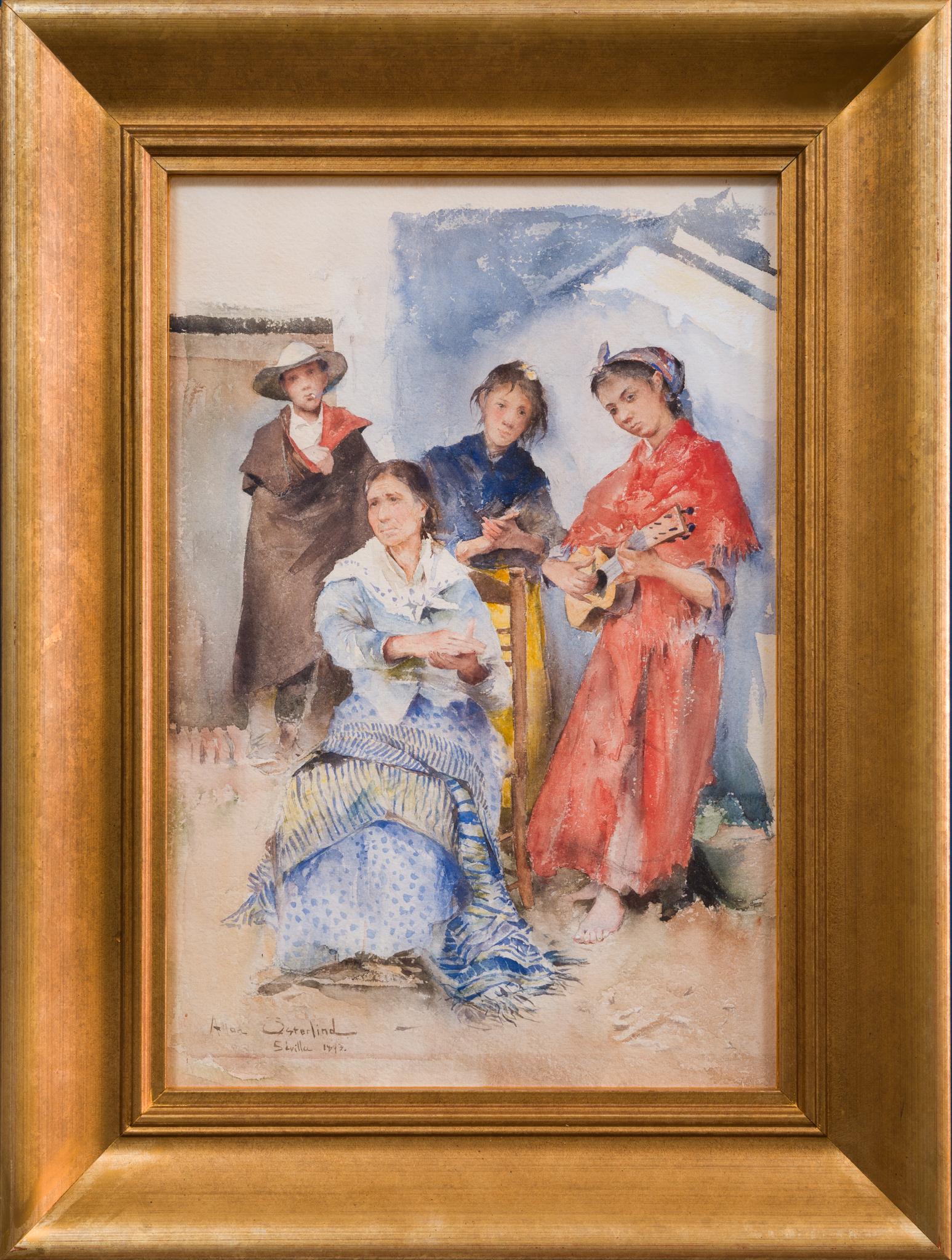
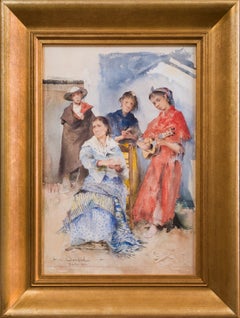
View AllEveryday Life Scene From Sevilla, 1893, Watercolor by Allan Österlind
Located in Stockholm, SE
Allan Österlind, a Swedish artist who became a well known figure in French art circles, beautifully captures the essence of Andalusian culture in his 1893 watercolor painting, "Sevil...
Category
1890s Figurative Drawings and Watercolors
Materials
Paper, Watercolor
$4,212 Sale Price
20% Off
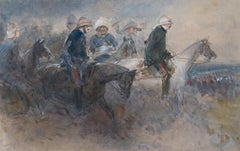
Lord Clyde and His Staff
Located in Stockholm, SE
In 1857 an uprising had broken out in India, known as ”The Mutiny". As far as British relations with India were concerned, the event represented a watershed, as a result of which the...
Category
1850s Figurative Drawings and Watercolors
Materials
Paper, Watercolor
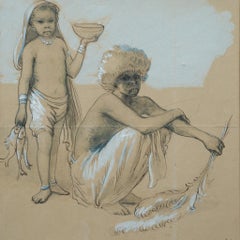
Abyssinien Ostrich Feather Merchant in Aden
Located in Stockholm, SE
Lundgren visited Aden as a passenger on board the steam ship ”Bengal” on his way from England to India during the winter 1857. The previous year an uprising had broken out in India, ...
Category
1850s Realist Figurative Drawings and Watercolors
Materials
Paper, Watercolor
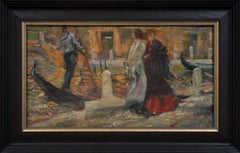
Venetian Scene with Gondoliers by Swedish Artist Allan Österlind
Located in Stockholm, SE
"Venetian Scene with Gondoliers" is an evocative portrayal of Venice, capturing the essence of the city’s romantic allure and bustling waterways. Created during Allan Österlind’s stu...
Category
1880s Figurative Paintings
Materials
Oil, Board
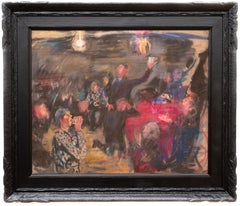
Party Time by Swedish Artist Eric Hallström, Pastel on Paper
Located in Stockholm, SE
Eric Hallström (1893-1946) Swedish
Party Time
pastel on paper
signed Eric Hallström
image dimensions approx 19.29 x 23.22 inches (49 x 59 cm)
frame 26.37 x 30.70 inches (67 x 78 cm...
Category
1920s Figurative Paintings
Materials
Paper, Pastel
$2,722 Sale Price
35% Off
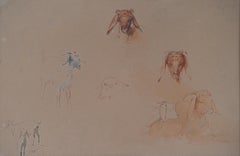
Studies of Goat Heads and Figures, Cairo (c. 1871)
Located in Stockholm, SE
Here Lundgren concentrates on individual studies of goats, especially their heads and expressions. In one sketch, a goat faces forward, its distinctive long ears and gentle features ...
Category
1870s Realist Animal Drawings and Watercolors
Materials
Paper, Watercolor
You May Also Like
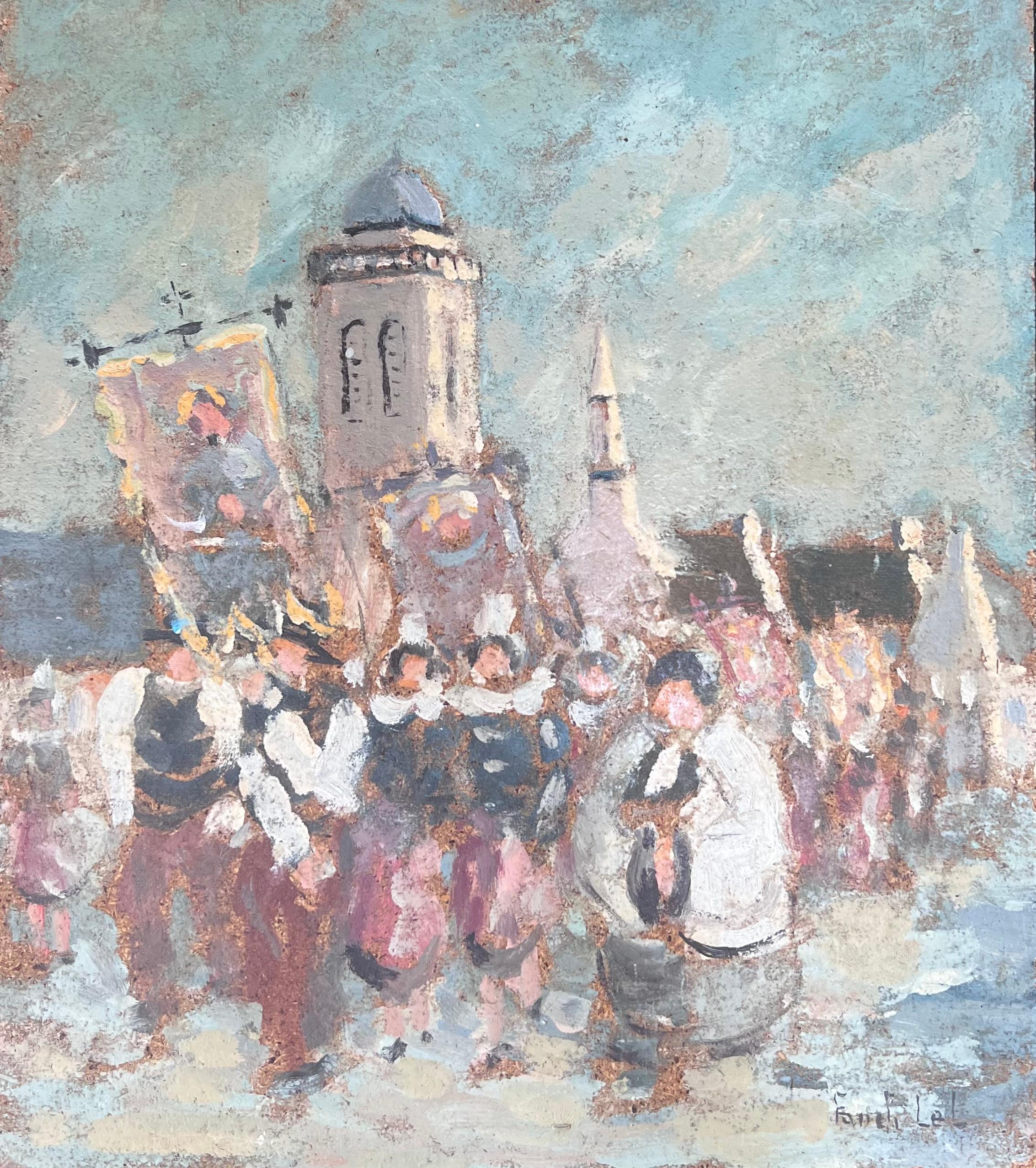
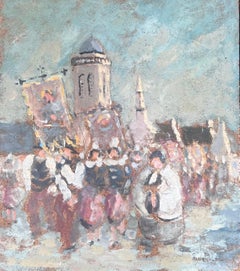
Figures Marching in Religious Parade Through A French Village Oil Painting
By Fanch Lel
Located in Cirencester, Gloucestershire
Parade
Signed by Fanch Lel
Size: 14 x 12.5 inches (height x width)
Oil painting on board, unframed
Condition: Good condition overall with minor surface handling marks and light wear ...
Category
20th Century Impressionist Landscape Paintings
Materials
Oil
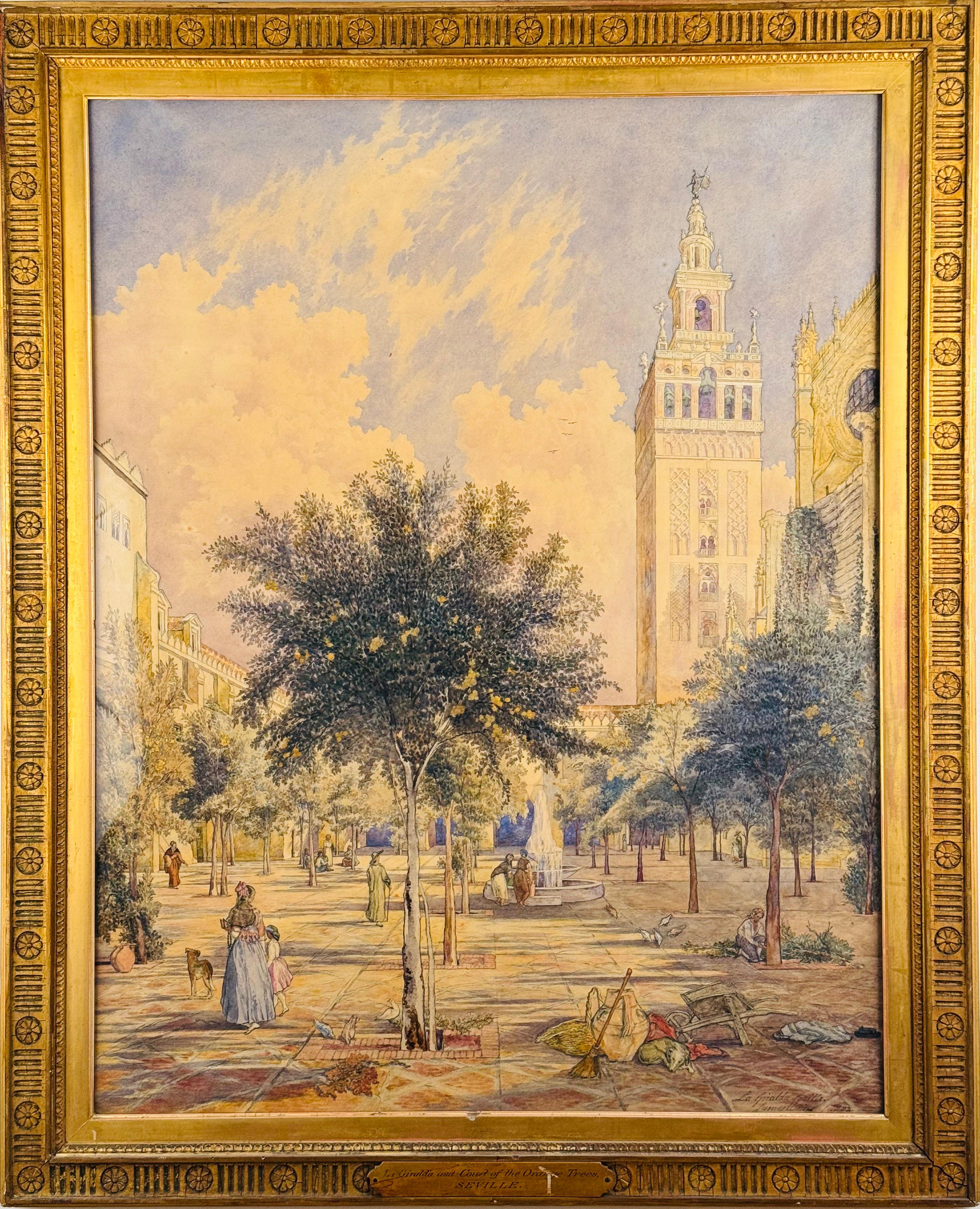
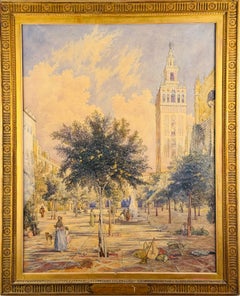
El Patio de los Naranjos, Sevilla
Located in Madrid, ES
JAMES UWINS
EL PATIO DE LOS NARANJOS, SEVILLA
titled, located, signed and dated "La Giralda Sevilla. / James Uwins 1882" (lower right)
watercolor on paper on wood panel
37 x 29 inche...
Category
1880s Realist Figurative Drawings and Watercolors
Materials
Watercolor
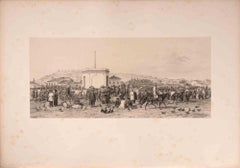
Vue du Marché de Lisbonne - Lithograph by Auguste Raffet - 1844
Located in Roma, IT
Lithograph realized by Raffet in 1846. Signed and dated in the plate.
Image dimension 19x42 cm.
A finely detailed lithograph by Auguste Raffet, depicting the bustling market of Lis...
Category
1840s Modern Figurative Prints
Materials
Lithograph
Isidore Pils (1813-1875) An Orientalist scene, signed watercolor
By Isidore Alexandre Augustin Pils
Located in Paris, FR
Isidore Pils (1813-1875)
An Orientalist scene
Signed lower left
Pencil and heightenings of watercolor on paper
15 x 24 cm
In a modern mount 40.5 x 53 cm
We know that Isidore Pils spent two years in Algeria starting in 1863, so this depiction of a festive scene could quite likely date from that period. It is very free in its execution, but at the same time very evocative.
Isidore-Alexandre-Augustin Pils (1815–1875) was a French academic painter of religious and military subjects.
Pils was born in Paris as the son of a soldier François Pils. At the age of twelve, he studied with Guillaume Guillon-Lethière for four years.
In 1831 he became a student at the École des Beaux-Arts and studied under François-Édouard Picot.
He competed for the Prix de Rome, which he won in 1838 for a history painting, St. Peter Healing a Lame Man at the Door of the Temple.
Although in poor health, Pils then spent the customary three years at the French Academy in Rome at the Villa Medici, which then had Jean Auguste Dominique Ingres as its director. While in Italy he visited Naples, Venice, and Florence.
Pils's earlier paintings have religious themes. In 1849 he completed his most famous work, Rouget de L'Isle Singing La Marseillaise, which now resides at the Musée historique de Strasbourg. After experiences travelling with French troops through the Crimea, his themes took on military and nationalistic subjects. He later produced many military scenes during the siege of Paris during the Franco-Prussian War of 1870.
Pils was appointed professor of painting at the École des Beaux-Arts in 1863 but left the same year for two years in Algeria. In 1868 he was elected to seat #14 of the Académie des Beaux-Arts. Among his students were Adrien Moreau...
Category
1870s Academic Figurative Drawings and Watercolors
Materials
Watercolor

Calvary of the Holy Sepulchre
By David Roberts
Located in London, GB
David Roberts R.A.
1796 - 1864
CALVARY - HOLY SEPULCHRE
First Edition lithograph
Full plate: 26
Presented in a acid free mount
Modern hand-coloured lithograph for the first editi...
Category
Late 19th Century Victorian Interior Prints
Materials
Lithograph
Bersaglieri in Rome - Watercolor - 1871
Located in Roma, IT
Bersaglieri in Rome is a.drawing realized in 1871 by Anonymous English artist.
Original watercolor on paper.
Good conditions.
Includes gilded frame.
This very rare artwork repre...
Category
1870s Contemporary Figurative Drawings and Watercolors
Materials
Watercolor