1 of 6
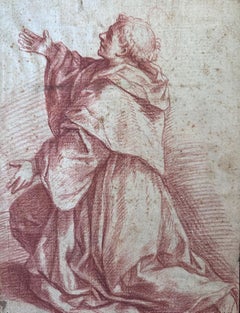
Ercole Graziani18th C Italian Old Master Drawing by Ercole Graziani St Anthony of PaduaCirca 1730
Circa 1730
$897.69List Price
About the Item
- Creator:Ercole Graziani (1688 - 1765)
- Creation Year:Circa 1730
- Dimensions:Height: 5.4 in (13.7 cm)Width: 3.67 in (9.3 cm)
- Medium:
- Movement Style:
- Period:
- Condition:
- Gallery Location:Gouda, NL
- Reference Number:1stDibs: LU116014282312
Authenticity Guarantee
In the unlikely event there’s an issue with an item’s authenticity, contact us within 1 year for a full refund. DetailsMoney-Back Guarantee
If your item is not as described, is damaged in transit, or does not arrive, contact us within 7 days for a full refund. Details24-Hour Cancellation
You have a 24-hour grace period in which to reconsider your purchase, with no questions asked.Vetted Professional Sellers
Our world-class sellers must adhere to strict standards for service and quality, maintaining the integrity of our listings.Price-Match Guarantee
If you find that a seller listed the same item for a lower price elsewhere, we’ll match it.Trusted Global Delivery
Our best-in-class carrier network provides specialized shipping options worldwide, including custom delivery.You May Also Like
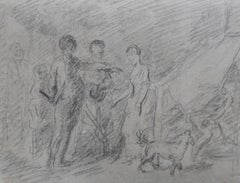
FINE 18th CENTURY OLD MASTER CHALK DRAWING - ROMANESQUE FIGURES INTERIOR SCENE
Located in Cirencester, Gloucestershire
Artist/ School: French School, 18th century
Title: Classical figures within an interior.
Medium: chalk on paper, mounted.
Size: drawing: 11.5 x 13.5 inches
Provenance:...
Category
Early 18th Century Old Masters Figurative Paintings
Materials
Chalk
$1,304
H 11.5 in W 13.5 in
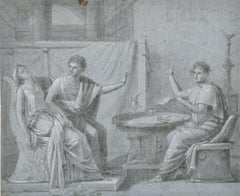
18th-century French school Study of a man seen from behind, drawing
Located in Paris, FR
18th-century French school
Study of a man seen from behind,
Charcoal and white chalk on brown paper
46 x 29 cm
Framed under glass : 60 x 43 cm
This beautiful study of a naked man...
Category
1760s Old Masters Nude Drawings and Watercolors
Materials
Charcoal, Chalk
$1,310
H 18.12 in W 11.42 in
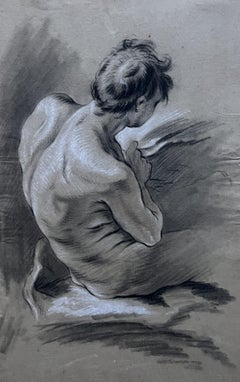
Drawing of a captive woman
By Henry Fuseli
Located in London, GB
Collections:
Sir Thomas Lawrence, who acquired the contents of Fuseli’s studio;
Susan, Countess of Guilford, née Coutts (1771-1837), acquired from the Lawrence estate;
Susan, Baroness North (1797-1884), daughter of the above;
Mrs A. M. Jaffé, acquired in France, c. 1950 to 2016.
Black chalks, on buff-coloured paper
Stamped verso: ‘Baroness Norths Collection / of Drawings by H Fuseli Esq.’
Framed dimensions: 26.38 x 20.63 inches
This boldly drawn sheet depicting a seated figure was made by Fuseli at an important and highly productive moment in his career. The monumental drawing is closely related to another sheet by Fuseli in the British Museum which Schiff published as subject unknown. Both drawings were made when Fuseli was designing his most important sequence of historical works, including scenes from Shakespeare and Milton, The Nightmare and The Death of Dido which was exhibited at the Royal Academy to great critical acclaim in 1781. The present drawing does not relate directly to any of Fuseli’s finished historical paintings of the period, but evidently the image of a slightly menacing, seated and covered old woman was precisely the sort of motif he was playing with. It is notable that the same figure reappears later in Fuseli’s work as the witch from Ben Jonson’s Witch’s Song which Fuseli produced as both a painting and engraving in 1812.
Fuseli returned to London in 1779 from a highly creative and productive period in Rome and established himself as one of the leading history painters of the period. Fuseli re-established contact with his old mentor Sir Joshua Reynolds, becoming a regular guest at his dinner table and visitor to his studio. The earliest and most striking manifestation of this strategy was Fuseli's Death of Dido, exhibited in 1781 at the Royal Academy. Executed on the same scale as Reynolds's version (Royal Collection), Fuseli's vertically oriented picture was hung directly opposite Reynolds's with its horizontal orientation, inevitably inviting comparison between the two works and garnering Fuseli much publicity and favourable reviews in the newspapers.
The present, previously unpublished sheet, relates closely to a drawing now in the British Museum. That sheet shows the same seated old woman, drawn on a smaller scale and more schematic in design, seated next to an anatomical drawing of a man. The pose of this figure is related to the pose of Dido in his Death of Dido; the foreshortened torso, arrangement of head, oblique view of Dido’s features and arms all suggest that the study can be viewed as an initial thought for the composition. Fuseli may have initially thought of including the figure of the hunched and covered old woman. Drawn on identical paper to the British Museum sheet, our study is an enlarged depiction of the same figure, more elaborately delineated and developed. The presence of a chain to the right of the figure, suggests that the iconography was related in some way to a scene of imprisonment.
Fuseli had first explored the motif of the hooded old woman in an early Roman drawing, 'The Venus Seller'. The idea of a grotesque old woman, hooded and with angular nose and projecting chin seen in profile was most spectacularly used by Fuseli in his sequence of paintings depicting The Three Witches from Macbeth. Fuseli seems to have kept the present sheet and may have returned to it when preparing a painting of The Witch and the Mandrake from Ben Jonson’s Witch’s Song from his Masque of Queens in 1812. Here the same seated figure looks out from under her hood and picks a mandrake by moonlight. Jonson’s drama had been performed at the court of James I in 1609, inspired the subject. To throw the nobility of the queens into relief, the poet added a coven of witches, one of whom declares: ‘I last night lay all alone, On the ground, to hear the mandrake groan; And plucked him up, though he grew full low, And, as I had done, the cock did crow.’ The figure was reversed in the associated etching which was published in 1812. It seems likely that the present drawing remained as part of Fuseli’s working archive of figure studies.
The present drawing was presumably purchased with the bulk of Fuseli’s drawings after the artist’s death by Sir Thomas Lawrence. Lawrence’s large group of Fuseli drawings were then acquired by Susan, Countess of Guildford (1771-1837). Lady Guildford was the eldest daughter of the banker Thomas Coutts (1735-1822), who himself had supported Fuseli’s journey to Rome in the 1770s and had remained one of the artist’s key...
Category
18th Century Old Masters Figurative Drawings and Watercolors
Materials
Chalk
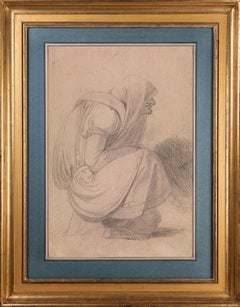
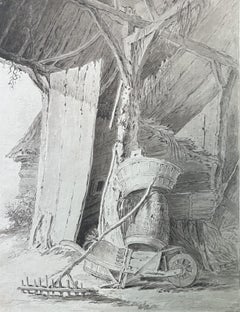
French School 18th century, Interior of a barn, drawing
Located in Paris, FR
French School 18th century,
Interior of a barn
Black chalk and black ink wash on paper
30.8 x 23.6 cm
Bears a mention " Le Prince" on the back of the sheet (see photograph)
In good ...
Category
1750s Old Masters Still-life Drawings and Watercolors
Materials
Chalk, Ink
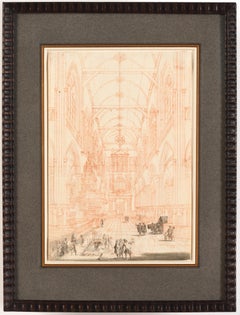
Interior of the Nieuwe Kerk, Amsterdam
Located in Paris, Île-de-France
Jan Goeree (Middelburg 1670 – Amsterdam 1731)
Interior of the Nieuwe Kerk, Amsterdam (c. 1724)
Red chalk for the architecture, pen and black ink, grey wash on paper
Composition reversed in preparation for engraving
25 × 17.5 cm
Watermark: Hunting horn, Churchill 318 (dated 1724)
Unsigned
Provenance
Private collection, France
Context & Attribution
Trained in the studio of Gérard de Lairesse, Jan Goeree was among the finest Dutch engravers of the early eighteenth century, celebrated for his architectural views of Amsterdam. This drawing is a preparatory study for an engraving of the same subject now preserved in a major public collection. The final print—slightly larger—closely follows the reversed composition of this sheet.
Subject
In the center of the Gothic nave, five bearers carry a catafalque toward a freshly dug grave—a tribute to the naval heroes often buried in the Nieuwe Kerk. This funerary motif, familiar from Dutch painting (e.g. Emanuel de Witte, 1657), evokes the vanitas theme and the transience of earthly life.
Technical Analysis
Goeree’s use of red chalk for the architecture and ink for the figures reveals his working method: the chalk lines could be used to produce a counterproof restoring the correct orientation of the architecture, while the inked figures remained adjustable before the design was transferred to the copper plate.
Place within the Oeuvre
Drawings of church...
Category
Early 18th Century Old Masters Interior Drawings and Watercolors
Materials
Chalk, Ink
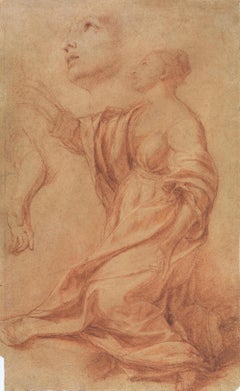
Studies of a kneeling female figure, an arm, a hand, and a head in profile
By Carlo Maratta (Ancona 1625 - Rome 1713)
Located in Paris, Île-de-France
Studio of Carlo Maratti (or Maratta)
Camerano 1625 – Rome 1713
Studies of a kneeling female figure, an arm, a hand, and a head in profile
Red chalk on paper
43.4 x 26.6 cm
Unsigne...
Category
Late 17th Century Old Masters Figurative Drawings and Watercolors
Materials
Chalk
$10,173
H 17.09 in W 10.48 in
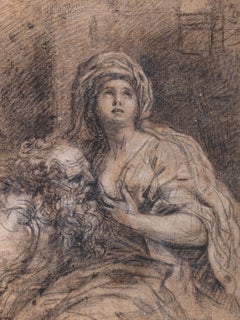
Roman Charity (Cimon and Pero)
Located in Paris, Île-de-France
Michel CORNEILLE the Younger (Paris, 1642 – 1708)
Roman Charity (Cimon and Pero)
Black chalk with white highlights on beige paper
Height: 28 cm – Width: 20 cm
Unsigned
France, cir...
Category
Late 17th Century Old Masters Figurative Drawings and Watercolors
Materials
Paper, Chalk, Charcoal
Italian School, 17th century - Study for the Vision of Saint Anthony
Located in Paris, Île-de-France
Italian School, 17th century
Study for the Vision of Saint Anthony
Red chalk on paper
247 x 185 mm
Unsigned
Provenance
Private collection, Paris
Collection of Count Alessandro Mag...
Category
17th Century Old Masters Figurative Drawings and Watercolors
Materials
Chalk
$3,351
H 9.73 in W 7.29 in
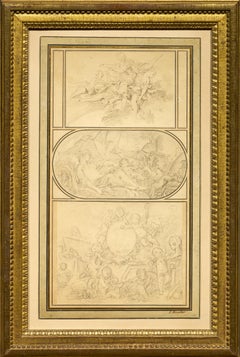
Three drawings by François Boucher in a mounting by Jean-Baptiste Glomy
By François Boucher
Located in PARIS, FR
We would like to thank Juliette Parmentier-Courreau of the Custodia Foundation for her welcome and support during the consultation of Glomy’s Journal des Ouvrages.
This spectacularly large "feuille de desseins ajustés" commissioned by François Boucher from Jean-Baptiste Glomy is emblematic of the painter's art and mastery of rocaille. It is also fully representative of the taste of this period in the field of decorative arts. The largest of these three drawings, placed at the bottom of the composition, is particularly interesting: dating from around 1756, it constitutes a modello (apparently unpublished) for the frontispiece of the "Catalogue des tableaux de Monsieur de Julienne"), preserved in the Morgan Library in New York.
1. François Boucher, the master of French rocaille
The extraordinary career of Francois Boucher was unmatched by his contemporaries in versatility, consistency and output. For many, particularly the writers and collectors who led the revival of interest in the French rococo during the last century, his sensuous beauties and plump cupids represent the French eighteenth century at its most typical. His facility with the brush, even when betraying the occasional superficiality of his art, enabled him to master every aspect of painting – history and mythology, portraiture, landscape, ordinary life and, as part of larger compositions, even still life. He had been trained as an engraver, and the skills of a draftsman, which he imbued in the studio of Jean-Francois Cars (1661 – 1738), stood him in good stead throughout his career; his delightful drawings are one of the most sought-after aspects of his oeuvre.
As a student of Francois Lemoyne (1688 - 1737), he mastered the art of composition. The four years he spent in Italy, from 1727-1731, educated him in the works of the masters, classics and history, that his modest upbringing had denied him.
On his return to Paris in 1734, he gained full membership of the Royal Academy of Painting and Sculpture with his splendid Rinaldo and Armida (Paris, Musée du Louvre). Although, throughout his career, he occasionally painted subjects taken from the Bible, and would always have considered himself first as a history painter, his own repertoire of heroines, seductresses, flirtatious peasant girls and erotic beauties was better suited to a lighter, more decorative subject matter. His mastery of technique and composition enabled him to move from large scale tapestry...
Category
1750s Old Masters Figurative Drawings and Watercolors
Materials
Chalk, Ink
$38,301
H 20.5 in W 11.63 in
France 18th Century, The Surprised Lovers, original drawing
Located in Paris, FR
France circa 1770
Two lovers surprised in bed
Black chalk on paper
13 x 17 cm
Modern frame : 34 x 38 cm
This drawing had been attributed to Gabriel de Saint Aubin (1724-1780). It's...
Category
1760s Old Masters Interior Drawings and Watercolors
Materials
Chalk