Items Similar to Lord Leighton (1830-1896), Studies for Captive Andromache
Want more images or videos?
Request additional images or videos from the seller
1 of 5
Frederic LeightonLord Leighton (1830-1896), Studies for Captive Andromache1888
1888
$19,273.73
£14,000
€16,403.17
CA$26,578.35
A$28,139.54
CHF 15,228.33
MX$336,319.29
NOK 189,819.08
SEK 173,582.82
DKK 122,510.64
About the Item
Frederic Leighton, 1st Baron Leighton, P.R.A. (1830-1896)
Studies for Captive Andromache
With the artist studio stamp (Lugt 1741a) (lower left); inscribed 'Andromache' (lower right)
c.1888
Charcoal and white chalk on buff paper laid down on card
10 x 13.7/8 in. (26.6 x 35.2 cm.)
Provenance
With Thomas Agnew
Sons, Ltd., London, (no. 29773) (label verso);
With Julian Hartnoll Gallery, London (label verso);
With Christopher Wood, London, 7th January 2003 (label verso; sales receipt included);
With Martin Beisly Fine Art, London (label verso);
Private Collection, Belgravia, London;
Until acquired by Whiteman's Fine Art, 2024.
Exhibited
London, Shepherd Gallery, English Romantic Art, 1840-1920, Autumn 1998.
Literature
Leonée and Richard Ormond, Lord Leighton (1975) no. 334.
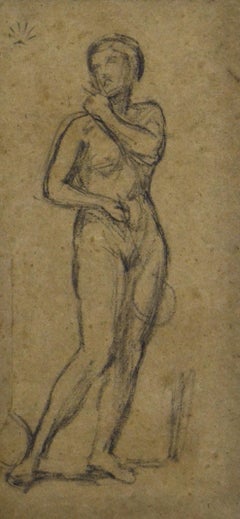
This preparatory drawing for Leighton’s 1888 Captive Andromache offers a rare opportunity to own a piece of the material history of a masterpiece. Captive Andromache (Fig.1), at over four metres in length, is the largest work of Leighton’s late period, and has been called the ‘last and greatest of Leighton’s great processional paintings’ [1]. The painting was purchased by Manchester Art Gallery for £4000 in 1888 – a record price for a Leighton painting during his lifetime. The painting remains in the Manchester collection, whilst Leighton’s first major work, Cimabue's Celebrated Madonna, was purchased by Queen Victoria and is now held in the National Gallery, London.
Frederic Leighton, 1st Baron Leighton, P.R.A. (1830-1896) spent his early years in Germany, Switzerland and Italy, being educated from 16 at the Städelsches Kunstinstitut, Frankfurt, where he was tutored by Eduard von Steinle [2]. Leighton is remarkable in having received a complete education in continental Europe, where most of his contemporaries only spent a year [3]. This may be observed in his flair for depicting classical subjects in academic style. In this accomplished preparatory drawing, Leighton studies the female form alongside a Greek storage jar. His focus is on the torsion within a figure, paused in motion whilst holding these vases. By the completion of the final work, the pottery has changed into specific pelikai (or kalpis [4],) and hydriai [5], with scenes delineated in both red and black figure styles. The final vases reference specific examples in the British museum collection, some which had been recently acquired. Yet it is possible that Leighton observed them from secondary sources during his drawing [6]. Ian Jenkins notes that, when rendering the vases, his living models likely posed with ‘whatever was to hand among the bric-à-brac of Leighton House’ [7].
Classical references can be seen in this drawing’s deeply delineated al antica drapery which reflects Leighton’s ‘increasingly sculptural style’ [8], which sought to reiterate the ‘ideal beauty inspired by Classical statuary… to resurrect past epochs of artistic achievement and an academic working-method associated with the “Old Masters”’ [9]. This ideal beauty coincides with an attention to naturalism as in this drawing the artist utilises white chalk to mark the play of highlights, which cascade across the classical drapery [10], situating the figures in the physical space of the viewer- and yet just out of reach. This sense of a liminal longing is expanded on in the final painting. Leighton was inspired by Homer’s Iliad and centres the present work around Andromache, former wife of the Trojan hero Hector killed in the Trojan war. Subsequently captured by the Greeks, she became the concubine of the conquering Neoptolemus, the son of Achilles. The final work depicts her arrival in Epirus, and Leighton’s rendering of her mournful figure dressed in black contrasts with the vibrant frieze of colourfully clothed people surrounding her, including the figures drawn here, thus indicating Andromache’s isolation. In a typically Greek reversal of fortune, Andromache is reduced to the humble status of a water bearer, the occupation studied within the present work. Leighton’s treatment of Andromache is arresting: with her head bowed, she looks silently towards the baby to the bottom right of the painting, observing what she could have had and yet completely alienated from the warmth of the interaction before her. This sense of sadness was evidenced in 1888, when the work was exhibited at the Royal Academy [11], accompanied by lines from Leighton’s friend, Elizabeth Barrett Browning's, contemporary translation of the Iliad: Some standing by, Marking thy tears fall, shall say ‘This is she, The wife of that same Hector that fought best Of all the Trojans when all fought for Troy’ [12].
This work bears, on the reverse, the artist’s studio stamp (lower left) and the inscription ‘Andromache’ (lower right). These studies offer fascinating insights into the artist’s process. The left-most figure (Fig.2), depicted leaning over a vase with an arm outstretched, is visible on the far right of the final painting, clothed in orange with a hand pressed against the wall. The outline of the figure behind her is loosely sketched in the study. The right-hand figure wears brown drapery in the final painting, and stands between Andromache and the group of
women near the wall (Fig.3). The right-hand figure shown here is translated in the final work to stand just behind Andromache. This further evinces the ultimate importance of draughtsmanship to Leighton, as he places a firm focus on disegno in this work [13]. In this drawing, we can see several positions for the woman’s feet being worked through, in order to achieve the delightfully balanced contrapposto which is found in the painting. This technical excellence was well recognised by Leighton’s contemporaries: having moved to London in 1860, Leighton became an associate of the Royal Academy in 1864, an Academician from 1868, and was made president in 1878. In 1896, just a day before his death, he became Baron Leighton of Stretton – the first painter to be given a peerage. He was the ‘late Victorian period’s most institutionally powerful artist’ [14], and ‘an academic painter par excellence’ [15]. His draughtsmanship continues to be recognised, receiving significant attention in the touring exhibition of Leighton’s works in 2006-2008 [16]. Leighton attributed a great deal of importance to his drawings, some of which he displayed in his studio, and which he intended to be preserved [17]. A number of similar studies for Captive Andromache are housed in Manchester Art Gallery, including female figure studies holding vases (such as A.N. 1983.59 and A.N. 1977.166), and a male figure study (A.N. 1982.137) which displays the artist’s attention to muscle definition and the human form.
In Study for Captive Andromache, a fascinating allusion to materiality is made. The figure to the left shows Leighton perfecting the positioning of this figure, moving the head and the angle of the arm and feet to realise the position of the figure which can be found leaning against the wall to the right of the finished painting. This is, in the words of Christopher Newall, ‘expressed with fluent manual dexterity, and his impressive fecundity of invention, evident in the repeated variants tried and discarded’ [18] Similarly, this drawing with charcoal and chalk allows a rare glimpse of the artist’s hand. An interrogation of materiality is used to gesticulate the immateriality of this vision depicted. Charcoal and chalk become paint and then flesh, and yet the classicising drapery hints at sculptural, and even architectural detail [19]. This transience of material and creation mean that when following the delicate lines of this page, one can follow the artist’s thought process as we witness the creation of a masterpiece.
We would like to thank Professor Liz Prettejohn for her opinion on the present the work, which she deemed ‘a classic example to me, on brown paper (as is typical for drawings of this date) and obviously part of Leighton's preparatory work for Captive Andromache. [20]’
Notes
[1] Edward Morris, Public Art Collections in North-West England: A History and Guide (Liverpool: Liverpool University Press, 2001). Page 118.
[2] Leonee Ormond, 'Frederic Leighton and the Illustrations for Romola,' The George Eliot Review, no. 45 (2014): 50–56. Page 50.
[3] Christopher Newall, The Art of Lord Leighton (Phaidon Press, 1990). Page 9.
[4] Ian Jenkins, 'Frederic Lord Leighton and Greek Vases,' The Burlington Magazine 125, no. 967 (October 1983): 596–605. Page 598.
[5] ibid. Page 597.
[6] ibid. Page 598.
[7] ibid. Page 601.
[8] Karl Kilinski II, 'Frederic Leighton’s "Daedalus and Icarus": Antiquity, Topography and Idealised Enlightenment,' The Burlington Magazine 148, no. 1237 (April 2006): 257–63. Page 257.
[9] Keren Rosa Hammerschlag, Frederic Leighton: Death, Mortality, Resurrection (Ashgate Publishing, 2015), 1–14. Page 5, 3.
[10] Elizabeth Prettejohn, 'The Classicism of Frederic Leighton' in Margot T. Brandlhuber and Michael Buhrs, eds., Frederic, Lord Leighton, 1830-1896 (Munich, Berlin, London, New York: Prestel, 2009). Pages 35-77. Page 43.
[11] Hammerschlag, Frederic Leighton. (2015). Page 4.
[12] Newall, The Art of Lord Leighton. (1990). Page 116.
[13] Amy Concannon, '"Brothers in Art: Drawings by Watts and Leighton" 17 November 2015—19 February 2016 Watts Gallery, Compton, Surrey,' The British Art Journal 17, Spring (2016): 149; Christopher Newall, Leighton the Academic, in Stephen Jones and Royal Academy of Arts, Frederic, Lord Leighton: Eminent Victorian Artist (New York: H.N. Abrams; London, 1996). Pages 55-68. Page 62.
A related study is at the Leighton House Museum: Studies for 'Captive Andromache': Drapery for Female Figures, c.1887, Black and white chalk on brown paper, 52.4 x 37.0 cm, Leighton House Museum, The Royal Borough of Kensington and Chelsea, reference number: LHO/D/0683.
[14] Hammerschlag, Frederic Leighton. (2015). Introduction.
[15] Prettejohn, 'The Classicism of Frederic Leighton' (2009). Page 36.
[16] Amy Concannon, '"Brothers in Art: Drawings by Watts and Leighton' 17 November 2015—19 February 2016 Watts Gallery, Compton, Surrey,” The British Art Journal 17, Spring (2016): 149.
[17] Sally Woodcock, 'Leighton and Roberson: An Artist and His Colourman,' The Burlington Magazine 138, no. 1121 (August 1996): 526–28. Page 527.
[18] Newall, Leighton the Academic. (1996). Pages 55-68. Page 64.
[19] Ciarán Rua O’Neill, 'Column Bodies: The Caryatid and Frederic Leighton’s Royal Academy Sketchbooks,' Sculpture Journal 25, no. 3 (2016): 421–32. Page 431, 423.
[20] Professor Elizabeth Prettejohn, email correspondence on having seen a digital copy of the work, Friday 8th November 2024. Professor Prettejohn further identified a similar piece with which to compare it, A sheet of studies for 'Captive Andromache', 10½ x 13¾ in. Christie’s, ‘Victorian and British Impressionist Art’, 15th June 2011, Lot 8.
- Creator:Frederic Leighton (1830 - 1896, British)
- Creation Year:1888
- Dimensions:Height: 10 in (25.4 cm)Width: 14 in (35.56 cm)
- Medium:
- Period:
- Condition:
- Gallery Location:Oxford, GB
- Reference Number:1stDibs: LU2912217259212
About the Seller
New to 1stDibs
Joined in the past six months.
No Reviews Yet
Vetted Professional Seller
Every seller passes strict standards for authenticity and reliability
1stDibs seller since 2025
- ShippingRetrieving quote...Shipping from: Oxford, United Kingdom
- Return Policy
More From This Seller
View AllPortrait of Prince Charles Edward Stuart, ‘Bonnie Prince Charlie’
Located in Oxford, GB
After Maurice-Quentin de la Tour (1704-1788), Portrait of Prince Charles Edward Stuart (1720-1788), Bonnie Prince Charlie (later Jacobite 'King C...
Category
Mid-18th Century Portrait Paintings
Materials
Pastel
Studio of Sir Peter Lely, Portrait of Lady Anne (later Queen Anne)
By Studio of Sir Peter Lely
Located in Oxford, GB
Studio of Sir Peter Lely (1618-1680)
Portrait of Lady Anne (1665–1714), later Queen
Oil on canvas
20⅞ x 16¾ in.
c.1678
Provenance
Capt. H. A. N. Forte of Polock, West Somerset;
Chri...
Category
17th Century Old Masters Portrait Paintings
Materials
Oil
En Deuil Blanc Portrait of Mary, Queen of Scots (1542-87)
Located in Oxford, GB
English School
‘En Deuil Blanc’ Portrait of Mary, Queen of Scots (1542-87)
Oil-on-panel
14 x 10 in.
c.1600
Provenance
Christie’s, South Kensington, November, 2011;
Private collecti...
Category
16th Century Portrait Paintings
Materials
Oil
The Clumber Maestris: A Pair of Bacchantes
By Michelangelo Maestri
Located in Oxford, GB
Michelangelo Maestri (c.1741-1812)
The Clumber Maestris: A Pair of Bacchantes, after frescoes from the Villa of Cicero, Pompei
c.1790
Pastel on paper
23 ½ x 17 ¼
Provenance
In the ...
Category
18th Century Figurative Paintings
Materials
Pastel
You May Also Like
Lord Frederick Leighton drawing, British pre-Raphaelite, original
By Frederic Leighton
Located in Petworth, West Sussex
Lord Frederick Leighton (British, 1830-1896)
Apprehending a thief
pencil on paper
the fragment measures approx. 17.1/3 x 11in. (44 x 28cm.)
signed ‘F Leighton’ (lower right)
Provenance: Gifted by Leighton to his cousin Edith Emily Jellicorse, nee Garnham, and thence by descent
We would like to thank Daniel Robins, the curator at Leighton House for the authenticating this work in full.
Daniel has suggested this study would have been executed when Leighton was studying in Frankfurt
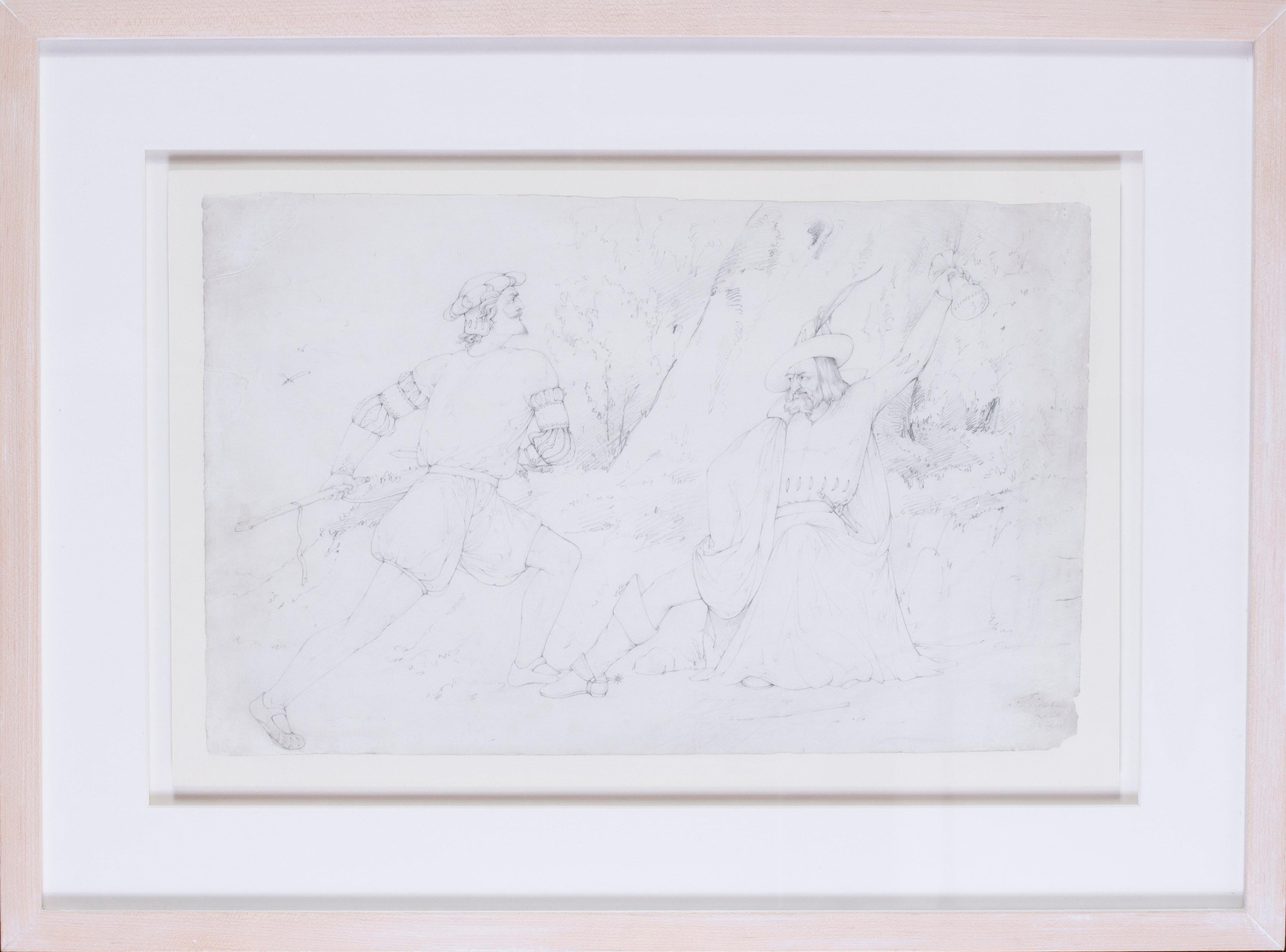
Leighton was born in Scarborough to Augusta Susan and Dr. Frederic Septimus Leighton. He received his artistic training on the European continent, first from Eduard von Steinle and then from Giovanni Costa. According to Daniel Robbins, the curator at Leighton House, This drawing comes from the time Leighton studied under Eduard von Steinle. He then studied at the Accademia di Belle Arti in Florence. From 1855 to 1859 he lived in Paris, where he met Ingres, Delacroix, Corot and Millet. In 1860, he moved to London, where he associated with the Pre-Raphaelites. In 1864 he became an associate of the Royal Academy and in 1878 he became its President (1878–96). American art critic Earl Shinn claimed at the time that "Except Leighton, there is scarce any one capable of putting up a correct frescoed figure in the archway of the Kensington Museum." His paintings represented Britain at the great 1900 Paris Exhibition. Leighton was knighted at Windsor in 1878 and was created a baronet, of Holland Park Road eight years later. He was the first painter to be given a peerage. Leighton remained a bachelor and rumours of him having an illegitimate child with one of his models, in addition to the supposition that Leighton may have been a homosexual, continue to be debated. On his death his barony was extinguished after existing for only a day; this is a record in the Peerage. His house in Holland Park, London has been turned into a museum. It contains many of his drawings and paintings, as well as some of his former art collection including a painting dedicated to Leighton by Sir John Everett Millais. The house also features many of Leighton's inspirations, including his collection of Iznik tiles. Its centrepiece is the magnificent Arab Hall. Leighton was an enthusiastic volunteer soldier, enrolling with the first group to join the 38th Middlesex (Artists') Rifle Volunteer Corps (later to be known as the Artists Rifles...
Category
19th Century Pre-Raphaelite Figurative Drawings and Watercolors
Materials
Paper, Pencil
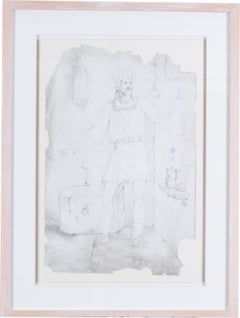
Pre-Raphaelite, early 19th Century drawing by the British artist Lord Leighton
By Frederic Leighton
Located in Petworth, West Sussex
Lord Frederick Leighton (British, 1830-1896)
A Medieval Allegory
Not signed
pencil on paper
the fragment measures approx. 19.1/2 x 13 in.
(49.5 x 33 cm.)
Provenance: Gifted by Leighton to his cousin Edith Emily Jellicorse, nee Garnham, and thence by descent.
We would like to thank Daniel Robins, the curator at Leighton House for the authenticating this work in full.
Daniel has suggested this study would have been executed when Leighton was studying in Frankfurt
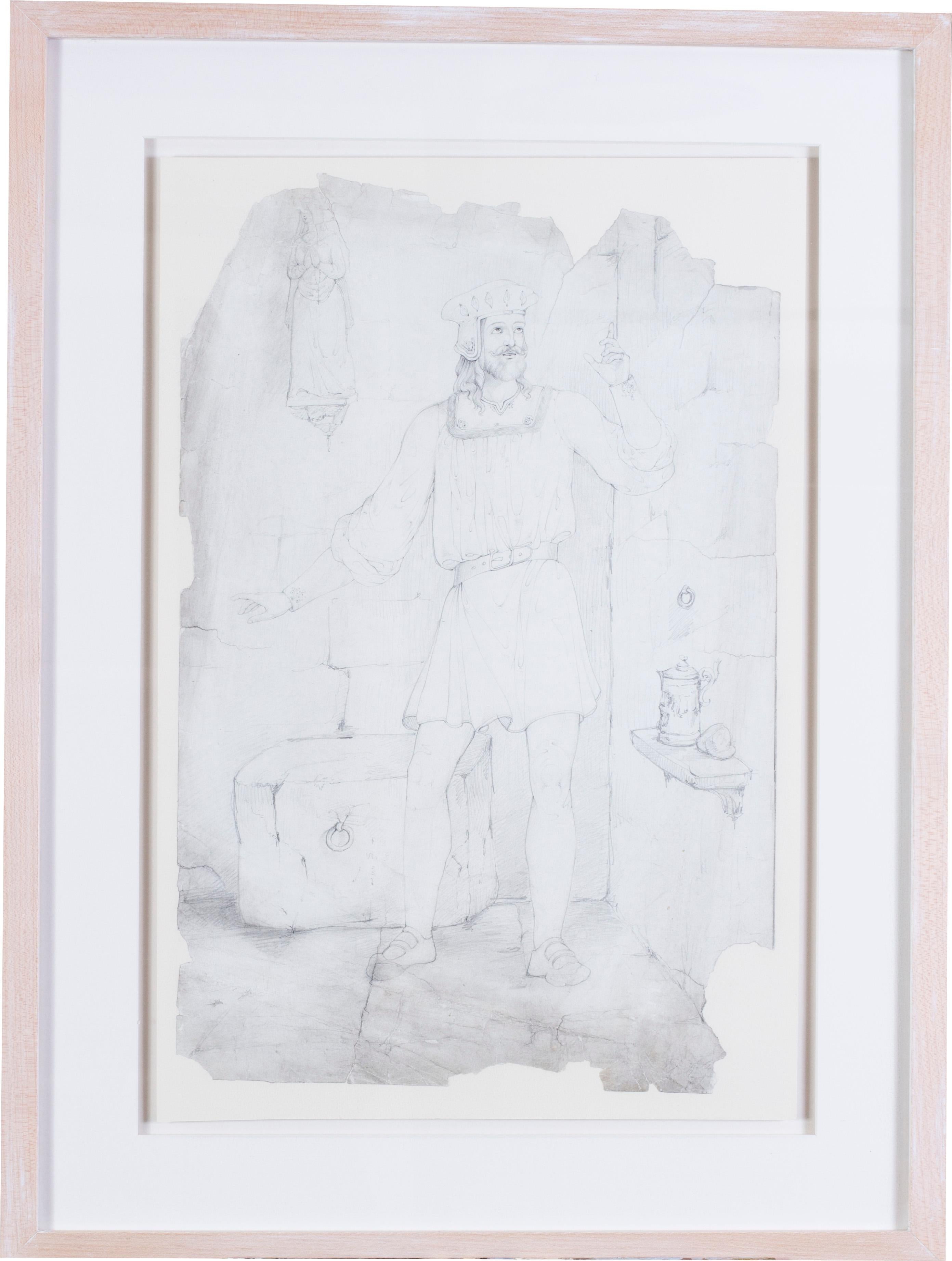
Leighton was born in Scarborough to Augusta Susan and Dr. Frederic Septimus Leighton. He received his artistic training on the European continent, first from Eduard von Steinle and then from Giovanni Costa. According to Daniel Robbins, the curator at Leighton House, This drawing comes from the time Leighton studied under Eduard von Steinle. He then studied at the Accademia di Belle Arti in Florence. From 1855 to 1859 he lived in Paris, where he met Ingres, Delacroix, Corot and Millet. In 1860, he moved to London, where he associated with the Pre-Raphaelites. In 1864 he became an associate of the Royal Academy and in 1878 he became its President (1878–96). American art critic Earl Shinn claimed at the time that "Except Leighton, there is scarce any one capable of putting up a correct frescoed figure in the archway of the Kensington Museum." His paintings represented Britain at the great 1900 Paris Exhibition. Leighton was knighted at Windsor in 1878 and was created a baronet, of Holland Park Road eight years later. He was the first painter to be given a peerage. Leighton remained a bachelor and rumours of him having an illegitimate child with one of his models, in addition to the supposition that Leighton may have been a homosexual, continue to be debated. On his death his barony was extinguished after existing for only a day; this is a record in the Peerage. His house in Holland Park, London has been turned into a museum. It contains many of his drawings and paintings, as well as some of his former art collection including a painting dedicated to Leighton by Sir John Everett Millais. The house also features many of Leighton's inspirations, including his collection of Iznik tiles. Its centrepiece is the magnificent Arab Hall. Leighton was an enthusiastic volunteer soldier, enrolling with the first group to join the 38th Middlesex (Artists') Rifle Volunteer Corps (later to be known as the Artists Rifles...
Category
19th Century Pre-Raphaelite Figurative Drawings and Watercolors
Materials
Paper, Pencil
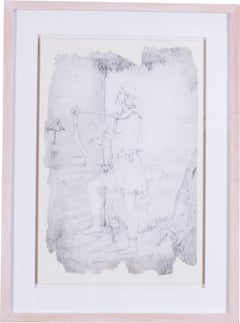
An early 19th Century drawing by the British pre-Raphaelite artist Lord Leighton
By Frederic Leighton
Located in Petworth, West Sussex
Lord Frederick Leighton (British, 1830-1896)
A very early study of a Medieval Minstrel
pencil on paper
Not signed
the fragment measures approx. 19.1/2 x 13 in.
(49.5 x 33 cm.)
Provenance: Gifted by Leighton to his cousin Edith Emily Jellicorse, nee Garnham, and thence by descent.
We would like to thank Daniel Robins, the curator at Leighton House for the authenticating this work in full.
Daniel has suggested this study would have been executed when Leighton was studying in Frankfurt
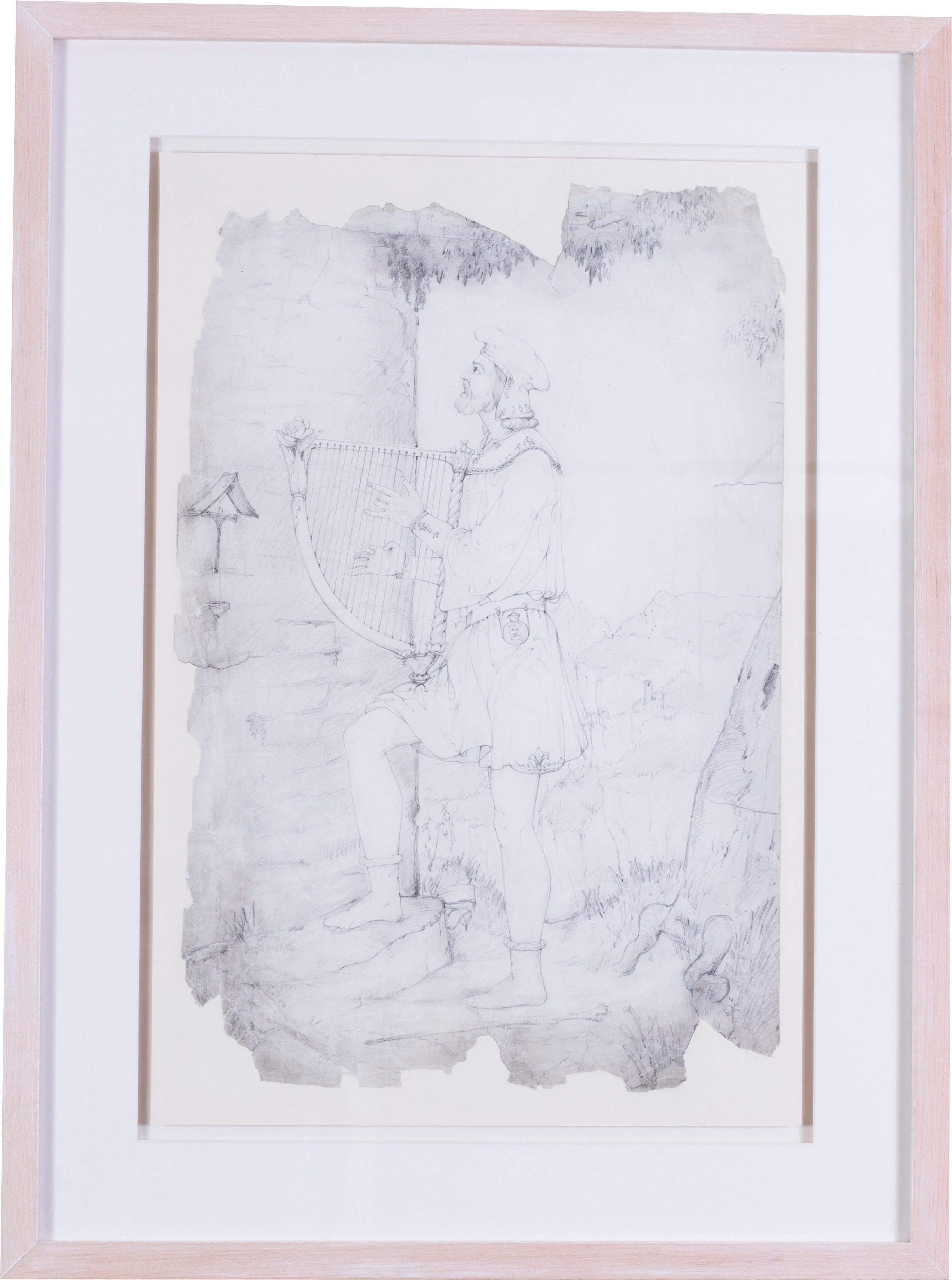
Leighton was born in Scarborough to Augusta Susan and Dr. Frederic Septimus Leighton. He received his artistic training on the European continent, first from Eduard von Steinle and then from Giovanni Costa. According to Daniel Robbins, the curator at Leighton House, This drawing comes from the time Leighton studied under Eduard von Steinle. He then studied at the Accademia di Belle Arti in Florence. From 1855 to 1859 he lived in Paris, where he met Ingres, Delacroix, Corot and Millet.
In 1860, he moved to London, where he associated with the Pre-Raphaelites. In 1864 he became an associate of the Royal Academy and in 1878 he became its President (1878–96). American art critic Earl Shinn claimed at the time that "Except Leighton, there is scarce any one capable of putting up a correct frescoed figure in the archway of the Kensington Museum." His paintings represented Britain at the great 1900 Paris Exhibition.
Leighton was knighted at Windsor in 1878 and was created a baronet, of Holland Park Road eight years later. He was the first painter to be given a peerage.
Leighton remained a bachelor and rumours of him having an illegitimate child with one of his models, in addition to the supposition that Leighton may have been a homosexual, continue to be debated. On his death his barony was extinguished after existing for only a day; this is a record in the Peerage. His house in Holland Park, London has been turned into a museum. It contains many of his drawings and paintings, as well as some of his former art collection including a painting dedicated to Leighton by Sir John Everett Millais. The house also features many of Leighton's inspirations, including his collection of Iznik tiles. Its centrepiece is the magnificent Arab Hall.
Leighton was an enthusiastic volunteer soldier, enrolling with the first group to join the 38th Middlesex (Artists') Rifle Volunteer Corps (later to be known as the Artists Rifles...
Category
19th Century Pre-Raphaelite Figurative Drawings and Watercolors
Materials
Paper, Pencil
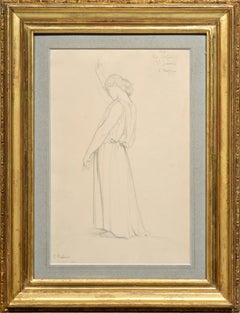
A Study for the Angel of Saint-Severin church in Paris, by Paul Flandrin
Located in PARIS, FR
After the restoration of the Saint-John chapel’s frescoes at the Saint-Severin church in Paris in 2022, the drawing presented here is a moving testimony to their creative process. It...
Category
1840s Old Masters Figurative Drawings and Watercolors
Materials
Chalk
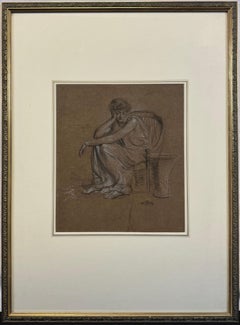
“Study for Neobule, 1894” Neoclassical Chalk Drawing British Signed 19th Century
By Edward John Poynter
Located in Yardley, PA
“Study for Neobule, 1894” by Sir Edward John Poynter (English, 1836-1919)
This exquisite 1894 study by Sir Edward John Poynter (1836–1919) serves as a preparatory drawing for his pa...
Category
1890s Aesthetic Movement Figurative Drawings and Watercolors
Materials
Paper, Chalk
Study for Battledore
Shuttlecock - British Aesthetic Movement drawing
By Albert Joseph Moore
Located in London, GB
ALBERT JOSEPH MOORE, ARWS
(1841-1893)
Study for Battledore & Shuttlecock
Signed with anthemion
Chalk on brown paper
27 by 13 cm., 10 ½ by 5 in.
(frame size 49 by 34.5 cm., 19 ¼ b...
Category
1870s Aesthetic Movement Figurative Drawings and Watercolors
Materials
Chalk