Want more images or videos?
Request additional images or videos from the seller
1 of 11
Gisella LoefflerLittle Native Girlc. 1919
c. 1919
$4,125List Price
About the Item
- Creator:Gisella Loeffler (1902 - 1977, American, Austrian)
- Creation Year:c. 1919
- Dimensions:Height: 15 in (38.1 cm)Width: 12 in (30.48 cm)Depth: 0.5 in (1.27 cm)
- Medium:
- Movement Style:
- Period:
- Condition:
- Gallery Location:Missouri, MO
- Reference Number:1stDibs: LU74733212393
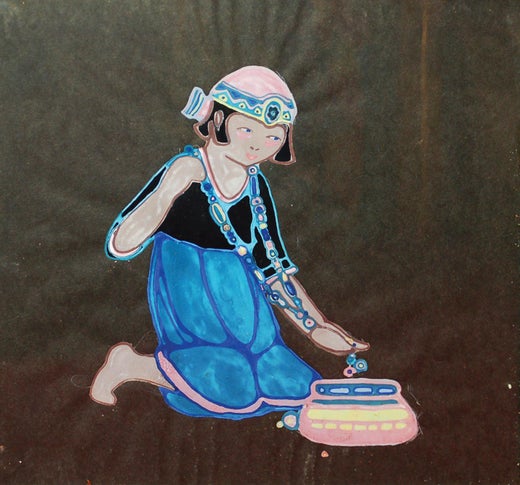
Gisella Loeffler
Born in Austria, Gisella came to the United States with her family in 1908, settling in St. Louis, MO. After studying art at Washington University in St. Louis, she became a prominent member of the local art community, joining the St. Louis Art Guild as well as the Boston Society of Arts and Crafts. In addition to creating posters for the St. Louis Post Dispatch, Gisella won prizes from the Artists Guild of the Author’s League of America in 1919 and 1920 and from the Kansas City Art Institute in 1923. She also began working in textiles, including batik, to which she would return later in her career. Having seen a local exhibition of paintings by Taos artists Oscar Berninghaus (who was from St. Louis) and Ernest Blumenschein, Gisella felt drawn to Taos, which reminded her of the villages of her native Austria. In 1933 the single mother with two daughters, Undine and Aithra, moved to Taos, where she lived off and on for the rest of her life. She traveled frequently, spending extended periods in Mexico, South America, and California, but always returned to New Mexico. Gisella initially applied an Austro-Hungarian folk-art style to the Indian and Hispanic subjects that she found in New Mexico. In her early work she covered her surfaces with decorative floral and faunal motifs, and her images were flat with no attempt at rendering traditional one-point perspective. Eventually, though, Gisella developed her own style, often using children or childlike figures as subjects. Still, the influence of her native country’s folk art remained evident in her New Mexican, Mexican, and South American images. In California, Gisella broadened her range of artistic pursuits. She taught art privately, created illustrations for Scripts Magazine, and did interior design for private homes. She also designed greeting cards, a practice she continued after her return to New Mexico, where she created a series of Christmas cards. Gisella began illustrating children’s books in 1941 when she collaborated on Franzi and Gizi with author Margery Bianco. Eventually she wrote and illustrated her own book, El Ekeko, in 1964. She also designed ceramics—her Happy Time Dinnerware, marketed by Poppy Trail and manufactured by Metlox of Manhattan Beach, CA, is highly collectible today. As a painter, she worked on canvas or paper in oil, casein, and watercolor. She also painted furniture. Besides making her own clothing, Gisella worked in other fabric arts such as batik and embroidery. In fact, she received the top award in fabric arts in 1959 and again in 1967 from the Mus-eum of International Folk Art in Santa Fe. But perhaps Gisella’s greatest legacy is the murals she painted for children’s areas in hospitals across the United States. Gisella’s death in 1977 left a large hole in the fabric of the Taos Art Colony and the entire Taos community. Yet her work, so colorful and full of joy, remains an uplifting presence in Taos.
About the Seller
5.0
Vetted Professional Seller
Every seller passes strict standards for authenticity and reliability
Established in 1970
1stDibs seller since 2017
157 sales on 1stDibs
Typical response time: Several days
Authenticity Guarantee
In the unlikely event there’s an issue with an item’s authenticity, contact us within 1 year for a full refund. DetailsMoney-Back Guarantee
If your item is not as described, is damaged in transit, or does not arrive, contact us within 7 days for a full refund. Details24-Hour Cancellation
You have a 24-hour grace period in which to reconsider your purchase, with no questions asked.Vetted Professional Sellers
Our world-class sellers must adhere to strict standards for service and quality, maintaining the integrity of our listings.Price-Match Guarantee
If you find that a seller listed the same item for a lower price elsewhere, we’ll match it.Trusted Global Delivery
Our best-in-class carrier network provides specialized shipping options worldwide, including custom delivery.You May Also Like
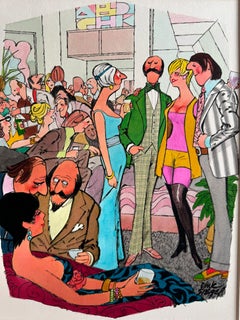
Threesome Swingers Cocktail Party 1970s Playboy Cartoon
By Dink Siegel
Located in Miami, FL
1970s Threesome Swingers Cocktail Party by Dink Siegel. If anyone has ever put pen to paper and tried to draw a face or a figure with any level of success, then you know how hard it...
Category
1970s American Modern Figurative Drawings and Watercolors
Materials
Ink, Gouache, Illustration Board
Barber Paints Man
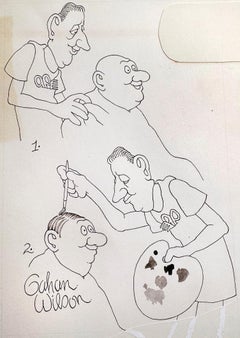
s Bald Head - "The Usual, Sir? Yes, Please."
Located in Miami, FL
Gahan Wilson was a Conceptual Artist before he was a Cartoonist. Before laying pen to paper, Wilson had to conceive a big idea. It was his idea, not the actual drawing, that was the...
Category
1990s American Modern Portrait Drawings and Watercolors
Materials
Paper, Ink, Gouache
$8,000
H 9.75 in W 7 in
Figura Femminile II
Located in Atlanta, GA
Son of painter Angelo Bonfanti, Maurizio Bonfanti attended Bergamo's Liceo Artistico and studied etching at the Accademia di Belle Arti in the same c...
Category
21st Century and Contemporary Modern Figurative Drawings and Watercolors
Materials
Gouache
Figura Femminile V
Located in Atlanta, GA
Son of painter Angelo Bonfanti, Maurizio Bonfanti attended Bergamo's Liceo Artistico and studied etching at the Accademia di Belle Arti in the same city. Though he enrolled to study ...
Category
21st Century and Contemporary Modern Figurative Drawings and Watercolors
Materials
Gouache
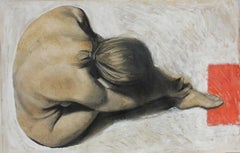
Figura Femminile IV
Located in Atlanta, GA
Son of painter Angelo Bonfanti, Maurizio Bonfanti attended Bergamo's Liceo Artistico and studied etching at the Accademia di Belle Arti in the same c...
Category
21st Century and Contemporary Modern Figurative Drawings and Watercolors
Materials
Gouache
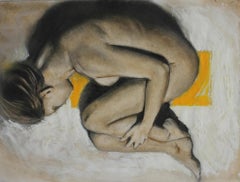
Cyclistes devant jardin et bosquet
By Gen Paul
Located in PARIS, FR
Gouache on paper
Signed lower right
Provenance:
- France, Private collection.
Category
Mid-20th Century Modern Figurative Drawings and Watercolors
Materials
Gouache

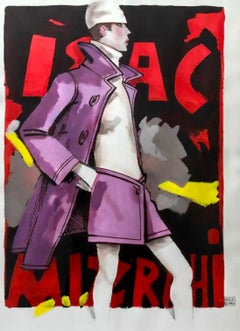
Issac Mizrahi illustration
By Michaele Vollbracht
Located in Miami, FL
Issac Mizrahi fashion illustrationon Arches paper signed in ink lower right Circa 1990's
Image 29.5" H x 21.25"
Frame: 31.5" H x 23.75" W x 1.5" D.
Th...
Category
1990s Modern Figurative Paintings
Materials
Watercolor, Gouache, Pencil
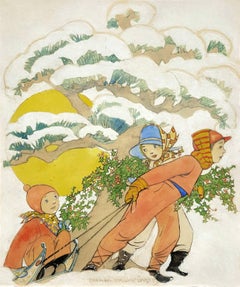
Women
s World Magazine Cover Illustration , Children Sledding
By Maginel Wright Enright Barney
Located in Miami, FL
Children Sledding, Women's World Magazine Cover, December 1939
Signed lower center image
watercolor, gouache, pencil, and wash on paper
Category
1930s American Modern Figurative Drawings and Watercolors
Materials
Gouache
$14,000
H 16.5 in W 14.5 in
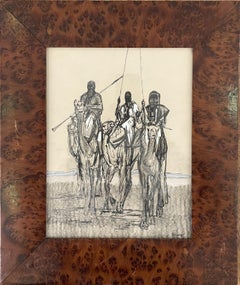
Paul JOUVE (1878-1973), "The Camel Riders"
By Paul Jouve
Located in Paris, FR
Paul Jouve was a French illustrator and sculptor, passionate about animals from a young age, which he discovered at the Natural History Museum and in Parisian zoos. He is the most fa...
Category
1930s Modern Figurative Drawings and Watercolors
Materials
Paper, India Ink, Gouache, Pencil
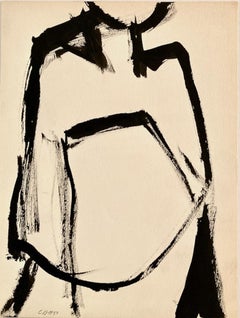
Clinton Hill, (Nude #1), 1951, drawing, figure/abstraction
By Clinton Hill
Located in New York, NY
Clinton Hill (1922-2003), created quintessential mid-century images, but figures are unusual in his work. This is from a very early period. In 1951 Hill studied at the Academie de la...
Category
Mid-20th Century American Modern Abstract Drawings and Watercolors
Materials
Gouache
More From This Seller
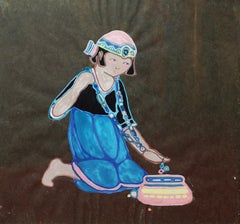
View AllThe Necklace and the Pot
By Gisella Loeffler
Located in Missouri, MO
Gisella Loeffler
"The Necklace and the Pot" c. 1919
Gouache on Paper
Initialed Lower Left
Framed Size: approx 15 x 15 inches
In a village filled with colorful characters, few Taos artists were as colorful as Gisella Loeffler [1900-1977]. From her handmade Austrian clothing and hand-painted furniture to whimsical paintings and letters written in multicolored crayon, joyful color defined the artist, who early on chose to use simply Gisella as her professional name and was known as such to everyone in Taos.
In spite of her fame there—the Taos News once labeled her a Taos legend—Gisella is rarely included in scholarly discussions of the Taos Art Colony. This oversight is likely due to the naive quality of her work, in which children or childlike adults inhabit a simple, brightly colored world filled with happiness. The macabre, the sad, the tortured, the offensive—all have no place in Gisella’s paintings. Her naive style of work looks very different from that of the better-known early Taos artists. Yet both Gisella’s artwork and her interesting life command attention.
Born in Austria, Gisella came to the United States with her family in 1908, settling in St. Louis, MO. After studying art at Washington University in St. Louis, she became a prominent member of the local art community, joining the St. Louis Art Guild as well as the Boston Society of Arts and Crafts. In addition to creating posters for the St. Louis Post Dispatch, Gisella won prizes from the Artists Guild of the Author’s League of America in 1919 and 1920 and from the Kansas City Art Institute in 1923. She also began working in textiles, including batik, to which she would return later in her career.
In the early 1920s Gisella married writer and music critic Edgar Lacher. A difficult character, Lacher may have chafed under Gisella’s success, for the couple divorced in the 1930s.
Having seen a local exhibition of paintings by Taos artists Oscar Berninghaus (who was from St. Louis) and Ernest Blumenschein, Gisella felt drawn to Taos, which reminded her of the villages of her native Austria. In 1933 the single mother with two daughters, Undine and Aithra, moved to Taos, where she lived off and on for the rest of her life. She traveled frequently, spending extended periods in Mexico, South America, and California, but always returned to New Mexico.
Gisella initially applied an Austro-Hungarian folk-art style to the Indian and Hispanic subjects that she found in New Mexico. In her early work she covered her surfaces with decorative floral and faunal motifs, and her images were flat with no attempt at rendering traditional one-point perspective. Eventually, though, Gisella developed her own style, often using children or childlike figures as subjects. Still, the influence of her native country’s folk art remained evident in her New Mexican, Mexican, and South American images.
In 1938 Gisella moved briefly to Los Griegos, north of Albuquerque, to be closer to medical facilities for her eldest daughter, who was suffering from rheumatic fever. Two years later, she moved to California to participate in the war effort, painting camouflage and decals on airplanes for Lockheed.
In California, Gisella broadened her range of artistic pursuits. She taught art privately, created illustrations for Scripts Magazine, and did interior design for private homes. She also designed greeting cards, a practice she continued after her return to New Mexico, where she created a series of Christmas cards.
Gisella began illustrating children’s books in 1941 when she collaborated on Franzi and Gizi with author Margery Bianco. Eventually she wrote and illustrated her own book, El Ekeko, in 1964. She also designed ceramics—her Happy Time Dinnerware, marketed by Poppy Trail...
Category
1910s Modern Figurative Drawings and Watercolors
Materials
Gouache
Price Upon Request
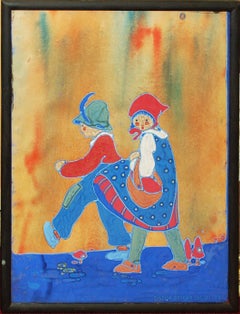
Going for a Stroll
By Gisella Loeffler
Located in Missouri, MO
Gisella Loeffler
"Going for a Stroll" c. 1919
Gouache on Paper
Initialed
Framed Size: approx 17 x 13 inches
In a village filled with colorful characters, few Taos artists were as colorful as Gisella Loeffler [1900-1977]. From her handmade Austrian clothing and hand-painted furniture to whimsical paintings and letters written in multicolored crayon, joyful color defined the artist, who early on chose to use simply Gisella as her professional name and was known as such to everyone in Taos.
In spite of her fame there—the Taos News once labeled her a Taos legend—Gisella is rarely included in scholarly discussions of the Taos Art Colony. This oversight is likely due to the naive quality of her work, in which children or childlike adults inhabit a simple, brightly colored world filled with happiness. The macabre, the sad, the tortured, the offensive—all have no place in Gisella’s paintings. Her naive style of work looks very different from that of the better-known early Taos artists. Yet both Gisella’s artwork and her interesting life command attention.
Born in Austria, Gisella came to the United States with her family in 1908, settling in St. Louis, MO. After studying art at Washington University in St. Louis, she became a prominent member of the local art community, joining the St. Louis Art Guild as well as the Boston Society of Arts and Crafts. In addition to creating posters for the St. Louis Post Dispatch, Gisella won prizes from the Artists Guild of the Author’s League of America in 1919 and 1920 and from the Kansas City Art Institute in 1923. She also began working in textiles, including batik, to which she would return later in her career.
In the early 1920s Gisella married writer and music critic Edgar Lacher. A difficult character, Lacher may have chafed under Gisella’s success, for the couple divorced in the 1930s.
Having seen a local exhibition of paintings by Taos artists Oscar Berninghaus (who was from St. Louis) and Ernest Blumenschein, Gisella felt drawn to Taos, which reminded her of the villages of her native Austria. In 1933 the single mother with two daughters, Undine and Aithra, moved to Taos, where she lived off and on for the rest of her life. She traveled frequently, spending extended periods in Mexico, South America, and California, but always returned to New Mexico.
Gisella initially applied an Austro-Hungarian folk-art style to the Indian and Hispanic subjects that she found in New Mexico. In her early work she covered her surfaces with decorative floral and faunal motifs, and her images were flat with no attempt at rendering traditional one-point perspective. Eventually, though, Gisella developed her own style, often using children or childlike figures as subjects. Still, the influence of her native country’s folk art remained evident in her New Mexican, Mexican, and South American images.
In 1938 Gisella moved briefly to Los Griegos, north of Albuquerque, to be closer to medical facilities for her eldest daughter, who was suffering from rheumatic fever. Two years later, she moved to California to participate in the war effort, painting camouflage and decals on airplanes for Lockheed.
In California, Gisella broadened her range of artistic pursuits. She taught art privately, created illustrations for Scripts Magazine, and did interior design for private homes. She also designed greeting cards, a practice she continued after her return to New Mexico, where she created a series of Christmas cards.
Gisella began illustrating children’s books in 1941 when she collaborated on Franzi and Gizi with author Margery Bianco. Eventually she wrote and illustrated her own book, El Ekeko, in 1964. She also designed ceramics—her Happy Time Dinnerware, marketed by Poppy Trail...
Category
1910s Modern Figurative Drawings and Watercolors
Materials
Gouache
Price Upon Request
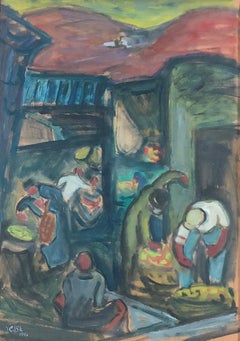
The Village Market
By Jacob Eisenscher
Located in Missouri, MO
Jacob (Yaacov) Eisenscher
"The Village Market" 1947
Gouache/Watercolor on Paper
Signed and Dated Lower Left
Image Size: approx 18 x 12.5
Framed Size: approx 27 1/8 x 22 1/4 inches
...
Category
1940s Realist Figurative Drawings and Watercolors
Materials
Paper, Gouache
Price Upon Request
Season
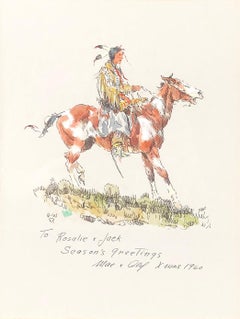
s Greetings 1960 (Brave on Horseback)
By Olaf Wieghorst
Located in Missouri, MO
Olaf Wieghorst (American, 1899-1988)
"Season's Greetings" (Brave on Horseback) 1960
Watercolor/Gouache on Paper
Initialed and Monogramed and Dated
Dedicated: "To Rosalie & Jack, Season's Greetings, Mae & Olaf Xmas 1960"
Site Size: 12 x 9 inches
Framed Size: approx. 22.5 x 18.5 inches
Born in Viborg, Denmark, Olaf Wieghorst was a child acrobatic performer from the age of nine when he began appearances at Tivoli Theater in Copenhagen and later toured Europe. He also learned horseback riding working on a stock farm, and horses became a major focus of his admiration and later his painting.
In 1918, he arrived in the United States, having worked as a cabin boy on a steamer. He served in the 5th U.S. Cavalry on the Mexican border in the days of Pancho Villa...
Category
1960s American Realist Figurative Drawings and Watercolors
Materials
Paper, Watercolor, Gouache
Price Upon Request
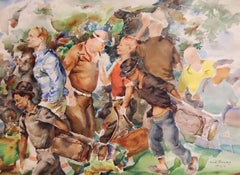
Golfers
By Frederick Conway
Located in Missouri, MO
Golfers, 1928
Fred Conway (American, 1900-1973)
Signed and Dated Lower Right
18.5 x 24.5 inches
30.5 x 37 inches with frame
A member of the faculty of the Washington University Art ...
Category
1920s American Modern Figurative Drawings and Watercolors
Materials
Paper, Watercolor
Price Upon Request
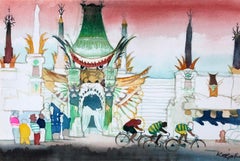
Chinese Theater, Los Angeles
By Dong Kingman
Located in Missouri, MO
Dong Kingman
"Chinese Theater, Los Angeles" 1965
Watercolor on Paper
Sheet Size: 15 x 22 inches
Framed Size: approx 19 x 26 inches
Dong Kingman, the world-renowned artist and teacher, died in his sleep on May 12, 2000 at age 89 in his home in Manhattan. The cause was pancreatic cancer.
Long acknowledged as an American watercolor master, he has received an extraordinary number of awards and honors throughout his 70-year career in the arts. Included are two Guggenheim fellowships in 1942 and 1943; the San Francisco Art Association First Purchase Prize, 1936; Audubon Artist Medal of Honor, 1946; Philadelphia Watercolor Club Joseph Pennel Memorial Medal, 1950; Metropolitan Museum of Art Award, and the National Academy Design 150th Anniversary Gold Medal Award, 1975.
In 1987, the American Watercolor Society awarded Dong Kingman its highest honor, the Dolphin Medal, "for having made outstanding contributions to art especially to that of watercolor."
His work is represented in the permanent collections of 50 museums and universities, including the Boston Museum of Fine Arts, M.H. deYoung Memorial Museum of Art, the Metropolitan Museum of Art, the Whitney Museum, Museum of Modern Art, Art Institute of Chicago, Pennsylvania Academy of Fine Arts, Sheldon Memorial Art Gallery and Sculpture Garden, Des Moines Art Center, Columbus Museum of Arts and Crafts, Brooklyn Museum and Hirshhorn Museum.
Born in Oakland, California in 1911 of Chinese descent, Kingman moved to Hong Kong at age five. He studied art and calligraphy in his formative years at the Lingnan School. The painting master Szeto Wai had recently studied art in Paris and took a keen interest in young Dongs precocious talents. He taught him both Chinese classical and French Impressionist styles of painting. Kingman returned home to Oakland when he was 18 at the height of the Depression. He worked as a newsboy and dishwasher to make ends meet.
When he was employed as a houseboy for the Drew family in San Francisco, he painted every spare moment. In a year, he created enough pictures to have a one-man show at the Art Center. It attracted the attention of San Francisco art critics who raved about Kingmans unique style. Wrote Junius Cravens of the San Francisco News: "That young Chinese artist is showing 20 of the freshest and most satisfying watercolors that have been seen hereabouts in many a day Kingman already has developed that universal quality which may place a sincere artist work above the limitations of either racial characteristics or schools. Kingmans art belongs to the world at large today." Dong Kingman became an overnight success.
From 1936 to 1941, he was a project artist for WPA and became a pioneer for a new school of painting, the "California Style." His two Guggenheim fellowships enabled him to travel the country painting American scenes. His first one-man show in New York at Midtown Galleries in 1942 was well received in the media, including Time, Newsweek, the New Yorker and American Artist. M.H. de Young Memorial Museum in San Francisco held a major exhibit of his watercolors in 1945.
In 1951, Midtown presented a 10-year retrospective of his work. Time Magazine wrote, "At age 40, Kingman is one of the worlds best watercolorists." Other retrospectives, including Corcoran in Washington,D.C. an d Witte Memorial Museum in San Antonio, were held for the artist. Kingman moved to Wildenstein (1958-1969) where he had successful exhibits in New York, London and Paris. Hammer Galleries exhibited his paintings in the 70s, and then the artist expanded his venues to the West Coast and Far East.
During World War II, he served with the OSS in Washington, D.C. where he was a cartographer. After his honorable discharge, Kingman moved to Brooklyn Heights from San Francisco when he became a guest lecturer and then art instructor at Columbia University (1946-1958). Hunter College also appointed him instructor in watercolors and Chinese Art (1948-1953). His teaching career continued with the Famous Artists School, Westport, CT in 1953, joining such distinguished artists on the faculty as Will Barnet, Stuart Davis, Norman Rockwell and Ben Shahn.
He also became a teaching member for 40 years for the Hewitt Painting Workshops, which conducts worldwide painting tours. He taught at the Academy of Art College in San Francisco, was a member of its board, and received an honorary doctorate from the Academy.
In 1954, the U.S. Department of State invited Kingman to go on a cultural exchange program tour around the world to give exhibitions and lectures and to meet local artists. When he came home, he presented the State Department with a 40-foot long report on a scroll, which later appeared in LIFE Magazine.
One of Kingman's most treasured experiences was his invitation by the Ministry of Culture of the Peoples Republic of China to exhibit in that country in 1981. He was the first American artist to be accorded a one-man show since diplomatic relations resumed. More than 100,000 visitors attended his exhibitions in Beijing, Hangzhou and Guangzhou and the retrospective received critical acclaim from the Chinese press. Noted the China Daily Mail, "Just as the master painters of the Song Dynasty roamed about mountain and stream to capture the rhythm of nature, Dong Kingman traveled the world capturing the dynamism of modern lifefamiliar scenes have been transformed into a vibrant new vision of life through color schemes with rhythms that play over the entire surface of the picture. The wind swept skies which enliven his watercolors remind us of the pleinairism of the French Impressionists."
Kingman, who has been fascinated with movies since seeing his first film "The Thief of Baghdad...
Category
1960s American Modern Landscape Drawings and Watercolors
Materials
Paper, Watercolor
Price Upon Request