Items Similar to Impressionistic Portrait of the Equestrian Artist Baptista Schreiber - Drawing
Want more images or videos?
Request additional images or videos from the seller
1 of 11
Gosta von HennigsImpressionistic Portrait of the Equestrian Artist Baptista Schreiber - Drawing1910-1920
1910-1920
$776.54
£580.35
€650
CA$1,071.27
A$1,173.38
CHF 617.78
MX$14,003.86
NOK 7,873.09
SEK 7,197.19
DKK 4,954.39
About the Item
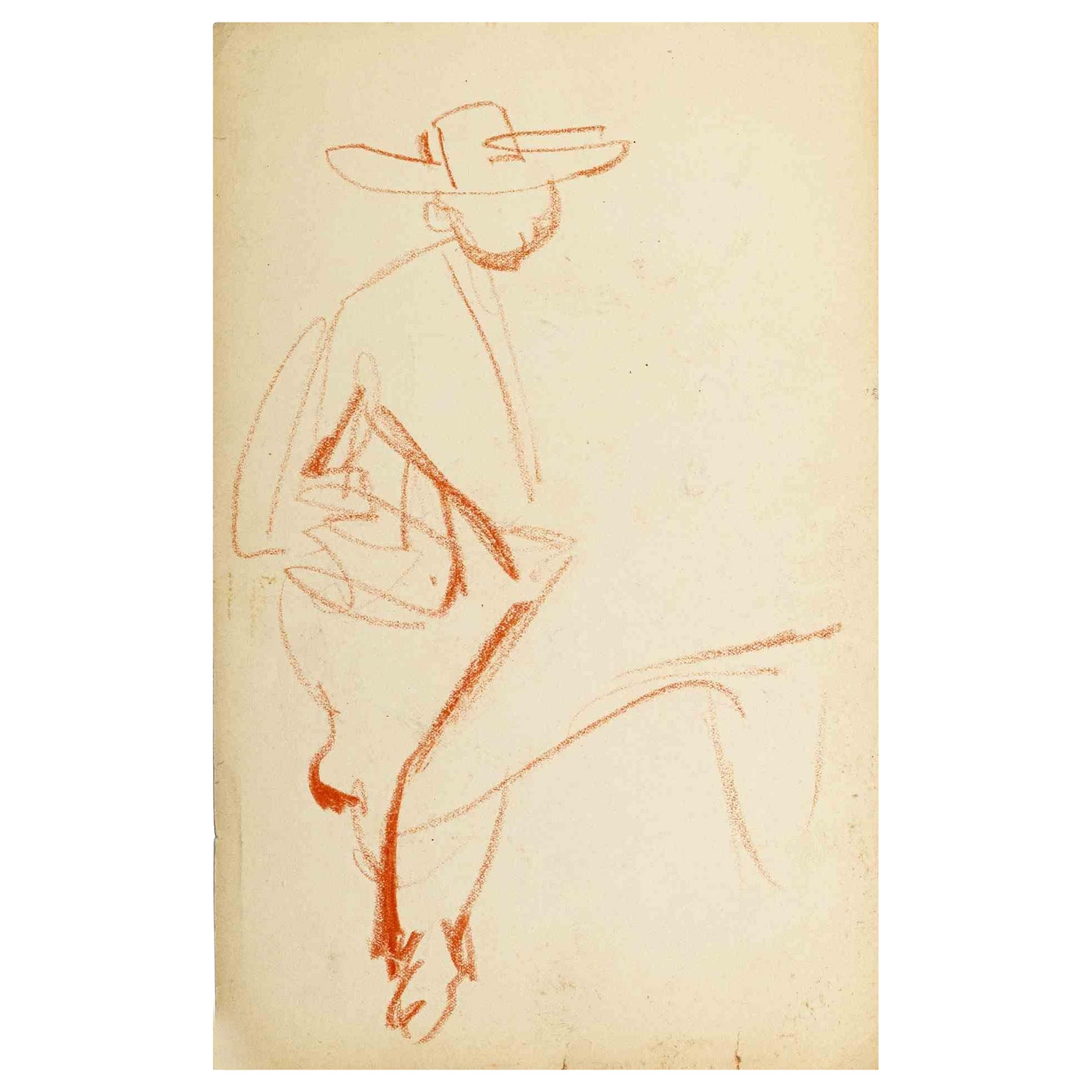
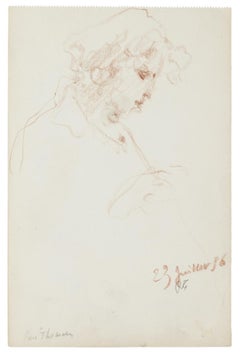
This expressive and atmospheric graphite drawing by Gösta von Hennigs (1866–1941) portrays the celebrated equestrian artist Baptista Schreiber within the charged setting of a circus manège. In the foreground, Schreiber is captured in an impressionistic moment of motion, her head turned toward her horse Menelik, which is only faintly suggested in the background. Behind her, her partner stands ready to lift her onto the horse, reinforcing the sense of immediacy and preparation before performance. On the reverse (a tergo), Schreiber is depicted riding her horse Menelik in the arena, wearing a striking feathered headdress. The audience appears schematically in the background, while to the right stands a male figure, possibly the circus director or presenter. The drawing is possibly a study for a painting, probably executed around 1905- 1915, and demonstrates von Hennigs’s assured command of line and movement, as well as his keen interest in performers and modern spectacle. The back panel has an old note describing the present drawing and attesting the artist, signed by Sven Petersohn, artexpert and one of the authors of the Swedish National Encyclopedia of Swedish artists. It is not signed.
Carl Gustaf Albert von Hennigs (1866-1941) was a Swedish painter whose career spans the transition from late 19th-century Impressionism to a highly personal engagement with modern urban and performative life.
Von Hennigs received his artistic training at the Artists’ Association School (Konstnärsförbundets skola) between 1891 and 1893, where he studied under Richard Bergh, Per Hasselberg, and Anders Zorn. During his early career, he painted street scenes, and focused on Stockholm motifs rendered in an impressionistic manner. He was an active member of the Artists’ Association (Konstnärsförbundet) and participated in many of its exhibitions until the organisation was dissolved in 1920.
From the early 1900s, von Hennigs gradually moved away from purely urban landscapes and developed a distinctive new subject matter. From around 1903 onwards, he increasingly drew inspiration from the world of the circus, the arena, and the manège, a thematic focus that earned him the epithet “the circus painter.” His works from this period depict acrobats, riders, jugglers, and clowns, executed in oil and watercolour. These compositions are marked by strong, vibrant colours and an impressionistic handling that emphasises movement, rhythm, and spectacle.
Stylistically, von Hennigs evolved from Impressionism toward a more decorative expression, influenced in part by Japanese colour woodcuts. His choice of viewpoints and compositional cropping often recalls Edgar Degas, particularly in the way figures are captured mid-motion and seen from unconventional angles. This approach allowed him to convey the fleeting, dynamic nature of performance with immediacy and visual intensity.
The Artists’ Association exhibition in Stockholm in 1912 marked a major breakthrough in his career. Prince Eugen purchased nine of his works at the exhibition, which were subsequently incorporated into the collection at Prins Eugens Waldemarsudde.
Von Hennigs’s reputation as an artist of movement and light was summarised in Svenska Dagbladets Yearbook in 1941, which noted his particular strength in capturing motion and the interplay of light and colour, while also observing a certain coolness in his work, arising from a strong focus on visual sensation despite the temperament of his motifs.
In addition to his artistic practice, von Hennigs played an important role in Swedish art education. He served as acting professor at the Royal University College of Fine Arts (Konsthögskolan) in Stockholm from 1928 to 1933. Today, Gösta von Hennigs is regarded as a key figure in Swedish early modern painting, especially celebrated for his vivid and innovative depictions of circus and performance life.
His works can be found in the Swedish National Museum, Modern museum of art, Prince Eugen Waldemarsudde and others.
Baptista Schreiber’s fame as an equestrian artist cannot be fully understood without placing her celebrated horse Menelik at the centre of her life and career. Schreiber, also known as Mijares-Schreiber, was the owner and trainer of Menelik, a white Arabian stallion who came to be regarded as the most famous circus horse in Sweden. Their partnership symbolized the height of artistic horsemanship in the early 20th century, when the bond between rider and horse was central to the show.
Menelik arrived in Schreiber’s life under extraordinary circumstances. In 1914, he was presented to her as a gift from Queen Alexandra of Great Britain and the British royal court, an exceptional gesture that reflects both Schreiber’s international reputation and the prestige surrounding her performances. The stallion was named after Emperor Menelik II of Ethiopia, a name that further enhanced the horse’s aura of strength, nobility, and exotic distinction.
Menelik’s death in 1931 caused widespread public attention and marked the end of an era. Together, their story has become part of Swedish cultural memory, illustrating how artistic performance, personal attachment, and public recognition could intersect in a way that elevated a circus horse to the level of a national icon.
- Creator:Gosta von Hennigs (1866 - 1941, Swedish)
- Creation Year:1910-1920
- Dimensions:Height: 15.36 in (39 cm)Width: 13 in (33 cm)Depth: 0.79 in (2 cm)
- Medium:
- Movement Style:
- Period:
- Condition:The drawing is in good condition. The paper has turned slightly brown. It has presently an acid free mounting.
- Gallery Location:Stockholm, SE
- Reference Number:1stDibs: LU2608217370262
About the Seller
5.0
Gold Seller
Premium sellers maintaining a 4.3+ rating and 24-hour response times
1stDibs seller since 2023
33 sales on 1stDibs
Typical response time: <1 hour
- ShippingRetrieving quote...Shipping from: Stockholm, Sweden
- Return Policy
More From This Seller
View AllPortrait of a Romani Woman - 19th Century Drawing
Located in Stockholm, SE
A graphite profile portrait drawing of a woman on paper by Johannes Collin (1873-1951), signed “Johannes Collin 98” and titled “Zigenerska”. This early and unusual work by Collin presents his interest in refined drawing and capturing character even at a modest scale. It dates from 1898, a formative moment for the artist when he was studying arts and stands out as a somewhat rare example of his graphic or drawing work rather than his better known small bronzes.
Johannes Collin was born in 1873 in Skåne, south Sweden.
After passing his matriculation at the Cathedral School in Lund in 1892, he studied at university in 1894–96 and then turned to art studies.
From 1899 to 1901 he studied at the Royal Academy of Fine Arts in Stockholm, and from 1903 to 1905 he studied sculpture in Paris.
Collin settled in Lund, Skåne and pursued a career as sculptor and poet. He died in 1951 in Lund.
He was the son of a farmer and raised in the Skåne countryside. Early on he developed a sensitivity to form, figure, and expression, combining his sculptural ambitions with literary leanings (he later published a small volume of poetry).
Collin appears to have had an individualistic personality: he moved in student and artistic circles in Lund, but also kept a modest, sometimes even eccentric public persona. In the mid-1930s, he increasingly turned to poetry and pared back his three-dimensional work.
From his early years, he gradually developed into a sculptor working in bronze and patinated materials. Much of his work consists of small‐scale bronzes with an intensity of expression. One critic (in Kulturens yearbook) wrote of Collin that “the monumental is not in the work’s external dimensions but in the attitude … your small sculptures have an inner monumentality”.
Collin exhibited his works in various venues: for example he took part in the Lund Exhibition (“Lundautställningen”) in 1907.
Internationally, he showed works in Munich in 1909 and 1913, where his efforts were positively reviewed.
A noteworthy retrospective or exhibition was held at the museum Kulturen in Lund, when a donation of Collin’s sculptures...
Category
1890s Other Art Style Portrait Drawings and Watercolors
Materials
Paper, Graphite
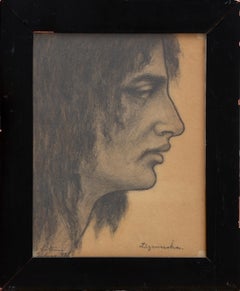
Cavalry Officer on his Horse
Located in Stockholm, SE
A finely worked watercolour on paper depicts a mounted cavalry officer—formal in bearing and costume—painted with the delicate clarity for which Egron Lundgren is best known. The she...
Category
Mid-19th Century Other Art Style Animal Drawings and Watercolors
Materials
Paper, Watercolor
Profile Portrait of Sitting Woman by Window - Charcoal and Opaque White 1910´s
Located in Stockholm, SE
A finely tuned oval drawing by the Finnish artist Ester Helenius depicting a young woman in profile seated on a chair. The room is suggested only by a diffuse background. Signed and ...
Category
1910s Jugendstil Portrait Drawings and Watercolors
Materials
Paper, Charcoal, Gouache
Portrait Gustav Wilhelm Palm - 19th Century Pencil and Pastel on Paper
Located in Stockholm, SE
Portrait of Gustaf Wilhelm Palm (1810–1890) by Lorenz Frølich (1820-1908)
Signed with monogram and dated May 1849. Pencil and pastel on paper. 29.5 × 21 cm.
This portrait of the Swed...
Category
1840s Naturalistic Portrait Drawings and Watercolors
Materials
Paper, Pastel, Carbon Pencil
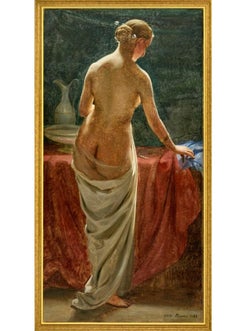
19th Century Neoclassical Scene - Psyche, Oil on Canvas
By Otto Bache
Located in Stockholm, SE
In this neoclassical oil on canvas signed and dated “Otto Bache 1864”, the artist depicts Psyche standing with her back turned to the viewer beside a red draped table. Her hair is arranged in a tight knot, secured with a hairpin adorned with two large pearls. She holds a light drapery that covers her legs, while the rest of her body remains nude. With her head turned toward the right, she gazes downward toward the table, where a blue gown or drapery lies, the garment she is about to put on.
Her softly illuminated profile emerges as she turns in the light falling from the upper left, creating a striking backlight that heightens the contrast along the contours of her body. On the richly red draped table before her rest her jewellery and, to her left, a large amphora-shaped jug and a tazza bowl. The light descending from above to the left defines the composition with sharp contrasts between brightness and shadow, revealing the delicate modelling of Psyche’s form and lending the scene a quiet sense of introspection and grace.
Exhibited: Winkel & Magnussen October 1915 no. 5, ill. p. 5.
Otto Bache was born in 1839 in Roskilde, Denmark, and died in 1927 in Copenhagen.
At the age of only eleven he was admitted to the Royal Danish Academy of Fine Arts in Copenhagen where he studied drawing and painting under the supervision of artists such as Wilhelm Marstrand. His early training gave him a basis in the Danish “Golden Age” tradition of realism and naturalism, but he went on to travel and extend his horizons. In 1866 he received an Academy travel-scholarship and went to Paris, then Italy (1867–68).
The influence of Paris is often noted: his palette became richer, his handling freer, his light stronger, and his subjects broader. Later in his career, from around 1887, he held the post as professor and on various occasions director of the Royal Danish Academy.
Bache’s early work reflects his rigorous academic training: careful drawing, subdued palette and interest in genre scenes and rural life. After his travel in Paris and Italy he adopted a somewhat more robust handling of color and light, but still remained essentially realist and narrative in approach.
He painted portraits, animal and hunting subjects, genre scenes, and large history-paintings depicting key moments from Danish history.
In particular, during the 1880s and 1890s when he was commissioned to execute large history canvases for the Museum of National History at Frederiksborg Castle and similar institutions, depicting events such as the exploits of Danish soldiers...
Category
1860s Other Art Style Figurative Paintings
Materials
Oil
Russian Princess Olga Meyendorff, born Gorchakov - 19th Century Portrait
Located in Stockholm, SE
Portrait of Princess Olga Gorchakov by female 19th century artist Elise Hügel.
An oval portrait of Princess Olga Gortschakoff (1838–1926), here pictured soon after her marriage to Baron Friedrich Adeldagus Felix von Meyendorff, becoming Baroness von Meyendorff, signed Elise Hügel and dated 1858. Executed in oil on canvas, the work shows a young Olga in her early 20´s...
Category
1850s Other Art Style Portrait Paintings
Materials
Canvas, Oil
You May Also Like
Portrait - Pencil Drawing on Paper - Mid-20th Century
Located in Roma, IT
Portrait is an original Pencil drawing on paper, realized by an anonymous artist in the Mid-20th Century. With another drawing on the rear.
Good conditions.
Category
Mid-20th Century Modern Figurative Drawings and Watercolors
Materials
Pencil
Portrait - Charcoal Drawing By Pierre Georges Jeanniot - Early 20th Century
By Pierre Georges Jeanniot
Located in Roma, IT
Portrait is an original Drawing on paper realized by the painter Pierre Georges Jeanniot (1848-1934).
Drawing in Pencil.
Hand-signed on the lower.
Good conditions except for aged ...
Category
Early 20th Century Modern Portrait Drawings and Watercolors
Materials
Pencil
Portrait of a Lady - Drawing by Hermann Paul -1890s
Located in Roma, IT
Portrait of a Lady is a Pencil Drawing realized by Hermann Paul.
Hand signed on the lower left corner. Passpartout included cm 51x35
Good condition.
René Georges Hermann-Paul (27...
Category
1890s Modern Figurative Drawings and Watercolors
Materials
Paper, Pencil
Portrait of a Woman - Original Charcoal Drawing - Early 20th Century
Located in Roma, IT
Portrait of a Woman is an original artwork realized by an Unknown Artist.
Gray point drawing and unsigned watercolor, written behind CH.L. Paper pasted on cardboard. Image Dimensio...
Category
Early 20th Century Modern Figurative Drawings and Watercolors
Materials
Paper, Pencil
Study for a Portrait - Original Pencil Drawing - 20th Century
Located in Roma, IT
"Study for a Portrait" is an original drawing in tempera on paper, realized by an Anonymous French Artist of the XX Century .
The state of preservation of the artwork is very good.
...
Category
20th Century Modern Figurative Drawings and Watercolors
Materials
Pencil
Equestrienne
, Salon d’Automne, Musée du Luxembourg, French Post-Impressionism
By Henri Ottmann
Located in Santa Cruz, CA
Signed lower right, 'Henry Ottmann' (French, 1877-1927) and created circa 1915.
An elegant pencil and ink-wash drawing showing two women conversing, one seated side-saddle on horse ...
Category
1910s Figurative Paintings
Materials
Paper, India Ink, Pencil
