Items Similar to The Death of Adonis, a neoclassical drawing by Jean-Guillaume Moitte (ca. 1785)
Want more images or videos?
Request additional images or videos from the seller
1 of 11
Jean-Guillaume MoitteThe Death of Adonis, a neoclassical drawing by Jean-Guillaume Moitte (ca. 1785)ca. 1785
ca. 1785
$5,731.15
£4,200.18
€4,750
CA$7,866.29
A$8,312.04
CHF 4,470.26
MX$99,510.54
NOK 56,007.10
SEK 51,294.37
DKK 36,186.48
About the Item
This elegant composition, whose curved shape suggests that it was intended for some decorative project, illustrates Moitte's shift around 1780 towards the neoclassical movement, inspired by the canons of the late Renaissance.
1. Jean-Guillaume Moitte painter, sculptor, draftsman, ornamentalist, illustrator, and engraver
Born in Paris in 1746, Jean-Guillaume Moitte was first trained in the studio of his father, a renowned engraver. Having decided to devote himself to sculpture, he then studied under Jean-Baptiste Pigalle and Jean-Baptiste II Lemoyne. In 1768, his sculpture depicting David carrying the head of Goliath in triumph earned him the first Prix de Rome in sculpture.
During his stay at the Villa Medici, Moitte discovered Roman antiquity and copied numerous ornamental elements, as well as all the bas-reliefs on Trajan's Column. Unfortunately, he had to cut short his stay in Rome for health reasons, but the documentation he gathered during his stay provided him with an inexhaustible source of inspiration.
Back in Paris, Jean-Guillaume Moitte began painting and sculpting in the Baroque style, which was still in vogue at the time. He also worked for the king's goldsmith, Henri Auguste, to whom he delivered numerous silverware designs. But he soon found his true style. Influenced by the works he had admired in Rome, Moitte became one of the first artists to promote the neoclassical movement.
In 1782, he was hired by the architect Pierre Rousseau to work with the sculptor Philippe-Laurent Roland on all the sculptures and ornamental elements for the Hôtel de Salm. In 1785, he produced neoclassical illustrations for the reissue of Fénelon's The Adventures of Telemachus.
In 1789, Moitte, who had always been very close to the philosophy of the Enlightenment, embraced the ideas of the French Revolution and put his art at the service of the new regime. In 1790, he was commissioned to create a statue of Jean-Jacques Rousseau, which was erected on the terrace of the Tuileries (now in the Carnavalet Museum). After the Reign of Terror, Jean-Guillaume Moitte's refined neoclassicism remained in favor. The artist produced monumental sculptures, including an equestrian statue of General Bonaparte.
Bonaparte entrusted him with the design of the funerary monument dedicated to Desaix, erected at the Great Saint Bernard Pass, the site of the general's burial.
Under the Consulate and then the Empire, Moitte continued to enjoy success, as evidenced by the commission for bas-reliefs for the Cour Carrée of the Louvre. The École des Beaux-Arts in Paris appointed him professor of sculpture on December 20, 1809. He died in 1810.
2. A mythological subject treated in the neoclassical style
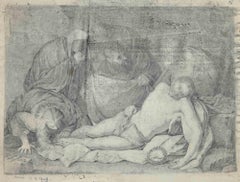
Adonis, a mere mortal of great beauty, had inspired the love of Aphrodite, the goddess of love. One day, while hunting in the Idalean forest , Adonis was mortally wounded in the leg by the boar he had shot. Continuing the classical decorative tradition dating back to the Renaissance, our design depicts the tragic moment when Aphrodite discovers the lifeless body of her lover, mortally wounded and lying on the ground.
Aphrodite has knelt down to lift Adonis's body, lovingly supporting his head with her right hand. Her tense facial expression betrays her pain at the sight of her lover's lifeless body, with his two spears, now useless, lying beside him.
Our drawing is finely executed in pen and black ink on brown paper; the modulations of the muscles and clothing of our two protagonists are delicately rendered with highlights of white gouache, complemented by a few touches of brown ink wash.
The figure of Adonis is reminiscent of the dead Christ as seen in countless Pietàs, giving this scene an almost religious connotation. The characteristic elongation of Adonis' legs and Aphrodite's left arm also provides them with a Mannerist grace.
3. Framing
Our drawing is presented in a sober Louis frame in carved and gilded wood, whose rigor harmonizes perfectly with this contemplative neoclassical atmosphere.
- Creator:Jean-Guillaume Moitte (1746 - 1810, French)
- Creation Year:ca. 1785
- Dimensions:Height: 11.75 in (29.85 cm)Width: 13.75 in (34.93 cm)Depth: 1.3 in (3.31 cm)
- Medium:
- Movement Style:
- Period:1780-1789
- Condition:Pen and black ink, brown wash enhanced with white, on curved brown paper Dimensions: 4 3/4 x 7 1/8 in (112 x 181 mm) – Framed : 11 ¾ x 13 ¾ in (30 x 35 cm) Signed lower right "Moitte" and annotated "The Death of Adonis" Period Louis XVI frame.
- Gallery Location:PARIS, FR
- Reference Number:1stDibs: LU1568217286012
About the Seller
5.0
Vetted Professional Seller
Every seller passes strict standards for authenticity and reliability
Established in 2020
1stDibs seller since 2021
11 sales on 1stDibs
Typical response time: 3 hours
- ShippingRetrieving quote...Shipping from: PARIS, France
- Return Policy
More From This Seller
View AllA rare neoclassical drawing by Jean-Pierre Péquignot, Girodet
s friend
Located in PARIS, FR
This neoclassical frieze, executed with great meticulousness in pen and ink, is a moving and rare testimony to the work of Jean-Pierre Péquignot, an extremely talented and particular...
Category
1790s Old Masters Figurative Drawings and Watercolors
Materials
Paper, Ink, Felt Pen
Allegory of the Treaty of Angoulême, a drawing attributed to Donato Mascagni
Located in PARIS, FR
We would like to thank Mrs. Ursula Verena Fischer Pace for suggesting the attribution to Donato Arsenio Mascagni.
We were immediately seduced by the rich tonalities of this allegory...
Category
1620s Old Masters Figurative Drawings and Watercolors
Materials
Ink
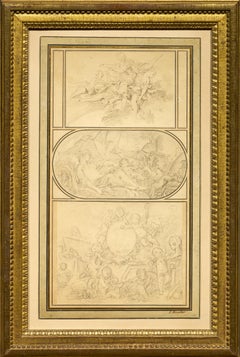
Three drawings by François Boucher in a mounting by Jean-Baptiste Glomy
By François Boucher
Located in PARIS, FR
We would like to thank Juliette Parmentier-Courreau of the Custodia Foundation for her welcome and support during the consultation of Glomy’s Journal des Ouvrages.
This spectacularly large "feuille de desseins ajustés" commissioned by François Boucher from Jean-Baptiste Glomy is emblematic of the painter's art and mastery of rocaille. It is also fully representative of the taste of this period in the field of decorative arts. The largest of these three drawings, placed at the bottom of the composition, is particularly interesting: dating from around 1756, it constitutes a modello (apparently unpublished) for the frontispiece of the "Catalogue des tableaux de Monsieur de Julienne"), preserved in the Morgan Library in New York.
1. François Boucher, the master of French rocaille
The extraordinary career of Francois Boucher was unmatched by his contemporaries in versatility, consistency and output. For many, particularly the writers and collectors who led the revival of interest in the French rococo during the last century, his sensuous beauties and plump cupids represent the French eighteenth century at its most typical. His facility with the brush, even when betraying the occasional superficiality of his art, enabled him to master every aspect of painting – history and mythology, portraiture, landscape, ordinary life and, as part of larger compositions, even still life. He had been trained as an engraver, and the skills of a draftsman, which he imbued in the studio of Jean-Francois Cars (1661 – 1738), stood him in good stead throughout his career; his delightful drawings are one of the most sought-after aspects of his oeuvre.
As a student of Francois Lemoyne (1688 - 1737), he mastered the art of composition. The four years he spent in Italy, from 1727-1731, educated him in the works of the masters, classics and history, that his modest upbringing had denied him.
On his return to Paris in 1734, he gained full membership of the Royal Academy of Painting and Sculpture with his splendid Rinaldo and Armida (Paris, Musée du Louvre). Although, throughout his career, he occasionally painted subjects taken from the Bible, and would always have considered himself first as a history painter, his own repertoire of heroines, seductresses, flirtatious peasant girls and erotic beauties was better suited to a lighter, more decorative subject matter. His mastery of technique and composition enabled him to move from large scale tapestry...
Category
1750s Old Masters Figurative Drawings and Watercolors
Materials
Chalk, Ink
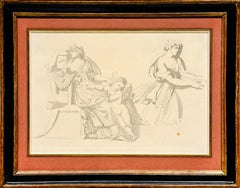
Frieze of antique figures, a drawing by the sculptor Antoine-Denis Chaudet
Located in PARIS, FR
Faithful to the neo-classical taste, sculptor Antoine-Denis Chaudet presents us with a frieze of antique figures executed in gray wash over pencil strokes, which is likely inspired b...
Category
Early 1800s Old Masters Figurative Drawings and Watercolors
Materials
Paper, Ink, Pencil
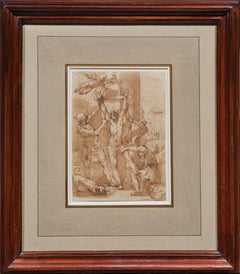
The Martyrdom of Saint Bartholomew, a preparatory drawing by Alessandro Casolani
Located in PARIS, FR
This powerful pen and brown ink wash drawing is a study for an altarpiece depicting The Martyrdom of Saint Bartholomew. Signed and dated 1604, it was painted at the end of his life b...
Category
Early 1600s Old Masters Figurative Drawings and Watercolors
Materials
Ink, Pen
Mercury and Io, a rediscovered painting by Jean-Baptiste Marie Pierre (ca. 1740)
Located in PARIS, FR
We would like to thank Mr. Nicolas Lesur for confirming the autograph nature of the entire composition after a direct examination of the painting on November 27, 2024.
This painting...
Category
1740s Old Masters Figurative Paintings
Materials
Canvas, Oil
You May Also Like
The Death of Attis, 18th Century French Red Chalk Drawing, Greek Mythology
Located in London, GB
Red chalk on paper
Image size: 9 x 7 inches (23 x 17.75 cm)
Acid free mount
The Greek god Attis was the spouse of Cybele, the fertility goddess. He was from Phrygia, a kingdom in c...
Category
18th Century French School Figurative Drawings and Watercolors
Materials
Chalk
Allegorical Scene - Sepia Drawing Attribute to L.F. Dubourg -Early 1700
Located in Roma, IT
Allegorical Scene is an original modern artwork attributed to the Louis Fabricius Dubourg in the first half of the XVIII Century.
Original sepia drawing...
Category
Early 18th Century Figurative Drawings and Watercolors
Materials
Ink
The Death of Coresus
By Jean-Baptiste Greuze
Located in Paris, Île-de-France
JEAN-BAPTISTE GREUZE
(Tournus 1725 - 1805 Paris)
The Death of Coresus, circa 1750
Pen and brown ink, black ink tips, gray wash on black chalk, 455 x 385 cm
Bears on the reverse in ...
Category
18th Century Old Masters Figurative Drawings and Watercolors
Materials
Ink, Watercolor
Louis-Félix de La Rue (1730-1777) A Mythological scene, drawing
By Louis-Félix Delarue
Located in Paris, FR
Louis-Félix de La Rue (1730-1777)
A Mythological scene
Pen and black ink on paper
Bears an old inscription with the name of the artist on the lower left bo...
Category
1770s Old Masters Figurative Drawings and Watercolors
Materials
Ink
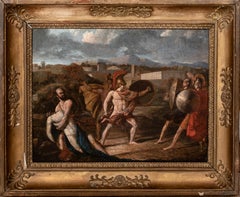
The Death Of Patroclus, 18th Century School of Jacques-Louis David (1748-1825)
By Jacques-Louis David
Located in Blackwater, GB
The Death Of Patroclus, 18th Century
School of Jacques-Louis David (1748-1825)
18th Century French Neo-Classical scene of the Death Of Patroclus, oil on panel. Excellent quality an...
Category
18th Century Portrait Paintings
Materials
Oil, Wood Panel
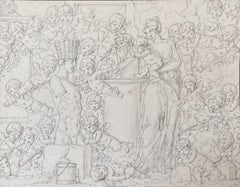
Dead Jesus - Drawing By August Anton Tischbein - 19th Century
By August Anton Tischbein
Located in Roma, IT
Dead Jesus is an Original pencil drawing realized by August Anton Tischbein in 19th century.
The artwork is in good condition.
No signature, numbered on the upper right corner n. 3...
Category
19th Century Modern Drawings and Watercolor Paintings
Materials
Pencil