Items Similar to Eighteenth century Old Master drawing - Apollo destroying Niobe
s children
Want more images or videos?
Request additional images or videos from the seller
1 of 5
John Hamilton MortimerEighteenth century Old Master drawing - Apollo destroying Niobe
s childrenc.1765
c.1765
$6,828.26
£5,000
€5,820.31
CA$9,407.18
A$10,252.17
CHF 5,428.97
MX$123,139.34
NOK 68,731.90
SEK 63,192.22
DKK 43,471.24
About the Item
Pen, ink and wash
Framed dimensions: 13 x 11 ¼ inches
Drawn c.1765
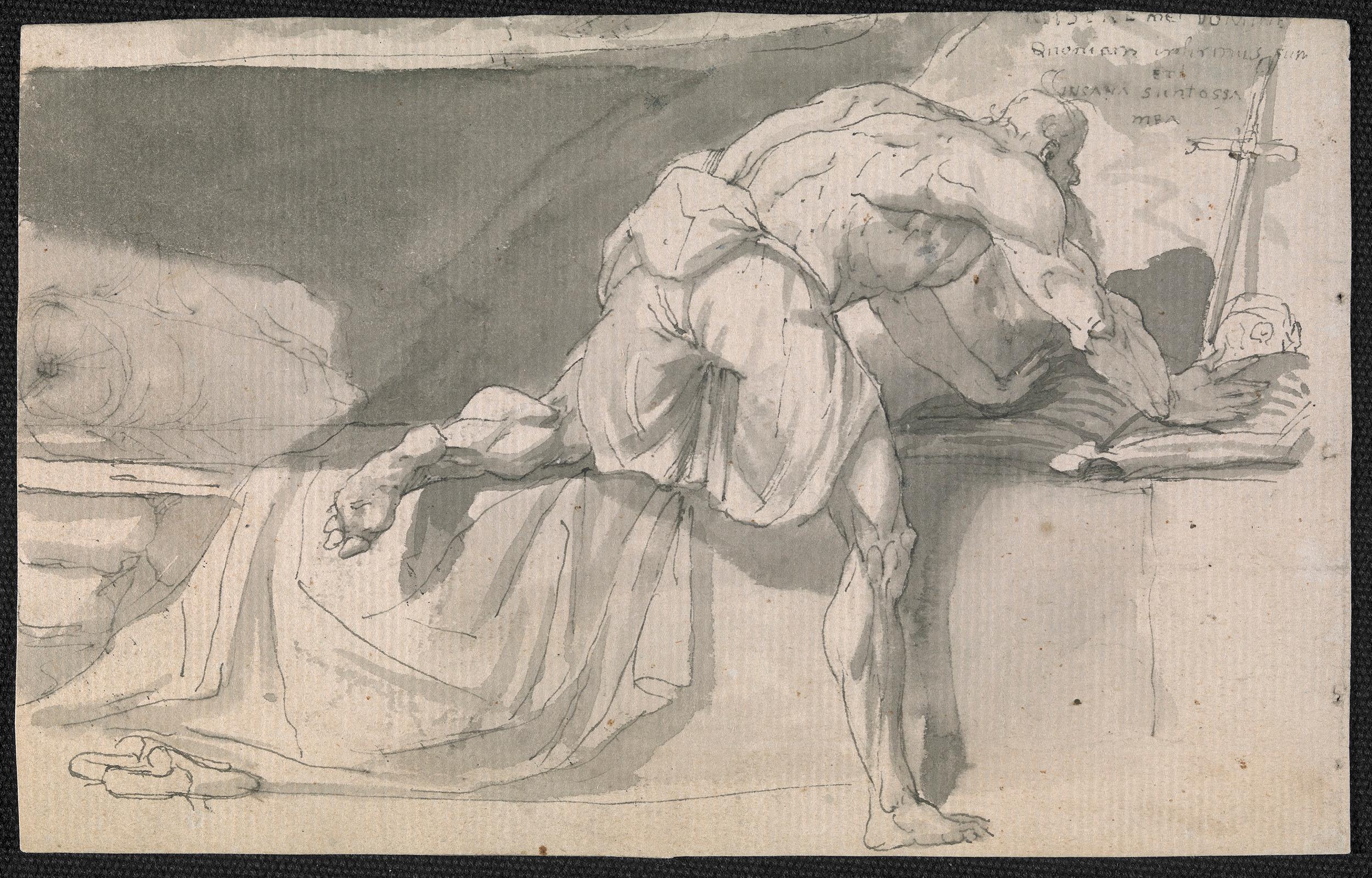
Verso: a study of a hanged man
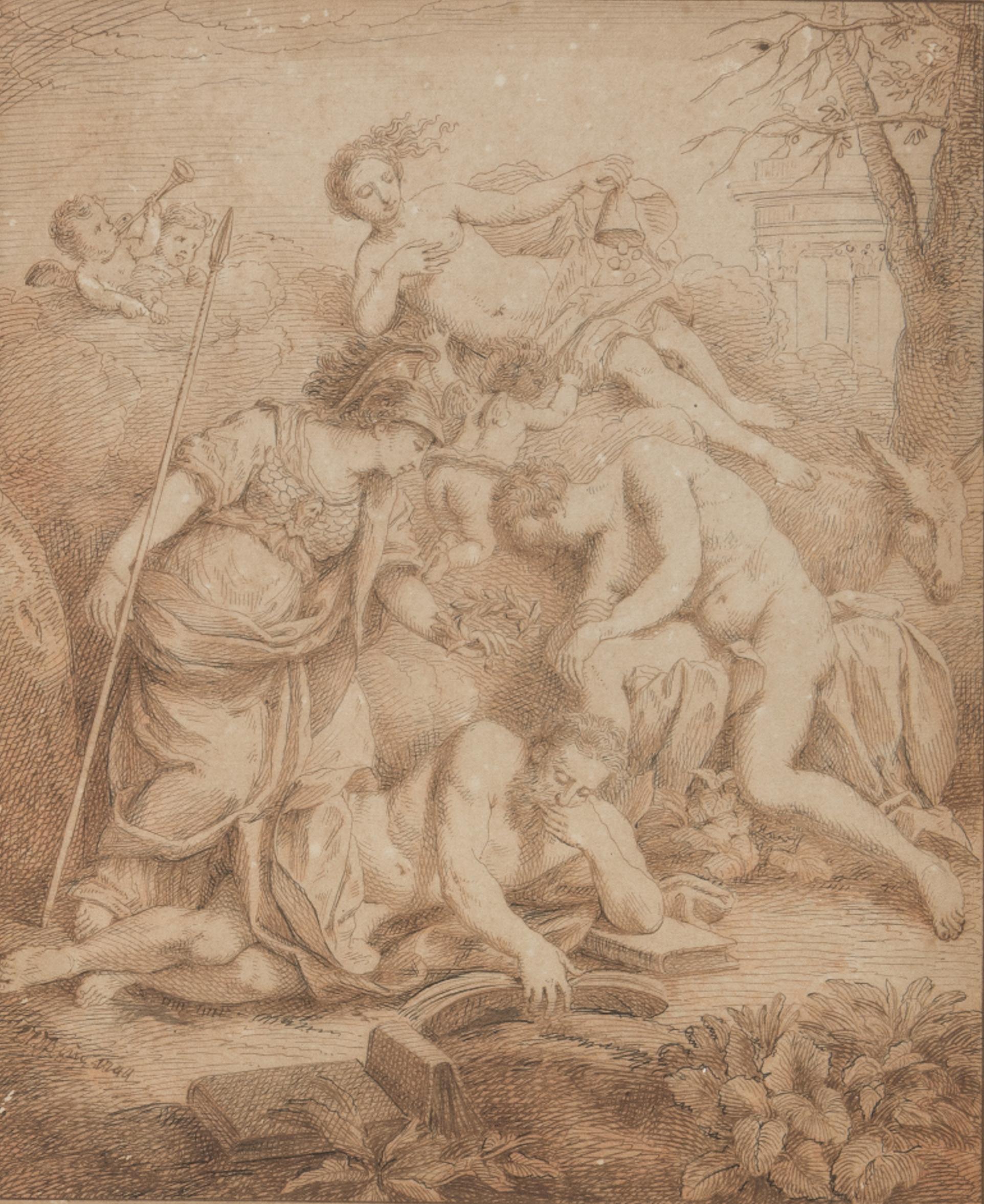
Mortimer has filled this small sheet with action, depicting in the top right, Apollo and Artemis destroying the children of Niobe, in the bottom a hermit-like saint, dressed in rags and contemplating a holy book, with a band of banditti suggested on the left. On the verso, there is a rapid black chalk sketch of a hanged man. The depiction of Apollo and Artemis in the act of destroying the children of Niobe recalls the work of Mortimer’s friend, Richard Wilson and may offer supporting evidence to a statement by Henry Angelo:
‘Mortimer and Wilson, though dissimilar in their general habits, were great cronies at this period: so much so, indeed, that Mortimer painted for his ingenious colleague the figures in the clouds and those on earth, in his famous picture of the Niobe… Nothing, to be sure, could be more like mere daubing than the figures of Wilson’s painting, generally.’
Whilst the idea that Mortimer had any involvement in Wilson’s depictions of Niobe has never been taken seriously, this drawing points to his awareness of the finished composition, the figures being close to those added by Placido Costanzi to at least one version of the painting. Mortimer did alter the figures in another of Wilson’s historical landscapes, his Meleager and Atalanta. Whilst the present drawing does not confirm Mortimer’s involvement with Wilson’s painting, it suggests that his friendship with Wilson and Thomas Jones meant he was actively thinking about the figural groups in their historical works.
- Creator:John Hamilton Mortimer (1740 - 1779, English)
- Creation Year:c.1765
- Dimensions:Height: 7.63 in (19.39 cm)Width: 6.13 in (15.58 cm)
- Medium:
- Movement Style:
- Period:
- Condition:
- Gallery Location:London, GB
- Reference Number:1stDibs: LU150728412212
John Hamilton Mortimer
John Hamilton Mortimer was a British figure and landscape painter and printmaker, known for romantic paintings set in Italy, works depicting conversations and works drawn in the 1770s portraying war scenes, similar to those of Salvator Rosa. Mortimer became President of the Society of Artists in 1774, five years before his death, at age 39.
About the Seller
5.0
Recognized Seller
These prestigious sellers are industry leaders and represent the highest echelon for item quality and design.
1stDibs seller since 2021
5 sales on 1stDibs
- ShippingRetrieving quote...Shipping from: London, United Kingdom
- Return Policy
More From This Seller
View AllEighteenth century Old Master drawing - St Jerome
By John Hamilton Mortimer
Located in London, GB
Pen, ink and wash
Framed dimensions: 9 ½ x 11 ¼ inches
Drawn c. 1763
This small, powerful study shows St Jerome contemplating the bible with a cross and sk...
Category
18th Century Old Masters Figurative Drawings and Watercolors
Materials
Ink, Pen
Drawing of a captive woman
By Henry Fuseli
Located in London, GB
Collections:
Sir Thomas Lawrence, who acquired the contents of Fuseli’s studio;
Susan, Countess of Guilford, née Coutts (1771-1837), acquired from the Lawrence estate;
Susan, Baroness North (1797-1884), daughter of the above;
Mrs A. M. Jaffé, acquired in France, c. 1950 to 2016.
Black chalks, on buff-coloured paper
Stamped verso: ‘Baroness Norths Collection / of Drawings by H Fuseli Esq.’
Framed dimensions: 26.38 x 20.63 inches
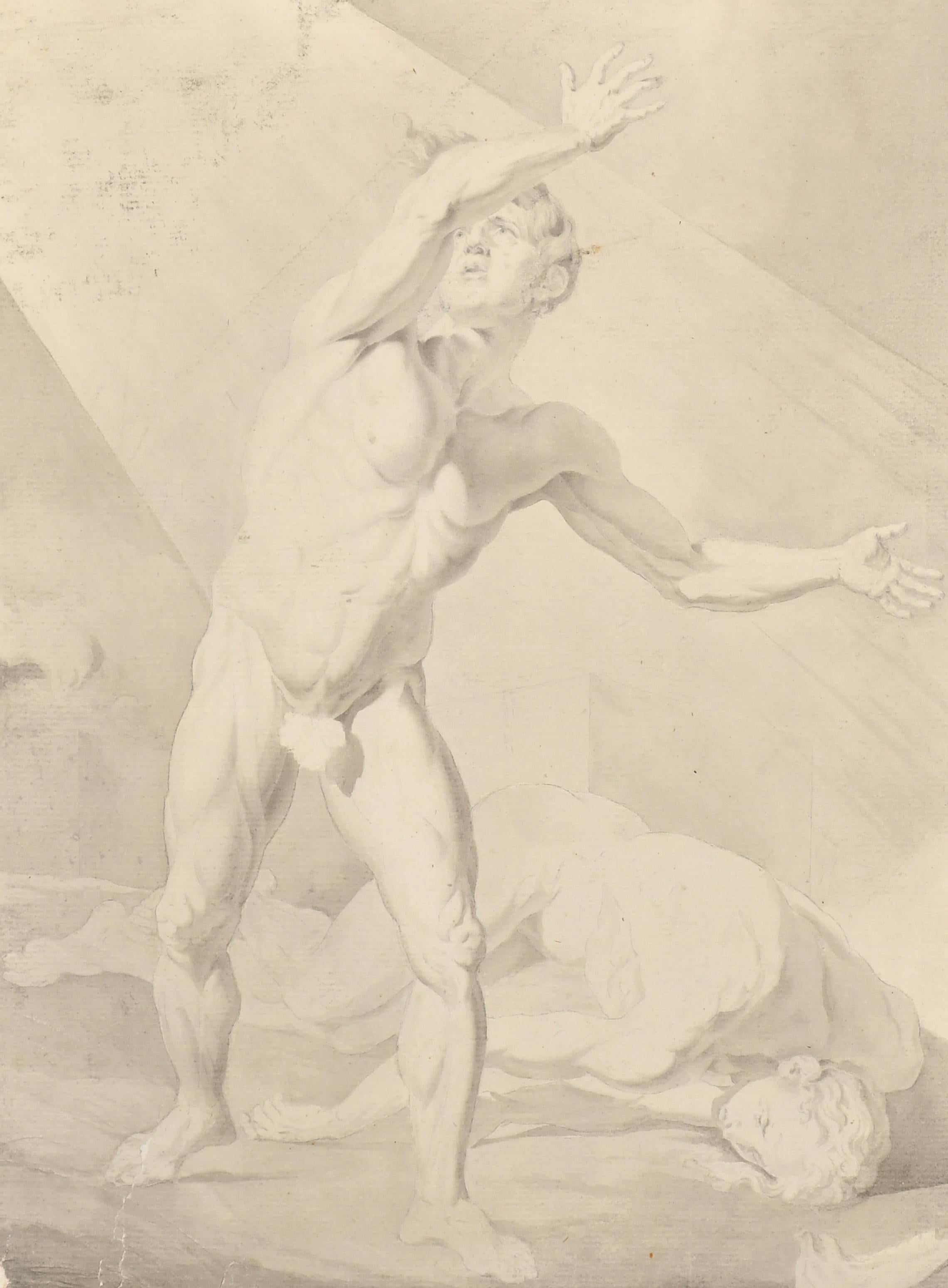
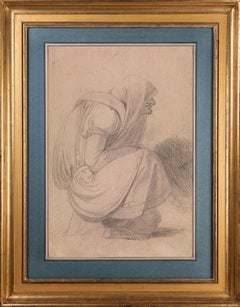
This boldly drawn sheet depicting a seated figure was made by Fuseli at an important and highly productive moment in his career. The monumental drawing is closely related to another sheet by Fuseli in the British Museum which Schiff published as subject unknown. Both drawings were made when Fuseli was designing his most important sequence of historical works, including scenes from Shakespeare and Milton, The Nightmare and The Death of Dido which was exhibited at the Royal Academy to great critical acclaim in 1781. The present drawing does not relate directly to any of Fuseli’s finished historical paintings of the period, but evidently the image of a slightly menacing, seated and covered old woman was precisely the sort of motif he was playing with. It is notable that the same figure reappears later in Fuseli’s work as the witch from Ben Jonson’s Witch’s Song which Fuseli produced as both a painting and engraving in 1812.
Fuseli returned to London in 1779 from a highly creative and productive period in Rome and established himself as one of the leading history painters of the period. Fuseli re-established contact with his old mentor Sir Joshua Reynolds, becoming a regular guest at his dinner table and visitor to his studio. The earliest and most striking manifestation of this strategy was Fuseli's Death of Dido, exhibited in 1781 at the Royal Academy. Executed on the same scale as Reynolds's version (Royal Collection), Fuseli's vertically oriented picture was hung directly opposite Reynolds's with its horizontal orientation, inevitably inviting comparison between the two works and garnering Fuseli much publicity and favourable reviews in the newspapers.
The present, previously unpublished sheet, relates closely to a drawing now in the British Museum. That sheet shows the same seated old woman, drawn on a smaller scale and more schematic in design, seated next to an anatomical drawing of a man. The pose of this figure is related to the pose of Dido in his Death of Dido; the foreshortened torso, arrangement of head, oblique view of Dido’s features and arms all suggest that the study can be viewed as an initial thought for the composition. Fuseli may have initially thought of including the figure of the hunched and covered old woman. Drawn on identical paper to the British Museum sheet, our study is an enlarged depiction of the same figure, more elaborately delineated and developed. The presence of a chain to the right of the figure, suggests that the iconography was related in some way to a scene of imprisonment.
Fuseli had first explored the motif of the hooded old woman in an early Roman drawing, 'The Venus Seller'. The idea of a grotesque old woman, hooded and with angular nose and projecting chin seen in profile was most spectacularly used by Fuseli in his sequence of paintings depicting The Three Witches from Macbeth. Fuseli seems to have kept the present sheet and may have returned to it when preparing a painting of The Witch and the Mandrake from Ben Jonson’s Witch’s Song from his Masque of Queens in 1812. Here the same seated figure looks out from under her hood and picks a mandrake by moonlight. Jonson’s drama had been performed at the court of James I in 1609, inspired the subject. To throw the nobility of the queens into relief, the poet added a coven of witches, one of whom declares: ‘I last night lay all alone, On the ground, to hear the mandrake groan; And plucked him up, though he grew full low, And, as I had done, the cock did crow.’ The figure was reversed in the associated etching which was published in 1812. It seems likely that the present drawing remained as part of Fuseli’s working archive of figure studies.
The present drawing was presumably purchased with the bulk of Fuseli’s drawings after the artist’s death by Sir Thomas Lawrence. Lawrence’s large group of Fuseli drawings were then acquired by Susan, Countess of Guildford (1771-1837). Lady Guildford was the eldest daughter of the banker Thomas Coutts (1735-1822), who himself had supported Fuseli’s journey to Rome in the 1770s and had remained one of the artist’s key...
Category
18th Century Old Masters Figurative Drawings and Watercolors
Materials
Chalk
18th century ink study for the Leveson-Gower Children
By George Romney
Located in London, GB
Collections: J. Goodfriend, USA.
Brown wash and pencil on laid paper
Framed dimensions: 13.25 x 11.75 inches
This powerful drawing was made at the time that Romney was painting the famous group portrait of the Gower Children now in Abbot Hall Art Gallery, Kendal. Romney was a bold and incisive draughtsman who made numerous rich brown ink studies, principally for historical compositions; by contrast, comparatively few studies linked directly to his portraits survive. The existence of a group of studies for the Gower Children underscores its importance to Romney. The sitters were the five youngest of the eight children of Granville, 2nd Earl Gower who, at the time the portrait was commissioned, was President of the Council in Lord North’s government and one of the best-connected and most influential people in England. The present drawing which is a large scale treatment of the composition in its final form perfectly distils Romney’s conceit: the younger children dancing whilst their elder sister, in the guise of a Bacchante plays the tambourine. The bold and dramatic study underlines both the artistic confidence and classical grandeur Romney gained during his trip to Italy between 1773 and 1775.
The commission from Granville, 2nd Earl Gower to paint five of his children came shortly after Romney’s Continental tour. The initial idea, as represented by the present drawing, seems to have been to paint Lady Anne, the figure on the right of the composition playing the tambourine, who was the youngest of Gower’s first four children by his second wife Lady Louisa Egerton and who married the Rev. Edward Vernon Harcourt, later Archbishop of York, with three of her younger half-siblings by Gower’s third wife, Lady Susanna Stewart: at the left Lady Georgina, who became Countess of St Germans following her marriage to the Hon. William Eliot; at the right Lady Charlotte Sophia, later Duchess of Beaufort and in the centre Lady Susanna, later Countess of Harrowby. Romney added a fifth child to the finished portrait, Gower’s son: Lord Granville, later created Viscount Granville and Earl Granville. In Italy Romney had produced a large number of studies of classical antiquities and old master paintings.
The commission from Gower offered Romney the opportunity to explore a complex multi-figural group, putting into practice the kind of ambitious classical quotations that Reynolds was currently exploiting. In 1773 Reynolds had completed the remarkable group portrait of the Montgomery Sisters, now in the Tate Gallery, London, which showed them adorning a herm of the Roman god Hymen; the composition used a garland to link the three figures who were shown in classical costume dancing at the foot of a Roman sculpture. Scholars have long pointed to a similar sources for the two compositions: the works of Nicolas Poussin. Whilst the Montgomery Sisters is based, in part, on a Bacchanal now in the Musée des Beaux-Arts, the Gower Children has always been associated with Poussin’s Dance to the Music of Time, now in the Wallace Collection, London. It seems more likely that Romney was looking to an antique source in the form of the Borghese Dancers, a Roman relief, then in Palazzo Borghese in Rome. Romney would have seen the relief of interlocking, dancing maidens and would also have known Guido Reni’s Aurora...
Category
18th Century Old Masters Portrait Drawings and Watercolors
Materials
Ink, Pencil

Portrait drawing of Harriot Mellon, Mrs Thomas Coutts
By Henry Fuseli
Located in London, GB
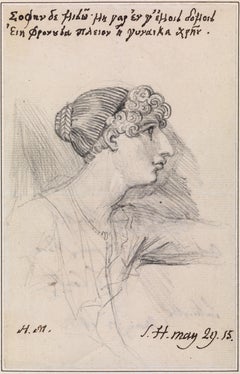
Inscribed by the artist in pen and brown ink, upper margin: 'σοφὴν δὲ μισῶ: μὴ γὰρ ἔν γ' ἐμοῖς δόμοις / εἴη φρονοῦσα πλείον' ἢ γυναῖκα χρή [Euripides, Hippolytus, 11, 640-41: “But a ...
Category
19th Century Old Masters Portrait Drawings and Watercolors
Materials
Pencil
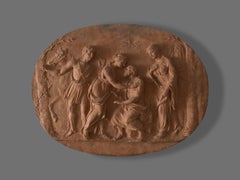
Oedipus before the Temple of the Furies at Colonus
Located in London, GB
Terracotta
19 x 25 ½ inches; 480 x 650 mm
Signed and dated: ‘W Tyler Excu. 1765’
Collections:
Cyril Humphris, London;
Humphris sale, Sotheby's, New York, 10-11 January 1995, lot 74...
Category
18th Century Old Masters Figurative Sculptures
Materials
Terracotta
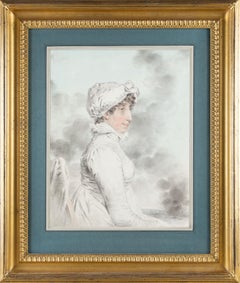
Regency portrait drawing of Arabella Graham-Clarke
By John Downman
Located in London, GB
Collections:
The sitter, and by descent;
Christie's, 19th March 1928, lot 6;
Private collection to 2019
Literature:
G.C. Williamson, John Downman, A.R.A., his Life and Works, Lon...
Category
Early 19th Century Old Masters Portrait Drawings and Watercolors
Materials
Pencil, Watercolor
You May Also Like
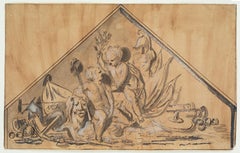
Old Master Drawing, Baroque, Jacob de Wit, Allegory of Victory, Putti, Ships
By Jacob De Wit
Located in Greven, DE
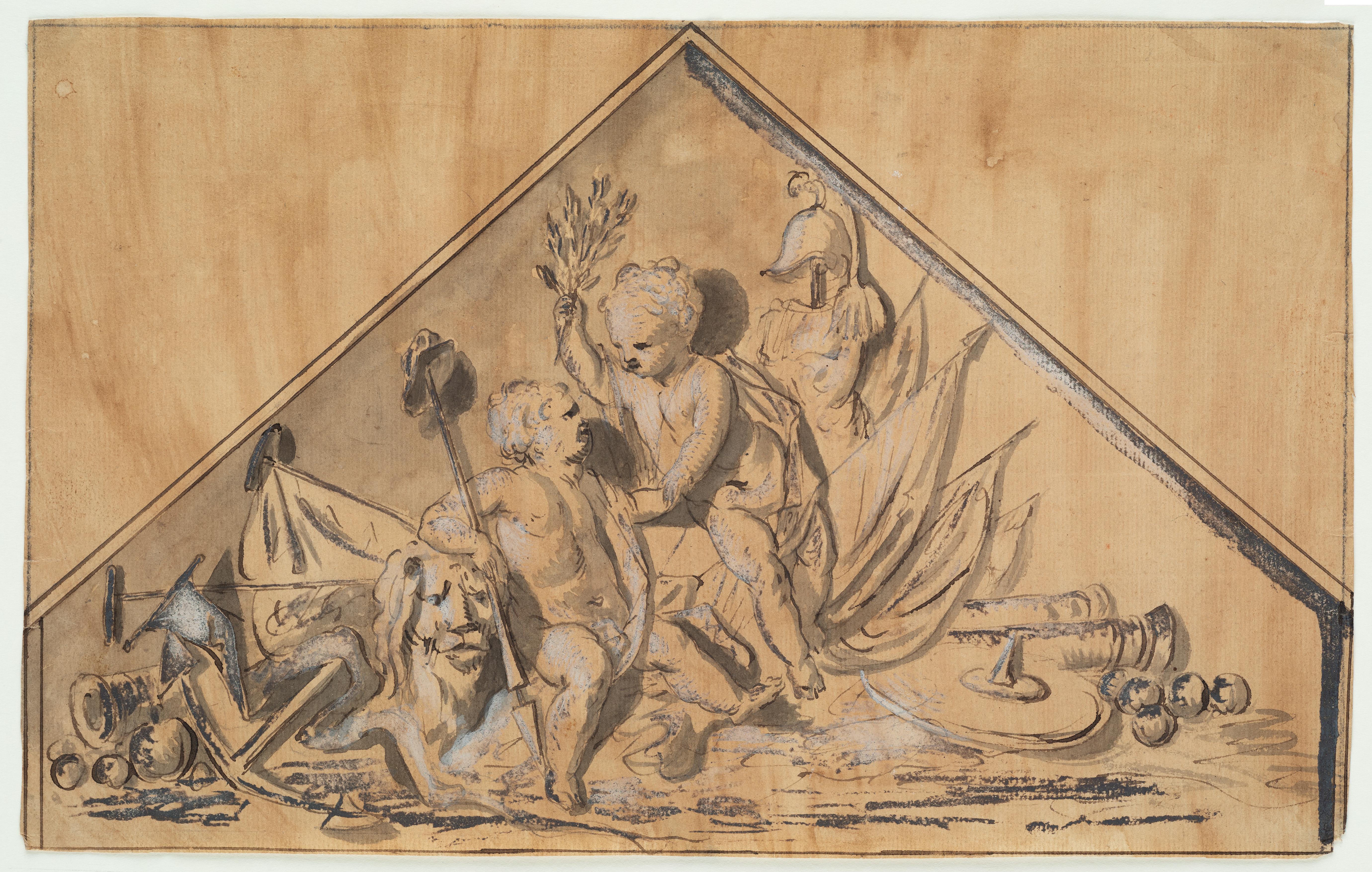
Two putti with symbols of war and victory (cannons, cannonballs, armour, anchor, lion's head, laurel branch/ olive branch, flag, staff with helmet) in pediment triangle.
Probably a design for a painting or architecture
Pen-and-ink drawing in black on brownish paper, black wash
Plain gold moulding with UV glass
Allegory of Victory, 18th Century, Old Master Drawing, By De Wit, Figurative
Jacob de Wit...
Category
Late 17th Century Baroque Figurative Drawings and Watercolors
Materials
Paper, Crayon
$2,177 Sale Price
35% Off
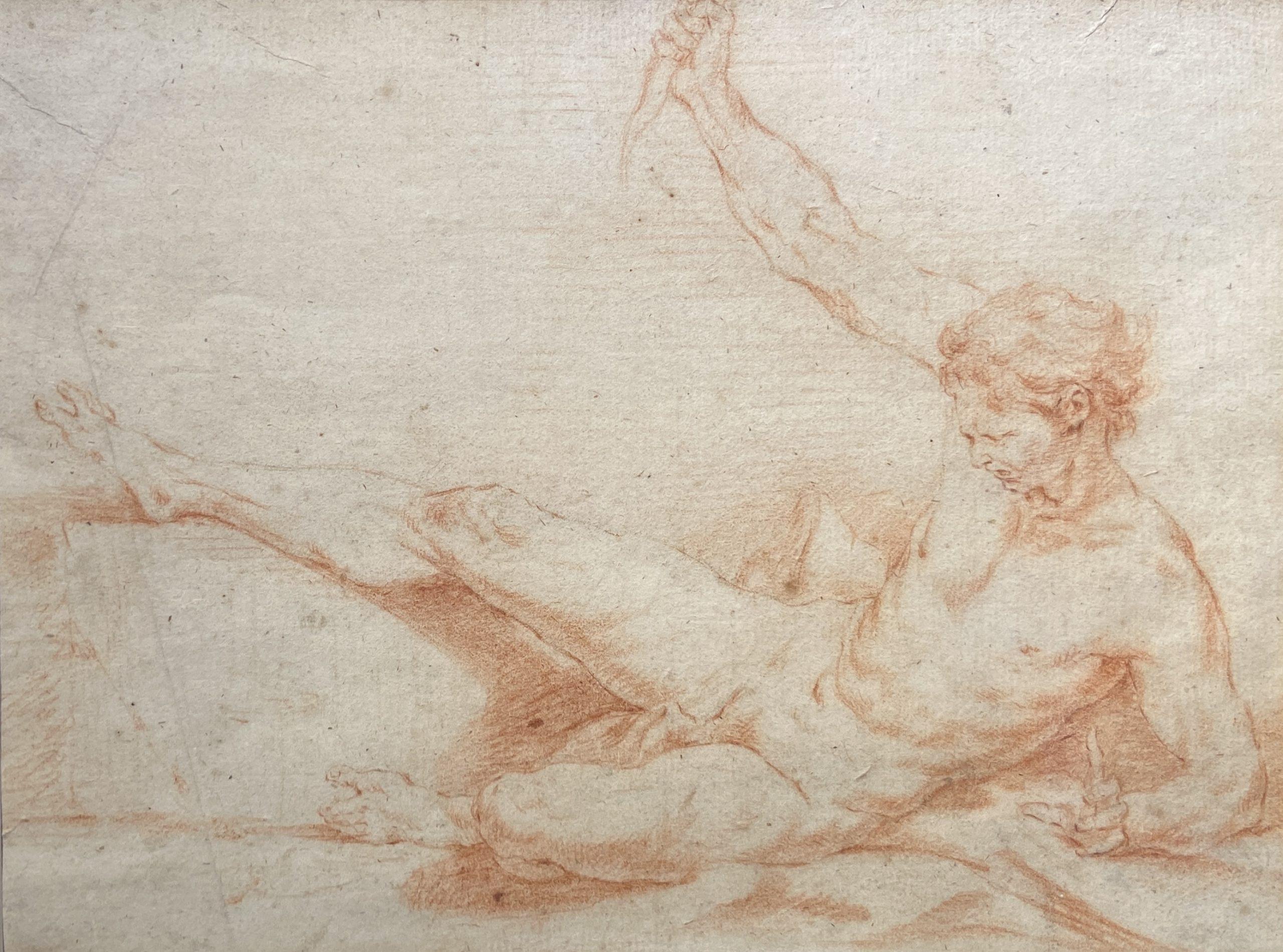
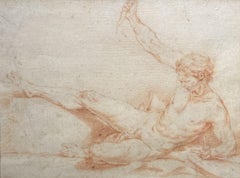
The Death of Attis, 18th Century French Red Chalk Drawing, Greek Mythology
Located in London, GB
Red chalk on paper
Image size: 9 x 7 inches (23 x 17.75 cm)
Acid free mount
The Greek god Attis was the spouse of Cybele, the fertility goddess. He was from Phrygia, a kingdom in c...
Category
18th Century French School Figurative Drawings and Watercolors
Materials
Chalk
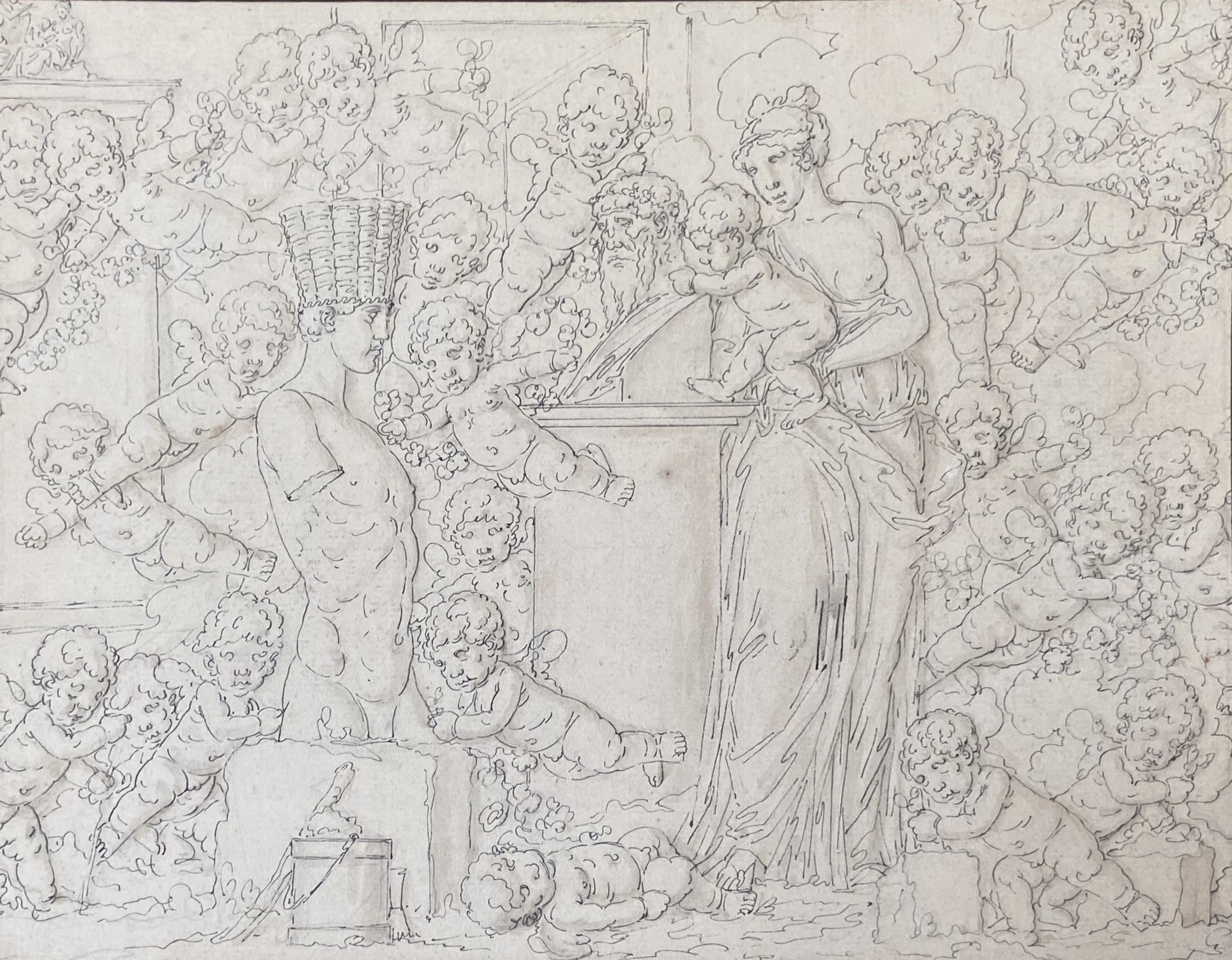
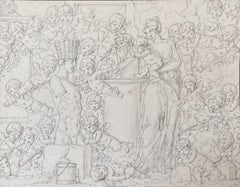
Louis-Félix de La Rue (1730-1777) A Mythological scene, drawing
By Louis-Félix Delarue
Located in Paris, FR
Louis-Félix de La Rue (1730-1777)
A Mythological scene
Pen and black ink on paper
Bears an old inscription with the name of the artist on the lower left bo...
Category
1770s Old Masters Figurative Drawings and Watercolors
Materials
Ink
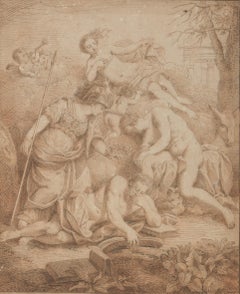
Allegorical Scene - Sepia Drawing Attribute to L.F. Dubourg -Early 1700
Located in Roma, IT
Allegorical Scene is an original modern artwork attributed to the Louis Fabricius Dubourg in the first half of the XVIII Century.
Original sepia drawing...
Category
Early 18th Century Figurative Drawings and Watercolors
Materials
Ink
Fine 18th Century French Old Master Ink Wash Drawing Cain
Abel Fighting
Located in Cirencester, Gloucestershire
'Cain et Abel'
Circle of Franois Devosge
(1732-1811) French
pencil drawing with watercolour wash on paper
size: 12.25 x 9 inches
private collection, France
The painting is in overall...
Category
18th Century Old Masters Figurative Paintings
Materials
Washi Paper, Color Pencil
$855 Sale Price
30% Off
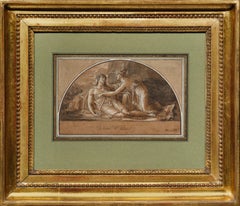
The Death of Adonis, a neoclassical drawing by Jean-Guillaume Moitte (ca. 1785)
Located in PARIS, FR
This elegant composition, whose curved shape suggests that it was intended for some decorative project, illustrates Moitte's shift around 1780 towards the neoclassical movement, insp...
Category
1780s Old Masters Figurative Drawings and Watercolors
Materials
Paper, Ink, Gouache, Pen
More Ways To Browse
Children Drawings
Old Master Paintings Of Children
Apollo Art
18th Century Pen And Ink
Artemis Antique
Apollo Painting
18th Century Pen
Master Apollo
Oil Painting Gold Frame Landscape
New York City Street Scenes
Grace Kelly Vintage
Vintage Folio
Impressionist Blue
Yellow Abstract Art
Rolling Stones
Spain Artist
19th Century Landscape Oil On Canvas
Black And White Nude Photography