Items Similar to "The Sphynx is Weary, She Dreams o
er the World" John La Farge, American Artist

Want more images or videos?
Request additional images or videos from the seller
1 of 8
John La Farge"The Sphynx is Weary, She Dreams o
er the World" John La Farge, American Artist1865
1865
$12,000
£9,117.04
€10,477.39
CA$16,855.47
A$18,346.76
CHF 9,721.29
MX$220,647.51
NOK 123,603.72
SEK 113,269.13
DKK 78,265.47
About the Item
John La Farge
The Sphynx is Weary, She Dreams o'er the World, 1865
Initialed and dated lower right
Gouache, watercolor and black chalk on illustration board
10 1/4 x 12 3/8 inches
Provenance
F. Burrall Hoffman, Jr., New York and Hobe Sound
Private Collection, Vermont
Private Collection, Kennett Square, Pennsylvania
John La Farge (1835-1910) was born in New York City to a family of French émigrés who had become very successful in America. La Farge was educated in Jesuit schools, including Fordham and Mount Saint Mary’s College in Maryland. He studied law, and received a Master’s degree in 1855. The legal profession did not appeal to him, however, and for a twenty-first birthday present, he began his art training with a year in Europe, where he entered the atelier of Thomas Couture. In 1858 he moved to Newport, Rhode Island to study with William Morris Hunt. There he met Henry James and his brother William, who were also studying with Hunt.
In the 1860s, he began a number of religious paintings that were important to his development, though not commercially successful. In 1877, he was asked to provide the decorative scheme of murals and wall colors for Trinity Church in Boston, which was an early marker for the emerging American Renaissance.
John La Farge reinvented the art of stained glass. In the mid-1870s, he began to experiment with stained glass, innovating in the use of opalescent glass. He was awarded patents for his new methods in 1880 and 1883, despite challenges from his rival, Louis Comfort Tiffany. At the International Exposition in Paris in 1889 he was awarded a first-class medal and the ribbon of the Legion of Honor. The jury citation lauded him as: “…the great innovator, the inventor of opaline glass. He has created in all its details an art unknown before, an entirely new industry, and in a country without tradition, he will begin one...” Siegfried Bing, who coined the term Art Nouveau, and was generally a partisan for La Farge’s rival Louis Comfort Tiffany, commended La Farge’s window of Christ in Majesty for Trinity Church: “All marveled at the large stained-glass window, whose astonishing brilliance surpassed, in its magic, anything of its kind created in modern times.” His first stained glass window for Trinity Church was installed in 1883, a depiction of Christ in Majesty on the west façade. This window was the model for the window of Christ Preaching (1889) which is now at Boston College.
La Farge was one of the very first western artists to become interested in the art of Japan, starting in the late 1850s. In 1870 he was the first American to publish a study of Japanese art, a chapter in Raphael Pumpelly’s book Across America and Asia (New York, 1870). He traveled to Japan in 1886 with his friend, Henry Adams. In 1890-91, they visited the South Seas, including Samoa and Tahiti. He published An Artist's Letters from Japan (New York: The Century Co., 1897) and Reminiscences of the South Seas (Garden City, N.Y.: Doubleday, Page
Company, 1912).
A respected intellectual and author, La Farge lectured at the Metropolitan Museum of Art and the Art Institute of Chicago; both series of lectures were published. The Met lectures were published as Considerations on painting; lectures given in the year 1893 at the Metropolitan Museum of Art (New York: Macmillan, 1901). The Chicago lectures were published as The Higher Life in Art: A Series of Lectures on the Barbizon School of France, Inaugurating the Scammon Course at the Art Institute of Chicago (New York: McClure, 1908).
Despite his many achievements, La Farge was not a successful businessman, and his career was marred by several bankruptcies.
John La Farge embodied many of the contradictions and aspirations of his age—a deep respect for tradition juxtaposed with a modernist drive to experiment with materials and to explore space and time, roaming across global cultures and past eras. His restless and probing intellect led him to experiment with artistic styles as diverse as Romanticism, Realism, Revivalism, and Symbolism. He was one of the most interesting examples of the Aesthetic Movement of the late nineteenth century, and his art is a unique bridge between European, Asian, Islamic, and American cultures.
- Creator:John La Farge (1835 - 1910, American)
- Creation Year:1865
- Dimensions:Height: 14.25 in (36.2 cm)Width: 16.5 in (41.91 cm)
- More Editions Sizes:Unique workPrice: $12,000
- Medium:
- Movement Style:
- Period:
- Condition:
- Gallery Location:New York, NY
- Reference Number:1stDibs: LU1841216891292
About the Seller
5.0
Platinum Seller
Premium sellers with a 4.7+ rating and 24-hour response times
Established in 2022
1stDibs seller since 2022
135 sales on 1stDibs
Typical response time: <1 hour
- ShippingRetrieving quote...Shipping from: New York, NY
- Return Policy
More From This Seller
View All"Reclining Nude" Mercedes Matter, Abstracted Nude, Early American Modernism
By Mercedes Matter
Located in New York, NY
Mercedes Matter
Reclining Nude, circa 1920
Signed "Mercedes Matter" on the overlap
Oil on canvas
32 x 51 inches
Born in New York in 1913 to famed Philadelphia Modernist, Arthur B. ...
Category
1920s American Modern Figurative Paintings
Materials
Canvas, Oil
"Female Nude, " Edith Glackens Dimock, Ashcan School Figurative Painting
By Edith Glackens Dimock
Located in New York, NY
Edith (Glackens) Dimock (1876 - 1955)
Untitled (Female Nude), circa 1915
Oil on canvas
34 1/2 x 28 1/4 inches
Signed lower left
Provenance:
Private Colle...
Category
1910s Ashcan School Nude Paintings
Materials
Canvas, Oil
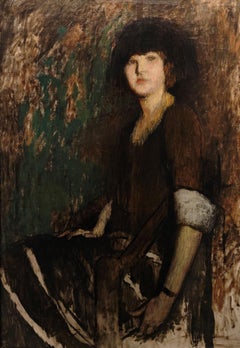
"Portrait of a Lady (Study for Harriet Blake)" Lilian Westcott Hale, Painting
By Lilian Westcott Hale
Located in New York, NY
Lilian Westcott Hale
Portrait of a Lady (Study for Harriet Blake)
Oil on canvas
40 ¼ x 30 ¼ inches
A leading American Impressionist working at t...
Category
1920s Impressionist Figurative Paintings
Materials
Canvas, Oil
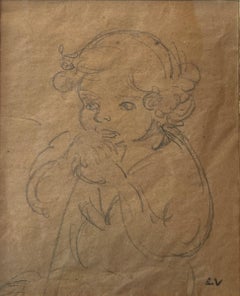
"Young Girl (Jenue Fille)" Louis Valtat, French Drawing
By Louis Valtat
Located in New York, NY
Louis Valtat
Young Girl
Stamped with initials lower right
Pencil on brown paper
Sight 7 x 6 inches
Provenance:
Mrs. Ernest M. Werner, New York
Private Collection, Rhode Island
Loui...
Category
Early 20th Century Fauvist Figurative Drawings and Watercolors
Materials
Paper, Pencil
$2,000 Sale Price
20% Off
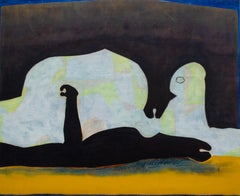
"Cronus Asleep in the Cave" David Hare, Large Abstract Surrealist Composition
By David Hare
Located in New York, NY
David Hare
Cronus Asleep in the Cave, 1971
Acrylic on linen
55 x 67 inches
“Freedom is what we want,” David Hare boldly stated in 1965, but then he added the caveat, “and what we are most afraid of.” No one could accuse David Hare of possessing such fear. Blithely unconcerned with the critics’ judgments, Hare flitted through most of the major art developments of the mid-twentieth century in the United States. He changed mediums several times; just when his fame as a sculptor had reached its apogee about 1960, he switched over to painting. Yet he remained attached to surrealism long after it had fallen out of official favor. “I can’t change what I do in order to fit what would make me popular,” he said. “Not because of moral reasons, but just because I can’t do it; I’m not interested in it.”
Hare was born in New York City in 1917; his family was both wealthy and familiar with the world of modern art. Meredith (1870-1932), his father, was a prominent corporate attorney. His mother, Elizabeth Sage Goodwin (1878-1948) was an art collector, a financial backer of the 1913 Armory Show, and a friend of artists such as Constantin Brancusi, Walt Kuhn, and Marcel Duchamp.
In the 1920s, the entire family moved to Santa Fe, New Mexico and later to Colorado Springs, in the hope that the change in altitude and climate would help to heal Meredith’s tuberculosis. In Colorado Springs, Elizabeth founded the Fountain Valley School where David attended high school after his father died in 1932. In the western United States, Hare developed a fascination for kachina dolls and other aspects of Native American culture that would become a recurring source of inspiration in his career.
After high school, Hare briefly attended Bard College (1936-37) in Annandale-on-Hudson. At a loss as to what to do next, he parlayed his mother’s contacts into opening a commercial photography studio and began dabbling in color photography, still a rarity at the time [Kodachrome was introduced in 1935]. At age 22, Hare had his first solo exhibition at Walker Gallery in New York City; his 30 color photographs included one of President Franklin Roosevelt.
As a photographer, Hare experimented with an automatist technique called “heatage” (or “melted negatives”) in which he heated the negative in order to distort the image. Hare described them as “antagonisms of matter.” The final products were usually abstractions tending towards surrealism and similar to processes used by Man Ray, Raoul Ubac, and Wolfgang Paalen.
In 1940, Hare moved to Roxbury, CT, where he fraternized with neighboring artists such as Alexander Calder and Arshile Gorky, as well as Yves Tanguy who was married to Hare’s cousin Kay Sage, and the art dealer Julian Levy. The same year, Hare received a commission from the American Museum of Natural History to document the Pueblo Indians. He traveled to Santa Fe and, for several months, he took portrait photographs of members of the Hopi, Navajo, and Zuni tribes that were published in book form in 1941.
World War II turned Hare’s life upside down. He became a conduit in the exchange of artistic and intellectual ideas between U.S. artists and the surrealist émigrés fleeing Europe. In 1942, Hare befriended Andre Breton, the principal theorist of surrealism. When Breton wanted to publish a magazine to promote the movement in the United States, he could not serve as an editor because he was a foreign national. Instead, Breton selected Hare to edit the journal, entitled VVV [shorth for “Victory, Victory, Victory”], which ran for four issues (the second and third issues were printed as a single volume) from June 1942 to February 1944. Each edition of VVV focused on “poetry, plastic arts, anthropology, sociology, (and) psychology,” and was extensively illustrated by surrealist artists including Giorgio de Chirico, Roberto Matta, and Yves Tanguy; Max Ernst and Marcel Duchamp served as editorial advisors.
At the suggestion of Jacqueline Lamba...
Category
1970s Abstract Paintings
Materials
Linen, Acrylic
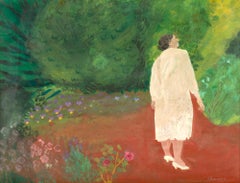
"Woman Listening" Honore Sharrer, Magical Realism Landscape with Flora
Figure
By Honore Sharrer
Located in New York, NY
Honore Sharrer (1920 - 2009)
Woman Listening
Signed lower right
Caseine on paper
15 x 20 inches
Provenance:
Forum Gallery, New York
Private Collection
...
Category
Late 20th Century American Realist Landscape Paintings
Materials
Paper, Casein
$8,800 Sale Price
20% Off
You May Also Like
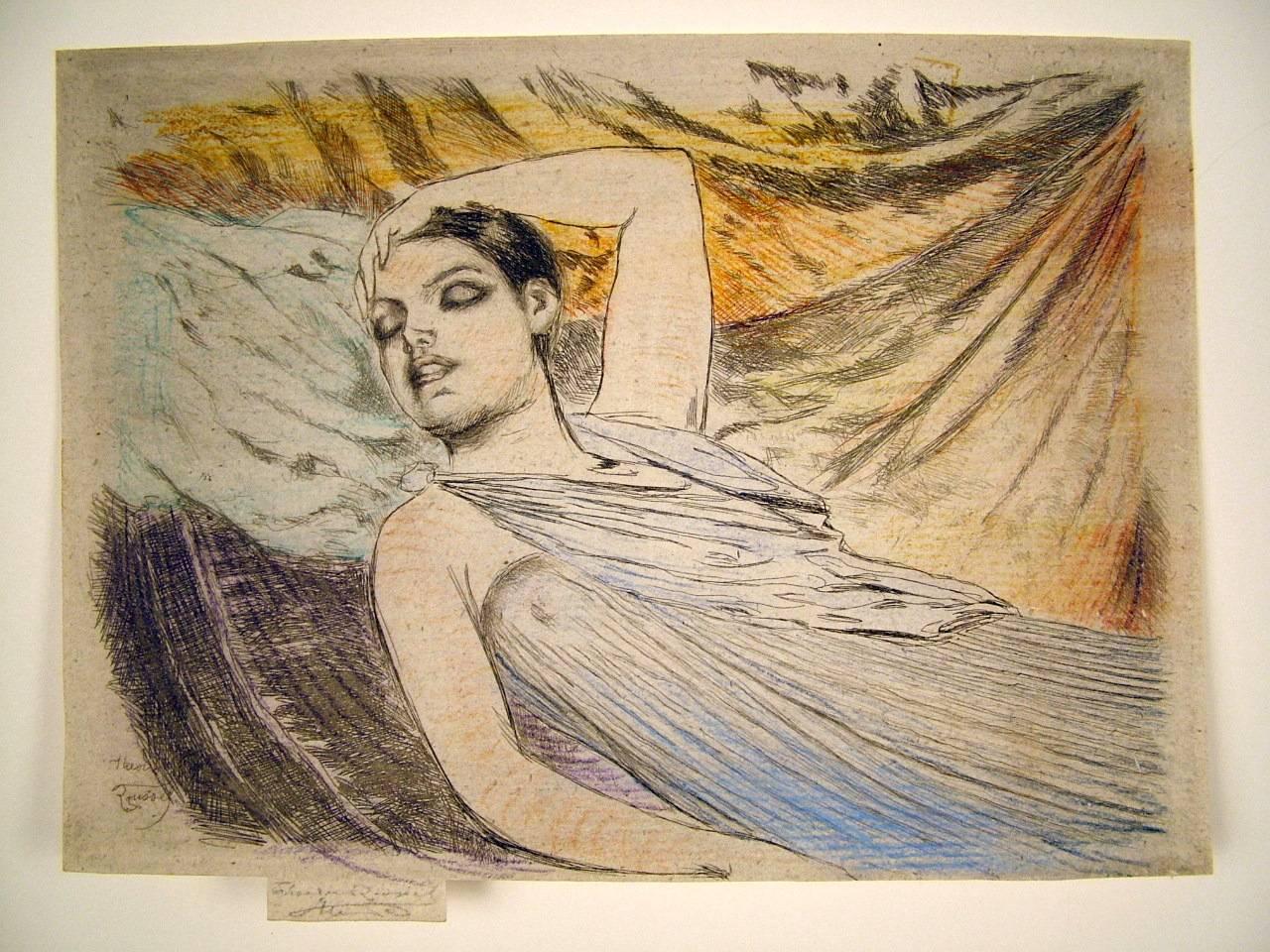
The Sleeping Model
By Theodore Casimir Roussel
Located in New York, NY
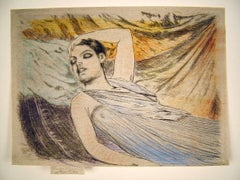
Theodore Roussel (1847-1926), The Sleeping Model or The Sleeper, etching and drypoint with additional pencil coloring, signed on the tab and inscribed “...
Category
1890s Impressionist Figurative Prints
Materials
Color Pencil, Drypoint, Etching
Reclining Woman I, Impressionist Watercolor and Gouache by Wayne Ensrud
By Wayne Ensrud
Located in Long Island City, NY
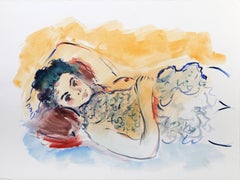
Wayne Ensrud, American (1934 - ) - Reclining Woman I, Year: 1980, Medium: Watercolor and Gouache on Paper, signed l.r., Size: 22.5 x 30 in. (57.15 x 76.2 cm)
Category
1980s Impressionist Nude Drawings and Watercolors
Materials
Watercolor, Gouache
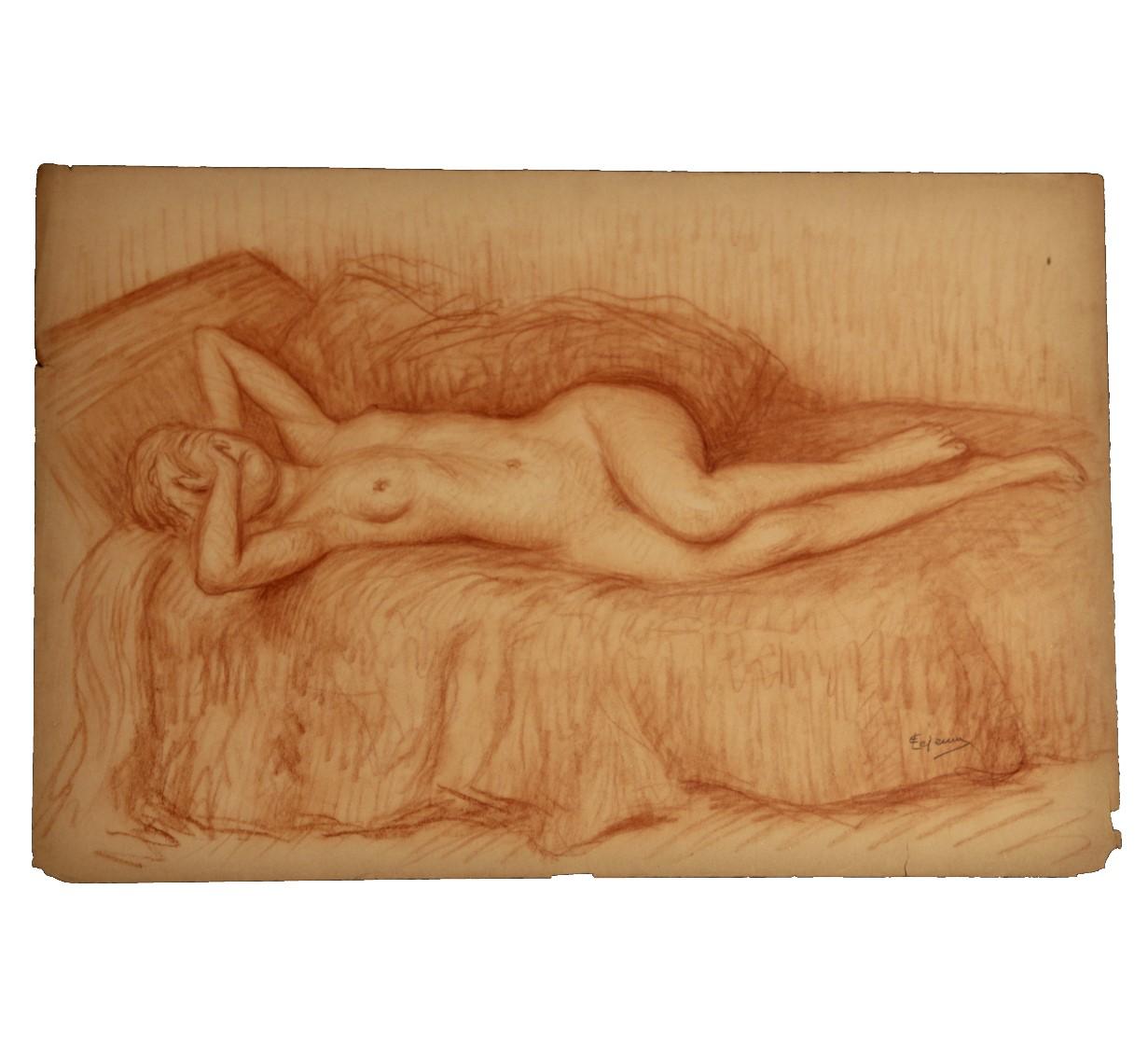
Reclining Nude Woman Covering Her Face
By Emile Lejeune
Located in Houston, TX
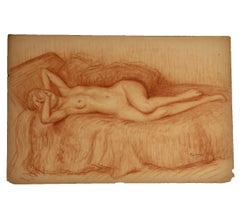
Reclining nude woman covering her face from the viewer. The work is signed by the artist. The paper is not framed.
Many others are available. Ple...
Category
1950s Naturalistic Figurative Drawings and Watercolors
Materials
Graphite
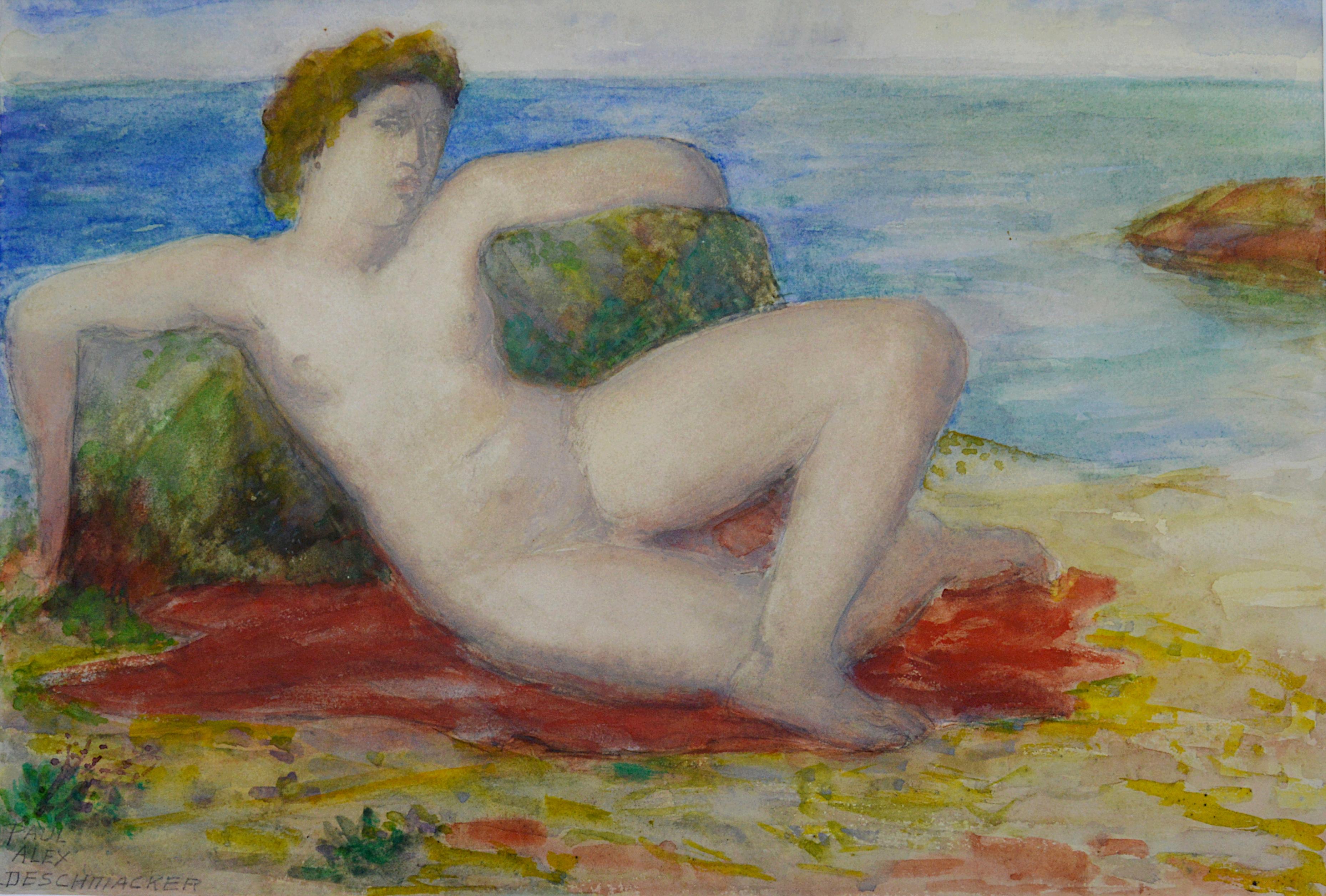
Deschmacker, Young Woman Lying By The Sea, Watercolor
By Paul Alex Deschmacker
Located in Saint Amans des cots, FR
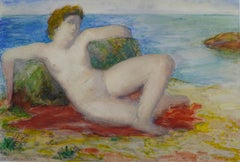
Watercolor by Paul-Alex Deschmacker, France, 1920s. This watercolor is in the classical period populated by mythological characters of Paul-Alex Deschmacker, itself becoming part of ...
Category
1920s Art Deco Figurative Drawings and Watercolors
Materials
Watercolor
Naked woman lying from behind signed
Located in Genève, GE
Work on paper signed
Dimension with frame 71.5 x 101.5 x 2.5 cm
This impressionist work depicts a reclining woman, captured with bold, fluid brushstrokes. The color palette, dominate...
Category
Late 20th Century Impressionist Nude Drawings and Watercolors
Materials
Watercolor
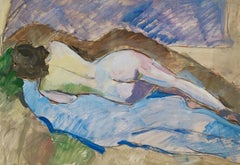
Reclined Nude - China Ink and Watercolor Drawing by Jean Chapin - Early 1900
By Jean Chapin
Located in Roma, IT
Reclined Nude is an ink and watercolor drawing realized by Jean Chapin in the First Half 20th Century.
The artwork represents a female nude.
Good conditions.
Jean Chapin (Paris,...
Category
Early 20th Century Figurative Drawings and Watercolors
Materials
Charcoal