Want more images or videos?
Request additional images or videos from the seller
1 of 3
Study of a Horseman Charging His Opponentc. 1683
c. 1683
$10,080.97List Price
About the Item
- Attributed to:Joseph Parrocel (1648 - 1704)
- Creation Year:c. 1683
- Dimensions:Height: 7.88 in (20 cm)Width: 11.42 in (29 cm)
- Medium:
- Movement Style:
- Period:Late 17th Century
- Condition:
- Gallery Location:Paris, FR
- Reference Number:1stDibs: LU2258216485212
About the Seller
5.0
Vetted Professional Seller
Every seller passes strict standards for authenticity and reliability
Established in 2010
1stDibs seller since 2022
6 sales on 1stDibs
Authenticity Guarantee
In the unlikely event there’s an issue with an item’s authenticity, contact us within 1 year for a full refund. DetailsMoney-Back Guarantee
If your item is not as described, is damaged in transit, or does not arrive, contact us within 7 days for a full refund. Details24-Hour Cancellation
You have a 24-hour grace period in which to reconsider your purchase, with no questions asked.Vetted Professional Sellers
Our world-class sellers must adhere to strict standards for service and quality, maintaining the integrity of our listings.Price-Match Guarantee
If you find that a seller listed the same item for a lower price elsewhere, we’ll match it.Trusted Global Delivery
Our best-in-class carrier network provides specialized shipping options worldwide, including custom delivery.You May Also Like
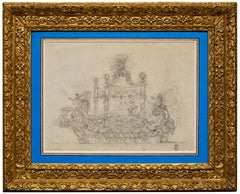
A dazzling Venetian Regatta Boat Study attributed to Alessandra Mauro
Located in PARIS, FR
This stunning Baroque study depicts a regatta boat, a type of vessel developed in eighteenth-century Venice for the regattas organized by the Serenissima during visits by royalty and princes. We propose to link this drawing to the work of Alessandro Mauro, an artist who specialized in this type of composition, as illustrated by a drawing from him at the Metropolitan Museum.
1. Description of the boat
The greatest decorative fantasy reigns in this preparatory study, which blends mythological and exotic elements with references to ancient Egypt. Our drawing is probably an initial thought, destined to be refined and clarified later in pen and ink (as evidenced by the ink stain in the lower right). A quadriga of seahorses guided by Neptune stands at the stern of the boat, shown well above the waterline (perhaps to outline its empty volume). One of the seahorses is ridden by a newt, while Amphitrite lies at the feet of the sea god.
The center of the boat is occupied by a vast baldachin resting on four atlantes and surmounted by a figure riding an animal (a dragon?). Three figures sit beneath the canopy, one of them on a griffin-shaped seat. This allusion to Egyptian antiquity echoes the winged sun (sometimes a symbol of the god Horus, as in the temple of Edfu in Egypt) that adorns the sides of the promontory on which this baldachin rests.
Another flag-bearer figure crouches at the stern of the boat on a raised seat, on the reverse of which is a crowned mermaid whose arm, extended backwards, rests on a mascaron decorated with a radiant face (Helios?) and whose torso surmounts an elephant's head. The heads of the rowers and their oars are sketched all along the boat, whose sides are embellished with elongated naiads.
2. The Venetian regatta boats
An exhibition held in 2013 at the Ca' Rezzonico (the Venetian eighteenth-century museum) paid tribute to these regatta boats through studies and prints depicting them. The regattas organized by the Serenissima in honor of visiting princes and sovereigns were among the most spectacular ceremonies in Venice. Some important artists of the 18th century contributed to the creation of these extravagant boats which were given exotic names such as bissona, malgarota or peota.
The specialists in this field were Andrea Urbani and the brothers Alessandro and Romualdo Mauro. They were born into a family of theater decorators in Piedmont, but little is known about their detailed biography. Alessandro was the architect of the Dresden opera house and of the St. Samuel Theater in Venice (in collaboration with his brother Romualdo), but also worked as stagehand and set designer in Vienna, Rome and Turin. A drawing produced around 1737 from the Metropolitan Museum (7th photo in the gallery) bears witness to his activity as a regatta boat designer.
This drawing is a much more elaborate version than the one presented here, having been entirely reworked in brown ink. However, a figure at the bow of the boat, executed solely in black chalk, still bears witness to a technique similar to that of our drawing.
It is difficult to know whether the boat depicted in our drawing was a project for an actual boat or whether it remained in the planning stage, but the front of our boat (Neptune and the quadriga of seahorses ridden by a newt) bears several similarities to that of a parade boat depicted in the print published by Michele Marieschi entitled Regatta on the Grand Canal, between the Foscari and Balbi Palaces (last photo in the gallery). This print is dated 1741, which could confirm that our work dates from around 1740.
The area between Neptune and the quadriga that precedes him on this strange paddle-boat appears to be partially submerged, confirming that the waterline of our boat was probably intended to be much lower than the one shown in our drawing.
The Correr Museum’s collection holds one of the most important collection of engravings and drawings devoted to these specifically Venetian Baroque productions. These boats were intended to last the duration of a festival. Today, they are only documented by preparatory drawings or prints that testify to the sumptuousness of their decoration. This taste for regatta boats lasted throughout the Venetian eighteenth century, and the conception of regatta boats also attracted great masters such as Giambattista Tiepolo, Francesco Guardi or Giambattista Piranesi...
Category
Mid-18th Century Old Masters Figurative Drawings and Watercolors
Materials
Chalk
$4,566
H 15.75 in W 19.25 in
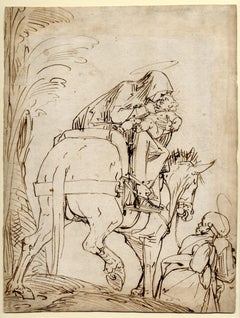
The Flight into Egypt
Located in New York, NY
Inscribed: 3. una Madonna che va in Egitto, verso, and Madonna che va in Egitto, recto
Provenance:
Private Collection, UK, since 1999
This expressive and boldly executed drawing is the work of Luca...
Category
16th Century Old Masters Figurative Drawings and Watercolors
Materials
Chalk, Ink, Pen, Paper
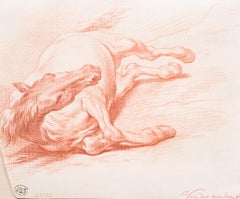
Study of a horse lying on its right side seen from the front
By Adam Frans van der Meulen
Located in Stockholm, SE
Provenance:
Jean-Marc Du Pan (1785–1838), Geneva (L. 1440), passed to his brother
Alexandre-Louis Du Pan (1787–1846);
his sale, Geneva, March 26–28, 1840, included in lots 913–917;
...
Category
17th Century Old Masters Animal Drawings and Watercolors
Materials
Paper, Crayon
$16,010
H 8.08 in W 9.65 in
The Searchers (Figurative Chalk Drawing of a Dog on Vintage Book Pages)
Located in Hudson, NY
Figurative chalk drawing of black Greyhound dog and red birds on vintage collaged book pages
'The Searchers' by Louise Laplante in 2022
chalk on vintage collaged book pages
28 x 46 1/2 inches unframed, 32 x 52 inches in natural wood frame with non-glare plexi
This graphic, figurative drawing in black chalk with collaged antique...
Category
2010s Contemporary Animal Drawings and Watercolors
Materials
Paper, Chalk

$4,800
H 32 in W 52 in D 1.5 in
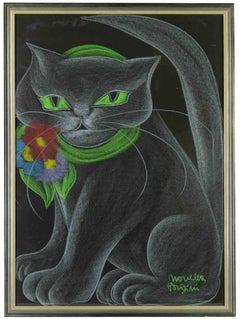
Cat - Drawing by Novella Parigini - 1970s
Located in Roma, IT
Cat is an artwork realized by Novella Parigini (Chiusi 1921 - Rome 1993)
Polychrome chalk on black paper.
83x63 cm frame included.
Hand signed in t...
Category
1970s Contemporary Animal Drawings and Watercolors
Materials
Chalk

Cat - Drawing by Novella Parigini - 1970s
Located in Roma, IT
Cat is an artwork realized by Novella Parigini in 1970s.
Oil Pastels on Cardboard.
Handsigned in green in the lower right part.
74 x 54 cm.
Very good conditions!
Category
1970s Contemporary Animal Drawings and Watercolors
Materials
Chalk
$481 Sale Price
30% Off
H 29.14 in W 21.26 in D 0.08 in
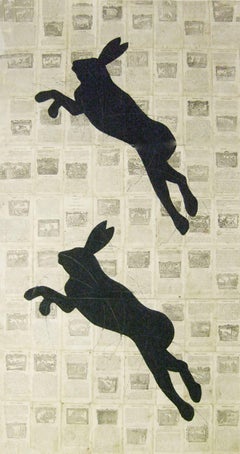
Ancient, Original, Modern Fables with Hares (Graphic Collage with Chalk
Paper)
Located in Hudson, NY
chalk on vintage collaged paper from a book of fables
Artwork measures 60 x 32 inches
65. x 35.5 inches framed, deckle edge paper is floated in n...
Category
2010s Contemporary Animal Drawings and Watercolors
Materials
Paper, Chalk
$6,850
H 65.5 in W 35.5 in D 2 in
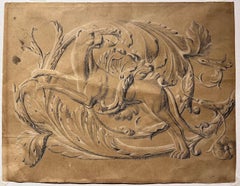
Italian neoclassical 19th century Italian figurative drawing antique frieze on paper
Located in Florence, IT
This drawing (pencil, ink and white lead on brown paper, 23 x 19, 5 cm) extremely accurately depicts an image taken from or inspired by antiquity, specifically an acanthus girale in ...
Category
19th Century Other Art Style Animal Drawings and Watercolors
Materials
Paper, Ink, Pencil, Chalk
$1,541
H 9.06 in W 11.62 in
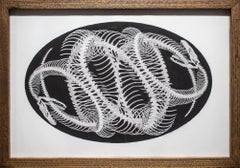
Umbilical Filigree Ovum (drawing)
By Hunter Stabler
Located in Philadelphia, PA
This is an original India ink, graphite, chalk, and pen on paper drawing by Hunter Stabler measuring 14.25”h x 20.25”w framed. The piece ships in the pictured frame.
Hunter Stable...
Category
21st Century and Contemporary Contemporary Figurative Drawings and Water...
Materials
Paper, Chalk, India Ink, Ballpoint Pen, Graphite
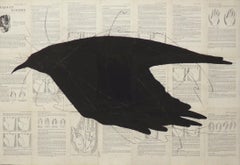
Raven Reads the Lines: Chalk Drawing of Black Bird on Vintage Book Pages
Located in Hudson, NY
Raven Reads the Lines (Chalk Drawing of Black Bird on Vintage Book Pages) by Louise Laplante
chalk on vintage collaged book pages.
Artwork measures ...
Category
2010s Contemporary Figurative Drawings and Watercolors
Materials
Paper, Chalk
More From This Seller
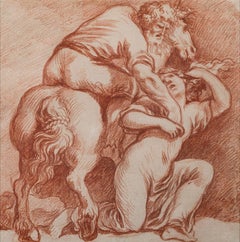
View AllMan on Horseback Abducting a Woman
Located in Paris, Île-de-France
Jean-Robert ANGO (Active 1759 – 1773)
Man on Horseback Abducting a Woman
Red chalk and white chalk
26.1 x 25.9 cm
Provenance
Libert-Castor sale, November 19, 1993 (lot no. 23, ill...
Category
1760s Old Masters Animal Drawings and Watercolors
Materials
Chalk
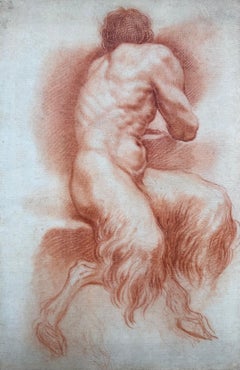
Study of a Seated Satyr, Seen from Behind
Located in Paris, Île-de-France
Domenico Maria Canuti (1625–1684)
Study of a Seated Satyr, Seen from Behind
Red chalk on laid paper with watermark
39 × 26 cm
Unsigned
Provenance:
Private Collection, France
Note...
Category
Late 17th Century Old Masters Nude Drawings and Watercolors
Materials
Chalk
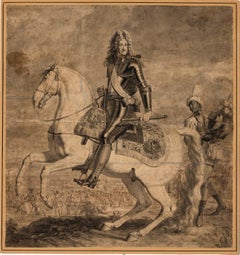
Georg Philipp I RUGENDAS (1666-1742) - Frederick I of Prussia
By Georg Philipp Rugendas the Elder
Located in Paris, Île-de-France
Georg Philipp I RUGENDAS (1666-1742)
Frederick I of Prussia
Red chalk, ink and brown wash on paper
45x42 cm
This drawing has been long considered representative of Charles VI. In r...
Category
Early 1700s Old Masters Animal Drawings and Watercolors
Materials
Ink, Watercolor
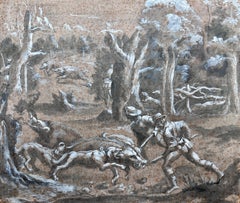
Hunting Scene
By Jan Van der Straet
Located in Paris, Île-de-France
Attributed to Jan VAN DER STRAET, called Stradanus (Bruges, 1523 – Florence, 1605)
Hunting Scene
Pen and brown ink, brown wash and white heightening on prepared brown paper,
26 × 31 cm
Unsigned
Provenance
Private collection, France
This striking and highly accomplished drawing depicts a wild boar hunt in a wooded landscape, animated by numerous figures and animals. The dramatic energy of the foreground, where hounds and hunters engage the beast, is heightened by the bold use of white heightening, which models the forms and enlivens the surface. The background, structured by tall trees and populated with additional hunting scenes, lends the composition a theatrical depth.
Attributed to Jan van der Straet, known as Stradanus, this work belongs to the artistic context of Medicean Florence, where the artist developed an important body of hunting scenes intended for illustration and engraving. Influenced by Italian Renaissance models as well as his native Flemish culture, Stradanus excelled in dynamic storytelling and elegant draftsmanship.
The drawing may have been a preparatory study for one of the compositions from the celebrated Venationes Ferarum, Avium, Piscium series, engraved in Antwerp under the supervision of Philips Galle...
Category
16th Century Old Masters Animal Drawings and Watercolors
Materials
Ink
$7,708
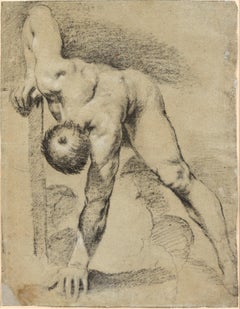
Leaning Nude Man (recto); Kneeling Man, Hands Tied Behind His Back (verso)
By Giovanni Francesco Barbieri (Il Guercino)
Located in Paris, Île-de-France
GIOVANNI FRANCESCO BARBIERI, known as GUERCINO
(1591-1666)
Leaning Nude Man (recto); Kneeling Man, Hands Tied Behind His Back (verso)
Black chalk heightened with white on light blu...
Category
1620s Old Masters Nude Drawings and Watercolors
Materials
Chalk, Charcoal
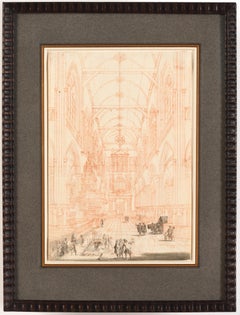
Interior of the Nieuwe Kerk, Amsterdam
Located in Paris, Île-de-France
Jan Goeree (Middelburg 1670 – Amsterdam 1731)
Interior of the Nieuwe Kerk, Amsterdam (c. 1724)
Red chalk for the architecture, pen and black ink, grey wash on paper
Composition reversed in preparation for engraving
25 × 17.5 cm
Watermark: Hunting horn, Churchill 318 (dated 1724)
Unsigned
Provenance
Private collection, France
Context & Attribution
Trained in the studio of Gérard de Lairesse, Jan Goeree was among the finest Dutch engravers of the early eighteenth century, celebrated for his architectural views of Amsterdam. This drawing is a preparatory study for an engraving of the same subject now preserved in a major public collection. The final print—slightly larger—closely follows the reversed composition of this sheet.
Subject
In the center of the Gothic nave, five bearers carry a catafalque toward a freshly dug grave—a tribute to the naval heroes often buried in the Nieuwe Kerk. This funerary motif, familiar from Dutch painting (e.g. Emanuel de Witte, 1657), evokes the vanitas theme and the transience of earthly life.
Technical Analysis
Goeree’s use of red chalk for the architecture and ink for the figures reveals his working method: the chalk lines could be used to produce a counterproof restoring the correct orientation of the architecture, while the inked figures remained adjustable before the design was transferred to the copper plate.
Place within the Oeuvre
Drawings of church...
Category
Early 18th Century Old Masters Interior Drawings and Watercolors
Materials
Chalk, Ink
Still Thinking About These?
All Recently ViewedMore Ways To Browse
Sothebys Antique
Horseman Antique
Tide Figure
Vintage Las Vegas Showgirls
Watercolour Antique Pre 1900 Paintings
Zero Mostel
Zuniga Pastel
Betty Rees Heredia
Blair Hobbs
Breastfeeding Painting
Carl Fredrik Reutersward
Conger Metcalf
Dora Carrington
Drawings And Watercolor Indonesia
E Nevil
Ellsworth Young
Embracing Nude Figures
Emma Jones