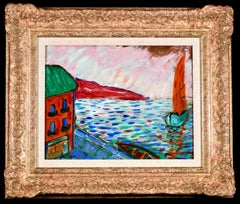
Want more images or videos?
Request additional images or videos from the seller
1 of 8
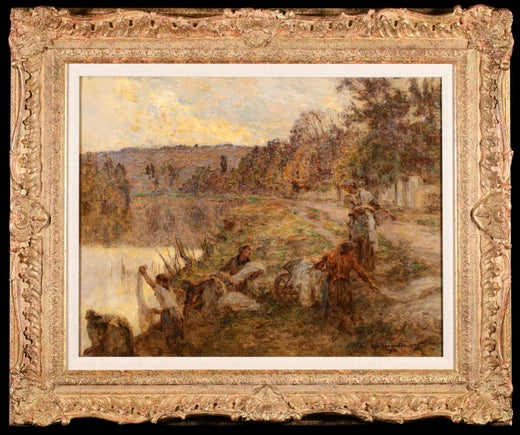
Léon Augustin LhermitteMarie Drax in her Garden - Barbizon Pastel, Figure in Landscape - Leon Lhermittec.1893
c.1893
$12,287.83List Price
About the Item
- Creator:Léon Augustin Lhermitte (1844-1925, French)
- Creation Year:c.1893
- Dimensions:Height: 30 in (76.2 cm)Width: 24.5 in (62.23 cm)
- Medium:
- Movement Style:
- Period:
- Condition:Very good condition.
- Gallery Location:Marlow, GB
- Reference Number:Seller: LFA00521stDibs: LU41537195332
Léon Augustin Lhermitte
L'hermitte often travelled to Britanny, as he was fascinated by the rural life there. His
work was shown in Paris but he also had a dealer who brought his pieces to the US, Canada, and Britain. Moreover, his work also spread through commissions in illustrated magazines. Vincent Van Gogh wrote "If every month Le Monde Illustré published one of his compositions...it would be a great pleasure for me to be able to follow it. It is certain that for years I have not seen anything as beautiful as this scene by L'hermitte...I am too preoccupied by L'hermitte this evening to be able to talk of other things." Originally from north-eastern France, Léon Augustin L'hermitte moved to Paris in time to attend the Salon des Refuses in 1863, and while studying at the École des Beaux Arts he gained recognition after his show in the Paris Salon in 1874. His many awards include the French Legion of Honour (1884) and the Grand Prize at the Exposition Universelle in 1889.
About the Seller
5.0
Vetted Professional Seller
Every seller passes strict standards for authenticity and reliability
Established in 2001
1stDibs seller since 2016
713 sales on 1stDibs
Typical response time: 5 hours
Authenticity Guarantee
In the unlikely event there’s an issue with an item’s authenticity, contact us within 1 year for a full refund. DetailsMoney-Back Guarantee
If your item is not as described, is damaged in transit, or does not arrive, contact us within 7 days for a full refund. Details24-Hour Cancellation
You have a 24-hour grace period in which to reconsider your purchase, with no questions asked.Vetted Professional Sellers
Our world-class sellers must adhere to strict standards for service and quality, maintaining the integrity of our listings.Price-Match Guarantee
If you find that a seller listed the same item for a lower price elsewhere, we’ll match it.Trusted Global Delivery
Our best-in-class carrier network provides specialized shipping options worldwide, including custom delivery.You May Also Like
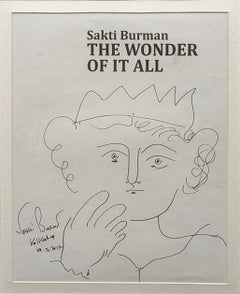
Untitled, Pastel on Paper, Black Colour by Modern Artist "In Stock"
By Sakti Burman
Located in Kolkata, West Bengal
Sakti Burman
Untitled - 11 x 9 inches ( Unframed Size )
Pastel on Paper , 2012
Born : 1935 Kolkata
Education : 1956 Government College of Arts and Crafts in Kolkata and the Ecole N...
Category
2010s Modern Figurative Paintings
Materials
Paper, Pastel
$753
H 11 in W 9 in D 1 in
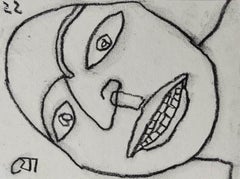
With Smiling Teeth, Dry Pastel on Paper by Artist Jogen Chowdhury "In Stock
By Jogen Chowdhury
Located in Kolkata, West Bengal
Jogen Chowdhury
With Smiling Teeth, Dry Pastel on Paper
7 x 9.25 inches , 2022 (unframed Size )
The framed size of the work is approx . 17 x 20 inches
The work will be shipped inclusive of framing.
Signed in Bengali
Style : He has immense contribution in inspiring young artists of India. Jogen Chowdhury had developed his individual style after his return from Paris. His most famous paintings are in ink, watercolor and pastel. He has painted in oil medium as well.
In Chowdhury’s more recent works the sensory experiences of cloth, bolsters, sofas and the human body are cross-projected to produce an uncanny world of tran-substantiated tumescence and flaccidness.
Jogen Chowdhury has been widely acknowledged to be, the master of the unbroken line. Like Léger, Chowdhury has been stirred by the linear Kalighat pat tradition, but his lines are emotive and used to express and suggest the character of a person. This is done by, distorting the form without breaking the line and in the world of young, contemporary art; distortion has been Jogen Chowdhury’s most significant impact. Perhaps, because of this, a common observation of his work is that his “people” are caricatures. The person feels familiar to the viewer but it is far more individualised – the face is imaginary but the psyche or characteristics are real. The power and beauty of his technique and line is this play between the known and unknown. In Jogen Chowdhury’s work, the figure is always in the foreground, it is primary, it conveys everything. He uses colour to give volume to his figures and the fluidity of his lines bring a sensual aspect to his forms.
About the Artist and his work :
Born : Born 1939 in Daharpara Village, Faridpur, Bangladesh. Jogen Chowdhury is an eminent Indian painter and considered an important painter of 21st century India.
Family Background :
His father Pramatnath Chowdhury was a Brahmin zamindar. Both his parents took interest in art, Jogen Chowdhury’s father Pramatnath Chowdhury painted several mythological scenes from the village theatres and also sculpted various Hindu icons. Whereas his mother was an expert in Alpana drawings.
1939-47 Jogen Chowdhury lived in a village atmosphere. And after partition in 1948, the whole family shifted. Till 1951 the whole family stayed at the police department quarter of his uncle, where on the walls Jogen Chowdhury painted his first painting, 1962 Jogen Chowdhury was employed as Designer in the Handloom Board.
Education :
1955-60: Studied at the Government College of Art and Crafts, Kolkata.
1965 : He went to paris to study in Ecole des Beaux Arts, in William Hayter’s Atelier 17.
Professional Experience :
1968-72 : He worked as an Art-Designer, Madras Handloom Board, Madras.
1970 : A collection of his poems were published, titled ‘Hridoy Train Beje Othey’.
1987 : Joined Kala Bhavan , Santiniketan as a professor of painting.
Selected Exhibitions :
1972, 1975 & 1978 respectively : I, III, IV Triennales at New Delhi.
1979: The Sao Paolo Biennale.
1980: The exhibitions at the Fukuoka Museum, Japan.
1982: The Royal Academy, London.
1982: The Hirschhorn Museum, Washington D.C.
1986: The II Havana Biennale.
1989: ‘Festival of India’, in Geneva.
2002: Saffron art...
Category
2010s Modern Figurative Drawings and Watercolors
Materials
Paper, Pastel, Mixed Media
$4,175
H 7 in W 9.25 in D 1 in
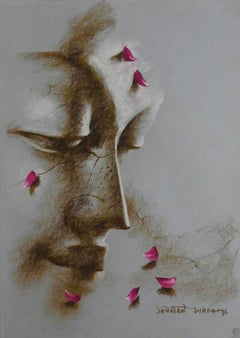
Yugpurush, Buddha, Mixed Media on Paper, Red Brown by Indian Artist "In Stock"
By Sanatan Dinda
Located in Kolkata, West Bengal
Sanatan Dinda - Yugpurush - 28 x 20 inches (unframed size)
Mixed Media on Paper
Shipment in roll form.
Style : Sanatan Dinda discovers the beautiful amidst the ruins of a dilapidate...
Category
2010s Contemporary Figurative Paintings
Materials
Paper, Pastel, Charcoal, Acrylic
$2,399
H 36 in W 28 in D 1 in
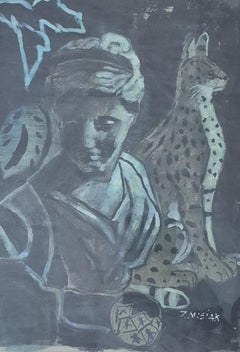
Sunset. Mixed media drawing, Black and white, Polish artist
Located in Warsaw, PL
ZOFIA ANNA MISIAK
Zofia Anna Misiak is a contemporary painter from an artistic family. Her parents are Janina Żylińska and Stanisław Misiak. Zofia Anna Misiak graduated from the Acad...
Category
2010s Surrealist Figurative Drawings and Watercolors
Materials
Paper, Gouache, Oil Pastel, Pastel, Acrylic
$833
H 11.42 in W 7.88 in
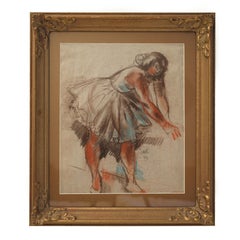
Ballet Dancer by Jules Schyl, Pastel on paper, Similarities with Degas
By Jules Schyl
Located in Stockholm, SE
Jules Schyl (Sweden, 1893-1977)
Title: Ballet Dancers
A Ballet Dancer painting is a rare find for an artist mostly known for his oeuvre with Cubism and Expressionist paintings. The current painting has many similarities with Degas sketches...
Category
1940s Impressionist Figurative Drawings and Watercolors
Materials
Paper, Crayon, Pastel
$1,342 Sale Price
54% Off
H 16.54 in W 13.78 in
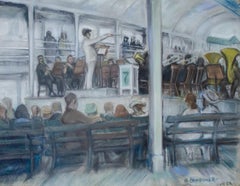
"Musical Conductor" Amy Londoner, Ashcan School, Figurative Concert Scene
By Amy Londoner
Located in New York, NY
Amy Londoner
Musical Conductor, 1922
Signed and dated lower right
Pastel on paper
Sight 18 x 23 inches
Amy Londoner (April 12, 1875 – 1951) was an American painter who exhibited at the 1913 Armory Show. One of the first students of the Henri School of Art in 1909. Prior to the Armory Show of 1913, Amy Londoner and her classmates studied with "Ashcan" painter Robert Henri at the Henri School of Art in New York, N.Y. One notable oil painting, 'The Vase', was painted by both Henri and Londoner.
Londoner was born in Lexington, Missouri on April 12, 1875. Her parents were Moses and Rebecca Londoner, who moved to Leadville, Colorado, by 1880. In 1899, Amy took responsibility for her father who had come to Los Angeles from Leadville and had mental issues. By 1900, Amy was living with her parents and sister, Blanche, in the vicinity of Leadville, Denver, Colorado. While little was written about her early life, Denver City directories indicated that nineteenth-century members of the family were merchants, with family ties to New York, N.Y. The family had a male servant. Londoner traveled with her mother to England in 1907 then shortly later, both returned to New York in 1909. Londoner was 34 years old at the time, and, according to standards of the day, should have married and raised a family long before. Instead, she enrolled as one of the first students at the Henri School of Art in 1909.
At the Henri School, Londoner established friendships with Carl Sprinchorn (1887-1971), a young Swedish immigrant, and Edith Reynolds (1883-1964), daughter of wealthy industrialist family from Wilkes-Barre, PA. Londoner's correspondence, which often included references to Blanche, listed the sisters' primary address as the Hotel Endicott at 81st Street and Columbus Avenue, NYC. Other correspondence also reached Londoner in the city via Mrs. Theodore Bernstein at 252 West 74th Street; 102 West 73rd Street; and the Independent School of Art at 1947 Broadway. In 1911, Londoner vacationed at the Hotel Trexler in Atlantic City, NJ. As indicated by an undated photograph, Londoner also spent time with Edith Reynolds and Robert Henri at 'The Pines', the Reynolds family estate in Bear Creek, PA.
Through her connections with the Henri School, Londoner entered progressive social and professional circles. Henri's admonition, phrased in the vocabulary of his historical time period, that one must become a "man" first and an artist second, attracted both male and female students to classes where development of unique personal styles, tailored to convey individual insights and experiences, was prized above the mastery of standardized, technical skill. Far from being dilettantes, women students at the Henri School were daring individuals willing to challenge tradition. As noted by former student Helen Appleton Read, "it was a mark of defiance,to join the radical Henri group."
As Henri offered educational alternatives for women artists, he initiated exhibition opportunities for them as well. Troubled by the exclusion of work by younger artists from annual exhibitions at the National Academy of Design, Henri was instrumental in organizing the no-jury, no-prize Exhibition of Independent Artists in 1910. About half of the 103 artists included in the exhibition were or had been Henri students, while twenty of the twenty-six women exhibiting had studied with Henri. Among the exhibition's 631 pieces, nine were by Amy Londoner, including the notorious 'Lady with a Headache'. Similarly, fourteen of Henri's women students exhibited in the groundbreaking Armory Show of 1913, forming about eight percent of the American exhibitors and one-third of American women exhibitors. Of the nine documented works submitted by Londoner, five were rejected, while four pastels of Atlantic City beach scenes, including 'The Beach Umbrellas' now in the Remington Collection, were displayed.
Following Henri's example, Londoner served as an art instructor for younger students at the Modern School, whose only requirement was to genuinely draw what they pleased. The work of dancer Isadora Duncan, another artist devoted to the ideals of a liberal education, was also lauded by the Modern School. Henri, who long admired Duncan and invited members of her troupe to model for his classes, wrote an appreciation of her for the Modern School journal in 1915. She was also the subject of Londoner's pastel Isadora Duncan and the Children: Praise Ye the Lord with Dance. In 1914, Londoner traveled to France to spend summer abroad, living at 99 rue Notre Dames des Champs, Paris, France. As the tenets of European modernism spread throughout the United States, Londoner showed regularly at venues which a new generation of artists considered increasingly passe, including the annual Society of Independent Artists' exhibitions between 1918 and 1934, and the Salons of America exhibition in 1922. Londoner also exhibited at the Morton Gallery, Opportunity Gallery, Leonard Clayton Gallery and Brownell-Lambertson Galleries in NYC. Her painting of a 'Blond Girl' was one of two works included in the College Art Associations Traveling Exhibition of 1929, which toured colleges across the country to broad acclaim.
Londoner later in life suffered from illnesses then suffered a stroke which resulted in medical bills significantly mounting over the years that her old friends from the Henri School, including Carl Sprinchorn, Florence Dreyfous, Florence Barley, and Josephine Nivison Hopper, scrambled to raise funds and find suitable long-term care facilities for Londoner. Londoner later joined Reynolds in Bear Creek, PA. Always known for her keen wit, Londoner retained her humor and concern for her works even during her illness, noting that "if anything happens to the Endicott, I guess they will just throw them out." Sprinchorn and Reynolds, however, did not allow this to happen. In 1960, Londoner's paintings 'Amsterdam Avenue at 74th Street' and 'The Builders' were loaned by Reynolds to a show commemorating the Fiftieth Anniversary of the Exhibition of Independent Artists in 1910, presented at the Delaware Art Center, Wilmington, DE. In the late 80's, Francis William Remington, 'Bill Remington', of Bear Creek Village PA, along with his neighbor and artist Frances Anstett Brennan, both had profound admiration for Amy Londoner's art work and accomplishments as a woman who played a significant role in the Ashcan movement. Remington acquired a significant number of Londoner's artwork along with Frances Anstett Brenan that later was part of an exhibition of Londoner's artwork in April 15 of 2007, at the Hope Horn...
Category
1920s Ashcan School Figurative Paintings
Materials
Paper, Pastel
$3,750
H 24.5 in W 29.5 in
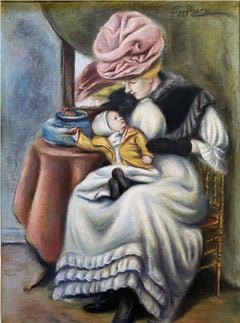
Mother and Child with Goldfish
By Peggy Dodds
Located in Los Angeles, CA
A whimsical pastel featuring a Mother with her Child on her lap that just pulled a goldfish from it's bowl.
A charming large work that is exquisitely framed.
Peggy Dodds Williams
...
Category
1930s Impressionist Figurative Paintings
Materials
Pastel, Archival Paper
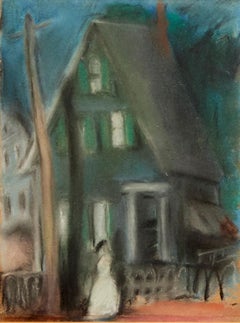
"Night Stroll" Amy Londoner, Ashcan School, Figurative Nocturne
By Amy Londoner
Located in New York, NY
Amy Londoner
Beach at Atlantic City, circa 1922
Signed lower right
Pastel on paper
Sight 23 x 18 inches
Amy Londoner (April 12, 1875 – 1951) was an American painter who exhibited at the 1913 Armory Show. One of the first students of the Henri School of Art in 1909. Prior to the Armory Show of 1913, Amy Londoner and her classmates studied with "Ashcan" painter Robert Henri at the Henri School of Art in New York, N.Y. One notable oil painting, 'The Vase', was painted by both Henri and Londoner.
Londoner was born in Lexington, Missouri on April 12, 1875. Her parents were Moses and Rebecca Londoner, who moved to Leadville, Colorado, by 1880. In 1899, Amy took responsibility for her father who had come to Los Angeles from Leadville and had mental issues. By 1900, Amy was living with her parents and sister, Blanche, in the vicinity of Leadville, Denver, Colorado. While little was written about her early life, Denver City directories indicated that nineteenth-century members of the family were merchants, with family ties to New York, N.Y. The family had a male servant. Londoner traveled with her mother to England in 1907 then shortly later, both returned to New York in 1909. Londoner was 34 years old at the time, and, according to standards of the day, should have married and raised a family long before. Instead, she enrolled as one of the first students at the Henri School of Art in 1909.
At the Henri School, Londoner established friendships with Carl Sprinchorn (1887-1971), a young Swedish immigrant, and Edith Reynolds (1883-1964), daughter of wealthy industrialist family from Wilkes-Barre, PA. Londoner's correspondence, which often included references to Blanche, listed the sisters' primary address as the Hotel Endicott at 81st Street and Columbus Avenue, NYC. Other correspondence also reached Londoner in the city via Mrs. Theodore Bernstein at 252 West 74th Street; 102 West 73rd Street; and the Independent School of Art at 1947 Broadway. In 1911, Londoner vacationed at the Hotel Trexler in Atlantic City, NJ. As indicated by an undated photograph, Londoner also spent time with Edith Reynolds and Robert Henri at 'The Pines', the Reynolds family estate in Bear Creek, PA.
Through her connections with the Henri School, Londoner entered progressive social and professional circles. Henri's admonition, phrased in the vocabulary of his historical time period, that one must become a "man" first and an artist second, attracted both male and female students to classes where development of unique personal styles, tailored to convey individual insights and experiences, was prized above the mastery of standardized, technical skill. Far from being dilettantes, women students at the Henri School were daring individuals willing to challenge tradition. As noted by former student Helen Appleton Read, "it was a mark of defiance,to join the radical Henri group."
As Henri offered educational alternatives for women artists, he initiated exhibition opportunities for them as well. Troubled by the exclusion of work by younger artists from annual exhibitions at the National Academy of Design, Henri was instrumental in organizing the no-jury, no-prize Exhibition of Independent Artists in 1910. About half of the 103 artists included in the exhibition were or had been Henri students, while twenty of the twenty-six women exhibiting had studied with Henri. Among the exhibition's 631 pieces, nine were by Amy Londoner, including the notorious 'Lady with a Headache'. Similarly, fourteen of Henri's women students exhibited in the groundbreaking Armory Show of 1913, forming about eight percent of the American exhibitors and one-third of American women exhibitors. Of the nine documented works submitted by Londoner, five were rejected, while four pastels of Atlantic City beach scenes, including 'The Beach Umbrellas' now in the Remington Collection, were displayed.
Following Henri's example, Londoner served as an art instructor for younger students at the Modern School, whose only requirement was to genuinely draw what they pleased. The work of dancer Isadora Duncan, another artist devoted to the ideals of a liberal education, was also lauded by the Modern School. Henri, who long admired Duncan and invited members of her troupe to model for his classes, wrote an appreciation of her for the Modern School journal in 1915. She was also the subject of Londoner's pastel Isadora Duncan and the Children: Praise Ye the Lord with Dance. In 1914, Londoner traveled to France to spend summer abroad, living at 99 rue Notre Dames des Champs, Paris, France. As the tenets of European modernism spread throughout the United States, Londoner showed regularly at venues which a new generation of artists considered increasingly passe, including the annual Society of Independent Artists' exhibitions between 1918 and 1934, and the Salons of America exhibition in 1922. Londoner also exhibited at the Morton Gallery, Opportunity Gallery, Leonard Clayton Gallery and Brownell-Lambertson Galleries in NYC. Her painting of a 'Blond Girl' was one of two works included in the College Art Associations Traveling Exhibition of 1929, which toured colleges across the country to broad acclaim.
Londoner later in life suffered from illnesses then suffered a stroke which resulted in medical bills significantly mounting over the years that her old friends from the Henri School, including Carl Sprinchorn, Florence Dreyfous, Florence Barley, and Josephine Nivison Hopper, scrambled to raise funds and find suitable long-term care facilities for Londoner. Londoner later joined Reynolds in Bear Creek, PA. Always known for her keen wit, Londoner retained her humor and concern for her works even during her illness, noting that "if anything happens to the Endicott, I guess they will just throw them out." Sprinchorn and Reynolds, however, did not allow this to happen. In 1960, Londoner's paintings 'Amsterdam Avenue at 74th Street' and 'The Builders' were loaned by Reynolds to a show commemorating the Fiftieth Anniversary of the Exhibition of Independent Artists in 1910, presented at the Delaware Art Center, Wilmington, DE. In the late 80's, Francis William Remington, 'Bill Remington', of Bear Creek Village PA, along with his neighbor and artist Frances Anstett Brennan, both had profound admiration for Amy Londoner's art work and accomplishments as a woman who played a significant role in the Ashcan movement. Remington acquired a significant number of Londoner's artwork along with Frances Anstett Brenan that later was part of an exhibition of Londoner's artwork in April 15 of 2007, at the Hope Horn...
Category
1910s Ashcan School Figurative Paintings
Materials
Paper, Pastel
$4,000
H 17.75 in W 14.5 in
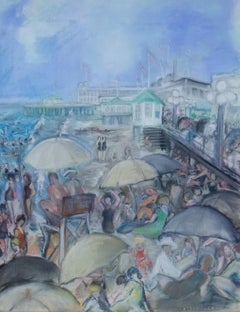
"Beach at Atlantic City, New Jersey" Amy Londoner, Ashcan School, Figurative
By Amy Londoner
Located in New York, NY
Amy Londoner
Beach at Atlantic City, circa 1922
Signed lower right
Pastel on paper
Sight 23 x 18 inches
Amy Londoner (April 12, 1875 – 1951) was an American painter who exhibited at the 1913 Armory Show. One of the first students of the Henri School of Art in 1909. Prior to the Armory Show of 1913, Amy Londoner and her classmates studied with "Ashcan" painter Robert Henri at the Henri School of Art in New York, N.Y. One notable oil painting, 'The Vase', was painted by both Henri and Londoner.
Londoner was born in Lexington, Missouri on April 12, 1875. Her parents were Moses and Rebecca Londoner, who moved to Leadville, Colorado, by 1880. In 1899, Amy took responsibility for her father who had come to Los Angeles from Leadville and had mental issues. By 1900, Amy was living with her parents and sister, Blanche, in the vicinity of Leadville, Denver, Colorado. While little was written about her early life, Denver City directories indicated that nineteenth-century members of the family were merchants, with family ties to New York, N.Y. The family had a male servant. Londoner traveled with her mother to England in 1907 then shortly later, both returned to New York in 1909. Londoner was 34 years old at the time, and, according to standards of the day, should have married and raised a family long before. Instead, she enrolled as one of the first students at the Henri School of Art in 1909.
At the Henri School, Londoner established friendships with Carl Sprinchorn (1887-1971), a young Swedish immigrant, and Edith Reynolds (1883-1964), daughter of wealthy industrialist family from Wilkes-Barre, PA. Londoner's correspondence, which often included references to Blanche, listed the sisters' primary address as the Hotel Endicott at 81st Street and Columbus Avenue, NYC. Other correspondence also reached Londoner in the city via Mrs. Theodore Bernstein at 252 West 74th Street; 102 West 73rd Street; and the Independent School of Art at 1947 Broadway. In 1911, Londoner vacationed at the Hotel Trexler in Atlantic City, NJ. As indicated by an undated photograph, Londoner also spent time with Edith Reynolds and Robert Henri at 'The Pines', the Reynolds family estate in Bear Creek, PA.
Through her connections with the Henri School, Londoner entered progressive social and professional circles. Henri's admonition, phrased in the vocabulary of his historical time period, that one must become a "man" first and an artist second, attracted both male and female students to classes where development of unique personal styles, tailored to convey individual insights and experiences, was prized above the mastery of standardized, technical skill. Far from being dilettantes, women students at the Henri School were daring individuals willing to challenge tradition. As noted by former student Helen Appleton Read, "it was a mark of defiance,to join the radical Henri group."
As Henri offered educational alternatives for women artists, he initiated exhibition opportunities for them as well. Troubled by the exclusion of work by younger artists from annual exhibitions at the National Academy of Design, Henri was instrumental in organizing the no-jury, no-prize Exhibition of Independent Artists in 1910. About half of the 103 artists included in the exhibition were or had been Henri students, while twenty of the twenty-six women exhibiting had studied with Henri. Among the exhibition's 631 pieces, nine were by Amy Londoner, including the notorious 'Lady with a Headache'. Similarly, fourteen of Henri's women students exhibited in the groundbreaking Armory Show of 1913, forming about eight percent of the American exhibitors and one-third of American women exhibitors. Of the nine documented works submitted by Londoner, five were rejected, while four pastels of Atlantic City beach scenes, including 'The Beach Umbrellas' now in the Remington Collection, were displayed.
Following Henri's example, Londoner served as an art instructor for younger students at the Modern School, whose only requirement was to genuinely draw what they pleased. The work of dancer Isadora Duncan, another artist devoted to the ideals of a liberal education, was also lauded by the Modern School. Henri, who long admired Duncan and invited members of her troupe to model for his classes, wrote an appreciation of her for the Modern School journal in 1915. She was also the subject of Londoner's pastel Isadora Duncan and the Children: Praise Ye the Lord with Dance. In 1914, Londoner traveled to France to spend summer abroad, living at 99 rue Notre Dames des Champs, Paris, France. As the tenets of European modernism spread throughout the United States, Londoner showed regularly at venues which a new generation of artists considered increasingly passe, including the annual Society of Independent Artists' exhibitions between 1918 and 1934, and the Salons of America exhibition in 1922. Londoner also exhibited at the Morton Gallery, Opportunity Gallery, Leonard Clayton Gallery and Brownell-Lambertson Galleries in NYC. Her painting of a 'Blond Girl' was one of two works included in the College Art Associations Traveling Exhibition of 1929, which toured colleges across the country to broad acclaim.
Londoner later in life suffered from illnesses then suffered a stroke which resulted in medical bills significantly mounting over the years that her old friends from the Henri School, including Carl Sprinchorn, Florence Dreyfous, Florence Barley, and Josephine Nivison Hopper, scrambled to raise funds and find suitable long-term care facilities for Londoner. Londoner later joined Reynolds in Bear Creek, PA. Always known for her keen wit, Londoner retained her humor and concern for her works even during her illness, noting that "if anything happens to the Endicott, I guess they will just throw them out." Sprinchorn and Reynolds, however, did not allow this to happen. In 1960, Londoner's paintings 'Amsterdam Avenue at 74th Street' and 'The Builders' were loaned by Reynolds to a show commemorating the Fiftieth Anniversary of the Exhibition of Independent Artists in 1910, presented at the Delaware Art Center, Wilmington, DE. In the late 80's, Francis William Remington, 'Bill Remington', of Bear Creek Village PA, along with his neighbor and artist Frances Anstett Brennan, both had profound admiration for Amy Londoner's art work and accomplishments as a woman who played a significant role in the Ashcan movement. Remington acquired a significant number of Londoner's artwork along with Frances Anstett Brenan that later was part of an exhibition of Londoner's artwork in April 15 of 2007, at the Hope Horn...
Category
1920s Ashcan School Figurative Paintings
Materials
Paper, Pastel
$3,750
H 29.5 in W 24.5 in
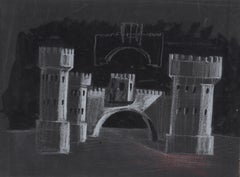
"Macbeth Stagecraft II" Pastel on Paper 10" x 12" in by Salah Abdel Kerim
By Salah Abdel Kerim
Located in Culver City, CA
"Macbeth Stagecraft II" Pastel on Paper 10" x 12" in by Salah Abdel Kerim
Born in Fayoum to a big family of 5 brothers and sisters. In 1938 he meets the famous painter Hussein Bikar and he becomes his student in the Faculty of Arts in Qena. He remained much attached to his professor all through his life. In 1940 he meets Hussein Youssef Amin and the Group of Contemporary Art at the secondary school of Farouk First in Abasya district in Cairo when he was introduced to surrealism for the first time. In 1943 he becomes a student at the Faculty of Fine Arts and graduates with excellence and honors in 1947. In 1948 he becomes an assistant to the interior decoration section at the FFA. He is then sent to a mission in Paris in 1952 and he becomes a student to Paul Colin and A.Marie Cassandre for publicity and theatre design. He then moves to Rome in 1956 to study cinema design. In 1957 he received the international prize in painting from San Vito Romano, Italy, and obtains his Ph.D. from Centro Sperimental di Cinemato Grafia. Back in Egypt in 1958, he is appointed professor at the FFA where he started experimenting with his masterpieces sculptures in wrote iron...
Category
20th Century Contemporary Figurative Paintings
Materials
Paper, Pastel
More From This Seller
View AllLes Puiseuses d
Eau - Barbizon Figurative Landscape Pastel by Leon Lhermitte
By Léon Augustin Lhermitte
Located in Marlow, Buckinghamshire
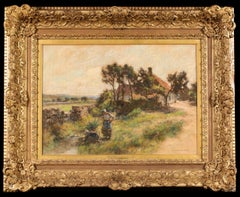
Signed figures in landscape pastel on canvas circa 1910 by French Barbizon painter Leon Augustin Lhermitte. The piece depicts a rural landscape with two women in traditional Breton c...
Category
1910s Barbizon School Landscape Paintings
Materials
Canvas, Pastel
Lavandieres - Barbizon Figurative Landscape Pastel by Leon Lhermitte
By Léon Augustin Lhermitte
Located in Marlow, Buckinghamshire
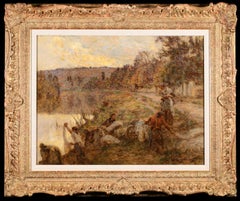
Signed figures in riverscape oil on canvas by French Barbizon painter Leon Augustin Lhermitte. The piece depicts a rural landscape with washerwomen in traditional Breton clothing was...
Category
1920s Barbizon School Figurative Paintings
Materials
Canvas, Oil
Marseille - Post Impressionist Landscape Pastel by Hugues Claude Pissarro
Located in Marlow, Buckinghamshire
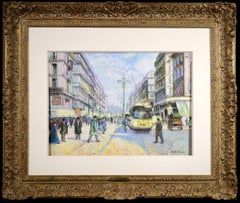
Signed and titled pastel on paper figures in landscape circa 1990 by French post impressionist painter Hugues Claude Pissarro. The work depicts a view of the tramway on the Rue de No...
Category
1990s Post-Impressionist Figurative Paintings
Materials
Paper, Pastel
Portrait of Berthe Lipchitz - Modern Portrait Pencil Drawing - Amedeo Modigliani
By Amedeo Modigliani
Located in Marlow, Buckinghamshire
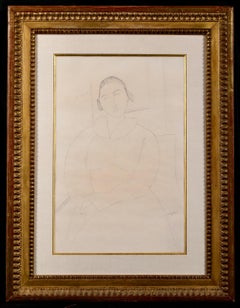
Signed pencil on paper portrait drawing by Italian artist Amedeo Clemente Modigliani. The portrait is of Berthe Lipchitz who was the wife of Modigliani's friend, the sculptor Jacques Lipchitz. This work is a study for "Portrait of Jacques & Berthe Lipchitz" which hangs in the Art Institute of Chicago.
Signature:
Signed lower right
Dimensions:
Framed: 26.75"x18.25"
Unframed: 18.75"x12.25"
Provenance:
The collection of Leopold Survage
The collection of Dimitri Snegaroff
The collection of Leopold Zborowski
Galerie Charpentier - Paris 1958
Private french collection
Galerie Pierre Levy - Paris
Private collection - United Kingdom
Exhibited:
Galerie Charpentier - Cent Tableaux de Modigliani - Paris, 1958
Les Peintres de Zborowski - ~Foundation L'Hermitage, Lausanne 1994
Amedeo Modigliani Exhibition - Museo d'Arte Moderna, Lugano 1999
Amedeo Modigliani was born into a middle-class Jewish family and was the brother of Eugenio Modigliani, who later became the leader of the Italian socialist workers’ party prior to the rise of fascism. Modigliani suffered from poor health as a child and contracted pleurisy in 1895, followed in 1898 by typhus with pulmonary complications, which culminated in tuberculosis in 1901. He moved to Livorno to study under Guglielmo Micheli, who had himself been a pupil of Giovanni Fattori, one of the Macchiaioli group of painters who worked in strong colour patches (macchie) to achieve vivid light and colour effects; their approach came as a reaction against academic art in Italy and, in much the same way as the French Impressionists, they advocated painting from nature rather than aspiring to communicate any particular message or ideology. In 1902, Modigliani enrolled at the academy of fine arts in Florence. He travelled to Rome and Venice in 1903, where he devoted the bulk of his day to visiting museums. At around this time he started to read Dante, dreaming no doubt of the Vita Nuova; he also devoured the works of Leopardi, Carducci, d’Annunzio, Spinoza and Nietzsche.
In 1906, Modigliani moved to Paris, lodging at the Rue Caulaincourt. At that juncture, nothing about him appeared to presage the brilliant career that was to follow. His arrival in the artists’ quarter, then known colloquially as the maquis - the labyrinthine tangle of narrow streets around today’s Avenue Junot in Montmartre - went virtually unnoticed by the artists already living and working there, including Picasso, Braque and Derain. Modigliani’s painting made next to no immediate impact and he was recognised primarily on account of his frail constitution, flashing eyes, innate elegance and intellectual prowess. He was accepted in the community that was Montmartre but never belonged to any particular ‘set’ or circle, and there is no record of his ever having been invited to Pablo Picasso’s studio, the famous ‘wash house’.
The literate and highly articulate Modigliani opted instead for the companionship of Maurice Utrillo, an instinctual painter of whom it could charitably have been said that his conversation was, at best, limited. Nonetheless, Modigliani and ‘Litrillo’ (as Utrillo was commonly known to the street urchins - the ‘p’tits poulbots’) began to frequent the cabarets and dance halls of the Butte de Montmartre, and the nefarious hashish dens - post-Baudelaire ‘institutions’, frequented in the main by out-of-work writers and talentless artists. Modigliani developed an addiction, which, compounded by his alcoholism, took its toll. It also transformed him from an artist of limited ability into one devoid of bourgeois scruples.
In his monograph, Modigliani: Sa Vie et Son Oeuvre, written in 1926 shortly after Modigliani’s death, André Salmon hinted at a ‘pact with the devil’. While somewhat overstating the case, this rather unpromising painter from Livorno metamorphosed virtually overnight into an artist of rare ability and sensitivity. The turning-point came in 1907, when Modigliani met Paul Alexandre, a doctor who befriended him, took him under his wing and purchased some of his work. The banal paintings he had turned out in Montmartre were suddenly superseded by exceptional works, produced first in Montmartre ( Cellist, 1909), and then in Montparnasse.
In Montparnasse, Modigliani started to move in artistic circles, meeting Chaim Soutine, Marc Chagall, Jules Pascin and others, all of whom lived and worked in the building in the Rue Vaugirard known as ‘La Ruche’ (‘the beehive’). Then, in the Cité Falguière, he met the Romanian-born sculptor Constantin Brancusi, who encouraged him to take up sculpture, which he did, between 1909 and 1913. In 1914, several dealers, including the erstwhile poet Léopold Zborowski and the collector Paul Guillaume, tried with little success to market Modigliani’s paintings. From 1914 to 1916, Modigliani was caught up in a tempestuous affair with the English poet and journalist Beatrice Hastings. In 1917, however, he met Jeanne Hébuterne at the Colarossi Academy, who became his constant companion and model, and who gave birth to their daughter Jeanne in 1918. In 1918 and 1919, Modigliani and Jeanne spent time in Nice on the Côte d’Azur but by 1920 he was suffering from tubercular meningitis. His friends, Kisling and the Chilean Ortiz de Zarate, brought him and a pregnant Jeanne back to Paris, where he died on January 20 1920 in the Hôpital de la Charité. His last words were reputed to be: ‘Cara Italia’. Modigliani’s brother, by this time a socialist member of parliament, telegrammed instructions to ‘bury him as befits a prince’. Jeanne Hébuterne, a budding twenty-year-old painter, killed herself and her unborn child on the day of Modigliani’s funeral by jumping to her death from a fifth-floor window.
Modigliani’s first paintings were undistinguished portraits in the Impressionist manner. After moving to Paris in 1907, his early work was influenced by the Swiss-born lithographer Théophile Alexandre Steinlen, Henri de Toulouse-Lautrec and Pablo Picasso, the latter then in his ‘blue’ period. From the onset, Modigliani’s principal preoccupation was the human figure. After the artistic (and literal) limbo of Montmartre, when his output was confined to a few Expressionist-like paintings of street life, the theatre and the circus, Modigliani suddenly erupted on the scene in 1909 with Cellist, a robust, well-constructed and vividly coloured canvas that utterly exceeded all prior expectations. He had not taken part in the protracted debates that took place nightly in Picasso’s studio, but he had superficially assimilated the Cubist ideas developed by Picasso and Georges Braque. Above all, Modigliani had been influenced by African art, which was a key feature of the Cubist movement. He succeeded in treading a fine line between the coolly analytical Cubist approach and the all-too-common European perception of African art as a succession of exaggerated facial grimaces.
It would appear that Modigliani had always been attracted to sculpture as a discipline. The friendly encouragement he received as of 1909 from Brancusi no doubt intensified his interest and reinforced his attempts to achieve a sustained simplicity of line and form. In 1910, he befriended the Russian artists Alexander Archipenko and Jacques Lipchitz, both of whom recorded Modigliani’s distaste for modelling in clay (which he referred to as ‘mud’), on the grounds that it degraded the art of sculpture. Like Brancusi, Modigliani believed in working directly, carving from wood in the case of two extant pieces, and from (sand)stone in others, with the exception of a few bronzes which were, presumably, modelled in clay before being cast into bronze. His sculpture was influenced by archaic and non-western cultures - early Graeco-Roman, African and Khmer - as well as heads carved on columns adorning the façades of Romanesque and Gothic cathedrals (Modigliani rarely sculpted a rear view of his figures). Up to approximately 1912, his sculptures take the form of tall cylinders, usually with elongated heads and shallow relief indentations or projections to indicate the hairline, facial features and neck. He departed from this style only infrequently, most notably in a small number of pieces believed to have been sculpted in 1913, which are characterised by a compressed, cubistic format and shallower and less distinct features. Modigliani eventually abandoned sculpture, presumably because of his general health and circumstances, and possibly due to the fact that his sculptures sold for even less than his paintings. During the years that he devoted to sculpture, Modigliani is recorded as producing only thirty canvases, although after 1913 his sculpture became reflected in his painting.
Following his Montmartre days, Modigliani’s work developed in both quantitative and qualitative terms, presumably helped by the relative stability of his relationship with Jeanne Hébuterne. The first paintings after his short-lived sculptural phase saw him revert briefly to Neo-Impressionist pointillism, followed by a episode marked by Cubism, which was mainly evident in portraits of friends and fellow artists living and working in Montparnasse: Henri Laurens; Juan Gris (1915); Jacques Lipchitz and his Wife; Chaim Soutine; Léopold Sauvage; Paul Guillaume; Max Jacob; Béatrice Hastings con Capello (all 1916); Mlle Modigliani (1917); Léon Bakst; Léopold Zborowski; Concierge’s Son; Adolescent (1918); Mademoiselle Lunia Czechowska; Madame Zborowska; Portrait of the Artist’s Wife (1919). A large number of other portraits exist among his drawings, most of which were executed impromptu in the street or cafés. These quickly drawn portraits often exhibit an urgency and surprising lucidity. Examples include Portrait of the Gypsy Painter Fabiano de Castro; André Salmon (1918); Portrait of the Artist’s Wife (1919); and Lada, Author; Mario, Composer (1920).
Whatever his shortcomings, Amedeo Modigliani ranks as one of the 20th-century’s greatest painters of the female form. The bulk of his painted nudes were produced in 1915-1916 (prior to that date they were predominantly drawings), and are taken from every walk of life, such as a regular at a Montparnasse café, or a waitress at the soup kitchen where he ate his meagre meals. In each instance, he invested his models with an almost aristocratic hauteur. This is exemplified in a number of paintings (usually based on numerous prior drawings): Flower Girl; Blonde Lady; Sleeping Nude (1917); Blonde Nude; Young Woman; Maria (1918); Pink Nude; Reclining Nude; Nude on a Divan; Woman with a Fan (1919); and Young Woman in a Chemise; Reclining Nude (1920). Modigliani painted his subjects in elongated, elliptic ovals: the swell of a breast, the pronounced curve of the pelvis, the fullness of the thigh, the symmetrically oval face and the graceful arabesque of the body. Facial features are reduced to a bare minimum, with the eyes typically empty, like those of a statue. He employed colour as a constructive material in much the same way as stone in sculpture, juxtaposing muted pinks, ochres and pale browns against discreet background tones supplied by décor and garments. The overall effect is to yield a flat image devoid of chiaroscuro but which captures the essence of a subject. It has often been remarked that his women, with their elongated heads and long, graceful necks, generally tilted to one side, possess a melancholy beauty akin to that of the Siena Madonnas (reproductions of which Modigliani kept pinned on his studio wall), which accounts for Modigliani’s soubriquet as the ‘painter of sorrows’. From 1917, the majority of his nudes, characterised by a more pronounced elongation of the female body and lighter palette, were modelled by Jeanne Hébuterne and Luna Czechowska.
Very few artists have been the subject of so many monographs and biographies as Modigliani; the selection appended to this entry indicates only some of the more important of these. Too much, perhaps, has been made of his life as an artiste maudit, of his ‘accursed’ yet colourful life rather than the quality of his work. Some critics have detected in him an artist of great and persistent intellectual curiosity; others emphasise that he was a ‘gentleman to the end’ and stress his physical frailty, ignoring the fact that this was an integral component of his creativity. More seriously, his posthumous fame amongst the public at large acts both for and against him, as if his subsequent popularity has become a yardstick of his artistic ability. The mannerism of his style ensures that a ‘Modigliani’ is instantly recognisable, but his success in adapting Cubism and African art to a language and palette that are entirely his own places him squarely at the heart of the modern movement.
Amedeo Modigliani’s work has featured in numerous group exhibitions, including: Paris in 1908, when he showed his Jewess and three other canvases; the Salon des Indépendants in 1910; and the Salon d’Automne in 1912, where he exhibited examples of his sculpture. His posthumous inclusion in the 1922 Venice Biennale was regarded in Italy as a complete fiasco, prompting the critic Giovanni Scheiwiller to paraphrase Charles Baudelaire’s remark to the effect that, ‘we know that precious few will understand us, but that shall be sufficient’. In 1917-1918, the Berthe Weill Gallery organised a one-man show at the instigation of Zborowski but, on the order of the then chief of police, some of Modigliani’s sensual nudes were withdrawn on account of alleged indecency. On 20 December 1918, the Paul Guillaume Gallery exhibited several paintings by Modigliani alongside others by Matisse, Picasso and Derain.
All other exhibitions of Modigliani’s work have been held since his death. They include those at the Bernheim-Jeune Gallery in Paris (1922); Galerie Bing (Paris, 1925 and 1927); Marcel Benhelm Gallery (Paris, 1931); Palais des Beaux-Arts (Brussels, 1933); Kunsthalle Basel (1934); American-British Art Center (New York, 1944); Galerie de France (Paris, 1945 and 1949); Gimpels Fils Gallery (London, 1947); Cleveland Museum of Art (1951); Museum of Modern Art (New York, 1951); Cantini Museum (Marseilles, 1958); Palazzo Reale (Milan, 1958); Galerie Charpentier (Paris, 1958); Chicago Arts Club (1959); Cincinnati Art Museum (1959); Galleria Nazionale d’Arte Moderna (Rome, 1959); Boston Museum of Fine Arts (1961); Perls Galleries (New York, 1963 and 1966); Kyoto National Museum of Modern Art (1968); Musée Jacquemart-André (Paris, 1970); Musée St-Georges (Liège, 1980); Tokyo Arts Centre (1980); Musée de l’Art Moderne de la Ville de Paris (1970; a comprehensive exhibition of Modigliani’s sculptures...
Category
1910s Modern Portrait Drawings and Watercolors
Materials
Paper, Pencil
Price Upon Request
Free Shipping
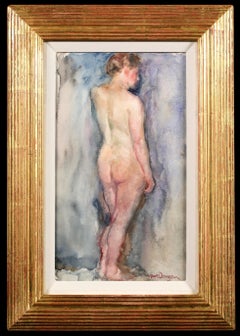
Un nu feminin - Fauvist Nude Figurative Watercolour by Kees Van Dongen
By Kees van Dongen
Located in Marlow, Buckinghamshire
Signed nude watercolour on paper circa 1900 by Kees van Dongen. The piece depicts a standing nude woman with her hair tied up facing away from the artist. This superb work can be dir...
Category
Early 1900s Fauvist Nude Drawings and Watercolors
Materials
Paper, Watercolor
Etude Barque au Quai - Normandy - Post Impressionist Seascape Oil - Othon Friesz
By Achille-Émile Othon Friesz
Located in Marlow, Buckinghamshire
Signed oil on paper laid on panel seascape c.1907 by French post impressionist painter Achille-Emile Othon Friesz. The piece is a study of a view of a boat in a quay at Normandy, Fra...
Category
Early 1900s Post-Impressionist Landscape Paintings
Materials
Oil, Panel, Laid Paper