Items Similar to A large drawing by Il Cigoli depicting Christ
s Entry into Jerusalem
Want more images or videos?
Request additional images or videos from the seller
1 of 14
Lodovico Cardi, known as Il CigoliA large drawing by Il Cigoli depicting Christ
s Entry into Jerusalem
$10,136.27
£7,505.48
€8,500
CA$14,000.55
A$14,994.60
CHF 8,060.99
MX$182,118.16
NOK 101,854.57
SEK 93,255.43
DKK 64,780.75
About the Item
This large sheet, delicately enhanced with blue ink wash, was created by Lodovico Cardi, known as Il Cigoli, the most prominent painter in Florence at the end of the 16th century. It depicts a festive episode that opens Christ’s Passion: His glorious entry into Jerusalem, riding on a donkey.
Another version of our drawing, slightly more accomplished and squared up, is part of the collections of the Städel Museum in Frankfurt, which leads us to believe that this one is probably the very first version of the large altarpiece commissioned before 1604 for a chapel in the Church of Santa Croce in Florence. Left unfinished upon the painter's death, this painting was the last religious subject Cigoli worked on, giving it a particularly poignant dimension...
1. Il Cigoli, a Florentine painter, draftsman, architect, and sculptor at the transition between Mannerism and Baroque
Born in Tuscany near San Miniato in 1559, Il Cigoli joined in Florence the workshop of Alessandro Allori, himself a pupil and heir of the painter Agnolo Bronzino, at the age of 13. Around 1584, he was called upon to collaborate with the architect Bernardo Buontalenti (1536-1608) and became friends with the astronomer Galileo Galilei, whose advice led him to write a Treatise on Perspective. This was also the period during which his painting was greatly influenced by Santi di Tito. Introduced by Buontalenti to the Medici court, he received his first painting commissions from the Grand Duke Francesco I in 1588, which led him to take Florentine nationality on June 15, 1588.
The decade from 1591 to 1601 marked the artist's artistic maturity, as he established himself as one of the leading Florentine painters of the time. He had his own studio, where painters such as Andrea Commodi, Giovanni Bilivert , and Cristofano Allori were trained. He also became the principal set designer for major Medici events, such as the wedding of Henry IV and Marie de Medici. His work was so appreciated by the Queen of France that in 1610, after the assassination of her husband, she entrusted him with the design of the monumental statue erected in honor of Henry IV on the Pont-Neuf in Paris.
Il Cigoli moved to Rome in 1604 but continued to return regularly to Florence to fulfill numerous commissions. He became a Knight of Malta in 1613 and died in Rome that same year.
Il Cigoli was the most prominent painter in Florence at the end of the 16th century and the first major representative of the "early Baroque" style. He revolutionized the practice of painting and drawing in Florence, much like the Carracci family did in Bologna around the same time. His work moved away from the "Mannerism" of the previous generation, tending towards a naturalism that became the preferred means of expression for the new religious fervor associated with the Counter-Reformation. Although his painting was rooted in the Florentine tradition, he also sought inspiration beyond the city and was greatly influenced by Federico Barocci (c. 1535-1612) and the Venetians. Like his painting, his drawing style was highly influential, profoundly affecting the entire next generation of Florentine artists. The large number of his drawings which have been preserved (mainly at the Uffizi Gallery in Florence) demonstrate the importance of draftsmanship in his work.
2. Description of the drawing and related artworks
IL Cigoli depicts Christ's triumphal entry into Jerusalem, an episode that follows the resurrection of Lazarus in Bethany and opens the Passion narrative. It is also one of the few episodes mentioned in three Gospels (John 12:13-15; Matthew 21:1-11 and Luke 19:28-40).
In keeping with Counter-Reformation tradition, Il Cigoli's drawing closely follows the Gospel account: Christ, riding on a donkey, is acclaimed by a large crowd; “a very large crowd spread their cloaks on the road, while others cut branches from the trees and spread them on the road." While we see a young man climbing a tree to cut branches in the upper right corner, others branches have already been scattered on the ground beneath the donkey's hooves. The bearded figure in the background on the right is holding a cloak he has just spread on the ground.
In this oblong drawing, Cigoli remains faithful to the Mannerist tradition of elongating figures, as demonstrated by the disproportionately long arm of the kneeling figure with a partially naked torso in the front row on the left. With this off-center perspective "à la Bibiena" , which draws us in with Christ under the monumental arch to follow him into Jerusalem, like the figure shown from behind on the right, this drawing already heralds a distinctly Baroque dynamic.
A magnificent drawing of similar dimensions, kept at the Städel Museum in Frankfurt, faithfully reproduces this same composition (9th photo in the gallery).
Enhanced with a wash in a darker blue than the turquoise ink used in our drawing, this drawing from the Städel Museum is also more accomplished: the use of wash is much more systematic (including in the background area inside the arch, which is only roughly sketched in pen in our drawing), and the contrasts inside the areas worked with wash are stronger. Several details have also been completed in pen, such as the coffers of the archway under which Christ is about to enter, and the eagle crowning the palace in the background. The laying down of a grid indicates that it was most probably used in the creation of the altarpiece for the church of Santa Croce.
The final canvas, which is still in the Santa Croce Church in Florence, shows several variations compared to the two preparatory studies (10th photo in the gallery).
This painting was probably commissioned around 1604, before Il Cigoli’s transfer to Rome, by the Serristori brothers, a patrician family from Florence, who were the benefactors of the altar for which it was intended. Left unfinished in Florence when the painter left for Rome, it was sent to him in Rome in 1610, and Il Cigoli was still working on it shortly before his death. He is reported to have given instructions to Giovanni Bilivert for its completion. The canvas was then restored in the 17th century by Bartolomeo Salvestrini to correct some damage caused by damp.
Il Cigoli is reported to have painted the head and clothes of Christ, as well as the two figures on the far right (the beardless old man and the child carrying an armful of branches on the right). The introduction of this child is one of the main differences between the painting and the two preparatory drawings: this group of two figures (the one who seemed to be running behind Christ and the child on his right) is now depicted in reverse, which gives more space to the child carrying branches, but removes the dynamic aspect of the running man.
The rest of the composition has also been simplified. While the two kneeling figures on the left (including the one in the front row with the exaggeratedly long arm) are still there, the woman standing on the left just above them has lost the child she was holding in her arms, and several figures (including the woman who was just behind her) have disappeared. As is often the case with works from the late Renaissance, the final work seems rather static and somewhat stilted compared to the freedom of execution in the two preparatory drawings.
3. Framing
We have chosen to frame this drawing with an Italian frame whose faux marble paint, in shades of blue, brings out its delicate wash.
Main bibliographic references :
Anna Matteoli Lodovico Cardi-Cigoli Pittore e Architetto – Pisa 1980
Franco Faranda Ludovico Cardi detto il Cigoli – Roma 1986
- Creator:Lodovico Cardi, known as Il Cigoli (1559 - 1613, Italian)
- Dimensions:Height: 24.38 in (61.93 cm)Width: 19.25 in (48.9 cm)
- Medium:
- Movement Style:
- Period:
- Condition:Black chalk, pen and brown ink, and blue ink wash on paper/ Dimensions: 16 x 10 7/8 in (405 x 277 mm) - Framed: 24 3/8 x 19 ¼ in (62 x 49 cm)/ Provenance: Christie’s London – July 4, 1989, lot 63 Collection of Professor Eric Gerald Stanley.
- Gallery Location:PARIS, FR
- Reference Number:1stDibs: LU1568217311102
About the Seller
5.0
Vetted Professional Seller
Every seller passes strict standards for authenticity and reliability
Established in 2020
1stDibs seller since 2021
11 sales on 1stDibs
Typical response time: 1 hour
- ShippingRetrieving quote...Shipping from: PARIS, France
- Return Policy
More From This Seller
View AllFrom Renaissance Venice to Barocco Naples, a drawing by Francesco La Marra
Located in PARIS, FR
This vigorous drawing presents a brilliant synthesis between the Venetian tradition of Titian, of which it is a distant echo, and the Neapolitan Baroque of Solimena, which strongly i...
Category
Mid-18th Century Old Masters Figurative Drawings and Watercolors
Materials
Paper, Ink, Felt Pen
Studies for the Judgment of Solomon, a double-sided drawing by Simone Cantarini
Located in PARIS, FR
In this double-sided red chalk study, Simone Cantarini offers us a double reflection on the theme of the Judgment of Solomon. This sheet reveals his precise style and his sense of de...
Category
1640s Old Masters Figurative Drawings and Watercolors
Materials
Chalk, Laid Paper
Allegory of the Treaty of Angoulême, a drawing attributed to Donato Mascagni
Located in PARIS, FR
We would like to thank Mrs. Ursula Verena Fischer Pace for suggesting the attribution to Donato Arsenio Mascagni.
We were immediately seduced by the rich tonalities of this allegory...
Category
1620s Old Masters Figurative Drawings and Watercolors
Materials
Ink
The Martyrdom of Saint Bartholomew, a preparatory drawing by Alessandro Casolani
Located in PARIS, FR
This powerful pen and brown ink wash drawing is a study for an altarpiece depicting The Martyrdom of Saint Bartholomew. Signed and dated 1604, it was painted at the end of his life b...
Category
Early 1600s Old Masters Figurative Drawings and Watercolors
Materials
Ink, Pen
Christ Falling on the Way to Calvary, a painting by Carlo Francesco Nuvolone
Located in PARIS, FR
This painting by Carlo Francesco Nuvolone, the great Lombard master of the mid-seventeenth century, is striking for its dazzling composition and the brilliant colors of Christ's tuni...
Category
1640s Old Masters Figurative Paintings
Materials
Canvas, Oil
Study for a Frontispiece, a baroque drawing by Giovanni Antonio Pellegrini
By Giovanni Antonio Pellegrini
Located in PARIS, FR
This masterly frontispiece study, executed with a very sure hand, testifies to the survival of the great Baroque taste in 18th century Venice. It could be one of the very last works by Giovanni Antonio Pellegrini: the few lines that cross the papal arms evoke those of Benedict XIV, who became pope in 1740, one year before the artist's death.
1. Giovanni Antonio Pellegrini and the European influence of Venetian history painting in the 18th century
Giovanni Antonio Pellegrini was born in Venice in 1675 and trained in the studio of the Milanese painter Paolo Pagani (1655 - 1716). Pagani, who had been living in Venice since 1667, took him to Moravia and Vienna from 1690 to 1696. After a stay in Rome from 1699 to 1701, Pellegrini married Angiola Carriera in 1704, the sister of the great pastelist Rosalba Carriera.
From 1708 onwards, Pellegrini left Venice and began an extensive tour of Europe: he worked in England between 1708 and 1713, where he met great success, particularly at Kimbolton Castle and Castle Howard. He then worked in Germany and the Netherlands, then in Bohemia and Austria, before returning briefly to England in 1719. In 1720 he was in Paris where he decorated the ceilings of the Royal Bank for John Law...
Category
1740s Old Masters Figurative Drawings and Watercolors
Materials
Ink
You May Also Like
17th Century by Giuseppe Nuvolone Adoration of the Magi Oil on paper and canvas
Located in Milano, Lombardia
Giuseppe Nuvolone (Milan, 1619 – 1703)
Title: Adoration of the Magi
Medium: Oil on paper applied to canvas
Dimensions: without frame 16.5 x 24 cm – with frame 22 x 29 cm
Antique sha...
Category
17th Century Old Masters Figurative Paintings
Materials
Canvas, Paper, Oil
The raising of Lazarus
By Giovanni Benedetto Castiglione
Located in Paris, Île-de-France
Giovanni Benedetto Castiglione, called Il Grechetto (Genoa 1609–1664 Mantua)
The Raising of Lazarus
Brush drawing in red and brown oil paint, heightened with blue and white, on laid...
Category
1650s Old Masters Figurative Drawings and Watercolors
Materials
Oil, Laid Paper
L
Annunziata in S. M. - Drawing by Giovanni Fontana - 16th Century
By Giovanni Fontana
Located in Roma, IT
L'Annunziata in S. M. sopra Minerva is an original old master artwork realized by Giovanni Fontana.
Ivory colored sheet attached on an ivory colored cardboard ( cm 35.8 x 26.7)
Bea...
Category
16th Century Old Masters Figurative Drawings and Watercolors
Materials
Paper, Pencil
$4,382 Sale Price
25% Off
François Boitard (1670-1715) Abraham and the Three Angels, original drawing
Located in Paris, FR
François Boitard (1670-1715)
Abraham and the Three Angels,
Signed lower left "F Boitard (...) fecit (...)"
28 x 44 cm
Pen and ink on yellow prepared paper...
Category
Early 1700s Old Masters Figurative Drawings and Watercolors
Materials
Ink
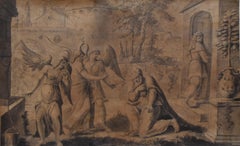
The Life of Christ - Watercolor and Pencil - Mid-20th Century
Located in Roma, IT
The Life of Christ has included Four marvelous original drawings in watercolor and pencil, realized by an Anonymous Artist of the mid-20th Century.
The...
Category
Mid-20th Century Modern Figurative Drawings and Watercolors
Materials
Watercolor, Pencil
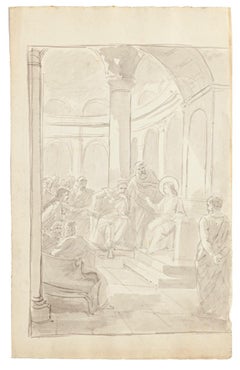
The Announcement - Drawing by Giovanni Fontana - 16th Century
By Giovanni Fontana
Located in Roma, IT
The announcement in S. Maria sopra Minerva is an original drawing in pencil on paper, realized by Giovanni Fontana.
The state of preservation of the artwork is good except for some ...
Category
16th Century Figurative Drawings and Watercolors
Materials
Paper, Pencil