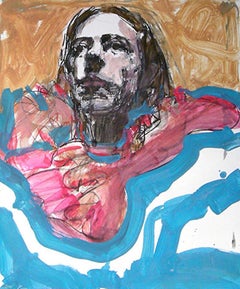
Items Similar to Rose Tattoo, Original Drawing by Luis Jimenez

Want more images or videos?
Request additional images or videos from the seller
1 of 8
Luis Alfonso JimenezRose Tattoo, Original Drawing by Luis Jimenez1983
1983
On Hold
$34,500
On Hold
£26,378.21
On Hold
€30,194.29
On Hold
CA$48,649.15
On Hold
A$52,960.07
On Hold
CHF 28,271.40
On Hold
MX$639,349.52
On Hold
NOK 355,477.73
On Hold
SEK 330,393.17
On Hold
DKK 225,507.55
About the Item
SHIPPING FEES INCLUDE SHIPPING CHARGE, PACKAGING
**INSURANCE**
Rose Tattoo
Luis Alfonso Jimenez 1940-2006
Color pencil on Arches paper
22 x 30.25 inches
Provenance: The original drawing was owned by Rozanne Charington, companion and model for "Rodeo Queen", "Rose Tattoo" and "Jimenez at Adeliza's Candy Store".
An original Drawing by Luis Jimenez, 1983, 22 x 30.25 inches. A stone lithograph edition was made from this drawing. There was a PBS documentary showing Jimenez drawing on the stone with the drawing in front of him and the making of the lithograph with Sette Publishing.
Luis Alfonso Jimenez
Born, 1940, El Paso, Texas, died 2006, Hondo, New Mexico.
Statement: Luis Jimenez, in his work, celebrates the vitality of life. . . . Jimenez es un hijo de la frontera; he knows its people and the landscape. It is the transformation of these people into art that is his most important contribution to the art of this vast region which stretches between Mexico and the United States.
His subject matter utilizes the popular images of the cultura del norte, and a large part of it is depicted and transformed in the rough and tumble world of la frontera. He is also a son of el norte, and so he uses its materials and explores its emerging, popular myths. The tension and attraction of Jimnez’s work is that he always creates within the space of his two worlds, the Mexicano and the Americano. He constantly shows us the irony of the two forces which repel, while showing us glimpses of the synthesis he seeks. What a gift it has been to us for this talented artist to reflect on the soul of our region. He gives meaning to our existence and history.
Rudolfo Anaya (passage chosen by the artist), A View from La Frontera, Man on Fire: Luis Jimnez, pp. 1, 3, 6Biography: Luis Jimnez was born in Texas to parents who had emigrated from Mexico to the United States; he would later dedicate his 1989 sculpture Border Crossing to his father, who had entered the country illegally. The elder Jimnez was a neon sign designer in El Paso, and Luis worked with him as a youth. His experience working in the neon shop and his fascination with U.S. car culture would both become major influences on his art career.
Jimenez studied architecture at the University of Texas, Austin (UTA), and also took art courses in which he first created sculptures with wood, steel, and fiberglass, choosing the latter because of its association with U.S. popular culture. He subsequently became one of the artists who made fiberglass an acceptable medium in the 1960s. In 1964 Jimenez received his B.S. in art from UTA, and he continued his studies at the Universidad Nacional Autnoma de Mexico in Mexico City.
In 1966 he moved to New York City and worked as an assistant to sculptor Seymour Lipton. Jimnez began to exhibit his art while in New York and in 1972 moved to New Mexico to focus on creating public sculptures, even as he maintained his diverse output of drawings, prints, and lithographs.
Drawing on his early experiences, Jimnez creates works that come from a border perspective, one that draws upon the hybridity bred by culture clashes. Often socially and politically informed, his works speak not only in regional terms, those germane to the southwestern United States, but to broader, more global issues as well. They exhibit a profoundly Chicano aesthetic and sensibility, one that is informed by Mexican and Mexican American traditions, North American popular culture, Chicano cultural icons, and images and themes unique to the Southwest. Death, sexuality, and the struggle of the common people are frequent themes.
Inspired by authors who write in an autobiographical style, Jimnez creates works that function as personal narrative yet are also able to make statements about culture in more global terms. His use of bold colors and lines, a legacy from his fathers work as a neon sign maker, lends a dynamic sensuality to his work, one that is particularly evident in his monumental fiberglass and acrylic urethane sculptural works
Many of Jimnezs works correspond to scholar Toms Ybarra-Fraustos definition of the Chicano aesthetic of rasquachismo, a lowbrow sensibility that appeals to the working class in that it applies to objects that subvert expressions of the mainstream or dominant culture. Creating art that speaks to the people, Jimnez is able to transform regional and culturally specific myths and symbols into globally recognized and relevant icons.
Exhibitions:
In addition to his personal work, Jimnez has been commissioned for numerous public art projects. In 1999 his sculpture Southwest Piet was designated a National Treasure by First Lady Hillary Clinton.
The many exhibitions featuring his work have included Human Concern/Personal Torment (Whitney Museum of American Art, New York, 1969).
The First International Motorcycle Art Show (Phoenix Art Museum, Phoenix, AZ, 1973).
Three Texas Artists (Centre Cultural Americaine, USIS, Paris, 1977),
Recent Trends in Collecting (Smithsonian Institution, Washington, DC, 1982).
Committed to Print (Museum of Modern Art, New York, 1989)
Printmaking in Texas: The 1980s (Modern Art Museum, Fort Worth, TX.
Laguna Gloria Art Museum, Austin, 1990.
The Whitney Biennial (Whitney Museum of American Art, New York, 1991)
Man On Fire: Luis Jimnez (Albuquerque Museum of Art, NM, 1994-95).
47th Annual Purchase Exhibition (American Academy of Arts and Letters, New York, 1995).
Traveling solo exhibition, Working Class Heroes: Images from the Popular Culture (1997-2000).
Jiménez
Collier Gallery has been in continuous operation for over 40 years. Originally located just off Main Street in downtown Scottsdale, Arizona, we have moved to Phoenix to accommodate and showcase our large inventory including:
• Original works by Maynard Dixon, Lon Megargee, Ed Mell, Fritz Scholder, Bill Schenck, Bill Lesch, Luis Jimenez, Greg
Singley, Dan Budnik, and other 20th century Western, WPA and Contemporary Southwestern artists.
• The Fine Art Estate of Lon Megargee
• Vintage rodeo photography from our collection, hand colored,
reproduced in very large format, archival quality.
• Western Antiques and Mid Century Modern furnishing, lighting, lamps and chandeliers from the 40s, 50s and 60s
Michael Collier has over 45 years of fine art expertise and framing design. A custom frame maker offering hand carved, gilded frames, finished in wood tones and genuine gold leaf. Michael has designed original signature frames for artists, museums and premier dealers across the United States. Michael is one of a few people in Arizona who has mastered the skill of hand dying mats and French Matting.
We provide custom picture framing services to designers, museums, galleries, artists, and private collectors. Custom picture and art framing, including original hand carved, gilded frames, mirror frames and special custom leather frames. All picture framing is done to archival standards with a specialty in hand dyed mats and french matting. Custom mirror frames in traditional, contemporary or western styles, designed to fit your home or business. Signature frames for Lon Megargee, Maynard Dixon, Ed Mell and Greg Singley.
All images copyright © 2000-2023 by Michael Collier. Permission to reproduce photos and paintings on this website and online catalog secured by Michael Collier. All rights reserved. No portion of this website and online catalog may be reproduced in any manner whatsoever without written permission from Michael Collier, Collier Gallery.
Disclaimer: Pricing and availability are subject to change without notice; please confirm the description of artwork or item when you contact us.
- Creator:Luis Alfonso Jimenez (1940 - 2006, American)
- Creation Year:1983
- Dimensions:Height: 22 in (55.88 cm)Width: 30.25 in (76.84 cm)
- Medium:
- Movement Style:
- Period:
- Condition:
- Gallery Location:Phoenix, AZ
- Reference Number:1stDibs: LU2623212834722
About the Seller
No Reviews Yet
Vetted Professional Seller
Every seller passes strict standards for authenticity and reliability
1stDibs seller since 2023
8 sales on 1stDibs
- ShippingRetrieving quote...Shipping from: Phoenix, AZ
- Return Policy
More From This Seller
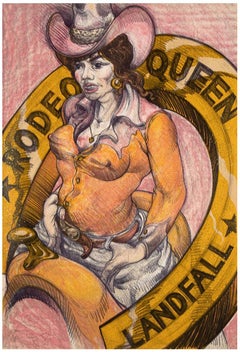
View AllRodeo Queen by Luis Jimenez
Located in Phoenix, AZ
Rodeo Queen, 1981
Edition 36/50
Signed lower left, Inscribed: for the "Rose" 82.
Provenance: Print was a gift to Rozanne Charington, companion and model for "Rodeo Queen", "Rose Tattoo" and "Jimenez at Adeliza's Candy Store".
Lithograph on paper
42 ½ × 29 in. (107.3 × 73.7 cm)
Luis Alfonso Jimenez
Born, 1940, El Paso, Texas, died 2006, Hondo, New Mexico.
Statement: Luis Jimenez, in his work, celebrates the vitality of life. . . . Jimenez es un hijo de la frontera; he knows its people and the landscape. It is the transformation of these people into art that is his most important contribution to the art of this vast region which stretches between Mexico and the United States.
His subject matter utilizes the popular images of the cultura del norte, and a large part of it is depicted and transformed in the rough and tumble world of la frontera. He is also a son of el norte, and so he uses its materials and explores its emerging, popular myths. The tension and attraction of Jimnez’s work is that he always creates within the space of his two worlds, the Mexicano and the Americano. He constantly shows us the irony of the two forces which repel, while showing us glimpses of the synthesis he seeks. What a gift it has been to us for this talented artist to reflect on the soul of our region. He gives meaning to our existence and history.
Rudolfo Anaya (passage chosen by the artist), A View from La Frontera, Man on Fire: Luis Jimenez, pp. 1, 3, 6Biography: Luis Jimenez was born in Texas to parents who had emigrated from Mexico to the United States; he would later dedicate his 1989 sculpture Border Crossing to his father, who had entered the country illegally. The elder Jimenez was a neon sign designer in El Paso, and Luis worked with him as a youth. His experience working in the neon shop and his fascination with U.S. car culture would both become major influences on his art career.
Jimenez studied architecture at the University of Texas, Austin (UTA), and also took art courses in which he first created sculptures with wood, steel, and fiberglass, choosing the latter because of its association with U.S. popular culture. He subsequently became one of the artists who made fiberglass an acceptable medium in the 1960s. In 1964 Jimenez received his B.S. in art from UTA, and he continued his studies at the Universidad Nacional Autonoma de Mexico in Mexico City.
In 1966 he moved to New York City and worked as an assistant to sculptor Seymour Lipton. Jimenez began to exhibit his art while in New York and in 1972 moved to New Mexico to focus on creating public sculptures, even as he maintained his diverse output of drawings, prints, and lithographs.
Drawing on his early experiences, Jimenez creates works that come from a border perspective, one that draws upon the hybridity bred by culture clashes. Often socially and politically informed, his works speak not only in regional terms, those germane to the southwestern United States, but to broader, more global issues as well. They exhibit a profoundly Chicano aesthetic and sensibility, one that is informed by Mexican and Mexican American traditions, North American popular culture, Chicano cultural icons, and images and themes unique to the Southwest. Death, sexuality, and the struggle of the common people are frequent themes.
Inspired by authors who write in an autobiographical style, Jimenez creates works that function as personal narrative yet are also able to make statements about culture in more global terms. His use of bold colors and lines, a legacy from his fathers work as a neon sign maker, lends a dynamic sensuality to his work, one that is particularly evident in his monumental fiberglass and acrylic urethane sculptural works
Many of Jimenez's works correspond to scholar Toms Ybarra-Fraustos definition of the Chicano aesthetic of rasquachismo, a lowbrow sensibility that appeals to the working class in that it applies to objects that subvert expressions of the mainstream or dominant culture. Creating art that speaks to the people, Jimenez is able to transform regional and culturally specific myths and symbols into globally recognized and relevant icons.
Exhibitions:
In addition to his personal work, Jimenez has been commissioned for numerous public art projects. In 1999 his sculpture Southwest Piet was designated a National Treasure by First Lady Hillary Clinton.
The many exhibitions featuring his work have included Human Concern/Personal Torment (Whitney Museum of American Art, New York, 1969).
The First International Motorcycle Art Show (Phoenix Art Museum, Phoenix, AZ, 1973).
Three Texas Artists (Centre Cultural Americaine, USIS, Paris, 1977),
Recent Trends in Collecting (Smithsonian Institution, Washington, DC, 1982).
Committed to Print (Museum of Modern Art, New York, 1989)
Printmaking in Texas: The 1980s (Modern Art Museum, Fort Worth, TX.
Laguna Gloria Art Museum, Austin, 1990.
The Whitney Biennial (Whitney Museum of American Art, New York, 1991)
Man On Fire: Luis Jimnez (Albuquerque Museum of Art, NM, 1994-95).
47th Annual Purchase Exhibition (American Academy of Arts and Letters, New York, 1995).
Traveling solo exhibition, Working Class Heroes: Images from the Popular Culture (1997-2000).
Jiménez
Collier Gallery has been in continuous operation for over 40 years. Originally located just off Main Street in downtown Scottsdale, Arizona, we have moved to Phoenix to accommodate and showcase our large inventory including:
• Original works by Maynard Dixon, Lon Megargee, Ed Mell, Fritz Scholder, Bill Schenck, Bill Lesch, Luis Jimenez, Greg
Singley, Dan Budnik, and other 20th century Western, WPA and Contemporary Southwestern artists.
• The Fine Art Estate of Lon Megargee
• Vintage rodeo...
Category
1980s Contemporary Figurative Prints
Materials
Lithograph
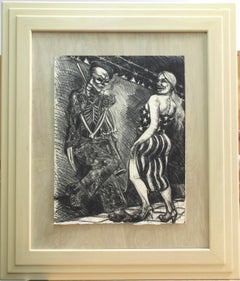
Coscolina Con Muerto (Flirt With Death)
Located in Phoenix, AZ
Coscolina Con Muerto (Flirt With Death) 1986
Stone Lithograph Edition 35/50
Size: 26.75 x 21 inches
Frame size: 44.75 x 39
Luis Alfonso Jimenez
Born, 1940, El Paso, Texas, died 2006, Hondo, New Mexico.
Statement: Luis Jimenez, in his work, celebrates the vitality of life. . . . Jimenez es un hijo de la frontera; he knows its people and the landscape. It is the transformation of these people into art that is his most important contribution to the art of this vast region which stretches between Mexico and the United States.
His subject matter utilizes the popular images of the cultura del norte, and a large part of it is depicted and transformed in the rough and tumble world of la frontera. He is also a son of el norte, and so he uses its materials and explores its emerging, popular myths. The tension and attraction of Jimnez’s work is that he always creates within the space of his two worlds, the Mexicano and the Americano. He constantly shows us the irony of the two forces which repel, while showing us glimpses of the synthesis he seeks. What a gift it has been to us for this talented artist to reflect on the soul of our region. He gives meaning to our existence and history.
Rudolfo Anaya (passage chosen by the artist), A View from La Frontera, Man on Fire: Luis Jimnez, pp. 1, 3, 6Biography: Luis Jimnez was born in Texas to parents who had emigrated from Mexico to the United States; he would later dedicate his 1989 sculpture Border Crossing to his father, who had entered the country illegally. The elder Jimnez was a neon sign designer in El Paso, and Luis worked with him as a youth. His experience working in the neon shop and his fascination with U.S. car culture would both become major influences on his art career.
Jimenez studied architecture at the University of Texas, Austin (UTA), and also took art courses in which he first created sculptures with wood, steel, and fiberglass, choosing the latter because of its association with U.S. popular culture. He subsequently became one of the artists who made fiberglass an acceptable medium in the 1960s. In 1964 Jimenez received his B.S. in art from UTA, and he continued his studies at the Universidad Nacional Autnoma de Mexico in Mexico City.
In 1966 he moved to New York City and worked as an assistant to sculptor Seymour Lipton. Jimnez began to exhibit his art while in New York and in 1972 moved to New Mexico to focus on creating public sculptures, even as he maintained his diverse output of drawings, prints, and lithographs.
Drawing on his early experiences, Jimnez creates works that come from a border perspective, one that draws upon the hybridity bred by culture clashes. Often socially and politically informed, his works speak not only in regional terms, those germane to the southwestern...
Category
1980s Contemporary Figurative Prints
Materials
Lithograph
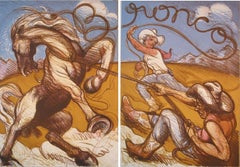
Bronco
Located in Phoenix, AZ
SHIPPING FEES INCLUDE SHIPPING CHARGE, PACKAGING & **INSURANCE**
Luis Alfonso Jimenez
Born, 1940, El Paso, Texas, died 2006, Hondo, New Mexico.
Statement: Luis Jimenez, in his work, celebrates the vitality of life. . . . Jimenez es un hijo de la frontera; he knows its people and the landscape. It is the transformation of these people into art that is his most important contribution to the art of this vast region which stretches between Mexico and the United States.
His subject matter utilizes the popular images of the cultura del norte, and a large part of it is depicted and transformed in the rough and tumble world of la frontera. He is also a son of el norte, and so he uses its materials and explores its emerging, popular myths. The tension and attraction of Jimnez’s work is that he always creates within the space of his two worlds, the Mexicano and the Americano. He constantly shows us the irony of the two forces which repel, while showing us glimpses of the synthesis he seeks. What a gift it has been to us for this talented artist to reflect on the soul of our region. He gives meaning to our existence and history.
Rudolfo Anaya (passage chosen by the artist), A View from La Frontera, Man on Fire: Luis Jimnez, pp. 1, 3, 6Biography: Luis Jimnez was born in Texas to parents who had emigrated from Mexico to the United States; he would later dedicate his 1989 sculpture Border Crossing to his father, who had entered the country illegally. The elder Jimnez was a neon sign designer in El Paso, and Luis worked with him as a youth. His experience working in the neon shop and his fascination with U.S. car culture would both become major influences on his art career.
Jimenez studied architecture at the University of Texas, Austin (UTA), and also took art courses in which he first created sculptures with wood, steel, and fiberglass, choosing the latter because of its association with U.S. popular culture. He subsequently became one of the artists who made fiberglass an acceptable medium in the 1960s. In 1964 Jimenez received his B.S. in art from UTA, and he continued his studies at the Universidad Nacional Autnoma de Mexico in Mexico City.
In 1966 he moved to New York City and worked as an assistant to sculptor Seymour Lipton. Jimnez began to exhibit his art while in New York and in 1972 moved to New Mexico to focus on creating public sculptures, even as he maintained his diverse output of drawings, prints, and lithographs.
Drawing on his early experiences, Jimnez creates works that come from a border perspective, one that draws upon the hybridity bred by culture clashes. Often socially and politically informed, his works speak not only in regional terms, those germane to the southwestern United States, but to broader, more global issues as well. They exhibit a profoundly Chicano aesthetic and sensibility, one that is informed by Mexican and Mexican American traditions, North American popular culture, Chicano cultural icons, and images and themes unique to the Southwest. Death, sexuality, and the struggle of the common people are frequent themes.
Inspired by authors who write in an autobiographical style, Jimnez creates works that function as personal narrative yet are also able to make statements about culture in more global terms. His use of bold colors and lines, a legacy from his fathers work as a neon sign maker, lends a dynamic sensuality to his work, one that is particularly evident in his monumental fiberglass and acrylic urethane sculptural works
Many of Jimnezs works correspond to scholar Toms Ybarra-Fraustos definition of the Chicano aesthetic of rasquachismo, a lowbrow sensibility that appeals to the working class in that it applies to objects that subvert expressions of the mainstream or dominant culture. Creating art that speaks to the people, Jimnez is able to transform regional and culturally specific myths and symbols into globally recognized and relevant icons.
Exhibitions:
In addition to his personal work, Jimnez has been commissioned for numerous public art projects. In 1999 his sculpture Southwest Piet was designated a National Treasure by First Lady Hillary Clinton.
The many exhibitions featuring his work have included Human Concern/Personal Torment (Whitney Museum of American Art, New York, 1969).
The First International Motorcycle Art Show (Phoenix Art Museum, Phoenix, AZ, 1973).
Three Texas Artists (Centre Cultural Americaine, USIS, Paris, 1977),
Recent Trends in Collecting (Smithsonian Institution, Washington, DC, 1982).
Committed to Print (Museum of Modern Art, New York, 1989)
Printmaking in Texas: The 1980s (Modern Art Museum, Fort Worth, TX.
Laguna Gloria Art Museum, Austin, 1990.
The Whitney Biennial (Whitney Museum of American Art, New York, 1991)
Man On Fire: Luis Jimnez (Albuquerque Museum of Art, NM, 1994-95).
47th Annual Purchase Exhibition (American Academy of Arts and Letters, New York, 1995).
Traveling solo exhibition, Working Class Heroes: Images from the Popular Culture (1997-2000).
Jiménez
Collier Gallery has been in continuous operation for over 40 years. Originally located just off Main Street in downtown Scottsdale, Arizona, we have moved to Phoenix to accommodate and showcase our large inventory including:
• Original works by Maynard Dixon, Lon Megargee, Ed Mell, Fritz Scholder, Bill Schenck, Bill Lesch, Luis Jimenez, Greg
Singley, Dan Budnik, and other 20th century Western, WPA and Contemporary Southwestern artists.
• The Fine Art Estate of Lon Megargee
• Vintage rodeo...
Category
1970s Contemporary Figurative Prints
Materials
Lithograph
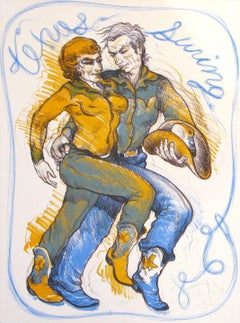
Texas Swing by Luis Jimenez
By Luis Jiménez
Located in Phoenix, AZ
Texas Swing
Luis Alfonso Jimenez 1940-2006
Stone Lithograph Edition of 50
Artist Proof
24 x 18 inches
Luis Alfonso Jimenez
Born, 1940, El Paso, Texas, died 2006, Hondo, New Mexico.
Statement: Luis Jimenez, in his work, celebrates the vitality of life. . . . Jimenez es un hijo de la frontera; he knows its people and the landscape. It is the transformation of these people into art that is his most important contribution to the art of this vast region which stretches between Mexico and the United States.
His subject matter utilizes the popular images of the cultura del norte, and a large part of it is depicted and transformed in the rough and tumble world of la frontera. He is also a son of el norte, and so he uses its materials and explores its emerging, popular myths. The tension and attraction of Jimnez’s work is that he always creates within the space of his two worlds, the Mexicano and the Americano. He constantly shows us the irony of the two forces which repel, while showing us glimpses of the synthesis he seeks. What a gift it has been to us for this talented artist to reflect on the soul of our region. He gives meaning to our existence and history.
Rudolfo Anaya (passage chosen by the artist), A View from La Frontera, Man on Fire: Luis Jimnez, pp. 1, 3, 6Biography: Luis Jimnez was born in Texas to parents who had emigrated from Mexico to the United States; he would later dedicate his 1989 sculpture Border Crossing to his father, who had entered the country illegally. The elder Jimenez was a neon sign designer in El Paso, and Luis worked with him as a youth. His experience working in the neon shop and his fascination with U.S. car culture would both become major influences on his art career.
Jimenez studied architecture at the University of Texas, Austin (UTA), and also took art courses in which he first created sculptures with wood, steel, and fiberglass, choosing the latter because of its association with U.S. popular culture. He subsequently became one of the artists who made fiberglass an acceptable medium in the 1960s. In 1964 Jimenez received his B.S. in art from UTA, and he continued his studies at the Universidad Nacional Autonoma de Mexico in Mexico City.
In 1966 he moved to New York City and worked as an assistant to sculptor Seymour Lipton. Jimnez began to exhibit his art while in New York and in 1972 moved to New Mexico to focus on creating public sculptures, even as he maintained his diverse output of drawings, prints, and lithographs.
Drawing on his early experiences, Jimenez creates works that come from a border perspective, one that draws upon the hybridity bred by culture clashes. Often socially and politically informed, his works speak not only in regional terms, those germane to the southwestern United States, but to broader, more global issues as well. They exhibit a profoundly Chicano aesthetic and sensibility, one that is informed by Mexican and Mexican American traditions, North American popular culture, Chicano cultural icons, and images and themes unique to the Southwest. Death, sexuality, and the struggle of the common people are frequent themes.
Inspired by authors who write in an autobiographical style, Jimenez creates works that function as personal narrative yet are also able to make statements about culture in more global terms. His use of bold colors and lines, a legacy from his fathers work as a neon sign maker, lends a dynamic sensuality to his work, one that is particularly evident in his monumental fiberglass and acrylic urethane sculptural works
Many of Jimenez's works correspond to scholar Toms Ybarra-Fraustos definition of the Chicano aesthetic of rasquachismo, a lowbrow sensibility that appeals to the working class in that it applies to objects that subvert expressions of the mainstream or dominant culture. Creating art that speaks to the people, Jimenez is able to transform regional and culturally specific myths and symbols into globally recognized and relevant icons.
Exhibitions:
In addition to his personal work, Jimenez has been commissioned for numerous public art projects. In 1999 his sculpture Southwest Piet was designated a National Treasure by First Lady Hillary Clinton.
The many exhibitions featuring his work have included Human Concern/Personal Torment (Whitney Museum of American Art, New York, 1969).
The First International Motorcycle Art Show (Phoenix Art Museum, Phoenix, AZ, 1973).
Three Texas Artists (Centre Cultural Americaine, USIS, Paris, 1977),
Recent Trends in Collecting (Smithsonian Institution, Washington, DC, 1982).
Committed to Print (Museum of Modern Art, New York, 1989)
Printmaking in Texas: The 1980s (Modern Art Museum, Fort Worth, TX.
Laguna Gloria Art Museum, Austin, 1990.
The Whitney Biennial (Whitney Museum of American Art, New York, 1991)
Man On Fire: Luis Jimnez (Albuquerque Museum of Art, NM, 1994-95).
47th Annual Purchase Exhibition (American Academy of Arts and Letters, New York, 1995).
Traveling solo exhibition, Working Class Heroes: Images from the Popular Culture (1997-2000).
Jiménez
Collier Gallery has been in continuous operation for over 40 years. Originally located just off Main Street in downtown Scottsdale, Arizona, we have moved to Phoenix to accommodate and showcase our large inventory including:
• Original works by Maynard Dixon, Lon Megargee, Ed Mell, Fritz Scholder, Bill Schenck, Bill Lesch, Luis Jimenez, Greg
Singley, Dan Budnik, and other 20th century Western, WPA and Contemporary Southwestern artists.
• The Fine Art Estate of Lon Megargee
• Vintage rodeo...
Category
1970s Contemporary Figurative Prints
Materials
Lithograph
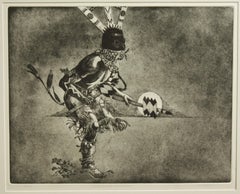
Apache Mountain Spirit Dancer
Located in Phoenix, AZ
SHIPPING CHARGES INCLUDE SHIPPING, PACKAGING & **INSURANCE**
Apache Mountain Spirit Dancer
James Rome
Etching 62/100
Image: 21.75 x 27.5 inches
Paper: 25 x...
Category
1980s Contemporary Figurative Prints
Materials
Etching
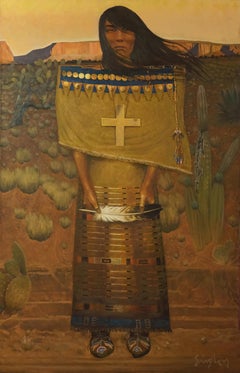
Dragon Fly by Greg Singley
Located in Phoenix, AZ
SHIPPING CHARGES INCLUDE SHIPPING, PACKAGING & **INSURANCE**
Greg Singley , born 1950-
Artist Statement:
When the sun sets in the desert South West, thin...
Category
2010s Contemporary Figurative Paintings
Materials
Oil
You May Also Like
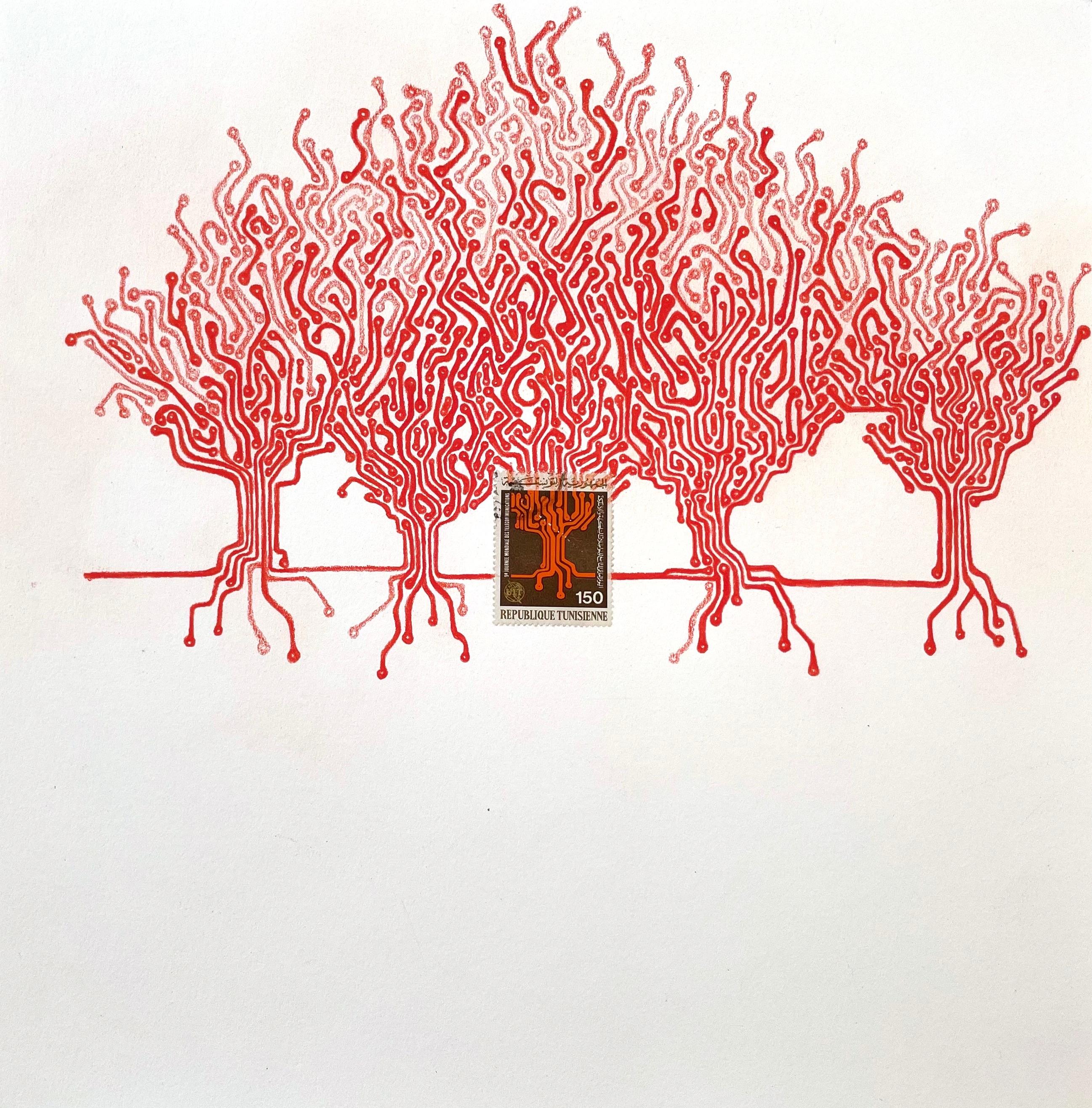
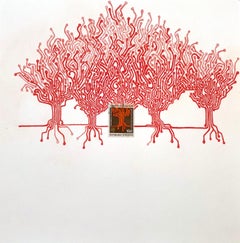
Tunisia, Red Trees (Colored Pencil and Unique Stamp Drawing by Andrea Moreau)
By Andrea Moreau
Located in Hudson, NY
Tunisia, Red Trees: Colored Pencil Drawing & Unique Stamp by Andrea Moreau
colored pencil and postage stamp on paper
11 x 11 inches
15 x 15 inches framed
Artist Statement:
My drawin...
Category
2010s Contemporary Landscape Drawings and Watercolors
Materials
Mixed Media, Color Pencil
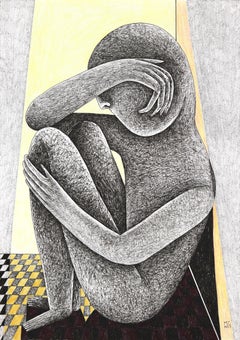
Alone
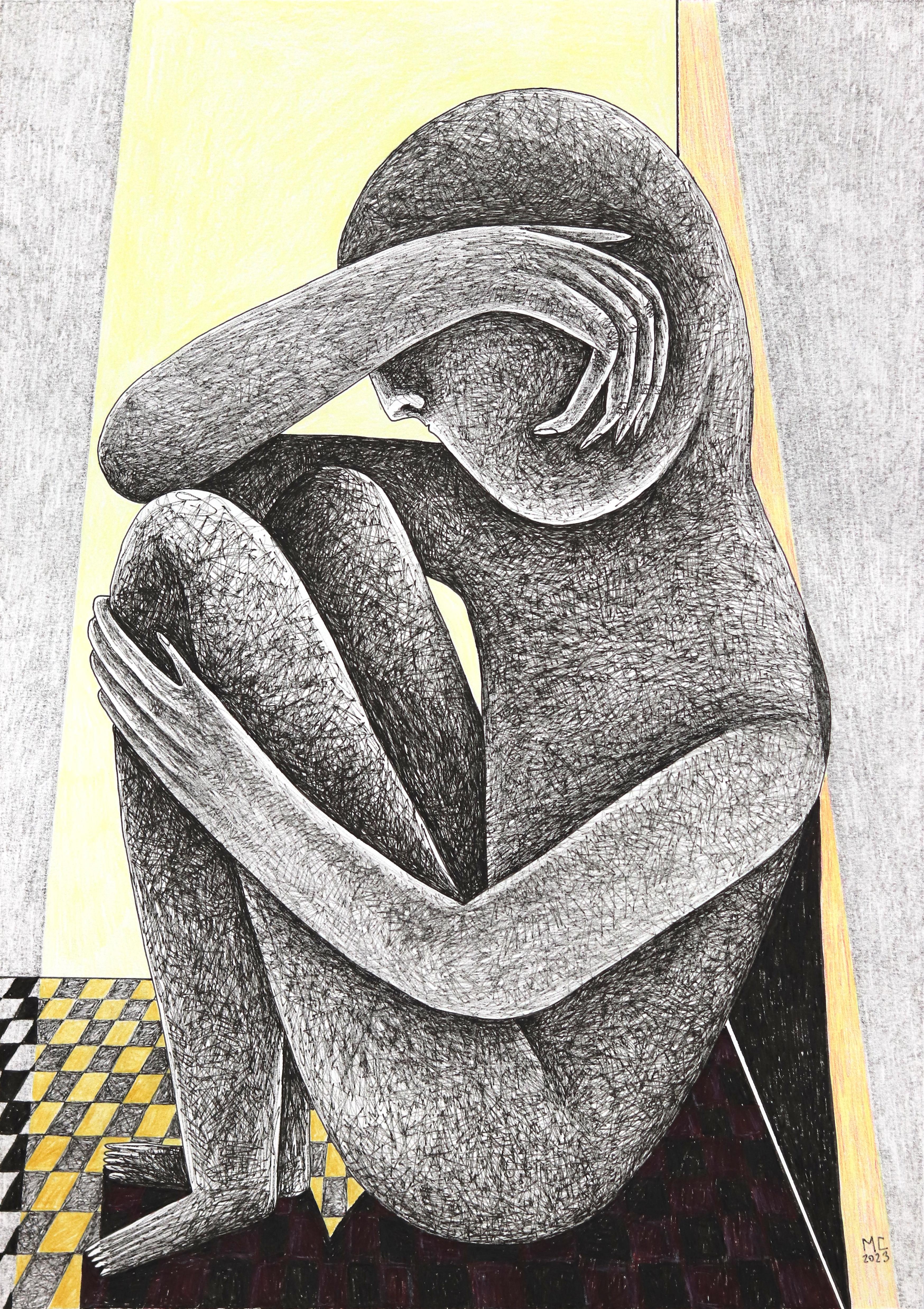
Cornered - Original Abstract Yellow Figurative Artwork on Paper
Located in Los Angeles, CA
Melissa Chalhoub, a 2014 graduate of Saint Joseph University in Beirut, seamlessly navigates the realms of cinema and visual art. With a background in directing and sound design for ...
Category
2010s Contemporary Figurative Drawings and Watercolors
Materials
Paper, Ink, Mixed Media, Color Pencil
Disconnection - Abstract Figurative Illustrative Mixed Media Art on Cardboard
Located in Los Angeles, CA
Melissa Chalhoub, a 2014 graduate of Saint Joseph University in Beirut, seamlessly navigates the realms of cinema and visual art. With a background in directing and sound design for ...
Category
2010s Contemporary Figurative Drawings and Watercolors
Materials
Ink, Mixed Media, Cardboard, Color Pencil

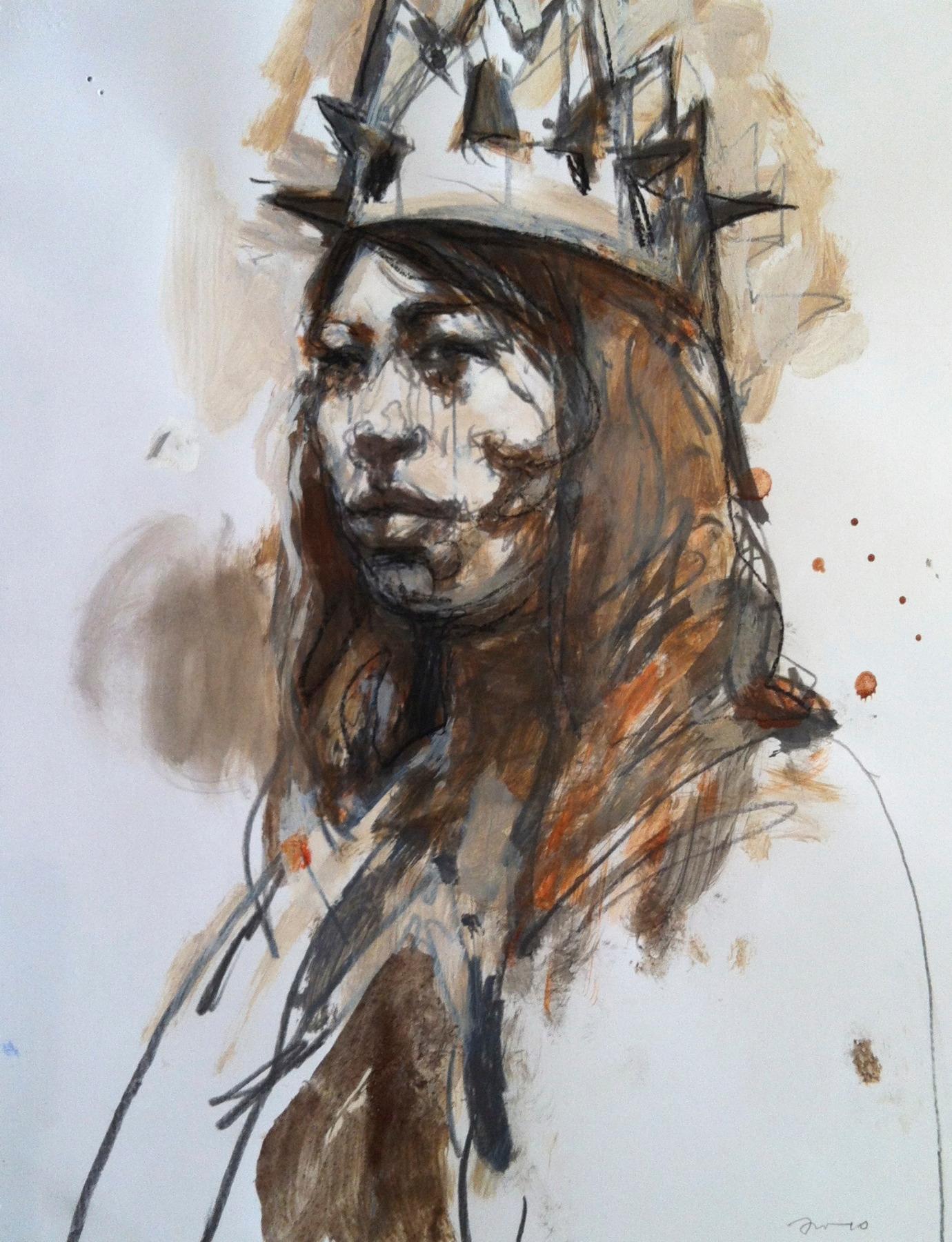
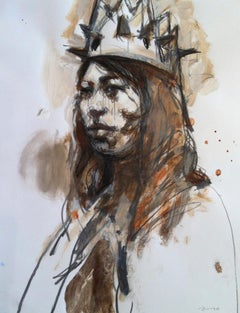
Memorial to Mr. Morris / woman
s head study - drawing painting
By Kim Frohsin
Located in Burlingame, CA
'Memorial to Mr. Morris' is created with stabilo pencil, ink, gouache, walnut ink and charcoal on paper. Comes in an archival crystal clear storage sleeve. The young woman's head wit...
Category
21st Century and Contemporary Contemporary Figurative Drawings and Water...
Materials
Ink, Mixed Media, Watercolor, Color Pencil
Talia in Fruitvale / woman with hat - red
gold - drawing painting
By Kim Frohsin
Located in Burlingame, CA
'Talia in Fruitvale' , head study of a young woman in a hat in mainly yellow and red, is created with mixed media on paper, including stabilo pencil, gouache, ink, dry point pigment,...
Category
21st Century and Contemporary Contemporary Figurative Drawings and Water...
Materials
Ink, Mixed Media, Watercolor, Color Pencil, Charcoal

Big Baloo / Head Study No. 86
By Kim Frohsin
Located in Burlingame, CA
Big Baloo / Head Study No. 86 , drawing / painting featuring the head portrait of a young woman. in blue, pink, gold and white. The work is created with mixed media on Bristol paper,...
Category
21st Century and Contemporary Contemporary Portrait Drawings and Waterco...
Materials
Charcoal, Mixed Media, Gouache, Color Pencil, Crayon