Items Similar to Japanese Art Ukiyo-e Figurative Painting, Hairdresser, Edo period
Want more images or videos?
Request additional images or videos from the seller
1 of 10
Mario B. GilJapanese Art Ukiyo-e Figurative Painting, Hairdresser, Edo period2014
2014
$2,103.97
$3,704.7743% Off
£1,558.31
£2,743.9443% Off
€1,752
€3,08543% Off
CA$2,878.13
CA$5,067.9443% Off
A$3,132.29
A$5,515.4743% Off
CHF 1,660.42
CHF 2,923.7543% Off
MX$37,683.82
MX$66,355.3543% Off
NOK 21,059.50
NOK 37,082.5043% Off
SEK 19,267.96
SEK 33,927.8943% Off
DKK 13,350.54
DKK 23,508.2343% Off
About the Item
Bijin-ga series II (nº 02)
Title: “Hairdresser”
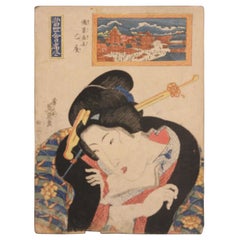
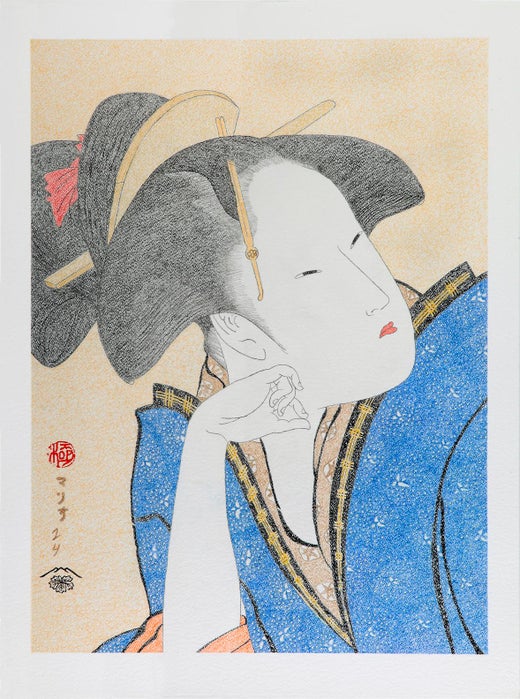
The interest in this picture is focused on the hairstyles of both women, a hairdresser leaning forward with a bow of intense black color, arranging his client's especially long hair. The ways of gripping both the hair and the comb, making it slide through the ocher-scented kimono of the customer, decorated with sea stars, stand out. Highlighting with great detail the drawing of loose hair on the obi of white lines on a red background, and the kosode of plum color.
This image is part of the Bijin-ga Series (“Pretty women”) drawn by Mario BGil, based in the Kitigawa Utamaro woodblock print "Hairdresser" (1798-1799), 39,8 x 26,8 cm. Museum of Fine Arts. Boston-USA.
Utamaro drawn a series of twelve prints whose themes were related to the manual works of women, and this "Hairdresser" is one of them.
Mario BGil reproduces the seal of the censor (Kiwame) and writes his own signature, Mario BGil, in Japanese, with the date 14 (2014).
The mesaurements of the drawing are 76 x 56 cm. (29,92 x 22,05 in.), with a painted surface of 67 x 49,5 cm.
With his work on the bijing-ga series, Mario BGil wanted to embellish, give brilliance and volume to the images presented by japanese artist Kitigawa Utamaro in those beautiful engravings, ennobled with the patina of time, which have served as inspiration. The result obtained is almost life-size portraits, endowed with strong chromaticism and valuable contrasts, all enhanced, in turn, with the volume provided by the weight and rigidity of the paper, and its thick texture (Fabriano Artistico “grana grosso”, 640g/m2; the thickness and hardness of the paper makes it necessary to transport it without rolling).
In this way, Mario BGil pays tribute to his admired artist and offers us a new and enriched vision of this popular facet of oriental art from the 18th and 19th centuries.
ABOUT THE ARTIST
Mario BGil is a self-taught artist who for years has combined his creative activity with his work in the business world, away from commercial art galleries. Man of very diverse interests and great artistic sensitivity, studied Art History and in 2012, a deep interest in oriental art was awakened in him so that he began to study the great masters of Japanese Ukiyo-e prints, who had such an influence on the European avant-garde of the late 19th century.
The discovery of Kitagawa Utamaro (1753-1806), a key figure in the metropolitan culture of Edo (now Tokyo), and a point of reference in the history of Japanese engraving, meant for Mario a change of course caused by the imperative need to study his images, recreate them and recreate himself in them, incorporating certain changes in both the format and the technique used.
The technique used by MBG is very different from that used in engravings with wooden blocks impregnated in inks of intense colors that serve as a model. On a paper of heavy weight and thick texture, Mario BGil outlines with a black pencil, and colors the spaces with pencils and watercolors. Faced with the intensity of color of the prints (already very lost in some of them due to their age and exposure to the sun), their drawings are sifted by the streaky white, due to the thick texture of the paper, showing more lines, soft and warmer tones, giving color to the backgrounds but leaving all the volumes corresponding to the skin blank, thus giving the figures a classic serenity that transcends their oriental character.
Between 2014 and 2015, Mario BGil made more than 35 drawings based on the prints selected from the huge amount of work produced by the master Utamaro that shows images of courtesans in different attitudes and poses that highlight the subtle delicacy of oriental feminine beauty.
Kitagawa Utamaro was a faithful representative of the tastes of the Japanese bourgeoisie of its time, which had transformed the life of the cities giving birth to a culture parallel to the official and aristocratic.
The activity of the new rising group took place in special neighborhoods of Edo (Tokyo) and Osaka and its banality, inconsistency and frivolity earned it the name of Ukiyo: "floating world"; a world that will give priority to a series of cultural manifestations much more popular and less intellectualized than those preferred by the nobility. The new neighborhoods are filled with brothels and shows that the upper classes will consider vain, and a new breed of heroes: sumo wrestlers, singers, actors and courtesans will come to reign in this "floating world."
In front of the traditional painting the stamp arises with images of this new world. The courtesans of the pleasure districts of Edo that Utamaro portrays, do not always appear perfectly dressed to receive the client, but are surprised while getting ready, or during the day. He observes them without being seen, spy on them in their daily and intimate work. All of them are women drawn in a similar style, with elongated faces, straight delicate noses (almost a single line) and other features reduced to a mere suggestion (the mouth, a tiny butterfly of red).
The importance that it has had in later European artists (Degas, Toulouse-Lautrec, Bonnard, Gauguin, Van Gogh ...) has been great and Mario BGil has not been able to escape the recreation of those images so classic and, at the same time, so current, paying clear tribute to its original creator.
BIOGRAPHY Mario BGil is a self-taught artist who for years has combined his creative activity with his work in the business world, away from commercial art galleries. Man of very diverse interests and great artistic sensitivity, studied Art History and in 2012, a deep interest in oriental art was awakened in him so that he began to study the great masters of Japanese Ukiyo-e prints, who had such an influence on the European avant-garde of the late 19th century. The discovery of Kitagawa Utamaro (1753-1806), a key figure in the metropolitan culture of Edo (now Tokyo), and a point of reference in the history of Japanese engraving, meant for Mario a change of course caused by the imperative need to study his images, recreate them and recreate himself in them, incorporating certain changes in both the format and the technique used. The technique used by MBG is very different from that used in engravings with wooden blocks impregnated in inks of intense colors that serve as a model. On a paper of heavy weight and thick texture, Mario BGil outlines with a black pencil, and colors the spaces with pencils and watercolors. Faced with the intensity of color of the prints (already very lost in some of them due to their age and exposure to the sun), their drawings are sifted by the streaky white, due to the thick texture of the paper, showing more lines, soft and warmer tones, giving color to the backgrounds but leaving all the volumes corresponding to the skin blank, thus giving the figures a classic serenity that transcends their oriental character. Between 2014 and 2015, Mario BGil made more than 35 drawings based on the prints selected from the huge amount of work produced by the master Utamaro that shows images of courtesans in different attitudes and poses that highlight the subtle delicacy of oriental feminine beauty. Kitagawa Utamaro was a faithful representative of the tastes of the Japanese bourgeoisie of its time, which had transformed the life of the cities giving birth to a culture parallel to the official and aristocratic. In front of the traditional painting, the stamp arises with images of this new world. The courtesans of the pleasure districts of Edo that Utamaro portrays, do not always appear perfectly dressed to receive the client but are surprised while getting ready, or during the day. He observes them without being seen, and spies on them in their daily and intimate work. All of them are women drawn in a similar style, with elongated faces, straight delicate noses (almost a single line), and other features reduced to a mere suggestion (the mouth, a tiny butterfly of red). The importance that it has had in later European artists (Degas, Toulouse-Lautrec, Bonnard, Gauguin, Van Gogh ...) has been great and Mario BGil has not been able to escape the recreation of those images so classic and, at the same time, so current, paying clear tribute to its original creator.
About the Seller
5.0
Gold Seller
Premium sellers maintaining a 4.3+ rating and 24-hour response times
Established in 2002
1stDibs seller since 2017
71 sales on 1stDibs
- ShippingRetrieving quote...Shipping from: Bilbao, Spain
- Return Policy
More From This Seller
View AllJapanese Art Ukiyo-e Figurative Painting, Tatsumi Roko, Edo Period
Located in Segovia, ES
Bijin-ga series XXVIII (Nº 28)
Title: Tatsumi Roko
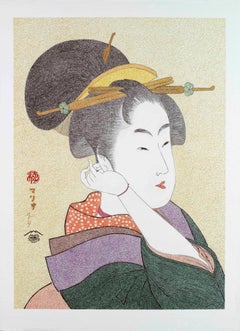
Portrait of Tatsumi Roko, a geisha of the pleasure quarters in the Edo period. The image belongs to the series Renowed Beauties Likened to the Six Inmortal Poets.
The popular top-class geishas of the day , known as “oiran”, were depicted in this type of print. In ukiyo-e woodblock prints, this close-up portrait view of the upper body is known as an okubi-e (bust portrait).
This image is part of the bijin-ga series (“Pretty women”) drawn by Mario BGil, based in the Kitigawa Utamaro woodblock print...
Category
2010s Edo Figurative Drawings and Watercolors
Materials
Paper, Crayon, Oil Crayon, Graphite
Japanese Art Ukiyo-e Figurative Painting, Miyahito of The Ôgiya, Edo Period
Located in Segovia, ES
Bijin-ga Series XXXIV (Nº 34)
Title: Miyahito of the Ôgiya
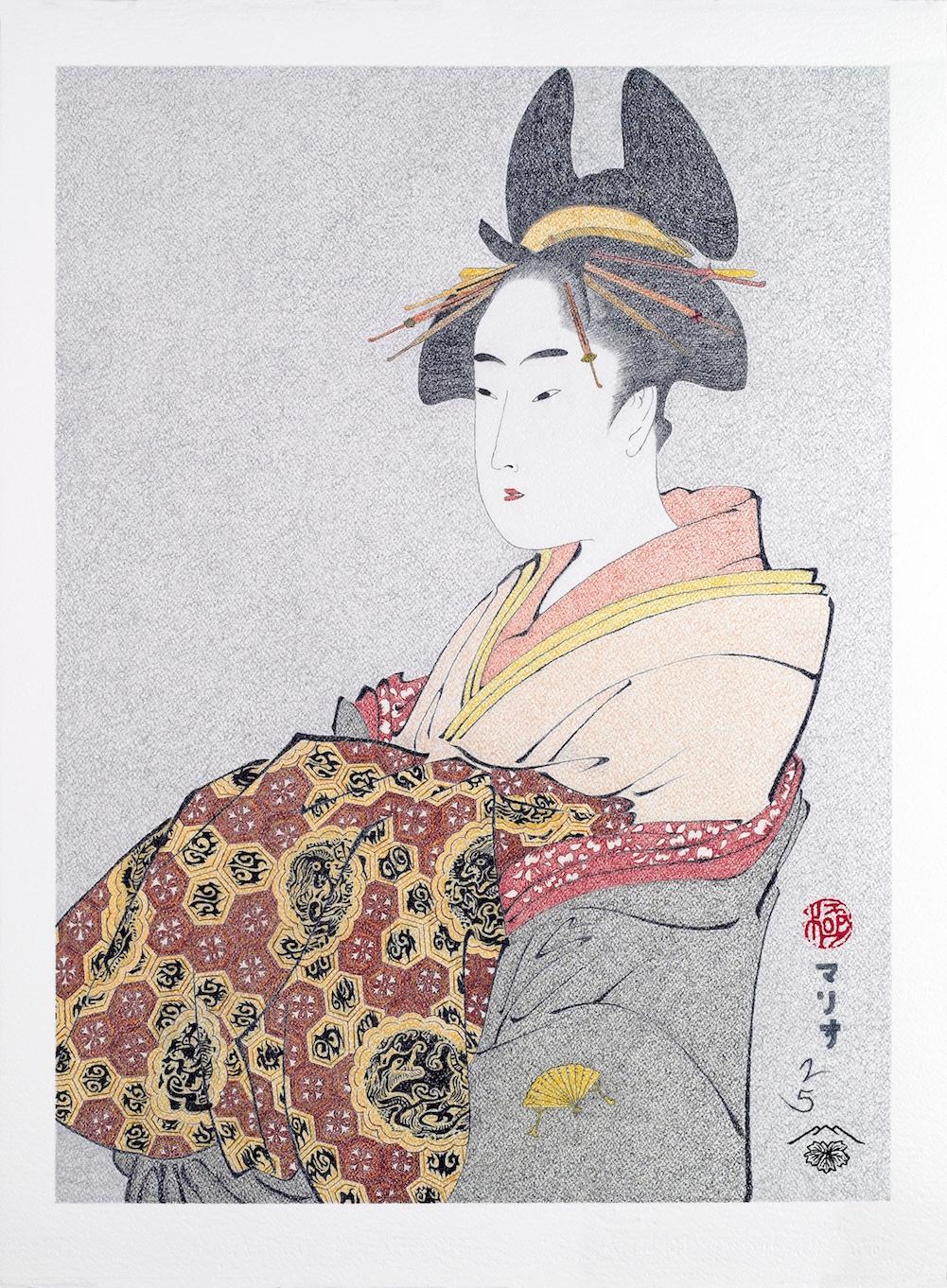
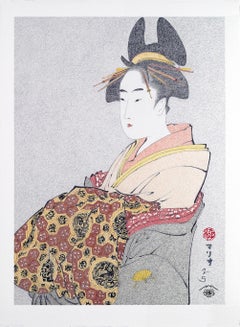
Three quarter portrait of the elegant courtesan Miyahito of the Ôgiya House. This beautifully dressed japanese woman wears a solid grey outer robe, which contrasts with her soft rose kimono and the colored obi with an intricate geometric pattern. Her hair is arranged high atop her head, adorned with several hairpins. A classic Utamaro beauty print recreated with extraordinary taste and subtlety by Mario BGil in this delicate drawing.
This image is part of the bijin-ga series (“Pretty women”) drawn by Mario BGil, based in the Kitigawa Utamaro woodblock print...
Category
2010s Edo Figurative Drawings and Watercolors
Materials
Paper, Crayon, Oil Crayon, Graphite
$4,793 Sale Price
31% Off
Japanese Art Ukiyo-e Figurative Painting, Bijin Ôkubi, Edo Period
Located in Segovia, ES
Bijin-ga series XXIX (Nº 29)
Title: Bijin Ôkubi
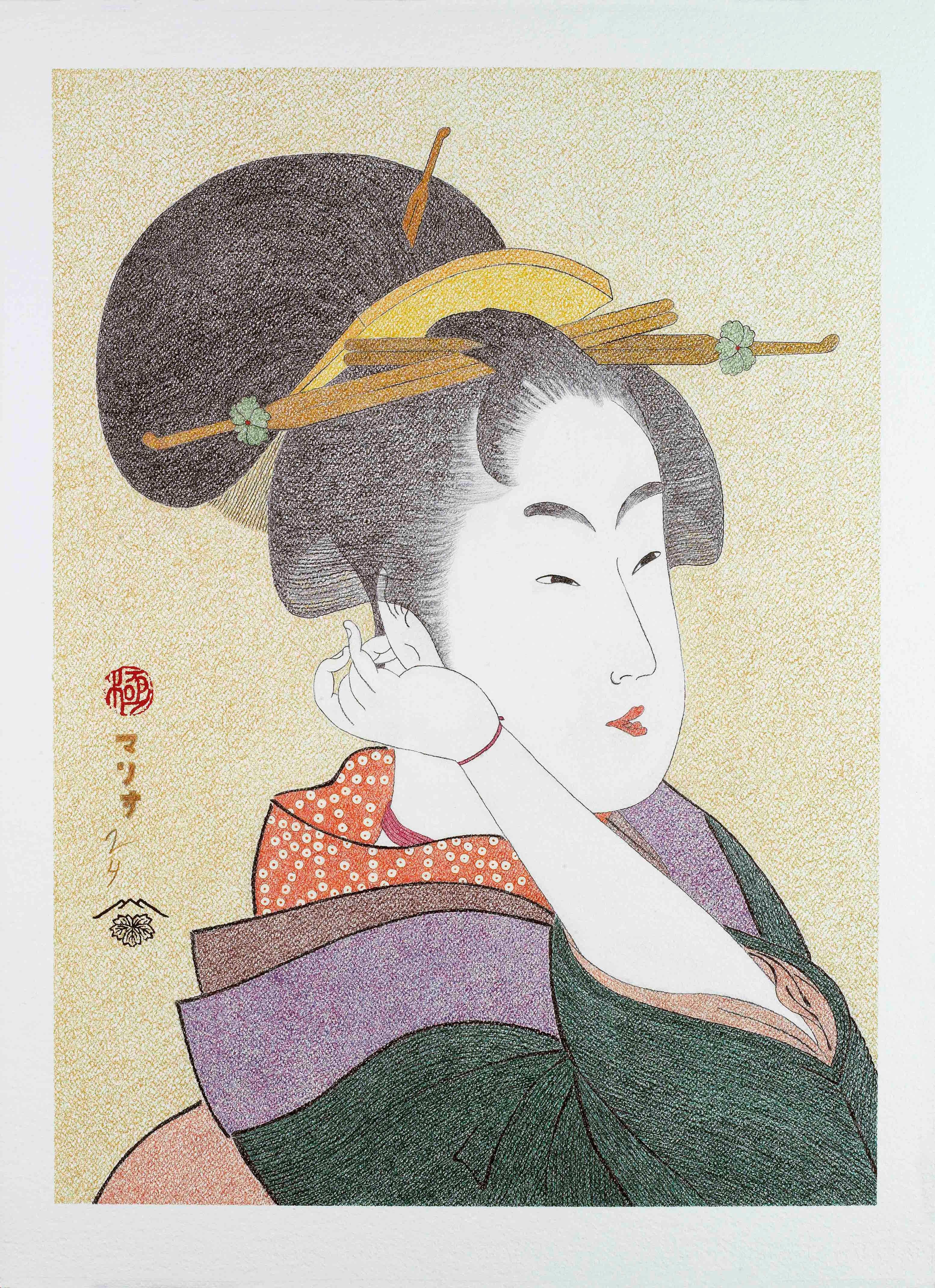
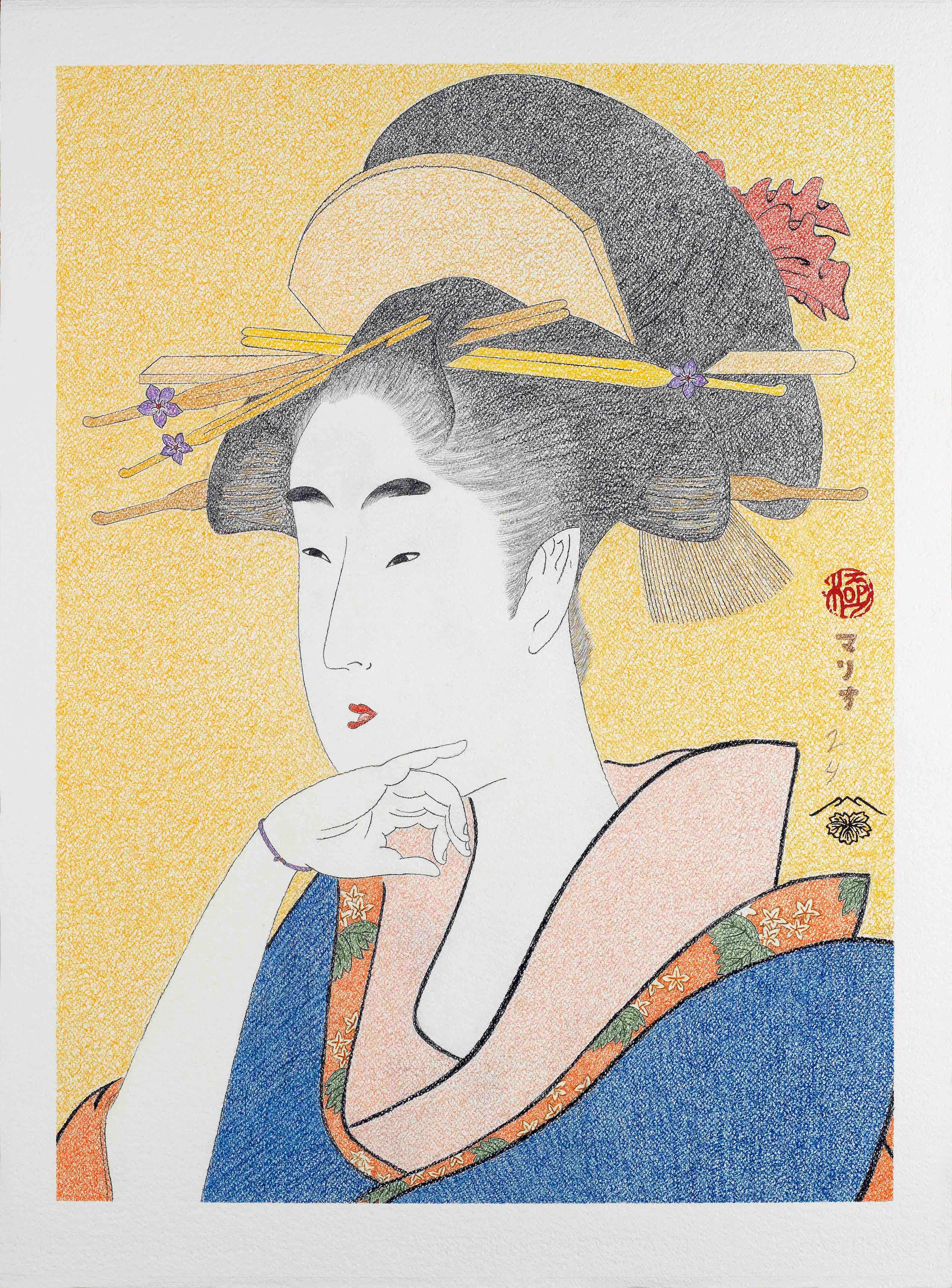
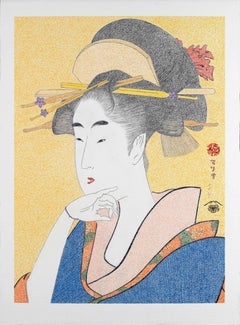
Upper torso portrait of a Japanese beauty, depicted with a graceful hand gesture and an ornate headdress. Her soft round features contrast with the colourful sharp angles of the collars of her kimono.
Her elongated oval face, straight nose and red butterfly lips are typical of the prototype of a beautiful woman, Bijin-ga. Her upper torso and face occupying the central section of the picture show a composition type that became known in time as Large-head pictures, or Okubi-e; compositions with which Utamaro became a model for generations of woodblock artists.
This image is part of the Bijin-ga series (“Pretty women”) drawn by Mario BGil, based in the Kitigawa Utamaro woodblock print...
Category
2010s Edo Figurative Drawings and Watercolors
Materials
Paper, Crayon, Oil Crayon, Graphite
$2,103 Sale Price
43% Off
Japanese Art Ukiyo-e Figurative Painting, Hanamurasaki of the Tamaya, Edo period
Located in Segovia, ES
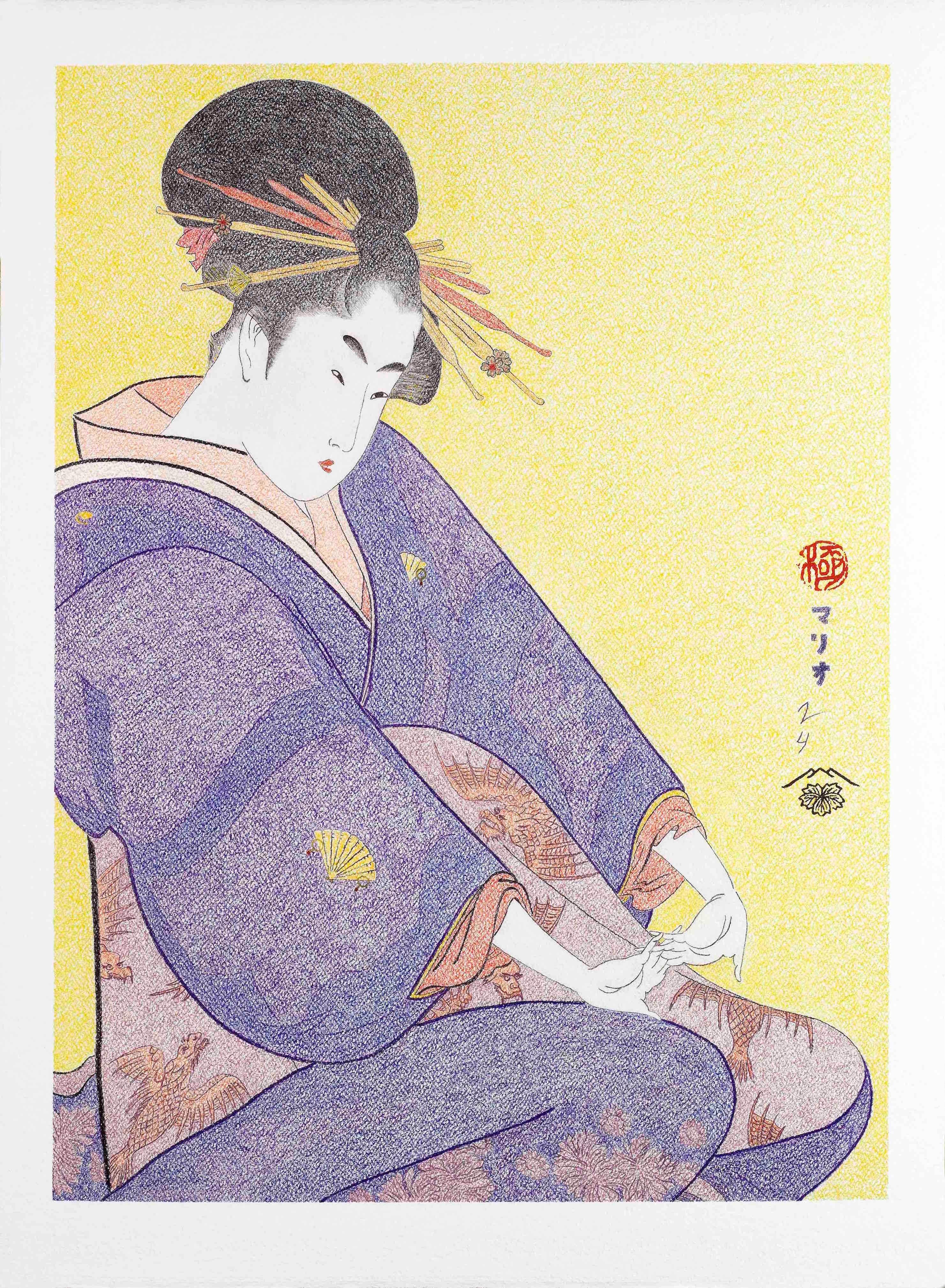
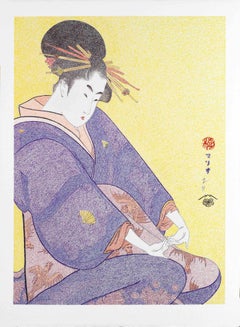
Portrait of the top-class courtesan Hanamurasaki elegantly combed, and dressed in a simple formal kimono and obi, adorned with symbols of her okiya. She is sitting on her knees in a graceful pose, stretching her arms forward and crossing her fingers with a delicate movement of the wrists.
This image is part of the “bijin-ga series” (Pretty women) drawn by Mario BGil, based in the Kitigawa Utamaro woodblock print “Hanamurasaky of the Tamaya”, (from the series: “Array of supreme beauties of the Present Day”, 1794), 36,2 x 25 cm. Museum of Fine Arts. Boston, USA.
The artist reproduces the seal of the censor (Kiwame) and from the original publisher ("Tsutaya", climbing leaf)), between the two, the signature of Mario BGil written in Japanese, with the date 14 (2014).
The mesaurements of the drawing are 76 x 56 cm. (29,92 x 22,05 in.), with a painted surface of 67 x 49,5 cm.
With his work on the "bijing-ga series", Mario BGil wanted to embellish, give brilliance and volume to the images presented by japanese artist Kitigawa Utamaro in those beautiful engravings, ennobled with the patina of time, which have served as inspiration. The result obtained is almost life-size portraits, endowed with strong chromaticism and valuable contrasts, all enhanced, in turn, with the volume provided by the weight and rigidity of the paper, and its thick texture (Fabriano Artistico “grana grosso”, 640g/m2; the thickness and hardness of the paper makes it necessary to transport it without rolling).
In this way, Mario BGil pays tribute to his admired artist and offers us a new and enriched vision of this popular facet of oriental art from the 18th and 19th centuries.
ABOUT THE ARTIST
Mario BGil is a self-taught artist who for years has combined his creative activity with his work in the business world, away from commercial art galleries. Man of very diverse interests and great artistic sensitivity, studied Art History and in 2012, a deep interest in oriental art was awakened in him so that he began to study the great masters of Japanese Ukiyo-e prints, who had such an influence on the European avant-garde of the late 19th century.
The discovery of Kitagawa Utamaro (1753-1806), a key figure in the metropolitan culture of Edo (now Tokyo), and a point of reference in the history of Japanese engraving...
Category
2010s Edo Figurative Drawings and Watercolors
Materials
Paper, Crayon, Oil Crayon, Graphite
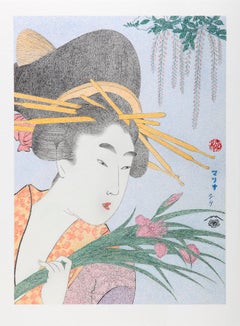
Japanese Art Ukiyo-e Figurative Painting, Hitomoto of the Daimonjiya, Edo period
Located in Segovia, ES
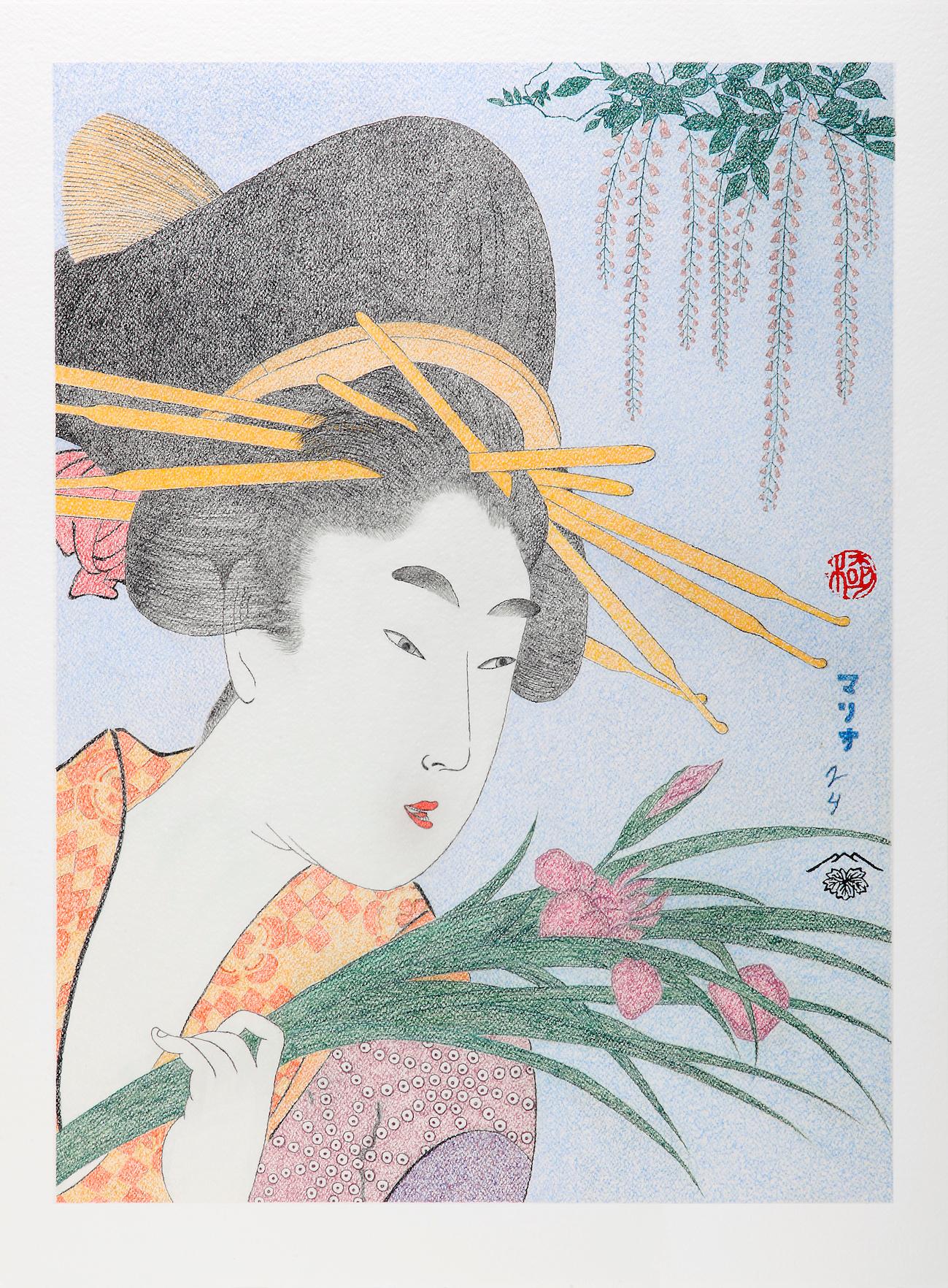
“Hitomoto of The Daimonjiya in Kyô-Machi Itchôme”
Hitomoto holds a bouquet of flowers looking to her left, with a surprised face, and with her mouth aj...
Category
2010s Edo Figurative Drawings and Watercolors
Materials
Paper, Crayon, Oil Crayon, Graphite
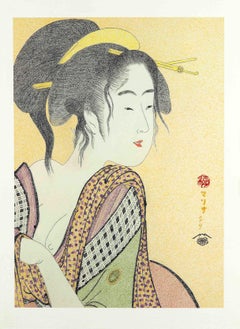
Japanese Art Ukiyo-e Figurative painting, Love for a farmer´s wife, Edo period
Located in Segovia, ES
Bijin-ga Series XVII (nº 17)
Title: Love for a farmer´s wife
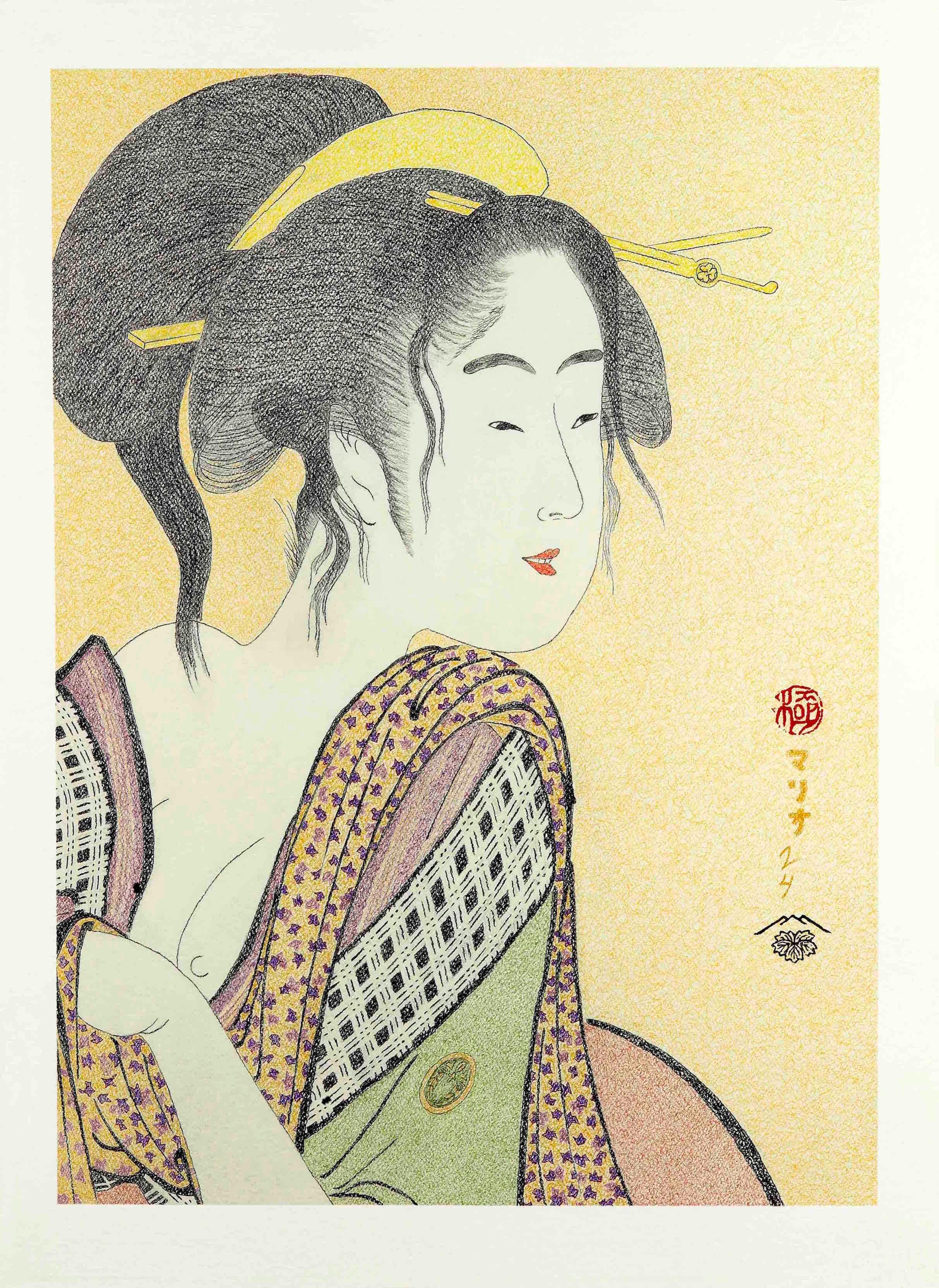
Sensual portrait of a young and beautiful farmer´s wife. Her cheerful and careless gesture, showing her chest between the open folds of the neckline of his humble dress; the strands of hair falling on her temples, and her smiling gesture denote the state of happiness enjoying love, in a well-deserved break from her hard work.
This image is part of the bijin-ga series (“Pretty women”) drawn by Mario BGil, based in the Kitigawa Utamaro woodblock...
Category
2010s Edo Figurative Drawings and Watercolors
Materials
Paper, Crayon, Oil Crayon, Graphite
You May Also Like
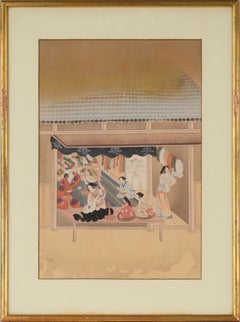
Japanese Artisans - Silk Dying -Japanese Woodblock Print
By Tosa Mitsuyoshi
Located in Soquel, CA
Japanese Artisans - Japanese Woodblock Print J
Japanese woodblock depicting six women, all wearing vibrant kimonos, working on crafts by Tosa Mitsuoki (Japanese, 1617-1691). Japanese,c. 1600. Handcraft depiction (dye works).Section from a painted screen with presentations of handcraft.Kita-in, Saitama.
Stamped lower left.
Presented in a white mat and giltwood frame.
Frame: 19"H x 14"W
Mat: 18.25"H x 13.25"W
Image: 14.5"H x 9.5"W
Tosa Mitsuoki was a Japanese painter, reinvigorating the Yamato style of classical Japanese painting. Yamato-e originated from interest in reproducing early Tang dynasty paintings, and was later reinvented and further refined to fit Japanese cultural perceptions in the late Heian period. Yamato, sometimes referred to as wa or kazu had become synonymous with the Tosa-ha by the Muromachi period as a way for Japanese artist to distinguish their works from those of mainland Chinese paintings, kara-e. Yamato-e incorporated various visual and literary techniques for establishing narrative. Works were not always accompanied with text and may rely on heavily on period specific visual motifs, icons, and symbols to relay a story or theme. Tosa style by the time of Mitsuoki focused heavily on depicting themes of plants and nature, famous places, meisho, the four seasons, shik, bird-and-flower, kacho. Many of these popular symbols and icons from mimicking Chinese practices, treating the original Chinese masterwork as a sort of prototype to improve upon. Popular formats for Mitsuoki's pictures were wall scrolls kakemono, or handscrolls that would be read from right to left with the accompanied story, sliding doors fusuma and folding screen panels byobu that featured up to six panels. Mitsuoki's style incorporated the depth and calligraphy techniques of ink wash brushwork similar to Song dynasty and Yuan dynasty Chinese court paintings...
Category
1920s Edo Landscape Paintings
Materials
Paper, Ink, Woodcut
$1,240 Sale Price
20% Off
Japanese Large Woodblock Print Backstage by Ito Shinsui
Located in Atlanta, GA
A rare Japanese Woodblock print by Itō Shinsui (1898-1972) entitled Backstage (or Gakuya 楽屋 in Japanese). Created in Showa 30th year (1955), the print is in a large format of Double ...
Category
Vintage 1950s Japanese Modern Prints
Materials
Wood, Paper
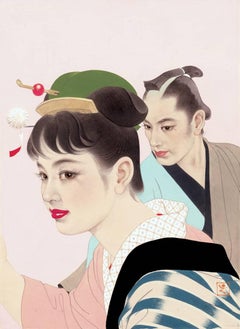
Original Painting for a Japanese Magazine Cover or Romance Novel
By Tatsumi Shimura
Located in Burbank, CA
Painting for a Japanese magazine cover, or possibly a romance novel. One can infer from the dramatic juxtaposition that it may have been designed for a s...
Category
1960s Showa Figurative Drawings and Watercolors
Materials
Paint, Paper
$2,800 Sale Price
26% Off
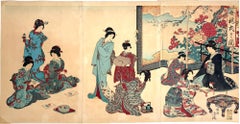
(Untitled), from the series Pictures of ladies
etiquette
By Yoshu Chikanobu
Located in Middletown, NY
Tokyo: c1893.
Wooblock tryptich printed in colors on hand laid mulberry paper, 14 3/4 x 29 inches (375 x 737 mm), the full sheet. Meiji period. In very good condition with extensive...
Category
Late 19th Century Figurative Prints
Materials
Handmade Paper, Woodcut
Traditional Japanese Geisha (Kiba II)
By Tatsumi Shimura
Located in Burbank, CA
A beautiful Japanese geisha dressed in a traditional robe shyly claps her hands together. She stands in front of a backdrop of a bamboo screen. This print...
Category
Early 2000s Showa Portrait Prints
Materials
Giclée

$975 Sale Price
50% Off
Biensennyo-ko Japanese Woodblock Print
By Keisai Eisen
Located in Houston, TX
Japanese Woodblock print of a Biensennyo-ko a powder face women. Behind the women is a framed cityscape. The print is possibly from the series "Eight Favorite Things in the Modern World". The woodblock print is printed on rice paper. The print is not framed.
Artist Biography: Keisai Eisen...
Category
Early 1800s Edo Portrait Prints
Materials
Woodcut