Want more images or videos?
Request additional images or videos from the seller
1 of 13

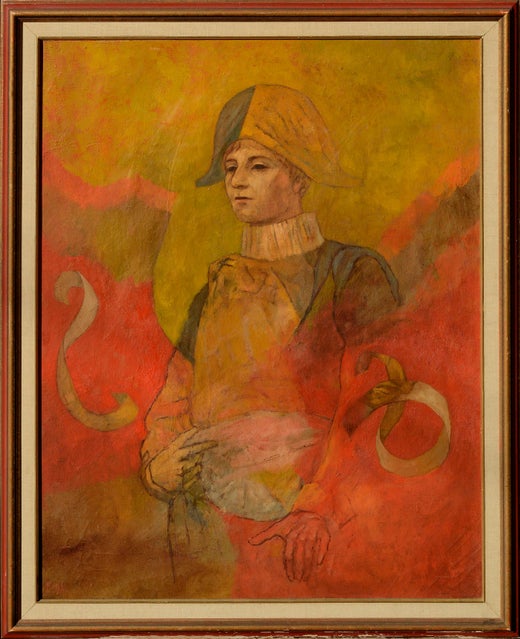
Robert Moesle
Figural , Carmel, California Post-Impressionist, Ruskin School of Art, Madrid

Circa 1975

$1,850List Price

You May Also Like

Wheat Field Harvest, Early 20th Century Figurative Landscape
Located in Soquel, CA
Early 20th century Italian figurative landscape of a traditional wheat field harvest scene, by S. Frosini (Italian, 20th Century). This figurative landscape in gouache depicts in gre...
Category

Early 20th Century Impressionist Figurative Drawings and Watercolors

Materials

Gouache, Illustration Board

Wheat Field Harvest, Early 20th Century Figurative Landscape
$600 Sale Price
20% Off
H 13.25 in W 19.75 in D 0.13 in
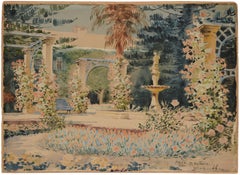
"San Anton Palace Malta" Early 20th Cent. Garden and Fountain Watercolor Russian
Located in Soquel, CA
A significant early 20th century landscape watercolor of the paradisical gardens at San Anton Palace in Attard, Malta by Nicholas Krasnoff, 1920 (Russian, 1864-1939). This beautiful piece is a wonderful example of the renowned Russian architect's prized watercolors, created while he was exiled to Malta in the early 1920's. Depicting a lush garden full of blooming, colorful flowers and a stately fountain at the San Anton Palace in Malta, one can see the deft hand and attention to detail rendered by the proficient artist and architect's hand. Signed "N. Krasnoff" lower right. Titled and dated "Malta, St. Antonio 1920". Unframed. Measures 10.25"H x 14.25"W. Right corner has a crease from being bent. Nikolay Petrovich Krasnov, also known as Nicholas Krasnoff or Peter Nicholas Krasnoff, was a Russian Serbian architect and painter. He served as Chief Architect of Yalta, Crimea (1887-1899). From 1922 he lived and worked in the Kingdom of Yugoslavia, and was a key figure in the architectural development of Belgrade. Attending the Moscow School of Painting, Sculpture and Architecture in 1876, aged 12. As a young artist he received patronage from Sergey Tretyakov, brother of the founder of Moscow's Tretyakov Gallery, and entrepreneur Petar Gubonyin. In 1887 Krasnov became Chief Architect in Yalta. At the age of 23, Krasnov had large responsibility for the rapid growth of the city. He expanded the promenade, which by 1913 became the city's main street, before creating a new city plan in 1889 (including a new sewer system, planning regulations, new streets, prevention of unregulated construction, a school and children's hospital, and the construction of the Pushkin Boulevard). Two concrete bridges were built over the river, and the embankment strengthened. Krasnov also ran a private practice in Yalta until 1911. Among his most famous work is the Livadia Palace, later the location of the 1945 Yalta Conference. Designed over 60 buildings in Crimea, blending a modernist style with local traditions. Also of note: Dulber Palace, Koreiz (1895-97), Alexander Nevsky Cathedral, Yalta (1902), Yusupov Palace, Koreiz (1909), Kokkoz Jami Mosque, Sokolyne (1910). In 1913, he presented a collection of illustrations he had produced of his works to the Saint Petersburg Academy of Arts, where he held the title of academician. An opponent of the Russian Revolution, he left Yalta with his family in 1919 for Malta, alongside the Dowager Empress Marie Feodorovna, sister of Queen Alexandra, and over 600 members of the Russian aristocracy. Nikolay was in a group housed in the empty Villa St Ignatius, which had been a Jesuit college and then a hospital during World War I. To earn money, Nikolay painted many scenes of Malta, signing his paintings as N. Krasnoff. He is known as Nicholas Krasnoff in Malta. In May 2016 MaltaPost issued a commemorative set of stamps in his honor. In 1922 Krasnov moved to Belgrade, then part of the Kingdom of Yugoslavia, where he became head of the Department of Monumental Architectural Developments and Monuments. His building designs in Serbia number around 60, and were created under the name Nikola Krasnov, as a mark of respect to his adopted homeland. His key works in Belgrade include: Ministry of Forestry building (now Ministry of Foreign Affairs) (1923) which bears a memorial plaque...
Category

1920s Impressionist Landscape Drawings and Watercolors

Materials

Paper, Watercolor, Illustration Board
Light Envelope with Tape, realist watercolor and pencil still life, 2016
By Margot Glass
Located in New York, NY
Margot Glass explores the fragility of communication, and people’s natural drive to find narrative in even the most ordinary of objects. In her Envelopes series, Glass works in water...
Category

2010s Contemporary Figurative Drawings and Watercolors

Materials

Watercolor, Illustration Board

Cherry Dancer
By Marcel Vertès
Located in Miami, FL
Cherry Dancer Marcel Vertes French, 1895-1961 Beautiful girl juggling cherries Work is round but is shown in a square frame and some of the artworks edge is exposed Description: ...
Category

1930s Post-Impressionist Figurative Drawings and Watercolors

Materials

Gouache, Illustration Board

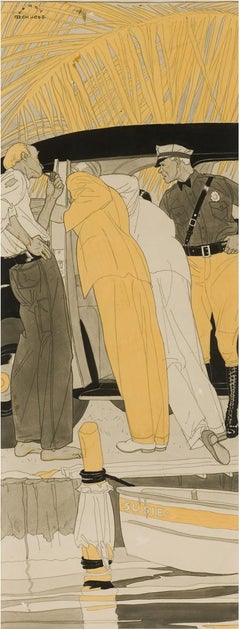
Searching the Car - Desaturated Colors Muted Warm Yellows and Grey
By Harry Beckhoff
Located in Miami, FL
This Harry Beckhoff illustration is masterfully rendered and intricately designed in line and wash. It's as abstract as it's representational with its graphic style, clean lines, and flat patterning. Every element in the composition works in harmony without a line out of place. The flat and abstract nature of the work rivals that of the great modernist painters of the 1930s. Perhaps this was done for a major newsstand magazine like Collier's. Although he studied with Dean Cornwell and Harvey Dunn, he didn't pursue the style of painterly brushstrokes and impastos. Instead, he defined his forms with flat shapes, whose internal forms are defined by thin lines. The emphasis is more on silhouette and line than it is on texture and lighting. Beckhoff also described his work as having been influenced by illustrators like Pierre Brissaud...
Category

1930s Figurative Drawings and Watercolors

Materials

Watercolor, Illustration Board

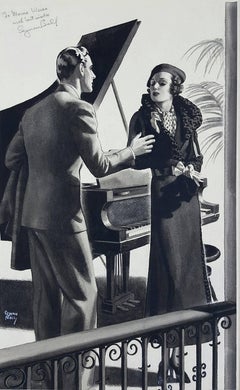
Art Deco Coulple Magazine Story Illustration, RedBook The Saturday Evening Post
By Seymour Alling Ball
Located in Miami, FL
Signed lower left: Seymour Ball Inscribed upper left: To Morris E Weiss with best wishes Seymour Ball" Matted not framed
Category

1930s Art Deco Figurative Drawings and Watercolors

Materials

India Ink, Watercolor, Illustration Board
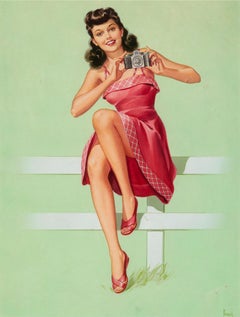
Pin Up Girl in Red Dress, Mid-Century, Female Artist
By Pearl Frush
Located in Miami, FL
The Pin-Up of ravishing young beauties in mid-century America was a widely popular art form. The assumption that Pin-Up art was the exclusive domain of men is a misnomer. Female illu...
Category

1940s American Realist Figurative Paintings

Materials

Watercolor, Illustration Board

Apocalypse, Catastrophic Destruction of the World, Surrealism - Life Magazine
Located in Miami, FL
Apocalypse in 1962? At the height of the Cold War, Life Magazine commissions an illustration that describes the world's end by means other than a nuclear war with Russia. Richard Erdoes brilliantly illustrates the work with his highly stylized painting technique. My favorite part of the work is on the left side showing a group of people packed together as they fall into oblivion. A clear reference would be Hieronymus Bosch's "The Last Judgment " Once Again the World Ends." Illustration published in Life Magazine, Feb. 9, 1962 Signed in lower right image. Unframed Richard Erdoes (Hungarian Erdős, German Erdös; July 7, 1912 – July 16, 2008) was an American artist, photographer, illustrator and author. Early life Erdoes was born in Frankfurt,[1] to Maria Josefa Schrom on July 7, 1912. His father, Richárd Erdős Sr., was a Jewish Hungarian opera singer who had died a few weeks earlier in Budapest on June 9, 1912.[2] After his birth, his mother lived with her sister, the Viennese actress Leopoldine ("Poldi") Sangora,[3] He described himself as "equal parts Austrian, Hungarian and German, as well as equal parts Catholic, Protestant and Jew..."[4] Career He was a student at the Berlin Academy of Art in 1933, when Adolf Hitler came to power. He was involved in a small underground paper where he published anti-Hitler political cartoons which attracted the attention of the Nazi regime. He fled Germany with a price on his head. Back in Vienna, he continued his training at the Kunstgewerbeschule, now the University of Applied Arts, Vienna.[5] He also wrote and illustrated children's books and worked as a caricaturist for Tag and Stunde, anti-Nazi newspapers. After the Anschluss of Austria in 1938 he fled again, first to Paris, where he studied at the Academie de la Grande Chaumiere, and then London, England before journeying to the United States. He married his first wife, fellow artist Elsie Schulhof (d. xxxx) in London, shortly before their arrival in New York City. In New York City, Erdoes enjoyed a long career as a commercial artist, and was known for his highly detailed, whimsical drawings. He created illustrations for such magazines as Stage, Fortune, Pageant, Gourmet, Harper's Bazaar, Sports Illustrated, The New York Times, Time, National Geographic and Life Magazine, where he met his second wife, Jean Sternbergh (d. 1995) who was an art director there. The couple married in 1951 and had three children.[6] Erdoes also illustrated many children's books. An assignment for Life in 1967 took Erdoes to the Pine Ridge Indian Reservation for the first time, and marked the beginning of the work for which he would be best known. Erdoes was fascinated by Native American culture, outraged at the conditions on the reservation and deeply moved by the Civil Rights Movement that was raging at the time. He wrote histories, collections of Native American stories...
Category

1960s Surrealist Figurative Drawings and Watercolors

Materials

Mixed Media, Gouache, Board, Illustration Board
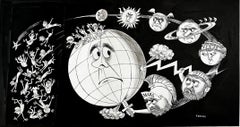
Environmental Prognostication Coil Narrative "Homo Sapiens R.I.P."
Located in Miami, FL
"They paved paradise and put up a parking lot," Joni Mitchell said. - - Created in 1969, at the dawn of the American environmental movement, artist Richard Erdoes draws a sequential narrative in the form of a coil. From inception to destruction, it illustrates a list of things that humans are doing to destroy the world we live in. The work was commissioned for school-age humans and executed in a whimsically comic way. Yet the underlying narrative is sophisticated and foreshadows a world that could be on the brink of ecological disaster. Graphically and conceptually, this work exhibits an endless amount of creativity and Erdoes cartoony style is one to fall in love with. Signed lower right. Unframed 12.4 inches Width: 12.85 inches Height is the live area. Board is 16x22 inches. Richard Erdoes (Hungarian Erdős, German Erdös; July 7, 1912 – July 16, 2008) was an American artist, photographer, illustrator and author. Early life Erdoes was born in Frankfurt,to Maria Josefa Schrom on July 7, 1912. His father, Richárd Erdős Sr., was a Jewish Hungarian opera singer who had died a few weeks earlier in Budapest on June 9, 1912.After his birth, his mother lived with her sister, the Viennese actress Leopoldine ("Poldi") Sangora,He described himself as "equal parts Austrian, Hungarian and German, as well as equal parts Catholic, Protestant and Jew..."[4] Career He was a student at the Berlin Academy of Art in 1933, when Adolf Hitler came to power. He was involved in a small underground paper where he published anti-Hitler political cartoons which attracted the attention of the Nazi regime. He fled Germany with a price on his head. Back in Vienna, he continued his training at the Kunstgewerbeschule, now the University of Applied Arts, Vienna.[5] He also wrote and illustrated children's books and worked as a caricaturist for Tag and Stunde, anti-Nazi newspapers. After the Anschluss of Austria in 1938 he fled again, first to Paris, where he studied at the Academie de la Grande Chaumiere, and then London, England before journeying to the United States. He married his first wife, fellow artist Elsie Schulhof (d. xxxx) in London, shortly before their arrival in New York City. In New York City, Erdoes enjoyed a long career as a commercial artist, and was known for his highly detailed, whimsical drawings. He created illustrations for such magazines as Stage, Fortune, Pageant, Gourmet, Harper's Bazaar, Sports Illustrated, The New York Times, Time, National Geographic and Life Magazine, where he met his second wife, Jean Sternbergh (d. 1995) who was an art director there. The couple married in 1951 and had three children.[6] Erdoes also illustrated many children's books. An assignment for Life in 1967 took Erdoes to the Pine Ridge Indian Reservation for the first time, and marked the beginning of the work for which he would be best known. Erdoes was fascinated by Native American culture, outraged at the conditions on the reservation and deeply moved by the Civil Rights Movement that was raging at the time. He wrote histories, collections of Native American stories...
Category

1960s American Realist Landscape Drawings and Watercolors

Materials

Ink, Gouache, Illustration Board

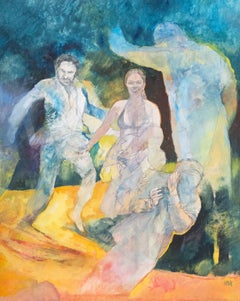
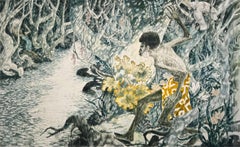
Australian Aboriginal Fairy Tale in Jungle Scene Fantasy like Paul Gauguin
Located in Miami, FL
Brilliant Italian Illustrator Gianni Benvenuti paints a moody fantasy that illustrates an Australian Fairy Tale. A young and fit Aboriginal man is scene chasing a beautiful Aborigin...
Category

1960s Surrealist Landscape Drawings and Watercolors

Materials

Tempera, Watercolor, Illustration Board, Pencil
More From This Seller

View All
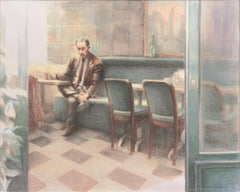
Cafe , Woman Artist, École Nationale Supérieure des Arts Décoratifs, Berkeley
Located in Santa Cruz, CA
Signed lower right, 'Marie Pascal' (French-American, 20th century) and painted circa 1990. Exhibited: Gallery Concord, December 1991. Marie Pascal studied at the École Nationale Sup...
Category

1990s Interior Drawings and Watercolors

Materials

Watercolor, Gouache, Illustration Board
Figural , Carmel, California Post-Impressionist, Ruskin School of Art, Madrid
By Robert Moesle
Located in Santa Cruz, CA
A large study of several people in action contrasted against a background of saffron yellow and cerulean blue. Signed lower right 'Moesle', painted circa 1975 and titled verso 'On ...
Category

1970s Figurative Drawings and Watercolors

Materials

Watercolor, Illustration Board

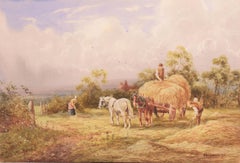
Harvest Time , Royal Birmingham Society of Artists, London Royal Academy
Located in Santa Cruz, CA
Signed lower right, 'H. Hammond' for Horace Murray Hammond (British, circa 1879-1966) and dated 1921. A luminously painted, bucolic view of harvest time in England with the lilac of...
Category

1930s Landscape Drawings and Watercolors

Materials

Watercolor, Gouache, Illustration Board
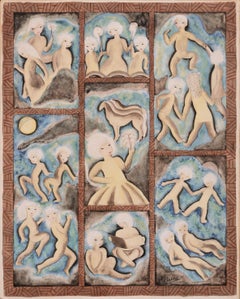
Childhood , Paris, Salon d Automne, New York, ASL, Corcoran, PAFA, Art Deco
By Nura Ulreich
Located in Santa Cruz, CA
Signed lower right 'Nura' for Nura Woodson Ulreich (American, 1899–1950). Titled, verso, 'Childhood', signed with artist's Paris address and dated 1926. This early twentieth-century...
Category

1920s Surrealist Figurative Drawings and Watercolors

Materials

Watercolor, Gouache, Illustration Board
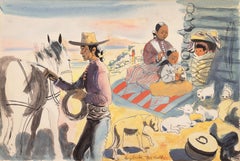
Navajo Family , Santa Fe, Modernism, Corcoran, Whitney, PAFA, AIC, WPA
By Eduard Buk Ulreich
Located in Santa Cruz, CA
Signed lower center, 'by Buk' for Eduard Buk Ulreich (American, 1889-1966), dedicated lower center, 'for Ruth' and painted circa 1945. Additionally signed and titled verso 'Navajo Fa...
Category

1940s Art Deco Figurative Drawings and Watercolors

Materials

Watercolor, Gouache, Illustration Board
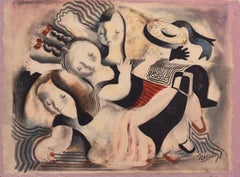
After School , Art Deco, Woman Artist, AIC, ASL, Paris, Salon d Automne, PAFA
By Nura Ulreich
Located in Santa Cruz, CA
Signed lower right, 'Nura' for Nura Woodson Ulreich (American, 1899-1950) and painted circa 1935. This early twentieth-century painter, lithographer, muralist, author, poet and ill...
Category

1930s Art Deco Figurative Drawings and Watercolors

Materials

Crayon, Watercolor, Gouache, Illustration Board, Pen, Pencil
Still Thinking About These?

All Recently Viewed