Items Similar to The Balneator by Sir Lawrence Alma-Tadema
Want more images or videos?
Request additional images or videos from the seller
1 of 10
Sir Lawrence Alma-TademaThe Balneator by Sir Lawrence Alma-TademaCirca 1876
Circa 1876
$175,000
£133,262.39
€152,177.14
CA$245,896.60
A$269,795.43
CHF 142,115.27
MX$3,209,501.22
NOK 1,820,479.55
SEK 1,662,346.40
DKK 1,136,909.70
About the Item
Sir Lawrence Alma-Tadema
1836-1912 Dutch
The Balneator
Signed and inscribed "L Alma Tadema. op CLXXVI." (lower right)
Pencil and watercolor with scratching out on paper on board
This exceptional work by Sir Lawrence Alma-Tadema depicts a Roman bath attendant, executed with the meticulous accuracy and technical brilliance that established the artist as the preeminent painter of classical antiquity in Victorian Britain. Created circa 1876 during Alma-Tadema's mature period, The Balneator demonstrates his remarkable ability to achieve oil painting effects in the challenging medium of watercolor.
Historically, a balneator was a bath attendant in Ancient Rome who assisted bathers in the caldarium, the hottest room of Roman bath complexes. Using sponges, strigils and specialized instruments, these attendants applied oils to bathers' skin and scraped them clean—an early form of cleansing that preceded modern soap. Alma-Tadema's fascination with Roman baths intensified around 1875 following his acquisition of extensive photographs documenting Pompeii and the archaeological treasures of its museum in Naples.
Executed in pencil and watercolor with a unique scratching out technique, this work showcases Alma-Tadema's legendary skill in rendering splendid interiors. Through subtle gradations of color and tone, he contrasts different types and colors of marble, creating a convincing architectural environment. The lifelike texture of the figure's costume tassels is a result of the artist's innovative technique of scratching horizontal lines directly into the paper, achieving remarkably convincing textile detail.
This work was first exhibited at the Society of Painters in Water-Colours winter exhibition of 1876-1877 alongside its accompanying work The Balneatrix, depicting a female bath attendant. Critics praised the work for achieving the same highly finished quality as Alma-Tadema's oil paintings and for his "consummate ability in the depiction of marbles and interiors." Reviews appeared in major London publications, including The Art Journal, The Globe, The Spectator and Illustrated London News.
The work's provenance traces directly from the artist through respected London dealers Pilgeram
Lefèvre in 1877, subsequently passing through important private collections. The painting has been extensively documented in literature, including Vern Swanson's definitive catalogue raisonné and Robert Barrow's comprehensive monograph.
Sir Lawrence Alma-Tadema was one of the most influential artists of the 19th century and perhaps art history’s greatest Neoclassical painter. During a career that spanned more than 60 years, he painted distinctive and “real to life” depictions of classical Greek and Roman antiquity. In 1852, he entered the Royal Academy of Antwerp in Belgium, and he devoted himself to thoroughly researching his subjects, striving for accuracy down to the smallest detail. It was a habit that would persist throughout his career and earn him great success during his lifetime.
In 1870, Alma-Tadema settled in England, where his Neoclassical works were particularly prized. He earned gold medals and highest honors in Amsterdam, at the Royal Academy, the Paris Salon and the 1867 Exposition Universelle, among countless others. Widely celebrated and admired, Queen Victoria herself awarded him British citizenship in 1873 and granted him knighthood in 1899. Today, his works are heralded as a significant part of art history, with his works gracing the walls of many major international museums, including Tate Britain, the Rijksmuseum and the Metropolitan Museum of Art.
Circa 1876
Paper: 14 3/4“ high x 10 3/4” wide (37.47 x 27.31 cm)
Framed: 21 1/2“ high x 17 1/8” wide x 2“ deep (69.75 x 54.61 x 5.08 cm)
Provenance:
The artist
With Pilgeram
Lefèvre, London, acquired directly from the above, 1877
Private collection, acquired in 1997
Private collection, California
Private collection, California
M.S. Rau, New Orleans
Literature:
"Society of Painters in Water Colours," The Globe, London, 5 December 1876, p. 6.
"Art Exhibition in London," The Glasgow Herald, Glasgow, 7 December 1876, p. 3.
"Society of Painters in Water Colours," The Daily News, London, 8 December 1876, p. 2.
"Art," The Spectator, London, 9 December 1876, p. 1541.
"Fine Arts," Illustrated London News, London, 9 December 1876, no. 1950, vol. LXIX,p. 562.
"Society of Painters in Water Colours," The Graphic, London, 9 December 1876, p. 578.
"Winter Exhibition of the Society of Painters in Water-Colours," The Athenaeum, London, 9 December 1876, p. 767.
"Water-Colour Exhibitions," The Saturday Review, London, 16 December 1876, p. 756.
E. W. Godwin, "Afternoon Strolls," The Architect, London, 23 December 1876, p. 364.
C. H. Ross, ed., "Winter Exhibition of the Society of Painters in Water Colours," Judy, vol. XX, London, 27 December 1876, p. 108.
L. Robinson, "Correspondance D'Angleterre," La Chronique des arts, Paris, 24 February 1877, p. 74.
"Fine Arts," Illustrated London News, London, 1 December 1877, no. 2003, vol. LXXI, p. 534.
C. E. Pascoe, "London Exhibitions," The Art Journal, vol. 3, London, 1887, p. 60.
"Winter Exhibitions," The Art Journal, vol. 8, London, 1887, p. 55.
R. Dircks, "Sir L. Alma-Tadema O.M., R.A., R.W.S.," The Art Journal, London, December 1910, p. 30.
V. G. Swanson, Sir Lawrence Alma-Tadema, London, 1977, p. 138.
R. Borger, Drei Klassizisten: Alma Tadema, Ebers, Vosmaer, Leiden, 1978, p. 11, no. 176.
V. G. Swanson, The Biography and Catalogue Raisonné of the Paintings of Sir Lawrence Alma-Tadema, London, 1990, p. 196, under no. 217.
R. J. Barrow, Lawrence Alma-Tadema, London and New York, 2001, pp. 99, 102, no. 95, illustrated.
B. Massabò, Albingaunum: itinerari archeologici di Albenga, Genoa, 2004, p. 102, illustrated.
Exhibited:
London, Society of Painters and Water-Colours, Winter Exhibition, 1876-1877, no. 332.
London, Dudley Gallery, Winter Exhibition, December 1877.
Los Angeles, The J. Paul Getty Museum, Luminous Paper: British Watercolors and Drawings, 19 July-23 October 2011, no. 27.
- Creator:Sir Lawrence Alma-Tadema (1836-1912, British)
- Creation Year:Circa 1876
- Dimensions:Height: 21.5 in (54.61 cm)Width: 17.13 in (43.52 cm)Depth: 2 in (5.08 cm)
- Medium:
- Movement Style:
- Period:
- Condition:
- Gallery Location:New Orleans, LA
- Reference Number:Seller: 32-13721stDibs: LU18616714792
About the Seller
5.0
Vetted Professional Seller
Every seller passes strict standards for authenticity and reliability
Established in 1912
1stDibs seller since 2013
20 sales on 1stDibs
Typical response time: 4 hours
- ShippingRetrieving quote...Shipping from: New Orleans, LA
- Return Policy
More From This Seller
View AllThe Water Carrier by Eugen von Blaas
Located in New Orleans, LA
Eugen von Blaas
Italian I 1843-1932
The Water Carrier
Signed and dated "E. von Blaas 1891" (lower right)
Oil on canvas
Eugen von Blaas’ unparalleled skill for genre painting is on...
Category
Late 19th Century Academic Figurative Paintings
Materials
Canvas, Oil
The Bather by Childe Hassam
By Childe Hassam
Located in New Orleans, LA
Childe Hassam
1859-1935 American
The Bather
Signed and dated “Childe Hassam” (lower right)
Oil on canvas
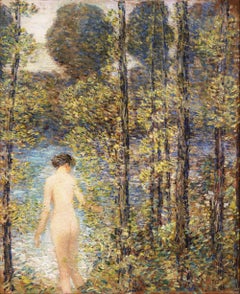
Considered by many to be America’s foremost Impressionist painter, Childe Hassam composed his tranquil and intimate oil on canvas The Bather in the early years of the 20th century. The creation of the artwork aligns with a period of Hassam’s career where the artist’s palette was transforming, matching ever closer with the pale and pastel hues of French Impressionists like Claude Monet. Even the subject — a nude woman — represents a greater alignment with the Impressionist project, as artists of the movement and their non-mythological and non-biblical nudes still generated cries of indecency. With Hassam’s signature brushwork and attention to color, The Bather serves as a dream-like vision, serene and sensuous, of a young woman bathing in a lush forest.
While the artist's skill for landscape painting is on display, it is Hassam's command of form, light and color that brings this canvas to life. He creates a captivating composition, placing the nude subject in the bottom left of the canvas. The soft, undulating curves of the woman's body in contrapposto and the glow of her fair skin are balanced by the strong verticals and deep earth tones of the tall trees to her right. Hassam delicately frames the nude in the vivid blues of the distant water, building luminous color that further draws the viewer’s eye and results in a somewhat voyeuristic appeal — endowing his nude with both a natural innocence and an intentional sensuality.
Born in Dorchester, Massachusetts, Childe Hassam began his artistic career as a freelance illustrator, working for national publications such as Harper’s Weekly, Scribner’s Monthly, and The Century. His first solo exhibition of watercolors took place in Boston in 1883, and he quickly catapulted onto the international scene, winning a bronze medal at the Exposition Universelle in Paris in 1889. The year before the present work was created, he received the Webb Prize from the Society of American Artists for another landscape painted at Gloucester. Hassam would receive numerous other awards throughout his career, most notably the Gold Medal for Distinguished Services to Fine Art from the American Dealers Association. A true master, Hassam depicted a way of life characteristic of both American and French society, and his work elucidates a critical chapter in American art history. Today, his work resides in the Oval Office of the White House and in numerous important museums, including the Metropolitan Museum of Art in New York, the National Gallery of Art in Washington, DC and the Museum of Fine Arts in Boston, among others.
This painting will be included in Stuart P. Feld's and Kathleen M. Burnside's forthcoming catalogue raisonné of the artist's work.
Circa 1905
Canvas: 24 1/2“ high x 20 18” wide
Frame: 35 7/8“ high x 31 1/4” wide x 3 1/4“ deep
Provenance:
Private Collection of William Young...
Category
20th Century Impressionist Nude Paintings
Materials
Canvas, Oil
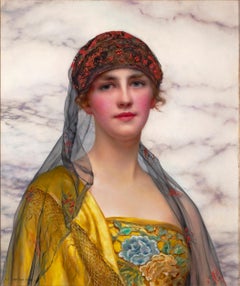
Portrait of a Beauty by William Clarke Wontner
By William Clarke Wontner
Located in New Orleans, LA
William Clarke Wontner
1857-1930 British
Portrait of a Beauty
Signed and dated "W. Wontner 1918" (lower left)
Oil on canvas
Classical beauty a...
Category
20th Century Portrait Paintings
Materials
Canvas, Oil
A Study of Two Models by Sir William Russell Flint
By William Russell Flint
Located in New Orleans, LA
Sir William Russell Flint, R.A., P.R.W.S.1880-1969 Scottish
A Study of Two Models
Signed "WRussell Flint" (bottom right)
Ethereal and sen...
Category
20th Century Figurative Drawings and Watercolors
Materials
Paper, Chalk
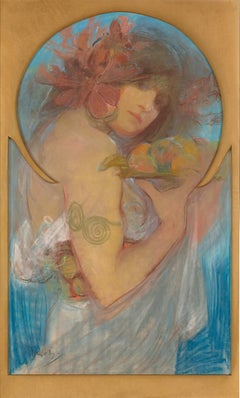
Fruit by Alphonse Mucha
By Alphonse Mucha
Located in New Orleans, LA
Alphonse Mucha
1860-1939 Czech
Fruit
Signed "Mucha" (lower left)
Pastel on paper
"Art only exists to communicate a spiritual message." —Alphonse Mucha
Alphonse Mucha's distincti...
Category
19th Century Art Nouveau Figurative Drawings and Watercolors
Materials
Paper, Pastel
A Pompeian Lady
By John William Godward
Located in New Orleans, LA
John William Godward
1861-1922 British
A Pompeian Lady
Signed and dated "J.W. Godward 1904" (lower right, partially covered by frame)
Oil on canvas
One of the last and greatest Victorian neoclassical painters, John William Godward is celebrated for his flawlessly executed images of graceful women posed in idealized ancient settings. In this work, entitled A Pompeian Lady, a classical beauty is caught idling in a moment of quiet, solitary reflection. Godward's elegant subjects are depicted with a degree of technical mastery that remains unsurpassed, and the work's dramatic palette, luxurious fabrics and classical vision are all characteristics of his unique take on the neoclassical style.
Godward was unmatched in terms of his technical skill and attention to detail. A master of contrasting textures, he paints a diaphanous gown draping against the model’s smooth, milky white skin, which sits against the painstakingly rendered individual hairs of a tiger’s pel. Scintillating color permeates the canvas as well, energizing the otherwise static scene. Each element is given careful attention, and the overall effect is one of both immaculate technique and sensual tactility.
Along with his contemporary and mentor, Sir Lawrence Alma-Tadema, Godward set the tone for the Victorian neoclassicist movement. He built his career upon creating images of idealized feminine beauty infused with a Greco-Roman-inspired style. Though greatly influenced by Alma-Tadema, Godward distinguished himself through his predilection for the solitary female figure. His fame rose dramatically in the first few years of the 20th century, when the present work was completed, due to the burgeoning strength of the British Empire and the Victorian society’s preoccupation with ancient Rome. To many of the newly affluent, Roman society was, as Iain Gale writes, “a flawless mirror of their own immaculate world.” The sensuality and mystery of Godward’s maidens, combined with his impressive antique backdrops...
Category
Early 20th Century Academic Portrait Paintings
Materials
Canvas, Oil
You May Also Like
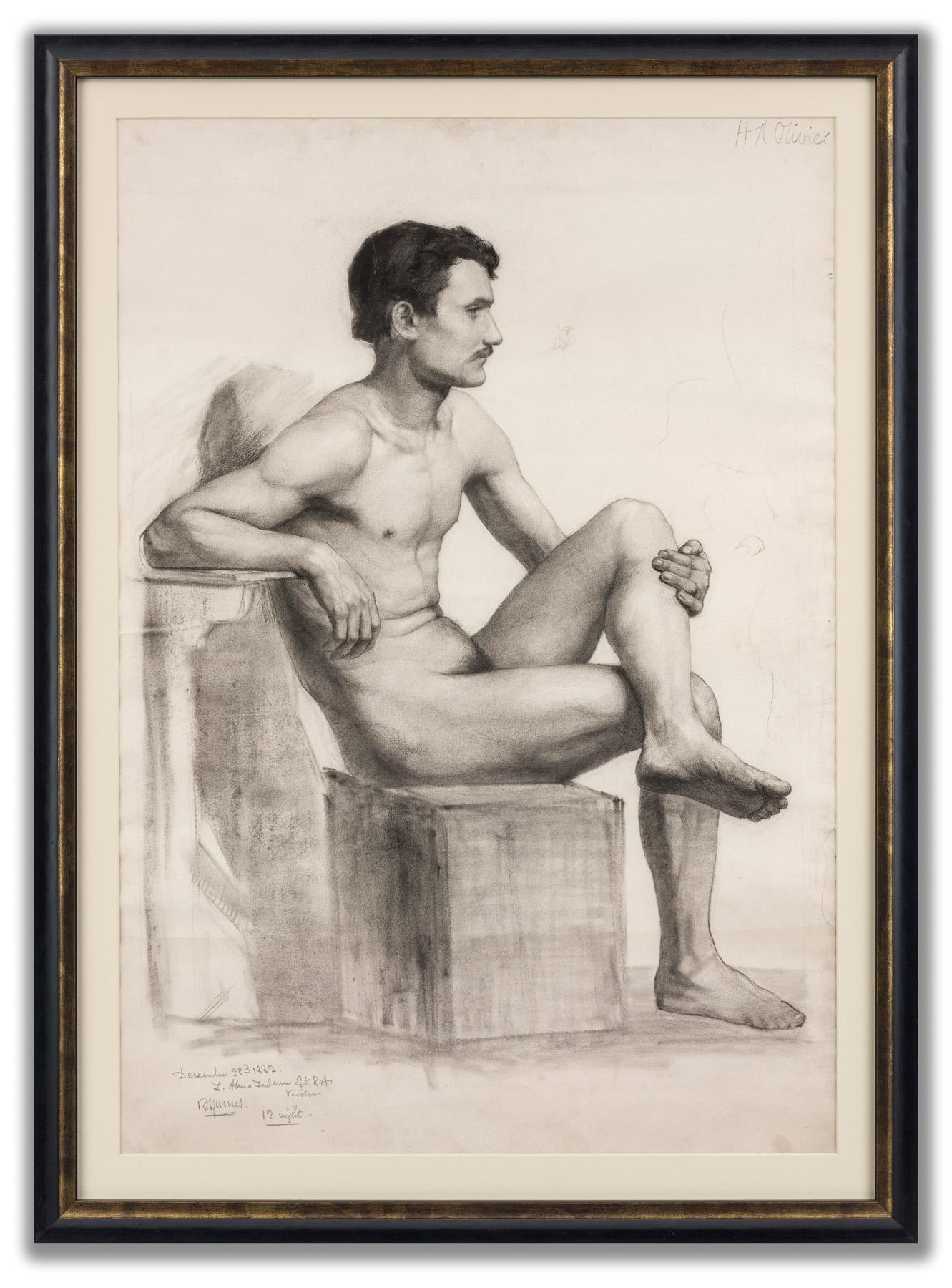
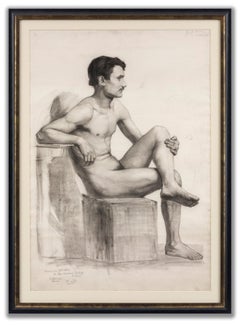
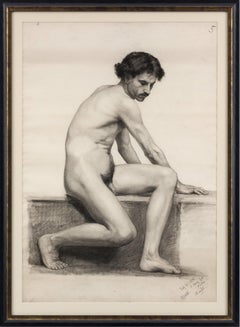
Academic Study (Male Nude)
Located in London, GB
Charcoal on paper, signed by the artist (upper right), and RA visitor L. Alma Tadema, RA., and dated (lower left), 76cm x 57cm, (64cm x 88cm framed).
Olivier studied at the Royal Academy Schools from 1881, where this extraordinary display of drafting took place. Olivier exhibited extensively, including the Royal Academy starting in 1883, and the Paris Salon. He exhibited at the Fine Art Society in the 1880s and at the Grafton Galleries in 1908. An official war artist in the Great War, his work is included in the collection of the Imperial War Museum. It is also contained in many regional art galleries. Drawings of the nude, called academic studies...
Category
1880s Victorian Nude Drawings and Watercolors
Materials
Paper, Charcoal
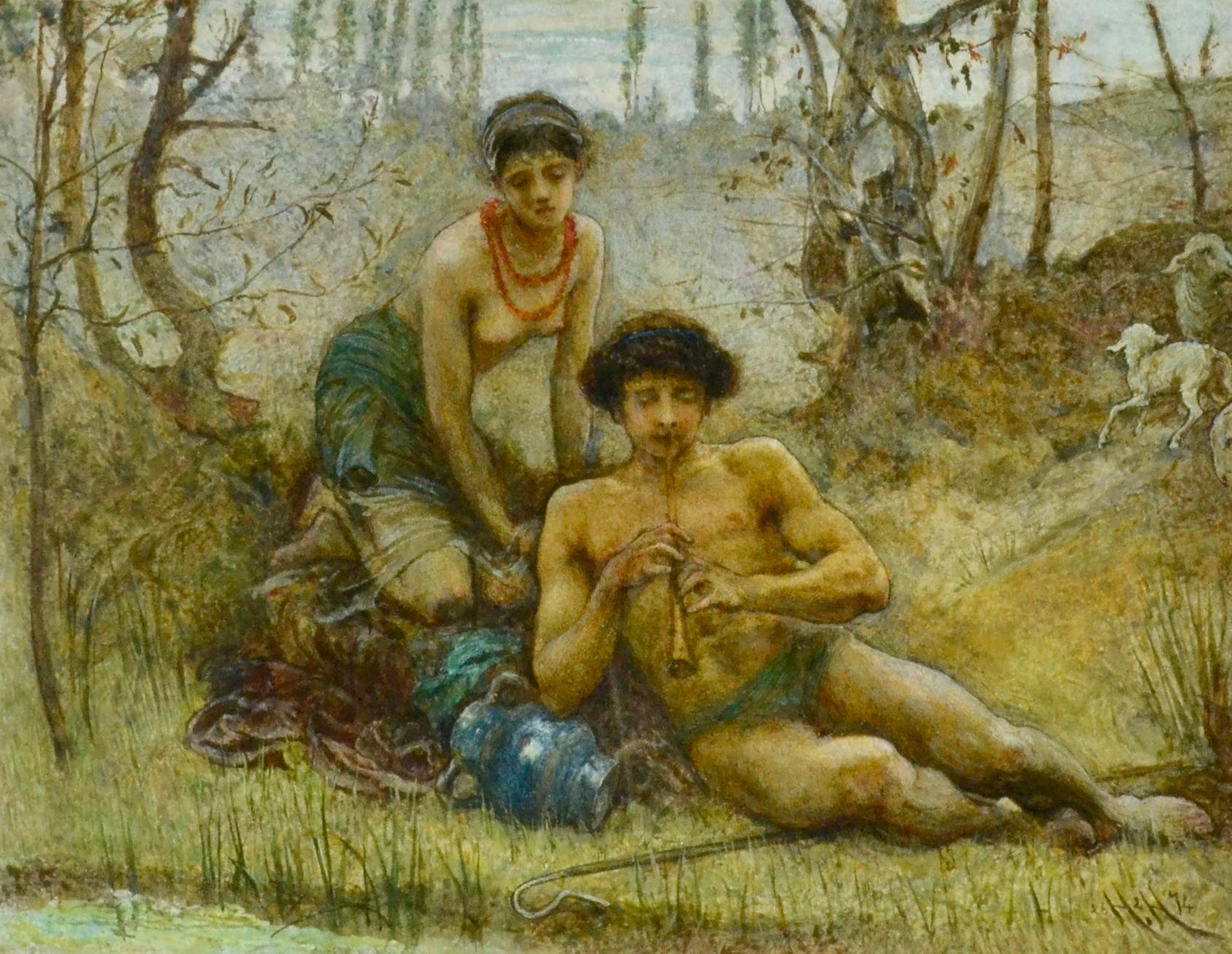
The Pipe
s of Pan - British Watercolour by Hubert von Herkomer
By Sir Hubert Von Herkomer R.A. RWS.
Located in London, GB
SIR HUBERT VON HERKOMER, RA, RWS
(1849-1914)
The Pipe’s of Pan
Signed with initials and dated 26/2/74
Watercolour and bodycolour on paper
17 by 22 cm., 6 ¾ by 8 ¾ in.
(frame size ...
Category
1870s Romantic Figurative Drawings and Watercolors
Materials
Watercolor
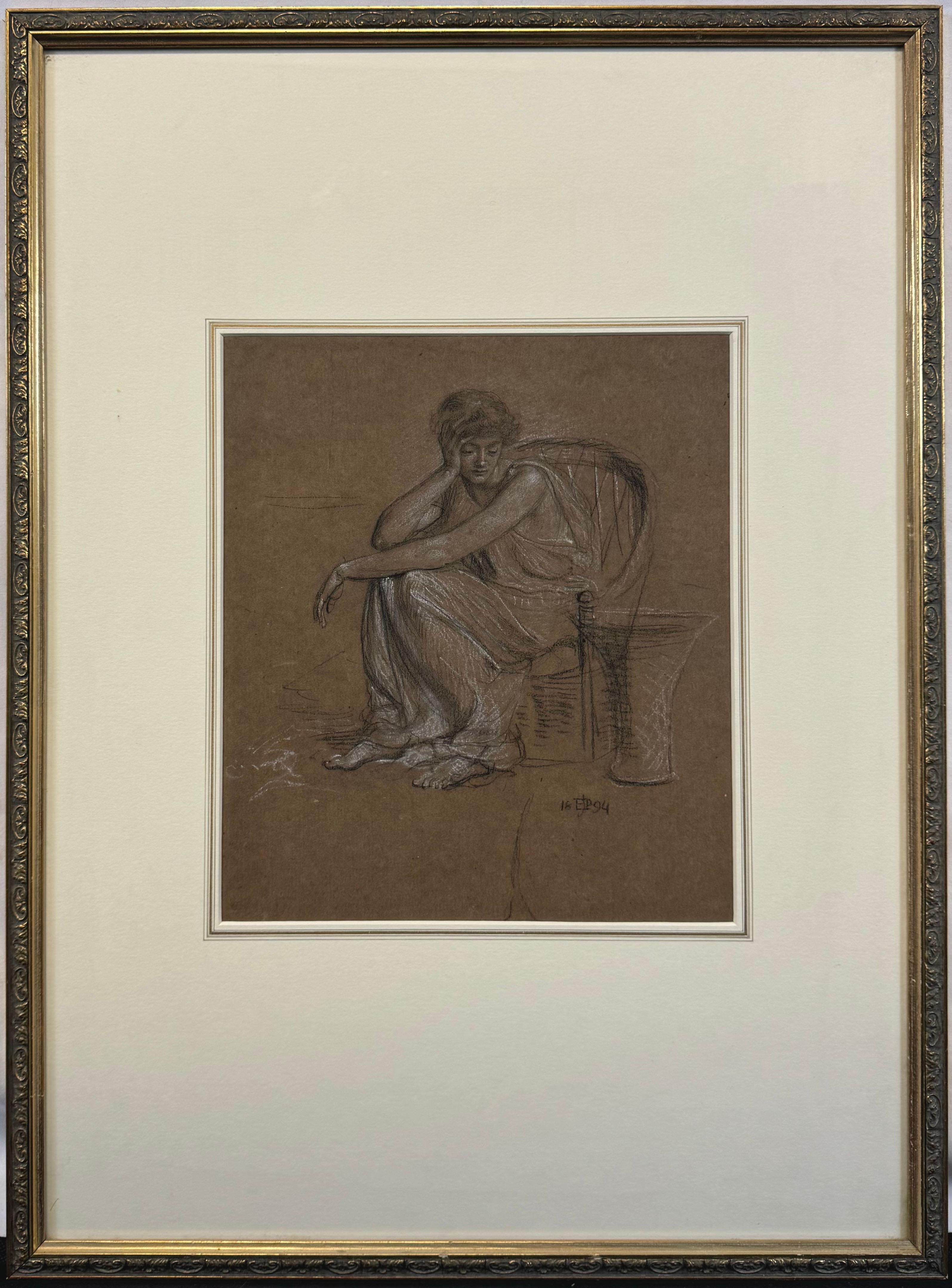
“Study for Neobule, 1894” Neoclassical Chalk Drawing British Signed 19th Century
By Edward John Poynter
Located in Yardley, PA
“Study for Neobule, 1894” by Sir Edward John Poynter (English, 1836-1919)
This exquisite 1894 study by Sir Edward John Poynter (1836–1919) serves as a preparatory drawing for his pa...
Category
1890s Aesthetic Movement Figurative Drawings and Watercolors
Materials
Paper, Chalk
Academic Study
Located in London, GB
Charcoal on paper
Signed by RA visitor Edwin Long and dated (lower right)
76cm × 57cm (88cm × 64cm framed)
Olivier studied at the Royal Academy Schools from 1881. He exhibited exten...
Category
Late 19th Century English School Figurative Drawings and Watercolors
Materials
Paper, Charcoal
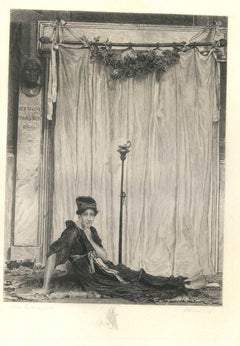
Egyptian - Original Etching on Parchment after Alma-Tadema by E. Romus
Located in Roma, IT
Image dimensions: 28.3x22 cm.
Egyptian is an original artwork realized by Edmond Romus in 19th century.
Black and white etching on parchment after Lawrence Alma-Tadema's painting re...
Category
Late 19th Century Modern Figurative Prints
Materials
Etching
Study for Battledore
Shuttlecock - British Aesthetic Movement drawing
By Albert Joseph Moore
Located in London, GB
ALBERT JOSEPH MOORE, ARWS
(1841-1893)
Study for Battledore & Shuttlecock
Signed with anthemion
Chalk on brown paper
27 by 13 cm., 10 ½ by 5 in.
(frame size 49 by 34.5 cm., 19 ¼ b...
Category
1870s Aesthetic Movement Figurative Drawings and Watercolors
Materials
Chalk