Tribal Figurative Drawings and Watercolors
to
2
5
1
2
Overall Width
to
Overall Height
to
6
2
2
1
1
5,282
3,474
599
396
271
261
243
219
165
162
50
49
49
28
6
2
8
5
4
3
2
2
2
2
1
1
1
1
1
6
5
4
2
2
4
2
6
Style: Tribal
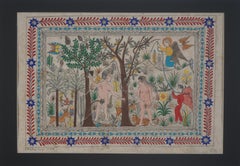
Illustration of the Garden of Eden- Amate Bark Drawing in Ink
Located in Soquel, CA
Illustration of the Garden of Eden done with Mexican Amate Bark Drawing in Ink
Vibrant illustration with Adam and Eve in the Garden of Eden by Cristino Florez Medina (Mexican, 1937-...
Category
Late 20th Century Tribal Figurative Drawings and Watercolors
Materials
India Ink, Handmade Paper
Corn Kachina, by Riley Sunrise, Quoyavema, Hopi, Kachina, Dancer, painting
Located in Santa Fe, NM
Corn Kachina, by Riley Sunrise, Quoyavema, Hopi, Kachina, Dancer, painting
Artist Signature - Riley Sunrise (1914-2006) Quoyavema “Another of the earlier Hopi artists, Riley Sunrise (Quoyavema) worked with Fred Kabotie and Waldo Mootzka in illustrating John Louw Nelson’s Rhythm for Rain. He is also known as Quoyavema or Kwayeshva, according to Nelson. His paintings are comparable to Fred Kabotie’s, with some of them showing more action and most of them revealing less detail. Sunrise is represented in the collections of the Denver Art Museum, Gilcrease Institute (Tulsa), and the Southwest Museum. The Museum of the American Indian in New York has an extensive collection of his paintings of native Hopi dances.” (Clara Lee Tanner: Southwest Indian...
Category
1940s Tribal Figurative Drawings and Watercolors
Materials
Paint, Paper
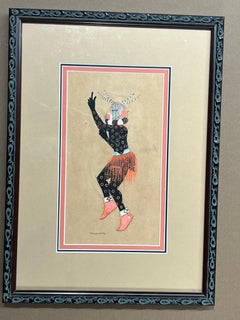
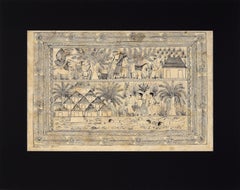
Illustration of a Village by the River - Amate Bark Drawing in Ink
Located in Soquel, CA
Illustration of a Village by the River - Amate Bark Drawing in Ink
Illustration with people in a village by Cristino Florez Medina (Mexican, 1937-2007). This piece is divided horizo...
Category
Late 20th Century Tribal Figurative Drawings and Watercolors
Materials
India Ink, Handmade Paper
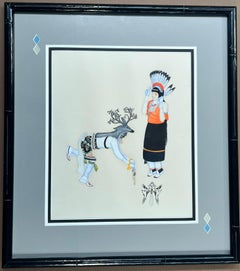
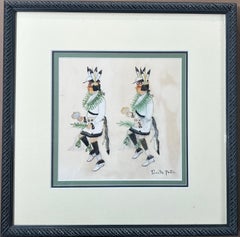
Deer Dance, painting by Tonita Pena, Santa Fe, Cochiti, Pueblo, male, female
Located in Santa Fe, NM
Deer Dance, painting by Tonita Pena, Santa Fe, Cochiti, Pueblo, male, female
Tonita Peña (born 1893 in San Ildefonso, died 1949 in Kewa Pueblo, New Mexico) was born as Quah Ah (meaning white coral beads) but also used the name Tonita Vigil Peña and María Antonia Tonita Peña. Peña was a renowned Pueblo artist, specializing in pen and ink on paper embellished with watercolor. She was a well-known and influential Native American artist and art teacher of the early 1920s and 1930s.
Tonita Peña was born on May 10, 1893, at San Ildefonso Pueblo, to Ascensión Vigil Peña and Natividad Peña of San Ildefonso Pueblo, New Mexico. When she was 12, her mother and younger sister died, as a result of complications due to the flu. Her father was unable to care for her and she was taken to Cochití Pueblo and was brought up by her aunt Martina Vigil Montoya, a prominent Cochití Pueblo potter. Peña attended St. Catherine Indian School in Santa Fe.
Edgar Lee Hewett, an anthropologist involved in supervising the nearby Frijoles Canyon excavations (now Bandelier National Monument) was instrumental in developing the careers of several San Ildefonso “self-taught” artists including Tonita Peña. Hewett purchased Peña's paintings for the Museum of New Mexico and supplied her with quality paint and paper. Peña began gaining more notoriety by the end of the 1910s selling an increasing amount of her work to collectors and the La Fonda Hotel. Much of this early work was done of Pueblo cultural subject matter, in a style inspired by historic Native American works, however, her use of an artist's easel and Western painting mediums gained her acceptance among her European-American contemporaries in the art world. At the age of 25, she exhibited her work at museums and galleries in the Santa Fe and Albuquerque area.
In the early 1920s, Tonita did not know how much her painting sold for at the Museum of New Mexico, so she wrote letters to the administrators because a local farmer was worried that she got paid too little.
In the 1930s Peña was an instructor at the Santa Fe Indian School and at the Albuquerque Indian School and the only woman painter of the San Ildefonso Self-Taught Group, which included such noted artists as Alfonso Roybal, Julian Martinez, Abel Sánchez (Oqwa Pi), Crecencio Martinez, and Encarnación Peña. As children, these artists attended San Ildefonso day school which was part of the institution of the Dawes Act of 1887, designed to indoctrinate and assimilate Native American children into mainstream American society.
In 1931, Tonita Peña exhibited at the Exposition of Indian Tribal Arts which was presented at the Grand Central Art Galleries in New York City. Works from this exhibition were shown at the 1932 Venice Biennial. That year is the only time Native American artists have shown in the official United States pavilion at that biennial, and Tonita Peña's paintings were part of that exhibition.[1 Her painting Basket Dance, that had shown in the Venice Biennial was acquired by the Whitney Museum of American Art in New York for $225. This was the highest price paid up to this time for a Pueblo painting...
Category
1940s Tribal Figurative Drawings and Watercolors
Materials
Paint, Paper
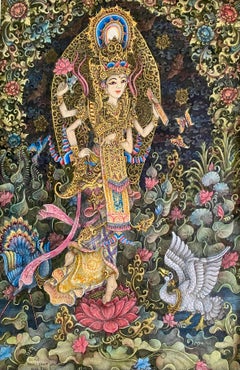
“Saraswati”
Located in Southampton, NY
Very finely executed ink and watercolor painting depicting the Balinese goddess, Saraswati. Signed lower left “De Mus, keliki-Kawan, Ubud, Bali”. The ...
Category
1970s Tribal Figurative Drawings and Watercolors
Materials
Ink, Watercolor, Archival Paper

$1,200 Sale Price
33% Off
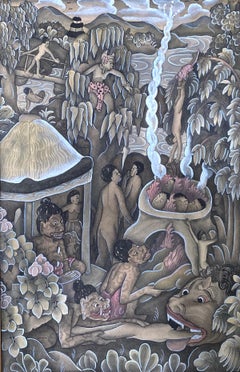
“Untitled”
Located in Southampton, NY
Provocative watercolor, gouache on paper Balinese tribal artwork. Not signed. Circa 1950. Condition is very good. No issues. Finely painted and meticulously detailed artwork of a ta...
Category
1950s Tribal Figurative Drawings and Watercolors
Materials
Paper, Watercolor, Gouache
$750 Sale Price
46% Off
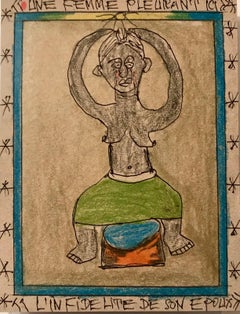
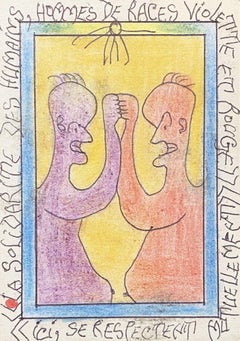
No title
Located in Tel Aviv - Jaffa, IL
Ballpoint Pens, Crayons And Colored Pencil On Cardboard
Unique piece
Hand signed and dated on the reverse
Category
Early 2000s Tribal Figurative Drawings and Watercolors
Materials
Ink, Cardboard, Pen, Color Pencil
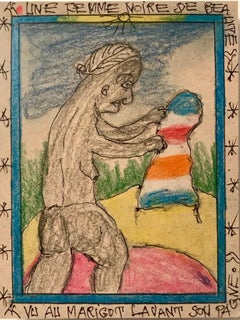
No title
Located in Tel Aviv - Jaffa, IL
Ballpoint Pens, Crayons And Colored Pencil On Cardboard
Unique piece
Hand signed and dated on the reverse
Category
Early 2000s Tribal Figurative Drawings and Watercolors
Materials
Ink, Pen, Color Pencil, Cardboard
Related Items
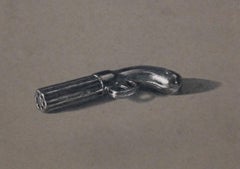
Gun from Clue
By A.J. Fries
Located in Buffalo, NY
An original mixed media drawing by American artist A.J. Fries.
Category
21st Century and Contemporary Tribal Figurative Drawings and Watercolors
Materials
Gouache, Graphite, Paper
Fine 1700
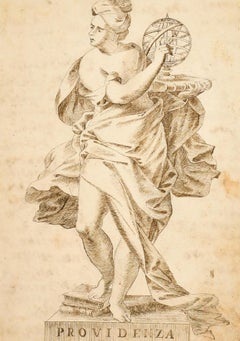
s Italian Old Master Ink
Wash Drawing Roman Allegorical Providenza
Located in Cirencester, Gloucestershire
'Providenza'
Italian School, 18th century
ink and wash drawing on paper, framed within a light oak wood frame (behind glass)
image size: 10.5 x 7 inches
overall framed: 17 x 13 inche...
Category
18th Century Tribal Figurative Drawings and Watercolors
Materials
Ink, Watercolor, Archival Paper
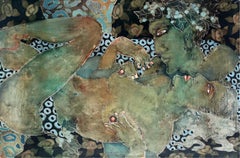
Tender words - XX Century, Mixed Media Figurative Painting, Nude, Couple
Located in Warsaw, PL
Gabryela Wasowicz is a Polish painter born in 1947. She studied at the Academy of Fine Arts of Warsaw and then at the Gerrit Rietveld Akademie in Amsterdam. Once she graduated in 197...
Category
1980s Tribal Figurative Drawings and Watercolors
Materials
Paper, Pastel, Watercolor, Gouache
$2,281
H 27.56 in W 39.38 in
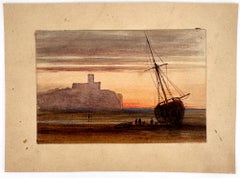
Schooner beached on the moors at sunset, Nothe Fort in the distance, Dorset.
Located in Middletown, NY
Watercolor on cream wove paper mounted to light weight card stock, 3 3/4 x 5 1/2 inches (94 x 138 mm), the full sheet. In good condition with minor uniform toning.
Sophia Beale was...
Category
Late 19th Century Tribal Figurative Drawings and Watercolors
Materials
Watercolor, Board, Handmade Paper
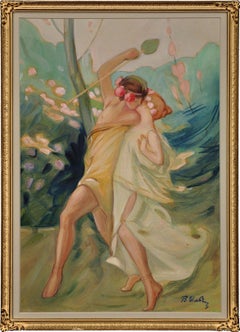
Framed Art Nouveau Period Painting A Greek Love Affair Theseus And Ariadne
Located in Sutton Poyntz, Dorset
Follower of Antoine Calbet.
French ( b.1860 - d.1944 ).
Theseus and Ariadne, Circa 1890 - 1910.
Mixed Media.
Watercolour, Gouache & Pastel
Image size 16.5 inches x 11.2 inches ( 42cm...
Category
Early 1900s Tribal Figurative Drawings and Watercolors
Materials
Paper, Pastel, Watercolor, Gouache
$1,783
H 18.51 in W 13.39 in D 0.89 in
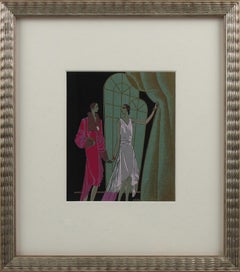
Original French Art Deco Gouache Illustration Drawing by J. Hilly
Located in Atlanta, GA
An original Art Deco illustration hand-painted with ink and gouache on paper. The drawing features two elegant women with large windows and drapery in the background. This image was ...
Category
1930s Tribal Figurative Drawings and Watercolors
Materials
Paper, Ink, Gouache
$500
H 15.57 in W 12 in D 2 in
Fine 1700
s Italian Old Master Ink
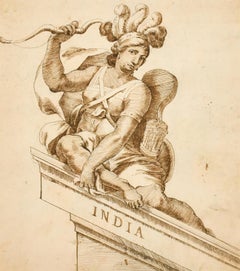
Wash Drawing Roman Allegorical India
Located in Cirencester, Gloucestershire
'India'
Italian School, 18th century
ink and wash drawing on paper, framed within a light oak wood frame (behind glass)
image size: 10.5 x 7 inches
overall framed: 17 x 13 inches
con...
Category
18th Century Tribal Figurative Drawings and Watercolors
Materials
Ink, Watercolor, Archival Paper
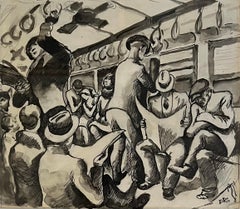
NYC Subway Mid 20th Century American Scene Social Realism WPA Modern 1930s
Located in New York, NY
NYC Subway Riders Mid 20th Century American Scene Social Realism WPA Modern 1930s
Daniel Celentano (1902 - 1980)
Subway Scene, 1930s
8 x 9 inches
Ink and wash on paper
Singed lower ...
Category
1930s Tribal Figurative Drawings and Watercolors
Materials
Paper, Ink, Gouache
Fenzoni, Painting AND preparatorial Drawing, John the Baptist, Italy Renaissance
By Ferrau Fenzoni
Located in Greven, DE
The painting and the preparatory drawing are offered together.
Provenance
Private collection, Germany, Trier, c. 1980- 2013
Saint John the Baptist
Brown ink and wash over red chalk on oatmeal paper
31 x 20.5 cm
Inscribed: „Ferrau Fenzonio da Faenza invt. esque … imp. da Fran. Villamena …“.
bears the collector's mark of Henry Scipio Reitlinger (1882-1950; Lugt 2274a) on a tiny label glued to the verso
On the reverse is a partial drawing of a Pieta, pricked for transfer.
Provenance
New York, Doyle, 14. October 2015, No. 6
The painting and the preparatory drawing resemble the composition of an engraving after Ferraù Fenzoni by Francesco Villamena. Drawing, engraving and painting are almost identical, except for minor differences. Even the measurements nearly correspond: painting (32 x 25,5 cm), drawing (30 x 20,5 cm), engraving (31,1 x 23,5 cm).
Dr. Guiseppe Scavizzi confirmed the attribution of the present panting to Fenzoni and he dates it to c. 1590.
The inscription on the drawing reads “Ferrau Fenzonio da Faenza invt. esque. . . imp. da Fran: Villamena . . .”. The engraving’s inscription also lists place and date “Ferra Fensionius inventor/F. Villamoena sculpsit Rome/Aspectu fruitur… antra puer/cum Privilegio… 1613”.
Interestingly, the engraving is not mirrored as it is in most printing processes. Painting, drawing and engraving are not reversed but the same. It is remarkable to note that there are further paintings by Fenzoni which were engraved in the same order and not reverted. They also show strong parallels regarding the compositions and the measurements (see for example “Deposition of Christ” ).
Ferraù Fenzoni was an Italian painter mainly active in Todi. He is also called Il Faenzone after his birthplace (Faenza). He apprenticed in Rome during the papacy of Gregory XIII and contributed to numerous fresco cycles under pope Sixtus V, such as the Loggia della Benedizioni in the Lateran Palace, the frescoes on the walls and vaults of the Scala Santa of the adjacent Basilica of San Giovanni in Laterano, and the decoration in the Sistine library. His expressive canvases straddle the styles of Mannerism and Baroque. In 1594, he moved to Todi. A “Last Judgement” by him is housed in the cathedral of Todi. He returned to Faenza in 1599, where he decorated chapels in the cathedral from 1612 to 1616. In 1622, he completed a “Deposition”, now in the local Pinacoteca. In 1640, Fenzoni was named “cavaliere dello speron d’oro” by Cardinal Colonna and, on 25th April 1634, he was nominated vicar and “castellano of Granarolo”.
Fenzoni‘s style is characterized by a mixture of the Mannerism of the Northern Netherlands and the Italian Baroque.
Saint John the Baptist, Old Master, 17th Century, By Fenzoni, Religious Scene, Rome Art...
Category
16th Century Tribal Figurative Drawings and Watercolors
Materials
Canvas, Oil, Handmade Paper

Ferrau FenzoniFenzoni, Painting AND preparatorial Drawing, John the Baptist, Italy Renaissance, 1590
$28,821 Sale Price
25% Off
H 12.21 in W 8.08 in
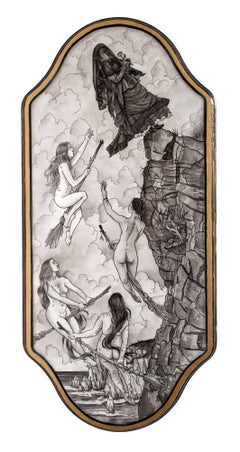
Fall to Grace
Located in Philadelphia, PA
"Fall to Grace" is an original ink and watercolor painting on paper mounted to wood by artist Robert Kraiza measuring 19in height x 9in width.
Artist Statement // In my work I invoke a whimsical world inspired by Victorian and Edwardian eras. To me they represent a romantic time period that has roots that extend directly into the modern world, both good and bad. The customs and aesthetics of the period are both fascinating and breathtaking but a vast portion of the population was victim to subjugation. It has since been eradicated on paper but still permeates to this day. I am exploring an imagined supernatural world hidden just out of sight where these woman could escape. This is an evolution from my earlier work set in the same time period with a continuous thread of humans and their animal companions.
Through witchcraft these women find strength in their abilities and each other to leave the oppressive world they inhabit behind and escape to the woods to their Covendom, the boundary that defines the territory of their coven. They shed their customs, their corsets, and their concerns at the edge of the forest and gather among the trees to explore their magical potential with their familiars at the side.
This body of work is exploring multiple media with a consistent theme and setting; combining watercolor painting, pen and ink illustrations, and graphite drawings. All pieces are created in monochrome on hot press watercolor paper mounted on wood with a gold painted border reminiscent of daguerreotype frames. Watercolor allows me to achieve results ranging from soft ethereal layered washes similar to oil glazes to precise minute details I include in all of my works.
Bio // ROBERT KRAIZA (pronounced: cry-zuh) is an illustrator and fine artist who lives and works in Philadelphia, Pennsylvania. He studied Media Arts and Animation at the Art Institute of Philadelphia. Interested in many media, he often paints in monochrome watercolor on a small scale, inspired by the Victorian era and whimsical dreams in both his art and personal aesthetic. Depicting fantasy worlds from the hidden life of nineteenth century witches to miniature children...
Category
21st Century and Contemporary Tribal Figurative Drawings and Watercolors
Materials
Ink, Watercolor, Archival Paper
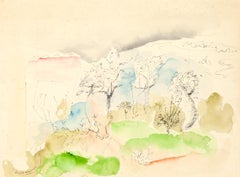
Landscape - Drawing in Ink and Watercolor and on paper by Gérard Guyomard
Located in Roma, IT
Landscape is an original drawing in watercolor and China ink on paper realized by the French contemporary artist Gérard Guyomard.
Hand-signed on the l...
Category
20th Century Tribal Figurative Drawings and Watercolors
Materials
India Ink, Watercolor
$480
H 13.78 in W 10.24 in D 0.04 in
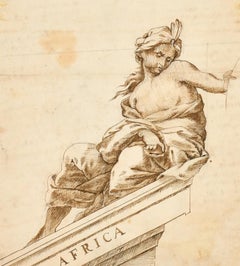
Fine 1700
s Italian Old Master Ink
Wash Drawing Roman Allegorical Africa
Located in Cirencester, Gloucestershire
'Africa'
Italian School, 18th century
ink and wash drawing on paper, framed within a light oak wood frame (behind glass)
image size: 10.5 x 7 inches
overall framed: 17 x 13 inches
co...
Category
18th Century Tribal Figurative Drawings and Watercolors
Materials
Ink, Watercolor, Archival Paper
$545 Sale Price
20% Off
H 17 in W 13 in
Previously Available Items
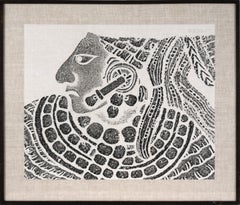
Bonampak, Sacerdote, Stela 1 (VI-VIII D.C.) Original Rubbing of Mayan Carving
Located in Soquel, CA
Bonampak, Sacerdote, Stela 1 (VI-VIII D.C.) Original Rubbing of Mayan Carving
Bold rubbing of a Mayan Stela by Nicolette (20th Century). This piece is a rubbing from Stela 1 at Bona...
Category
1970s Tribal Figurative Drawings and Watercolors
Materials
India Ink, Mulberry Paper
H 29.5 in W 33.75 in D 1.25 in
Pueblo Dancers, painting, by Tonita Pena, Cochiti, Pueblo, Santa Fe, Native Amer
Located in Santa Fe, NM
Pueblo Dancers, painting, by Tonita Pena, Cochiti, Pueblo, Santa Fe, Native Amer
Tonita Peña (born 1893 in San Ildefonso, died 1949 in Kewa Pueblo, New Mexico) was born as Quah Ah (meaning white coral beads) but also used the name Tonita Vigil Peña and María Antonia Tonita Peña. Peña was a renowned Pueblo artist, specializing in pen and ink on paper embellished with watercolor. She was a well-known and influential Native American artist and art teacher of the early 1920s and 1930s.
Tonita Peña was born on May 10, 1893, at San Ildefonso Pueblo, to Ascensión Vigil Peña and Natividad Peña of San Ildefonso Pueblo, New Mexico. When she was 12, her mother and younger sister died, as a result of complications due to the flu. Her father was unable to care for her and she was taken to Cochití Pueblo and was brought up by her aunt Martina Vigil Montoya, a prominent Cochití Pueblo potter. Peña attended St. Catherine Indian School in Santa Fe.
Edgar Lee Hewett, an anthropologist involved in supervising the nearby Frijoles Canyon excavations (now Bandelier National Monument) was instrumental in developing the careers of several San Ildefonso “self-taught” artists including Tonita Peña. Hewett purchased Peña's paintings for the Museum of New Mexico and supplied her with quality paint and paper. Peña began gaining more notoriety by the end of the 1910s selling an increasing amount of her work to collectors and the La Fonda Hotel. Much of this early work was done of Pueblo cultural subject matter, in a style inspired by historic Native American works, however, her use of an artist's easel and Western painting mediums gained her acceptance among her European-American contemporaries in the art world. At the age of 25, she exhibited her work at museums and galleries in the Santa Fe and Albuquerque area.
In the early 1920s, Tonita did not know how much her painting sold for at the Museum of New Mexico, so she wrote letters to the administrators because a local farmer was worried that she got paid too little.
In the 1930s Peña was an instructor at the Santa Fe Indian School and at the Albuquerque Indian School and the only woman painter of the San Ildefonso Self-Taught Group, which included such noted artists as Alfonso Roybal, Julian Martinez, Abel Sánchez (Oqwa Pi), Crecencio Martinez, and Encarnación Peña. As children, these artists attended San Ildefonso day school which was part of the institution of the Dawes Act of 1887, designed to indoctrinate and assimilate Native American children into mainstream American society.
In 1931, Tonita Peña exhibited at the Exposition of Indian Tribal Arts which was presented at the Grand Central Art Galleries in New York City. Works from this exhibition were shown at the 1932 Venice Biennial. That year is the only time Native American artists have shown in the official United States pavilion at that biennial, and Tonita Peña's paintings were part of that exhibition.[1 Her painting Basket Dance, that had shown in the Venice Biennial was acquired by the Whitney Museum of American Art in New York for $225. This was the highest price paid up to this time for a Pueblo painting...
Category
1940s Tribal Figurative Drawings and Watercolors
Materials
Paint, Paper
No title
Located in Tel Aviv - Jaffa, IL
Ballpoint Pens, Crayons And Colored Pencil On Cardboard
Unique piece
Hand signed and dated on the reverse
Category
Early 2000s Tribal Figurative Drawings and Watercolors
Materials
Ink, Cardboard, Pen, Color Pencil
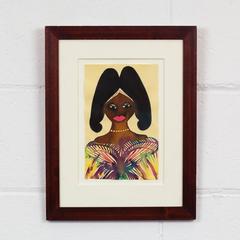
Untitled (Royal Portrait)
By Chris Ofili
Located in Toronto, Ontario
Chris Ofili's Royal Portraits are the most iconic and popular works from his fascinating oeuvre.
They highlight an important element in his work; the celebration of Afrocentric li...
Category
21st Century and Contemporary Tribal Figurative Drawings and Watercolors
Materials
Watercolor
Tribal figurative drawings and watercolors for sale on 1stDibs.
Find a wide variety of authentic Tribal figurative drawings and watercolors available for sale on 1stDibs. Works in this style were very popular during the 21st Century and Contemporary, but contemporary artists have continued to produce works inspired by this movement. Frequently made by artists working with Paint, and Paper and other materials, all of these pieces for sale are unique and have attracted attention over the years. Not every interior allows for large Tribal figurative drawings and watercolors, so small editions measuring 5.12 inches across are also available. Prices for figurative drawings and watercolors made by famous or emerging artists can differ depending on medium, time period and other attributes. On 1stDibs, the price for these items starts at $750 and tops out at $2,700, while the average work sells for $1,075.