Items Similar to Planting (Spring Plowing) - Watercolor Landscape Painting with Figures, c. 1939
Video Loading
Want more images or videos?
Request additional images or videos from the seller
1 of 14
Thomas Hart BentonPlanting (Spring Plowing) - Watercolor Landscape Painting with Figures, c. 1939c. 1939-1940
c. 1939-1940
$475,000
£355,075.03
€409,586.61
CA$665,000.48
A$702,682.95
CHF 377,906.61
MX$8,412,421.95
NOK 4,734,727.80
SEK 4,336,323.45
DKK 3,059,133
About the Item
"Planting (Spring Plowing)", a vibrant watercolor and graphite on paper by Thomas Hart Benton, circa 1939-40, embodies the artist's signature Regionalist style. The work depicts a rural scene where two figures toil in a field, one guiding a plow pulled by a donkey, the other carrying a bucket, sowing seeds under a bright, cloud-streaked sky. The rolling, richly hued earth, painted in warm browns and oranges, contrasts with the lush green foliage and distant trees, while a small structure sits at the horizon, grounding the composition in everyday life. Benton's dynamic lines and fluid brushwork capture the rhythm of labor and the vitality of spring, infusing the scene with a sense of movement and purpose. The reverse image of this artwork was transformed into a lithograph in 1939, with notable examples housed in prestigious museum collections including the Smithsonian American Art Museum, Nelson Atkins Museum of Art, Minneapolis Institute of Art, and the Chazen Museum of Art. This print adaptation underscores the piece's cultural significance, reflecting Benton's influence on American art during the Depression era and the resonance of this particular subject celebrating the resilience and harmony of its people with nature. Created with a keen eye for detail and a deep connection to the land, "Planting (Spring Plowing)" showcases Benton's ability to blend realism with his hallmark muscular style. It is accompanied by two letters written by Thomas Hart Benton to Lon Ramsey, its original owner, and bears an inscription by the artist on the verso.
Provenance:
Lon and Wilmia Ramsey, Winnetka, Illinois, by 1968
Private Collection, by descent from above
Private Collection, Kansas
Exhibition:
New York, Associated American Artists Galleries, Thomas Benton, April 9 - May 3, 1941, no. 12
West Palm Beach, Florida, Ann Norton Sculpture Gardens, Figurative Masters of the Americas, January 4 – February 12, 2023
Thomas Hart Benton was an American-born painter best known for his depictions of the everyday life of the average, working-class American. Benton’s early travels and studies allowed him to meet and study with artists such as Diego Rivera, whose influence can be seen in Benton’s murals, and Stanton MacDonald-Wright, whose influence is evident in Benton’s Synchromist style. During WWI, Benton served in the Navy, and was instructed to give accurate representations of the warship’s camouflage markings, and of the activity on the docks. The need for accuracy in that work, which he felt was crucial to him as an American and as an artist, influenced his style in his later murals. He declared himself an enemy of Modernism and adopted his naturalistic and representational style, which is now known as Regionalism. Some of his works sparked controversy because he painted historical events or political undercurrents that some did not want publicized. Later in life, he taught at the Kansas City Art Institute, and mentored artists such as Jackson Pollock, until he was dismissed for his controversial political views.
- Creator:Thomas Hart Benton (1889-1975, American)
- Creation Year:c. 1939-1940
- Dimensions:Height: 18 in (45.72 cm)Width: 21.75 in (55.25 cm)
- Medium:
- Movement Style:
- Period:
- Condition:
- Gallery Location:Palm Desert, CA
- Reference Number:Seller: 39755.b1stDibs: LU9317243722
Thomas Hart Benton
Thomas Hart Benton was born in Neosho, Missouri on April 15, 1889. Even as a boy, he was no stranger to the "art of the deal" or to the smoke-filled rooms in which such deals were often consummated. His grandfather had been Missouri's first United States Senator and served in Washington for thirty years. His father, Maecenas Benton, was United States Attorney for the Western District of Missouri under Cleveland and served in the United States House of Representatives during the McKinley and Theodore Roosevelt administrations. Benton's brother, Nat, was prosecutor for Greene County, Missouri, during the 1930s. As soon as he could walk, Benton traveled with his father on political tours. There he learned the arts of chewing and smoking, and while the men were involved in their heated discussions, Benton delighted in finding new cream colored wallpaper on the staircase wall, at the age of six or seven, and drew in charcoal his first mural, a long multi-car freight train. As soon as he was eighteen, even though his father wanted him to study law, Benton left for Chicago where he studied at the Art Institute during the years 1907 and 1908. He continued his studies in Paris, where he learned delicious wickedness, aesthetic and otherwise. Once back home, he became the leader of the Regionalist School, the most theatrical and gifted of the 1930s muralists and as Harry Truman described him,"the best damned painter in America." Detractors said that Benton was "a fascist, a communist, a racist and a bigot"; the ingenious structure, powerful use of modeling and scale and the high-colored humanity of the murals and easel paintings are retort enough. He was a dark, active dynamo, only 5 ft., 3 1/2 in. tall. He was outspoken, open, charmingly profane; he had a great mane of hair and a face the texture of oak bark. He wore rumpled corduroy and flannel, and walked with the unsteady swagger of a sailor just ashore. He poured a salwart drink, chewed on small black cigars and spat in the fire. Benton was once described as the "churlish dean of regionalist art." If you listened to a variety of art authorities, you would find them equally divided between Harry Truman's assessment of Benton as "the best damned painter in America" and Hilton Kramer who proclaimed Benton "a failed artist." The East Coast art establishment tended to regard Benton as memorable for one reason only: he was the teacher of Jackson Pollock. Benton was married in 1922 to Rita, a gregarious Italian lady, and they had a daughter and a son. At the height of his fame in the 1940s, Benton bungled the buy-out he was offered by Walt Disney and went his own way, completing his last mural in 1975 in acrylics the year of his death. He died in 1975.
About the Seller
4.8
Recognized Seller
These prestigious sellers are industry leaders and represent the highest echelon for item quality and design.
Established in 1996
1stDibs seller since 2011
115 sales on 1stDibs
Typical response time: 1 hour
- ShippingRetrieving quote...Shipping from: Palm Desert, CA
- Return Policy
More From This Seller
View AllSea Movement, Maine - Watercolor Waterscape Painting, Maine Coast, 1937
By John Marin
Located in Palm Desert, CA
John Marin's "Sea Movement, Maine" (1937) exemplifies his dynamic approach to watercolor, a medium he transformed into one of the most expressive vehicles of early American modernism...
Category
Mid-20th Century American Modern Landscape Drawings and Watercolors
Materials
Paper, Watercolor
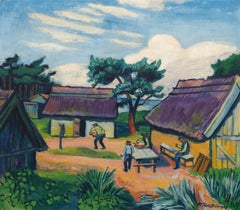
Alte Fischerhutten - Expressionist Oil Painting of Fisherman’s Village, 1949
By Max Pechstein
Located in Palm Desert, CA
Alte Fischerhütten (1949) by Max Pechstein is an oil on canvas in which the artist transforms a humble cluster of weathered fishing huts into a study of light, form, and atmosphere. Broad, rhythmic brushstrokes delineate the worn timbers and thatched roofs, while a sky streaked with lavender and rose imbues the scene with a quiet, almost meditative luminosity. Pechstein's bold outlines and flattened perspective are tempered by a late-career restraint, allowing the simple geometry of dunes, huts, and sea to resonate with an almost timeless calm. The artwork is signed lower right, "HMPechstein 1949" and signed verso, "Alte Fischerhütten 1949 HMPechstein”
Provenance:
Private Collection, Europe
Lempertz, Cologne, June 15, 1966, lot 531
Selected Artists Galleries, New York, acquired by 1970
Private Collection, New York, acquired from the above
Private Collection, by descent from above
Phillips, New York, Wednesday, November 15, 2023, lot 123
Private Collection, acquired from the above
Literature:
Aya Soika, Max Pechstein The Catalgoue raisonne of oil paintings, Volume II 1919–1954, Munich, 2011, no. 1949/12, p. 490, illustrated
Hermann Max Pechstein was born on December 31, 1881, in Zwickau, into a working-class family headed by his father, a textile-mill craftsman. Drawn to art early on, he apprenticed as a decorative painter from 1896 to 1900 before enrolling at Dresden’s School of Applied Arts and, from 1902, studying under Otto Gussmann at the Royal Academy of Fine Arts. His academic grounding—unique among his future peers—laid a solid foundation for the bold, expressive work that would follow.
In 1906 Erich Heckel invited Pechstein to join Die Brücke, the pioneering Expressionist collective, and he quickly became one of its most active members. Exposure to ethnographic wood carvings in Dresden in 1905 spurred his first woodcuts, and travels to Italy (1907) and Paris (1908)—where he befriended the Fauvist Kees van Dongen—expanded his palette and compositional daring. After relocating to Berlin in 1908, he co-founded the New Secession in 1910, serving as its chairman and gaining acclaim for richly colored prints inspired by Van Gogh, Matisse, and the Fauves.
With the outbreak of World War I, Pechstein’s peripatetic life took him from internment in Japan to service on the Western Front in 1916. In the revolution’s aftermath, he aligned with radical socialist art...
Category
Mid-20th Century Expressionist Landscape Paintings
Materials
Canvas, Oil
Study For Three Sisters - Figurative Mixed Media Drawing on Paper, 1954
By Balthus (Balthasar Klossowski de Rola)
Located in Palm Desert, CA
"Study for Three Sisters," a 1954 mixed media drawing by Balthus, offers an intimate glimpse into the artist's preliminary creative process. Executed in pencil with subtle blue water...
Category
Mid-20th Century Impressionist Figurative Drawings and Watercolors
Materials
Paper, Mixed Media

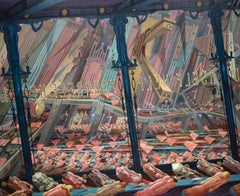
American Street Scene
By Irving Norman
Located in Palm Desert, CA
A painting by Irving Norman. "American Street Scene" is a macabre social surrealism city scape, oil on canvas in a bold palette of reds, blues, and yellows by artist Irving Norman. T...
Category
Mid-20th Century Post-War Figurative Paintings
Materials
Canvas, Oil
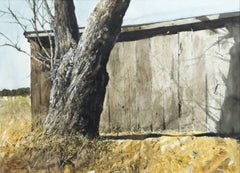
Tree Trunk and Barn
By Gregory Sumida
Located in Palm Desert, CA
A watercolor by Gregory Sumida. "Tree Trunk and Barn" is a watercolor on pressed board executed in earthy browns, yellows, whites and blues and depicting a bare branched, tree trunk ...
Category
1970s American Realist Landscape Drawings and Watercolors
Materials
Watercolor, Board
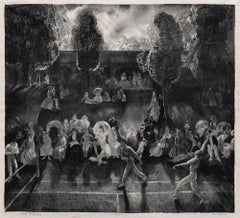
Tennis (Tennis Tournament)
By George Wesley Bellows
Located in Palm Desert, CA
A lithograph by George Bellows. “Tennis (Tennis Tournament)” is a realistic lithograph on paper in black and white by American Realist, George Bellows. Bellows’ depictions of sportin...
Category
1920s American Realist Landscape Prints
Materials
Lithograph
You May Also Like
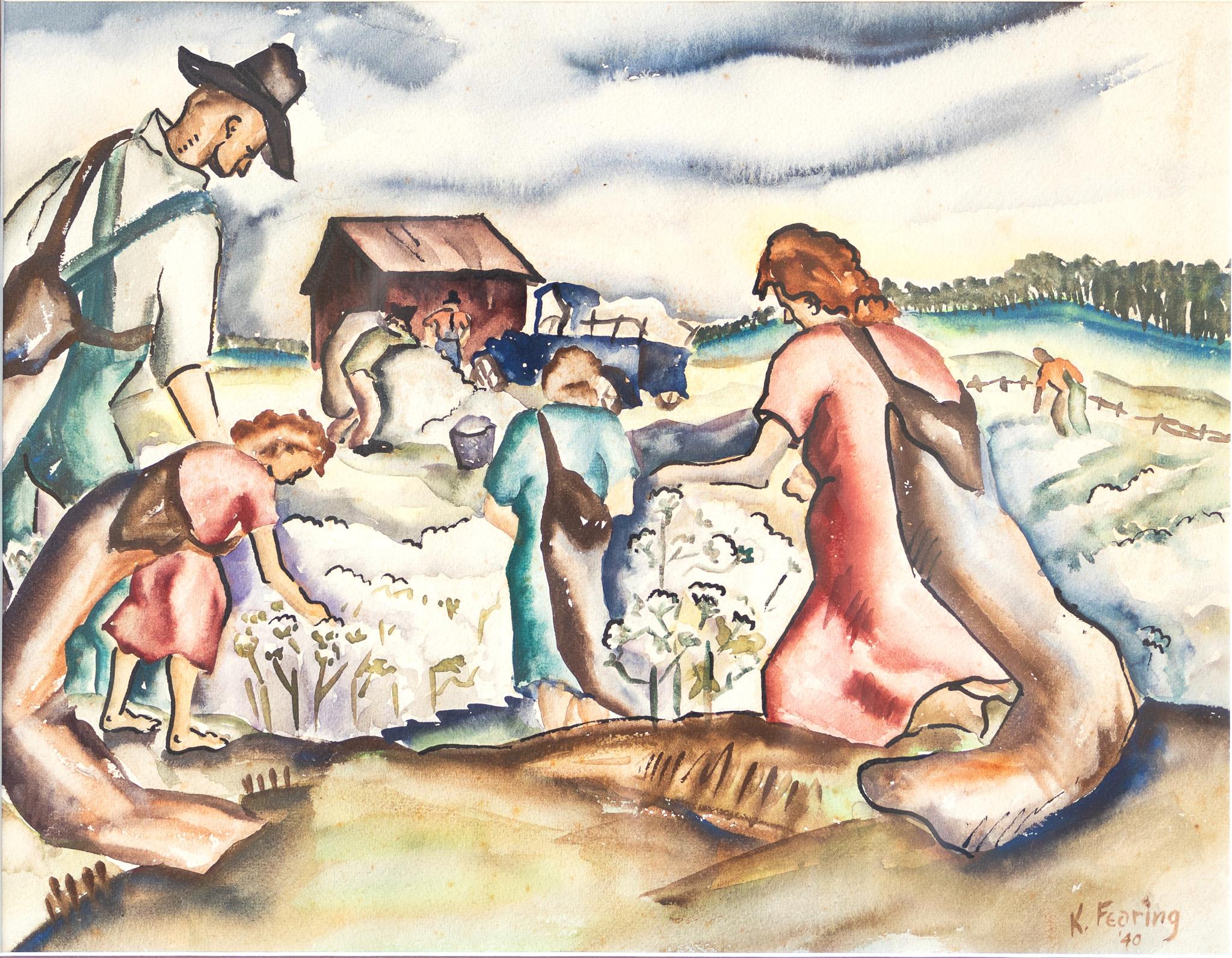
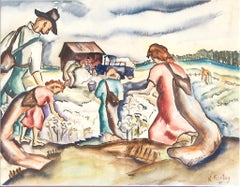
"Sharecroppers" Watercolor Scene of a Family Laborers Working in a Cotton Field
By Kelly Fearing
Located in Austin, TX
Watercolor on Paper
Page Size: 14 x 17 in.
Frame Size: 22.5 x 26.5 in.
Signed, bottom right: "K. Fearing '40"
This watercolor painting from 1940 ...
Category
1940s American Realist Figurative Drawings and Watercolors
Materials
Watercolor, Archival Paper
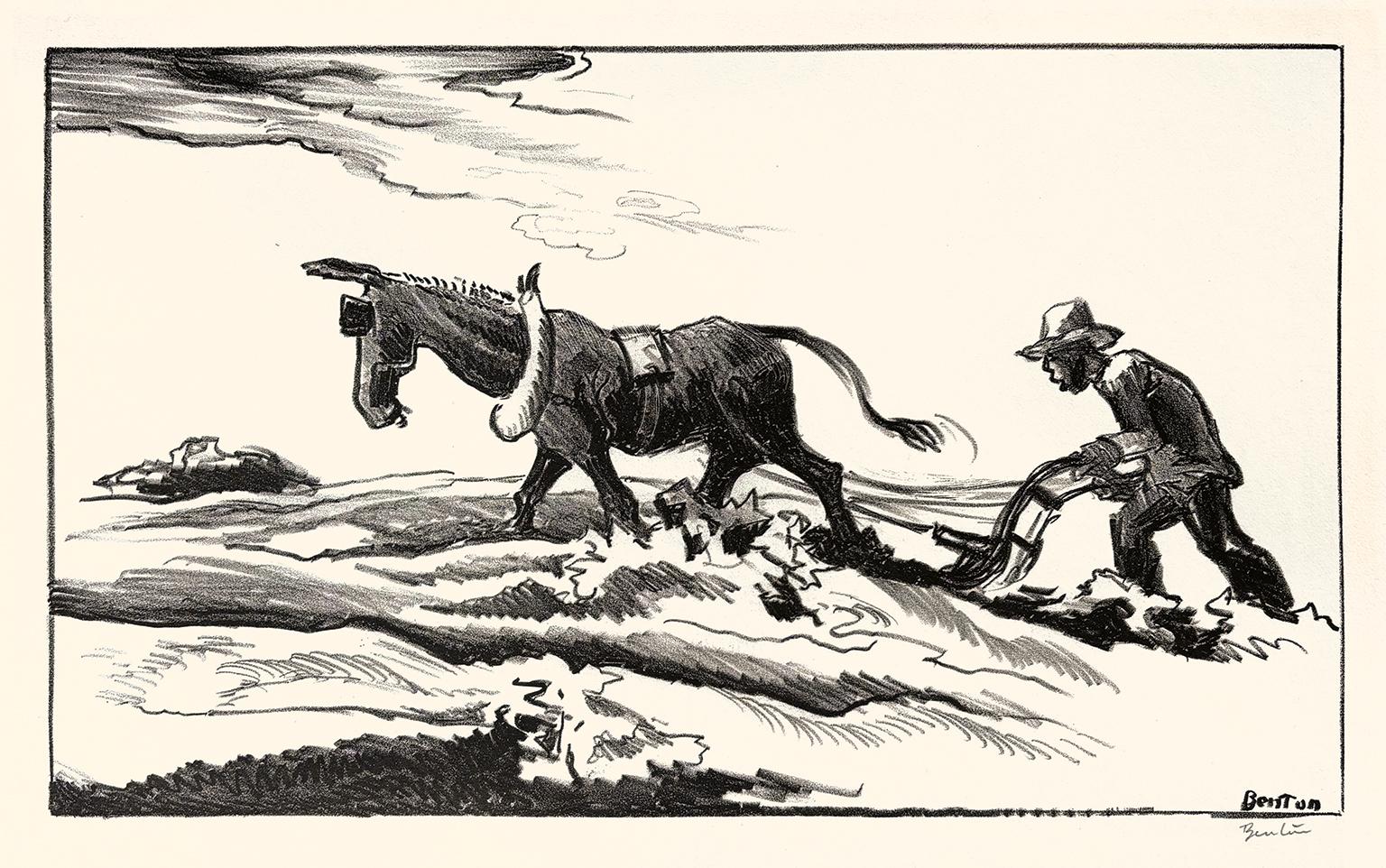
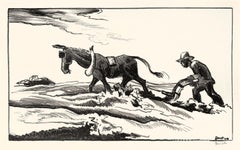
Plowing It Under
— WPA Era American Regionalism
By Thomas Hart Benton
Located in Myrtle Beach, SC
Thomas Hart Benton, 'Goin' Home', lithograph, 1937, edition 250, Fath 14. Signed in pencil. Signed in the stone, lower right. A fine, richly-inked impression, on off-white, wove pape...
Category
1930s American Realist Figurative Prints
Materials
Lithograph
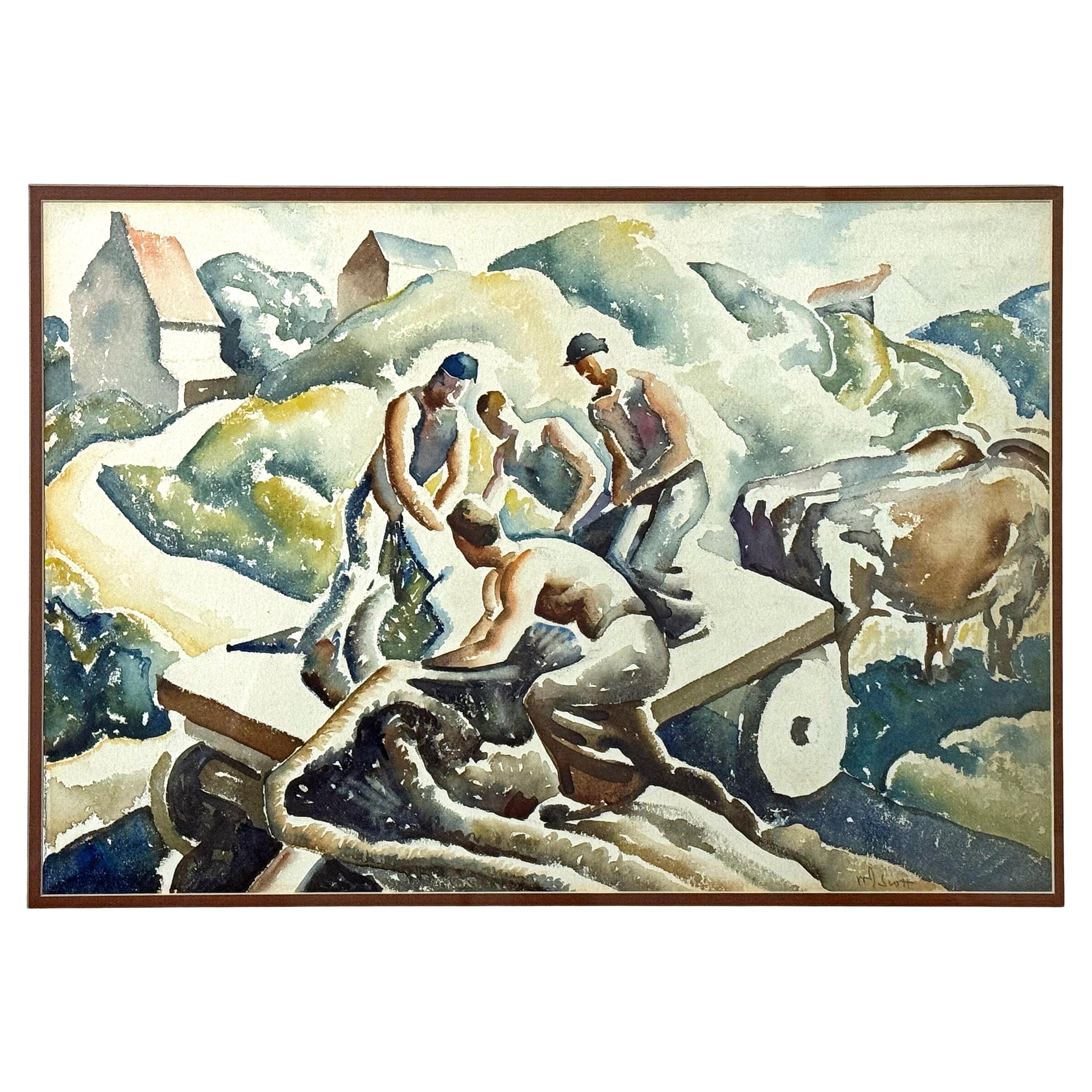
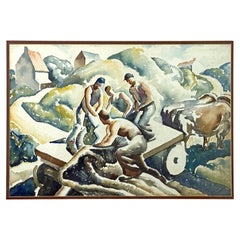
"Loading the Wagon", Important Regional Scene Ptg, Thomas Hart Benton Colleague
Located in Philadelphia, PA
This classic example of American Scene painting, depicting a group of four laborers loading the harvest onto a wagon amidst the fields, has the energy and dynamic of Thomas Hart Bent...
Category
Vintage 1930s American Art Deco Paintings
Materials
Paint
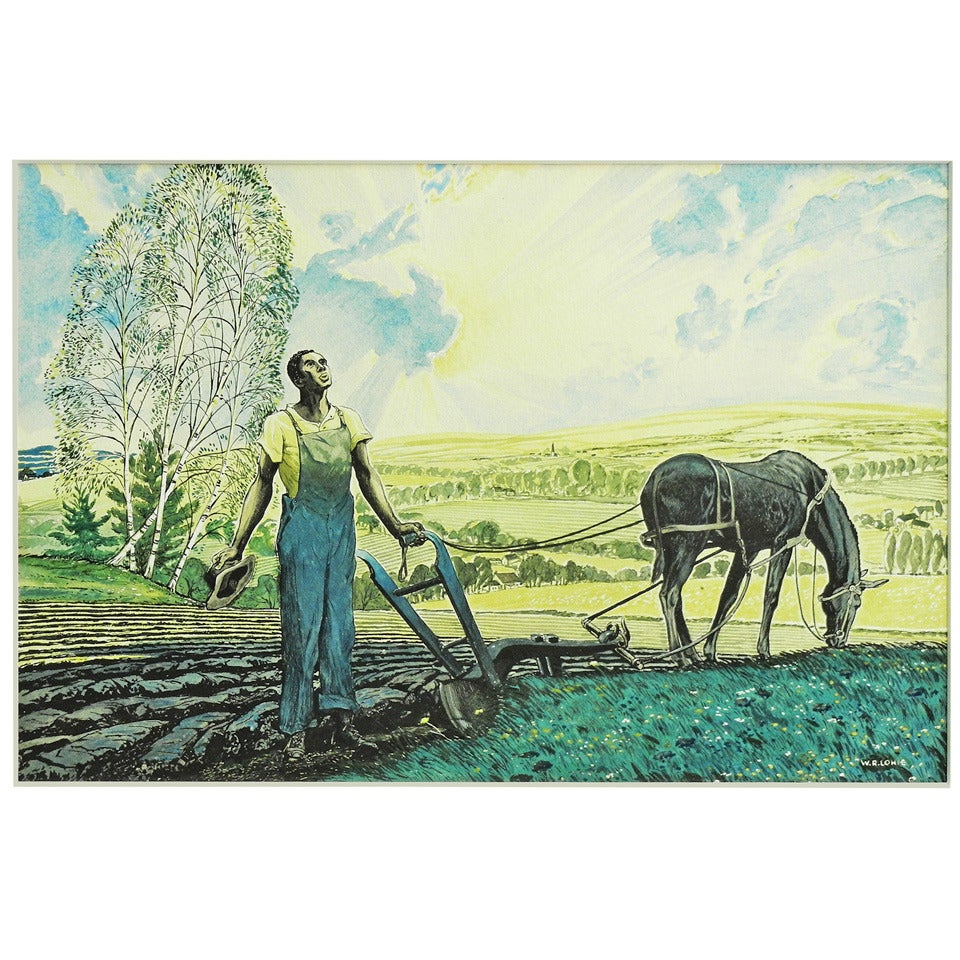
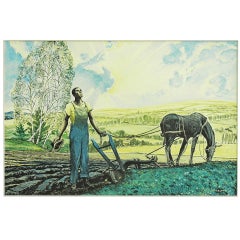
"Plowing at Sunrise, " Art Deco Paean to the Black Farmer, 1930s
By Willis Lohse
Located in Philadelphia, PA
Beautifully conceived, dramatically set and very finely painted, this gouache and ink painting by Willis R. Lohse is a paean to the hard work and nobility of the black farmer in America, hat in hand as he marvels at the beauty of the day. Full of lovely colors -- lemon yellow, cerulean and fresh green -- Lohse captures a lovely moment where the farmer pauses to look upward, amidst sprays of birch trees and expanses of rolling fields. Lohse was a German-American artist who is best known for his illustrations for fiction and fantasy books published between the 1920s and 1950s, including "The Boy Who Found the King," "Raff, the Jungle Bird...
Category
Vintage 1930s American Art Deco Paintings
Materials
Gouache, Ink, Paper
"White Calf, " Farm Genre Scene Original Lithograph by Thomas Hart Benton
By Thomas Hart Benton
Located in Milwaukee, WI
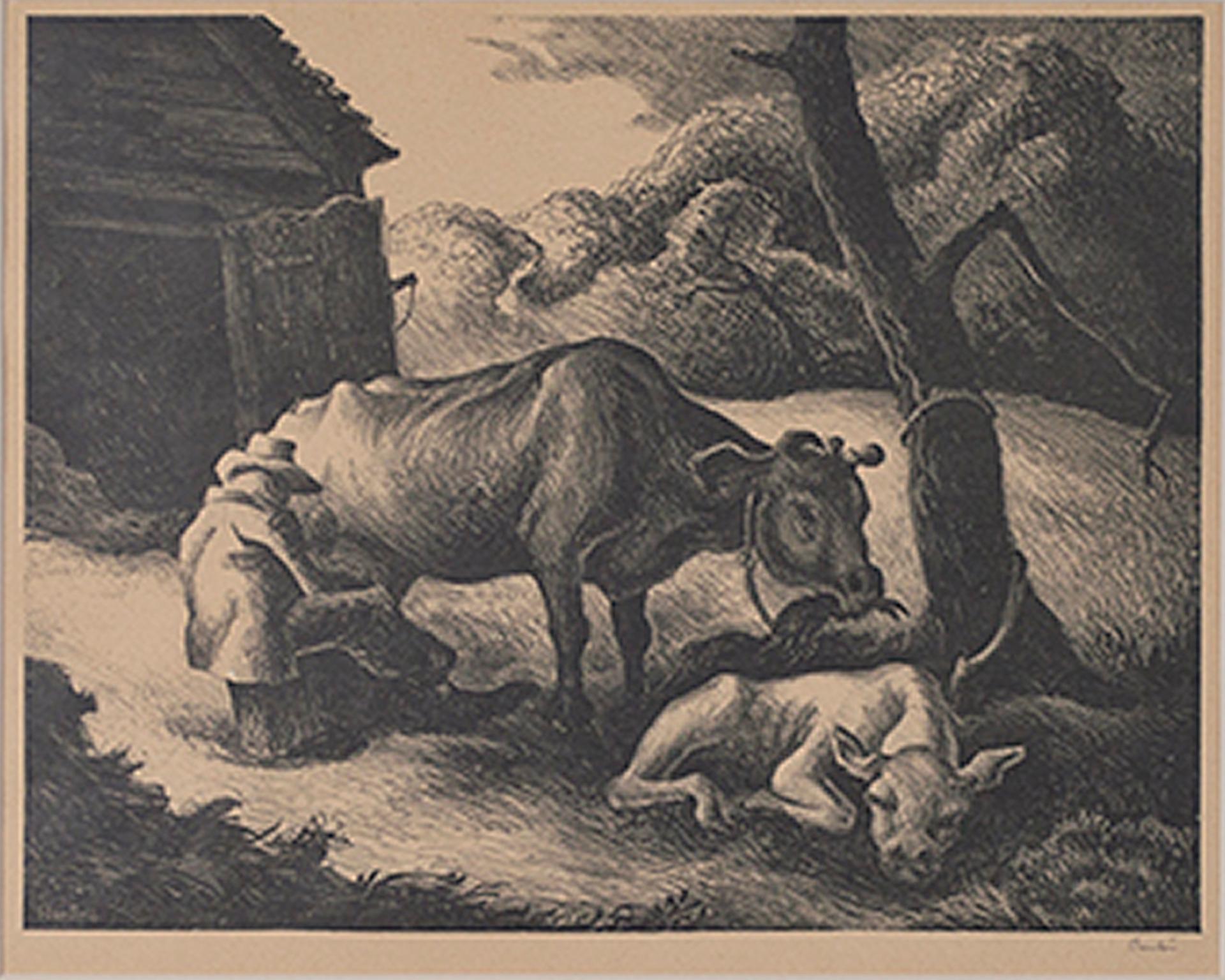
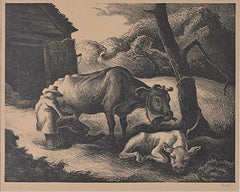
"White Calf" is an original lithograph print by Thomas Hart benton. It features the image of a man milking a cow while her calf lays down in front. Benton's breathtaking way of rende...
Category
1940s American Modern Animal Prints
Materials
Lithograph
Thomas Hart Benton Original Lithograph, 1939 - "Shallow Creek"
By Thomas Hart Benton
Located in Phoenix, AZ
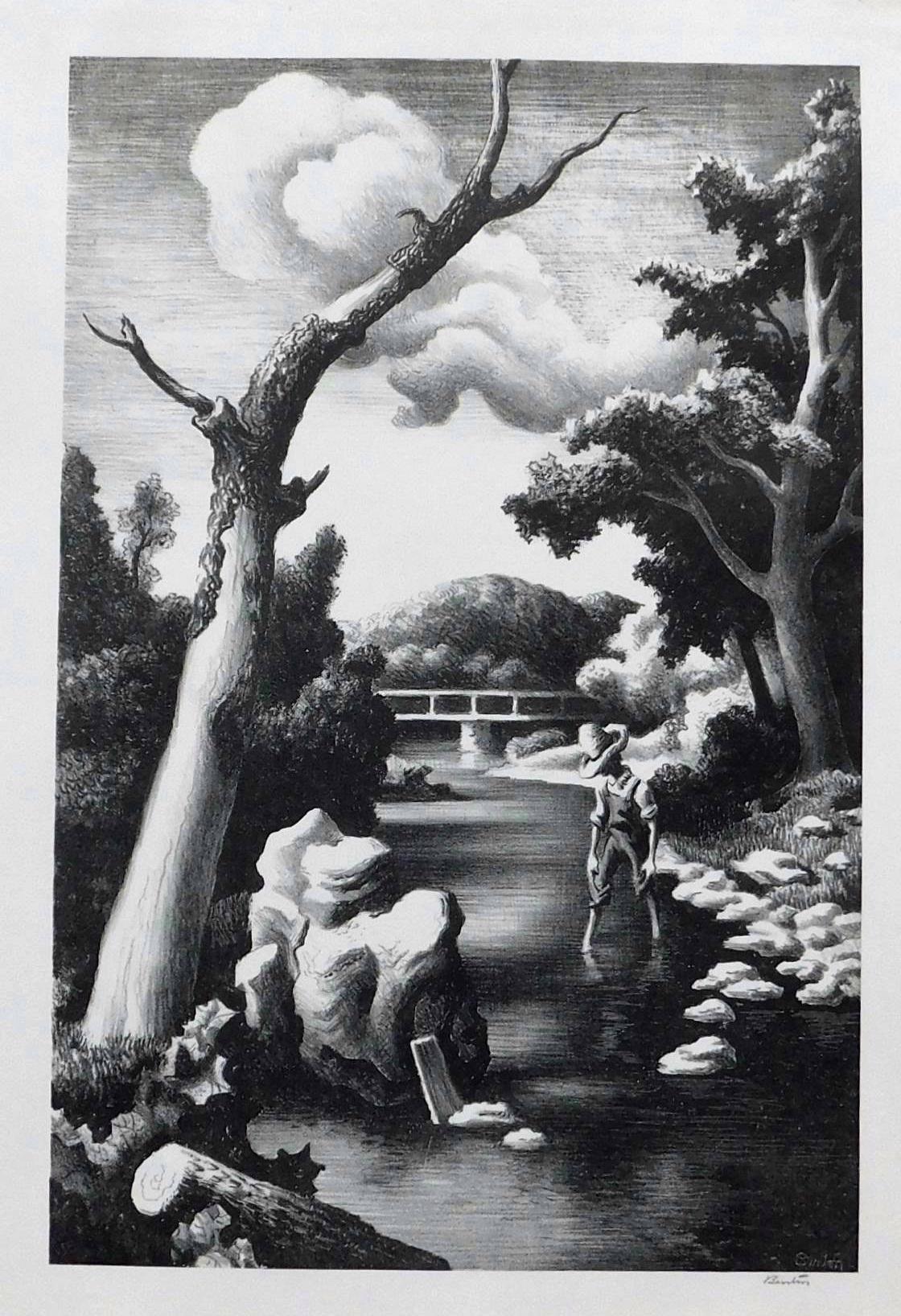
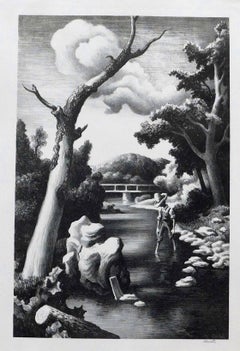
Original stone lithograph by well-known Regionalist Thomas Hart Benton (1889-1975).
Titled: "Shallow Creek.” The print has full margins and is in excellent condition.
AAA print creat...
Category
1930s Landscape Prints
Materials
Paper
Read More
Penelope Gottlieb’s Comic-Style Painting Is a Requiem for a Vanished Flower
This piece may look like Pop art fun, but embedded within is a message of a planet on the brink.
10 Reasons Art Collectors Are Obsessed with Andy Warhol
More than three decades after his death, the prolific Pop artist and cultural icon's body of work continues to captivate. Here's a primer of some of his most notable motifs and mediums.