Items Similar to Italian School 18th Century Drawing - Red Chalk on Paper
Want more images or videos?
Request additional images or videos from the seller
1 of 16
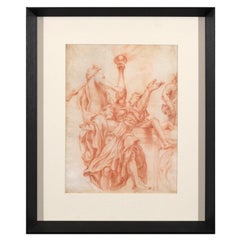
UnknownItalian School 18th Century Drawing - Red Chalk on Paper17th/18th century
17th/18th century
$2,156.11
£1,612.28
€1,800
CA$2,970.58
A$3,239.83
CHF 1,716.24
MX$38,840.96
NOK 21,857.31
SEK 19,986.89
DKK 13,716.72
About the Item
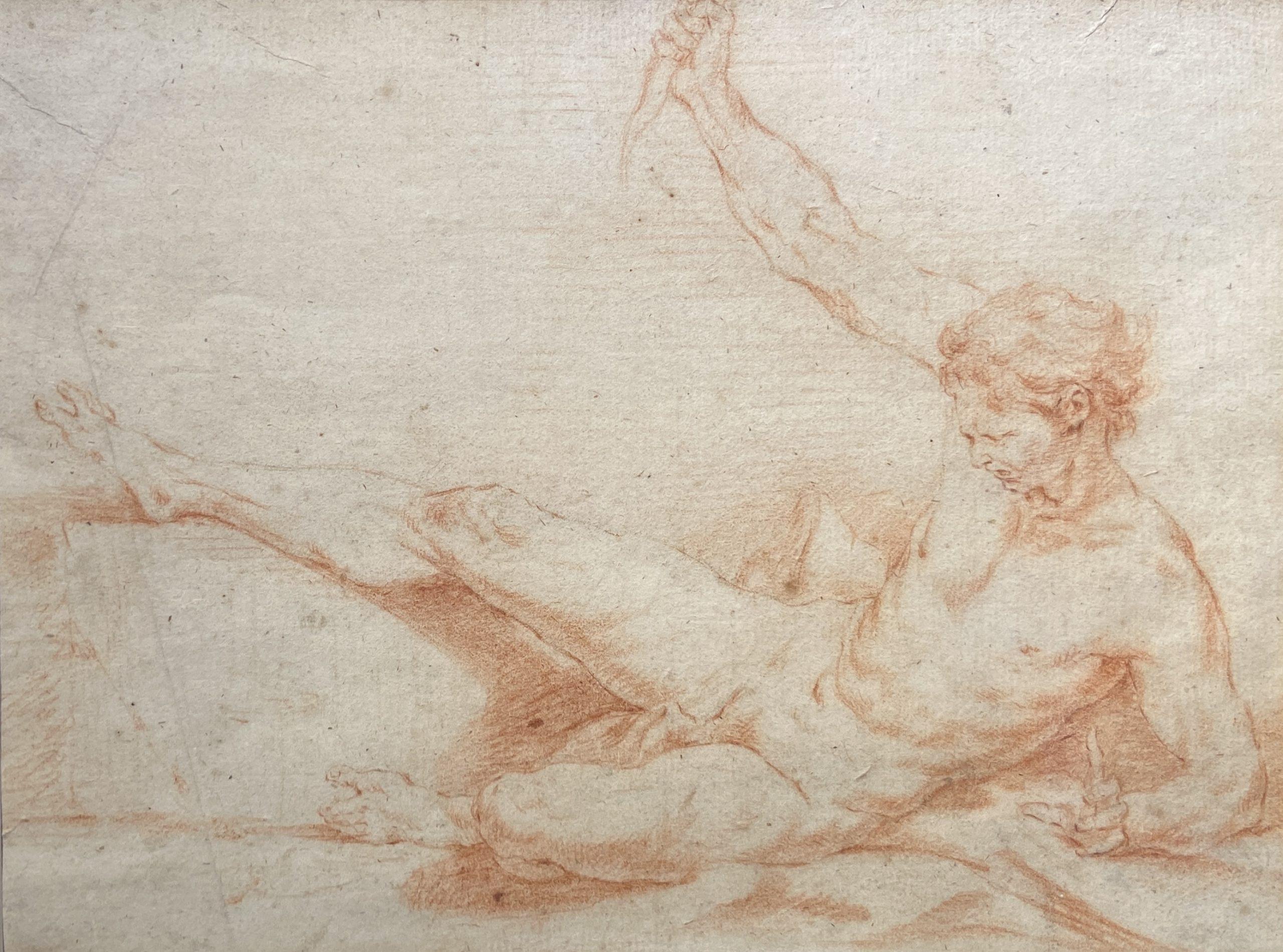
An Italian red chalk drawing depiction on paper, probably 17th or 18th century, illustrating the dramatic scene of Polyphemus hurling a boulder at Acis and Galatea. Attributed to an unidentified, probably Italian master, the composition portrays a narrative from ancient Greek mythology where the jealous giant cyclops Polyphemus, in a fit of rage, kills Acis by crushing him with a massive rock. This piece seems to draw inspiration from Annibale Carracci's renowned ceiling frescoes in the Palazzo Farnese, Rome, specifically the "Loves of the Gods" series painted circa 1597–1601. One particular fresco in this series depicts Polyphemus in the act of throwing a rock at Acis and Galatea, suggesting that the artist of this drawing may have been influenced by Carracci's interpretation. While there are notable differences, the compositional similarities indicate a study to the earlier masterpiece. Throughout the centuries, numerous artists visited the Farnese Gallery to study and draw inspiration from Carracci's work, underscoring its significant impact on subsequent art.
The subject matter derives from ancient Greek mythology, specifically the tale of Acis, Galatea, and Polyphemus, made famous through Ovid’s Metamorphoses. The Cyclops Polyphemus, a fearsome, one-eyed giant, is deeply in love with Galatea, a beautiful sea-nymph. However, Galatea’s affections lie with Acis, a handsome young mortal shepherd. Enraged by jealousy upon discovering the lovers together, Polyphemus unleashes his wrath by ripping a boulder from the earth and hurling it at Acis, fatally crushing him. Stricken with grief, Galatea transforms Acis's blood into a river spirit, thus granting him immortality.
The scene has been a powerful symbol in Western art and literature for centuries—portraying unrequited love, jealousy, and tragic loss. It has inspired countless works across time, from Roman frescoes to Baroque painting and Romantic poetry.
Annibale Carracci (1560–1609) was a pivotal figure in Italian Baroque painting. Born in Bologna, he, along with his brother Agostino and cousin Ludovico, founded the Carracci Academy, aiming to reform art by emphasizing naturalism and the study of classical models. Carracci's work is characterized by its harmonious composition, dynamic movement, and vivid depiction of human emotion. His frescoes in the Palazzo Farnese, particularly the "Loves of the Gods" series, are considered masterpieces that bridge the Renaissance and Baroque periods. Carracci's innovative approach and dedication to blending classical traditions with contemporary techniques significantly influenced the trajectory of European art.
- Creation Year:17th/18th century
- Dimensions:Height: 14.18 in (36 cm)Width: 20.48 in (52 cm)Depth: 0.4 in (1 cm)
- Medium:
- Movement Style:
- Period:
- Condition:Paper laid on paper. Older restoration to lower edge parts and possibly some trimming at lower bottom. Some minor staining but otherwise in seemingly good condition. Presently mounted in a passepartout.
- Gallery Location:Stockholm, SE
- Reference Number:1stDibs: LU2608216083102
About the Seller
5.0
Gold Seller
Premium sellers maintaining a 4.3+ rating and 24-hour response times
1stDibs seller since 2023
33 sales on 1stDibs
Typical response time: <1 hour
- ShippingRetrieving quote...Shipping from: Stockholm, Sweden
- Return Policy
More From This Seller
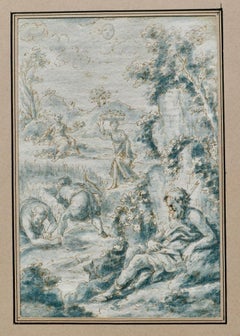
View AllAllegory of Summer - 17th Century Italian Sepia and Watercolor Drawing
Located in Stockholm, SE
A fine Italian watercolor and sepia drawing, an allegory of summer. People harvesting, eating and drinking in a hilly landscape, probably by Antonio Grano (c.1669-1718). In the fron...
Category
Late 17th Century Italian School Figurative Drawings and Watercolors
Materials
Paper, Ink, Watercolor
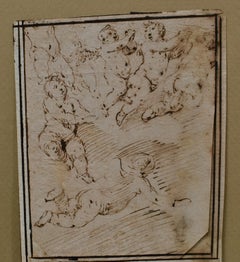
Italian School 17th Century Drawing of Putti
Located in Stockholm, SE
A fine small Italian 17th/18th century sepia ink study of 6 putti in different positions. Paper mounted on paper. A tergo written "Scuola Lombarda".
A putto/putti are figure in a wo...
Category
17th Century Italian School Figurative Drawings and Watercolors
Materials
Ink
Italian Harbor Scene - 18th Century Oil on Panel.
Located in Stockholm, SE
An Italian veduta scene by Marten J. Waefelaers (1748–1799), signed and dated “M.J. Waefelaers 1791” lower left, oil on panel. (The signature is a bit hidden behind the frame). The g...
Category
1790s Flemish School Landscape Paintings
Materials
Oil, Wood Panel
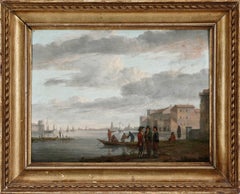
Italian Capriccio with Ruins Venice - 18th Century Oil on Canvas
By Gaetano Vetturali (Lucca, 1701-1783)
Located in Stockholm, SE
A Venetian capriccio view with classical architectural ruins and in the background the church of San Giorgio Maggiore and the Church of Santa Maria della Salute next to the Grand Can...
Category
1770s Old Masters Landscape Paintings
Materials
Canvas, Oil

19th Century Neoclassical Scene - Psyche, Oil on Canvas
By Otto Bache
Located in Stockholm, SE
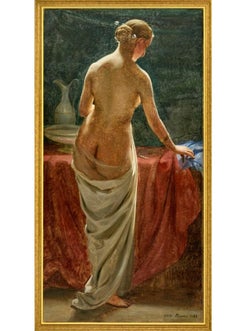
In this neoclassical oil on canvas signed and dated “Otto Bache 1864”, the artist depicts Psyche standing with her back turned to the viewer beside a red draped table. Her hair is arranged in a tight knot, secured with a hairpin adorned with two large pearls. She holds a light drapery that covers her legs, while the rest of her body remains nude. With her head turned toward the right, she gazes downward toward the table, where a blue gown or drapery lies, the garment she is about to put on.
Her softly illuminated profile emerges as she turns in the light falling from the upper left, creating a striking backlight that heightens the contrast along the contours of her body. On the richly red draped table before her rest her jewellery and, to her left, a large amphora-shaped jug and a tazza bowl. The light descending from above to the left defines the composition with sharp contrasts between brightness and shadow, revealing the delicate modelling of Psyche’s form and lending the scene a quiet sense of introspection and grace.
Exhibited: Winkel & Magnussen October 1915 no. 5, ill. p. 5.
Otto Bache was born in 1839 in Roskilde, Denmark, and died in 1927 in Copenhagen.
At the age of only eleven he was admitted to the Royal Danish Academy of Fine Arts in Copenhagen where he studied drawing and painting under the supervision of artists such as Wilhelm Marstrand. His early training gave him a basis in the Danish “Golden Age” tradition of realism and naturalism, but he went on to travel and extend his horizons. In 1866 he received an Academy travel-scholarship and went to Paris, then Italy (1867–68).
The influence of Paris is often noted: his palette became richer, his handling freer, his light stronger, and his subjects broader. Later in his career, from around 1887, he held the post as professor and on various occasions director of the Royal Danish Academy.
Bache’s early work reflects his rigorous academic training: careful drawing, subdued palette and interest in genre scenes and rural life. After his travel in Paris and Italy he adopted a somewhat more robust handling of color and light, but still remained essentially realist and narrative in approach.
He painted portraits, animal and hunting subjects, genre scenes, and large history-paintings depicting key moments from Danish history.
In particular, during the 1880s and 1890s when he was commissioned to execute large history canvases for the Museum of National History at Frederiksborg Castle and similar institutions, depicting events such as the exploits of Danish soldiers...
Category
1860s Other Art Style Figurative Paintings
Materials
Oil
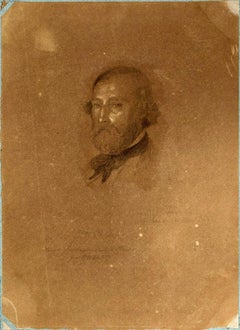
Portrait Gustav Wilhelm Palm - 19th Century Pencil and Pastel on Paper
Located in Stockholm, SE
Portrait of Gustaf Wilhelm Palm (1810–1890) by Lorenz Frølich (1820-1908)
Signed with monogram and dated May 1849. Pencil and pastel on paper. 29.5 × 21 cm.
This portrait of the Swed...
Category
1840s Naturalistic Portrait Drawings and Watercolors
Materials
Paper, Pastel, Carbon Pencil
You May Also Like
The Death of Attis, 18th Century French Red Chalk Drawing, Greek Mythology
Located in London, GB
Red chalk on paper
Image size: 9 x 7 inches (23 x 17.75 cm)
Acid free mount
The Greek god Attis was the spouse of Cybele, the fertility goddess. He was from Phrygia, a kingdom in c...
Category
18th Century French School Figurative Drawings and Watercolors
Materials
Chalk
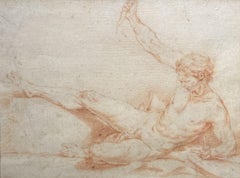
Old Masters Chalk Drawing, 17th Century Italian Sanguine on Paper
Located in London, GB
Sanguine chalk on paper
Image size: 7 x 8 1/2 inches (18 x 22 cm)
Acid free cut-out mount
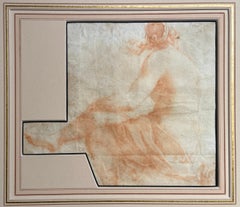
This 17th century drawing depicts a reclining woman with her back.
The Sanguine chalk that...
Category
17th Century Italian School Figurative Drawings and Watercolors
Materials
Paper, Chalk
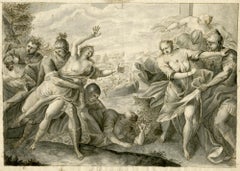
Il Ratto della Sabine – Italian School 18th century
Located in Middletown, NY
An intense scene of an incident in the legendary history of Rome.
Italian School 18th century, circa 1700.
Ink and wash in brown and grayish black ink on cream laid paper, 12 1/8 x...
Category
Late 18th Century Italian School Figurative Drawings and Watercolors
Materials
Ink, Handmade Paper, Graphite, Watercolor, Laid Paper
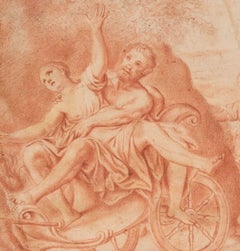
Rape of the Sabines - Sanguine Drawing End of 18th Century
Located in Roma, IT
Rat of Sabinesis an original sanguine drawing on thick cream-colored paper, realized by an anonymous French artist of the end of XVIII century.
A superb original drawing with skille...
Category
Late 18th Century Figurative Drawings and Watercolors
Materials
Pastel
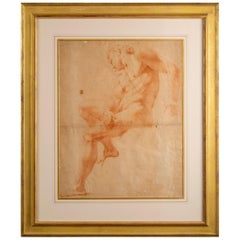
Large Red Chalk Drawing, 18th Century Italian School
Located in Kittery Point, ME
Nude male academy.
Red chalk on paper.
While the artist who drew this drawing is not known, the confidence in the trait along with the fascinating perspect...
Category
Antique Mid-18th Century Italian Rococo Drawings
Materials
Paper
Francesco Bartolozzi (1727–1815) — Red Chalk Drawing, 18th Century
Located in Lisboa, PT
Francesco Bartolozzi (1727–1815) — Red Chalk Drawing, 18th Century
Medium: Red chalk on paper
Artist: Francesco Bartolozzi (attr.)
Origin: Italy, 18th Century
Frame Dimensions: App...
Category
Antique Late 18th Century Portuguese Drawings
Materials
Paper
More Ways To Browse
Italian Baroque Painting
Annibale Carracci
Drawings Italian 18th Century
Red Chalk Drawing
Roman Baroque Painting
Wpa Art Charles
18th Century Charcoal Drawing
Abraham Manievich
Abram Lerner
Amado M Pena Jr
Andrzej Szypluk
Bain De Soleil
Barbara Nessim
Cyclops Painting
Eduardo Esquivel
French Dress Sketches
Georges Clairin
Gibson Girl Vintage