Items Similar to A woman in jewels and a gossamer sari – Rajasthani School, 19th century


Want more images or videos?
Request additional images or videos from the seller
1 of 3
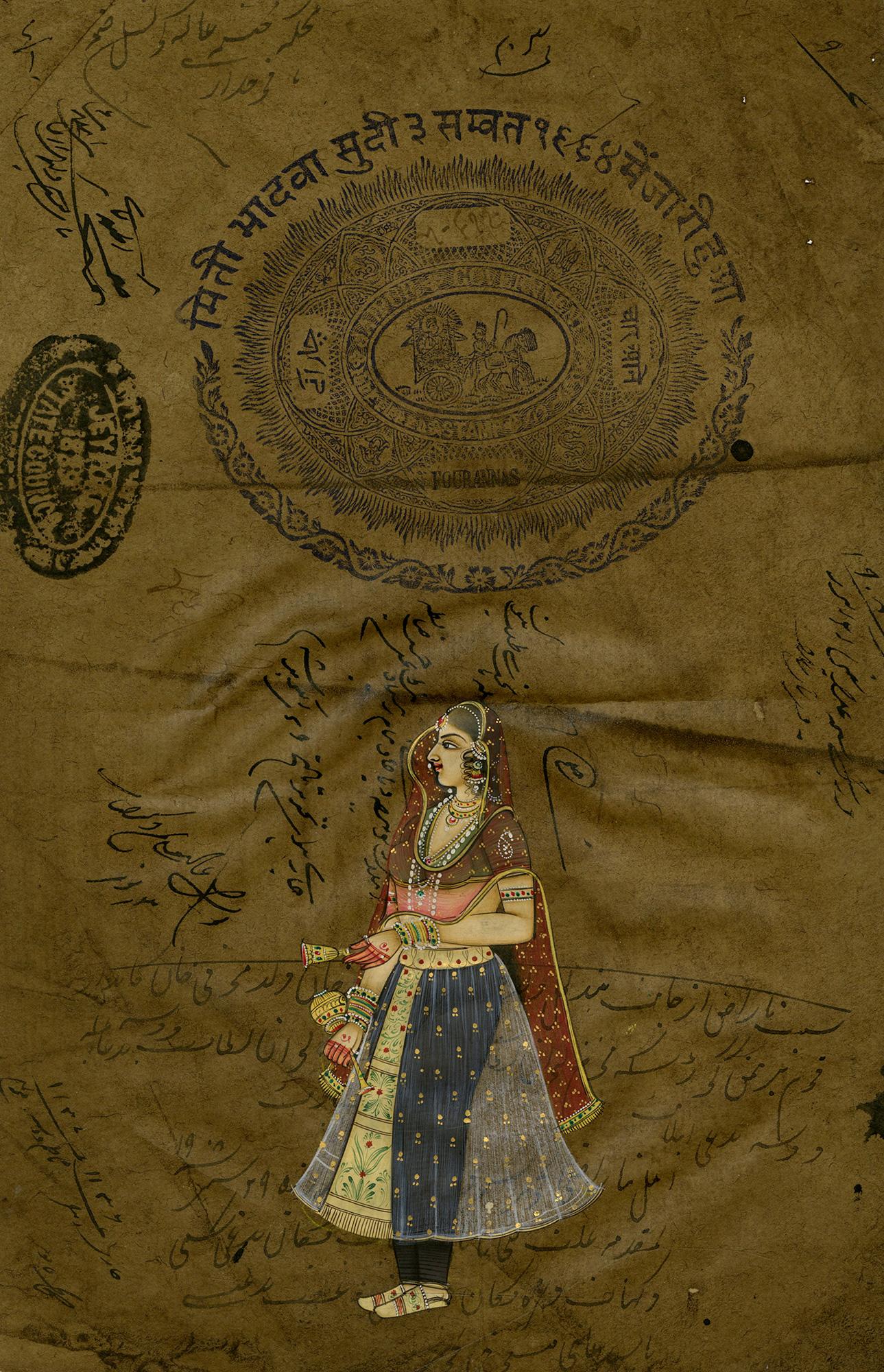
UnknownA woman in jewels and a gossamer sari – Rajasthani School, 19th century1890
1890
$650
£494.55
€569.83
CA$922.80
A$990
CHF 531.01
MX$11,919.41
NOK 6,694.05
SEK 6,104.04
DKK 4,257.37
About the Item
A woman in jewels and a gossamer sari churns butter for ghee.
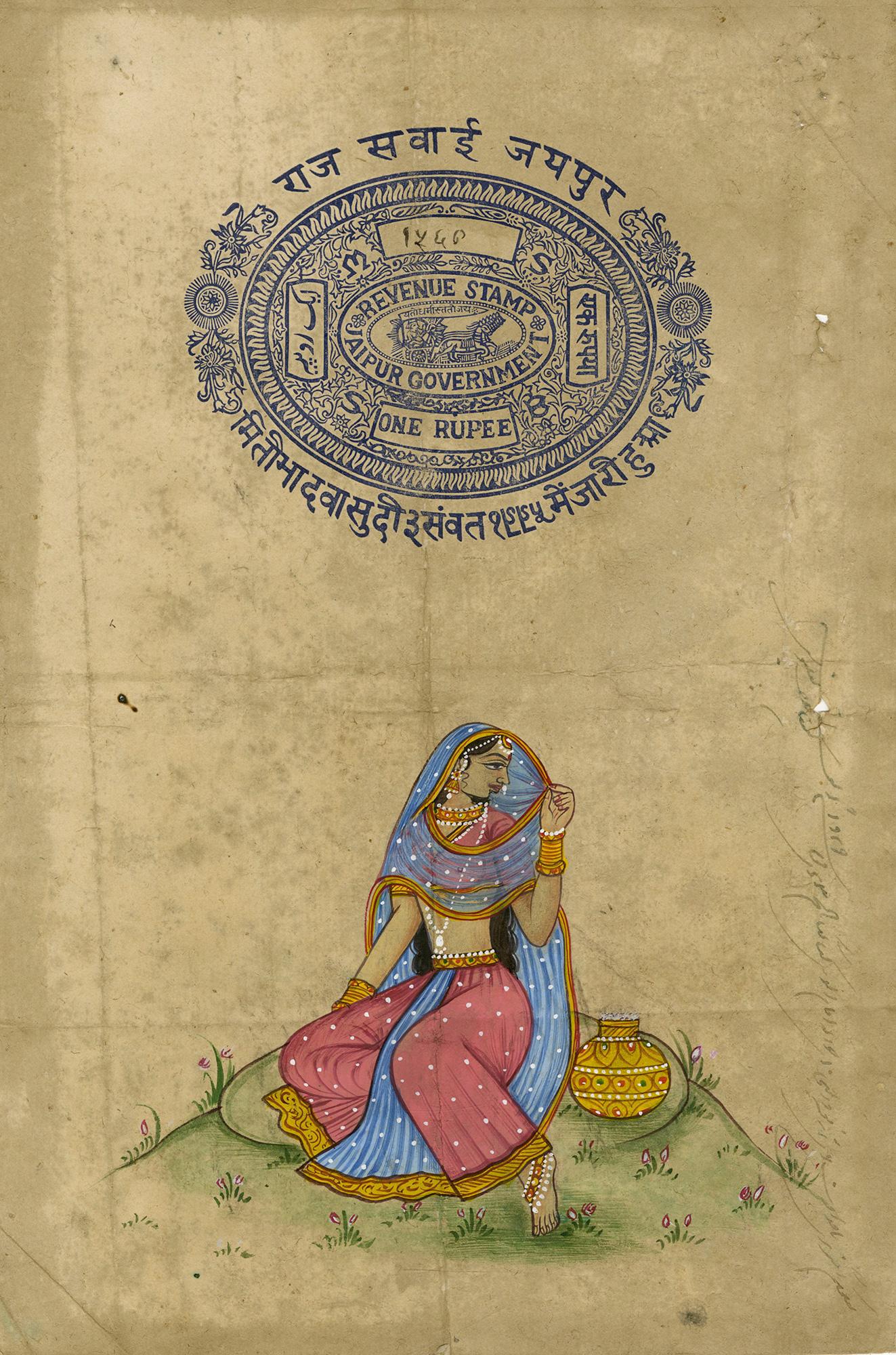
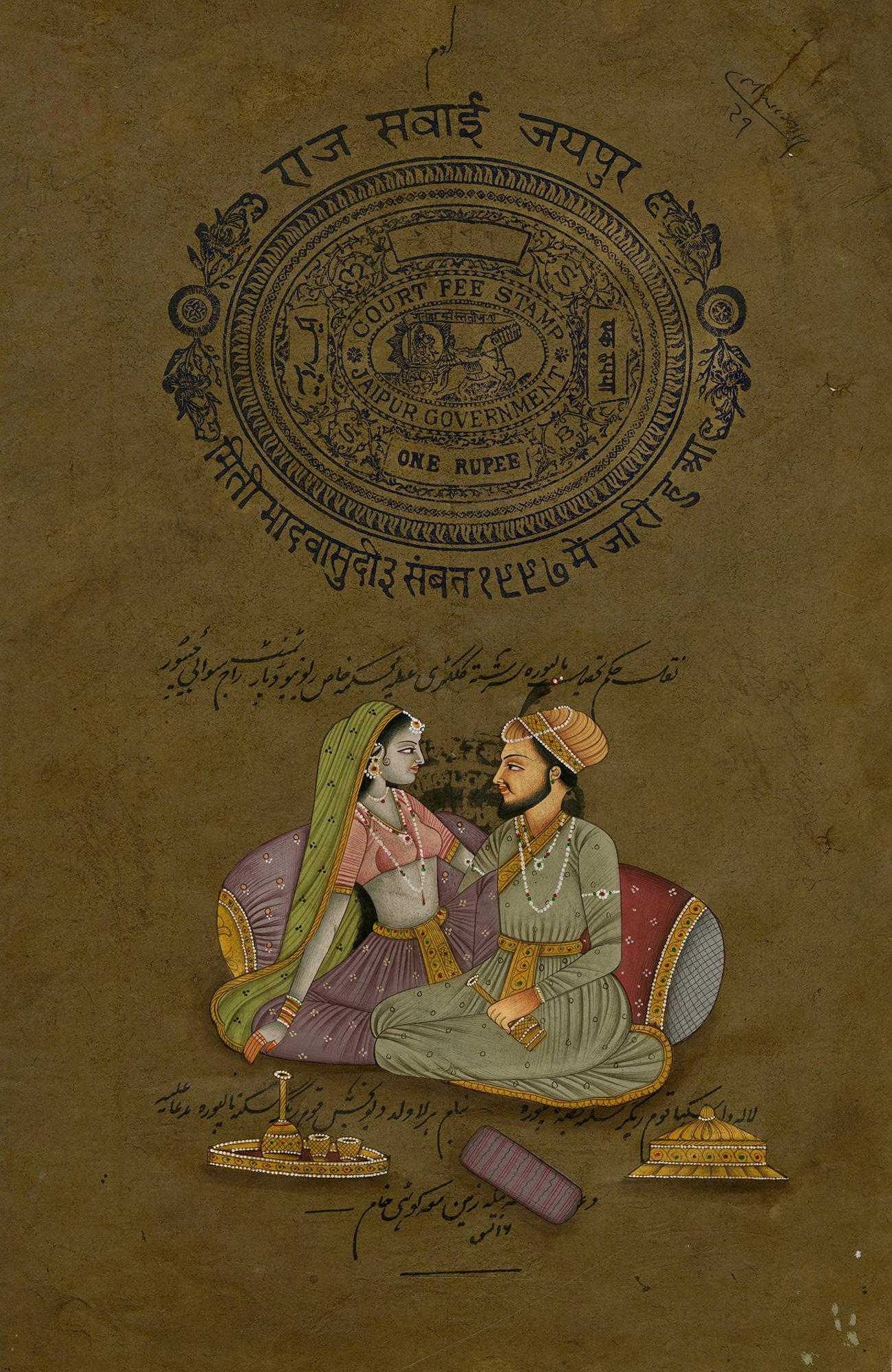
Ink and gouache with gold heightening on fibrous, brown laid paper, with a Jaipur Court Fee tax stamp in purple ink on the recto, 13 1/4 x 8 7/8 inches (336 x 226 mm). Toning, handling creases and minor scattered surface soiling throughout. There are scattered coeval inscriptions in ink on the recto and verso.
A traditional Indian butter churn is operated by rapidly pulling a rope which turns a paddled spindle. The paddles churn cows milk inside a large jar until milk solids form. Ghee is made from cow milk butter, which is treated with low heat until the water evaporates, leaving behind milk solids. The solids are skimmed off or strained if needed. Ghee is a staple food on the Indian subcontinent, and as a cooking oil, it is the most widely used food in India, apart from wheat and rice. Because of its exalted status at Hindu weddings, ghee is expensive and in high demand. Male wedding guests are expected to compete with each other to see who can eat the most of it; consuming two pounds or more at a sitting is considered a proof of virility.
On the stamp:
The first revenue stamps in India were issued in the mid-nineteenth century during the Raj, and they are still being issued to this day. Apart from issues for the whole of India, many princely states, provinces, and other states also had (or still have) their own revenue stamp issues. Before independence, Indian revenue stamps were closely modeled on similar designs from Great Britain, as is the case with this carriage motif stamp from Jaipur. The stamps were issued to denote various denominations, including rupees and annas. An anna (or ānna) was a currency unit formerly used in British India, equal to 1⁄16 of a rupee. It was subdivided into four (old) Paisa or twelve pies (thus there were 192 pies in a rupee). When the rupee was decimalized and subdivided into 100 (new) paise, one anna was therefore equivalent to 6.25 paise. This particular stamp was used as evidence of court taxes remitted for property dealings.
- Creation Year:1890
- Dimensions:Height: 13.23 in (33.6 cm)Width: 8.9 in (22.6 cm)
- Medium:
- Movement Style:
- Period:
- Condition:
- Gallery Location:Middletown, NY
- Reference Number:Seller: BH13411stDibs: LU1979215123802
About the Seller
5.0
Vetted Professional Seller
Every seller passes strict standards for authenticity and reliability
Established in 2004
1stDibs seller since 2022
81 sales on 1stDibs
Typical response time: 20 hours
- ShippingRetrieving quote...Shipping from: Middletown, NY
- Return Policy
More From This Seller
View AllRajput Ragamala miniature of woman with bell&rattle. Rajasthani School, 19th C.
Located in Middletown, NY
Ink and gouache with gold heightening on fibrous, brown laid paper with a Jaipur Court Fee tax stamp in gray ink, and the 1889 Jaipur State Council stamp in black ink, 13 1/4 x 8 3/4 inches (335 x 222 mm). Toning, handling creases and minor scattered surface soiling throughout. There are scattered coeval Hindi inscriptions in ink on the recto.
"A ragamala, translated from Sanskrit as "garland of ragas," is a series of paintings depicting a range of musical melodies known as ragas. Its root word, raga, means color, mood, and delight, and the depiction of these moods was a favored subject in later Indian court paintings...
Category
19th Century Rajput Figurative Drawings and Watercolors
Materials
Gold
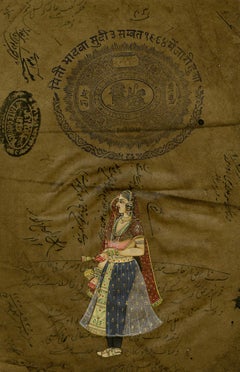
Nur Jahan seated with a painted spice jar. Rajasthani School, 19th cent.
Located in Middletown, NY
Ink and gouache with gold heightening on fibrous, brown laid paper with a Jaipur Court Fee tax stamp in purple ink, 13 3/8 x 8 3/4 inches (340 x 222 mm). Toning, handling creases and...
Category
19th Century Rajput Figurative Drawings and Watercolors
Materials
Gold
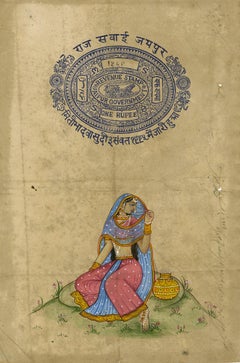
Shah Jahan taking tea with a concubine. Rajasthani School, 19th century
Located in Middletown, NY
Ink and gouache with gold heightening on brown laid paper with a Jaipur Court Fee tax stamp in black ink, 13 3/8 x 8 3/4 inches (340 x 222 mm). Toning, handling creases and minor sca...
Category
19th Century Rajput Figurative Drawings and Watercolors
Materials
Gold
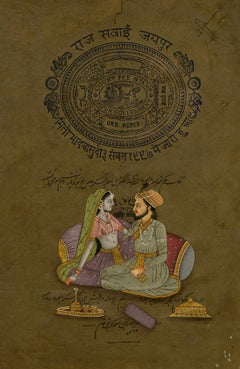
Raja Mahan Singh Mirpuri – Rajasthani School, 19th century
Located in Middletown, NY
Ink and gouache with yellow heightening on fibrous, brown laid paper with a Jaipur Court Fee tax stamp in blue ink, 13 1/2 x 8 3/4 inches (343 x 222 mm). Toning, handling creases and...
Category
19th Century Rajput Figurative Drawings and Watercolors
Materials
Gold

A Rajput prince with a sword, dagger, lotus – Rajasthani School, 19th century
Located in Middletown, NY
Ink and gouache with gold heightening on fibrous, brown laid paper, with a Jaipur Court Fee tax stamp in purple ink on the recto, 12 1/2 x 9 inches (318 x 230 mm). Toning, handling c...
Category
19th Century Rajput Figurative Drawings and Watercolors
Materials
Gold
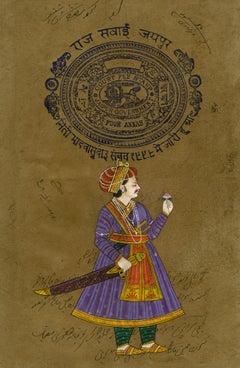
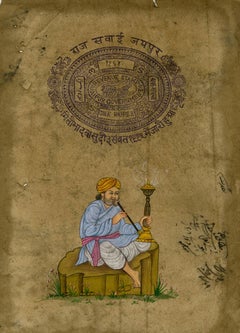
Turbaned man seated, smoking a hookah – Rajasthani School, 19th century
Located in Middletown, NY
Ink and gouache with yellow heightening on fibrous, brown laid paper, with a Jaipur Court Fee tax stamp in purple ink on the recto, and the Jaipur State Council Stamp dated June 5 18...
Category
19th Century Rajput Figurative Drawings and Watercolors
Materials
Gold
You May Also Like
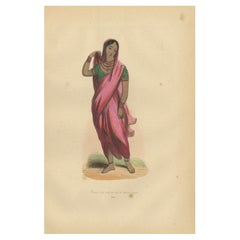
Elegant 1844 Lithograph of a High-Class Indian Woman in Traditional Saree
Located in Langweer, NL
This handcoloured lithograph titled "Jeune fille indoue de la haute classe" depicts a young high-class Indian woman adorned in traditional attire.
The print is part of Auguste Wahlen's "Moeurs, Usages et Costumes de tous les Peuples de Monde," published in 1844.
This lithograph utilizes handcolouring techniques to enhance the vividness and detail of the traditional Indian saree, which is characterized by its bright pink and green hues and intricate draping style.
The saree, a timeless symbol of Indian femininity, is elegantly wrapped, showcasing the elaborate textile craftsmanship of India. The woman's jewelry, including bangles and necklaces, reflects the cultural importance of adornments in Indian society, often indicating social status and personal wealth.
This print is captivating due to its rich depiction of cultural attire and the graceful demeanor of the woman, which together illustrate the refined aesthetic and social codes of India's upper class during the 19th century. The lithograph not only serves as a beautiful piece of art but also as an important cultural document that provides insights into the traditional attire and societal norms of historical India.
Keywords:
- Antique Indian prints...
Category
Antique 1840s Prints
Materials
Paper
$142 Sale Price
20% Off
Rajasthani Indian Painting with Nobleman Holding Lotus Flower and Pearl Necklace
Located in Marbella, ES
This majestic traditional painting is executed in the Rajasthani miniature style, one of the most refined expressions of classical North Indian art. It depicts a royal nobleman dress...
Category
Mid-20th Century Indian Paintings
Materials
Fabric
1970s Traditional Indian Painting in Rajasthani Miniature Style with Nobleman
Located in Marbella, ES
This elegant painting depicts an Indian nobleman in profile, dressed in a royal robe of vivid orange hues and gold detailing, delicately holding a lotus flower in his hand. The work ...
Category
Mid-20th Century Indian Paintings
Materials
Fabric
Rajasthani Hand Painted Indian Portrait Painting of a Man in Traditional Dress
Located in Oklahoma City, OK
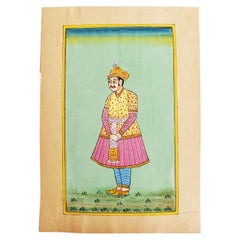
A fabulous piece of hand-painted Folk Art created in India. This painting depicts a traditional Rajasthani man in traditional dress. He wears a decorative yellow and pink dress and s...
Category
21st Century and Contemporary Indian Anglo Raj Paintings
Materials
Paint, Paper
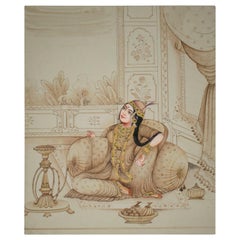
1970s Indian Paper Drawing of a Woman Sitting in a Palace Room
Located in Marbella, ES
1970s Indian paper drawing of a woman sitting in a palace room. Hand drawn in ochre Tones and belonging to a larger private collection.
Category
Late 20th Century Indian Drawings
Materials
Paper
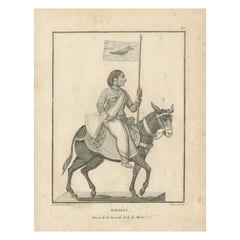
Unique 1806 Mudevi Goddess of Discord Antique Print - Hindu Engraving
Located in Langweer, NL
Title: Unique 1806 Mudevi Goddess of Discord Antique Print - Hindu Engraving
Description: This intriguing antique print, titled "Moudévi, Déesse de la Discorde et de la Misère," dep...
Category
Antique Early 1800s Prints
Materials
Paper
More Ways To Browse
Jewel Painting
British India
Used Saris
Antique Paddle
19th Century Male Oil Paintings
Milk Cow
19th Century Painting India
Rajasthani Paintings
Antique Milk Churns
Trains Pencil Drawing
Vintage Devil Drawing
Yuval Wolfson
1904 Worlds Fair
Alexandre Bida
Antique Hen House
Boris Aronson
Charcoal Boat Drawing
Charcoal Drawings Men