Items Similar to Venus of Philae by Henry Roderick Newman


Want more images or videos?
Request additional images or videos from the seller
1 of 10
Henry Roderick NewmanVenus of Philae by Henry Roderick Newman1899
1899
$39,850
£30,404.57
€34,613.20
CA$56,009.61
A$61,568.21
CHF 32,323.02
MX$732,090.31
NOK 415,101.02
SEK 378,112.17
DKK 258,616.13
About the Item
Henry Roderick Newman
1843-1917 American
Venus of Philae
Signed, dated and inscribed lower left
Watercolor on paper
A masterwork of American Pre-Raphaelite painting, Venus of Philae captures Henry Roderick Newman's meticulous architectural rendering and profound understanding of ancient Egyptian sacred spaces. Painted during the artist's winter sojourn to Egypt in 1899, this luminous watercolor transports viewers into the hallowed hypostyle hall of the Temple of Isis at Philae, one of antiquity's most revered sanctuaries and a site that captivated 19th-century travelers and artists alike.
Newman's composition draws the eye through towering columns adorned with lotus and papyrus capitals, their surfaces bearing carved hieroglyphics and relief sculptures proclaiming Isis's divine power. The artist renders the temple interior with extraordinary precision, capturing shadow and light filtering through ancient stones. Warm ochres and tans dominate the palette, punctuated by deep blue Egyptian sky, while a small figure in dark robes provides scale and emphasizes the architecture's monumentality.
The "Venus" reference in the work's title is somewhat misleading, as this is actually the Temple of Isis, not Venus, the Roman goddess of love. However, during the 19th century, Isis was sometimes identified with Venus/Aphrodite due to their shared associations with femininity, beauty and divine power.
Henry Roderick Newman stands as one of the most accomplished self-taught artists of the American Pre-Raphaelite movement. Born in Easton, New York, Newman initially pursued medicine but devoted himself entirely to painting following his father's death in 1861. After establishing his reputation at the National Academy of Design, Newman relocated to Florence in 1872, developing his signature architectural style inspired by Giotto and Fra Angelico. Beginning in 1887, Newman spent each winter in Egypt, drawn to ancient monuments and crystalline light. His Egyptian watercolors combine archaeological precision with poetic sensibility. A closely related painting of the same subject is held in the collection of the Metropolitan Museum of Art, while other works by Newman reside in many of the world’s most esteemed institutions.
Dated 1899
Paper: 25 1/2" high x 16 5/8" wide (64.77 x 42.23 cm)
Frame: 34 1/2" high x 25 1/2" wide x x1 1/4" deep (87.63 x 64.77 x 3.18 cm)
- Creator:Henry Roderick Newman (1843 - 1917, American)
- Creation Year:1899
- Dimensions:Height: 34.5 in (87.63 cm)Width: 25.5 in (64.77 cm)Depth: 1.25 in (3.18 cm)
- Medium:
- Movement Style:
- Period:
- Condition:
- Gallery Location:New Orleans, LA
- Reference Number:Seller: 32-15231stDibs: LU18617372902
About the Seller
5.0
Vetted Professional Seller
Every seller passes strict standards for authenticity and reliability
Established in 1912
1stDibs seller since 2013
20 sales on 1stDibs
Typical response time: 4 hours
- ShippingRetrieving quote...Shipping from: New Orleans, LA
- Return Policy
More From This Seller
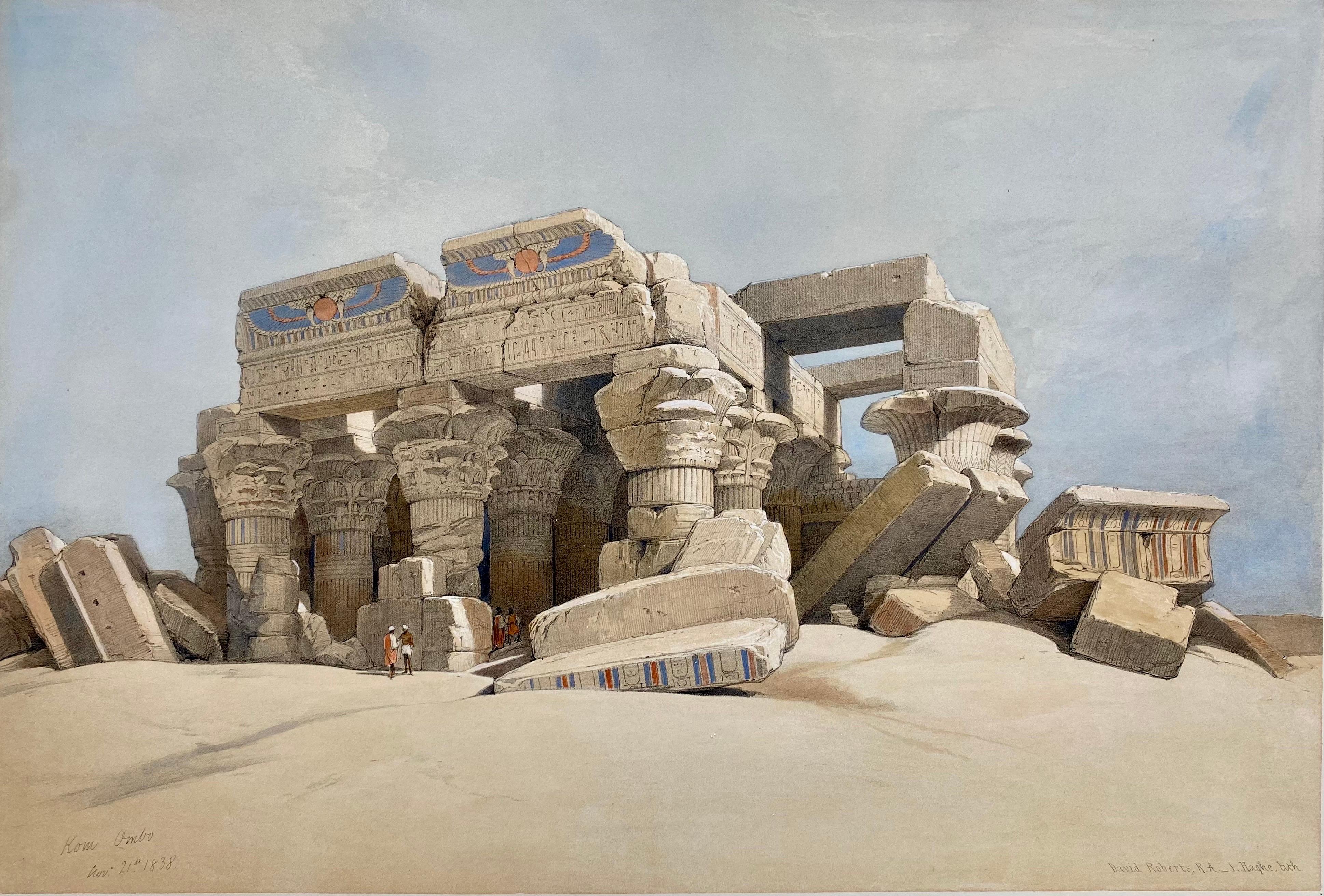
View AllA Study of Two Models by Sir William Russell Flint
By William Russell Flint
Located in New Orleans, LA
Sir William Russell Flint, R.A., P.R.W.S.1880-1969 Scottish
A Study of Two Models
Signed "WRussell Flint" (bottom right)
Ethereal and sen...
Category
20th Century Figurative Drawings and Watercolors
Materials
Paper, Chalk
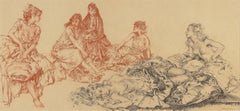
Karnak by Eleanor Parke Custis
By Eleanor Parke Custis
Located in New Orleans, LA
Eleanor Parke Custis
1897-1983 American
Karnak
Signed 'Eleanor Parke Custis -' (lower right)
Gouache and charcoal on paper
American painter Eleanor Parke Custis demonstrates her mastery of the gouache medium in Karnak. A celebration of color and a relic of the artist’s travels abroad, the composition is well-balanced, exuding photojournalistic and documentarian qualities.
In Karnak, Custis paints a compelling and dynamic image of a great ancient Egyptian ruin. Seven distant men, likely Bedouins dressed...
Category
20th Century Realist Landscape Paintings
Materials
Paper, Charcoal, Gouache
Study for “L’Acropole”
By Paul Delvaux
Located in New Orleans, LA
Paul Delvaux
1897-1994 Belgian
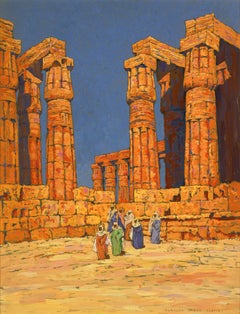
Study for “L’Acropole”
Signed and dated "P.Delvaux 1965" (lower right)
Watercolor, pen and ink on paper
This preliminary drawing for Paul Delvaux’s greatest masterpiece L’Acropole, which resides today in the Centre Pompidou in Paris, features the artist’s most beloved subject — mystical scenes of nude women. A centrally-placed, stoic woman draped in a long green gown stands with her arms outstretched by her sides. She gazes at another idealized woman in the foreground, lying nude on a chaise lounge, while behind her, multitudes of other women in white dresses undertake a long procession towards a distant door. The captivating scene exudes the unique Surrealist style for which the artist has become known.
With this skillful rendering of the surreal setting, Delvaux has mastered depicting nude women in a sensual yet non-erotic manner. The artist drew inspiration from a variety of sources, including the futuristic writings of Jules Verne and the mythos of Homer, and blended them with his subconscious themes, which frequently included the nude female form. In combination with the loose concepts of form and perspective found in the 16th-century Mannerist paintings that Delvaux studied in Italy before World War II, his distinctive style served to create memorable dreamscapes without veering into lewdness. Like the very best Surrealist images, the work is both innovative and engaging.
Paul Delvaux's earliest and most lasting influences in his art were the futuristic writings of Jules Verne and the mythos of Homer. After completing his initial artistic training at the Académie Royale des Beaux-Arts in Brussels, Delvaux exhibited with Surrealists Dalí...
Category
20th Century Post-Impressionist Nude Drawings and Watercolors
Materials
Paper, Ink, Watercolor, Pen
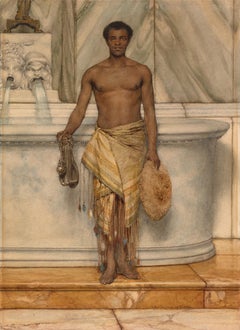
The Balneator by Sir Lawrence Alma-Tadema
By Sir Lawrence Alma-Tadema
Located in New Orleans, LA
Sir Lawrence Alma-Tadema
1836-1912 Dutch
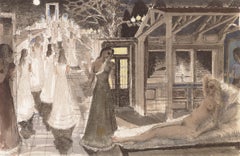
The Balneator
Signed and inscribed "L Alma Tadema. op CLXXVI." (lower right)
Pencil and watercolor with scratching out on paper on board
...
Category
19th Century Academic Figurative Drawings and Watercolors
Materials
Paper, Watercolor, Board, Pencil
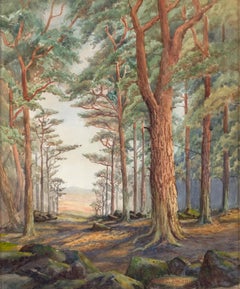
White Mountains of New Hampshire by Louis Comfort Tiffany
By Louis Comfort Tiffany
Located in New Orleans, LA
Louis Comfort Tiffany
1848-1933 American
White Mountains of New Hampshire
Signed "Louis C. Tiffany" (lower right)
Watercolor
Louis Comfort Tiffany, best known for his revolutiona...
Category
20th Century Impressionist Landscape Drawings and Watercolors
Materials
Watercolor
The Bather by Childe Hassam
By Childe Hassam
Located in New Orleans, LA
Childe Hassam
1859-1935 American
The Bather
Signed and dated “Childe Hassam” (lower right)
Oil on canvas
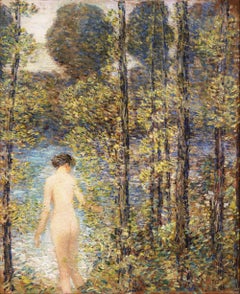
Considered by many to be America’s foremost Impressionist painter, Childe Hassam composed his tranquil and intimate oil on canvas The Bather in the early years of the 20th century. The creation of the artwork aligns with a period of Hassam’s career where the artist’s palette was transforming, matching ever closer with the pale and pastel hues of French Impressionists like Claude Monet. Even the subject — a nude woman — represents a greater alignment with the Impressionist project, as artists of the movement and their non-mythological and non-biblical nudes still generated cries of indecency. With Hassam’s signature brushwork and attention to color, The Bather serves as a dream-like vision, serene and sensuous, of a young woman bathing in a lush forest.
While the artist's skill for landscape painting is on display, it is Hassam's command of form, light and color that brings this canvas to life. He creates a captivating composition, placing the nude subject in the bottom left of the canvas. The soft, undulating curves of the woman's body in contrapposto and the glow of her fair skin are balanced by the strong verticals and deep earth tones of the tall trees to her right. Hassam delicately frames the nude in the vivid blues of the distant water, building luminous color that further draws the viewer’s eye and results in a somewhat voyeuristic appeal — endowing his nude with both a natural innocence and an intentional sensuality.
Born in Dorchester, Massachusetts, Childe Hassam began his artistic career as a freelance illustrator, working for national publications such as Harper’s Weekly, Scribner’s Monthly, and The Century. His first solo exhibition of watercolors took place in Boston in 1883, and he quickly catapulted onto the international scene, winning a bronze medal at the Exposition Universelle in Paris in 1889. The year before the present work was created, he received the Webb Prize from the Society of American Artists for another landscape painted at Gloucester. Hassam would receive numerous other awards throughout his career, most notably the Gold Medal for Distinguished Services to Fine Art from the American Dealers Association. A true master, Hassam depicted a way of life characteristic of both American and French society, and his work elucidates a critical chapter in American art history. Today, his work resides in the Oval Office of the White House and in numerous important museums, including the Metropolitan Museum of Art in New York, the National Gallery of Art in Washington, DC and the Museum of Fine Arts in Boston, among others.
This painting will be included in Stuart P. Feld's and Kathleen M. Burnside's forthcoming catalogue raisonné of the artist's work.
Circa 1905
Canvas: 24 1/2“ high x 20 18” wide
Frame: 35 7/8“ high x 31 1/4” wide x 3 1/4“ deep
Provenance:
Private Collection of William Young...
Category
20th Century Impressionist Nude Paintings
Materials
Canvas, Oil
You May Also Like
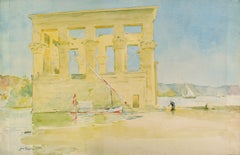
Temple of Isis, View of Philae (verso)
By Henry Bacon
Located in Fairlawn, OH
Temple of Isis
Philae (verso)
Dpouoble sided watercolor, 1902
Signed on front lower left: "Henry Bacon" and dated 1902
Note:
The Temple of Isis is located on the Island of Philae at ...
Category
Early 1900s American Impressionist Landscape Drawings and Watercolors
Materials
Watercolor
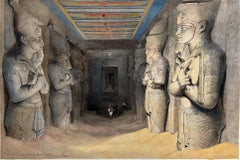
Interior of the Great Temple of Aboo Simbel - Orientalist - David Roberts
By David Roberts
Located in London, GB
David Roberts R.A.
1796 - 1864
Interior of the Great Temple of Aboo Simbel
Subscription edition and First edition lithographs available
Full plate: 139
Acid free mount
With David ...
Category
19th Century Victorian Interior Prints
Materials
Lithograph
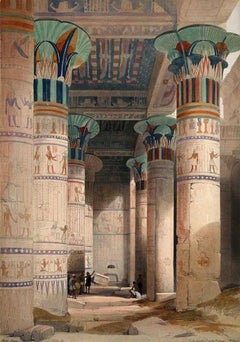
View Under The Grand Portico of The Temple, Philae
By David Roberts
Located in London, GB
David Roberts RA
View Under The Grand Portico of The Temple, Philae
1796 - 1864
First Edition lithograph
Full plate: 126
Presented in a acid free mount
One of the grander temple com...
Category
1840s Realist Landscape Prints
Materials
Laid Paper, Lithograph
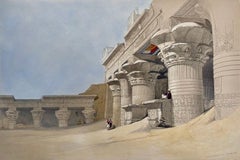
Facade of the Pronaos of the Temple of Edfou - David Roberts - orientalist
By David Roberts
Located in London, GB
David Roberts
1796 - 1864
Facade of the Pronaos of the Temple of Edfou
First Edition lithograph
Full plate: 208
Presented in a acid free mount
We have all 250 of the Lithograph set...
Category
1840s Landscape Prints
Materials
Lithograph
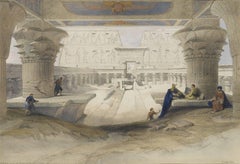
View From Under The Portico of The Temple of Edfou, Upper Egypt
By David Roberts
Located in London, GB
David Roberts R.A.
1796 - 1864
VIEW FROM UNDER THE PORTICO OF THE TEMPLE OF EDFOU, UPPER EGYPT
First edition lithograph available
Full plate: 157
Presented in an acid free mount
We have in stock a full set of the David Roberts lithographs...
Category
Mid-19th Century Landscape Prints
Materials
Lithograph
Kom Ombo - David Roberts - Orientalist
By David Roberts
Located in London, GB
David Roberts
1796 - 1864
Kom Ombo
First Edition lithograph
Full plate: 210
Presented in an acid free mount
Category
1840s Landscape Prints
Materials
Lithograph