1890s Interior Drawings and Watercolors
to
1
4
1
1
Overall Width
to
Overall Height
to
16
71
466
313
8
11
16
47
28
62
25
24
32
31
14
1
4
2
5
3
3
2
2
1
1
1
1
1
3
3
1
1
1
5
5
1
Period: 1890s
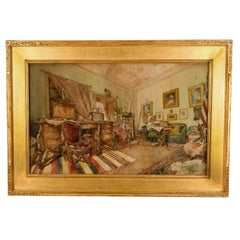
Fine Antique 19th Century Italian Watercolor Roman Interior Scene Painting 1880
Located in Portland, OR
A very beautiful watercolor painting by the celebrated Italian artist Daniele Bucciarelli (1839–1911), of a interior scene circa 1880.
The painting depicts the interior of a grand ro...
Category
Italian School 1890s Interior Drawings and Watercolors
Materials
Watercolor
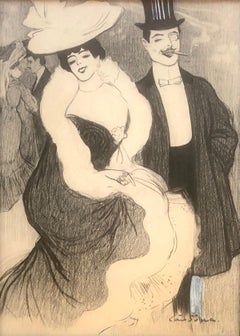
Paris modernist scene mixed media drawimg
Located in Sitges, Barcelona
Joan Cardona Lladós (1877-1957) - Modernist Paris scene - Mixed media (charcoal and white wax).
Drawing measurements 40x29 cm.
Frame measurements 66x54 cm.
He was born in Barcelona on June 30, 1877, he was registered with the name of Juan Bautista José Pedro. His parents Josep Cardona i Farré (Sant Salvador, 1852-Barcelona, ?) and Maria Lladós i Vidal (Isona, 1855-Barcelona, 1935) came from Sant Salvador de Toló and Isona, respectively, two towns very close to Tremp, in the Pallars Jussà region, close to the Lleida Pyrenees. The Cardona Lladós family was of humble origins, linked to the rural and peasant world. José Cardona and María Lladós married around 1876, when they were twenty-five and twenty-one years old respectively. The couple decided to improve their precarious situation by moving to live in Barcelona.
In 1877 Joan Cardona was born in the family home, at 62 Mediana de San Pedro Street, in the Ribera neighborhood of Barcelona and very close to the Rec Comtal. Joan Cardona was the firstborn of three brothers. When he was six years old, his sister Consuelo was born (1883) and later his younger sister, María (1888), was born. Josep Cardona i Farré was a day laborer and lived at least until the birth of his third daughter, María, in 1888. Her death, for reasons unknown to us, would occur shortly after.
After the death of Josep Cardona, León Farré i Duró (Isona, 1867-Barcelona, 1932) became part of the family nucleus with his mother María Lladós, who took care of the child Cardona and his sisters Consuelo and María.
Farré learned to play the guitar and was the most extraordinary disciple of the composer and guitarist Francesc Tàrrega i Eixea (Vila-real, 1852-Barcelona, 1909). Joan Cardona had in her stepfather the man who instilled in her a special musical and artistic sensitivity. The young Cardona took classes at the Academia Baixas, inaugurated in 1892 by the painter Joan Baixas i Carreter and installed on Carrer del Pi, a private center where a good batch of leading Catalan Modernisme artists were trained.
Cardona married Clemencia Parade Cazabat at the beginning of the century. Daughter of Carles Parade and Amara Cazabat, she was born in 1870 in Bagnères de Bigorre...
Category
Modern 1890s Interior Drawings and Watercolors
Materials
Mixed Media

$5,886 Sale Price
51% Off
Self-portrait - Homo nudus -
Located in Berlin, DE
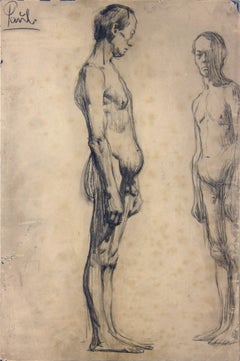
Bruno Paul (1874 Seifhennersdorf - 1968 Berlin). Self-portrait, c. 1895. Pencil on paper, mounted on cardboard, 53.5 x 35 cm, signed 'Paul' at upper left.
- Homo nudus -
About the artwork
In a mirrored situation, Bruno Paul looks at himself in the picture. While his body, which is the size of the format, is shown in profile parallel to the picture, he turns his head into the picture in order to become aware of himself there, whereby the lighter use...
Category
Realist 1890s Interior Drawings and Watercolors
Materials
Pencil
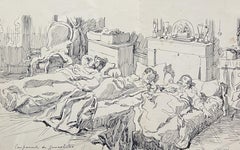
Louis Tinayre (1861-1942) An encampment of journalists, signed drawing
Located in Paris, FR
Louis Tinayre (1861-1942)
An encampment of journalists in Chambéry,
signed and titled lower left "Campement de journalistes à Chambéry"
Ink on paper
In quite good condition, a a visible vertical fold in the centre, some stains and foxings
21 x 29 cm
Framed : 33.7 x 45.5 cm
Louis Tinayre's background and adventurous life obviously inform this humorous and detailed scene. He demonstrates a remarkable sense of observation, capturing this scene of extraordinary life like a journalistic illustrator.
A contributor, to whom I'd like to express my sincere thanks, sheds important light on the nature of this scene.
It appears that this drawing is the draft for an illustration published in “Le Monde illustré” of August 4, 1888 (page 77), to accompany the article “Épilogue du voyage présidentiel” (Epilogue to the presidential trip) - president Sadi Carnot- en Savoie et en Dauphiné (p. 74), which ends with: “As a picturesque note, we enclose an improvised journalists' dormitory in Chambéry, where our colleagues deeply regretted the comfort of the special train”.
As a quasi-ethnographic observer, Tinayre's interest lies in the journalists' camp, which he turns into a tender, comical scene. We understand him better when we know that he may have been similarly fascinated by the territories of Madagascar, the North Pole or the Far West that he painted and drew.
Louis Tinayre was born on 14 March 1861 in Neuilly-sur-Seine. His mother, Victoire Tinayre, was a teacher and a member of the International Workers' Association.
Louis was the son of a Communard couple. His father, Jean Joseph, known as Jules Tinayre (Issoire 1821 - Paris 1871) was shot during the Bloody Week. His mother, Victoire Tinayre, fled with her children. Louis was the first to be sent to Hungary, and the rest of the family (including his brother Julien) joined him there later. He studied Fine Arts at the Hungarian University of Fine Arts in Budapest.
Returning to Paris in 1880 (after the amnesty), Louis Tinayre assiduously frequented Le Chat noir, where he met the positivists and Adèle Jacomet (Buenos Aires 1867-1946), whom he married in 1888.
He became an animal painter and press illustrator and was sent by Le Monde Illustré to cover the second expedition to Madagascar (then under French protectorate) in 1895.
He stayed there, fascinated, for six months and produced numerous drawings and photographs. Back in France, he created eight 5 x 4 meters dioramas presented at the National and Colonial Exhibition in Rouen in 1896.
He returned to Madagascar in 1898 to prepare the creation of a giant panorama representing the surrender of Antananarivo in 1895. The Malagasy pavilion at the 1900 Universal Exhibition in Paris allowed him to admire the dioramas (on the ground floor) and the panorama (on the first floor).
On his second trip, Tinayre took a Lumière cinematograph with him to document the daily life of the Malagasy people, no doubt to facilitate the design of the vast panorama. These short films were donated to the Cinémathèque française in 2009 by his grandson, Alain Tinayre.
One of the admirers of Tinayre's drawings, watercolours, paintings and photographs at the Universal Exhibition was Prince Albert I of Monaco: from 1901 onwards, Tinayre accompanied him on his hunts, painting scenes in North Africa, Russia, the Far West (Wyoming) and the North Pole. Tinayre, the official painter of the Prince's scientific expeditions, left his name to a glacier.
Together with the painter Alexandre Jean-Baptiste Brun, he painted the four murals in the large amphitheatre of the Oceanographic Institute in Paris. Louis Tinayre painted the figures while Alexandre Brun...
Category
Realist 1890s Interior Drawings and Watercolors
Materials
Ink
Charterhouse School Chapel watercolour by Meadows-Frost
Located in London, GB
To see our other public school pictures, scroll down to "More from this Seller" and below it click on "See all from this Seller."
Meadows-Frost (possibly Sir John Meadows Frost [185...
Category
1890s Interior Drawings and Watercolors
Materials
Watercolor
Man sitting in the studio - Thinking about art -
Located in Berlin, DE
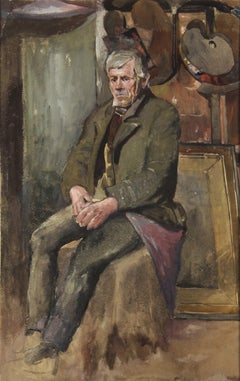
Adolph Eduard Otto von Faber du Faur (1828 Ludwigsburg - 1901 Munich). Man sitting in the studio. Watercolour painting, 43 x 27 cm (visible size), 73 x 53 cm (frame), monogrammed at lower right, estate stamp.
Upper right corner neatly repaired, small tear in the wall to the left of the sitter.
- Thinking about art -
About the artwork
The sitter, an elderly man, is seated in a studio on a pedestal reminiscent of an academy hall. The earthy, dark tones give the scene a weighty quality. The lightest tones are found in the incarnate parts of the figure, which do not stand out from the other colours of the picture, but are linked to them. As a result, the sitter's face is both part of and the highlight of the colour references in the picture. The colour of the sitter's skin is reflected in his pink coat, while his white-grey hair matches the colour of the wall next to him. This almost monochrome wall surface, in turn, is connected across the portrait to the framed picture standing on the floor, which seems to have been erased by this correspondence with the empty wall surface. Through the palette, which is positioned directly behind the sitter's head, the reference to painting, which is already given by the studio space, is explicitly linked to the sitter, who thus seems to be contemplating the question of the meaning of art.
This raises the question of whether Faber Du Faur, who had become lonely in his old age, might have painted a self-portrait here in his later years. In addition to the studio setting, the sitter's explicit reference to the palette and the fact that the picture was part of his estate, the only summary elaboration of the body suggests a self-portrait, while the representation of the face is concretised with the wide-open eyes typical of a self-portrait. This concentration on the face gives the impression of the artist's melancholy introspection, captured by the palette and related to the meaning of painting, whose dark character is reinforced by the concealment of the palette hanging on the right of the picture in the light tones so characteristic of Faber Du Faur. In the course of this resignation, Faber du Faur advises his son Hans, who has also become a painter: "Promise me one thing: never move to Munich, they'll kill you here!"
Whoever the sitter may be, the references to painting make the portrait a resigned self-contemplation by Faber Du Faur, focused on art.
About the artist
After leaving school, Otto Faber du Faur entered the service of the Württemberg army, at the same time cultivating his artistic talent. In 1851, on the recommendation of his father Christian Wilhelm, who was himself a battle painter, he spent six months in Munich as an apprentice to Alexander von Kotzebue. In 1852 he was granted a year's leave of absence from military service to study battle painting in the studio of Adolphe Yvon...
Category
Realist 1890s Interior Drawings and Watercolors
Materials
Watercolor
Related Items
"Masha
s fairy tales" watercolor cm. 17 x 22 1970
Located in Torino, IT
Children, illustrations, tales
Marina Evgenevna USPENSKAYA (Moscow, 1925 – 2007)
Marina Evgenevna Uspenskaya was born in Moscow. She graduated from the 1905 Art College, where she ...
Category
Realist 1890s Interior Drawings and Watercolors
Materials
Paper, Watercolor

$1,801 Sale Price
25% Off
H 14.97 in W 13 in
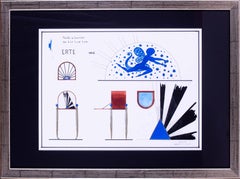
Erte original furniture art deco designs in ink, gold paint and watercolour
Located in Petworth, West Sussex
Romain de Tirtoff, called ERTE (Russian/French, 1892-1990)
Meuble a Courrier
Ink, gold paint and watercolour
Inscribed with details (upper left) and signed with studio stamp (lower right)
11.1/2 x 15.1/8 in. (29.3 x 38.5 cm.)
Provenance: The personal collection of the artist
Gifted to Serge Leeman and thence by descent
Romain de Tirtoff, commonly known as Erté, is widely recognized as the most influential artist of the Art Deco movement. His distinguished career spanned over 80 years and crossed over into several mediums including fashion illustration, stage and costume design and bronze sculpture.
Erté was born on November 23, 1892 in St. Petersburg, Russia. His father was a military man...
Category
Art Deco 1890s Interior Drawings and Watercolors
Materials
Ink, Watercolor
$2,059
H 11.5 in W 15.13 in D 1 in
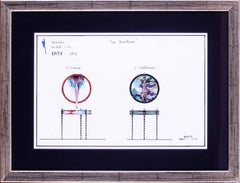
Original Erte Art Deco table watercolour and ink designs, 20th Century
Located in Petworth, West Sussex
Romain de Tirtoff called ERTE (Russian/French, 1892-1990)
Les emotions: La Tristesse et l’Indifference
Ink and watercolour
Inscribed with details and signed with studio stamp (lower...
Category
Art Deco 1890s Interior Drawings and Watercolors
Materials
Paper, Ink, Watercolor
$2,204
H 9.63 in W 14.13 in D 1 in
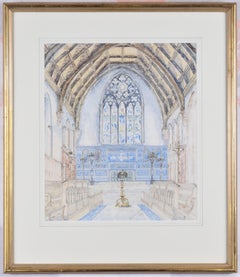
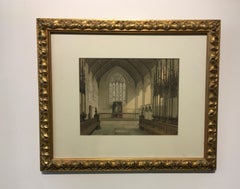
Historic English Chapel Interior,
by Unknown, Watercolor Painting
Located in Oklahoma City, OK
This framed and matted 16" x 19" watercolor painting by an Unknown artist depicts an historic English chapel interior. The interior of the church features the large stained glass window pane...
Category
Realist 1890s Interior Drawings and Watercolors
Materials
Watercolor
$400 Sale Price
20% Off
H 16 in W 19 in D 1 in
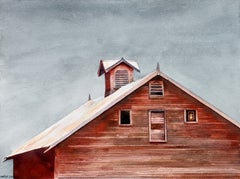
For the Prodigal, Original Painting
By Dwight Smith
Located in San Francisco, CA
Artist Comments
Barns stand as a sanctuary for many farms across America. In this painting, a lit lantern in a high window of the structure acts as a guiding light under the ...
Category
Realist 1890s Interior Drawings and Watercolors
Materials
Watercolor
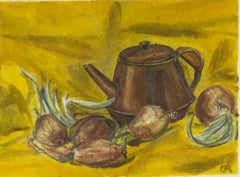
Brown teapot surrounded by red onions on Yellow background
By Glenora Richards
Located in New Orleans, LA
Glenny created beautiful miniature watercolors, mostly still life. This image of a bronze teapot with red onions is a unique work of art.
Glenora Rich...
Category
Realist 1890s Interior Drawings and Watercolors
Materials
Watercolor
$71 Sale Price
25% Off
H 2 in W 2.5 in
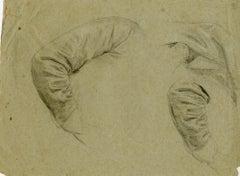
Studies of arms in draped sleeves
Located in Middletown, NY
Charcoal and graphite on grayish laid paper, 10 1/2 x 7 3/4 inches (265 x 195 mm), the full sheet. Scattered light, minor and unobtrusive foxing, several non-archival cellophane tape...
Category
Italian School 1890s Interior Drawings and Watercolors
Materials
Handmade Paper, Laid Paper, Graphite, Charcoal
$450
H 10.44 in W 7.68 in
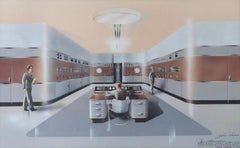
RCA Design Art Deco Streamline Mid Century Modern American Scene Architectural
By John Vassos
Located in New York, NY
RCA Design Art Deco Streamline Mid Century Modern American Scene Architectural
John Vassos (1898-1985)
RCA 50 D Transmitter and Control Desk
12 x 19 1/2 (sight)
Mixed media on boar...
Category
Art Deco 1890s Interior Drawings and Watercolors
Materials
Mixed Media, Board
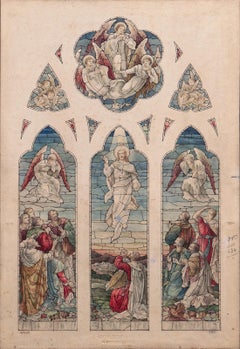
Study for a Stained Glass Window
, Devotional, Ecclesiastical, Pre-Raphaelite
Located in Santa Cruz, CA
A sensitively drawn and highly-detailed study for a three-panel set of stained glass windows showing the ascension of Jesus by angels and mortals.
Initialed, lower right, 'EB-J', an...
Category
Academic 1890s Interior Drawings and Watercolors
Materials
Ink, Watercolor, Gouache
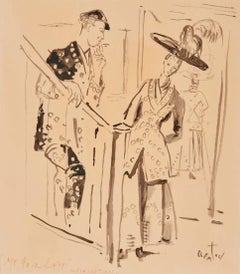
"My Fair Lady" 1958 West End Theatre Costume Drawing Mid 20th Century Modern
By Cecil Beaton
Located in New York, NY
"My Fair Lady" 1958 West End Theatre Costume Drawing Mid 20th Century Modern
Cecil Beaton (1904 – 1980) "My Fair Lady," Pen and ink on paper. ...
Category
Performance 1890s Interior Drawings and Watercolors
Materials
Paper, Ink, Pen
$20,000
H 21 in W 19 in D 2 in
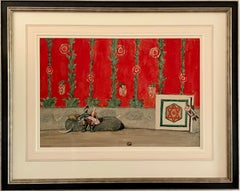
Claude Shepperson - Petrushka - Watercolour scene from the Ballets Russes
By Claude Allin Shepperson
Located in London, GB
CLAUDE ALLIN SHEPPERSON, ARA, ARWS
(1867-1921)
Petrushka – Scene from the Ballets Russes
Signed l.l.: Shepperson
Watercolour over traces of pencil on paper
Framed
30.5 by 45.5 cm., 12 by 18 in.
(frame size 52.5 by 66 cm., 20 ¾ by 26 in.)
Provenance:
Richard C Davis...
Category
Realist 1890s Interior Drawings and Watercolors
Materials
Watercolor, Paper
Distant Echoes, Original Painting
Located in San Francisco, CA
Artist Comments
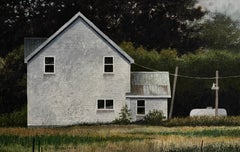
Bathed in quiet light, a weathered farmhouse radiates a sense of history and solitude. The faded clapboard siding, rusted tin roof, and simple lines stand resil...
Category
Realist 1890s Interior Drawings and Watercolors
Materials
Watercolor
Previously Available Items
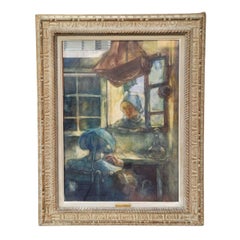
Pastel Impressionism Intimate Blue Scene Gaston La Touche, France
By Gaston La Touche
Located in Valladolid, ES
Refine and unique pastel on paper by French artist Gaston La Touche. The work introduces us, as viewers, to a private and intimate setting, in which we see a woman peering through t...
Category
Impressionist 1890s Interior Drawings and Watercolors
Materials
Paper
H 38.98 in W 30.71 in D 1.58 in
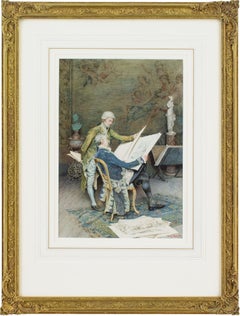
Giuseppe Signorini, The Connoisseurs
Located in Cheltenham, GB
This exquisite late-19th-century watercolour by Italian artist Giuseppe Signorini (1857-1932) depicts two art connoisseurs musing over an old master...
Category
Italian School 1890s Interior Drawings and Watercolors
Materials
Paper, Watercolor, Gouache
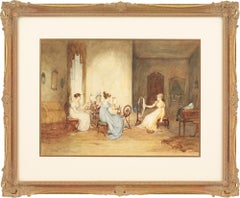
George H Hay, Spinning Wool, Watercolour
Located in Cheltenham, GB
This late 19th-century watercolour by Scottish artist George H Hay RSA (1831-1912) depicts four young ladies, wearing outfits synonymous with the 1820s, spinning wool within a simple...
Category
Romantic 1890s Interior Drawings and Watercolors
Materials
Paper, Watercolor
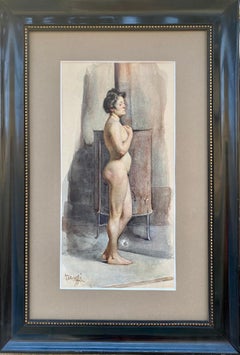
Italian Art nouveau Nude Boudoir painting woman warming herself by a stove Paris
By Tito Lessi
Located in Norwich, GB
A very pure and tender rendition of a female nude. Elegant in its simplicity, the artist's model, is warming herself by a large stove!
It is a work by Tito Lessi dating from circa 1890. Lessi was born in Florence, Italy and studied at the Florentine Academy of Fine Arts, under Enrico Pollastrini and Antonio Ciseri...
Category
Academic 1890s Interior Drawings and Watercolors
Materials
Watercolor, Laid Paper
H 18.9 in W 12.6 in D 0.4 in
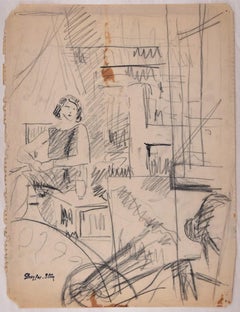
Interior Scene Sketch - Original Charcoal Drawing by J. Dreyfus-Stern
Located in Roma, IT
Interior Scene Sketch is an original artwork realized in pencil by Jean Dreyfus Stern in the first decades of the XX Century.
Pencil on paper.
Hand signed by the artist in ink on...
Category
1890s Interior Drawings and Watercolors
Materials
Charcoal
H 13.59 in W 10.24 in D 0.04 in
"Breaking Surf"
Located in Southampton, NY
Original watercolor by the American artist, George Howell Gay. Signed lower left. Circa 1895. Some condition issues. Repaired tear by signature. Two small scratches top left sky. Sm...
Category
Academic 1890s Interior Drawings and Watercolors
Materials
Paper, Watercolor
French Watercolor - Cathedral Interior
Located in Houston, TX
Uniquely hued watercolor of the interior of a classical, 1894. Signed lower right.
Original artwork on paper displayed on a white mat with a gold border. Archival plastic sleeve ...
Category
1890s Interior Drawings and Watercolors
Materials
Paper, Watercolor
Still Thinking About These?
All Recently ViewedMore Ways To Browse
Horse Painting Gold Frame
Horse Polo Paint
Hunt Double Bunnies
Hunt Etchings
Hunt Slonem Bunnies Heart
Hunt Slonem Heart Bunny
Hunt Slonem Oval
Hunt Slonem Parrots
Hunt Slonem Peace Plan
Hunt Slonem Rabbit
Irving Petlin
Isle Of Arran
Italian Fields Painting
J Harvey Painting
J Macdonald
Jack Frost Vintage
Jackie Stewart
Jaguar Xk