1 of 7
Kate MillettStudy For Lesbian Body Poster1977
1977
Price:$1,020.71
$1,400List Price
About the Item
- Creator:Kate Millett (1934 - 2017, American)
- Creation Year:1977
- Dimensions:Height: 12 in (30.48 cm)Width: 18 in (45.72 cm)
- Medium:
- Movement Style:
- Period:
- Condition:
- Gallery Location:New York, NY
- Reference Number:1stDibs: LU5182248683
Authenticity Guarantee
In the unlikely event there’s an issue with an item’s authenticity, contact us within 1 year for a full refund. DetailsMoney-Back Guarantee
If your item is not as described, is damaged in transit, or does not arrive, contact us within 7 days for a full refund. Details24-Hour Cancellation
You have a 24-hour grace period in which to reconsider your purchase, with no questions asked.Vetted Professional Sellers
Our world-class sellers must adhere to strict standards for service and quality, maintaining the integrity of our listings.Price-Match Guarantee
If you find that a seller listed the same item for a lower price elsewhere, we’ll match it.Trusted Global Delivery
Our best-in-class carrier network provides specialized shipping options worldwide, including custom delivery.You May Also Like
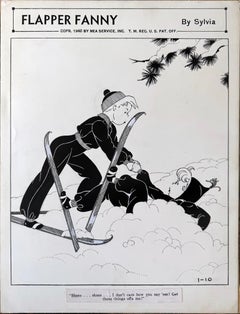
Flapper Fanny - Female Cartoonist of the Golden Age
Located in Miami, FL
Flapper Fanny - Female Cartoonist of the Golden Age
Sylvia Sneidman was originally a fashion illustrator, but assumed the helm of the famous jazz-age panel cartoon "Flapper Fanny Sa...
Category
1940s American Modern Figurative Drawings and Watercolors
Materials
India Ink, Archival Paper
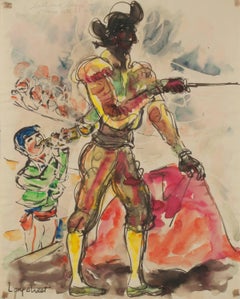
Bull Ring Brass - Mexico City
By Stephen Longstreet
Located in Fairlawn, OH
Bull Ring Brass - Mexico City
Watercolor, pen and ink on paper, 1955
Signed in ink, dated and titled in pencil (see photos)
Condition: 1'' repaired tear left edge, along with other minor tears.
Tape stains from previous matting visible in the four corners
Image/Sheet size: 19 3/8 x 15 5/8 inches
Provenance: Acquired directly from the Artist
Joseph M. Erdelac, Cleveland, friend and
patron of Longstreet
Stephen Longstreet (1907-2002)
The artist’s own grandchildren attempt to fathom the real life and nature of Stephen Longstreet, prolific author, artist, screenplay writer, and jazz aficionado.
Born Chauncy Weiner (sometimes spelled Wiener) in New York City in 1907, Longstreet reinvented himself on a regular basis. Changing his name first to “Henry,” then “Henri,” he started his career as a commercial artist for a department store. In various public biographies he claimed to have studied in New York, London, and Paris, and said he was a student of cartoonist Ralph Barton (1891-1931). Facts that can be documented are that he was art editor for Golfer and Sportsman magazines, and was a contributor to various other magazines including The New Yorker, Saturday Evening Post, Colliers, Life, and Hooey, among others. He wrote sketches for NBC radio and the Rudy Vallee Show.
In the 1930s, Longstreet worked and wrote under the names Thomas Burton, David Ormsbee, and Paul Haggard...
Category
1950s American Modern Figurative Drawings and Watercolors
Materials
India Ink, Watercolor, Pen
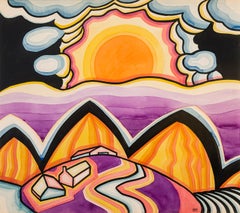
Woodstock
By Winold Reiss
Located in New York, NY
Signed (in white gouache, at lower left): Winold Reiss; (with estate stamp, at lower right): Winold /
Reiss
Category
20th Century American Modern Abstract Drawings and Watercolors
Materials
Ink, India Ink
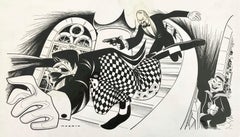
Man w Gun "Sleuth" Original Ink Drawing Theater Film Caricature Illustration Art
Located in Surfside, FL
Samuel Norkin (January 10, 1917 – July 30, 2011) was a Brooklyn, New York-born cartoonist who specialized in theater caricatures for more than even decades. His drawings of theater, opera, ballet and film celebrities appeared in Variety, Backstage, The Philadelphia Inquirer, The Washington Post, Los Angeles Times, The Boston Globe and many other publications.
Norkin learned composition and anatomy from the muralist Mordi Gassner. He received a scholarship to the Metropolitan Art School after his high school graduation, and he later attended Cooper Union, the Brooklyn Museum Art School and the School of Fine and Industrial Art. During the 1940s, newspaper editors wanted to devote more space to new theatrical productions, but photo opportunities usually did not happen until a show opened. Norkin took advantage of the situation and gained access to rehearsals, performers, costume sketches, fittings and scenic designs, providing editors with illustrations prior to an opening.
From 1940 to 1956, his theatrical illustrations were a regular feature in the New York Herald Tribune. Then for the next 26 years, he covered the performing arts for the Daily News. Since 1940, Norkin has had more than 4000 drawings published.
When he began doing theatrical caricature, he supplied his own captions, which eventually prompted him to write articles and reviews. He was an art critic for the Carnegie Hall house program and a cultural reporter for the Daily News.
Norkin's theater reminiscences and 266 drawings came together in the book Sam Norkin, Drawings, Stories (Heinemann, 1994), which was reviewed by David Barbour:
A Norkin caricature cartoon is often densely packed with detail and may feature a great deal of solid black space. He also is more daring in his drafting; many of his pieces, in particular one from the Broadway production of The Phantom of the Opera, feature steeply raked lines which plunge vertiginously from top to bottom, to highly dramatic effect. On the other hand, many of Norkin's effects border on the surreal. His version of Michael Jeter and Jane Krakowski in Grand Hotel depicts the pair as a series of interrlated curves; Jeter, in particular, looks like a machine that you crank up and let loose on stage. His version of Constance Cummings as a stroke victim in Wings, uses cruelly sharp angles to create a Cubist deconstruction of the actress's face and limbs, which mirrors the disintegration of the character's mental functions. Norkin offers a wide-ranging collection of his works... He also showscases actors at different points in their careers (as in a trio of portraits of John Gielgud and Ralph Richardson) and different takes on different productions (he gives us a number of Salomes from the Metropolitan and New York City Operas).
Exhibitions
Artwork by Norkin has been exhibited in the Lincoln Center Library and Museum of the Performing Arts, the Museum of the City of New York, the Metropolitan Opera House, the Hudson River Museum in (Yonkers, New York) and various galleries.
Awards
In 1942, Sam Norkin drew Joan Roberts, who was then starring on Broadway in Oklahoma!.
Various awards received over the years by Norkin include an award for "Outstanding Theater Art" from the League of American Theatres and Producers. (1980) and an award for “Lifetime Body of Work” (1995) from the Drama Desk, the association of drama critics, drama editors and drama reporters. Along with David Levine, Al Hirschfeld and Kin Platt he is one of the great artists of the American press. He received two awards from the National Cartoonists Society, the Special Features Award (1980) and the Silver T-Square Award (1984).
Sleuth is a 1970 play written by Anthony Shaffer. The Broadway production received the Tony Award for Best Play, and Anthony Quayle and Keith Baxter received the Drama Desk Award for Outstanding Performance. The play was adapted for feature films in 1972, 2007 and 2014.
The play is set in the Wiltshire manor house of Andrew Wyke, an immensely successful mystery writer. Wyke's home reflects his obsession with the inventions and deceptions of fiction and his fascination with games and game-playing. He lures his wife's lover Milo Tindle to the house and convinces him to stage a robbery of her jewelry, a proposal that sets off a chain of events that leaves the audience trying to decipher where Wyke's imagination ends and reality begins.
Shaffer said the play was partially inspired by one of his friends, composer Stephen Sondheim, whose intense interest in game-playing is mirrored by the character of Wyke, and by John Dickson Carr.
Paul Rogers and Keith Baxter in the Broadway production of Sleuth (1971)
Directed by Clifford Williams, Sleuth opened on 12 January 1970 at the Royal Theatre in Brighton, England. The play eventually transferred to the United States and opened on Broadway on November 12, 1970, at the Music Box Theatre, where it ran for 1,222 performances. Anthony Quayle and Keith Baxter starred as Andrew Wyke and Milo Tindle, with other parts listed as played by Stanley Wright, Sydney Maycock and Liam McNulty.
When Quayle left the production in 1972, he was succeeded by Paul Rogers, George Rose...
Category
20th Century American Modern Drawings and Watercolor Paintings
Materials
India Ink, Archival Paper
$650
H 11.8 in W 20 in D 0.13 in
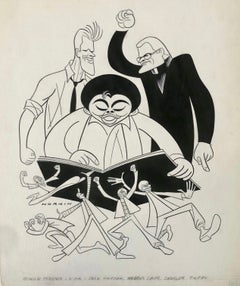
"Stand up Tragedy" Marcus Chong Original Ink Drawing Theater Caricature Art
Located in Surfside, FL
"Stand up Tragedy" - Jack Coleman, Marcus Chong & Charles Cioffi
Samuel Norkin (January 10, 1917 – July 30, 2011) was a Brooklyn, New York-born cartoonist who specialized in theater ...
Category
20th Century American Modern Drawings and Watercolor Paintings
Materials
Paper, India Ink
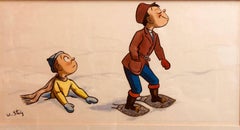
Whimsical Illustration "Snow" Cartoon, 1938 Mt Tremblant Ski Lodge William Steig
By William Steig (b.1907)
Located in Surfside, FL
Lighthearted Illustration of Outdoor Pursuits This one being cross country Snow Shoes signed "W. Steig"
Provenance: from Mrs. Joseph B. Ryan, Commissioned by ...
Category
1930s American Modern Figurative Drawings and Watercolors
Materials
India Ink, Watercolor, Illustration Board
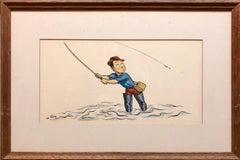
Whimsical Fishing Illustration Cartoon 1938 Mt Tremblant Ski Lodge William Steig
By William Steig (b.1907)
Located in Surfside, FL
Lighthearted Illustration of Outdoor Pursuits This one of a fisherman signed "W. Steig"
Provenance: from Mrs. Joseph B. Ryan, Commissioned by Joe Ryan for the bar at his ski resort, Mount Tremblant Lodge, in 1938.
Mont Tremblant, P.Q., Canada
Watercolor and ink on illustration board, sights sizes 8 1/2 x 16 1/2 in., framed.
In 1938 Joe Ryan, described as a millionaire from Philadelphia, bushwhacked his way to the summit of Mont Tremblant and was inspired to create a world class ski resort at the site. In 1939 he opened the Mont Tremblant Lodge, which remains part of the Pedestrian Village today. This original illustration is on Whatman Illustration board. the board measures 14 X 22 inches. label from McClees Galleries, Philadelphia, on the frame backing paper.
William Steig, 1907 – 2003 was an American cartoonist, sculptor, and, in his later life, an illustrator and writer of children's books. Best known for the picture books Sylvester and the Magic Pebble, Abel's Island, and Doctor De Soto, he was also the creator of Shrek!, which inspired the film series of the same name. He was the U.S. nominee for both of the biennial, international Hans Christian Andersen Awards, as a children's book illustrator in 1982 and a writer in 1988.
Steig was born in Brooklyn, New York in 1907, and grew up in the Bronx. His parents were Polish-Jewish immigrants from Austria, both socialists. His father, Joseph Steig, was a house painter, and his mother, Laura Ebel Steig, was a seamstress who encouraged his artistic leanings. As a child, he dabbled in painting and was an avid reader of literature. Among other works, he was said to have been especially fascinated by Pinocchio.He graduated from Townsend Harris High School at 15 but never completed college, though he attended three, spending two years at City College of New York, three years at the National Academy of Design and a mere five days at the Yale School of Fine Arts before dropping out of each.
Hailed as the "King of Cartoons" Steig began drawing illustrations and cartoons for The New Yorker in 1930, producing more than 2,600 drawings and 117 covers for the magazine. Steig, later, when he was 61, began writing children's books. In 1968, he wrote his first children's book. He excelled here as well, and his third book, Sylvester and the Magic Pebble (1969), won the Caldecott Medal. He went on to write more than 30 children's books, including the Doctor DeSoto series, and he continued to write into his nineties. Among his other well-known works, the picture book Shrek! (1990) formed the basis for the DreamWorks Animation film Shrek (2001). After the release of Shrek 2 in 2004, Steig became the first sole-creator of an animated movie franchise that went on to generate over $1 billion from theatrical and ancillary markets after only one sequel. Along with Maurice Sendak, Saul Steinberg, Ludwig Bemelmans and Laurent de Brunhofff his is one of those rare cartoonist whose works form part of our collective cultural heritage.
In 1984, Steig's film adaptation of Doctor DeSoto directed by Michael Sporn was nominated for the Academy Award for Best Animated Short Film. As one of the most admired cartoonists of all time, Steig spent seven decades drawing for the New Yorker magazine. He touched generations of readers with his tongue–in–cheek pen–and–ink drawings, which often expressed states of mind like shame, embarrassment or anger. Later in life, Steig turned to children's books, working as both a writer and illustrator.
Steig's children's books were also wildly popular because of the crazy, complicated language he used—words like lunatic, palsied, sequestration, and cleave. Kids love the sound of those words even if they do not quite understand the meaning. Steig's descriptions were also clever. He once described a beached whale as "breaded with sand."
Throughout the course of his career, Steig compiled his cartoons and drawings into books. Some of them were published first in the New Yorker. Others were deemed too dark to be printed there. Most of these collections centered on the cold, dark psychoanalytical truth about relationships. They featured husbands and wives fighting and parents snapping at their kids. His first adult book, Man About Town, was published in 1932, followed by About People, published in 1939, which focused on social outsiders. Sick of Each Other, published in 2000, included a drawing depicting a wife holding her husband at gunpoint, saying, "Say you adore me."
According to the Los Angeles Times, fellow New Yorker artist...
Category
1930s American Modern Figurative Drawings and Watercolors
Materials
India Ink, Watercolor, Illustration Board
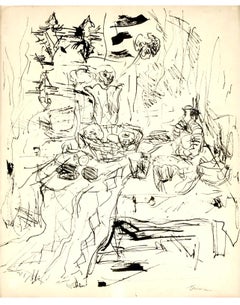
Original California Figurative Abstract Still Life Ink Drawing Joyce Treiman
By Joyce Treiman
Located in Surfside, FL
Joyce Treiman
Ink on paper, framed under glass; signed in pencil lower right;
Dimensions: 16 1/2 x 13 3/4 inches; 18 3/4 x 14 3/4 inches frame.
Joyce Wahl Treiman was an American painter, printmaker, sculptor and teacher. Her work ranged from "the impishly perverse and humorously paradoxical to the brilliant and profound." She was known as an excellent draftsperson throughout her career. She made several trips to Europe to study the old masters, and the human figure is central in her work. In her later paintings she is known to have inserted self-portraits. She attended Stephens College in Columbia, Missouri, and then studied at the State University of Iowa (today the University of Iowa) under the influential painter Philip Guston. During World War II she worked as a commercial artist but resigned when she began to have success with exhibitions of her work in Chicago and New York.
In 1945 she married Kenneth Treiman, and son Donald, now an Architect, was born in 1950. The Treimans, along with Rene and Rose Wahl, moved to Los Angeles in 1960. She was in an exhibit of Tamarind prints...
Category
Mid-20th Century American Modern Abstract Paintings
Materials
India Ink, Paper
$850
H 18.75 in W 14.75 in
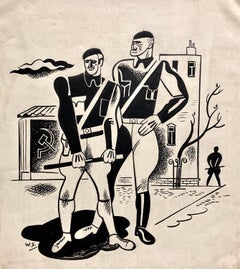
William Sanderson, Fascists
By William Sanderson
Located in New York, NY
Latvia-born William Sanderson became a contributor to the New Yorker and New Masses magazines during the 1930s. He was drafted into the Army during World Wa...
Category
1940s American Modern Figurative Drawings and Watercolors
Materials
India Ink
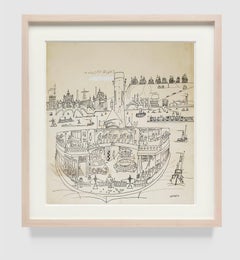
New York Harbor with Ferry boats and Victorian Houses - Holiday Magazine Cover
By Saul Steinberg
Located in Miami, FL
Steinberg's Holiday Magazine Cover, " The North of Jersey " is similar to his famous New Yorker Cover "View of the World from 9th Avenue”. ...
Category
1950s American Modern Landscape Drawings and Watercolors
Materials
India Ink, Gouache
$58,000
H 17.75 in W 15.5 in
Still Thinking About These?
All Recently ViewedMore Ways To Browse
Lesbian Art
Lesbian Painting
Nude Female Charcoal
Watercolor Ships
Ink Wash Painting
Modern Stained Glass Window
Scottish Watercolor
Scottish Watercolour
Watercolor Paintings Valleys
Surreal Collage
Standing Female Nude
Barn Watercolor
Conte Crayon Drawings
Vintage Felt Paintings
California Watercolor Artist
Landscape And Country Paintings
Lawrence Lee
Dutch Watercolour