Items Similar to Study for « Paysage de Fribourg » - 1943 a drawing by Balthus (1908 - 2001)
Want more images or videos?
Request additional images or videos from the seller
1 of 8
Balthus (Balthasar Klossowski de Rola) Study for « Paysage de Fribourg » - 1943 a drawing by Balthus (1908 - 2001)
$15,982.15
£11,939.90
€13,500
CA$22,254.35
A$23,911.06
CHF 12,828.24
MX$281,699.85
About the Item
Provenance: Frédérique Tison, Château de Chassy (Burgundy-Franche Comté - France)
Bibliography: J. Clair, V. Monnier Balthus, catalogue raisonné of the complete works, Gallimard, Paris 1999 - number D513 reproduced in black and white (page 231)
Related works :
• Another preparatory study (pencil on paper - 33x45.1 cm) is listed in the catalogue raisonné as D512
• A sketch in a sketchbook (catalogue raisonné reference CC1469/9)
• Paysage de Fribourg, an oil on canvas executed in 1944, dimensions 72 x 99 cm, referenced in the catalogue raisonné under number P146 (sold at Sotheby's on 4 December 1984 - number 71)
Balthus lived in Switzerland during the war and this preparatory study is a souvenir executed during the last days of his stay in Fribourg. Evoking the landscapes of the Italian primitives, he presents us with an immense, shadowless landscape, captured by the immobility of winter. The various preparatory studies allow us to better understand the artist's creative process.
1. Balthus, a unique artist in the art of the 20th century
Balthus occupies a special place in 20th century art, which is often marked by the legacy of Marcel Duchamp or turned towards abstraction. Balthus, on the contrary, presents figurative work, based on rigorous drawing and characterized by his ability to master form through meticulous construction. The work attracts and the artist disconcerts; there is somewhat of a "Balthus mystery", largely maintained and staged by the artist himself. During his lifetime, his work was the subject of numerous exhibitions organised in the world's greatest museums (at the Musée des Arts Décoratifs in Paris in 1966, at the Tate Gallery in London in 1968, at the Centre Pompidou in Paris and at the Metropolitan Museum of Art in New York in 1983-1984, and at the Palazzo Grassi in Venice in 2001, to name but a few).
Balthus was born on 29 February 1908 into a cosmopolitan family; his father was of Prussian and Polish origin and his mother, Elsa Dorothea Spiro, nicknamed Baladine, was of Ashkenazi and Russian descent. At the beginning of the war, his family took refuge in Switzerland, where he stayed with his mother while his parents separated. In 1919, his mother met the poet Rainer Maria Rilke (1875 - 1926) who became her lover; Balthus (the nickname of the painter from which he chose his artist's name) was brought up in the artistic milieu of his mother's friends.
Balthus moved to Paris with his mother in 1924. He enrolled at the Grande Chaumière academy and frequented Pierre Bonnard's studio. In 1926, he travelled to Italy where he discovered the frescoes of Piero della Francesca and Masaccio, which had a lasting influence on his art. Influenced by the surrealists, he held his first solo exhibition in 1934. Alongside his paintings, which were increasingly successful, he created several theatre, ballet and opera sets, an activity he continued after the war. In 1938, he held his first exhibition in New York.
He married Antoinette de Watteville (1912-1997) in 1937 and the couple settled during the war first in Champrovent in Savoie, then in Fribourg in Switzerland where two of their sons were born and finally in Cologny near Geneva from 1942 onwards. In 1945 the couple separated and Balthus returned to Paris.
In 1953, Balthus, then aged 45, decided to move to the Château de Chassy in the Morvan region. He was soon joined there by his niece by marriage (the daughter of his brother Pierre Klossowski's wife from her first marriage), Frédérique Tison, who became his muse and mistress. At Chassy, facing the landscapes of the Morvan, in the immense space of the house, Balthus worked and created a huge number of works. His painting evolved to become closer to the fresco, in the manner of the Italian Renaissance masters.
Frédérique Tison accompanied Balthus to Rome when he was appointed Director of the Villa Medici by André Malraux in 1961. When they finally broke up in 1966, Balthus gave her Chassy where she settled. In 1962, during a trip to Japan, Balthus met Setsuko Ideta. She became his wife in 1967. In 1977, at the end of their time in Rome, they settled in a large chalet in Rossinière (Switzerland) where the painter lived until his death on 18 February 2001.
2. Description of the artwork
This landscape allows us to discover vast horizons with meandering views of the Sarine, the river that crosses Fribourg. The site is easily identifiable on a map of Fribourg and was probably drawn from the terrace of the Cordeliers convent, overlooking the other bank. The geometrically shaped hills rise towards the horizon; the landscape is structured by the many paths that cross it. A human presence is represented by a tiny, enigmatic silhouette on the edge of the river. The introduction of this figure allows us to measure the distance that separates us from the other bank and the immensity of this panorama. Like the landscapes depicted in the backgrounds of the Italian primitives, no shadows are represented, which gives this winter landscape a hypnotic strangeness.
The rather vaporous nature of the drawing, in which the landscape appears to be shrouded in a winter mist, contrasts with the precision with which the group of buildings and the few trees surrounding them in the foreground on the left are described. This meticulous description, together with the rather Germanic character of the building, evokes the precision of Dürer's landscapes.
3. Related works and creative process
A sketch kept in a sketchbook and another preparatory drawing give us a better understanding of the artist's creative process leading to the final painting.
It seems likely to us that the study in the sketchbook was the first idea for the painting and that Balthus subsequently studied the right-hand side (the drawing we are presenting) and the left-hand side of the painting in two separate studies that partly overlap (the house at the foot of the hill in our drawing being the one we find at the extreme right of the other study).
While in the final painting Balthus accurately reproduces the group of buildings on the right of our drawing, the group on the left of the other study is vastly simplified, while the river in the foreground is given a much more prominent place.
We have chosen to frame this preparatory drawing in a 17th century Spanish frame with faded gilding which further enhances the timelessness of this winter landscape.
Main bibliographic reference :
J. Clair, V. Monnier Balthus, catalogue raisonné of the complete works, Gallimard, Paris 1999
- Creator:Balthus (Balthasar Klossowski de Rola) (1908 - 2001, French)
- Dimensions:Height: 27 in (68.58 cm)Width: 31.75 in (80.65 cm)
- Medium:
- Movement Style:
- Period:
- Condition:Size : 14 3/4" x 19 11/16" (37.5 x 50 cm) Framed 27’’x 31 ¾” (68.7 x 80.7 cm).
- Gallery Location:PARIS, FR
- Reference Number:1stDibs: LU156829447272
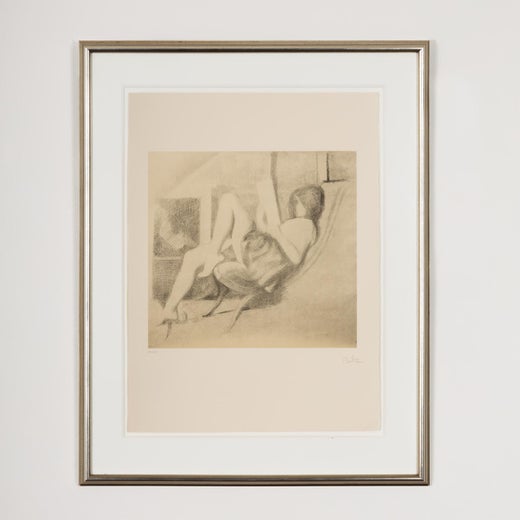
Balthus (Balthasar Klossowski de Rola)
Balthus was born on 29 February 1908 into a cosmopolitan family; his father was of Prussian and Polish origin and his mother, Elsa Dorothea Spiro, nicknamed Baladine, was of Ashkenazi and Russian descent. At the beginning of the war, his family took refuge in Switzerland, where he stayed with his mother while his parents separated. In 1919, his mother met the poet Rainer Maria Rilke (1875 - 1926) who became her lover; Balthus (the nickname of the painter from which he chose his artist's name) was brought up in the artistic milieu of his mother's friends. Balthus moved to Paris with his mother in 1924. He enrolled at the Grande Chaumière academy and frequented Pierre Bonnard's studio. In 1926, he travelled to Italy where he discovered the frescoes of Piero della Francesca and Masaccio, which had a lasting influence on his art. Influenced by the surrealists, he held his first solo exhibition in 1934. Alongside his paintings, which were increasingly successful, he created several theatre, ballet and opera sets, an activity he continued after the war. In 1938, he held his first exhibition in New York.
He married Antoinette de Watteville (1912-1997) in 1937 and the couple settled during the war first in Champrovent in Savoie, then in Fribourg in Switzerland where two of their sons were born and finally in Cologny near Geneva from 1942 onwards. In 1945 the couple separated and Balthus returned to Paris. In 1953, Balthus, then aged 45, decided to move to the Château de Chassy in the Morvan region. He was soon joined there by his niece by marriage (the daughter of his brother Pierre Klossowski's wife from her first marriage), Frédérique Tison, who became his muse and mistress. At Chassy, facing the landscapes of the Morvan, in the immense space of the house, Balthus worked and created a huge number of works. His painting evolved to become closer to the fresco, in the manner of the Italian Renaissance masters. Frédérique Tison accompanied Balthus to Rome when he was appointed Director of the Villa Medici by André Malraux in 1961. When they finally broke up in 1966, Balthus gave her Chassy where she settled. In 1962, during a trip to Japan, Balthus met Setsuko Ideta. She became his wife in 1967. In 1977, at the end of their time in Rome, they settled in a large chalet in Rossinière (Switzerland) where the painter lived until his death on 18 February 2001.
About the Seller
5.0
Vetted Professional Seller
Every seller passes strict standards for authenticity and reliability
Established in 2020
1stDibs seller since 2021
11 sales on 1stDibs
Typical response time: 3 hours
- ShippingRetrieving quote...Shipping from: PARIS, France
- Return Policy
More From This Seller
View AllStudy for "Getting up" – 1955, a preparatory drawing by Balthus (1908 -2001)
By Balthus (Balthasar Klossowski de Rola)
Located in PARIS, FR
In 1955, as he was residing at the Château de Chassy in the Morvan for two years, Balthus created a large painting entitled "Getting up". Balthus was inspired for this painting by t...
Category
1950s Modern Nude Drawings and Watercolors
Materials
Watercolor, Pencil
View of a Mansion in the South of France, a drawing by Claude-Joseph Vernet
By Claude-Joseph Vernet
Located in PARIS, FR
We would like to thank Madame Beck-Saiello for confirming the autograph nature of this drawing after an in-person examination.
It was probably during an excursion in the countryside near Avignon that Claude-Joseph Vernet executed this drawing, enhanced with pen and brown ink, depicting a mansion on a hilltop overlooking a small village with geometric shapes.
1. Joseph Vernet, a painter influenced by Italy
Claude-Joseph Vernet was born in Avignon in 1714, the son of Antoine Vernet (1689-1753), an artisan painter of architectural decorations, coach panels, and the like. He moved to the studio of Philippe Sauvan (1697-1792), a leading history painter in Avignon, and then worked with Jacques Viali (active 1681-1745), a decorative, landscape, and marine painter in Aix-en-Provence. Vernet's first recorded paintings were decorative overdoors executed in 1731 in the Aix townhouse of the marquise de Simiane. In 1734, Joseph de Seytres, marquis de Caumont, a leading amateur in Avignon, sponsored Vernet to make a study trip to Italy to complete his artistic education and to draw antiquities for his patron.
As Avignon was a papal territory in Vernet's day, he also had a number of useful introductions among influential churchmen when he arrived in Rome. Vernet was soon at home in the French community there, and he was encouraged by Nicolas Vleughels (1668-1737), director of the Académie de France in Rome, even though the young painter had no official affiliation with the royal institution. He likely entered the studio of the French marine painter Adrien Manglard...
Category
1730s Old Masters Landscape Drawings and Watercolors
Materials
Ink, Laid Paper, Pen, Carbon Pencil
View of Ariccia, a preparatory drawing by Achille Bénouville (1815 - 1891)
Located in PARIS, FR
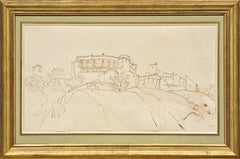
This very modern drawing presents a view of Ariccia, a small town 25 kilometres south-east of Rome. The Palazzo Chigi (in which the film-maker Luchino Visconti would film a large part of The Leopard a century later) and the adjoining church are seen from the bottom of the ravine that surrounds the town. This drawing is a moving testimony to the attraction of the city for artists of the Romantic period, who established in Ariccia a vivid artists' colony.
1. Achille Bénouville...
Category
1850s Romantic Landscape Drawings and Watercolors
Materials
Ink, Gouache, Pencil
Study for the Spring (preparatory to the Four Seasons) by René-Marie Castaing
Located in PARIS, FR
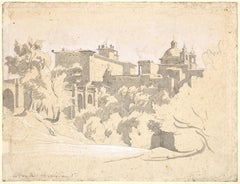
René-Paris Castaing, winner of the Grand Prix de Rome in 1924, left a large body of work, both sacred and secular. Many churches in the Pyrénées-Atlantiques, in South-West France still bear witness to the diversity of his talent. In 1942, he began a major decoration project for the Château de Diusse, in the north-east of the county, including an allegory of the four seasons. The vigorous pastel we are presenting here is a study for Spring, depicted as Flore undressing. This commission was a veritable swan song for the artist, who died a year later at the age of 47.
1. René-Marie Castaing, the great inter-war painter in Pau
René-Marie Castaing was born in Pau on December 16th 1896. His father, Joseph Castaing, was also a painter: he was the official portraitist of Pau's high society, which was particularly cosmopolitan at the end of the century, when many rich foreigners spent the winter in Pau, taking advantage of the mild weather to enjoy an outdoor lifestyle punctuated by hunting, horse ridings and golf.
René-Marie Castaing was admitted to the Ecole Nationale Supérieure des Beaux-Arts in Paris in April 1920 and entered the studio of Paul-Albert Laurens (1870-1934). In 1924, he was awarded the First Grand Prix de Rome for Painting, which earned him a stay at the Villa Médicis for more than three years. He then returned to Pau in 1928, where he lived until his death.
Castaing's work is marked by the academic tradition, in which drawing plays as important a role as painting. Although his drawings are often sketches that help to set up large painted compositions, they stand as independent artworks in which the artist fully expresses the vivacity of his talent.
Castaing was a fervent Christian and religious painting played an essential part in his work, as shown by the decorations he created for the churches of Bizanos, Borce, Bidache and Salies-de-Béarn. The painter also created several secular decorations, such as that for the dining room of the Villa Saint-Basil's in Pau in 1935, and the Hunting at the Albret’s time commissioned in 1940 by the Prefecture of Pau. The décor created in 1942-1943 for the Château de Diusse, a mansion located north-east of Pau, was his last large-scale décor, as the painter died shortly after its completion on December 8th 1943.
2. Description of the drawing
Our pastel depicts an eminently secular theme: Spring is embodied by Flore, crouching on the ground with one knee touching the ground. She reveals her ample bosom by removing her shirt, her arms raised above her shoulders to undress.
Given Castaing's classical training at the Beaux-Arts and the influence of ancient statuary...
Category
1940s Art Deco Nude Drawings and Watercolors
Materials
Pastel
Landscape with Trees and a Fisherman walking, a drawing by Jan Van Goyen
By Jan Josefsz Van Goyen
Located in PARIS, FR
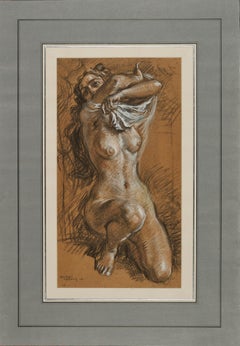
No Dutch draughtsman ever captured the atmosphere of the rural countryside of Holland with the same atmospheric and engaging simplicity that Van Goyen achieved in drawings such as this. Indeed, his landscapes were seminal in the development of the genre. The present sketch conveys a striking sense of movement within the natural landscape, conveyed by the deftly applied strokes of chalk, from which the artist’s hand can be sensed. The composition is characteristic of his work, with the low horizon affording significance to the broad sky and the soaring birds within. This feeling of windswept motion powerfully evokes the expansive Dutch farmland with which he was evidently preoccupied.
1. Jan van Goyen...
Category
1650s Old Masters Landscape Drawings and Watercolors
Materials
Chalk, Ink, Laid Paper
Study for a Hunting Scene, a red chalk sketch attributed to Karel du Jardin
Located in PARIS, FR
We would like to thank Carolina Trupiano Kowalczyk for suggesting this attribution to Karel du Jardin after direct examination of the artwork. Her study of the drawing (in Italian), ...
Category
1650s Old Masters Figurative Drawings and Watercolors
Materials
Chalk, Ink, Laid Paper
You May Also Like
Tuscan Landscape - Pencil Drawing i - 1930s
Located in Roma, IT
Tuscany Landscape is a beautiful pen and pencil drawing on cream-colored paper, realized in the 1930s by an Italian artist.
Good conditions with some foxing.
The artwork is realize...
Category
1930s Modern Figurative Drawings and Watercolors
Materials
Pen, Pencil

Paysage en Normandie by Georges Manzana Pissarro - Charcoal landscape
By Georges Henri Manzana Pissarro
Located in London, GB
Paysage en Normandie by Georges Manzana Pissarro (1871-1961)
Charcoal on paper
32 x 39 cm (12 ⅝ x 15 ⅜ inches)
Stamped lower right, Manzana Pissarro
Executed circa 1930
Artist biogr...
Category
1930s Post-Impressionist Landscape Drawings and Watercolors
Materials
Paper, Charcoal
Landscape - Drawing By Reynold Arnould - 1979
Located in Roma, IT
Landscape is a pencil drawing realized by Reynold Arnould (Le Havre 1919 - Parigi 1980).
Good condition on a yellowed paper.
No signature.
Reynold Arnould was born in Le Havre, ...
Category
1970s Modern Landscape Drawings and Watercolors
Materials
Paper, Pencil
Paysage - Drawing by Auguste Carrier - Early 20th Century
Located in Roma, IT
Watercolor on paper realized in the early 20th Century.
Hand signed lower left.
A delicate watercolor depicting a sunlit landscape of rolling hills and cultivated fields. Carrier e...
Category
Early 20th Century Modern Figurative Drawings and Watercolors
Materials
Watercolor
Landscape - Original Pencil on Paper by Marcel Mangin - Mid-20th Century
By Marcel Mangin 1
Located in Roma, IT
Landscape is an original pencil on paper realized by Marcel Mangin.
Signed on the lower right.
Good conditions except for a trace of humidity on the up...
Category
Early 20th Century Modern Figurative Drawings and Watercolors
Materials
Pencil
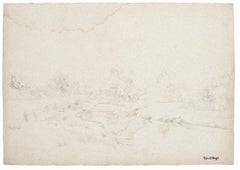
Landscape - Charcoal Drawing on Paper by R. Santerne-Early 20th Century
Located in Roma, IT
Landscape is a beautiful original drawing on paper realized by Robert Santerne between the 1930s and 1940s.
Stamped on the rear "Atelier R.Santerne"
Aged conditions with repaired r...
Category
Early 20th Century Modern Figurative Drawings and Watercolors
Materials
Paper, Charcoal
More Ways To Browse
Framed Drawings
Preparatory Drawing
Italian Fresco
Swiss Chalet
Klossowski Pierre
Stamp Collection
Antique Naples
Antique Animal Art
Black And White Landscape Photos
Portrait Of A Black Woman
Antique Oil Signs
Vintage Black Photos
Still Life Photography
Original Antique Paintings
Antique Frame Portrait
Venice Paintings
David Gray
Grace Kelly