Items Similar to Thun (Switzerland), Pastel and Pencil Painting by Charles March Gere

Want more images or videos?
Request additional images or videos from the seller
1 of 3
Charles March Gere, RA, RWSThun (Switzerland), Pastel and Pencil Painting by Charles March Gere20th Century
20th Century
$1,846.01
£1,350
€1,586.58
CA$2,569.36
A$2,756.47
CHF 1,478.51
MX$33,187.48
NOK 18,638.38
SEK 16,995.62
DKK 11,853.90
About the Item
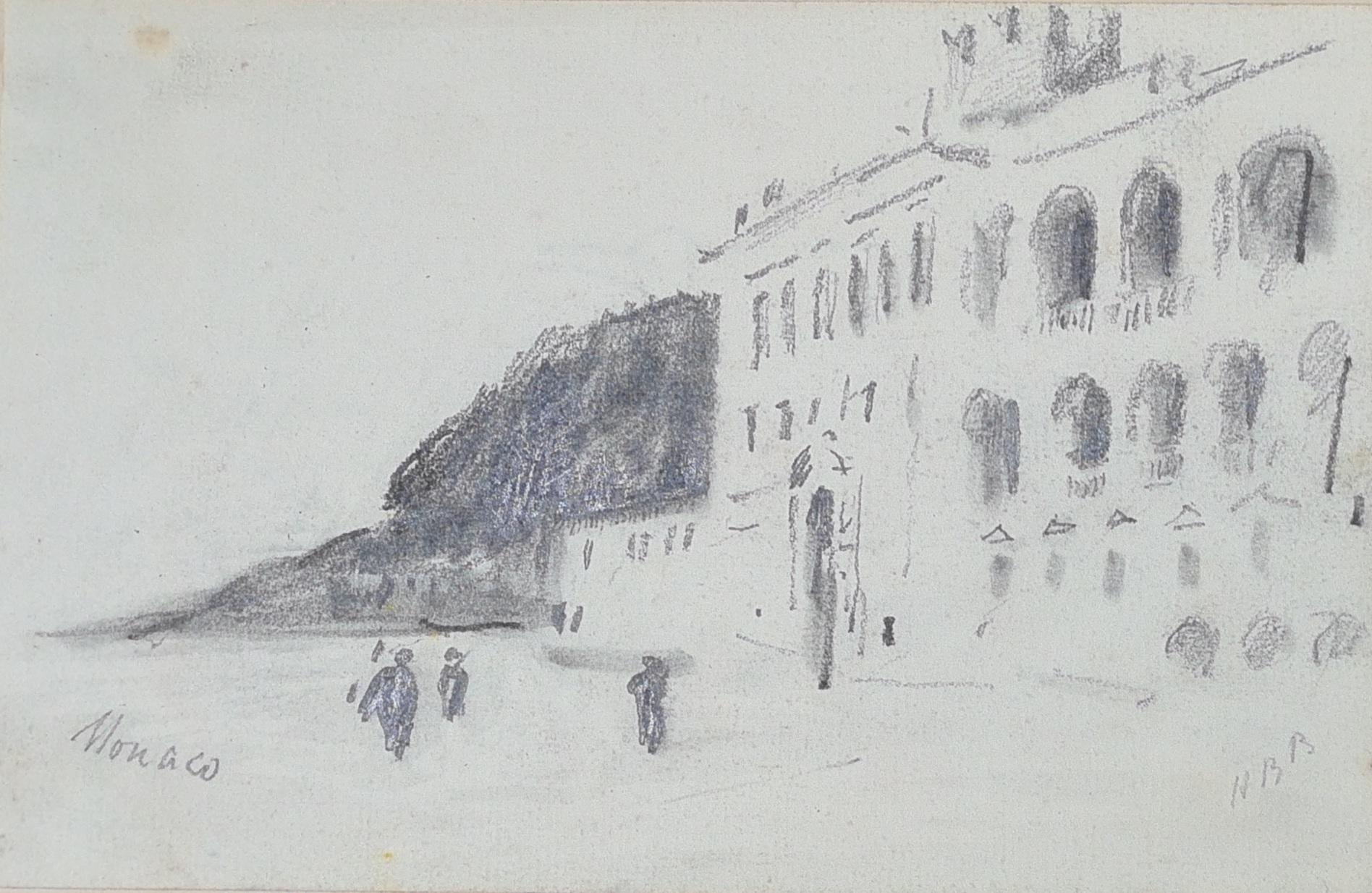
Thun (Switzerland), Pastel and Pencil Painting by Charles March Gere
Additional information:
Medium: Pastel and pencil
14 x 15.5 cm
5 1/2 x 6 1/8 in
Signed with monogram and title under mount
The Town of Thun is in the Canton of Bern in Switzerland, Gere visited on one of his many sketching tours of the Alps.
Charles March Gere RA RWS was an English painter, illustrator of books, and stained glass and embroidery designer associated with the Arts and Crafts movement.
He painted his signal work in 1897 entitled The Lady of Grey Days.The painting was purchased in 1912 and given to Aurora Howard, a descendant of the Earl of Carlisle (of Castle Howard). It was last seen in public in 1988 when it was included in the Barbican exhibition The Last Romantics and used as a poster to advertise the exhibition on most London Underground stations.
A member of the Birmingham Group of artist-craftsmen that formed around Joseph Southall, Gere taught at the Birmingham School of Art under Edward R. Taylor and illustrated many books for William Morris's 'Kelmscott Press', including the frontispiece to Morris's own News from Nowhere.
- Creator:Charles March Gere, RA, RWS (1884 - 1963, British)
- Creation Year:20th Century
- Dimensions:Height: 5.5 in (13.97 cm)Width: 6.125 in (15.56 cm)
- Medium:
- Period:
- Condition:
- Gallery Location:Kingsclere, GB
- Reference Number:1stDibs: LU2718214573882
Charles March Gere, RA, RWS
Gere was born in Gloucester and studied at the Birmingham School of Art under E R Taylor. He joined the staff of the art school in 1893. In the 1890s he worked as an illustrator, contributing to The Quest and books illustrated by the Birmingham Group and designing the frontispiece for William Morris’s News from Nowhere (Kelmscott Press, 1892). In his early career he was involved in a number of the arts and crafts, designing embroidery, metalwork and stained glass and painting the reredos in the Chapel at Madresfield. Gradually, however, he became almost exclusively a landscape painter. In about 1904 he and his sister Margaret settled in Painswick, near Stroud, and many of his subjects were found in the surrounding Cotswolds, which was to become his favourite painting ground. He exhibited at the New Gallery, Society of Painters in Tempera, Royal Academy, New English Art Club, Royal Watercolour Society and Art Workers Guild. A memorial exhibition was held in Gloucester in 1963.
About the Seller
No Reviews Yet
Vetted Professional Seller
Every seller passes strict standards for authenticity and reliability
Established in 2010
1stDibs seller since 2024
44 sales on 1stDibs
Typical response time: 5 hours
- ShippingRetrieving quote...Shipping from: Kingsclere, United Kingdom
- Return Policy
More From This Seller
View AllPainswick, Watercolour Over Pencil Painting by Charles March Gere, 1930s circa
By Charles March Gere, RA, RWS
Located in Kingsclere, GB
Painswick, Watercolour Over Pencil Painting by Charles March Gere, 1930s circa
Additional information:
Medium: Watercolour over pencil
15.5 x 29.5 cm
6 1/8 x 11 5/8 in
Signed and titled verso
Charles March Gere RA RWS was an English painter, illustrator of books, and stained glass and embroidery designer associated with the Arts and Crafts movement.
He painted his signal work in 1897 entitled The Lady of Grey Days.The painting was purchased in 1912 and given to Aurora Howard, a descendant of the Earl of Carlisle (of Castle Howard). It was last seen...
Category
20th Century Landscape Drawings and Watercolors
Materials
Watercolor
Lake Annecy, Oil on Board Painting by Peter Greenham
By Peter Greenham
Located in Kingsclere, GB
Lake Annecy, Oil on Board Painting by Peter Greenham 1909-1992
Additional information:
Medium: Oil on board
18 x 27 cm
7 1/8 x 10 5/8 in
Signed with initials
Provenance
Jonleigh Gallery, Surrey
Peter Greenham was a distinguished figurative painter of portraits, landscapes and incidents from domestic life. His work was both sensitive and intelligent and like himself, without showiness or pretension. He was keeper of the Royal Academy Schools and a popular figure who taught many well-known artists including Martin Yeoman, Peter Kuhfeld, Edmund Fairfax-Lucy and Jane Corsellis.
Greenham was born in Streatham and educated at Dulwich before studying English at Magdalen College, Oxford, followed by Fine Art at the Byam Shaw School of Art in Kensington from 1936-39 under the supervision of Ernest Jackson.
After leaving Byam Shaw he became a schoolmaster at Magdalen College School, Oxford and was elected an Associate of the Royal Academy in 1951 and an R.A. in 1960.
In 1964 he succeeded Sir Henry Rushbury as Keeper of the Royal Academy Schools, a position he held with distinction until his retirement in 1985. The Keeper has the responsibility of running the RA Schools and Greenham showed himself to have great sympathy and understanding for his students.
In retirement he was able to concentrate entirely on his painting and tended to paint places he knew well such as the Norfolk coast, Northumberland, Oxfordshire and Annecy as well as his wife, the painter Jane Dowling...
Category
20th Century Landscape Paintings
Materials
Board

From the Calcina, September (Venice), by Peter Greenham, 1991
By Peter Greenham
Located in Kingsclere, GB
From the Calcina, September (Venice), Watercolour over Pencil Painting, 1991
Additional information:
Medium: Watercolour over pencil
15.2 x 21.6 cm
6 x 8 1/2 in
Signed, dated and titled on the reverse
Peter Greenham was a distinguished figurative painter of portraits, landscapes and incidents from domestic life. His work was both sensitive and intelligent and like himself, without showiness or pretension. He was keeper of the Royal Academy Schools and a popular figure who taught many well-known artists including Martin Yeoman, Peter Kuhfeld, Edmund Fairfax-Lucy and Jane Corsellis.
Greenham was born in Streatham and educated at Dulwich before studying English at Magdalen College, Oxford, followed by Fine Art at the Byam Shaw School of Art in Kensington from 1936-39 under the supervision of Ernest Jackson.
After leaving Byam Shaw he became a schoolmaster at Magdalen College School, Oxford and was elected an Associate of the Royal Academy in 1951 and an R.A. in 1960.
In 1964 he succeeded Sir Henry Rushbury as Keeper of the Royal Academy Schools, a position he held with distinction until his retirement in 1985. The Keeper has the responsibility of running the RA Schools and Greenham showed himself to have great sympathy and understanding for his students.
In retirement he was able to concentrate entirely on his painting and tended to paint places he knew well such as the Norfolk coast, Northumberland, Oxfordshire and Annecy as well as his wife, the painter Jane Dowling...
Category
20th Century Landscape Drawings and Watercolors
Materials
Watercolor
Italian Scene, Pen and Ink with Wash Painting by Reginald Brill, 1950s circa
By Reginald Brill
Located in Kingsclere, GB
Italian Scene, Pen and Ink with Wash Painting by Reginald Brill, 1950s circa
Additional information:
Medium: Pen and ink with wash
33 x 48.3 cm
13 x 19 in
Reginald " Reggie" Brill was a versastile 20th century artist and teacher.
Brill was born in London in 1902 and spent his early childhood there and in Yorkshire. By the time of the First World War, at the age of 13, he was living in lodgings in London, working in a City office and attending St Martins School of Art in the evenings. Considering his lack of education, winning a scholarship to The Slade (now part of University College London) in 1921 where he studied under Henry Tonks for three years, was a huge achievement.
On leaving The Slade he found patronage in Lincolnshire, but by the time of the General Strike (1926) he had returned to London and was working on Lansbury's Labour Weekly. He married Rosalie, also an artist, and in 1927 won the Prix de Rome in Decorative Painting. Following two years at The British School in Rome, Brill went to teach at Blackheath School of Art. During 1930 he spent three months painting in Egypt and it was there that he met Col. T G Gayer-Anderson, one of the twin brothers who were to bequeath The Little Hall in Lavenham as a hostel for art students. It was there that Brill retired to act as warden, thus continuing his nurturing of art students until his death in 1972.
Brill took up his appointment at The School of Art, Kingston upon Thames in January 1934. It was situated in the Technical Institute (Kingston Hall Road) and Brill found it bohemian and disorganised. He proceeded to inject enthusiasm, order and discipline. Within 5 years of his appointment a purpose-built School of Art was opened in Knights Park. It remained open throughout the war and by 1945 there was a waiting list for places. Under the skilled and totally dedicated direction of Brill, Kingston School of Art became established with national reputation for excellence. In 1961 Sir Charles Wheeler opened the new building at Knights Park. Costing £100,000, this more than doubled the size of the Art School.
Brill, was a well-known figure in Kingston. His eloquence made him popular as a guest speaker and his promotion of Art and Design stretched well beyond the doors of Knights Park. Apart from establishing two of the main buildings which makeup what is now known as the Faculty of Design, one of the most visible local contributions he made was the setting up of a topographical collection of paintings depicting Kingston, which has since become known as The Brill Collection at Kingston Museum. Brill gained huge respect and admiration from the hundreds of pupils who studied at Kingston during his 30-year leadership.
He published two books, Modern Painting 1946 and Art as a Career 1962, both bearing a strong educational angle. He regularly exhibited along with leading artists of his era at The Royal Academy, both his paintings and his acutely observed drawings. All the while he was a prolific artist, although reading his diaries, intensely self-critical. His perfectionism, acute powers of observation and relentless research can be seen in his drawings, which via the media and methods he explored throughout his life reflect mid 20th century British Art at its most typical. His major series of work, known as 'The Martyrdom of Man', was carried on in parallel to his career as a teacher. These paintings reflect his care for fellow man and depict people at work, e.g., The Operation, The Jury, Linemen, Waiting Room and Rest, which recently sold at Sotheby’s and was specially restored for The Brill Retrospective. His smaller works also play with the theme of everyday events and communication amongst people, such as The Bull Ring and Market Place paintings.
Brill's name is associated particularly with human figure compositions, but he also worked on landscapes, portraits and details of plants, animals, interiors etc. As one would expect he moved from one media to another, and his unusual hand painted and cut paper mosaics...
Category
20th Century Landscape Paintings
Materials
Pen

Italian Landscape, Pen Painting by Reginald Brill, 1950 circa
By Reginald Brill
Located in Kingsclere, GB
Italian Landscape, Pen Painting by Reginald Brill, 1950 circa
Additional information:
Medium: Ink
20 x 34 cm
7 7/8 x 13 3/8 in
Reginald " Reggie" Brill was a versastile 20th century artist and teacher.
Brill was born in London in 1902 and spent his early childhood there and in Yorkshire. By the time of the First World War, at the age of 13, he was living in lodgings in London, working in a City office and attending St Martins School of Art in the evenings. Considering his lack of education, winning a scholarship to The Slade (now part of University College London) in 1921 where he studied under Henry Tonks for three years, was a huge achievement.
On leaving The Slade he found patronage in Lincolnshire, but by the time of the General Strike (1926) he had returned to London and was working on Lansbury's Labour Weekly. He married Rosalie, also an artist, and in 1927 won the Prix de Rome in Decorative Painting. Following two years at The British School in Rome, Brill went to teach at Blackheath School of Art. During 1930 he spent three months painting in Egypt and it was there that he met Col. T G Gayer-Anderson, one of the twin brothers who were to bequeath The Little Hall in Lavenham as a hostel for art students. It was there that Brill retired to act as warden, thus continuing his nurturing of art students until his death in 1972.
Brill took up his appointment at The School of Art, Kingston upon Thames in January 1934. It was situated in the Technical Institute (Kingston Hall Road) and Brill found it bohemian and disorganised. He proceeded to inject enthusiasm, order and discipline. Within 5 years of his appointment a purpose-built School of Art was opened in Knights Park. It remained open throughout the war and by 1945 there was a waiting list for places. Under the skilled and totally dedicated direction of Brill, Kingston School of Art became established with national reputation for excellence. In 1961 Sir Charles Wheeler opened the new building at Knights Park. Costing £100,000, this more than doubled the size of the Art School.
Brill, was a well-known figure in Kingston. His eloquence made him popular as a guest speaker and his promotion of Art and Design stretched well beyond the doors of Knights Park. Apart from establishing two of the main buildings which makeup what is now known as the Faculty of Design, one of the most visible local contributions he made was the setting up of a topographical collection of paintings depicting Kingston, which has since become known as The Brill Collection at Kingston Museum. Brill gained huge respect and admiration from the hundreds of pupils who studied at Kingston during his 30-year leadership.
He published two books, Modern Painting 1946 and Art as a Career 1962, both bearing a strong educational angle. He regularly exhibited along with leading artists of his era at The Royal Academy, both his paintings and his acutely observed drawings. All the while he was a prolific artist, although reading his diaries, intensely self-critical. His perfectionism, acute powers of observation and relentless research can be seen in his drawings, which via the media and methods he explored throughout his life reflect mid 20th century British Art at its most typical. His major series of work, known as 'The Martyrdom of Man', was carried on in parallel to his career as a teacher. These paintings reflect his care for fellow man and depict people at work, e.g., The Operation, The Jury, Linemen, Waiting Room and Rest, which recently sold at Sotheby’s and was specially restored for The Brill Retrospective. His smaller works also play with the theme of everyday events and communication amongst people, such as The Bull Ring and Market Place paintings.
Brill's name is associated particularly with human figure compositions, but he also worked on landscapes, portraits and details of plants, animals, interiors etc. As one would expect he moved from one media to another, and his unusual hand painted and cut paper mosaics...
Category
20th Century Landscape Paintings
Materials
Pen
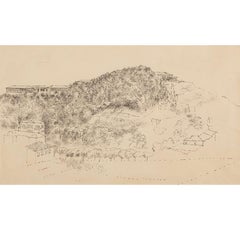
Horses by a Lake (Snowdonia), Watercolour on Linen Painting, 1926
By Charles March Gere, RA, RWS
Located in Kingsclere, GB
Horses by a Lake (Snowdonia), Watercolour on Linen Painting, 1926
Additional information:
Medium: Watercolour on linen
36.5 x 51.5 cm
14 3/8 x 20 1/4 in
Signed and dated
Charles March Gere RA RWS was an English painter, illustrator of books, and stained glass and embroidery designer associated with the Arts and Crafts movement.
He painted his signal work in 1897 entitled The Lady of Grey Days.The painting was purchased in 1912 and given to Aurora Howard, a descendant of the Earl of Carlisle (of Castle Howard). It was last seen...
Category
20th Century Landscape Drawings and Watercolors
Materials
Watercolor

You May Also Like
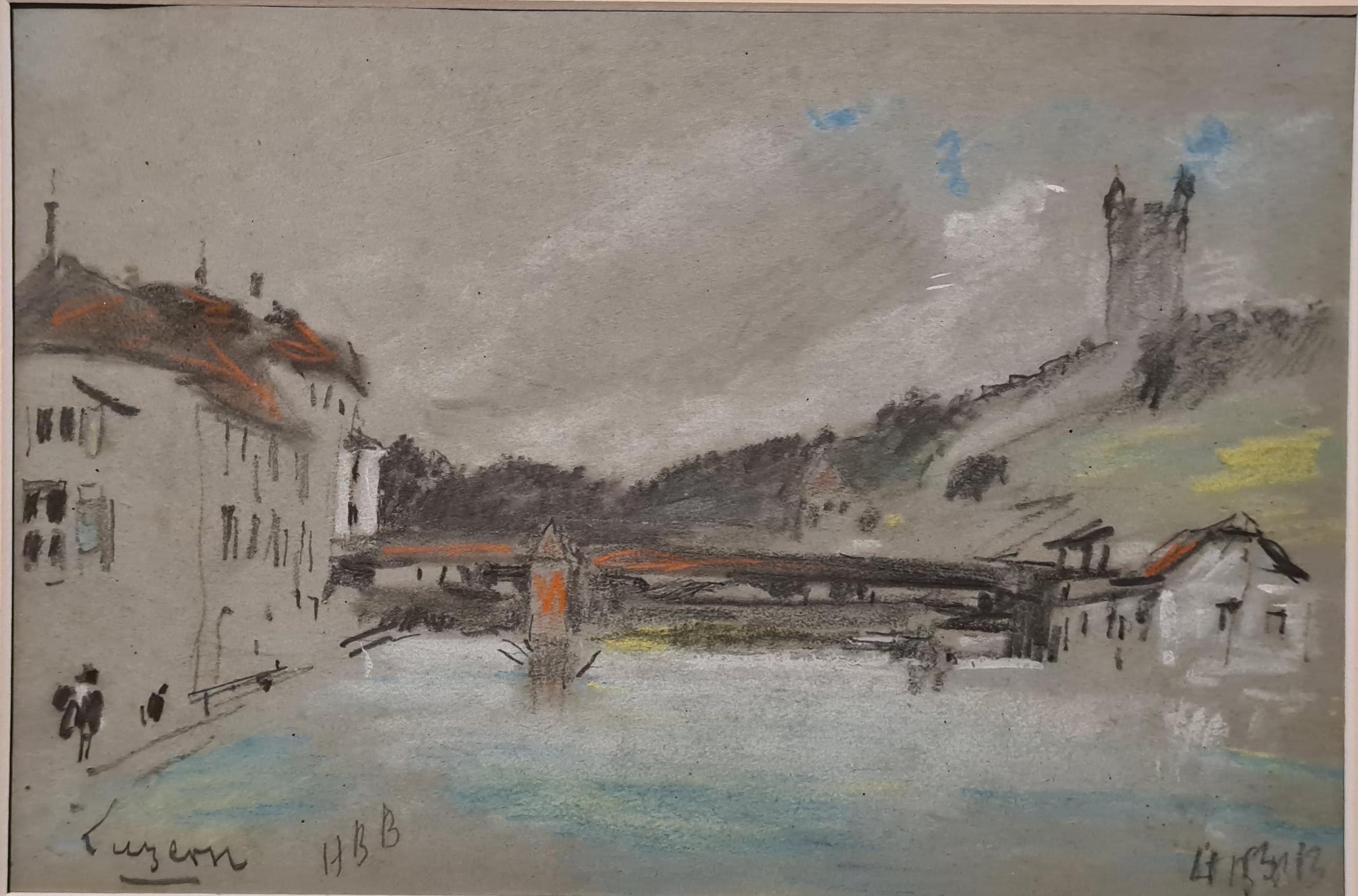
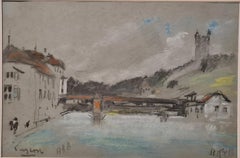
19th century pastel of a river scene, The Chapel Bridge, Lucerne, Switzerland.
By Hercules Brabazon Brabazon
Located in Cotignac, FR
Mid 19th century pastel drawing view of the Chapel Bridge and river Reuss in Lucerne, Switzerland by Hercules Brabazon Brabazon. The work...
Category
1860s Landscape Drawings and Watercolors
Materials
Paper, Pastel, Pencil
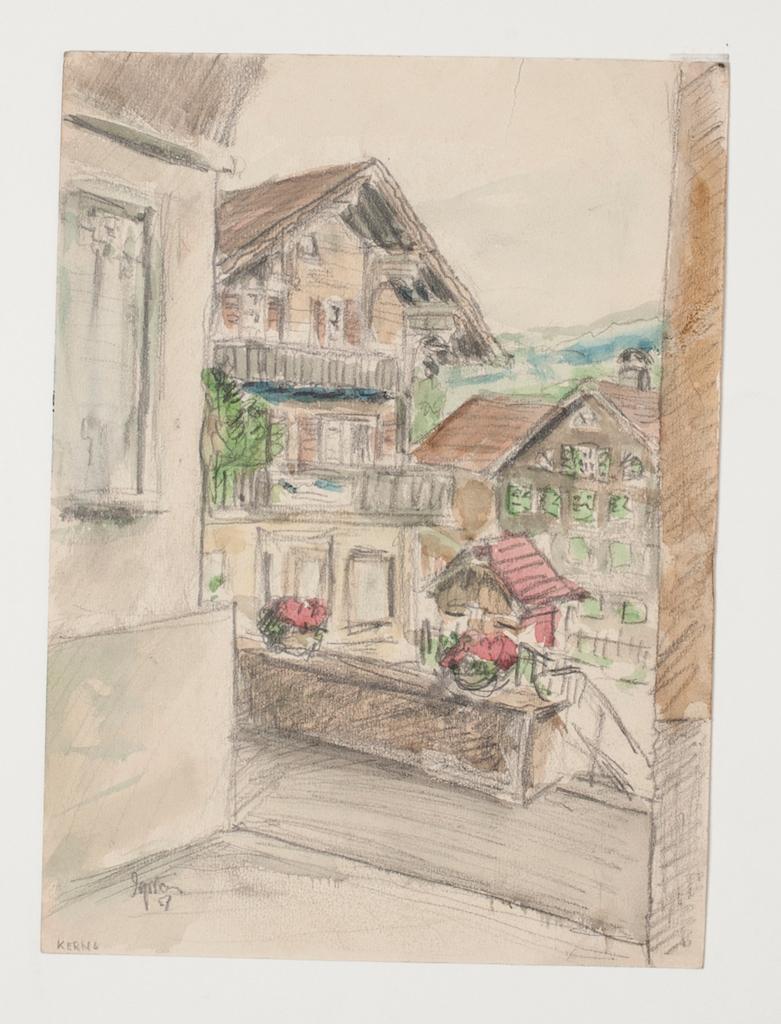
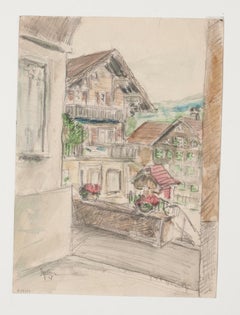
Mountain Village - Original Pencil and Pastel Drawing by Werner Epstein - 1957
By Werner Epstein 1
Located in Roma, IT
Mountain Village is an original drawing in pencil and pastel on paper realized in 1957 by Werner Epstein.
Hand-signed and dated on the lower left in pencil.
The state of preservation is very good except for a small rip at the top right.
Applied on a white Passepartout: 40 x 30 cm
The artwork represents a beautiful mountain village landscape...
Category
1950s Modern Figurative Drawings and Watercolors
Materials
Pencil, Pastel
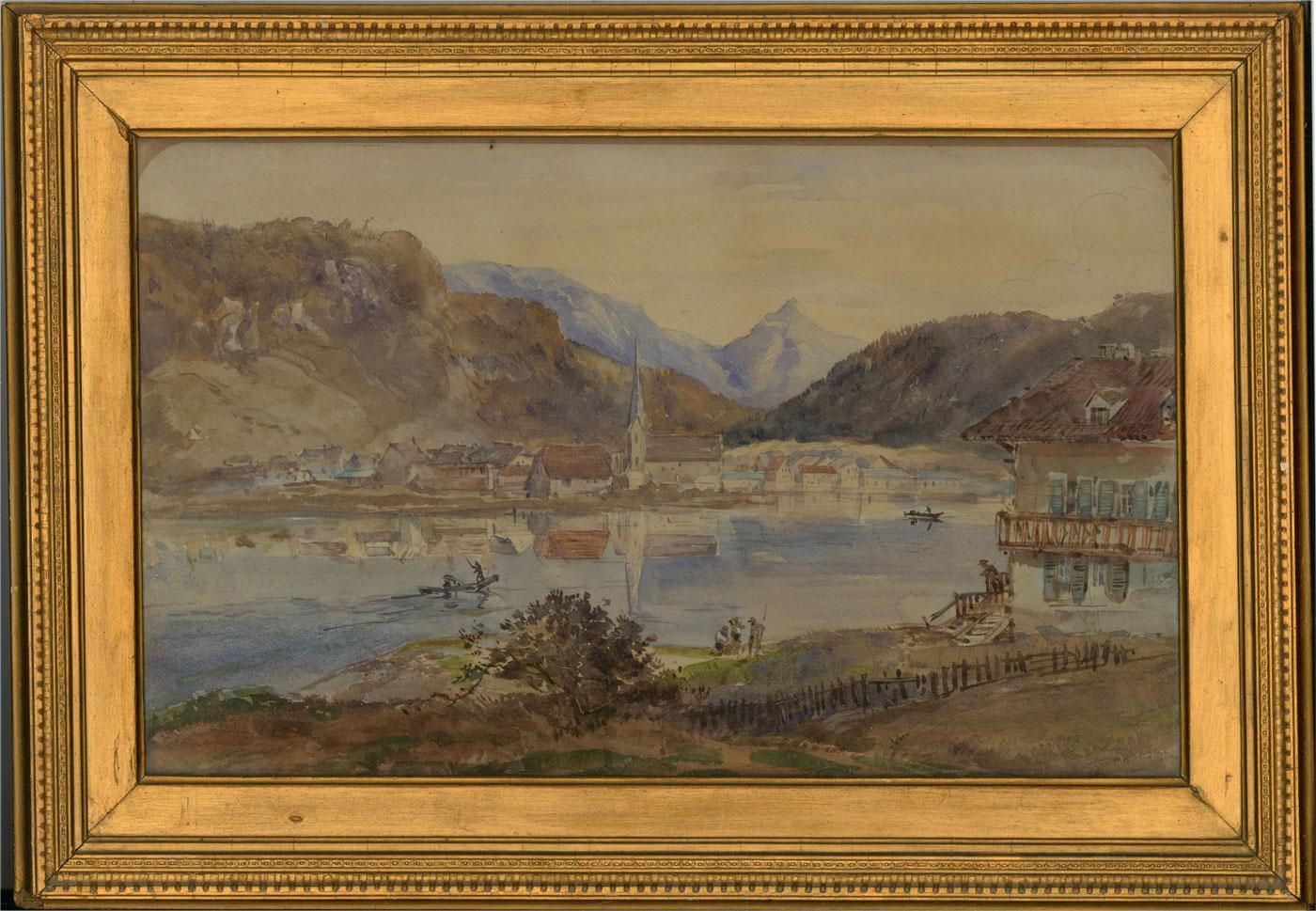
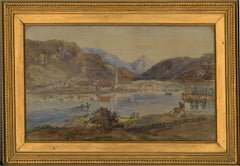
Early 20th Century Watercolour - Alpine Town
Located in Corsham, GB
A charming Alpine watercolour showing a pretty town, nestled in the valley of the great mountains beside a clear lake. A chalet can be seen to the right in the foreground with people fishing out front. The painting is unsigned and presented in a gilt effect cassetta frame...
Category
20th Century Landscape Drawings and Watercolors
Materials
Watercolor
$304 Sale Price
20% Off
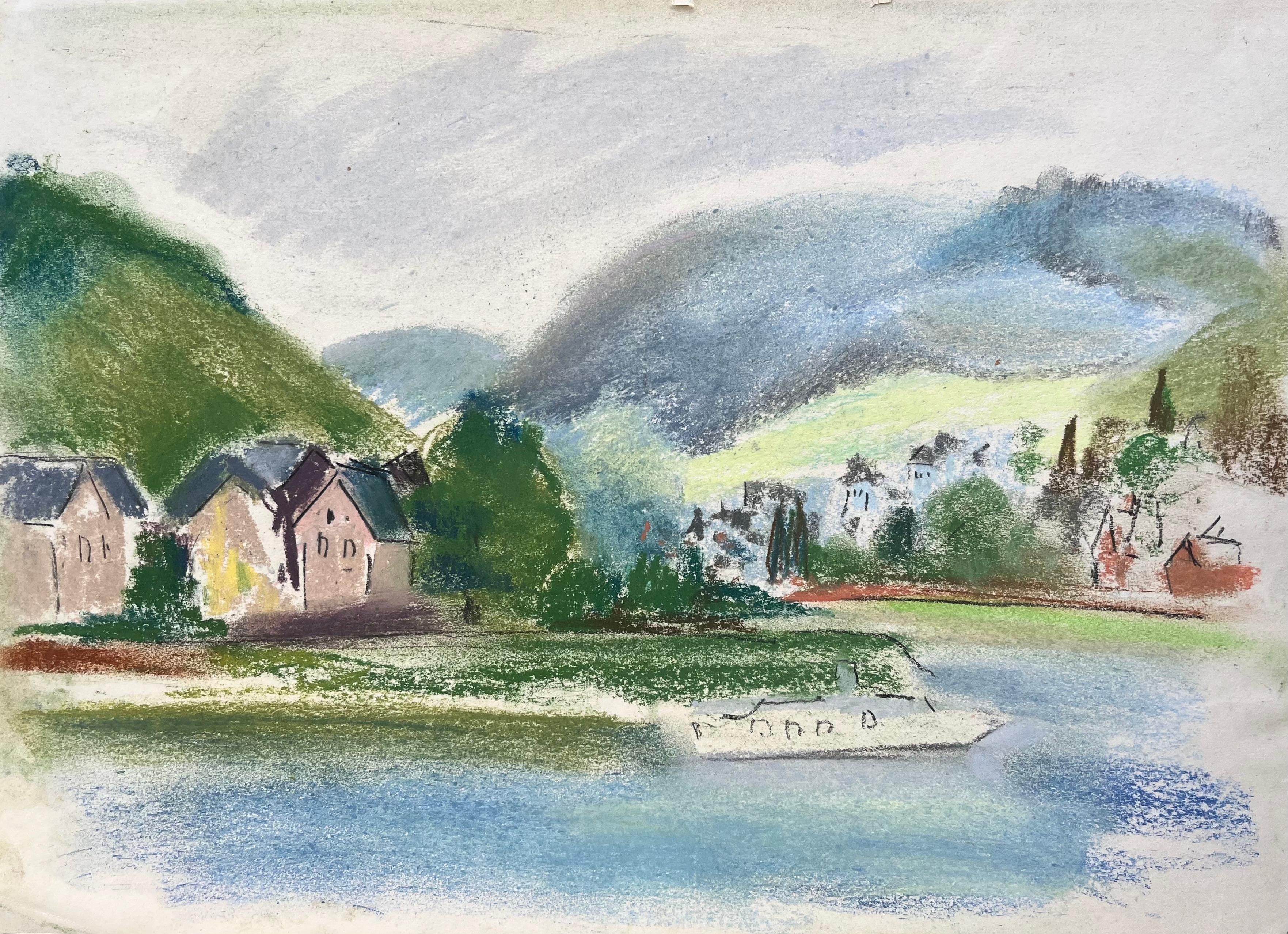
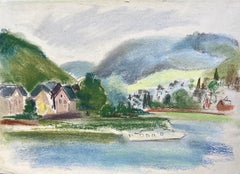
Mid-20th Century Pastel of Riverside Village and Boat in France
Located in Cirencester, Gloucestershire
Title: Mid-20th Century Pastel of Riverside Village and Boat in France
by Anne Marie Migette Perard (French 1902-1977)
Medium: Pastel on unframed paper
Size: 10.5 inches (height) x 1...
Category
Mid-20th Century Post-Impressionist Landscape Paintings
Materials
Pastel
$530 Sale Price
20% Off
19th Century Pastel
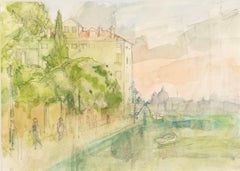
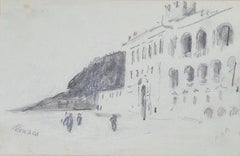
Pencil on Paper. The Royal Palace, Monte Carlo, Monaco.
By Hercules Brabazon Brabazon
Located in Cotignac, FR
Mid 19th century pastel drawing view of the Royal Palace, Monte Carlo, Monaco by British artist Hercules Brabazon Brabazon. The work is titl...
Category
Mid-19th Century Landscape Drawings and Watercolors
Materials
Paper, Pastel, Pencil
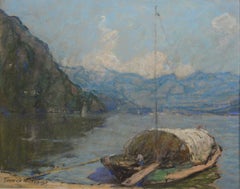
Early Twentieth Century Landscape Seascape Pastel Drawing of Bellagio Lake Como
By John Terrick Williams
Located in ludlow, GB
Early Twentieth Century Landscape Seascape Pastel Drawing of San Giovanni, Bellagio on Lake Como.
An atmospheric picture of a Fishing Vessel on the Lake with the hills in the background. It is an "en plein air" study that has beautiful light and shadows placing it firmly in the School of Post Impressionism.
John Terrick Williams...
Category
Early 20th Century Impressionist Landscape Drawings and Watercolors
Materials
Oil Pastel
More Ways To Browse
Vintage Marchal
Vintage Thun
Swiss Landscape Paintings
Landscape Painting Switzerland
Tatton Winter
Watercolor Redwoods
Bert Van Bork
Charles Criner
Church Architectural Drawings
Desert Mountain Landscape Watercolor
Emma Mendenhall
George Chinnery
John Linfield
Justin Faivre
Leonardo Cremonini
M Vernon
Maria Ada Gianni
Retro Donald Art Company