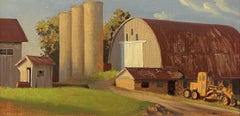
Items Similar to Amish Farmscape #2 Study
Want more images or videos?
Request additional images or videos from the seller
1 of 2
Edmund LewandowskiAmish Farmscape #2 Study1982
1982
$4,750
£3,614.06
€4,164.13
CA$6,743.51
A$7,234.58
CHF 3,880.48
MX$87,103.41
NOK 48,918.03
SEK 44,606.46
DKK 31,111.59
About the Item
Amish Farmscape #2, 1982, gouache, 9 x 12 inches, signed and dated lower right, label verso: “Artist-E. Lewandowski, Title- Amish Farmscape #2 STUDY, Date- 1982, Size- 9”x 12”, Medium- Gouache”, Provenance: Franklin Riehlman, Riverdale, New York, to Herman Zerweck, Ann Arbor, Michigan, 1996; Provenance: Richard Hartman, Gallery of Wisconsin, Wisconsin
Edmund Lewandowski was among the best of the second-generation Precisionists. He is credited with extending Precisionism to the Midwest and successfully evolving the style into the 1980s and 1990s with his Neo Immaculate works.
Lewandowski was born and raised in Milwaukee, Wisconsin, and studied at the Layton School of Art with Garrett Sinclair. He achieved early success in 1936 when two of his watercolors were shown at the Phillips Collection as part of a Federal Art Project exhibition. Then, in 1937, his work was first exhibited at Edith Halpert’s Downtown Gallery which represented Lewandowski into the 1950s. Under Halpert’s guidance, Lewandowski continued to explore watercolor as his main medium during the 1930s and 1940s, since the gallery already represented Charles Sheeler, who worked primarily in oils. Sheeler became Lewandowski’s major influence as the primary leader of the ill-defined, but very recognizable Immaculate School artists, which included other Downtown Gallery painters, Niles Spencer, George Ault, and Ralston Crawford, as well as Charles Demuth and Preston Dickinson, both of whom died at a young age and had been represented by the Charles Daniel Gallery. Sheeler is credited with giving Lewandowski technical advice on how to make his paintings more precise and by all accounts, Sheeler was a supporter of Lewandowski’s work.
Through the Downtown Gallery, Lewandowski’s paintings were accepted into major national and international exhibitions and purchased by significant museums and collectors. Franklin and Eleanor Roosevelt and Nelson Rockefeller acquired works by Lewandowski. He was included in the Museum of Modern Art’s important 1943 exhibition, American Realists and Magic Realists as well as juried exhibitions at the Whitney Museum of American Art, the Pennsylvania Academy of Fine Arts, and the Art Institute of Chicago. Lewandowski also completed commissions for magazines during the 1940s and 1950s, including several covers for Fortune. Throughout his career, Lewandowski explored urban and rural architecture, industry, machinery, and nautical themes. Looking back on his career, Lewandowski wrote, “My overwhelming desire as an artist through the years has been to record the beauty of man-made objects and energy of American industry on canvas. For as far back as I can recall, the cityscapes, farms and depictions of industrial power and technological efficiency have had a great attraction for me. I try to treat these observations with personal honesty and distill these impressions to a visual order.”
Late in his career, Lewandowski enjoyed a resurgence of popularity as he was represented during the 1980s by New York’s Sid Deutsch and Allison Galleries before joining Keogh
Riehlman during the 1990s. Lewandowski’s work was the subject of a retrospective, Edmund Lewandowski Precisionism and Beyond, organized by The Flint Institute of Arts in 2010. That exhibition traveled to the Mobile Museum of Art, Georgia Museum of Art and Winthrop University Galleries.
- Creator:Edmund Lewandowski (1914 - 1998, American)
- Creation Year:1982
- Dimensions:Height: 9 in (22.86 cm)Width: 12 in (30.48 cm)Depth: 1 in (2.54 cm)
- More Editions Sizes:9 x 12 inchesPrice: $4,750
- Medium:
- Movement Style:
- Period:
- Condition:
- Gallery Location:Los Angeles, CA
- Reference Number:1stDibs: LU1859216796392
Edmund Lewandowski
Regarded as a leading American precisionist and exemplary arts educator, Edmund D. Lewandowski once explained that his “overwhelming desire . . . through the years has been to record the beauty of man-made objects and energy of American industry,” a goal he successfully achieved in a career that spanned five decades and numerous locations, including the American Midwest, South, and New England. Born to Polish parents in Milwaukee, Wisconsin, Lewandowski attended the Layton School of Art, studying under regionalist artist Gerrit Sinclair. Inspired by Sinclair’s modern style and urban subjects, Lewandowski’s early paintings reflect a similar approach that would later evolve to industrial themes executed in a hard-edged precisionist manner. His most well-known subjects include chemical plants, shipyards, factories, farms, and oil rigs. Following graduation, Lewandowski worked as a public school teacher and commercial artist while pursuing his painting. His career took a significant step forward when, in 1936, his work caught the eye of the progressive art dealer Edith Halpert, who offered him representation at her celebrated Downtown Gallery in New York City. A key figure in modern art, Halpert encouraged Lewandowski to experiment with Precisionism and to remain in Milwaukee. In 1937, Lewandowski met Charles Sheeler, considered a leader in the American Precisionist movement, whose style would most significantly influence the younger artist’s career. Through his association with the Downtown Gallery and the work he executed for the Federal Art Project between 1936 and 1939, Lewandowski attracted important critical notice and was included in exhibitions at such notable institutions as the Metropolitan Museum of Art, Museum of Modern Art (Magic Realism exhibition), and Art Institute of Chicago during the 1940s alone. At the Downtown Gallery, he exhibited alongside other artists such as Charles Demuth, Georgia O'Keeffe, Ralston Crawford, George Ault, and Niles Spencer. Following military service as an Air Force mapmaker and camouflage artist from 1942–1946, Lewandowski joined the faculty of his alma mater, the Layton School of Art, in 1947. From that time on, he divided his time between creating art and teaching another generation of aspiring artists. His teaching career took him to institutions throughout the United States, including Florida State University. Following his tenure at Florida State, Lewandowski returned to Layton as its director, remaining until 1972. Throughout these years, the artist would create and exhibit works on paper and canvas, as well as execute commissioned large-scale mosaic murals. In 1973, Lewandowski joined the faculty at Winthrop University in Rock Hill, South Carolina, where he would serve as the art department chair until his retirement in 1984. Edmund Lewandowski’s art showcases an exacting technical skill honed in his early training and advanced by his relationship with Sheeler. His ultrarealistic works painted in watercolor, gouache, or oil range from early farmscapes to industrial scenes and marine subjects, a variety that reflects the artist’s constant quest for aesthetic evolution. Today, Lewandowski’s work can be seen at prestigious national museums.
About the Seller
5.0
Vetted Professional Seller
Every seller passes strict standards for authenticity and reliability
1stDibs seller since 2022
18 sales on 1stDibs
Typical response time: 2 hours
- ShippingRetrieving quote...Shipping from: Los Angeles, CA
- Return Policy
More From This Seller
View AllSnowy Barn #2
By Marina Stern
Located in Los Angeles, CA
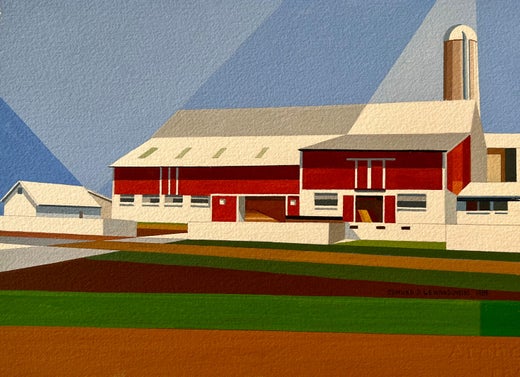
Snowy Barn #2, 1971, oil on canvas, signed and dated verso, 18 x 23 inches
Marina Stern was a multifaceted New York-based artist whose works ranged from Expressionism and Pop Art to the Neo Immaculate paintings and pastels for which she is best known. A native of Venice, Stern and her family fled in 1939 to escape Italy’s repressive racial laws. After living in England for several years, the family arrived in the United States in 1941. A bright and capable student, Stern graduated from New York’s Julia Richman High School at age 15 and soon enrolled in the Pratt Institute to pursue an interdisciplinary education in the arts. Despite majoring in advertising design, Stern favored her fine art courses. She graduated from Pratt in 1946 at age 18 and began working for advertising agencies.
After a brief marriage which ended in divorce, Stern married her second husband, who encouraged the artist to study at the Art Students League of New York, under the renowned Japanese American modernist, Yasuo Kuniyoshi. In Fall 1953, Stern gave birth to her first child, Michael, as she continued to study at the Arts Students League. Later in the Spring of 1957, Stern gave birth to her daughter Nina, as she continued to balance motherhood with her fine art practice and commercial art and design work.
Stern’s first significant exhibitions were in 1962 at the Waverly Gallery and the Osgood Gallery, both in New York, followed by inclusion of her work in the Bertha Schaefer Traveling Collage Show from 1963 to 1964. Stern made a splash in the avant-garde art world in 1964 when Time magazine reviewed a show at Amel Gallery which featured three of her audio-visual paintings. Time’s critic noted that Stern created the “cleverest noisemakers” in the exhibition. Time dubbed this work “Talkie Pop,” a label which Stern rejected. Following this recognition, Stern was selected for inclusion in The New American Realism at the Worcester Art Museum—a major showcase of leading artists, including Andy Warhol, Robert Indiana, Roy Lichtenstein, and Jasper Johns.
After the Worcester exhibition, Stern began to shift away from her “talking” Pop paintings to mysterious, interior scenes with orange, blue or black walls with windows or doors rising above black and white floors, often depopulated, but sometimes with figures. One of these works, Seven Minus Twenty-One Equals Seven, entered the permanent collection of New York’s Museum of Modern Art in 1966. By 1969, Stern began to incorporate industrial images into these scenes, and in the early 1970s, Stern created her first Neo-Immaculate works of rural, and urban landscapes, which she described as her most satisfying work. Stern often depicted locations that she held close -- New York, New Jersey, Iowa (where her son attended college), Sharon, Connecticut (where her family spent weekends and vacations) and her native Venice, Italy.
Stern’s success as a Neo Immaculate painter led to consistent New York gallery representation for over two decades, first with Lee Ault
Co and James Yu Gallery, and then Forum Gallery, where she had six solo shows. In 1971, Stern completed a Neo-Immaculate mural commission for the Port Authority of New York, George Washington Bridge #1 and #2, followed by another commission from the NY Cityarts Public Art Program in 1976 for a mural on Mulberry Street. Stern also enjoyed solo exhibitions in Boston (Eleanor Rigelhaupt Gallery), Connecticut (Silo Gallery, the Hotchkiss School, J. Rosenthal Fine Arts Gallery, Tremaine Gallery, and Staib Gallery), Chicago (Michael Rosenfeld Gallery), and Santa Fe (Santa Fe East Gallery). Her work was included in group shows at over a dozen public institutions, including The National Academy of Design, The Staten Island Museum, Worcester Art Museum, the Oklahoma Art Center, and the Arkansas Art Center. The Southern Alleghenies Museum of Art hosted a retrospective of four decades of Stern’s work from January 19 to April 22, 2007, entitled Perception and the Cultural Environment: The Paintings of Marina...
Category
1970s American Modern Landscape Paintings
Materials
Oil, Canvas
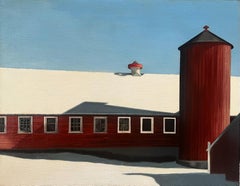
Orange Grove Landscape
By Dorr Bothwell
Located in Los Angeles, CA
Orange Grove Landscape, 1941, gouache on illustration board, 14 inches x 18 inches (image), 22 x 26 inches (framed) signed and dated lower right, newly framed with museum glazing
...
Category
1940s American Modern Paintings
Materials
Gouache, Board
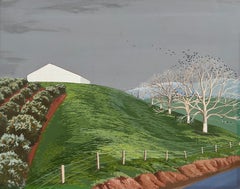
Pleasant Ridge
Located in Los Angeles, CA
Pleasant Ridge, 1966-7, oil on board, signed, dated and titled verso, 16 x 24 inches, exhibited: Robert Herrmann, Cincinnati Art Galleries, Cincinnati, OH, March 4 to 28, 2000, no. 1...
Category
Mid-20th Century American Modern Landscape Paintings
Materials
Masonite, Oil
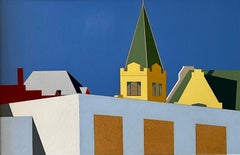
Suburb (in Winter)
Located in Los Angeles, CA
This painting is part of our exhibition Charles Goeller: A Wistful Loneliness.
Oil on canvas, 20 x 15 inches, Signed lower right
Exhibited:
1) Portrai...
Category
1940s American Modern Landscape Paintings
Materials
Oil
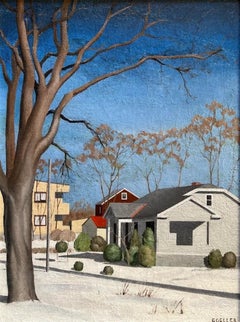
Landscape
Located in Los Angeles, CA
Landscape, c. 1930-40s, oil on panel, signed lower right, 16 x 20 inches
Jeanette Maxfield Lewis was a California-based landscape painter and etcher. Born in Oakland, she spent much...
Category
1930s American Modern Landscape Paintings
Materials
Oil, Panel
Untitled
Located in Los Angeles, CA
Untitled, c. 1940s, oil on Masonite, signed lower right, 19 ¾ x 25 ¾ inches
Ava Vorhaus Gabriel was a New York-based painter, lithographer, and designer. Born in Larchmont, Gabriel ...
Category
1940s American Modern Landscape Paintings
Materials
Masonite, Oil
You May Also Like
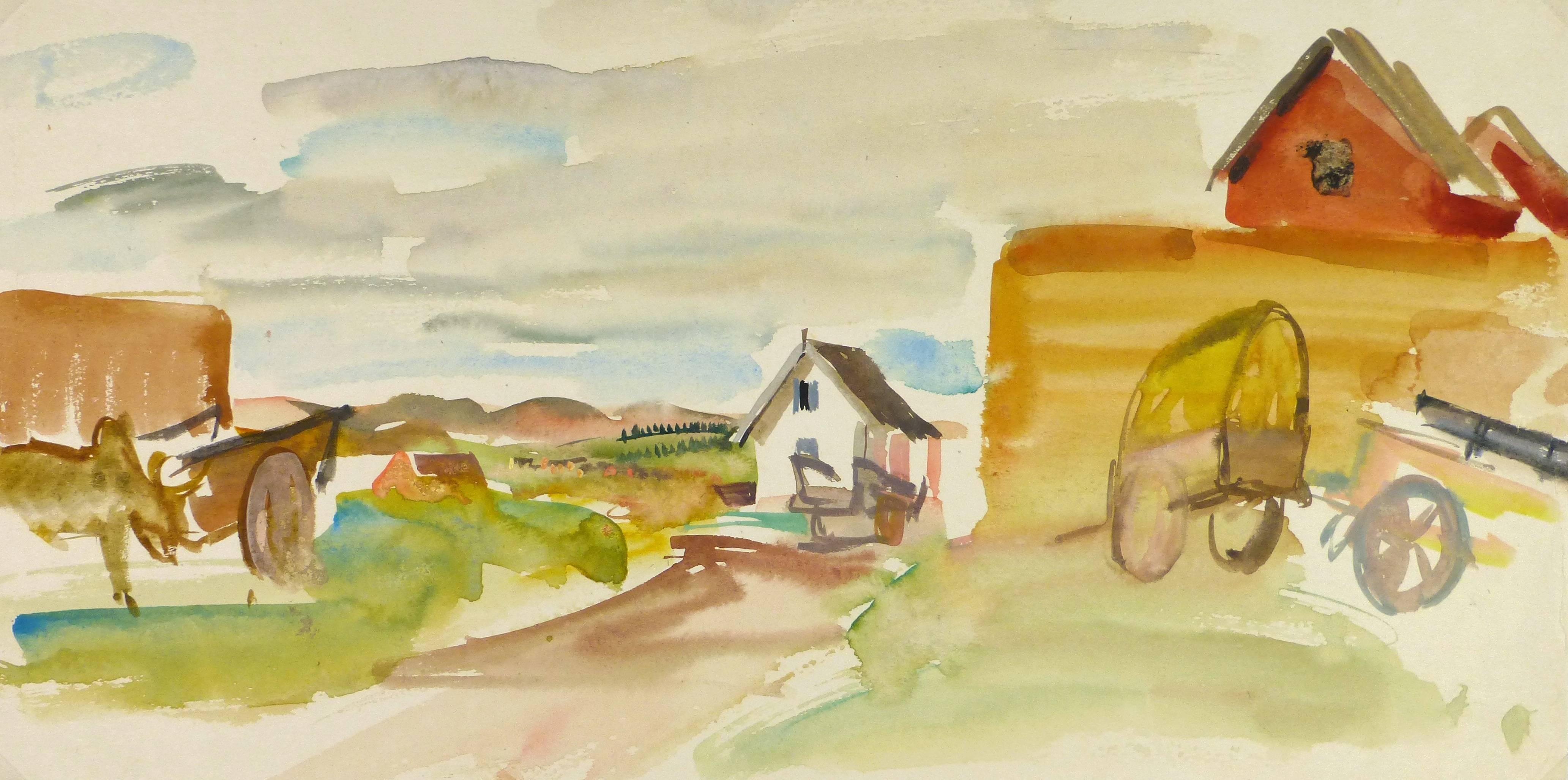
Serene Farm in Watercolors
By Stephane Magnard
Located in Houston, TX
Madagascan watercolor farm scene by French artist Stephane Magnard, circa 1950.
Original artwork on paper displayed on a white mat with a gold border. Archival plastic sleeve and C...
Category
1950s Landscape Drawings and Watercolors
Materials
Paper, Watercolor
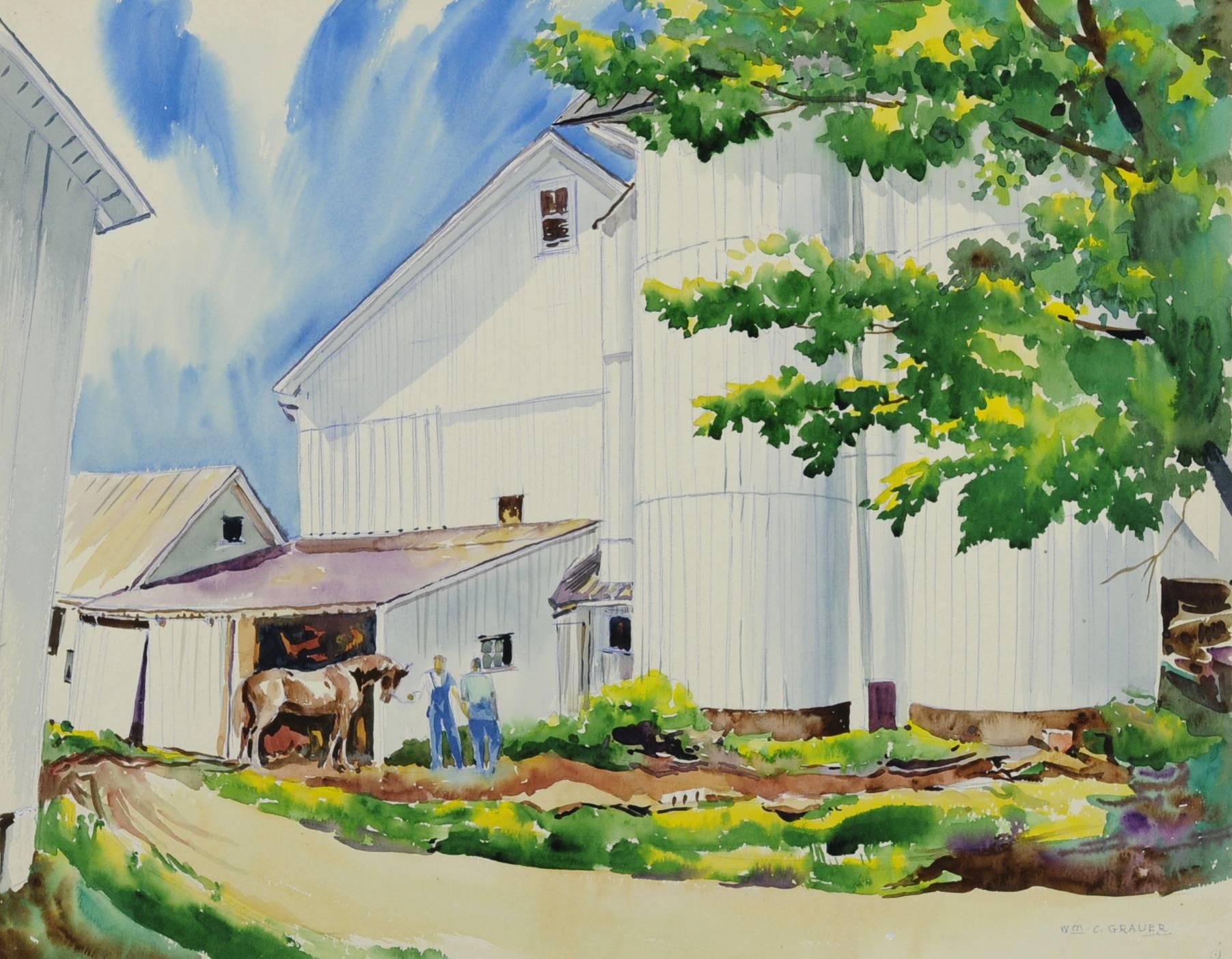
untitled (The White Barn with Farmers and Horse)
By William Grauer
Located in Fairlawn, OH
untitled (The White Barn with Farmers and Horse)
Watercolor, c. 1950
Signed by the artist in ink lower right: Wm. C. Grauer
Numbered in pencil verso: 152
Provenance:
Estate of the Ar...
Category
1950s American Realist Landscape Drawings and Watercolors
Materials
Watercolor
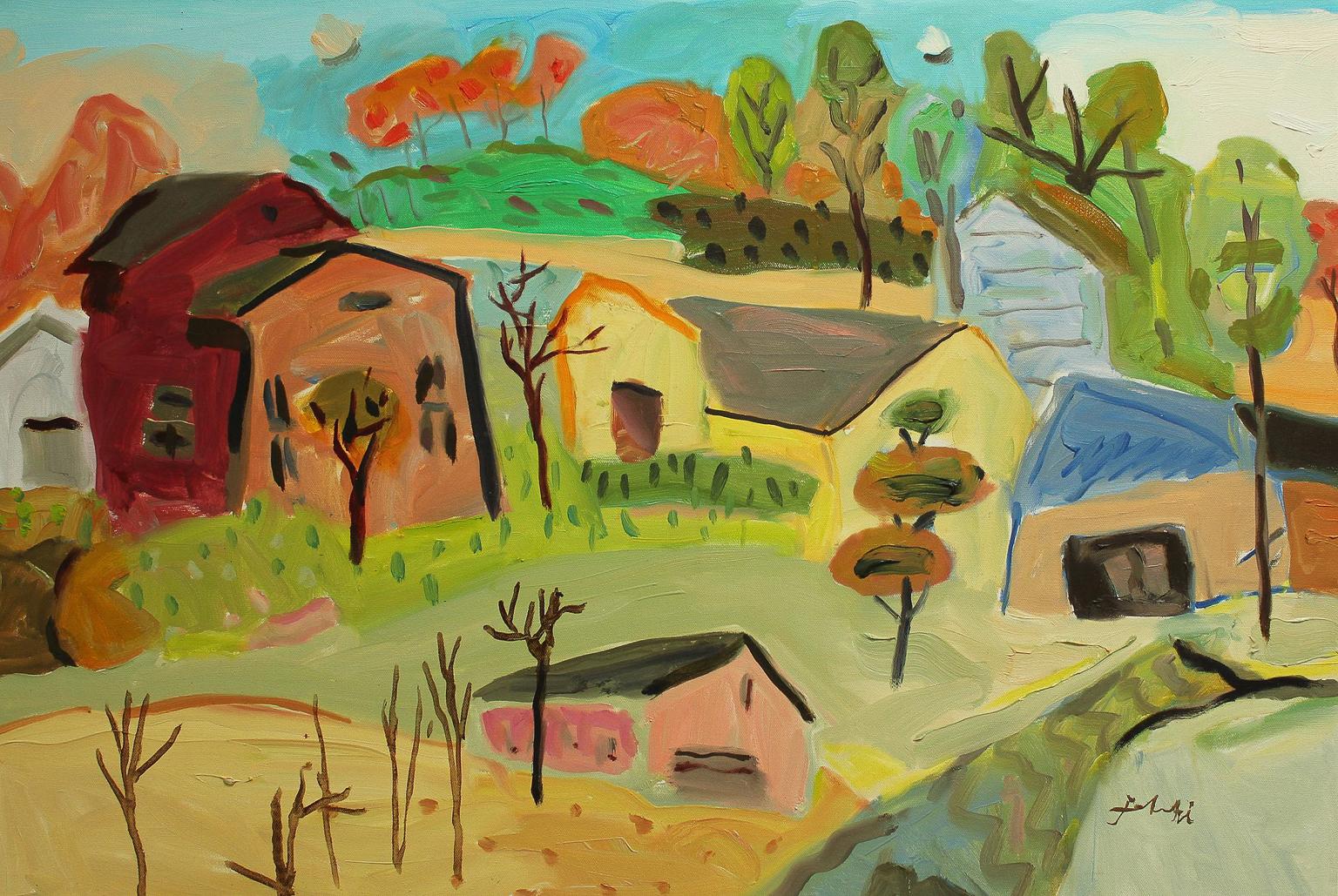
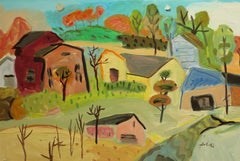
Hillside Barns
By Zygmund Jankowski
Located in Gloucester, MA
Zygmund Jankowski (1925–2009) painted traditional subjects with exuberant irreverence for traditional rules of color, composition, and perspective. He disparaged imitation and deligh...
Category
1980s Contemporary Landscape Paintings
Materials
Canvas, Oil
Price Upon Request
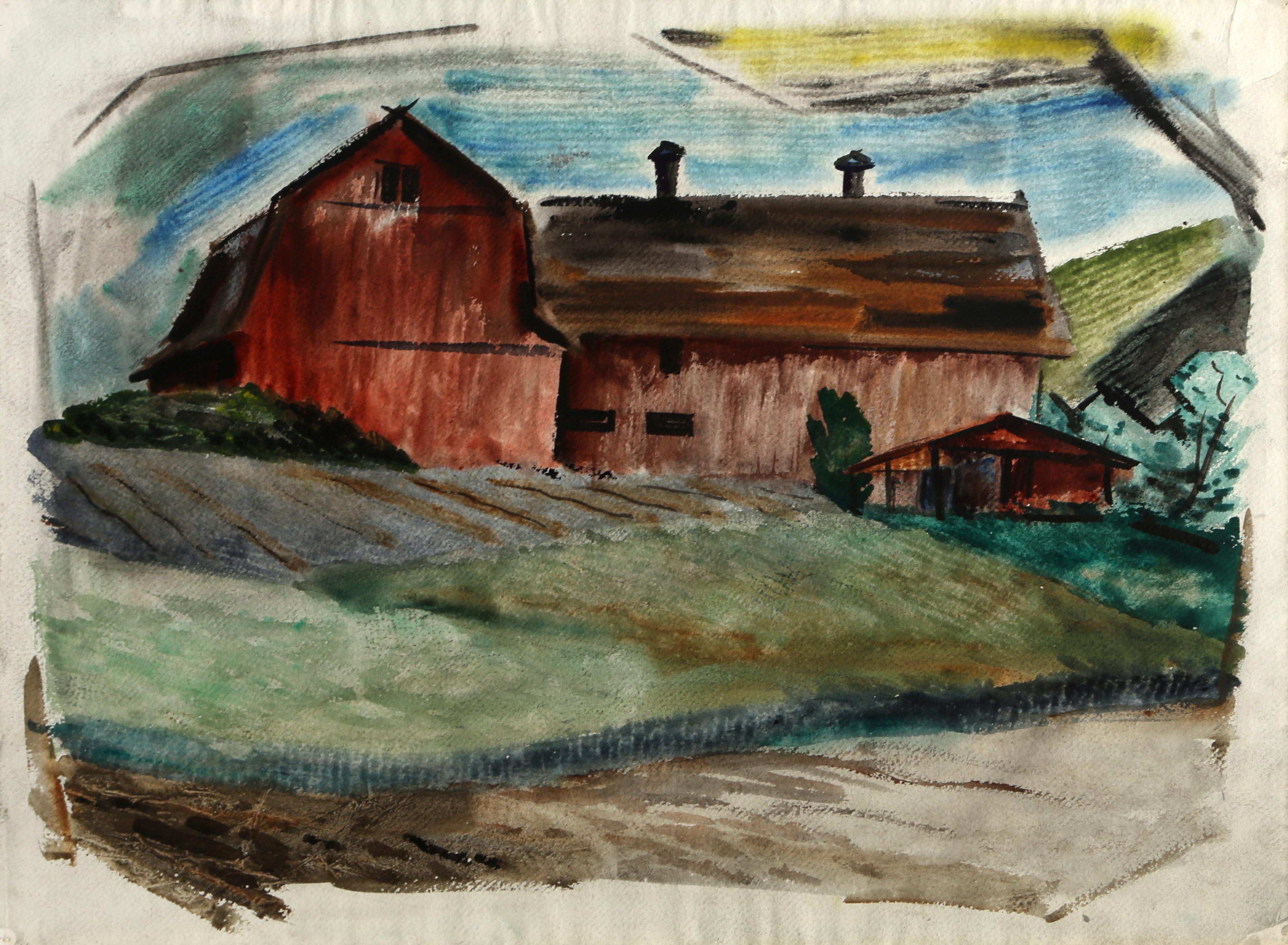
Red Barn, Watercolor by Chris Ritter
Located in Long Island City, NY
This unique work is a watercolor by American artist Chris Ritter. The painting depicts a landscape of rolling green hills with a red barn centered in the ...
Category
1960s Landscape Drawings and Watercolors
Materials
Watercolor
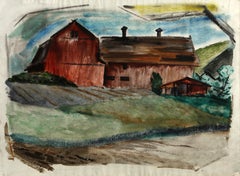
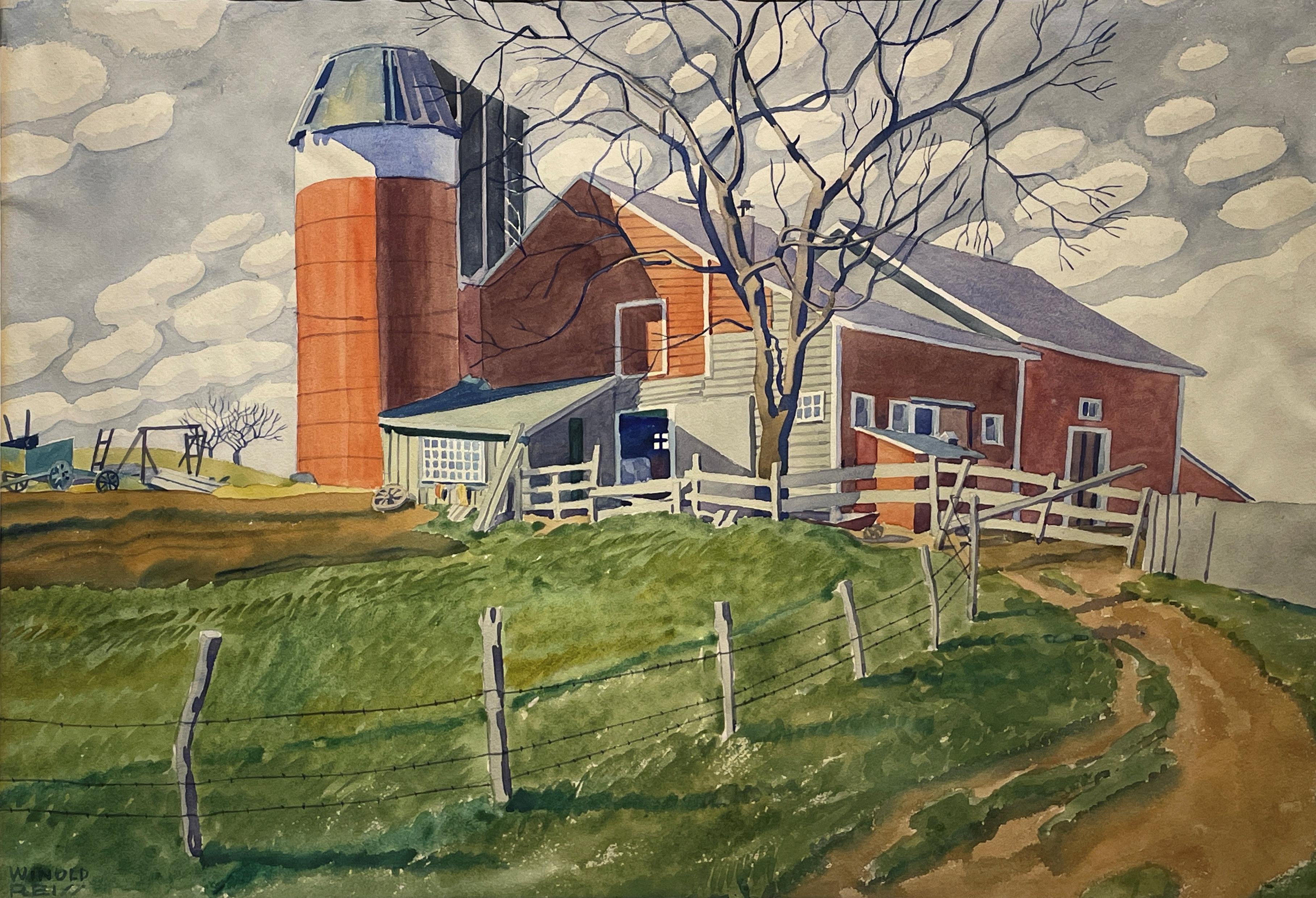
"The Red Silo" Winold Reiss, Modernist Landscape, Vibrant American Red Barn
By Winold Reiss
Located in New York, NY
Winold Reiss
The Red Silo
Signed lower left
Watercolor on paper
20 x 29 inches
Winold Reiss (1886-1953) was an artist and designer who emigrated to the United States from Germany i...
Category
1930s Modern Figurative Drawings and Watercolors
Materials
Paper, Watercolor
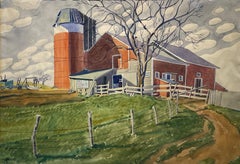
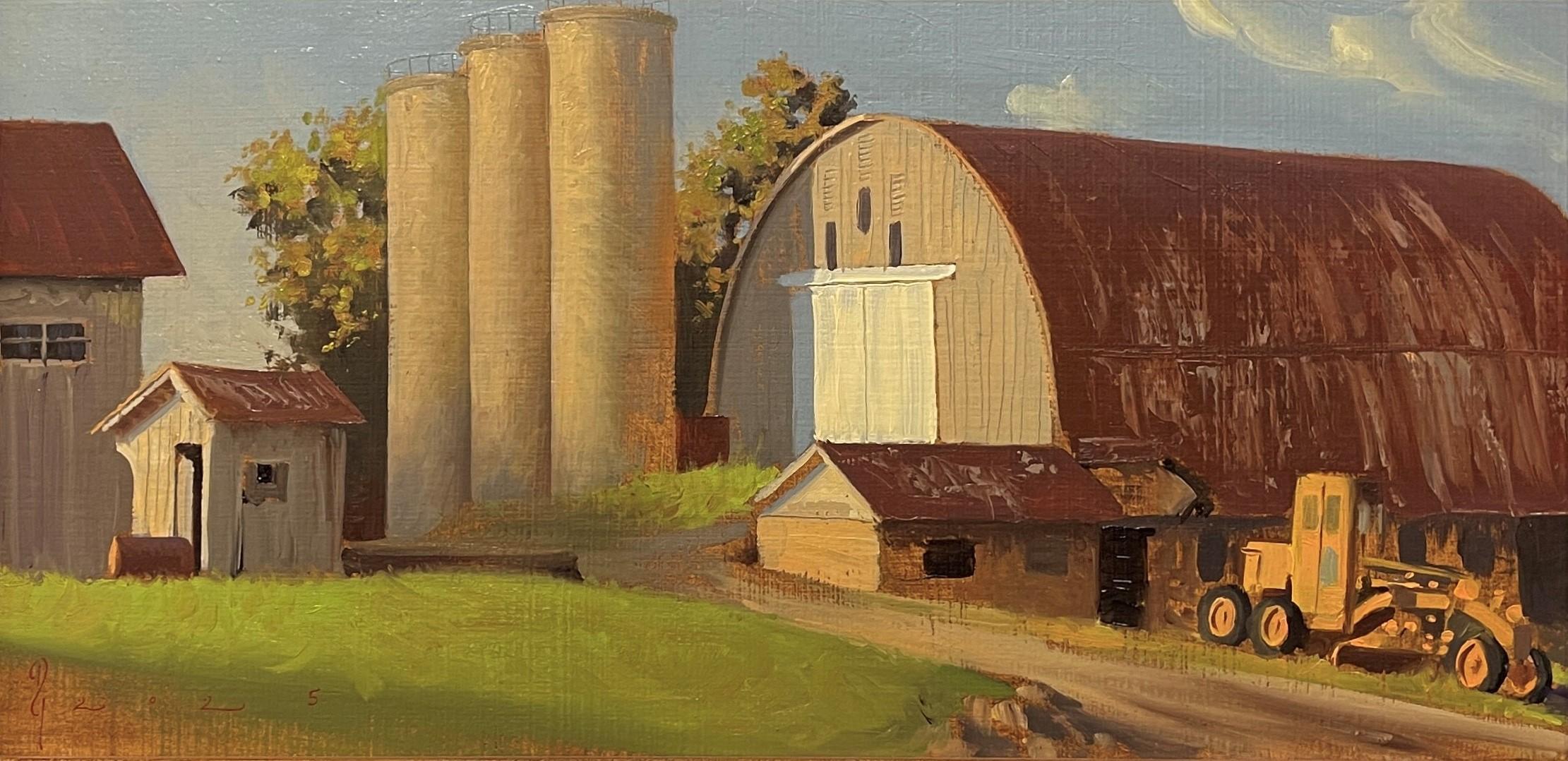
"Farm Near Brandywine" Original Oil Painting, PA farm landscape
Located in Denver, CO
"Farm Near Brandywine" by Diego Glazer is an original oil painting depicting a quaint farm scene.
Artist Statement: Painted en plein air on the drive back to the Brandywine Museum ...
Category
2010s American Realist Landscape Paintings
Materials
Oil, Panel