Items Similar to Woodland / - The Inner Drama of the Landscape -
Want more images or videos?
Request additional images or videos from the seller
1 of 6
Eduard Peithner von LichtenfelsWoodland / - The Inner Drama of the Landscape -1884
1884
$693.80
£515.18
€580
CA$953.24
A$1,036.75
CHF 549.44
MX$12,422.49
NOK 6,983.13
SEK 6,397.49
DKK 4,421.98
About the Item
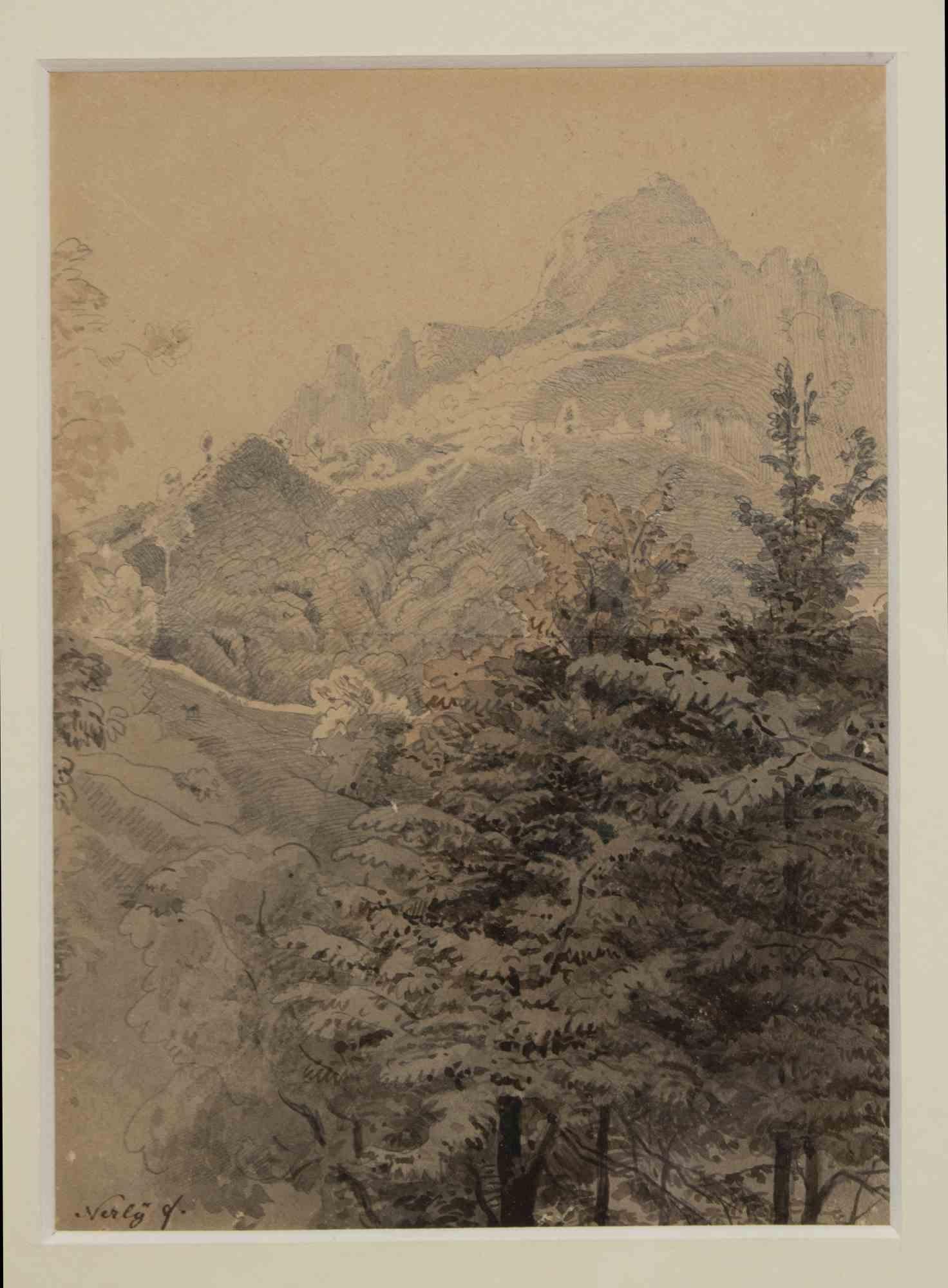
Eduard Peithner von Lichtenfels (1833 Vienna - 1913 Berlin), Woodland, 1884. Watercolor and pen and ink on drawing paper, 30.4 cm x 22.5 cm, signed, dated and inscribed by the artist at lower left.
- in good condition
- The Inner Drama of the Landscape -
During his excursions, Eduard Peithner von Lichtenfels repeatedly discovered the inexhaustible richness of nature. Using a combination of pen-and-ink drawing and watercolor, techniques in which the artist specialized, he captured particularly impressive scenes. Here, we see a group of nearly uprooted conifers standing on a slope, extending the terrain's descending line upwards. Their uprooting appears all the more dramatic this way, especially since the two trees standing in a line — viewed from right to left — perform a tilting movement that increases the tension in the picture even more. The movement of the branches, heightened by the interplay of light and shadow, adds to the drama. The location and exact date suggest that this is not an artistic composition but rather an accurate depiction of the inner drama of the natural world before the artist's eyes.
About the artist
Eduard Peithner von Lichtenfels began studying at the Vienna Academy of Fine Arts in 1854. In 1857, he moved to the Düsseldorf Academy of Art, where he was particularly influenced by Carl Friedrich Lessing's landscape paintings. In 1868, he became a member of the Academy in Vienna, where he taught landscape painting as a professor from 1872 to 1907. He also served as rector of the academy from 1878 to 1880 and from 1897 to 1899. As a landscape painting teacher, he promoted close study of nature and regularly took excursions to the Wachau. This led to the Wachau becoming a popular subject in Austrian landscape painting, and some of his students settled there. His students included Ferdinand Andri, Wilhelm Bernatzik, Eduard Zetsche, Heinrich Tomec, Hans Wilt, Johann Nepomuk Geller, and Maximilian Suppantschitsch. After retiring, Peithner von Lichtenfels lived in Nuremberg and Berlin for a time, where he died.
GERMAN VERSION
Eduard Peithner von Lichtenfels (1833 Wien - 1913 Berlin), Waldstück, 1884. Aquarell und Feder auf Zeichenpapier, 30,4 cm x 22,5 cm, links unten eigenhändig signiert, datiert und ortsbezeichnet.
- in gutem Zustand
- Das innere Drama der Landschaft -
Auf seinen Gängen in die Landschaft entdeckte Eduard Peithner von Lichtenfels immer wieder aufs Neue die unerschöpfliche Reichhaltigkeit Natur. Mit der Kombination aus Federzeichnung und Aquarell, auf die sich der Künstler zur Naturdarstellung spezialisiert hatte, hielt er besonders eindrucksvolle Entdeckungen fest. Hier sehen wir eine Gruppe nahezu entwurzelten Nadelbäumen, die an einem Hang stehen und die absteigende Linie des Geländes nach oben verlängern. Auf diese Weise in die Umgebung eingefügt, wirkt ihre Entwurzelung umso dramatischer, zumal die beiden in einer Linie stehenden Bäume – von rechts nach links betrachtet – eine die Bildspannung nochmals steigernde Kippbewegung vollziehen. Dabei entfaltet die durch das Spiel von Licht und Schatten gesteigerte Bewegung der Äste eine zusätzliche dramatische Dynamik. Darauf, dass hier keine künstlerische Komposition vorliegt, sondern der Künstler die innere Dramatik der vor Augen stehenden Natur zur Darstellung gebracht hat, verweist die Ortsbezeichnung und die genaue Datierung.
zum Künstler
Eduard Peithner von Lichtenfels nahm 1854 das Studium an der Wiener Akademie auf und wechselte 1857 an die Düsseldorfer Akademie, wo ihn insbesondere die Landschaftsmalerei Carl Friedrich Lessings prägte. 1868 wurde er Mitglied der Wiener Akademie, an der als Professor von 1872 bis 1907 die Klasse der Landschafsmalerei leitete. Zudem war er von 1878 bis 1880 und von 1897 bis 1899 Rektor der Akademie. Als Lehrer für Landschaftsmalerei beförderte er ein genaues Naturstudium und unternahm regelmäßig Exkursionen in die Wachau, was dazu führte, dass die Wachau in der Folge zu einem bevorzugten Motiv der österreichischen Landschaftsmalerei wurde und sich einige seiner Schüler dort niederließen. Zu seinen Schülern zählten unter anderen Ferdinand Andri, Wilhelm Bernatzik, Eduard Zetsche, Heinrich Tomec, Hans Wilt, Johann Nepomuk Geller und Maximilian Suppantschitsch. Nach seiner Pensionierung lebte Peithner von Lichtenfels zeitweise in Nürnberg und Berlin, wo er verstarb.
About the Seller
5.0
Vetted Professional Seller
Every seller passes strict standards for authenticity and reliability
Established in 2014
1stDibs seller since 2023
23 sales on 1stDibs
- ShippingRetrieving quote...Shipping from: Berlin, Germany
- Return Policy
More From This Seller
View AllSummer Forest Landscape, 1915 / - The Forest Walk -
Located in Berlin, DE
Stanislas Warnie (1879-1958), Summer Forest Landscape, 1915. Watercolor, 31.5 cm x 45 cm (passepartout), 50.5 cm x 63.5 cm (frame), signed "S. Warnie" at lower left and dated "1915"....
Category
1910s Art Nouveau Landscape Drawings and Watercolors
Materials
Watercolor
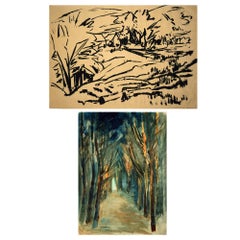
Landscape verso Forest interior / - Landscape as a space of imagination -
Located in Berlin, DE
Herbert Seidel (1906 Berlin - 1974 Rüdersdorf), Landscape verso Forest interior, around 1950. India ink on grained, bleached paper, 40.5 x 58 cm, signed “Herbert Seidel” in pencil on...
Category
1950s Abstract Landscape Drawings and Watercolors
Materials
Paper
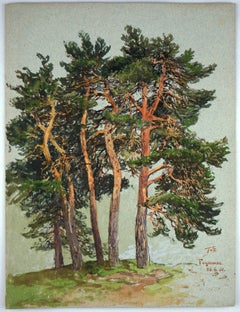
Norwegian Pine Grove - The inner glow of the trees -
Located in Berlin, DE
Themistokles von Eckenbrecher (1842 Athens - 1921 Goslar), Norwegian pine grove, 1901. Watercolor on blue-green paper, 30 x 22 cm. Signed, dated and inscribed in his own hand "TvE. Fagermes [i.e. Fagermes]. 26.6.[19]01."
- Slight crease throughout at left margin, otherwise in good condition.
About the artwork
Themistokles von Eckenbrecher often traveled to Norway to study the nature that fascinated him there. On June 26, 1901, near the southern Norwegian town of Fagernes, in the summer evening sun, he saw a small pine grove, which he immediately captured in a watercolor. He exposed the trees growing on a small hill in front of the background, so that the pines completely define the picture and combine to form a tense motif. The tension comes from the contrast of form and color. The trunks, growing upward, form a vertical structure that is horizontally penetrated by the spreading branches and the pine needles, which are rendered as a plane. This structural tension is further intensified by the color contrast between the brown-reddish iridescent trunks and branches and the green-toned needlework.
Themistokles von Eckenbrecher, however, does not use the observed natural scene as an inspiring model for a dance of color and form that detaches itself from the motif and thus treads the path of abstracting modernism. Its inner vitality is to be brought to light and made aesthetically accessible through the work of art.
It is precisely in order to depict the inner vitality of nature that von Eckenbrecher chooses the technique of watercolor, in which the individual details, such as the needles, are not meticulously worked out, but rather a flowing movement is created that unites the contrasts. The trees seem to have formed the twisted trunks out of their own inner strength as they grew, creatingthose tense lineations that the artist has put into the picture. The inner strength continues in the branches and twigs, culminating in the upward growth of the needles. At the same time, the trunks, illuminated by the setting sun, seem to glow from within, adding an almost dramatic dimension to the growing movement.
Through the artwork, nature itself is revealed as art. In order to make nature visible as art in the work, von Eckenbrecher exposes the group of trees so that they are bounded from the outside by an all-encompassing contour line and merge into an areal unity that enters into a figure-ground relationship with the blue-greenish watercolor paper. The figure-ground relationship emphasizes the ornamental quality of the natural work of art, which further enforces the artwork character of the group of trees.
With the presentation of Themistokles von Eckenbrecher's artistic idea and its realization, it has become clear that the present watercolor is not a study of nature in the sense of a visual note by the artist, which might then be integrated into a larger work context, but a completely independent work of art. This is why von Eckenbrecher signed the watercolor. In addition, it is marked with a place and a date, which confirms that this work of nature presented itself to him in exactly this way at this place at this time. At the same time, the date and place make it clear that the natural work of art has been transferred into the sphere of art and thus removed from the time of the place of nature.
About the artist
Themistocles' parents instilled a life of travel in their son, who is said to have spoken eleven languages. His father, who was interested in ancient and oriental culture, was a doctor and had married Francesca Magdalena Danelon, an Italian, daughter of the British consul in Trieste. During a stay in Athens - Gustav von Eckenbrecher was a friend of Heinrich von Schliemann and is said to have given him crucial clues as to the location of Troy - Themistokles saw the light of day in 1842.
After an interlude in Berlin, where Themistokles was educated at the English-American School, the journey began again. From 1850 to 1857 the family lived in Constantinople, after which the father opened a practice in Potsdam, where Themistokles, who wanted to become a painter, was taught by the court painter Carl Gustav Wegener.
In 1861 the von Eckenbrechers left Potsdam and settled in Düsseldorf. There Themistokles received two years of private tuition from Oswald Aschenbach, who greatly admired the talented young artist. After his artistic training, he undertook extensive travels, often accompanied by Prince Peter zu Sayn-Wittgenstein, which took him to northern and eastern Europe, but above all to the Middle East and even to South America. The paintings that resulted from these journeys established his artistic reputation and led to his participation in large panoramas such as the 118 x 15 metre Entry of the Mecca Caravan into Cairo, painted for the City of Hamburg in 1882.
1882 was also the start of a total of 21 study trips to Scandinavia, most of them to Norway, and the unique Norwegian landscape with its rugged fjords became a central motif in his work. Along with Anders Askevold and Adelsteen Normann...
Category
Early 1900s Naturalistic Landscape Drawings and Watercolors
Materials
Watercolor
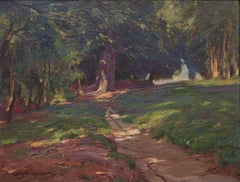
Forest landscape bathed in sunlight / - The Monumentality of the Forest -
Located in Berlin, DE
Wilhelm Feldmann (1859 Lüneburg - 1932 Lübeck), Sunny forest landscape, c. 1900. Oil on canvas, marouflaged on wood, 37 cm x 48 cm (inside dimensions), 42.5 cm x 53.5 cm (frame), sig...
Category
Early 1900s Impressionist Landscape Paintings
Materials
Oil
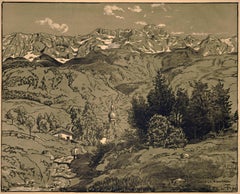
S. Anton Patenkirchen / - The Home of the Landscape -
Located in Berlin, DE
Hans Thoma (1839 Bernau - 1924 Karlsruhe), S. Anton Patenkirchen, 1895. Algraph on strong wove paper, published by Breitkopf und Härtel in Leipzig as ‘Zeitgenössisches Kunstblatt Nr....
Category
1890s Realist Figurative Prints
Materials
Paper
At the pond / - The longing of the landscape -
Located in Berlin, DE
Hans Thoma (1839 Bernau - 1924 Karlsruhe), At the pond, 1897. Algraph on strong wove paper, published by Breitkopf und Härtel in Leipzig as ‘Zeitgenössisches Kunstblatt Nr. 148’, 23....
Category
1890s Realist Figurative Prints
Materials
Paper
You May Also Like
Landscape with Trees - Original Drawing by George-Henri Tribout - 1940
By Georges-Henri Tribout
Located in Roma, IT
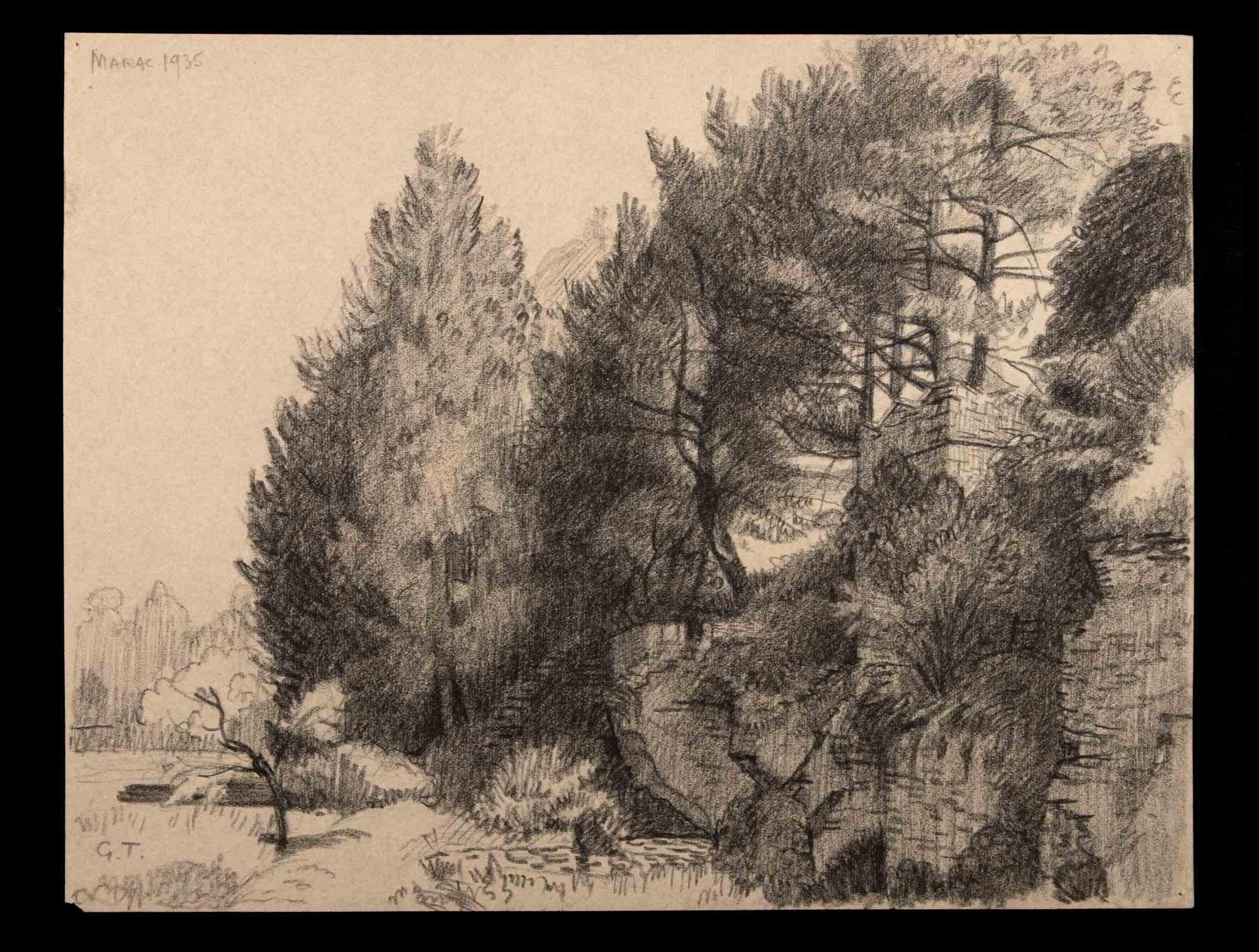
Landscape with Trees is an original artwork realized by Georges Henri Tribout in 1935 in Marac. Pencil Drawing, hand signed on the lower margin left and dated "Marac 1935" on the lef...
Category
1940s Modern Landscape Drawings and Watercolors
Materials
Paper, Pencil
In the Wood - Drawing by Charlotte Gardelle - Early 20th Century
Located in Roma, IT
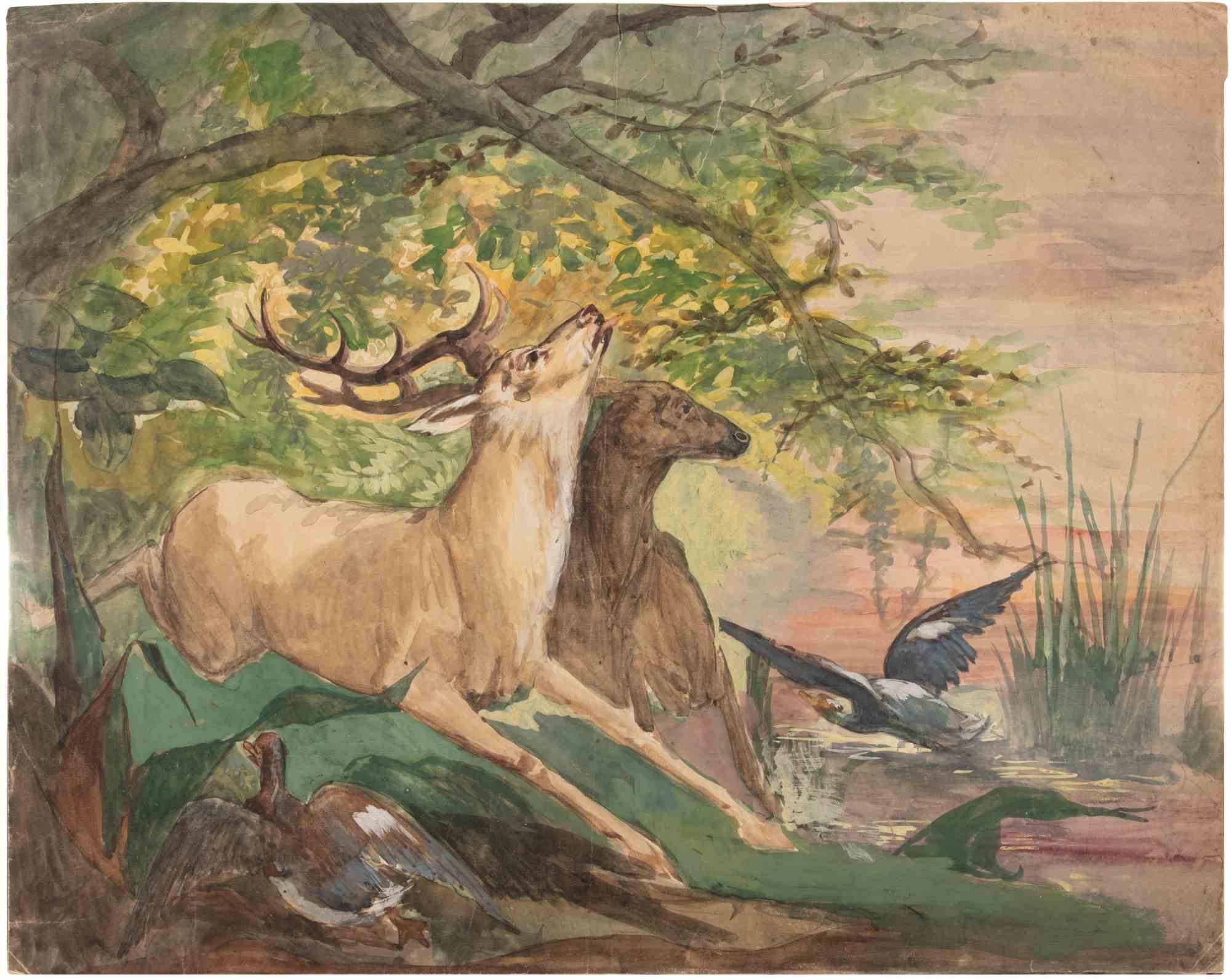
Mixed media on paper, ink, gouache and watercolor, realized by Charlotte Gardelle (1879-1953) in the early 20th Century.
Fair condition, due to some rips in the paper. Not signed.
...
Category
Early 20th Century Modern Landscape Drawings and Watercolors
Materials
Ink, Watercolor
Mid 19th Century Watercolour - Forest Seclusion
Located in Corsham, GB
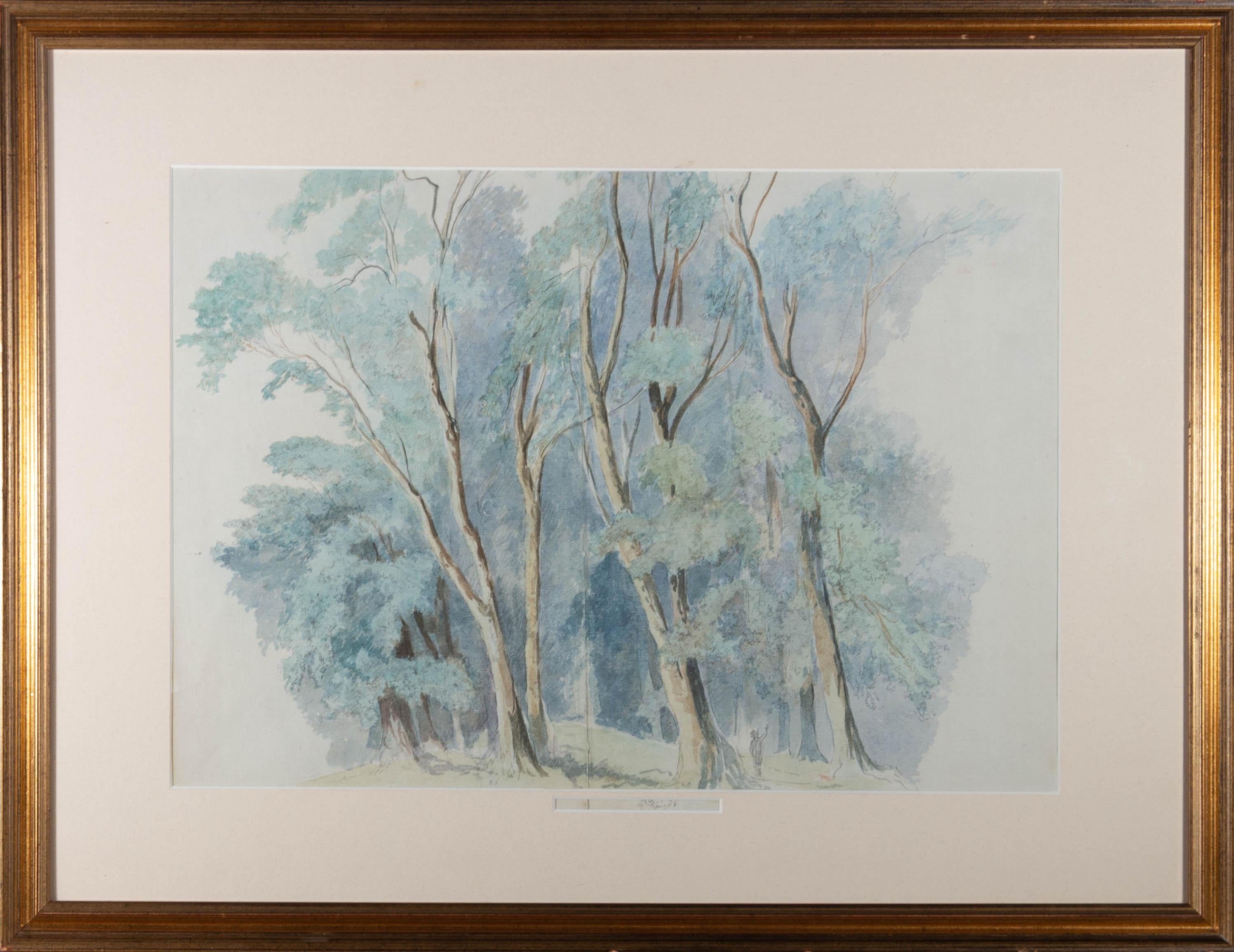
A lively and Romantic watercolour depicting a figure reaching to touch the lower branches of towering trees. Presented glazed in a cream mount and a distressed gilt-effect wooden fra...
Category
19th Century Landscape Drawings and Watercolors
Materials
Watercolor
$296 Sale Price
20% Off
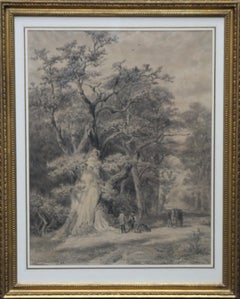
Hasbrucken Wald Altenberg Germany - The Forest - Dutch 19thC wooded landscape
By Cornelius Springer
Located in Hagley, England
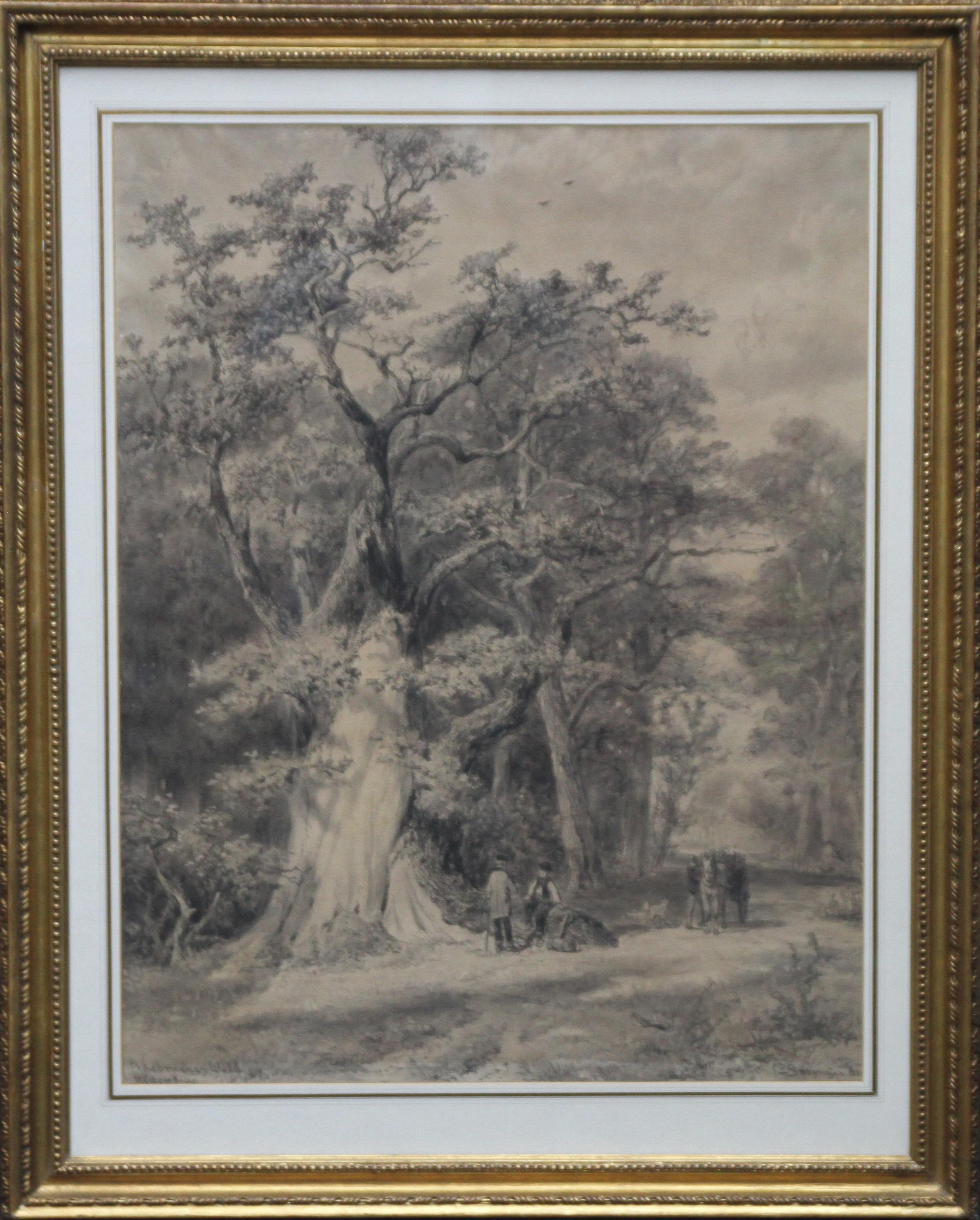
A stunning large drawing, signed and dated 1880, by Cornelius Springer. It is house behind glass in a fine frame. A huge heroic Ruisdael tree empowers this picture. Beneath it, worke...
Category
19th Century Realist Landscape Drawings and Watercolors
Materials
Pencil
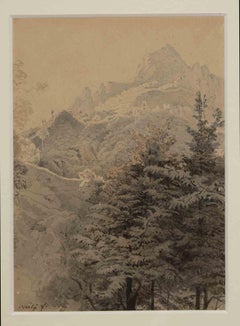
Mountains - Original Drawing by Friedrich Paul Nerly - 19th Century
Located in Roma, IT
Mountains is an original artwork realized in the end of 19th century by Friedrich Paul Nerly.
Pencil drawing and watercolor.
The artwork is hand signed on the lower left margin.
T...
Category
Late 19th Century Modern Figurative Drawings and Watercolors
Materials
Watercolor
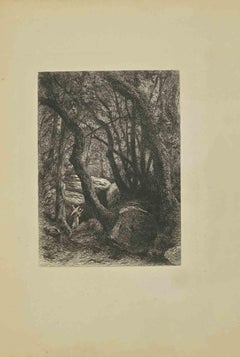
In The Forest - Etching by Eugène Burnand - Late 19th century
Located in Roma, IT
In The Forest is an etching realized by Eugène Burnand (1850-1921) in the Late 19th century.
Good conditions with foxing.
The artwork is realized through short and deft strokes, a...
Category
Late 19th Century Old Masters Figurative Prints
Materials
Engraving, Etching
More Ways To Browse
Dior Hat
Landscape Painting Austria
Gary Shepard
George Yater
Gillian M Hobbs
Henry Thomas Schafer
Herb Saylor
Horace Middleton
Hutchings Watercolor
Isabel Wrightson
Isabelle Schrock Barnett
J A Kirkpatrick
J Francesco Painting
James Hamilton Mackenzie
Jean Harney
Jess Cauthorn
John Davis Watercolor
Joseph Henninger