Items Similar to Rocky Landscape with Trees and Temple Ruins a drawing by Giulio Parigi (ca 1615)
Want more images or videos?
Request additional images or videos from the seller
1 of 11
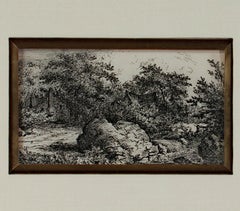
Giulio ParigiRocky Landscape with Trees and Temple Ruins a drawing by Giulio Parigi (ca 1615)1615
1615
$8,284.02
£6,190.42
€7,000
CA$11,535.09
A$12,395.67
CHF 6,650.99
MX$146,013.37
NOK 83,628.88
SEK 76,394.44
DKK 53,361.54
About the Item
This Rocky Landscape with Trees and the Ruins of a Temple is a drawing by Giulio Parigi, an eclectic and prolific artist of the Medici court. An engraver, architect, furniture and jewelry designer and scenographer, he was also the master of a renowned academy, where he taught mechanics, perspective, architecture, and landscape painting.
This drawing is a new addition to the artist's catalog. It demonstrates the extraordinary temperament of this artist, who offers us here an original synthesis between scenic fantasy and the influence of the imaginary world created by Nordic artists, freely inspired by the real landscape of Tivoli.
1. Giulio Parigi, a multi-talented artist at the heart of the artistic life of his time
Giulio Parigi was born in Florence on April 6, 1571. He was the son of Alfonso di Santi Parigi, originally from Prato, and Alessandra di Berto Fiammeri. Trained by his architect father and great-uncle Bartolomeo Ammannati, he was quickly integrated into the artistic milieu of the court, working from an early age under the direction of Bernardo Buontalenti, with whom he later collaborated as decorator and draftsman. In 1594, he enrolled at the Academy of Drawing as a "painter"; in 1597, he was pensioned by the Grand Ducal Court.
From 1613, Giulio Parigi worked intensively as a civil engineer for the Grand Duke, which led him to Rome in 1616. On his return to Florence, Parigi won the competition launched by Cosimo II for the enlargement of the Pitti palace; he began by building the "Grotticina di Vulcano" in the Boboli gardens (1617) and laid the foundation stone for the palace's north wing on May 29, 1620. Parigi remained in charge of the works until 1633, when he was succeeded by his son Alfonso, who continued the enlargement according to his father's instructions.
In the graphic output of Giulio Parigi and the engravers of his entourage, we find many illustrations of festivities and theatrical performances at the Medici court, testifying to the pre-eminence of the court over Florentine public life. As an architect and a scenographer, an engraver and a draughtsman, Giulio Parigi is one of the most convincing examples of the relationship between these ephemeral creations linked to the theater or grand festivities and the Mannerist language, strongly influenced by the Nordic currents present in the artistic culture of grand-ducal Florence.
With the formation of the famous Accademia, Giulio Parigi gathered around him a large number of pupils: in addition to Jacques Callot (a landscape painter and engraver), we can cite his sons Alfonso (an architect, engineer, scenographer and engraver) and Andrea (an engineer, excellent landscape painter and skilful inventor of fireworks), Antonio Cantagallina (a master of perspective), and his brother Giovan Francesco (a landscape painter and master of fortifications), and artists such as Giovanni da S. Giovanni and, for a time, Stefano della Bella, Baccio del Bianco or Agostino Tassi.
Giulio died in Florence on July 13, 1635, and was buried in the chapel of the church of S. Felice in Piazza, which he had designed.
2. Subject and identification of our drawing
The well-preserved sheet shows a forest of trees with complex, gnarled trunks, whose sparse foliage is evoked by oblique and parallel hatching. The ground is studded with boulders, also shaped by hatching. The composition is closed on the left by a rocky entablature running along the edge. This scenographic expedient is characteristic of stage decors intended for theatrical performances. On the right a trunk curves out, with a typically Nordic physiognomy.
The space is skilfully structured in several planes: from the first, set in a contrasting chiaroscuro, we pass to a luminous clearing, beyond which rise rocky mounds with sharp profiles, drawn with a single stroke of the pen in brown ink, which punctuate the landscape and give a vibrant sense of movement. Above the rocks rise the ruins of an ancient temple, whose six columns in the cella indicate its original round shape.
This temple is loosely based on that of the Sibyl (or Vesta) at Tivoli, situated above the rocky spur adjoining the ancient acropolis of Tibur overlooking the vast Aniene valley. The Flemish artists Paul Bril (1554-1626) and Jan Brueghel the Elder (1568-1625) were the first to be fascinated by the power and mystery of this place, where the natural elements, impetuous and picturesque, freely blend into the landscape.
In the clearing in lower right foreground, with fine, angular calligraphy executed with a pen, the author leaves the following inscription: "Di Flaminio Giuletto/ Venari Saturn [ale?]". While the second part, difficult to decipher, could refer to a theatrical performance (perhaps executed at the time of the winter festivities known as Saturnalia?), the first part is a clear reference to Giulio's northern style of depicting landscapes, which, by distinguishing him from his Florentine contemporaries, had earned him the nickname "Flemish".
In all likelihood, our sheet was executed, probably around 1615, during a session at the Accademia, as a test of skill on a naturalist theme that adhered to the taste for fantasy transposed into the real world in using a modern artistic language, inspired by Nordic painters. It is possible that this drawing was intended for engraving, as evidenced by the parallel hatching of the cloud-sprinkled sky.
Our drawing can be compared with two others by the artist in the Uffizi : the Tuscan Landscape (P. 220), and the Landscape with a Farm (P170).
3. Framing
Our drawing comes in a cherrywood frame with a highly original pinecone scale decoration. Dating from the early 19th century, it probably originates from northern Italy.
- Creator:Giulio Parigi (1571 - 1635, Italian)
- Creation Year:1615
- Dimensions:Height: 15.38 in (39.07 cm)Width: 19.5 in (49.53 cm)
- Medium:
- Movement Style:
- Period:
- Condition:Dimensions : 7’’ x 11 3/4" (177 x 297 mm) - Framed: 15 3/8’’ x 19 ½’’ (39 x 49.5 cm) We would like to thank Carolina Trupiano Kowalczyk for confirming the attribution of this drawing to Giulio Parigi after direct examination of the artwork.
- Gallery Location:PARIS, FR
- Reference Number:1stDibs: LU1568216220682
About the Seller
5.0
Vetted Professional Seller
Every seller passes strict standards for authenticity and reliability
Established in 2020
1stDibs seller since 2021
11 sales on 1stDibs
Typical response time: 3 hours
- ShippingRetrieving quote...Shipping from: PARIS, France
- Return Policy
More From This Seller
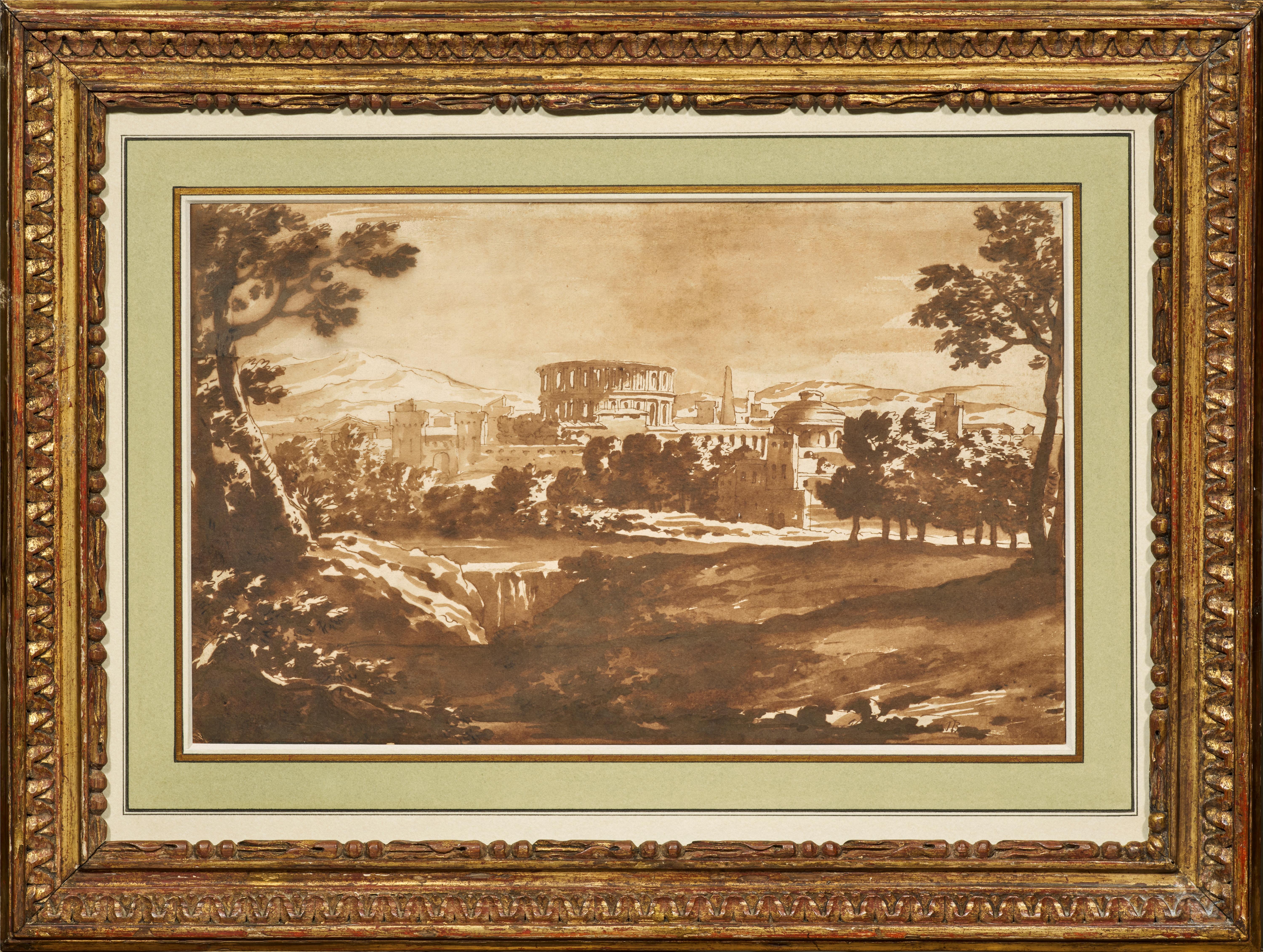
View AllView of an Antique City, a wash landscape by Jan de Bisschop (1628 - 1671)
Located in PARIS, FR
The attribution to Jan de Bisschop has been confirmed by the RKD with the following comment: "We base this attribution on the dark washes, the subject represented and the monogram".
...
Category
17th Century Old Masters Landscape Drawings and Watercolors
Materials
Ink, Pen
Landscape with Trees and a Fisherman walking, a drawing by Jan Van Goyen
By Jan Josefsz Van Goyen
Located in PARIS, FR
No Dutch draughtsman ever captured the atmosphere of the rural countryside of Holland with the same atmospheric and engaging simplicity that Van Goyen achieved in drawings such as this. Indeed, his landscapes were seminal in the development of the genre. The present sketch conveys a striking sense of movement within the natural landscape, conveyed by the deftly applied strokes of chalk, from which the artist’s hand can be sensed. The composition is characteristic of his work, with the low horizon affording significance to the broad sky and the soaring birds within. This feeling of windswept motion powerfully evokes the expansive Dutch farmland with which he was evidently preoccupied.
1. Jan van Goyen...
Category
1650s Old Masters Landscape Drawings and Watercolors
Materials
Chalk, Ink, Laid Paper
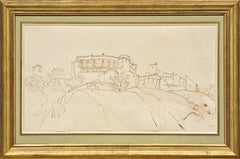
View of a Mansion in the South of France, a drawing by Claude-Joseph Vernet
By Claude-Joseph Vernet
Located in PARIS, FR
We would like to thank Madame Beck-Saiello for confirming the autograph nature of this drawing after an in-person examination.
It was probably during an excursion in the countryside near Avignon that Claude-Joseph Vernet executed this drawing, enhanced with pen and brown ink, depicting a mansion on a hilltop overlooking a small village with geometric shapes.
1. Joseph Vernet, a painter influenced by Italy
Claude-Joseph Vernet was born in Avignon in 1714, the son of Antoine Vernet (1689-1753), an artisan painter of architectural decorations, coach panels, and the like. He moved to the studio of Philippe Sauvan (1697-1792), a leading history painter in Avignon, and then worked with Jacques Viali (active 1681-1745), a decorative, landscape, and marine painter in Aix-en-Provence. Vernet's first recorded paintings were decorative overdoors executed in 1731 in the Aix townhouse of the marquise de Simiane. In 1734, Joseph de Seytres, marquis de Caumont, a leading amateur in Avignon, sponsored Vernet to make a study trip to Italy to complete his artistic education and to draw antiquities for his patron.
As Avignon was a papal territory in Vernet's day, he also had a number of useful introductions among influential churchmen when he arrived in Rome. Vernet was soon at home in the French community there, and he was encouraged by Nicolas Vleughels (1668-1737), director of the Académie de France in Rome, even though the young painter had no official affiliation with the royal institution. He likely entered the studio of the French marine painter Adrien Manglard...
Category
1730s Old Masters Landscape Drawings and Watercolors
Materials
Ink, Laid Paper, Pen, Carbon Pencil
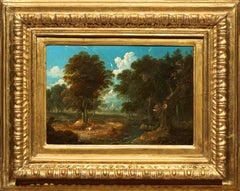
Stag Hunting in the Vicinity of Nuremberg by a German Artist Peter von Bemmel
Located in PARIS, FR
This small landscape shows a hunting scene: two riders are chasing a stag with their dogs at the edge of a forest. Signed by Peter von Bemmel, it is typical of the production of this...
Category
1720s Old Masters Landscape Paintings
Materials
Copper
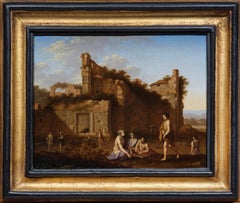
Gathering in antique Ruins, a monogrammed painting by Jan van Haensbergen
By Jan Van Haensbergen
Located in PARIS, FR
Jan van Haensbergen was a painter of the Dutch Golden Age and a pupil of Cornelius van Poelenburgh (Utrecht 1594 - 1667). The painting we are presenting is inspired by Poelenburgh’s landscapes from his Italian sojourn. The dreamlike atmosphere of this Gathering in antique ruins appealed to us. Against a backdrop of antique ruins, three draped characters (perhaps bathers) are sitting in a circle, greeting a fourth character walking towards them.
Their tranquility contrasts with the bustle of the other characters in the background. They constitute a vivid illustration of otium, this leisure time that allows us to realize our full potential. With this Arcadian landscape, Jan van Haensbergen invites us in turn to leave the hustle and bustle of everyday life behind, to take a break, to enjoy the present moment chatting with close friends…
1. Jan van Haensbergen, a landscape and portrait painter of the Dutch Golden Age
Jan van Haensbergen was born in 1642 in Gorinchem, a town in southern Holland to the east of Rotterdam. He was a pupil of Cornelius van Poelenburgh, and began by painting landscapes inspired by those of his master, in an Italianate style. Between 1668 and 1669, he was registered at the Guild of Saint Luke in Utrecht.
In 1669, he moved to The Hague, where he joined the Confrérie Pictura, an artist society founded in 1656. His portraits, which became his main activity as a painter after settling in The Hague, were strongly influenced by Caspar Netscher (Prague or Heidelberg 1639 - The Hague 1684), whom he met in The Hague and whose son Constantijn became his son-in-law by marrying his daughter Magdalena.
In addition to his work as an artist, Van Haensbergen was also an art dealer, probably helped by his appointment as Dean of the Confrérie Pictura, where he also teached.
2. Description of the artwork and related paintings
This painting seems to us to be a kind of allegory of otium, that quiet bliss promised by Epicurus. It might even evoke an Epicurean proverb: "It is better to lie on the naked ground and be at ease, than to have a golden carriage and a rich table and be worried" .
Three draped young people - two men and a woman in the background - are seated in a circle, greeting a fourth figure walking towards them, hair disheveled and body draped in a towel as if drying off after a bath, indicating the need for prior purification to fully enjoy this rest. Their nonchalance contrasts with the bustle of the various characters in the background.
The composition is punctuated by successive diagonals, and opens onto a landscape on the right, with a succession of mountainous planes. This painting is typical of the Italianate works produced by Van Haensbergen in the 1660s under the influence of Cornelis van Poelenburgh...
Category
17th Century Old Masters Landscape Paintings
Materials
Oak, Oil
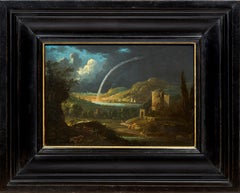
River Landscape with Shepherds and Architecture, a painting by Jan van Bunnik
By Jan van Bunnik
Located in PARIS, FR
This painting has been the subject of a study by the art historian Fabrizio Dassie (available on request), confirming its inclusion in Jan van Bunnik’s corpus.
In this painting, Ja...
Category
Late 17th Century Old Masters Landscape Paintings
Materials
Copper
You May Also Like
17th century etching black and white landscape scene forest trees figures sky
By Claude Lorrain
Located in Milwaukee, WI
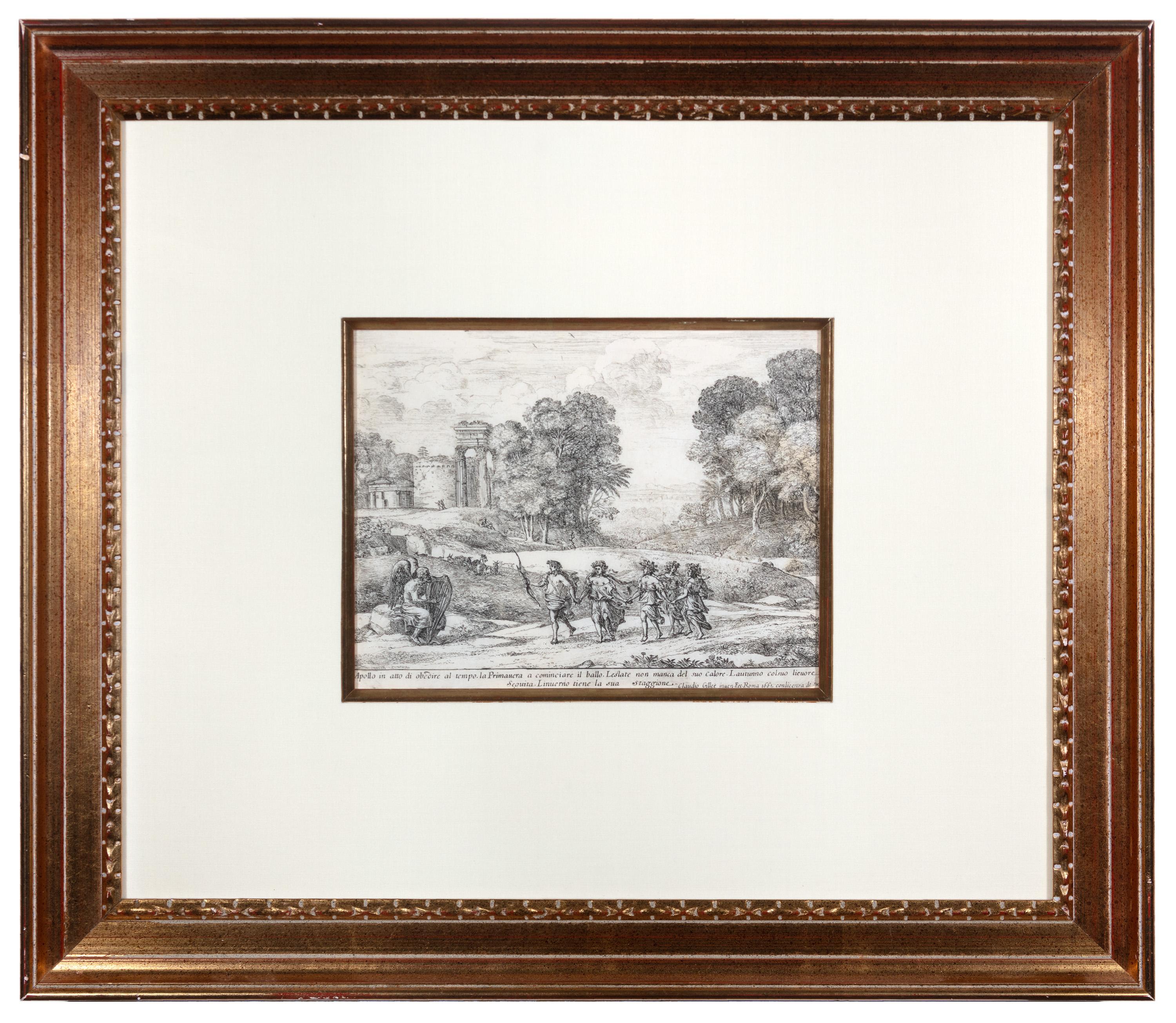
"Le Temps, Apollon, et les Saisons (Time, Apollo, and the Seasons)" is an etching by Claude Gellée (Le Lorrain). This etching is the Fifth state (A). This state is also in collections in Paris (BN, L, PP) and Washington; Mannocci cat. no. 43. The inscription reads: "Apollo in atto di obedire al tempo. La Primavera a cominciare il ballo. Lestate no manca del suo calore. L'aurunno colsuo licore / Seguita. Linvernno tiene la sua staggione, Claudio Gillee inven.Fec.Roma 1662 con licenza de super."
A powerful example of Claude's staging of landscape in the classical manner is the etching "Time,
Apollo, and the Seasons," done in 1662 after Poussin's painting of 1624-1636, "Dance to the Music of Time...
Category
Mid-17th Century Old Masters Landscape Prints
Materials
Etching
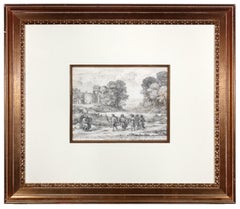
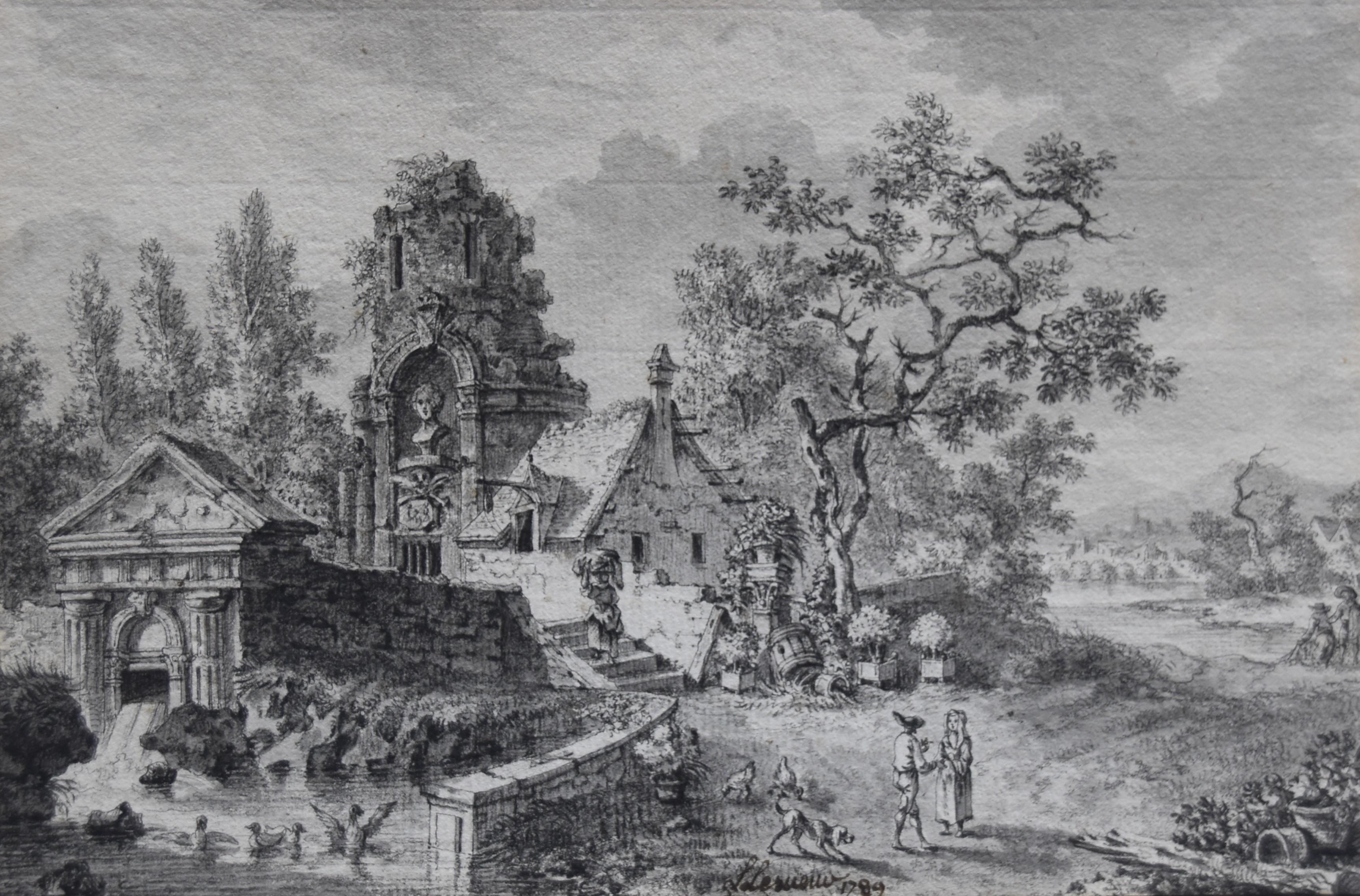
Louis Lesueur (1746-1803) Landscape with ruins, 1789, drawing signed and dated
Located in Paris, FR
Louis Lesueur (1746-1803)
A Fantasy Landscape with ancient ruins, 1789,
signed and dated "L Lesueur 1789" in the bottom centre
Pen and ink and ink wash on paper
14.8 x 22 cm
In goo...
Category
1780s Old Masters Landscape Drawings and Watercolors
Materials
Ink
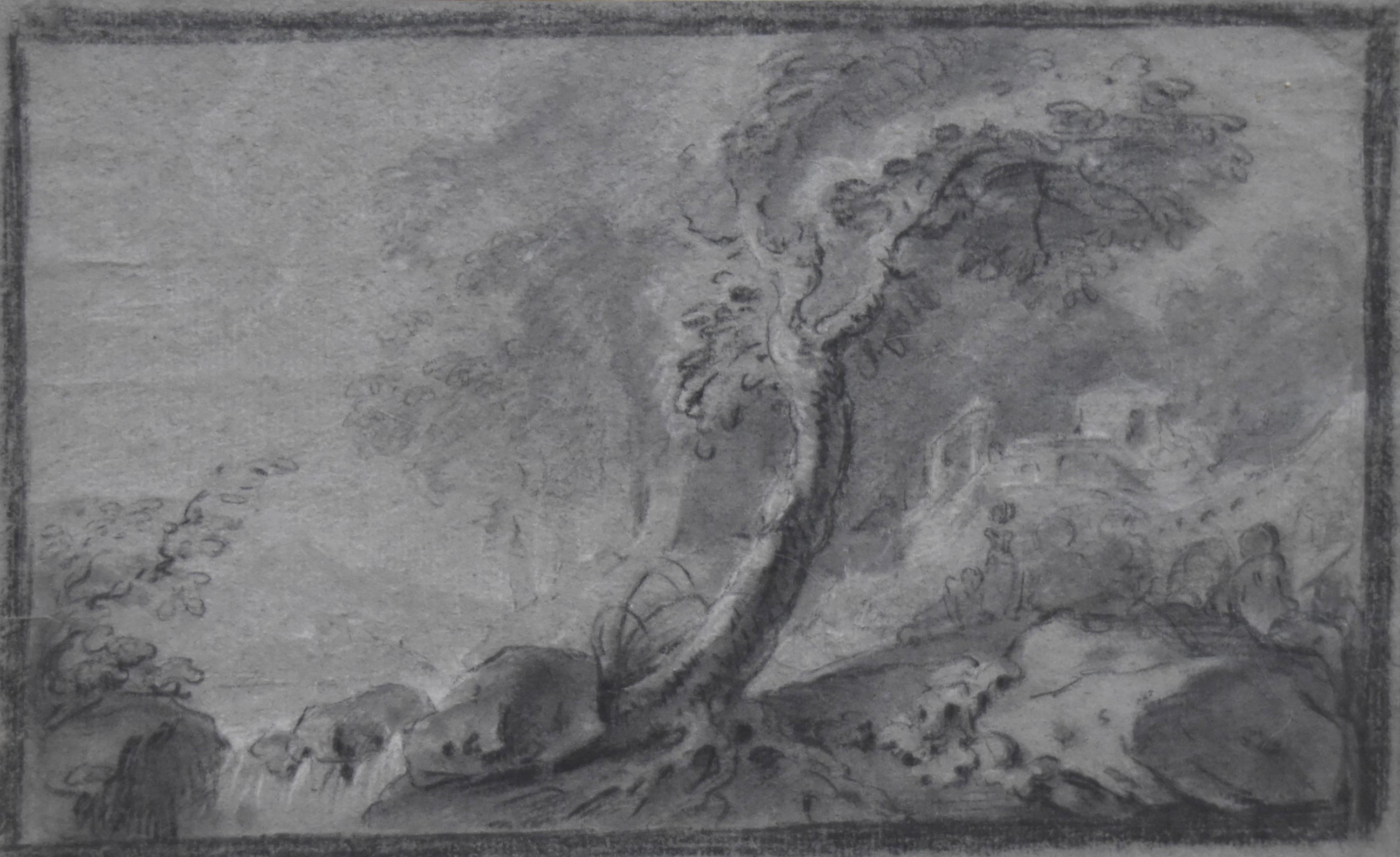
France 18th Century, Pastorale (Arcadian Landscape), original drawing
Located in Paris, FR
France 18th Century,
Pastorale (Arcadian Landscape)
Black chalk and heightenings of white gouache on blue-grey paper
19 x 31 cm
Framed : 34.5 x 46.5 cm
The atmosphere and the subje...
Category
1760s Old Masters Landscape Drawings and Watercolors
Materials
Chalk
$1,008 Sale Price
20% Off
17th century etching black and white landscape forest trees figures scene
By Claude Lorrain
Located in Milwaukee, WI
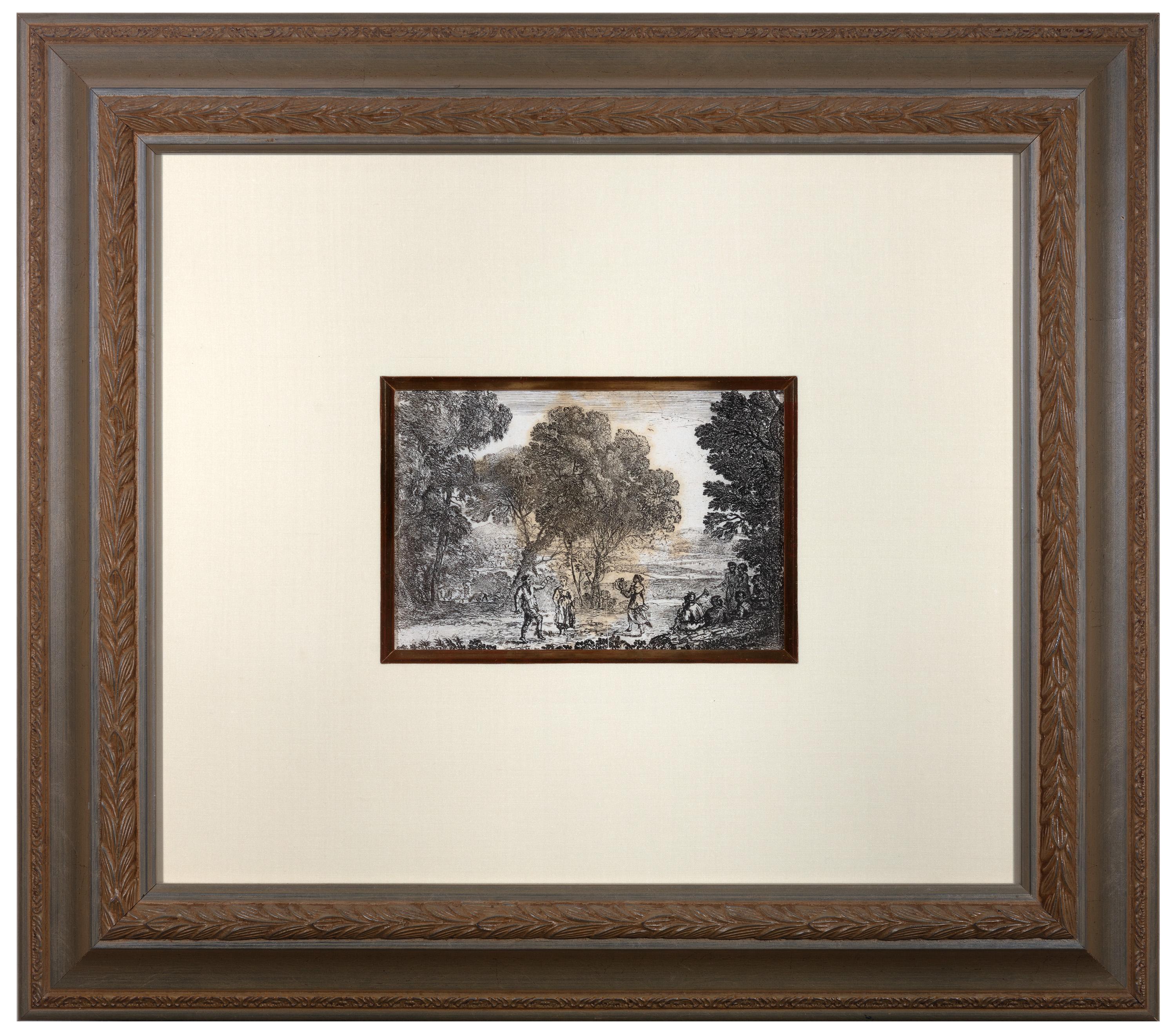
"La Danse Sous Les Arbes (The Country Dance)" is an etching by Claude Gellee (Le Lorrain). This etching is in the collections of the Metropolitan Museum and the Louvre. Publisher: Ma...
Category
Mid-17th Century Old Masters Landscape Prints
Materials
Etching
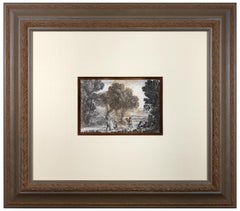
18th century landscape etching pastoral house nature scene detailed ink trees
By John Thomas Smith
Located in Milwaukee, WI
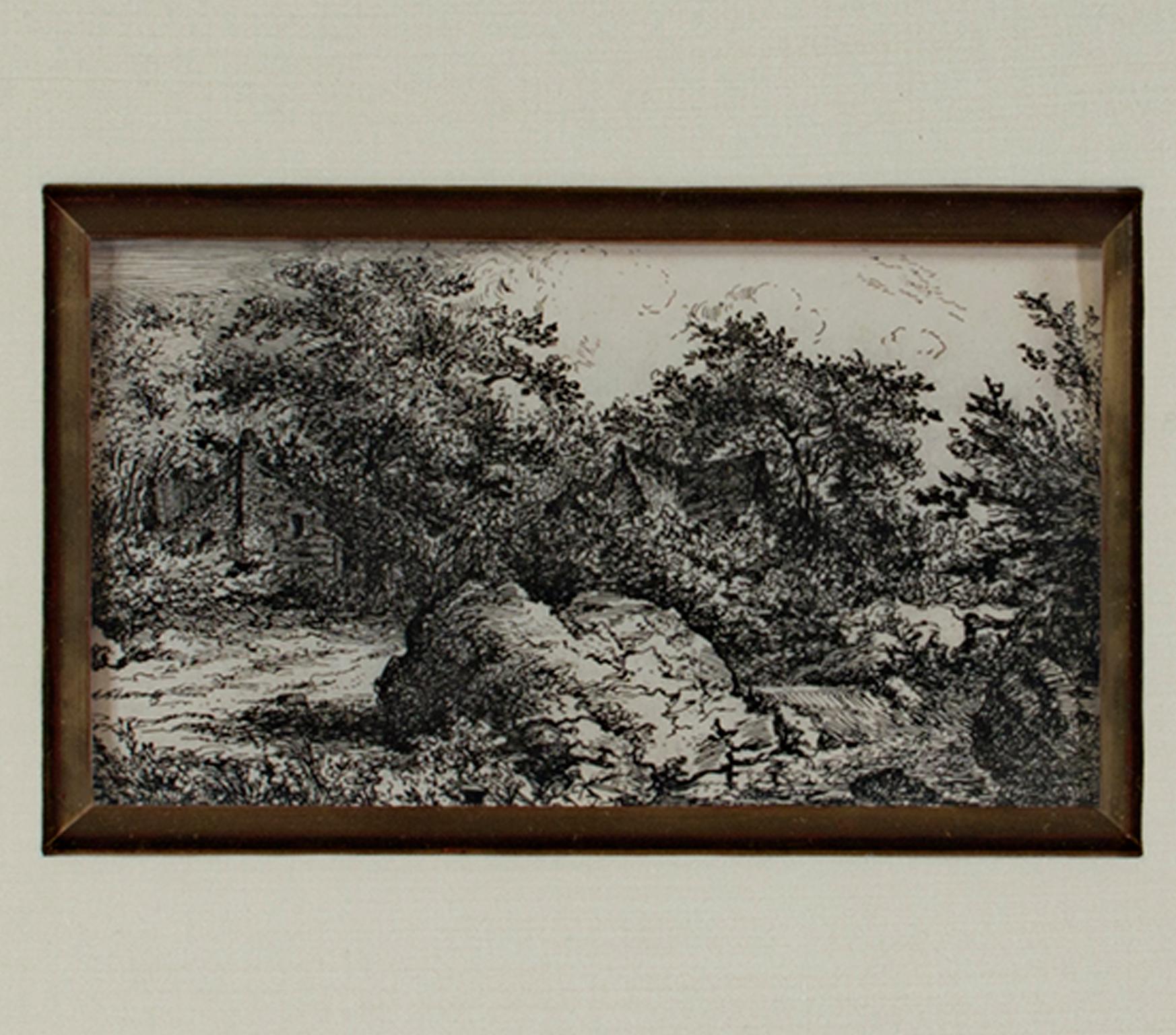
"Figure by the Cottage in Forest" is an original etching by John Thomas Smith. The miniature landscape shows a pair of cottages in the woods, nestled back into the trees. A river flo...
Category
1790s Old Masters Landscape Prints
Materials
Paper, Ink, Etching
Pair of Neoclassical Landscape Drawings, French School, Late 18th Century
Located in Kittery Point, ME
Depicting a pastoral scene and a hillside view.
Ink on paper.
One is signed Waudelaincourt fecit
Antoine Hubert Wandelaincourt, French (1731-1819).
Category
Antique Late 18th Century French Neoclassical Drawings
Materials
Paper
More Ways To Browse
Antique Furniture And Jewelry
Antique Architectural Drawings
Antique Spurs
Ancient Column
Tuscan Landscape
Landscape With Ruins
Antique Aly
Pitti Palace
Jan Brueghel The Elder
Paul Bril
Antique Calligraphy Pens
Doug Patterson
Douglass Parshall
Dutch Naive Painting
Ed Walaitis
Edward Seago Watercolour
Edward Walaitis
Emmanuel Levy