Items Similar to View of an Antique City, a wash landscape by Jan de Bisschop (1628 - 1671)
Want more images or videos?
Request additional images or videos from the seller
1 of 9
Jan de BisschopView of an Antique City, a wash landscape by Jan de Bisschop (1628 - 1671)
$7,176.36
£5,328.85
€6,000
CA$9,859.24
A$10,718.98
CHF 5,683.22
MX$128,493.45
NOK 72,230.78
SEK 66,173.22
DKK 45,739.25
About the Item
The attribution to Jan de Bisschop has been confirmed by the RKD with the following comment: "We base this attribution on the dark washes, the subject represented and the monogram".
This powerful wash with warm hues is highly evocative of the talent of Jan de Bisschop, an amateur artist of the Dutch Golden Age. He is an endearing character: although most of his work, consisting mainly of landscapes and reproductions of artworks, is largely inspired by Italy, he probably never went to Italy. An amateur artist, he nevertheless had a real influence on other artists of his time, such as in particular his friend Jacob van der Ulft.
1. Jan de Bisschop, lawyer and amateur painter and engraver
Despite his amateur status, Jan de Bisschop (also known as Johannes Episcopius) was widely influential in art and art publishing. Born in Amsterdam in 1628, he became a lawyer and set up practice in The Hague around 1652. He later founded a drawing academy there. He mingled with an elite circle of intellectuals that included his friend and fellow amateur draftsman Constantijn Huygens the Younger (1628 - 1697).
Bartholomeus Breenbergh (1598 - 1657), who lived in de Bisschop's native Amsterdam after a long stay in Rome (between 1619 and 1630), most influenced de Bisschop's draftsmanship. De Bisschop's landscapes in brown ink wash imitated Breenbergh's evocations of Italianate sunlight. Despite drawing numerous Italianate landscapes, de Bisschop probably never went to Italy; other artists' works were his sources. Whether drawing with pen or brush, de Bisschop used a warm golden-brown ink, later named "bisschops-inkt" after him. De Bisschop in his turn had a great influence on his friend Jacob van der Ulft.
In addition to landscapes, de Bisschop made figure studies and drawings after classical sculptures and famous paintings, primarily by Italian artists. His publications, which reproduced antique sculptures and Old Master drawings, were instrumental in disseminating the classical style in Holland. He also designed title pages for books, mostly by classical authors, and published his own compositions.
2. Description of the artwork
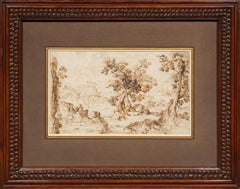
Behind a lake that appears to be cascading down a waterfall, framed by two trees, the landscape presented here by James de Bisschop evokes an ideal city surrounded by walls, into which opens a gateway flanked by two towers that can be seen on the left. The city is dominated by an amphitheatre that seems disproportionately high for its circumference. An obelisk and a building with a dome reminiscent of the Pantheon in Rome complete this reference to antiquity.
It is to be noted that the upper part of our drawing (including the large tree on the left) is on a different sheet which has been pasted with the lower part’s one. This technique was widely used in the 17th century at a time when paper was costly to hide a mistake or allow some reworking while keeping the largest part of a drawing.
Two related drawings in the Amsterdam Rijksmuseum illustrate Bisschop's highly specific technique (and his taste for oblong formats): Mountain Landscape in Italy (RP-T- 1898-A-3528. 118 x 209 mm - 4th photo in the gallery) and Colosseum in Rome with Buildings (RP-T-1909-39. 124 x 208 mm - last photo in the gallery).
- Creator:Jan de Bisschop (1652 - 1726)
- Dimensions:Height: 13.75 in (34.93 cm)Width: 18.5 in (46.99 cm)
- Medium:
- Movement Style:
- Period:
- Condition:20 x 32 cm (77/8 x 125/8 ) - Framed 35 x 47 cm (133/4 x 18 ½ ) Signed with the initials "JB" lower right Louis XVI style carved and gilded wood frame.
- Gallery Location:PARIS, FR
- Reference Number:1stDibs: LU1568214052352
About the Seller
5.0
Vetted Professional Seller
Every seller passes strict standards for authenticity and reliability
Established in 2020
1stDibs seller since 2021
11 sales on 1stDibs
Typical response time: 1 hour
- ShippingRetrieving quote...Shipping from: PARIS, France
- Return Policy
More From This Seller
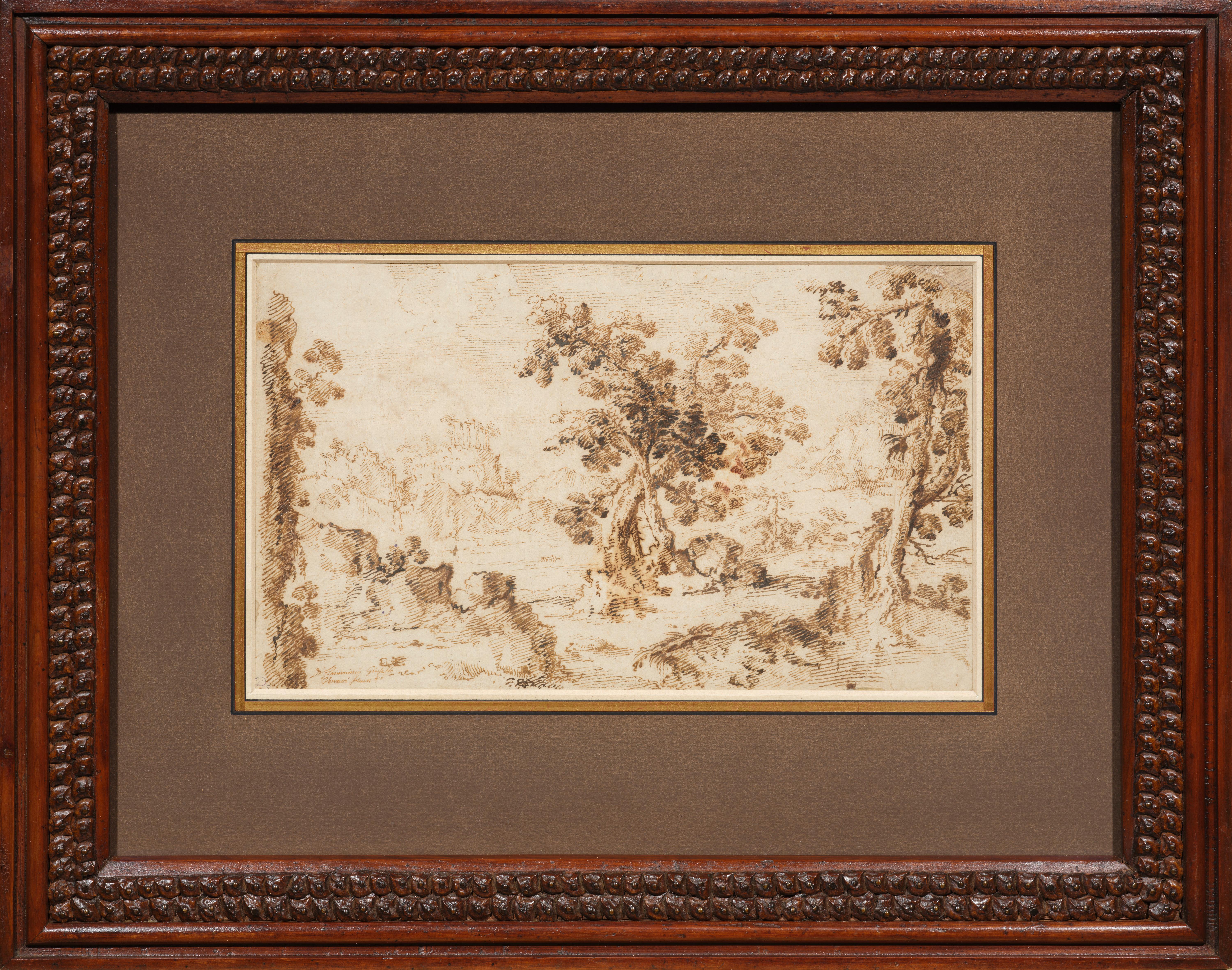
View AllRocky Landscape with Trees and Temple Ruins a drawing by Giulio Parigi (ca 1615)
Located in PARIS, FR
This Rocky Landscape with Trees and the Ruins of a Temple is a drawing by Giulio Parigi, an eclectic and prolific artist of the Medici court. An engraver, architect, furniture and je...
Category
1610s Old Masters Landscape Drawings and Watercolors
Materials
Ink, Laid Paper, Pen
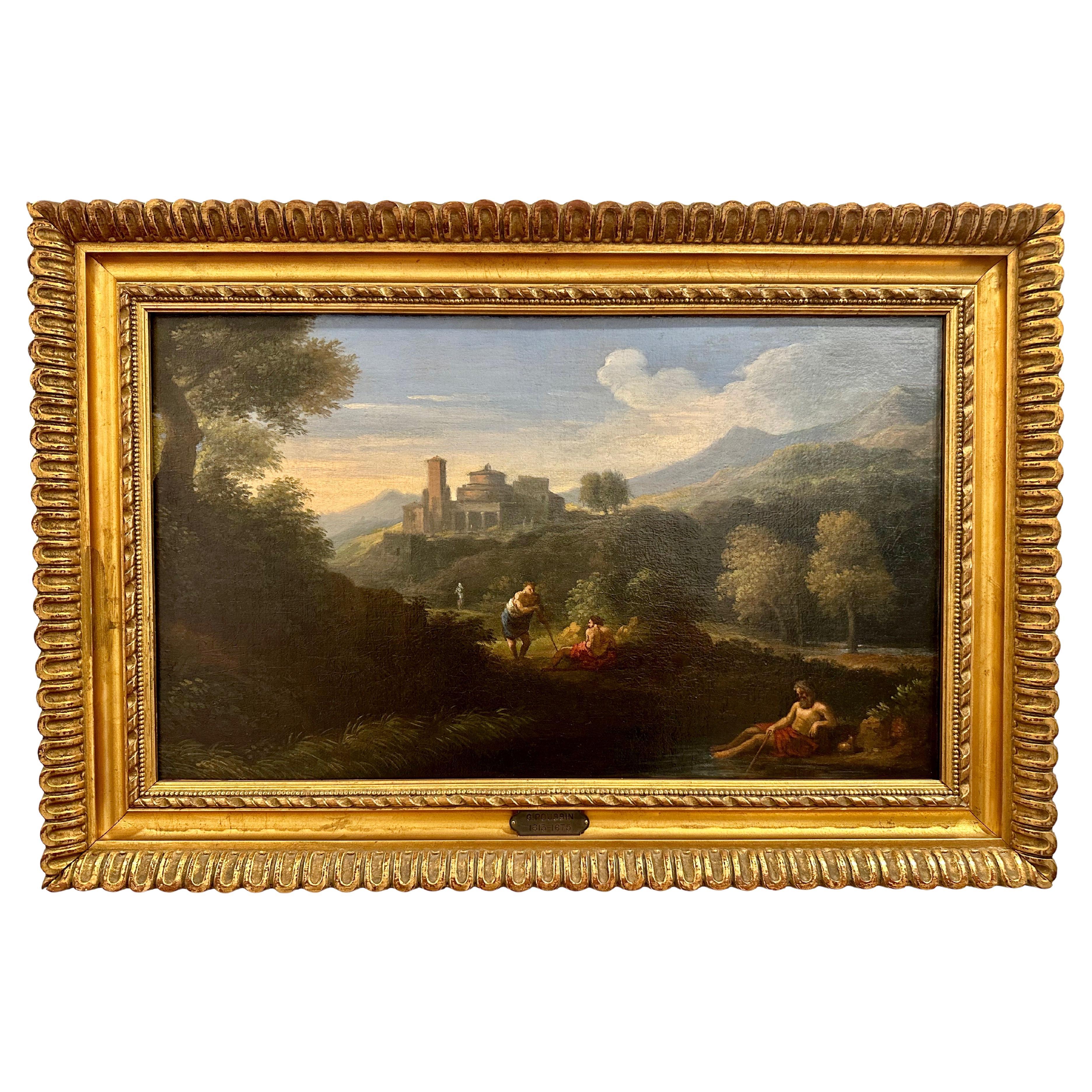
River Landscape with Shepherds and Architecture, a painting by Jan van Bunnik
By Jan van Bunnik
Located in PARIS, FR
This painting has been the subject of a study by the art historian Fabrizio Dassie (available on request), confirming its inclusion in Jan van Bunnik’s corpus.
In this painting, Ja...
Category
Late 17th Century Old Masters Landscape Paintings
Materials
Copper
View of the Posillipo coastline near Naples by William Marlow (1740 - 1813)
By William Marlow
Located in PARIS, FR
In this drawing, inspired by his stay in Naples in 1765, William Marlow presents us with a view of Cape Posillipo, to the west of Naples, an essential stage during the Grand Tour. Th...
Category
1760s Old Masters Landscape Drawings and Watercolors
Materials
Ink
View of Ariccia, a preparatory drawing by Achille Bénouville (1815 - 1891)
Located in PARIS, FR
This very modern drawing presents a view of Ariccia, a small town 25 kilometres south-east of Rome. The Palazzo Chigi (in which the film-maker Luchino Visconti would film a large part of The Leopard a century later) and the adjoining church are seen from the bottom of the ravine that surrounds the town. This drawing is a moving testimony to the attraction of the city for artists of the Romantic period, who established in Ariccia a vivid artists' colony.
1. Achille Bénouville...
Category
1850s Romantic Landscape Drawings and Watercolors
Materials
Ink, Gouache, Pencil
View of a Mansion in the South of France, a drawing by Claude-Joseph Vernet
By Claude-Joseph Vernet
Located in PARIS, FR
We would like to thank Madame Beck-Saiello for confirming the autograph nature of this drawing after an in-person examination.
It was probably during an excursion in the countryside near Avignon that Claude-Joseph Vernet executed this drawing, enhanced with pen and brown ink, depicting a mansion on a hilltop overlooking a small village with geometric shapes.
1. Joseph Vernet, a painter influenced by Italy
Claude-Joseph Vernet was born in Avignon in 1714, the son of Antoine Vernet (1689-1753), an artisan painter of architectural decorations, coach panels, and the like. He moved to the studio of Philippe Sauvan (1697-1792), a leading history painter in Avignon, and then worked with Jacques Viali (active 1681-1745), a decorative, landscape, and marine painter in Aix-en-Provence. Vernet's first recorded paintings were decorative overdoors executed in 1731 in the Aix townhouse of the marquise de Simiane. In 1734, Joseph de Seytres, marquis de Caumont, a leading amateur in Avignon, sponsored Vernet to make a study trip to Italy to complete his artistic education and to draw antiquities for his patron.
As Avignon was a papal territory in Vernet's day, he also had a number of useful introductions among influential churchmen when he arrived in Rome. Vernet was soon at home in the French community there, and he was encouraged by Nicolas Vleughels (1668-1737), director of the Académie de France in Rome, even though the young painter had no official affiliation with the royal institution. He likely entered the studio of the French marine painter Adrien Manglard...
Category
1730s Old Masters Landscape Drawings and Watercolors
Materials
Ink, Laid Paper, Pen, Carbon Pencil
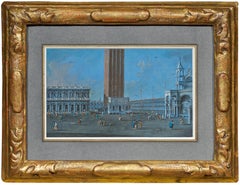
View of Piazza San Marco, a tempera signed by Giacomo Guardi (1764 - 1835)
Located in PARIS, FR
Signed and localized on the verso :
"Vedute di parte dalla Piazza dif.a alla Loggetta e cam
panil parte della Zecca ed in lontan Proc.e vechie e parte della chiesa
punto preso vic...
Category
Early 19th Century Old Masters Landscape Drawings and Watercolors
Materials
Tempera
You May Also Like
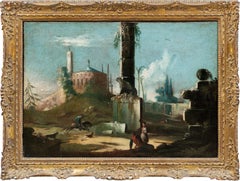
Antonio Stom (Venetian painter) - 18th century landscape - Architectural View
By Antonio Stom
Located in Varmo, IT
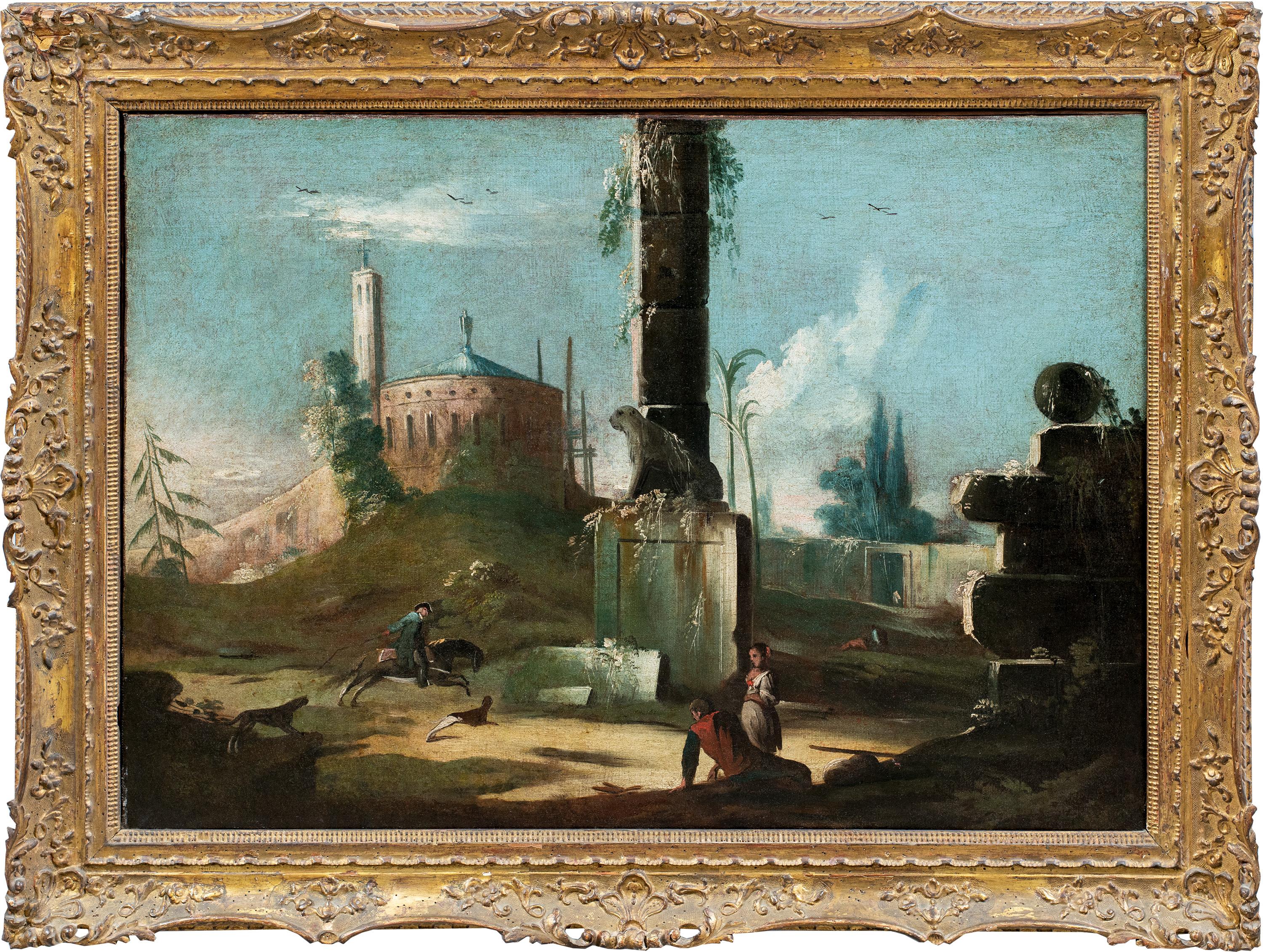
Antonio Stom (Venice 1688 - Venice 1734) - Architectural Capriccio with Classical Ruins and Heraldic Lion.
70.5 x 99.5 cm unframed, 90.5 x 119 cm framed.
Oil on canvas, in a carved...
Category
Mid-18th Century Rococo Landscape Paintings
Materials
Canvas, Oil
Pair of Roman Landscapes - by J.F. Van Bloemen - 18th Century
By Jan Frans van Bloemen (Orizzonte)
Located in Roma, IT
Beautiful couple of Roman Landscape by J. F. Van Bloemen, in very good conditions and with later wooden frames.
Bibliography and Exhibitions:
Old Master Exhibition, H.Terry-Engell, ...
Category
Early 18th Century Landscape Paintings
Materials
Oil, Canvas

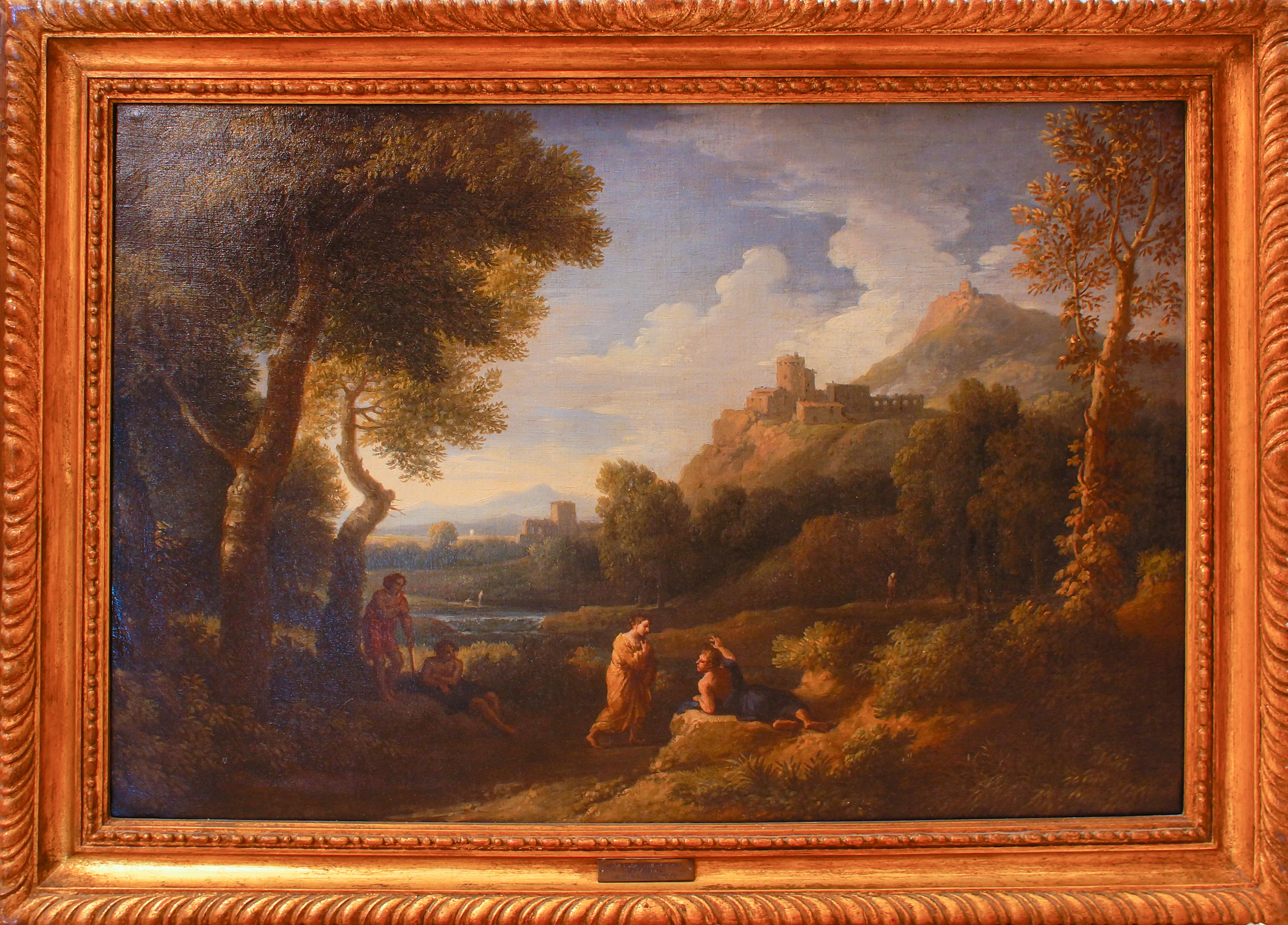
Jan Frans van Bloemen called Orizzonte (Antwerp 1662-Rome 1749), Roman Landscape
Located in CH
Jan Frans van Bloemen, called Orizzonte (Antwerp, 1662 – Rome, 1749)
A Late 17th–Early 18th Century Italian Landscape with Figures of the Roman Campagna...
Category
Antique Late 17th Century Dutch Baroque Paintings
Materials
Canvas
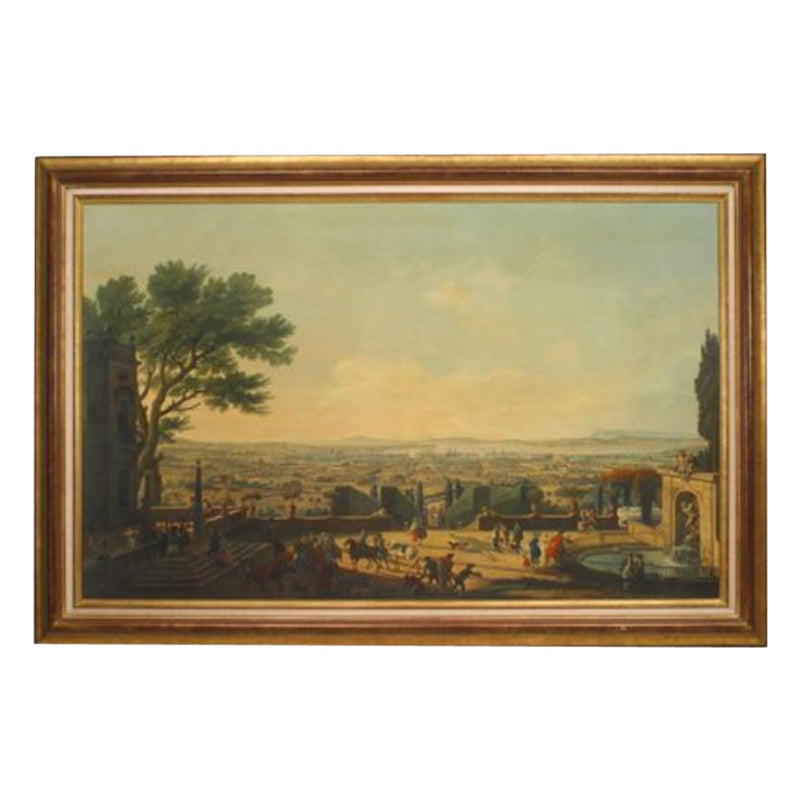
Landscape "The Town and Harbour of Toulon"
Located in Queens, NY
Copy of a landscape painting titled "The Town and Harbour of Toulon" showing expansive view from courtyard with people, horses, and dogs by the sea
Category
Late 20th Century American Louis XV Paintings
Materials
Paint
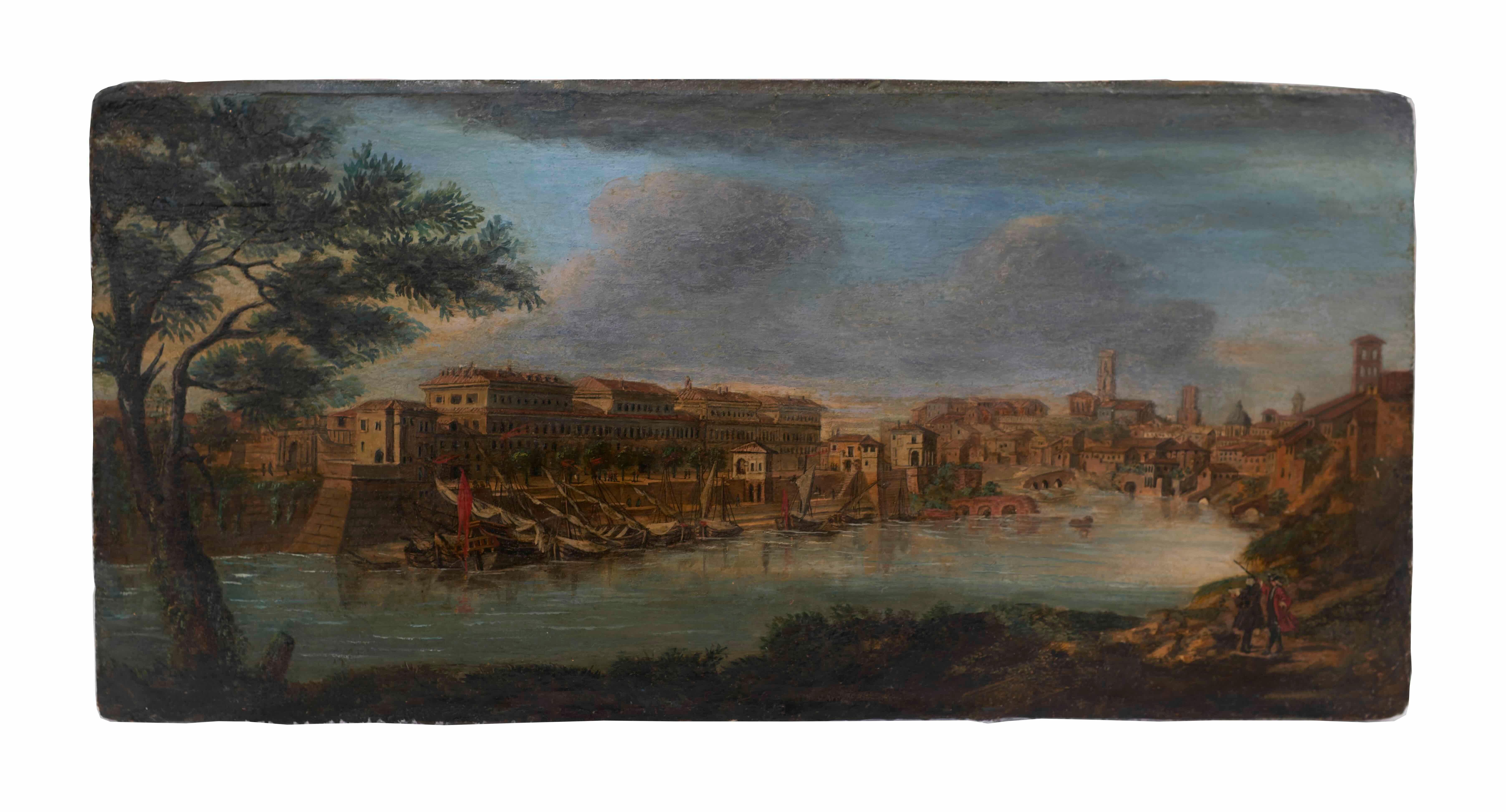
19th C Painting of View of Venice After Gaspar Van Wittel (1653-1736)
Located in San Francisco, CA
19th C Painting of View of Venice
After Gaspar Van Wittel (1653-1736)
Oil on Wood Panel
Beautifully Restored
Unframed
10" x 13.25
Category
19th Century Landscape Paintings
Materials
Oil, Wood Panel
Francesco Battaglioli (Venetian master) - 18th century painting - Landscape
By Francesco Battaglioli
Located in Varmo, IT
Francesco Battaglioli (Modena c. 1710 - Venice post-1796) - Architectural Capriccio with Figures.
83.5 x 114.5 cm unframed, 98 x 130 cm with fra...
Category
Mid-18th Century Rococo Landscape Paintings
Materials
Canvas, Oil