Items Similar to Landscape with Trees and a Fisherman walking, a drawing by Jan Van Goyen
Want more images or videos?
Request additional images or videos from the seller
1 of 5
Jan Josefsz Van GoyenLandscape with Trees and a Fisherman walking, a drawing by Jan Van Goyenca. 1650
ca. 1650
$17,757.95
£13,266.56
€15,000
CA$24,727.06
A$26,567.84
CHF 14,253.60
MX$312,999.83
About the Item
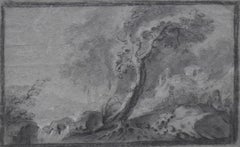
No Dutch draughtsman ever captured the atmosphere of the rural countryside of Holland with the same atmospheric and engaging simplicity that Van Goyen achieved in drawings such as this. Indeed, his landscapes were seminal in the development of the genre. The present sketch conveys a striking sense of movement within the natural landscape, conveyed by the deftly applied strokes of chalk, from which the artist’s hand can be sensed. The composition is characteristic of his work, with the low horizon affording significance to the broad sky and the soaring birds within. This feeling of windswept motion powerfully evokes the expansive Dutch farmland with which he was evidently preoccupied.
1. Jan van Goyen, a pioneer in Dutch landscape painting
Jan van Goyen was ambitious in his yearning for prosperity and recognition. Son of a cobbler in Leiden, he was apprenticed at the young age of ten to local painters. After a year of travelling through France, Van Goyen's received his formative training from the landscapist Esaias van de Velde in Haarlem in 1617. Haarlem, centre of monochrome still lifes, put Jan van Goyen forward as the first and leading painter of Dutch tonal landscapes.
Eventually, Van Goyen moved to the court city, The Hague, where he became head of the Guild of Saint Luke. Regardless his substantial artistic output, Van Goyen was also active (although not very successful) as an art collector, dealer, auctioneer, appraiser, tulip and real estate investor. Surrounded by artists, he let the adjoining house to acclaimed fellow landscapist Paulus Potter. Two of Van Goyen's daughters married respectively his student, the genre painter Jan Steen and still life painter Jacques de Claeuw. Van Goyen's portrait by acclaimed colleague Gerard ter Borch confirms his prominent position among the Dutch artworld elite.
Van Goyen travelled the length and breadth of the Netherlands recording details of landscape and topography in black chalk. A small sketchbook tucked into his pocket, the draughtsman in search of inspiration could quickly delineate sand dunes and architectural structures in the vicinity of his hometown or accompany him on extended journeys. Back in his studio, the sketches would provide endless inspiration, combining different motifs into imaginary landscape compositions. These drawings not only functioned as preliminary studies for motifs in paintings, Van Goyen at times also reworked them into larger, more finished drawings, typically monogrammed and dated, and intended for sale. Never attempting to depict accurate views, Van Goyen's preliminary studies unfold as topographical elements in his composite landscapes.
His graphic work was inventoried by Beck in 1972 and included several hundred drawings; more than a thousand have been recorded today. Almost exclusively executed in black chalk at the beginning, these drawings were enriched from the end of the 1640s onwards with a light wash of grey or brown ink, like the one presented here.
2. Description of the artwork
A group of trees along a river, a fisherman walking with his dog, a fishing rod on his shoulder, the description of this landscape seems banal. But the atmospheric rendering is the real subject here: the immense sky shaded by discreet lines of black chalk in which a few birds fly, the dunes where the play of light and wind creates deep contrasts between areas of shadow and full clarity (rendered by a masterful use of reserves).
Despite its small size and the fact that it was taken from life, the extreme composition of our drawing must be emphasised. Our landscape is organised around a diagonal running from the lower left to the upper right, following the edge of the mound at the bottom left and the tree tops in the middle of the composition. There is a strong contrast between the movement of the trees and the direction taken by the fisherman and its dog, and the flight of birds in the sky in the opposite direction.
Van Goyen's technique is remarkable for its skill and precision: with a comma or a loop he brings a character to life, and a touch of wash is enough to convey the atmosphere. Our drawing has not been listed by Beck, but in the supplement to the catalogue raisonné published in 1987 (under number 409) there is a composition with broad similarities.
3. Framing
We have chosen to frame this drawing in a Dutch ebony veneer frame which brings out the grey range in which our landscape develops (with some imperceptible touches of brown in the foliage of the trees).
Main bibliographic sources :
Hans-Ulrich Beck - Jan van Goyen 1596 - 1656. Ein Oeuvreverzeichnis - Van Gendt
Co. Amsterdam 1972 - Ergänzungen zum Katalog - Davaco 1987
(collective) - Regards sur l'art hollandais du XVIIème siècle - Fondation Custodia 2004
- Creator:Jan Josefsz Van Goyen (1596 - 1656, Dutch)
- Creation Year:ca. 1650
- Dimensions:Height: 3.63 in (9.23 cm)Width: 5.63 in (14.31 cm)
- Medium:
- Movement Style:
- Period:1650-1659
- Condition:Dimensions : 3 5/8’’x 5 5/8’’ (92 x 142 mm) ; framed : 9 7/8’’x 12 1/8’’ (25 x 30.8 cm) This drawing is presented in a Dutch ebony veneer frame. Provenance: Alfred Brod Gallery, London; English private collection since 1965.
- Gallery Location:PARIS, FR
- Reference Number:1stDibs: LU1568211234292
About the Seller
5.0
Vetted Professional Seller
Every seller passes strict standards for authenticity and reliability
Established in 2020
1stDibs seller since 2021
11 sales on 1stDibs
Typical response time: 3 hours
- ShippingRetrieving quote...Shipping from: PARIS, France
- Return Policy
More From This Seller
View AllRocky Landscape with Trees and Temple Ruins a drawing by Giulio Parigi (ca 1615)
Located in PARIS, FR
This Rocky Landscape with Trees and the Ruins of a Temple is a drawing by Giulio Parigi, an eclectic and prolific artist of the Medici court. An engraver, architect, furniture and je...
Category
1610s Old Masters Landscape Drawings and Watercolors
Materials
Ink, Laid Paper, Pen
View of an Antique City, a wash landscape by Jan de Bisschop (1628 - 1671)
Located in PARIS, FR
The attribution to Jan de Bisschop has been confirmed by the RKD with the following comment: "We base this attribution on the dark washes, the subject represented and the monogram".
...
Category
17th Century Old Masters Landscape Drawings and Watercolors
Materials
Ink, Pen
River Landscape with Shepherds and Architecture, a painting by Jan van Bunnik
By Jan van Bunnik
Located in PARIS, FR
This painting has been the subject of a study by the art historian Fabrizio Dassie (available on request), confirming its inclusion in Jan van Bunnik’s corpus.
In this painting, Ja...
Category
Late 17th Century Old Masters Landscape Paintings
Materials
Copper
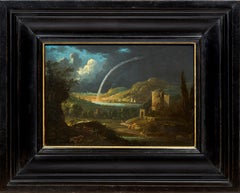
View of a Mansion in the South of France, a drawing by Claude-Joseph Vernet
By Claude-Joseph Vernet
Located in PARIS, FR
We would like to thank Madame Beck-Saiello for confirming the autograph nature of this drawing after an in-person examination.
It was probably during an excursion in the countryside near Avignon that Claude-Joseph Vernet executed this drawing, enhanced with pen and brown ink, depicting a mansion on a hilltop overlooking a small village with geometric shapes.
1. Joseph Vernet, a painter influenced by Italy
Claude-Joseph Vernet was born in Avignon in 1714, the son of Antoine Vernet (1689-1753), an artisan painter of architectural decorations, coach panels, and the like. He moved to the studio of Philippe Sauvan (1697-1792), a leading history painter in Avignon, and then worked with Jacques Viali (active 1681-1745), a decorative, landscape, and marine painter in Aix-en-Provence. Vernet's first recorded paintings were decorative overdoors executed in 1731 in the Aix townhouse of the marquise de Simiane. In 1734, Joseph de Seytres, marquis de Caumont, a leading amateur in Avignon, sponsored Vernet to make a study trip to Italy to complete his artistic education and to draw antiquities for his patron.
As Avignon was a papal territory in Vernet's day, he also had a number of useful introductions among influential churchmen when he arrived in Rome. Vernet was soon at home in the French community there, and he was encouraged by Nicolas Vleughels (1668-1737), director of the Académie de France in Rome, even though the young painter had no official affiliation with the royal institution. He likely entered the studio of the French marine painter Adrien Manglard...
Category
1730s Old Masters Landscape Drawings and Watercolors
Materials
Ink, Laid Paper, Pen, Carbon Pencil
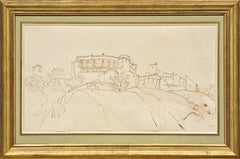
Stag Hunting in the Vicinity of Nuremberg by a German Artist Peter von Bemmel
Located in PARIS, FR
This small landscape shows a hunting scene: two riders are chasing a stag with their dogs at the edge of a forest. Signed by Peter von Bemmel, it is typical of the production of this...
Category
1720s Old Masters Landscape Paintings
Materials
Copper
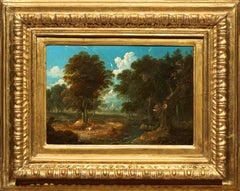
View of Ariccia, a preparatory drawing by Achille Bénouville (1815 - 1891)
Located in PARIS, FR
This very modern drawing presents a view of Ariccia, a small town 25 kilometres south-east of Rome. The Palazzo Chigi (in which the film-maker Luchino Visconti would film a large part of The Leopard a century later) and the adjoining church are seen from the bottom of the ravine that surrounds the town. This drawing is a moving testimony to the attraction of the city for artists of the Romantic period, who established in Ariccia a vivid artists' colony.
1. Achille Bénouville...
Category
1850s Romantic Landscape Drawings and Watercolors
Materials
Ink, Gouache, Pencil
You May Also Like
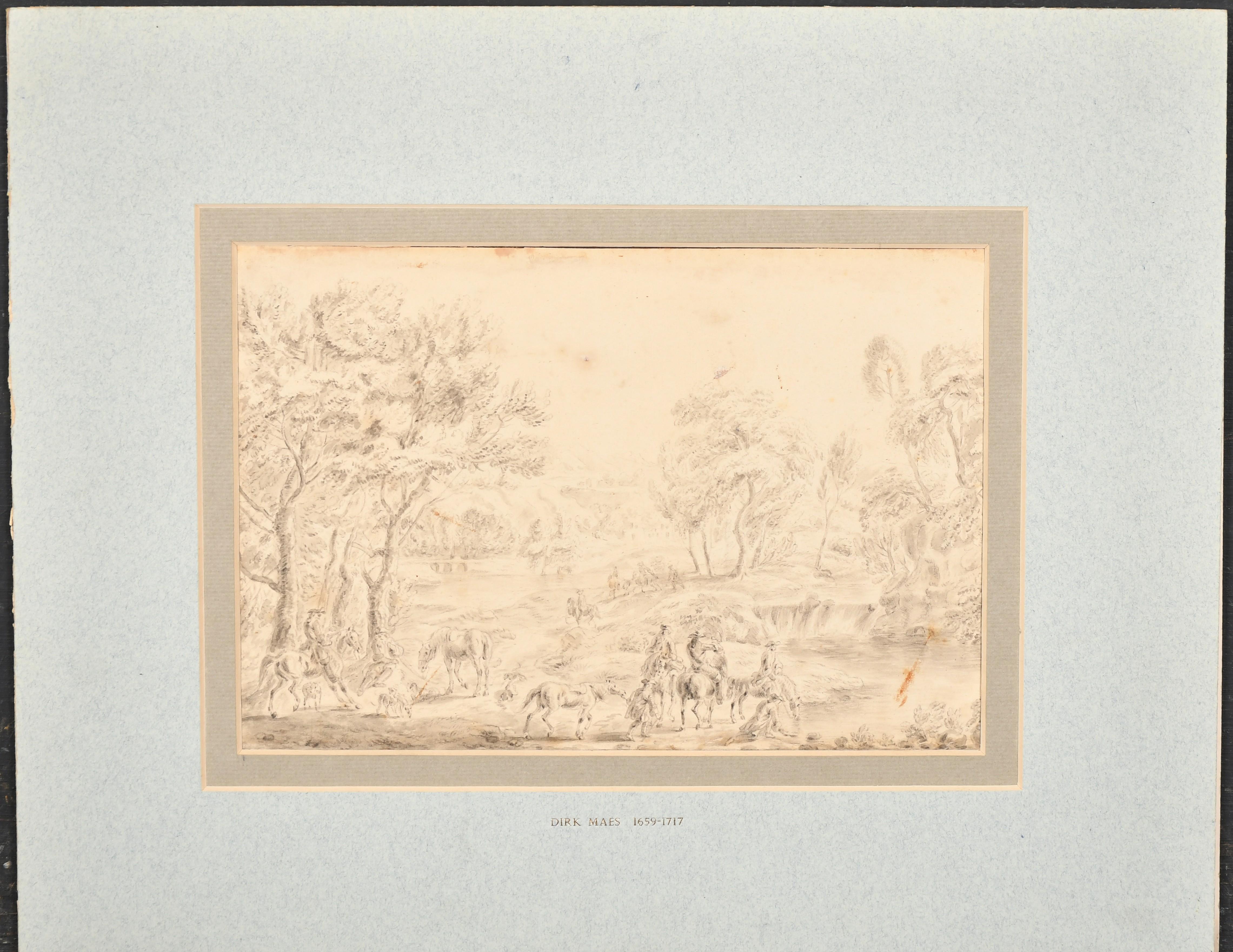
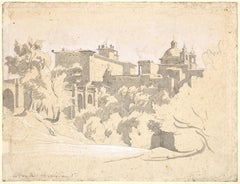
Fine 17th Century Dutch Old Master Drawing Hunting Party Landscape
Located in Cirencester, Gloucestershire
The Hunting Party
Attributed to Dirk Maes (1659-1717) Dutch.
Figures in a Classical Landscape,
Watercolour and wash on paper,
Mounted, unframed image 6.75" x 9.75" (17.1 x 24.7cm)...
Category
17th Century Old Masters Landscape Paintings
Materials
Watercolor, Pencil
$1,201 Sale Price
20% Off
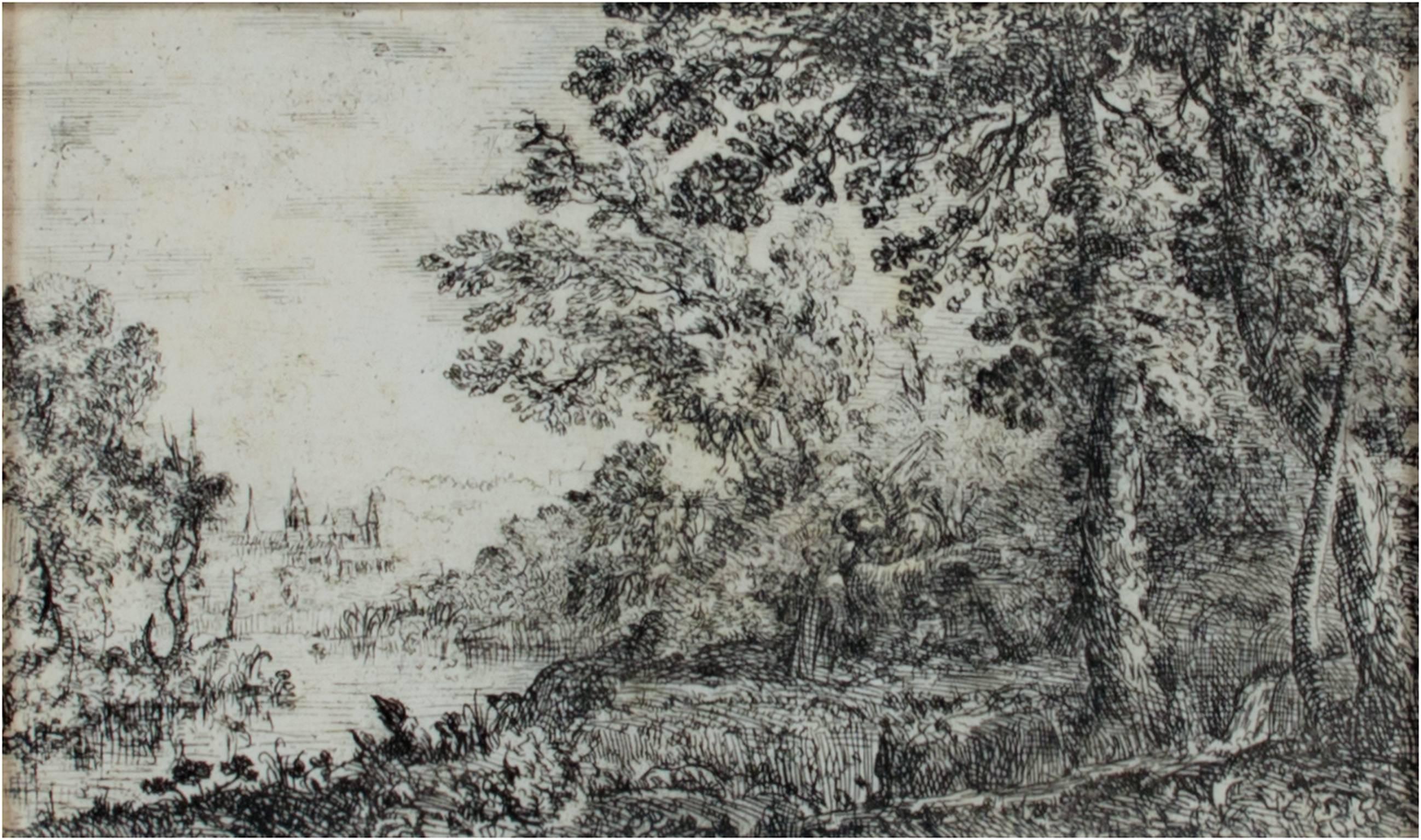
17th century etching black and white landscape forest trees river scene
By Claude Lorrain
Located in Milwaukee, WI
"L'Apparition (The Vision)" is an original etching by Claude Lorrain (Claude Gellee). This print depicts a religious vision near the edge of a river. The publisher is Mannocci #5 and...
Category
1630s Old Masters Landscape Prints
Materials
Etching
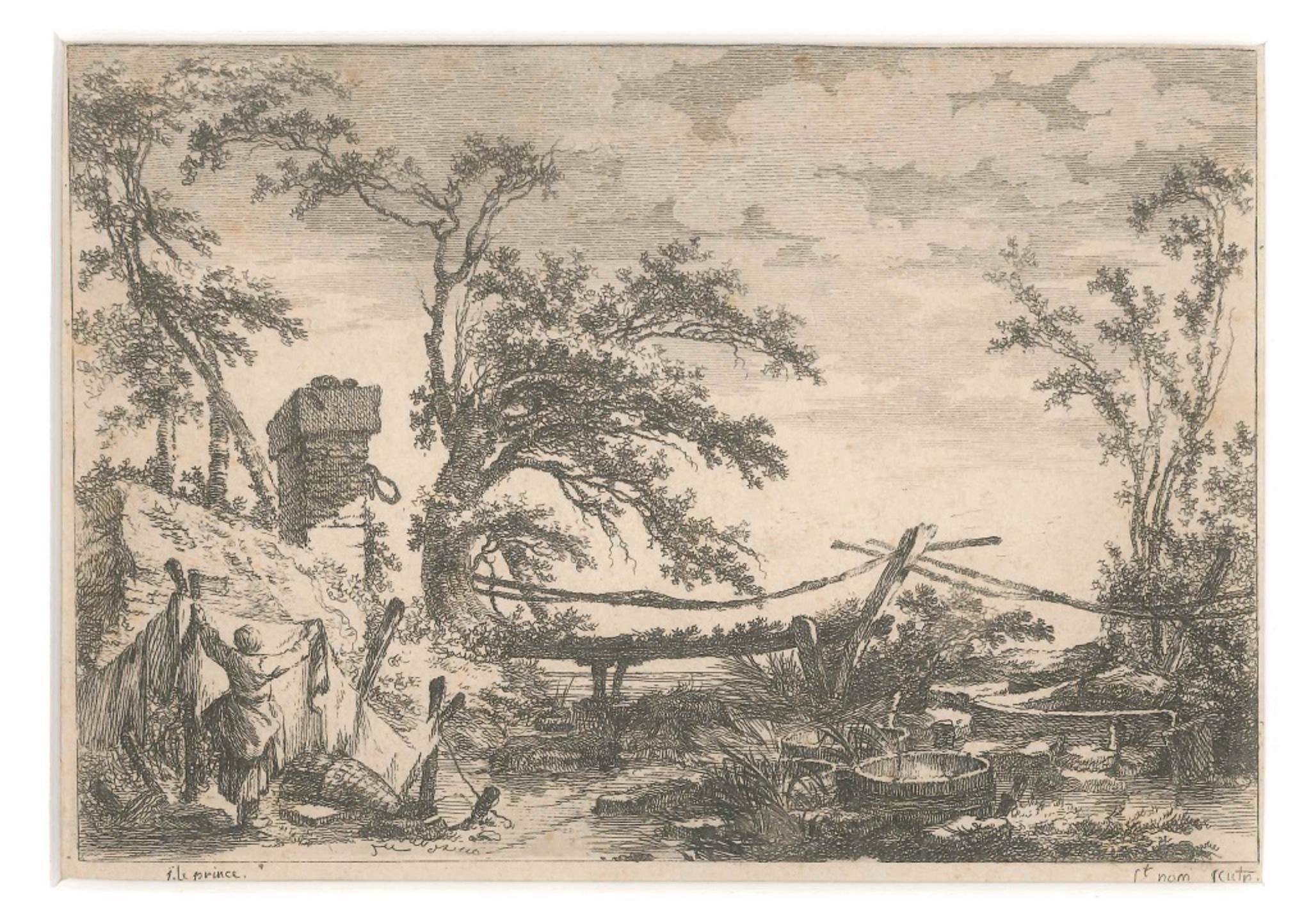
Landscape with Bridge - Etching by J. C. Richard de Saint-Non - 18th Century
Located in Roma, IT
Landscape with Bridge is a beautiful black and white etching realized by Jean-Claude Richard de Saint-Non at the end of 18th Century.
On lower margin under the image the inscriptio...
Category
Late 18th Century Old Masters Landscape Prints
Materials
Etching

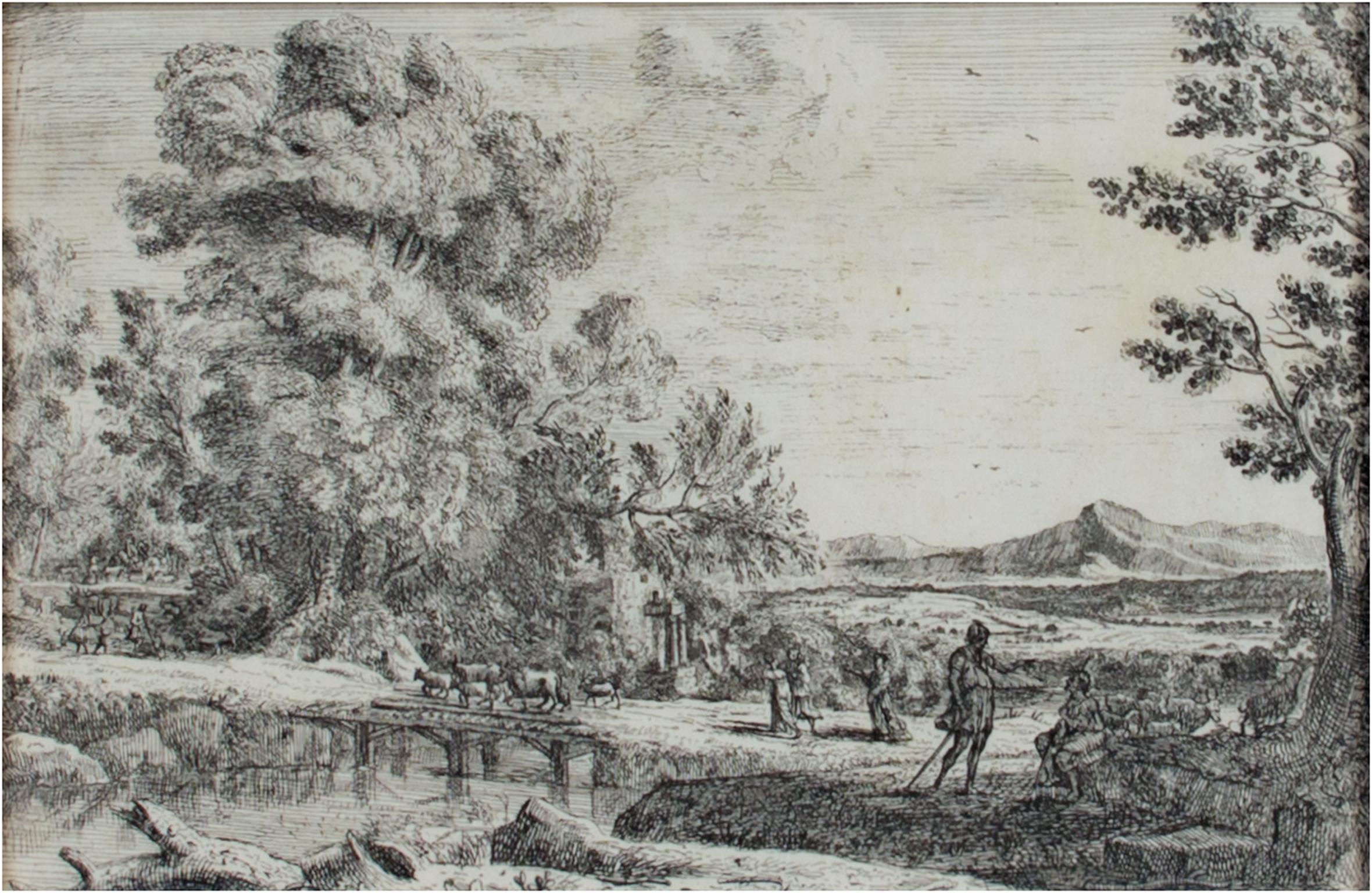
17th century etching black and white landscape forest trees river figures scene
By Claude Lorrain
Located in Milwaukee, WI
"Le Point de Bois (Rebecca & Eliezer)" is an etching by Claude Gellee (Le Lorrain). This etching is in the collections of the Metropolitan Museum and the Louvre. Publisher: Mannocci ...
Category
Mid-17th Century Old Masters Landscape Prints
Materials
Etching
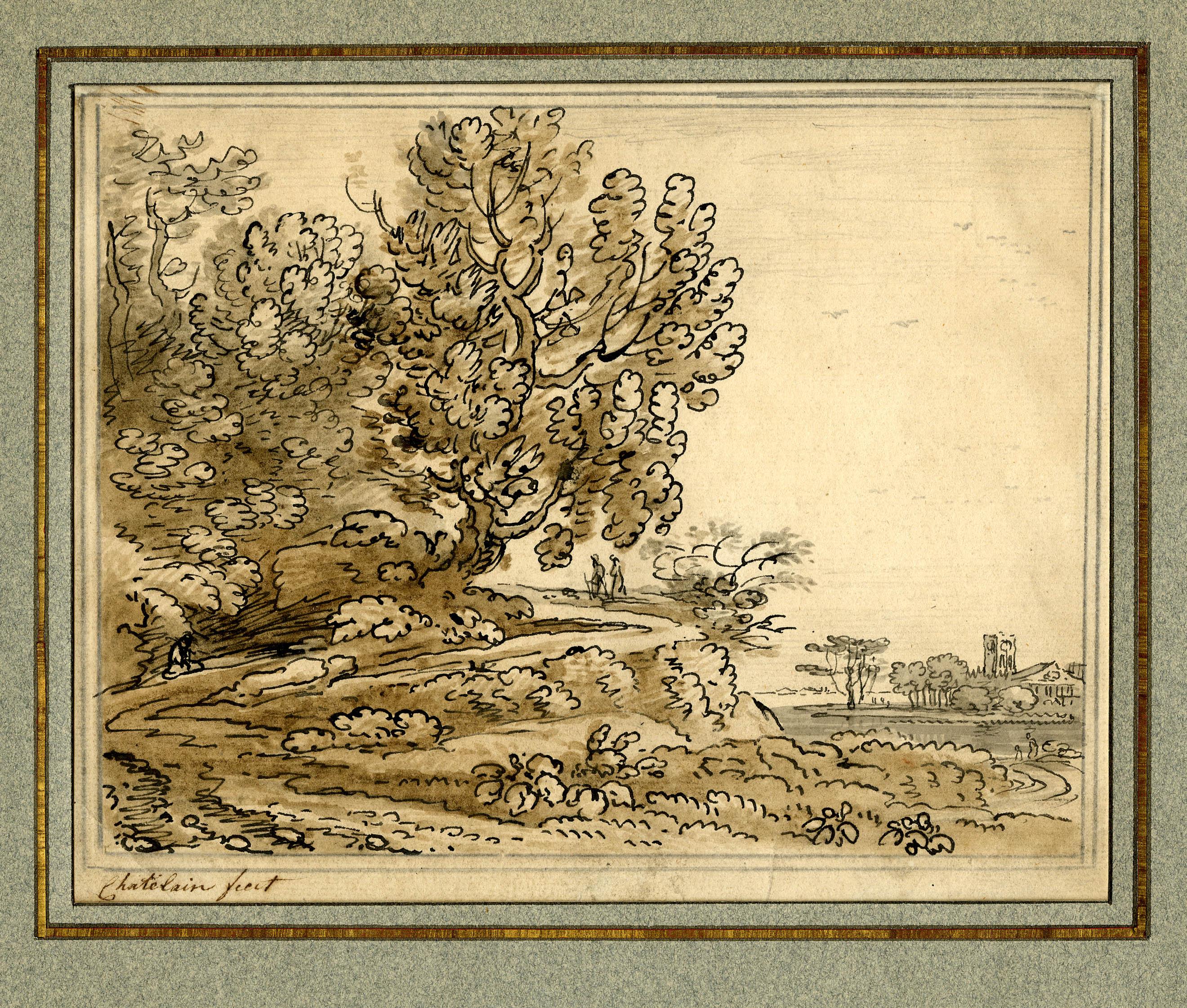
Landscape with Figures in the English Countryside
Located in Fairlawn, OH
Landscape with Figures in the English Countryside
Pen, ink and graphite with gray and brown washes on laid watermarked paper, c. 1740
Signed by the artist lower left of image: "Chate...
Category
1740s Romantic Landscape Drawings and Watercolors
Materials
Ink
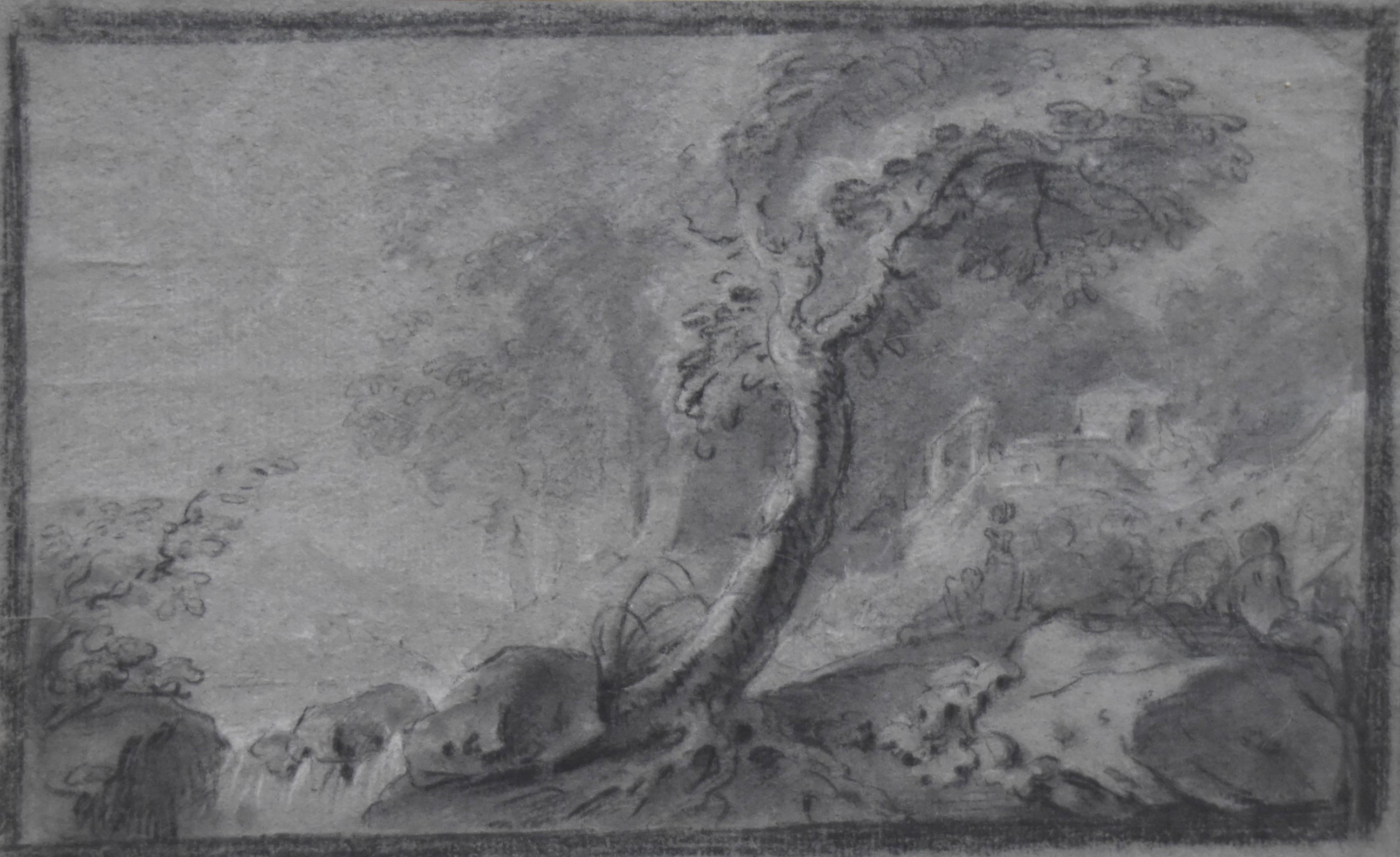
France 18th Century, Pastorale (Arcadian Landscape), original drawing
Located in Paris, FR
France 18th Century,
Pastorale (Arcadian Landscape)
Black chalk and heightenings of white gouache on blue-grey paper
19 x 31 cm
Framed : 34.5 x 46.5 cm
The atmosphere and the subje...
Category
1760s Old Masters Landscape Drawings and Watercolors
Materials
Chalk
$1,008 Sale Price
20% Off
More Ways To Browse
Pioneer Paintings
Fishing Rod
Antique Cobbler
Antique Fishing Rods
Jan Van Goyen
Gerard Ter Borch
French Garden Drawings
Robert Stein
Vintage Holiday Brochures
California Woman Artists Landscape
Colored Pencil Landscape
Henri Clamen
Vivian Bewick
Montmartre Drawing
Spencer Gore
Brabazon Brabazon
Graphite Drawing Tree
Palm Tree Drawing