Want more images or videos?
Request additional images or videos from the seller
1 of 11
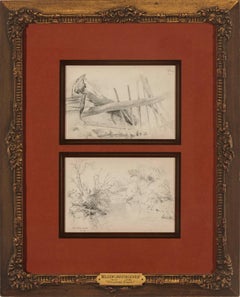
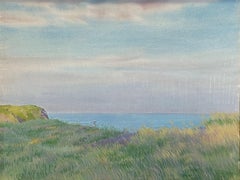
John Singer Sargent"Study off Newport, Rhode Island" John Singer Sargent Drawing, Impressionism1876
1876
Price:$24,320
$25,600List Price
About the Item
- Creator:John Singer Sargent (1856-1925, American)
- Creation Year:1876
- Dimensions:Height: 15.5 in (39.37 cm)Width: 21 in (53.34 cm)
- Medium:
- Movement Style:
- Period:
- Condition:
- Gallery Location:New York, NY
- Reference Number:1stDibs: LU1841213248932
About the Seller
5.0
Platinum Seller
Premium sellers with a 4.7+ rating and 24-hour response times
Established in 2022
1stDibs seller since 2022
132 sales on 1stDibs
Authenticity Guarantee
In the unlikely event there’s an issue with an item’s authenticity, contact us within 1 year for a full refund. DetailsMoney-Back Guarantee
If your item is not as described, is damaged in transit, or does not arrive, contact us within 7 days for a full refund. Details24-Hour Cancellation
You have a 24-hour grace period in which to reconsider your purchase, with no questions asked.Vetted Professional Sellers
Our world-class sellers must adhere to strict standards for service and quality, maintaining the integrity of our listings.Price-Match Guarantee
If you find that a seller listed the same item for a lower price elsewhere, we’ll match it.Trusted Global Delivery
Our best-in-class carrier network provides specialized shipping options worldwide, including custom delivery.You May Also Like
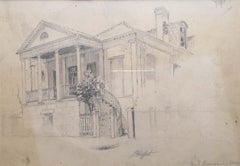
Beauregard House, New Orleans
By Louis Oscar Griffith
Located in New Orleans, LA
Louis Oscar Griffith (1875-1956) was an American painter known for his etchings, paintings, and aquatints of landscapes, especially scenes of Brown County, Indiana, New Orleans, LA and Texas. Griffith was born in Indiana in 1875 but later moved to Dallas, TX with his family. As a teen, he took art lessons with acclaimed landscape artist, Frank Reaugh...
Category
1910s Impressionist Landscape Drawings and Watercolors
Materials
Paper, Graphite
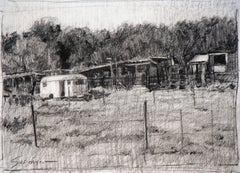
"Times Gone By" (2012) By Susie Hyer, Original Graphite Drawing on Paper
Located in Denver, CO
"Times Gone By" (2012) By Susie Hyer is an original handmade graphite drawing on paper that depicts a trailer and an old dilapidated house behind a short wire fence. This piece measu...
Category
2010s Impressionist Figurative Drawings and Watercolors
Materials
Paper, Graphite
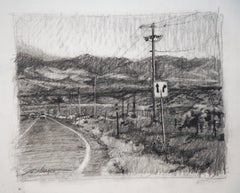
"Road Warriors" (2012) By Susie Hyer, Original Graphite Drawing on Paper
Located in Denver, CO
"Road Warriors" (2012) By Susie Hyer is an original handmade graphite drawing on paper that depicts a road with cars in the distance, and mountains in the background. This piece meas...
Category
2010s Impressionist Figurative Drawings and Watercolors
Materials
Paper, Graphite
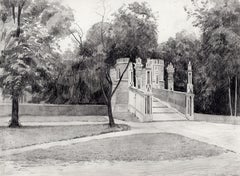
Tsaritsyno
By Simon Kozhin
Located in Zofingen, AG
The figured bridge in Tsaritsyno Park is one of the first on the path of a visitor to the park in the Gothic style, which has been preserved since its construction in 1776, having go...
Category
Early 2000s Impressionist Landscape Drawings and Watercolors
Materials
Magazine Paper, Pencil, Graphite
"Central Park"
By William Langson Lathrop
Located in Lambertville, NJ
Jim’s of Lambertville is proud to offer this artwork.
Signed. Complemented by a hand carved and gilt frame.
William L. Lathrop (1859-1938)
Deemed “Father of the New Hope Art Colony”, William Langson Lathrop was born in Warren, Illinois. He was largely self-taught, having only studied briefly with William Merritt Chase in 1887, at the Art Students League. Lathrop first moved east in the early 1880s, and took a job at the Photoengraving Company in New York City. While there, he befriended a fellow employee, Henry B. Snell. The two men became lifelong friends and ultimately, both would be considered central figures among the New Hope Art Colony.
Lathrop's early years as an artist were ones of continuing struggle. His efforts to break through in the New York art scene seemed futile, so he scraped enough money together to travel to Europe with Henry Snell in1888. There he met and married an English girl, Annie Burt. Upon returning to New York, he tried his hand at etching, making tools from old saw blades. Even though his prints were extremely beautiful, he still was impoverished. Lathrop would return to his family in Ohio, before once again attempting the New York art scene. In 1899, with great trepidation, he submitted five small watercolors to an exhibit at the New York Watercolor Club. He won the Evans Prize, the only award given, and four of the five paintings were sold the opening night. At age forty Lathrop’s career would finally take off and he became an “overnight success
Lathrop came to Phillips Mill for the first time in1898, to visit his boyhood friend, Dr. George Marshall. Shortly after, he and his family purchased the old miller’s house from Dr. Marshall. The Lathrop’s home became a social and artistic center for the growing New Hope colony. Tea and fascinating conversation was the “order of the day” every Sunday. This was a scene fondly recalled by many younger art students that Lathrop taught privately at Phillips Mill. It was common to see groups of his students painting and sketching along the banks of the canal or aboard his canal boat. He had previously taught in the Poconos and at the Lyme, Connecticut Summer School in1907, but Phillips Mill always remained Lathrop’s permanent address.
In 1928, a committee headed by Lathrop was formed to purchase the old Phillips Mill building as a place to hold community gatherings and art exhibitions. The committee had success and in 1929 the Phillips Mill Community Association was formed. This became the center of the New Hope Art Colony holding annual exhibitions and still operating today.
In 1930, Lathrop had built a sailboat he named the “Widge”. For eight consecutive seasons he sailed it along the coast of Long Island...
Category
Early 20th Century American Impressionist Landscape Drawings and Waterco...
Materials
Paper, Graphite
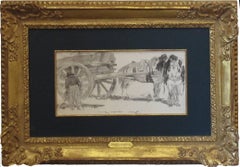
"Horse Cart"
By Daniel Garber
Located in Lambertville, NJ
Jim’s of Lambertville Fine Art Gallery is proud to present this piece by Daniel Garber (1880 - 1958).
One of the two most important and, so far, the most valuable of the New Hope Sc...
Category
Early 20th Century American Impressionist Landscape Drawings and Waterco...
Materials
Paper, Graphite
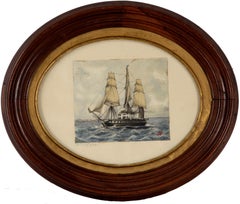
19th Century Maritime Seascape, USS Steam Frigate Niagara
Located in Soquel, CA
19th century maritime seascape of a naval ship similar to those used in the war of 1812, by William B. Hoff (American, 1846-1903). This miniature wat...
Category
19th Century American Impressionist Landscape Drawings and Watercolors
Materials
Paper, Watercolor, Graphite
$1,600 Sale Price
20% Off
H 10.5 in W 12.5 in D 1 in
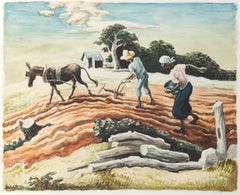
Planting (Spring Plowing) - Watercolor Landscape Painting with Figures, c. 1939
By Thomas Hart Benton
Located in Palm Desert, CA
"Planting (Spring Plowing)", a vibrant watercolor and graphite on paper by Thomas Hart Benton, circa 1939-40, embodies the artist's signature Regionalist style. The work depicts a ru...
Category
Mid-20th Century American Impressionist Figurative Drawings and Watercolors
Materials
Paper, Watercolor, Graphite
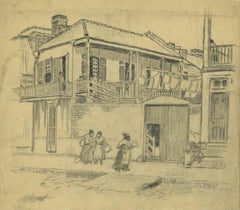
Preliminary Drawing for the color aquatint "New Orleans, Street Gossip"
By Louis Oscar Griffith
Located in Fairlawn, OH
Preliminary Drawing for the color aquatint "New Orlaens, Street Gossip"
Signed by the artist in pencil lower left
Graphite on tracing paper, 1916-1917
An impr...
Category
1910s American Impressionist Landscape Drawings and Watercolors
Materials
Graphite
$1,500
H 9.38 in W 10.75 in
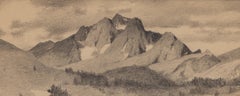
1910 Colorado Plein Air Landscape Sketch – Mountains, Valley
Field Drawing
By Charles Partridge Adams
Located in Denver, CO
This original circa 1910 graphite landscape drawing is a rare and intimate work by renowned Colorado artist Charles Partridge Adams (1858–1942), celebrated for his mastery of the Ame...
Category
1910s American Impressionist Landscape Drawings and Watercolors
Materials
Graphite
$1,450
H 11.5 in W 16.5 in D 0.75 in
More From This Seller
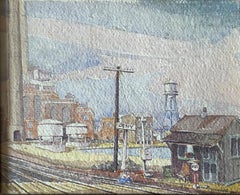
View All"Train Station, " Max Kuehne, Industrial City Scene, American Impressionism
By Max Kuehne
Located in New York, NY
Max Kuehne (1880 - 1968)
Train Station, circa 1910
Watercolor on paper
8 1/4 x 10 1/4 inches
Signed lower right
Provenance:
Private Collection, Illinois
Max Kuehne was born in Halle, Germany on November 7, 1880. During his adolescence the family immigrated to America and settled in Flushing, New York. As a young man, Max was active in rowing events, bicycle racing, swimming and sailing. After experimenting with various occupations, Kuehne decided to study art, which led him to William Merritt Chase's famous school in New York; he was trained by Chase himself, then by Kenneth Hayes Miller. Chase was at the peak of his career, and his portraits were especially in demand. Kuehne would have profited from Chase's invaluable lessons in technique, as well as his inspirational personality. Miller, only four years older than Kuehne, was another of the many artists to benefit from Chase's teachings. Even though Miller still would have been under the spell of Chase upon Kuehne's arrival, he was already experimenting with an aestheticism that went beyond Chase's realism and virtuosity of the brush. Later Miller developed a style dependent upon volumetric figures that recall Italian Renaissance prototypes.
Kuehne moved from Miller to Robert Henri in 1909. Rockwell Kent, who also studied under Chase, Miller, and Henri, expressed what he felt were their respective contributions: "As Chase had taught us to use our eyes, and Henri to enlist our hearts, Miller called on us to use our heads." (Rockwell Kent, It's Me O Lord: The Autobiography of Rockwell Kent. New York: Dodd, Mead and Co., 1955, p. 83). Henri prompted Kuehne to search out the unvarnished realities of urban living; a notable portion of Henri's stylistic formula was incorporated into his work.
Having received such a thorough foundation in art, Kuehne spent a year in Europe's major art museums to study techniques of the old masters. His son Richard named Ernest Lawson as one of Max Kuehne's European traveling companions. In 1911 Kuehne moved to New York where he maintained a studio and painted everyday scenes around him, using the rather Manet-like, dark palette of Henri.
A trip to Gloucester during the following summer engendered a brighter palette. In the words of Gallatin (1924, p. 60), during that summer Kuehne "executed some of his most successful pictures, paintings full of sunlight . . . revealing the fact that he was becoming a colorist of considerable distinction." Kuehne was away in England the year of the Armory Show (1913), where he worked on powerful, painterly seascapes on the rocky shores of Cornwall. Possibly inspired by Henri - who had discovered Madrid in 1900 then took classes there in 1906, 1908 and 1912 - Kuehne visited Spain in 1914; in all, he would spend three years there, maintaining a studio in Granada. He developed his own impressionism and a greater simplicity while in Spain, under the influence of the brilliant Mediterranean light. George Bellows convinced Kuehne to spend the summer of 1919 in Rockport, Maine (near Camden). The influence of Bellows was more than casual; he would have intensified Kuehne's commitment to paint life "in the raw" around him.
After another brief trip to Spain in 1920, Kuehne went to the other Rockport (Cape Ann, Massachusetts) where he was accepted as a member of the vigorous art colony, spearheaded by Aldro T. Hibbard. Rockport's picturesque ambiance fulfilled the needs of an artist-sailor: as a writer in the Gloucester Daily Times explained, "Max Kuehne came to Rockport to paint, but he stayed to sail." The 1920s was a boom decade for Cape Ann, as it was for the rest of the nation. Kuehne's studio in Rockport was formerly occupied by Jonas Lie.
Kuehne spent the summer of 1923 in Paris, where in July, André Breton started a brawl as the curtain went up on a play by his rival Tristan Tzara; the event signified the demise of the Dada movement. Kuehne could not relate to this avant-garde art but was apparently influenced by more traditional painters — the Fauves, Nabis, and painters such as Bonnard. Gallatin perceived a looser handling and more brilliant color in the pictures Kuehne brought back to the States in the fall. In 1926, Kuehne won the First Honorable Mention at the Carnegie Institute, and he re-exhibited there, for example, in 1937 (Before the Wind). Besides painting, Kuehne did sculpture, decorative screens, and furniture work with carved and gilded molding. In addition, he designed and carved his own frames, and John Taylor Adams encouraged Kuehne to execute etchings. Through his talents in all these media he was able to survive the Depression, and during the 1940s and 1950s these activities almost eclipsed his easel painting. In later years, Kuehne's landscapes and still-lifes show the influence of Cézanne and Bonnard, and his style changed radically.
Max Kuehne died in 1968. He exhibited his work at the National Academy of Design, the Art Institute of Chicago, the Carnegie Institute in Pittsburgh, the Memorial Art Gallery of the University of Rochester, and in various New York City galleries. Kuehne's works are in the following public collections: the Detroit Institute of Arts (Marine Headland), the Whitney Museum (Diamond Hill...
Category
1910s American Impressionist Landscape Drawings and Watercolors
Materials
Paper, Watercolor
"Monhegan Island, Maine, " Edward Dufner, American Impressionism Landscape View
By Edward Dufner
Located in New York, NY
Edward Dufner (1872 - 1957)
Monhegan Island, Maine
Watercolor on paper
Sight 16 x 20 inches
Signed lower right
With a long-time career as an art teacher and painter of both 'light' and 'dark', Edward Dufner was one of the first students of the Buffalo Fine Arts Academy to earn an Albright Scholarship to study painting in New York. In Buffalo, he had exchanged odd job work for drawing lessons from architect Charles Sumner. He also earned money as an illustrator of a German-language newspaper, and in 1890 took lessons from George Bridgman at the Buffalo Fine Arts Academy.
In 1893, using his scholarship, Dufner moved to Manhattan and enrolled at the Art Students League where he studied with Henry Siddons Mowbray, figure painter and muralist. He also did illustration work for Life, Harper's and Scribner's magazines.
Five years later, in 1898, Dufner went to Paris where he studied at the Academy Julian with Jean-Paul Laurens and privately with James McNeill Whistler. Verification of this relationship, which has been debated by art scholars, comes from researcher Nancy Turk who located at the Smithsonian Institution two 1927 interviews given by Dufner. Turk wrote that Dufner "talks in detail about Whistler, about how he prepared his canvasas and about numerous pieces he painted. . . A great read, the interview puts to bed" the ongoing confusion about whether or not he studied with Whistler.
During his time in France, Dufner summered in the south at Le Pouleu with artists Richard Emil Miller...
Category
Early 20th Century American Impressionist Landscape Drawings and Waterco...
Materials
Paper, Watercolor
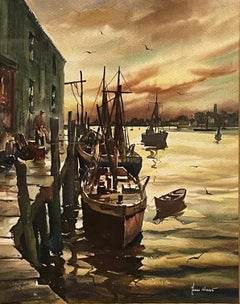
"Gloucester Harbor at Sunset, " John Hare, Cape Ann, New England Watercolor View
Located in New York, NY
John Hare
Gloucester Harbor at Sunset, Massachusetts
Signed lower right
Watercolor on paper
16 x 12 inches
John Cuthbert Hare, 1908-1978, was a watercolorist who painted boats, seascapes and harbor scenes. He was primarily associated New England, especially Cape Cod, Massachusetts where he spent his summers from 1938 to 1965. However, he was in Florida where he was a member of the St. Augustine Art Association, and other locations on the East Coast.
It is likely Hare was born in New York City. He first studied commercial art in Brooklyn at the Pratt Institute and also studied at the Art Students League in Manhattan. He worked for Hearst newspapers corporation, and in 1933 married. In the next few years, he and his wife traveled extensively, camping and painting and exhibiting his work in galleries.
In 1935, they visited St. Augustine and an exhibition of his watercolors was held there in the old bank...
Category
Mid-20th Century Impressionist Landscape Drawings and Watercolors
Materials
Paper, Watercolor
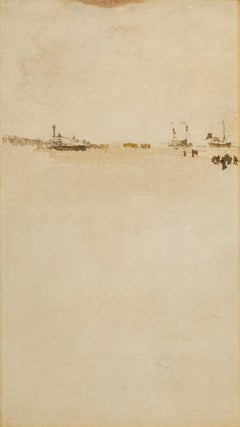
"Beach Scene at Dieppe" James Abbott McNeill Whistler, Tonalist Watercolor
By James Abbott McNeill Whistler
Located in New York, NY
James Abbott McNeill Whistler
Beach Scene at Dieppe, 1885-86
Watercolor on paper, mounted on board
8 1/2 x 5 inches
Signed on the reverse
Provenance:
Miss Annie Burr Jennings
Mrs. ...
Category
1880s Impressionist Landscape Drawings and Watercolors
Materials
Paper, Watercolor
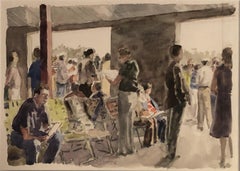
Out of the Sun (Under the Racetrack Grandstand), Saratoga Springs, Anne Diggory
By Anne Diggory
Located in New York, NY
Anne Diggory (b. 1951)
Out of the Sun (Under the Racetrack Grandstand), 1978
Watercolor on paper
7 x 10 inches
Signed and dated lower left
Provenance:
Ac...
Category
1970s Contemporary Landscape Drawings and Watercolors
Materials
Paper, Watercolor, Pencil
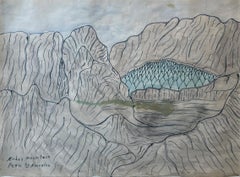
"Andes Mountains Peru South America, " Joseph Yoakum, Black Folk Art Landscape
By Joseph Yoakum
Located in New York, NY
Joseph Yoakum
Andes Mountains Peru So America, circa 1960s
Colored pencil and ballpoint pen on paper
7 1/4 x 10 1/2 inches
Provenance:
Karen Lennox Gallery, Chicago
Private Collection, South Dakota
Yoakum began drawing in the early 1960s. Most of his work consists of radiantly colored landscapes with mountains, water, trees, and winding roads in abstract and complex configurations. his period of greatest activity — 1965 to 1970 — when he usually made one drawing a day.
Yoakum maintained he had seen all the places represented in his drawings, a statement that may not be true in some instances. He traveled a great deal, beginning in his early teens when he ran away from home and became a circus handyman. Yoakum’s drawings can be considered memory images growing out of either actual or imagined experiences. All of his drawings have titles that grew longer and more specific over the years. He dated his works with a rubber stamp — an oddly impersonal, labor-saving device.
Although Joseph Yoakum gave vastly different accounts of his background, he was, throughout his life, classified as an African American. Sometimes Yoakum claimed that he was a full-blooded “Nava-joe” Indian, one of twelve or thirteen children born to a farmer on an Indian reservation in Window Rock, Arizona. At other times he insisted that he was of African-American descent. He described his mother as a strong woman who was a doctor and knowledgeable in the use of herbal medicines. Yoakum’s family moved to Kansas City, Missouri, during his early childhood. His father was employed briefly in the railroad yards prior to settling permanently on a farm in nearby Walnut Grove...
Category
1960s Folk Art Landscape Paintings
Materials
Paper, Watercolor, Ballpoint Pen, Color Pencil
Still Thinking About These?
All Recently ViewedMore Ways To Browse
Carolus Duran
Stanford White
J Alden Weir
Claude Monet Spring In Giverny
Edward Boit
Edward Darley Boit
Newport Rhode Island Paintings
Elizabeth Allen
John Singer Sargent Studies
Museum Bee
Museum Bees
Old California Watercolors
Paul Emile Pissarro Pastel
Pencil Drawings Canadian
Susan Van Campen
Thomas Knight
Thomas Schaller
Andrew King