1 of 4
UnknownRare 17th Cenury Hand Colored “Mappa Aestivarum Insularum Alias Barmudas”1630
1630
$3,400List Price
About the Item
- Creation Year:1630
- Dimensions:Height: 20 in (50.8 cm)Width: 25.5 in (64.77 cm)Depth: 1 in (2.54 cm)
- More Editions Sizes:Packing MaterialsPrice: $24
- Medium:
- Period:
- Condition:
- Gallery Location:Gallatin, TN
- Reference Number:1stDibs: LU57333313543
Authenticity Guarantee
In the unlikely event there’s an issue with an item’s authenticity, contact us within 1 year for a full refund. DetailsMoney-Back Guarantee
If your item is not as described, is damaged in transit, or does not arrive, contact us within 7 days for a full refund. Details24-Hour Cancellation
You have a 24-hour grace period in which to reconsider your purchase, with no questions asked.Vetted Professional Sellers
Our world-class sellers must adhere to strict standards for service and quality, maintaining the integrity of our listings.Price-Match Guarantee
If you find that a seller listed the same item for a lower price elsewhere, we’ll match it.Trusted Global Delivery
Our best-in-class carrier network provides specialized shipping options worldwide, including custom delivery.You May Also Like
At Tunbridge Well
By Agostino Aglio
Located in Middletown, NY
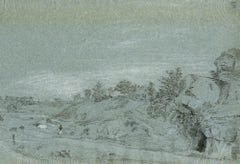
Black crayon and graphite with white heightening on blue handmade laid paper. Adhered at all four corners to a period support, on which the title and an illegible date (perhaps 1815) appear to be written in the artist's hand.
________
Aglio was born in Cremona is 1777 and his artistic talent was recognized early in his life. He was promised a place at the University in Milan by the Holy Roman Emperor, however, his formal education was upended before it even began by the invasion of Italy and Austria by Napoleon. Aglio joined the war effort and fought in a series of major battles near Venice before becoming seriously ill. At the age of about 23 he was released from duty, and traveled to Rome to focus on his health, and landscape painting. In Rome, Aglio studied with the renowned artist Campovecchio. At the invitation of well known British architect William Wilkins (designer of the National Gallery and University College London), Aglio relocated to London in 1803. He made London his permanent home, and married Letitia Clarke in 1805. He enjoyed a lucrative career painting frescoes in the interiors of high society townhouses, country manors, and major London concert halls and theaters. Most notably, Aglio painted multiple official portraits of Queen Victoria...
Category
Early 19th Century Old Masters Landscape Drawings and Watercolors
Materials
Crayon, Handmade Paper, Laid Paper, Color Pencil, Graphite
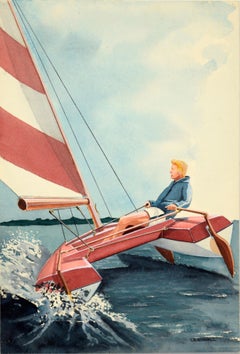
Solo Race in a Catamaran - Adventure Illustration in Watercolor and Ink on Paper
Located in Soquel, CA
Detailed illustration of a sailor in a catamaran by Edward T. Liljenwall (American, 1943-2010). The sailboat is tilted at an extreme angle, with the sailor leaning out over the edge ...
Category
1980s Pop Art Figurative Drawings and Watercolors
Materials
Ink, Color Pencil, Laid Paper
$1,720 Sale Price
20% Off
H 21.25 in W 14 in D 0.03 in
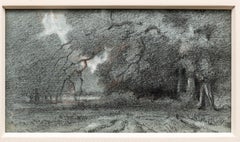
Pencil and Gouache Drawing of Fontainebleau Forest, France 19th century
Located in SANTA FE, NM
Drawing of Fontainebleau Forest
Barbizon, France
Pierre Auguste Brunet Houard (1829 - 1922)
19th century
Pencil, colored pencil, gouache, paper
8 x 4 1/2 (16 3/8 x 12 1/4 frame) inc...
Category
1860s Barbizon School Landscape Drawings and Watercolors
Materials
Gouache, Laid Paper, Pencil, Color Pencil
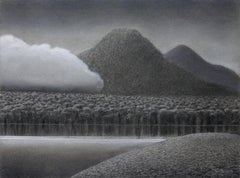
Tomas Sanchez Drawing, La nube
By Tomás Sánchez
Located in Miami, FL
Tomas Sanchez
La nube, 2018
Conte on paper
12 x 16 in
Provenance:
Studio of the artist
Marlborough Gallery, NYC
Certificate by the artist included
Category
21st Century and Contemporary Contemporary Landscape Drawings and Waterc...
Materials
Conté, Laid Paper, Graphite
Tomas Sanchez drawing, Untitled
By Tomás Sánchez
Located in Miami, FL
Tomas Sanchez
Untitled, 1997
Conte on paper
18 x 12 in
Included a certificate of authenticity by the artist
Category
1990s Contemporary Landscape Drawings and Watercolors
Materials
Conté, Laid Paper, Graphite
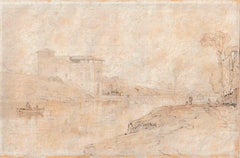
The Tiber, near Rome / Italian School 18th Century
Located in Middletown, NY
Pen and sepia ink wash on cream laid paper, 4 1/8 x 6 3/16 inches (103 x 152 mm). In good condition with scattered areas of light brown discoloration, and un...
Category
Mid-18th Century Old Masters Landscape Drawings and Watercolors
Materials
Ink, Laid Paper, Pencil
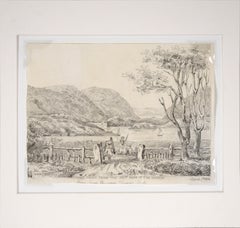
"West Point from the East Bank of the Hudson" Antique Drawing on Paper Watkinson
Located in Soquel, CA
"West Point from the East Bank of the Hudson" Antique Drawing on Paper
Delicate and detailed drawing by Hartford, Connecticut artist Edward Watkins Wells (1819-1898) The viewer looks out past a gate at the Hudson River, with its characteristic mountain banks. A shepherd is driving a flock of sheep towards the gate and viewer. The scene appears to have been copied from a drawing book published in 1827, based on the inscription at the bottom edge.
Presented in white archival mat
Mat size: 12"H x 12"W
Paper size: 7.5"H x 9.25"W
Notes of interest on Edward Watkinson Wells
Our most significant acquisition this year came from a dealer in Philadelphia. It is a 450-page diary written over 10 years (1841-1851) by Hartford artist and dilettante Edward Watkinson Wells (1819-1898), one of the many nephews of our founder, David Watkinson (1778-1857).
Edward was immersed in Hartford’s cultural life in the 1840s, exhibited his works at local fairs and gave lessons to the locals. He portrays an active involvement with with his large extended family, which often crossed and re-crossed the other prominent families of Hartford (i.e., Barnard, Channing, Dexter, Ely, Gallaudet, Gill, Goodrich, Hudson, Rockwell, Silsbee, Tappan, Terry, Tracy, Trumbull, Van Renselaer, and Wadsworth).
Edward describes dancing and costume parties, soirees, teas, dinners, and receptions in private homes and public venues. He meets Charles Dickens and his wife when they come through Hartford in 1842, and describes brushes with other luminaries, such as Col. Thomas L. McKenney (who lectures on American Indians), and the Unitarian clergyman Rev. Henry Giles, who gave a pro-Irish speech.
Other entertainments included a balloon ascension, exhibitions of mesmerism and hypnotism, parades, and performances by well-known groups. He also chronicles the progression of the construction of the Wadsworth Atheneum, and touches on his father’s far-reaching interests in the business world–canals, railroads, factories, and real estate.
The cost of this valuable document of mid-19thC Hartford was generously underwritten entirely by a member of the Watkinson Trustees.
Trinity College and the Watkinson Virtual Library has content on Edward Watkinson Wells.
Yale College also:
Edward Watkinson Wells also kept a diary, of which three volumes are preserved (folder 32). He describes a trip by steamboat to Florida, ca. 1855-1860, and the social life and customs he observed there. The other two volumes detail his daily life in Hartford during 1856-1860, and record the deaths of his father and David Watkinson in 1857.
Other items contained in the William Wells...
Category
1830s Romantic Landscape Drawings and Watercolors
Materials
Laid Paper, Pencil
$2,500
H 12 in W 12 in D 0.25 in
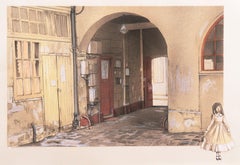
French Courtyard
, Large School of Paris Drawing, Ecole des Beaux Arts, Lyon
By Denis Paul Noyer
Located in Santa Cruz, CA
Signed lower left, 'Denis Paul Noyer' (French, b. 1940) and created circa 1975.
An exceptionally finely-detailed, silver point and colored pencil drawing showing a view of a Parisia...
Category
1960s Landscape Drawings and Watercolors
Materials
Metal
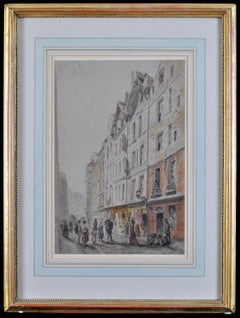
Rue Galande - Fine 19th Century French Paris Street Antique Watercolour Painting
Located in Sevenoaks, GB
A fine signed and dated 1868 watercolour and pencil on laid paper depicting a bustling scene on Rue Galande in the 5th arrondissement of Paris, by Alfred-Alexandre Delauney. Excellen...
Category
1860s Landscape Drawings and Watercolors
Materials
Watercolor, Laid Paper, Pencil
$1,158
Free Shipping
H 18.9 in W 13.78 in
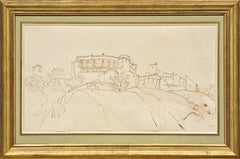
View of a Mansion in the South of France, a drawing by Claude-Joseph Vernet
By Claude-Joseph Vernet
Located in PARIS, FR
We would like to thank Madame Beck-Saiello for confirming the autograph nature of this drawing after an in-person examination.
It was probably during an excursion in the countryside near Avignon that Claude-Joseph Vernet executed this drawing, enhanced with pen and brown ink, depicting a mansion on a hilltop overlooking a small village with geometric shapes.
1. Joseph Vernet, a painter influenced by Italy
Claude-Joseph Vernet was born in Avignon in 1714, the son of Antoine Vernet (1689-1753), an artisan painter of architectural decorations, coach panels, and the like. He moved to the studio of Philippe Sauvan (1697-1792), a leading history painter in Avignon, and then worked with Jacques Viali (active 1681-1745), a decorative, landscape, and marine painter in Aix-en-Provence. Vernet's first recorded paintings were decorative overdoors executed in 1731 in the Aix townhouse of the marquise de Simiane. In 1734, Joseph de Seytres, marquis de Caumont, a leading amateur in Avignon, sponsored Vernet to make a study trip to Italy to complete his artistic education and to draw antiquities for his patron.
As Avignon was a papal territory in Vernet's day, he also had a number of useful introductions among influential churchmen when he arrived in Rome. Vernet was soon at home in the French community there, and he was encouraged by Nicolas Vleughels (1668-1737), director of the Académie de France in Rome, even though the young painter had no official affiliation with the royal institution. He likely entered the studio of the French marine painter Adrien Manglard...
Category
1730s Old Masters Landscape Drawings and Watercolors
Materials
Ink, Laid Paper, Pen, Carbon Pencil
Still Thinking About These?
All Recently ViewedMore Ways To Browse
Miniature Maps
John Speed Maps
John Speed Antique Maps
Bermuda Map
Sharon Galligan
Stefan Bleekrode
Steven Kozar On Sale
Thomas Edward Francis
Verne R Horton
Vernon Nye
Vincent Campanella
Vincent Nesbert
Vintage Pub Doors
Waldorf Astoria Painting
Warren Zimmer
Watercolour Hot Air Balloon
Werner Drewes On Sale
William Henry Rinehart