Want more images or videos?
Request additional images or videos from the seller
1 of 5
W.O.J. NieuwenkampEntrance to the temple at Klungkung, Bali, 19251925
1925
$17,815.33List Price
About the Item
- Creator:W.O.J. Nieuwenkamp (1874 - 1950, Dutch, Indonesian)
- Creation Year:1925
- Dimensions:Height: 20.87 in (53 cm)Width: 18.31 in (46.5 cm)Depth: 0.04 in (1 mm)
- Medium:
- Movement Style:
- Period:
- Framing:Frame IncludedFraming Options Available
- Condition:
- Gallery Location:Amsterdam, NL
- Reference Number:1stDibs: LU147128030342
About the Seller
No Reviews Yet
Vetted Professional Seller
Every seller passes strict standards for authenticity and reliability
1stDibs seller since 2021
Authenticity Guarantee
In the unlikely event there’s an issue with an item’s authenticity, contact us within 1 year for a full refund. DetailsMoney-Back Guarantee
If your item is not as described, is damaged in transit, or does not arrive, contact us within 7 days for a full refund. Details24-Hour Cancellation
You have a 24-hour grace period in which to reconsider your purchase, with no questions asked.Vetted Professional Sellers
Our world-class sellers must adhere to strict standards for service and quality, maintaining the integrity of our listings.Price-Match Guarantee
If you find that a seller listed the same item for a lower price elsewhere, we’ll match it.Trusted Global Delivery
Our best-in-class carrier network provides specialized shipping options worldwide, including custom delivery.You May Also Like
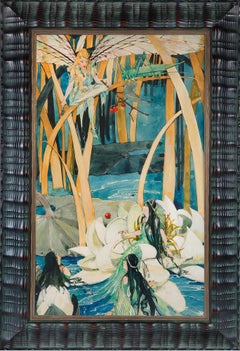
Fairies among the Lily Pads - Female Illustrator Fantasy
Located in Miami, FL
A turn-of-the-century fantasy illustration by female illustrator May Audubon Post features a charming fairy with expanded wings resting on Lilly s...
Category
Early 1900s Art Nouveau Figurative Drawings and Watercolors
Materials
Paper, Ink, Watercolor
$35,000
H 14.5 in W 24 in
Drawing from Hagbynäs Sweden, 1779
Located in Stockholm, SE
Jonas Carl Linnerhielm (1758–1829)
Hagbynäs
Dated and titled “1779 in Aug. Vid Hagbynäs”
Red chalk on paper
21.3 × 33.4 cm (8.4 × 13.1 in.)
with frame 40.5 x 51 cm (15 ⁷/⁸ x 20 ⅛ i...
Category
1770s Romantic Landscape Drawings and Watercolors
Materials
Paper, Chalk
Old Tree and September Wind Clouds
By Charles E. Burchfield
Located in New York, NY
Old Tree and September Wind Clouds, 1961, by Charles Burchfield (1893-1967)
Conte crayon on paper
13 ½ x 19 ½ inches unframed (34.29 x 49.53 cm)
19 ¾ x 25 ½ inches framed (50.165 x 6...
Category
1960s American Modern Landscape Drawings and Watercolors
Materials
Paper, Conté
Inconscience by Yvon Pissarro - Contemporary work on paper
By Yvon Pissarro
Located in London, GB
Inconscience by Yvon Pissarro (b. 1937)
Conté chalk and pastel pencil on paper
50 x 65 cm (19 ³/₄ x 25 ⁵/₈ inches)
Signed lower left, y. vey
Provenance: Studio of the artist, Montpe...
Category
21st Century and Contemporary Figurative Drawings and Watercolors
Materials
Paper, Chalk, Conté, Pastel, Pencil
Evasion by Yvon Pissarro - Contemporary work on paper
By Yvon Pissarro
Located in London, GB
Evasion by Yvon Pissarro (b. 1937)
Conté chalk, crayon, pastel pencil on paper
65 x 50 cm (25 ⁵/₈ x 19 ³/₄ inches)
Signed twice y. vey
Provenance: Studio of the artist, Montpellier
...
Category
21st Century and Contemporary Figurative Drawings and Watercolors
Materials
Paper, Chalk, Conté, Crayon, Pastel, Pencil
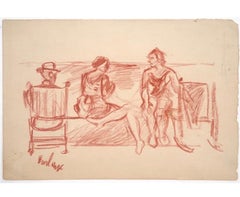
Modernist Conte Crayon Drawing Beach Scene David Burliuk Russian Futurist
By David Burliuk
Located in Surfside, FL
David Burliuk (Ukrainian, 1882-1967)
Three figure on the beach (Hamptons, Long Island New York)
Conte crayon drawing on paper.
Hand signed lower left.
Unframed
Provenance: Bloomsbury Auctions
David Davidovich Burliuk (Дави́д Дави́дович Бурлю́к; 1882-1967) was a Russian poet, artist and publicist of Ukrainian origin associated with the Futurist and Neo-Primitivist movements. Burliuk has been described as "the father of Russian Futurism."
David Burliuk was born on 21 July 1882 in the village of Riabushky (near Lebedyn, Ukraine) in the Kharkov Governorate of the Russian Empire. Burliuk's family was artistically inclined; two of his brothers were talented artists as well, Nikolai and Volodimir Burliuk. The Burliuk family partly descended from Ukrainian Cossacks on their father's side, who held premier positions in the Hetmanate. His mother, Ludmyla Mikhnevich, was of ethnic Belarusian descent.
From 1898 to 1904, he studied at Kazan and Odesa art schools, as well as at the Royal Academy in Munich. His exuberant, extroverted character was recognized by Anton Azhbe, his professor at the Munich Academy, who called Burliuk a "wonderful wild steppe horse". During a time of significant industrialization and political change, movements such as the famed Der Blaue Reiter, a group Burliuk associated with in 1912, while he was in Munich, emphasized a shift away from the classical styles of the past, prioritizing the innovations of the future.
In 1907, he made contact with the Russian art world; he met and befriended Mikhail Larionov, and they are both credited as being major forces in bringing together the contemporary art world. In 1908, an exhibition with the group Zveno ("The Link") in Kiev was organized by David Burliuk together with Wladimir Baranoff-Rossine, Alexander Bogomazov, his brother Volodymyr (Wladimir) Burliuk and Aleksandra Exter. The exhibition was a flop, especially because they were all unknown painters. The Burliuks and Larionov left for the aforementioned brothers' home in Chernianka, also known as Hylea; it was during this stay that their work became more Avant-Garde. That autumn, while visiting Ekster, they organized an exhibition which took place in the street; it was a success, and enough money was raised to go to Moscow.
In 1909, Burliuk painted a portrait of his future wife, Marussia, on a background of flowers and rocks...
Category
Mid-20th Century American Modern Figurative Drawings and Watercolors
Materials
Paper, Conté, Crayon
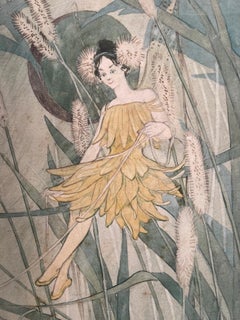
Fairy in the Pussy Willows with Baby and Spider Web Fantasy Children
s Book
Located in Miami, FL
This work is presented more as a concept piece since it's condition is destresed.
Illustrator Hazel Frazee was a Female Illustrator in the first quarter of the 20th century for child...
Category
1920s Art Nouveau Landscape Drawings and Watercolors
Materials
Watercolor, Pencil
$2,500
H 19.25 in W 14 in D 1 in
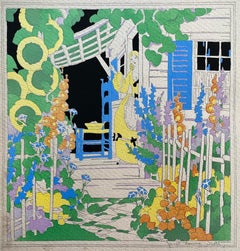
Arts and Crafts Illustration of Women in Yellow Dress in Foliage
Located in Miami, FL
This is an elegantly rendered and designed work with fine lines and flat colors by an accomplished female illustrator.
Signed lower right Framed in an old simple wooden frame with...
Category
1920s Art Nouveau Figurative Drawings and Watercolors
Materials
Pencil, Woodcut
$7,000
H 7.5 in W 7.5 in D 1 in
Princess Herminie and the Tapestry Prince - Female Illustrator
Located in Miami, FL
An original pen and ink by Barbara Macdonald 1892-1969, that was published on page 70 of the 1922 book, 'Princess Herminie and the Tapestry Prince,' written by Lee Ivatt. The second ...
Category
1920s Art Nouveau Figurative Drawings and Watercolors
Materials
Ink, Pen
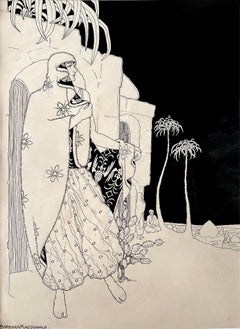
$10,000
H 13 in W 9.5 in D 1 in
Summer Forest Landscape, 1915 / - The Forest Walk -
Located in Berlin, DE
Stanislas Warnie (1879-1958), Summer Forest Landscape, 1915. Watercolor, 31.5 cm x 45 cm (passepartout), 50.5 cm x 63.5 cm (frame), signed "S. Warnie" at lower left and dated "1915"....
Category
1910s Art Nouveau Landscape Drawings and Watercolors
Materials
Watercolor
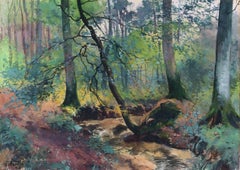
$617 Sale Price
20% Off
H 12.41 in W 17.72 in
More From This Seller
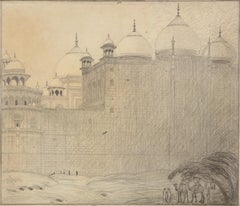
View AllPart of the ring-wall of the Taj Mahal, Agra, India, 1914
Located in Amsterdam, NL
Part of the ring-wall of the Taj Mahal, Agra, India, 1914
Signed with initials and dated bottom right
Black chalk on paper, 45.5 x 53 cm
Literature:
Ernst Braches en J.F. Heijbro...
Category
1910s Art Nouveau Landscape Drawings and Watercolors
Materials
Paper, Chalk
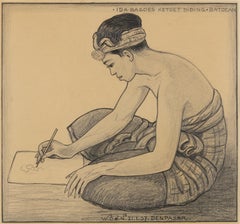
Portrait of artist Ida Bagoes Ketut Diding, Bali, 1937
Located in Amsterdam, NL
Ida Bagoes Ketut Diding, Artist on bali 1937
Signed with initials, dated and titled, bottom centre
Black chalk on paper, 29 x 31 cm
Literature:
Ernst Braches en J.F. Heijbroek, W....
Category
1930s Art Nouveau Landscape Drawings and Watercolors
Materials
Paper, Graphite
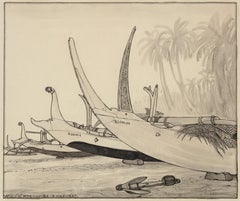
Beach of Kusambe, Bali 1937
Located in Amsterdam, NL
Four outrigger proa’s on the beach of Kusambe, Bali, 1937
Signed with initials, dated and described with location bottom left
Pencil and ink on paper, 29.7 x 35 cm
In ebonized frame with white mount
WILLEM OTTO WIJNAND NIEUWENKAMP
(1874-1950)
Nieuwenkamp was born on July 27th 1874 in Amsterdam. His father owned sailing ships sailing to Indonesia and hearing the stories of the returning captains evoked in the young Nieuwenkamp an obsession for distant lands and adventure. After a failed attempt by his father to have his son make a career in his business, Nieuwenkamp attended the Academy for Decorative Art in Amsterdam. However, he left within one year to go his own way.
He was an autodidact and a great experimenter with new techniques, particularly in the art of etching. Nieuwenkamp was a very focused man with the discipline of a scientist tempered by the sensitivity of an artist, a lust for adventure, a natural appreciation for ethnic arts and an enormous ambition to tread new paths.
In 1898 he visited Indonesia for the first time and on his second visit in 1903-1904 he went on to Bali and became the first foreign artist to love Bali and the Balinese with a passion. Having secured agreements with several museums in the Netherlands to obtain Balinese art and objects for their collections, Nieuwenkamp immediately started to purchase and order a wide range of ethnographic art and objects from local artists and craftsmen.
Through his drawings and books, he gave an excellent impression of Balinese art and culture at that time. Since 1854 Northern Bali was under Dutch...
Category
1930s Art Nouveau Landscape Drawings and Watercolors
Materials
Paper, India Ink, Pencil
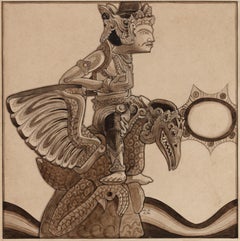
Statue of Vishnu Garuda, Bali, 1904
Located in Amsterdam, NL
Statue of Vishnu Garuda, Bali, 1904
Signed with initials
Pencil and ink on paper, 21.4 x 21.3 cm
Literature:
Bruce W. Carpenter, W.O.J. Nieuwenkamp. First European Artist in Bali,...
Category
Early 1900s Art Nouveau Landscape Drawings and Watercolors
Materials
Paper, Pencil, India Ink
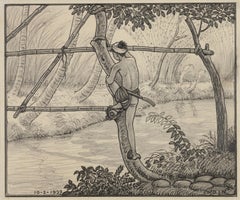
Wobbly bridge, Tabanan, Bali, 1937
Located in Amsterdam, NL
Wobbly bridge, Tabanan, Bali, 1937
Signed with initials bottom right and dated, bottom left
Pencil and ink on paper, 22 x 26.3 cm
In ebonized frame with white mount
Willem Otto Wi...
Category
1930s Art Nouveau Landscape Drawings and Watercolors
Materials
Paper, India Ink, Pencil
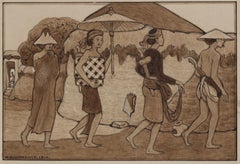
Four Balinese, Bali (1910)
Located in Amsterdam, NL
Four Balinese, 1910
Signed and dated bottom left
Pencil and ink on paper, 15.6 x 23 cm
In ebonized frame with white mount.
Literature:
W.O.J. Nieuwenkamp, Zwerftochten op Bali, Amsterdam, 1910, p. 36
WILLEM OTTO WIJNAND NIEUWENKAMP
(1874-1950)
Nieuwenkamp was born on July 27th 1874 in Amsterdam. His father owned sailing ships sailing to Indonesia and hearing the stories of the returning captains evoked in the young Nieuwenkamp an obsession for distant lands and adventure. After a failed attempt by his father to have his son make a career in his business, Nieuwenkamp attended the Academy for Decorative Art in Amsterdam. However, he left within one year to go his own way.
He was an autodidact and a great experimenter with new techniques, particularly in the art of etching. Nieuwenkamp was a very focused man with the discipline of a scientist tempered by the sensitivity of an artist, a lust for adventure, a natural appreciation for ethnic arts and an enormous ambition to tread new paths.
In 1898 he visited Indonesia for the first time and on his second visit in 1903-1904 he went on to Bali and became the first foreign artist to love Bali and the Balinese with a passion. Having secured agreements with several museums in the Netherlands to obtain Balinese art...
Category
1910s Art Nouveau Landscape Drawings and Watercolors
Materials
Paper, Pencil
Recently Viewed
View AllMore Ways To Browse
Boat Paintings
American Landscape Oil Paintings
1980 Lithograph
Abstract Painting Of A Square
Oil Paintings By A North
Purple Heart
Vintage Lithograph Posters
Philadelphia Art
Paris Landscape Oil On Canvas
Artist Proof Print
Black And White Italy Photography
Abstract Acrylic Portraits On Canvas
Abstract Painting Yellow And Red
History Of America
Black And White Architectural Prints
Blue And Yellow Oil Painting
Contemporary Still Life Painting
40 X 60 Black White Photography