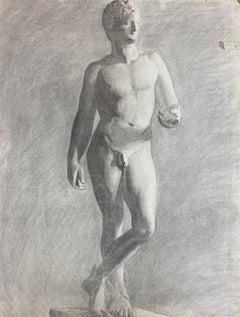
Items Similar to Study of the Apollo Belvedere, Graphite Sketch, 19th Century
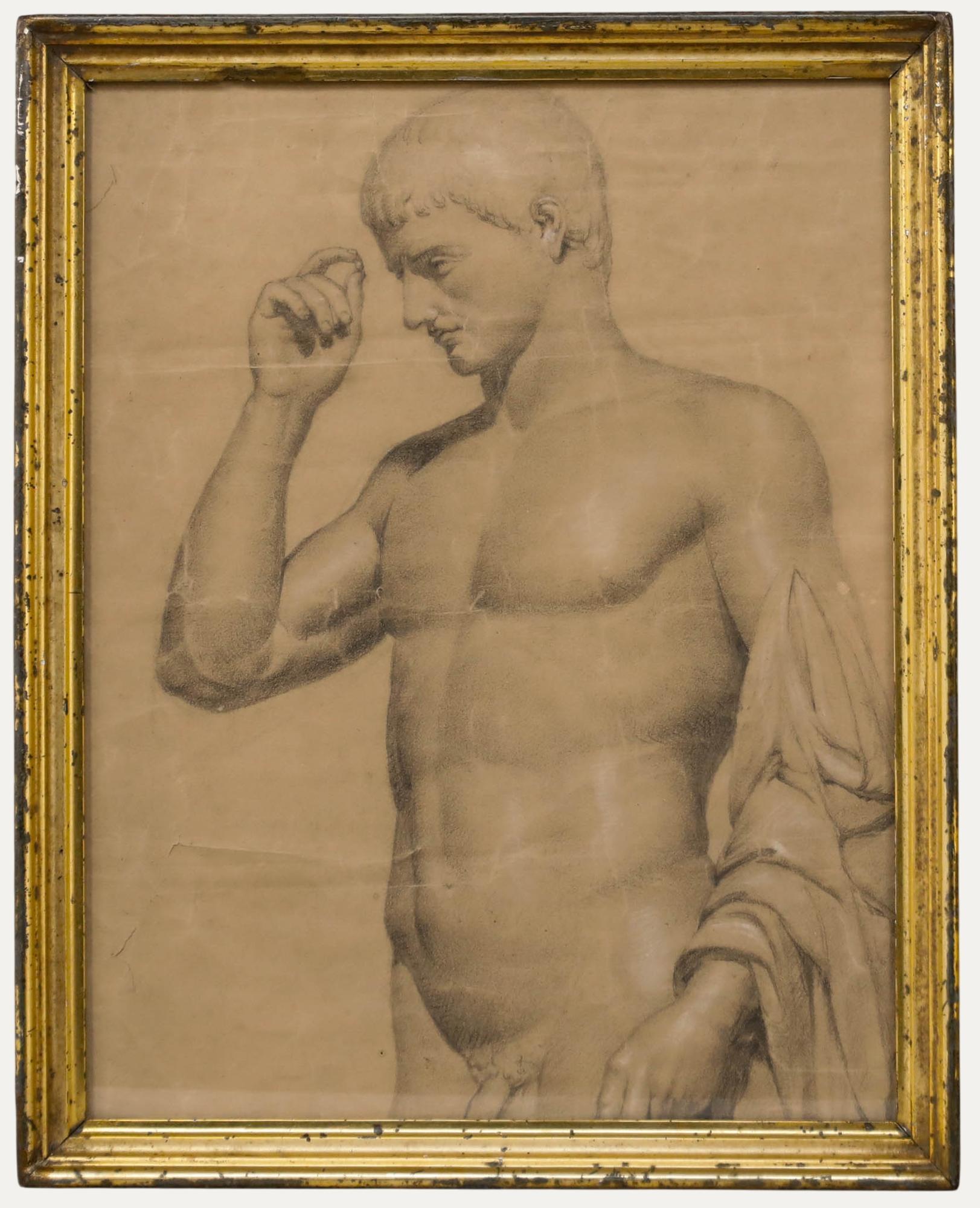
Want more images or videos?
Request additional images or videos from the seller
1 of 5
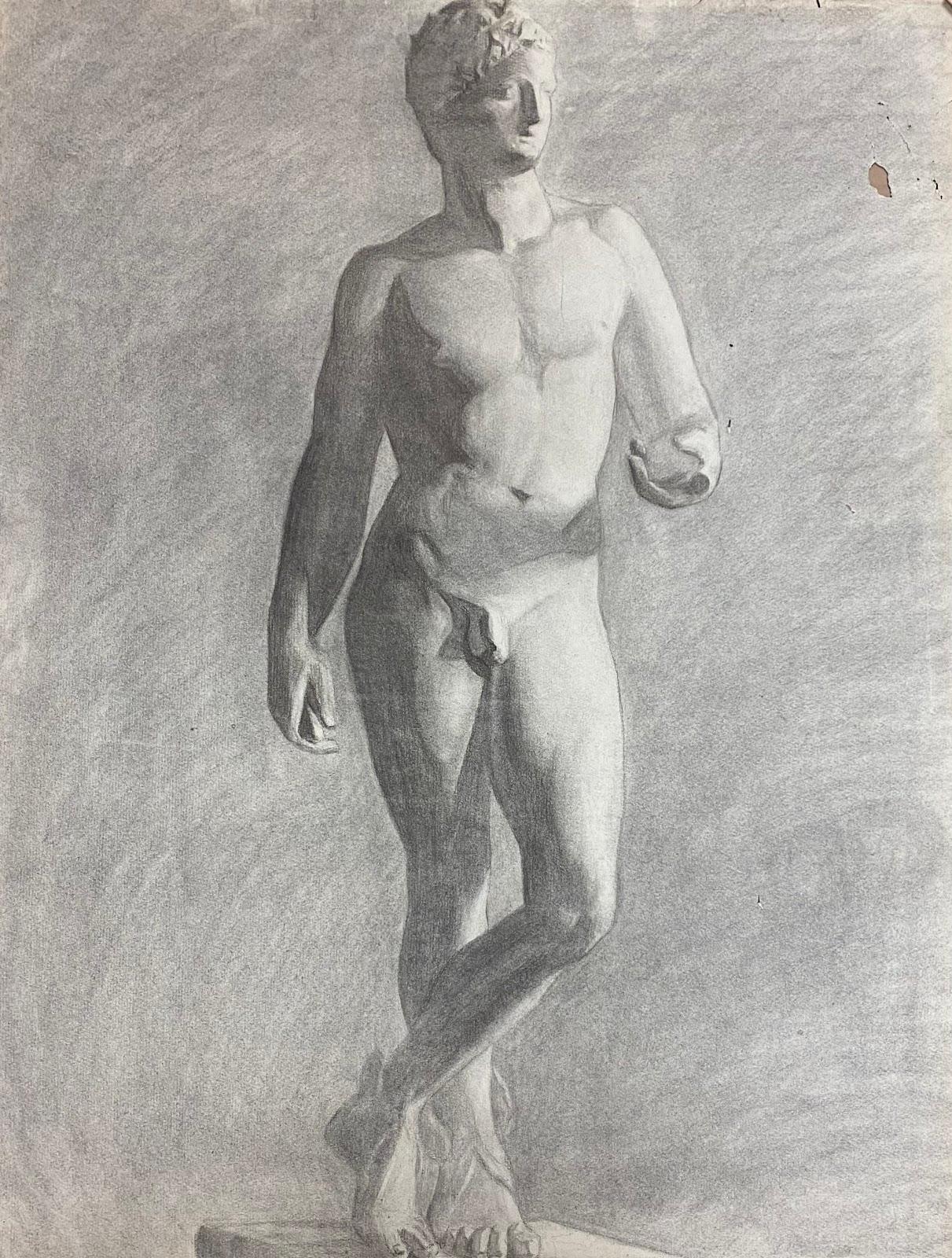
19th Century European SchoolStudy of the Apollo Belvedere, Graphite Sketch, 19th Century
$1,602.33
£1,150
€1,351.14
CA$2,192.13
A$2,317.65
CHF 1,245.44
MX$27,835.33
NOK 15,595.13
SEK 14,270.70
DKK 10,090.02
About the Item
Graphite on paper
Image size: 13 3/4 x 26 inches (35 x 66 cm)
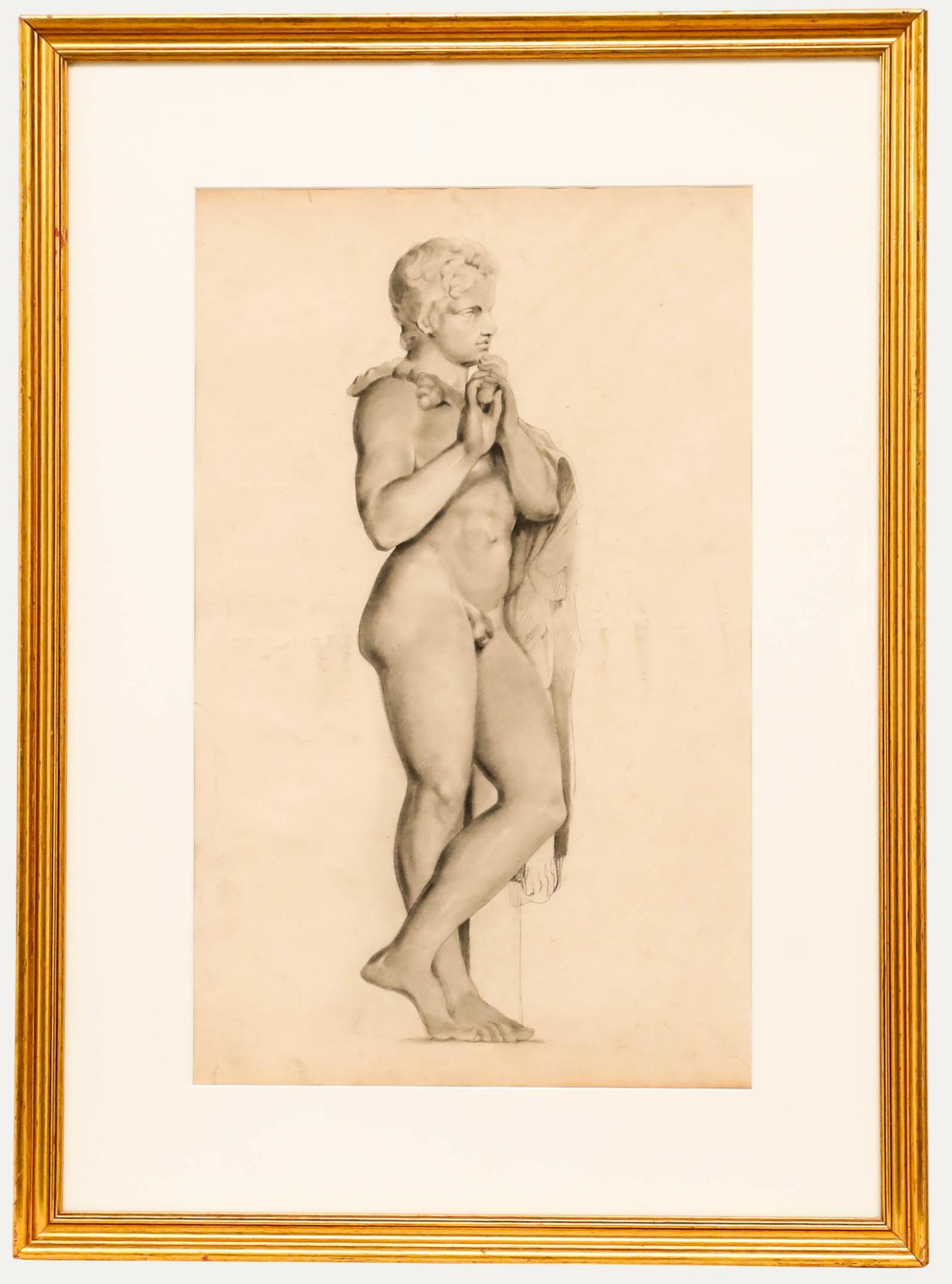
This is most likely to be a drawing from an Academy student, executed as part of their academic training. The academic training often included executing copies of plaster casts of sculptures and drawings by master artists.
The sculpture is the marble statue of Apollo, currently held in the Vatican Museums. A marble statue of 88 inches (2.24 meters) of a beardless, athletic Apollo. The statue was discovered in the 15th century. It was probably found around 1485 in Anzio, 35 miles south of Rome. The statue itself is a copy of an Ancient Greek bronze statue.
In this sketch we can see how the surface of the statue is very smooth, with the graphite having been used with great skill as it has been blended seamlessly between areas of deep shadow and bright lights. Apollo’s face shows a neutral expression. He steps forward a bit with his right leg and throws back his cloak over his left shoulder to show his fully naked body. He looks to his left and has his left arm stretched out to support his cloak.
Apollo's beautiful curly hair has been accurately depicted with lines of deep shadow. His hair is tied on the top with a band and his curls hang down his neck. Around his torso, he is wearing a quiver to hold his arrows. He is also wearing sandals. On the left side, the statue is supported by a tree trunk that can just bee seen here behind Apollo's leg. The viewer can just see a snake carved on the left side of the tree, its body suggested to us in the graphite.
It is not entirely clear what mythological story is depicted in this statue, though it is suggested that Apollo originally was carrying a bow and arrow. This pose may represent Apollo who has just released an arrow with the bow that he was holding in his left hand. Some people suggest that this statue represents the moment that Apollo has just killed the serpent (which is a dragon) Python. The snake on the left, which may be a python, may serve as additional evidence to support this story.
- Creator:19th Century European School
- Dimensions:Height: 26 in (66.04 cm)Width: 13.75 in (34.93 cm)
- More Editions Sizes:1 of 1Price: $1,602
- Medium:
- Period:
- Framing:Framing Options Available
- Condition:
- Gallery Location:London, GB
- Reference Number:1stDibs: LU52412640442
About the Seller
5.0
Gold Seller
Premium sellers maintaining a 4.3+ rating and 24-hour response times
Established in 2007
1stDibs seller since 2014
87 sales on 1stDibs
Typical response time: 2 hours
- ShippingRetrieving quote...Shipping from: London, United Kingdom
- Return Policy
More From This Seller
View AllAnatomy of Man, Signed Graphite Nude Sketch on Paper, 19th Century French Artist
Located in London, GB
Graphite on laid paper, signed verso and paper watermarks and atelier stamp
Image size: 23 ¾ x 16 ¾ inches (60.25 x 43.5 cm)
Gilt Whistler frame
Leon Bellemont
Born on August 20, 1866, in the family home on rue du Grand-Cloître, Léon Bellemont studied from 1875 to 1883 at the Diderot college, where he was an excellent student. At the same time, he joined the municipal drawing school, where his exceptional predispositions were very quickly noted.
In 1884, at the age of 18, Léon Bellemont left Langres to join Paris and its National School of Decorative Arts, then the prestigious Ecole des Beaux-Arts. There, he followed the teaching of Léon Bonnat, a renowned portraitist, and obtained his first rewards and several prizes. It was in 1892, however, that his artistic career took off, with his first participation in the Salon des artistes français, where he exhibited until 1956.
A landscape and impressionist painter, particularly impressing marine worlds, Léon Bellemont stayed more and more regularly in Brittany at the beginning of the 20th century, where he painted numerous paintings. His notoriety grew, as did the profits from his sales, and the State itself ended up placing a few orders with him. His work “The Breton Faith” was, for example, acquired by the museum in Buenos Aires (Argentina).
Subsequently, always in search of inspiration, Léon Bellemont travelled extensively. He was in Bruges from 1907 to 1909, then traveled across France for several years participating in exhibitions. During the First World War, he settled in Algiers where he remained for several years. He then returned to Paris, worked extensively there and achieved great fame. A socialite, he frequented salons and regularly received his friends Jules Adler...
Category
Late 19th Century French School Nude Drawings and Watercolors
Materials
Laid Paper, Graphite
Study of a Woman Sitting, Graphite Drawing, 19th Century French School
Located in London, GB
Graphite on paper
Image size: 13 x 10 1/2 inches (33 x 27 cm)
Mounted
This is a delicate 19th century academic graphite drawing of a seated female nude in the neoclassical style.
A...
Category
19th Century French School Nude Drawings and Watercolors
Materials
Paper, Graphite
The Death of Attis, 18th Century French Red Chalk Drawing, Greek Mythology
Located in London, GB
Red chalk on paper
Image size: 9 x 7 inches (23 x 17.75 cm)
Acid free mount
The Greek god Attis was the spouse of Cybele, the fertility goddess. He was from Phrygia, a kingdom in c...
Category
18th Century French School Figurative Drawings and Watercolors
Materials
Chalk
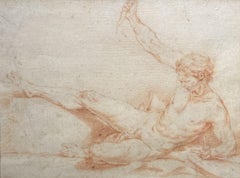
Nude Study, Graphite on Paper, 20th Century British Artwork
By William Dring
Located in London, GB
Graphite on paper
Image size: 22 x 26 inches (56 x 66 cm)
Mounted and framed
William Dring
Dring was born with the forenames Dennis William, but was known colloquially as John. He was the brother of the artist James Dring. He married the painter Grace Elizabeth Rothwell...
Category
20th Century Nude Drawings and Watercolors
Materials
Paper, Graphite
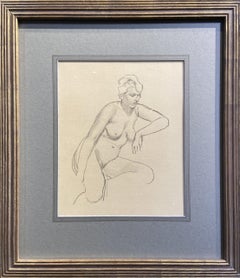
Study of a Standing Female Nude
By Evelyn de Morgan
Located in London, GB
Evelyn de Morgan
Study of a Standing Female Nude
1855 - 1917
Black chalk and pastel on grey paper
Image size: 12 ½ x 19 inches (48.2 x 31.7 cm)
Pre-Raphaelite style frame
Provenance
J.S. Mass & Co., Ltd., London, J.X. Reynolds & Co., Ltd.
Once she had graduated from the Slade School of Art, Evelyn continued to draw every day for the rest of her life. Her drawings are enlightening not only for their skill and subject matter, but also for their ability to teach us her working process. From loose compositional sketches, Evelyn swiftly progressed to detailed life studies for the figures in her paintings. Choosing to draw mainly on a grey wove paper in pencil and pastel, Evelyn produced hundreds of figure studies. Her rigorously-examined double studies of clothed and nude figures are particularly fascinating and underline the artist’s obsession with the human form and her desire for accuracy. A deep understanding of anatomy is obvious in this drawing and looking at the work you feel as though you can reach out and feel the muscle and bone under the skin, that you could feel the pulse of life through the soft skin.
Evelyn de Morgan
Born into a landowning family, from an early age Evelyn De Morgan, née Pickering, demonstrated a precocious artistic talent and a passionate desire to pursue a career as an artist, writing in her diary on her seventeenth birthday ‘Art is eternal, life is short… I have not a moment to lose’ (Evelyn De Morgan’s Diary, 30 August 1872, De Morgan Foundation Archive). Her maternal uncle, the artist John Roddam Spencer-Stanhope encouraged her talents and accompanied her on her first formative journeys to Italy where she discovered the Renaissance masters, particularly Botticelli. Overcoming initial parental opposition, Evelyn enrolled at the newly formed Slade School in 1873, one of the first women to do so.
The Slade revolutionised women’s artistic education by allowing female students to study the nude from life alongside their male counterparts. Whilst at the Slade she began to submit work under her middle name Evelyn, rather than her Christian name Mary, as its gender ambiguity offered a chance for her work to be judged on its own merit.
One of her tutors, Edward Poynter...
Category
20th Century Victorian Nude Drawings and Watercolors
Materials
Paper, Chalk, Pastel
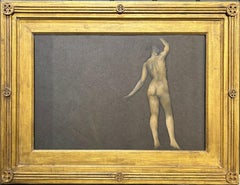
Europa and the Bull, 20th Century British Graphite Drawing, Signed
Located in London, GB
Graphite on paper, signed with stamp
Image size: 9 x 6 ¾ inches
Acid free mount
Born in London, Moody studied at Battersea Polytechnic and at Royal College of Art under William Roth...
Category
20th Century English School Figurative Drawings and Watercolors
Materials
Graphite
You May Also Like
Study for Statue - Pencil Drawing by Giovanni Fontana - Early 17th Century
By Giovanni Fontana
Located in Roma, IT
Study for Statue is an original drawing in pencil on paper, realized by the architect and engineer Giovanni Fontana (1540-1614).
The state of preservation of the artwork is good exc...
Category
Early 17th Century Renaissance Figurative Drawings and Watercolors
Materials
Pencil
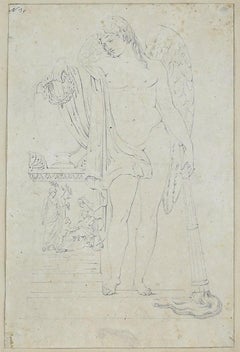
19th Century Graphite Drawing - Young Satyr Playing the Flute
Located in Corsham, GB
A pencil study of a young nude satyr playing a flute. He is leaning against a tree, which is draped with an animal skin. This iconographic type is found in numerous exemplars; howeve...
Category
19th Century Nude Drawings and Watercolors
Materials
Graphite
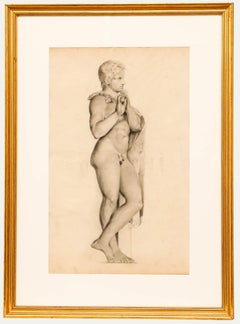
Male Nude / - The Drama of the Nude -
Located in Berlin, DE
Johann Heinrich Meil (1730 Gotha - 1820 Berlin), Male Nude, 1807. White heightened, occasionally wiped charcoal drawing on brownish paper, 51 cm x 39.5 cm, signed “J.[ohann] H.[einri...
Category
Early 19th Century Rococo Nude Drawings and Watercolors
Materials
Paper
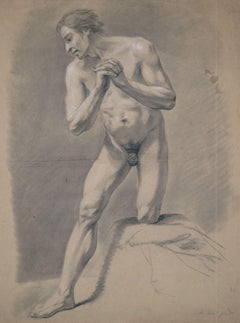
Early 20th Century Graphite Drawing - Marcellus
Located in Corsham, GB
A finely detailed graphite study of a statue of Marcellus, nephew of Emperor Augustus who founded the Roman Empire. The statue is held in the Louvre. The drawing features subtle whit...
Category
20th Century Nude Drawings and Watercolors
Materials
Graphite
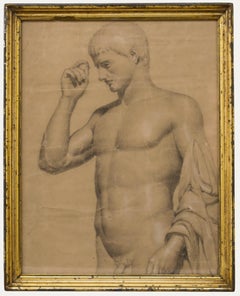
1900s French Atelier Academic Drawing Portrait of Classical Male Nude Sculpture
Located in Cirencester, Gloucestershire
Life study drawing
original atelier drawing
by the French artist, Jeanne Nachat (1898-1984)
Nachat attended the prestigious Académie des Beaux-Arts in Pa...
Category
Early 20th Century Academic Nude Drawings and Watercolors
Materials
Charcoal, Pencil
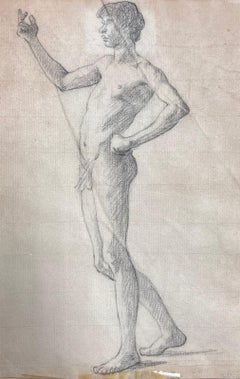
19th Century French Academic Drawing Portrait of Male Nude Young Man
Located in Cirencester, Gloucestershire
The Artists Model
Portrait of a Young Male Nude
French, late 19th century
pencil drawing on artist paper, unframed
with further sketches verso
artist paper: 13 x 9.5 inches
provenanc...
Category
Late 19th Century French School Nude Paintings
Materials
Pencil
More Ways To Browse
Art And Sketch And Hands
European School Paintings 19th Century
European 19th Century Painting
Antique Bow And Arrow
Antique Plaster Cast
Apollo Art
European School Painting
Carved Snake
Antique Greek Statue
Apollo Painting
Ancient Greek Bronze
Statues Rome Antique
Apollo Marble Statue
Naked Drawing
Nude Female Pencil Drawings
Line Drawing Nude
Nude Line Drawings
Original Signed Charcoal Drawings