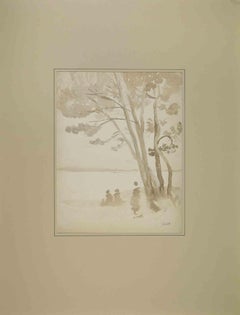
Items Similar to Love Scene Under a Tree / - At the breast of Mother Nature -
Want more images or videos?
Request additional images or videos from the seller
1 of 6
Emil OrlikLove Scene Under a Tree / - At the breast of Mother Nature -1912
1912
$3,365.32
£2,492.80
€2,800
CA$4,603.64
A$5,017.73
CHF 2,652.83
MX$60,404
NOK 33,671.05
SEK 30,869.47
DKK 21,334.45
About the Item
Emil Orlik (1870 Prague - 1932 Berlin), Love Scene Under a Tree, 1912. Mixed media on paper, 14.5 cm x 25 cm (sheet size), 35.5 cm x 46 cm (frame), signed “ORLIK.” lower right and dated “[19]12.” Framed with passe-partout under glass.
- Image in very good condition, frame with minor scratches
- At the breast of Mother Nature -
A young woman with a pageboy haircut leans her back against a tree, which is thus associated with her, a connection that is further emphasized by the color of her dress, which matches the bark of the tree. At the same time, however, the tree also serves as a frame that highlights her, particularly accentuating her pink bare skin. She has half removed her transparent top, exposing her large breasts. They are kissed by the man lying between her bare legs, who is tenderly embraced by the smiling woman, while the branches, which also stand for her, enclose his entire body.
In this erotic subject, which is extremely rare in Emil Orlik's oeuvre, the artist lends the contemporary love scene an allegorical depth that is a homage to the feminine. The young woman becomes Mother Nature, approaching the man who has entered her sacred grove. Through his masterful use of brushstrokes, Emil Orlik succeeds in lending the scene an intense sense of vitality.
About the artist
Emil Orlik grew up in Prague and studied at Heinrich Knirr's painting school in Munich from 1889 to 1891 and then at the Munich Art Academy from 1891 to 1893. From 1894 to 1896, Orlik returned to Prague, where he did a year of military service and became friends with Reiner Maria Rilke, who inspired him to design books. In 1896 Orlik returned to Munich, where he developed an artistic friendship with Bernhard Pankok. The following year, Orlik opened a studio in Prague, which he ran until 1904. In 1898 he undertook a nearly year-long study trip to England, Scotland, Holland, Belgium and Paris. In 1904, Orlik became a teacher at the Vienna Museum of Decorative Arts. He had been a member of the Vienna Secession since 1899 and published in the Jugendstil magazine 'Ver Sacrum'. In 1905 he was appointed professor at the Berlin Museum of Decorative Arts, where he succeeded Otto Eckmann as head of the graphics class until Eckmann's death in 1932. George Grosz, Hanna Höch and Karl Hubbuch were among his students.
In 1900 Orlik made a year-long trip to Japan, which had a lasting influence on his art. In 1904 he published the portfolio "From Japan" and from 1905 to 1910 he illustrated the six-volume edition of the works of the English diplomat Lafcadio Hearn, who lived in Japan. In 1912 he made his second trip to Japan, which also took him to Egypt, Sudan, Ceylon, China, and Korea. His artistic impressions were reflected in the portfolios "Journey to Egypt" (1921) and "Journey to Japan" (1921). The late 1920s were also marked by numerous trips to America, France, Spain, Italy and Yugoslavia.
In addition to his artistic work as an interior designer, which included designs for costumes and stage sets for Max Reinhardt's Deutsches Theater, Orlik was primarily a graphic artist and sought-after portraitist. He painted portraits of Gerhard Hauptmann, Henrik Ibsen, Bernhard Pankok, Gustav Mahler, Max Klinger, Rainer Maria Rilke, Ernst Barlach, Lovis Corinth, Otto Dix, Käthe Kollwitz, Max Slevogt, Franz Werfel, Rudolf Steiner, Thomas Mann, Albert Einstein, Franz Marc and Alfred Döblin, among others. His virtuosity as a portraitist led Orlik to be hired as a portraitist for the Brest-Litovsk Peace Conference, which resulted in the portfolio "Caricatures from Brest-Litovsk" (1918).
GERMAN VERSION
Emil Orlik (1870 Prag - 1932 Berlin), Liebesszene unter einem Baum, 1912. Mischtechnik auf Papier, 14,5 cm x 25 cm (Blattgröße), 35,5 cm x 46 cm (Rahmen), unten rechts mit „ORLIK.“ signiert und auf „[19]12“ datiert. Mit Passepartout unter Glas gerahmt.
- Bild in sehr gutem Zustand, Rahmen mit leichteren Kratzern
- Am Busen von Mutter Natur -
Eine junge Frau mit Pagenschnitt lehnt mit dem Rücken an einem Baum, der auf diese Weise ihr zugeordnet ist, was zusätzlich durch die Farbe des Kleides unterstrichen wird, die der Borke des Baumes entspricht. Zugleich ist der Baum aber auch ein sie hervorhebender Rahmen, der ihre rosafarbene nackte Haut besonders zur Geltung bringt. Sie hat ihr transparentes Oberteil zur Hälfte abgestreift und ihre großen Brüste freigelegt. Sie werden von dem zwischen ihren nackten Beinen liegenden Mann geküsst, wobei der Mann zärtlich von der lächelnden Frau umarmt wird, während die ebenfalls für sie einstehenden Zweige seinen ganzen Körper umschließen.
In diesem für das Oeuvre Emil Orliks äußerst raren erotischen Sujet verleiht der Künstler der zeitgenössischen Liebesszene eine allegorische Tiefe, die eine Huldigung des Weiblichen ist. Die junge Frau wird zur Mutter Natur, die den Mann nähert, der sich dazu in ihren heiligen Hain begeben hat. Durch die virtuos gesetzten Strichlagen gelingt es Emil Orlik, der Szenerie eine intensive Lebendigkeitswirkung zu verleihen.
zum Künstler
In Prag aufgewachsen studierte Emil Orlik von 1889 bis 1891 in München an der Malschule von Heinrich Knirr und anschließend, von 1891 bis 1893, an der Münchner Kunstakademie. Von 1894 bis 1896 hielt sich Orlik wieder in Prag auf, leistete dort den einjährigen Militärdienst ab und freundete sich mit Reiner Maria Rilke an, der ihn zur Buchgestaltung inspirierte. 1896 ging Orlik abermals nach München, wo sich eine künstlerische Freundschaft mit Bernhard Pankok entwickelte. Im Folgejahr eröffnete Orlik ein Atelier in Prag, das er bis 1904 führte. 1898 unternahm er eine nahezu einjährige Studienreise nach England, Schottland, Holland, Belgien und Paris. 1904 wurde Orlik Lehrer am Wiener Kunstgewerbemuseum. Er war bereits seit 1899 Mitglied der Wiener Secession und veröffentlichte in der Jugendstilzeitschrift ‚Ver Sacrum‘. 1905 erfolgte der Ruf zum Professor an das Berliner Kunstgewerbemuseum, wo er als Nachfolger Otto Eckmanns bis zu seinem Todesjahr, 1932, die Graphiklasse leitete. Dort gehörten George Grosz, Hanna Höch und Karl Hubbuch zu seinen Schülern.
Im Jahre 1900 unternahm Orlik eine seine Kunst nachhaltig prägende einjährige Japanreise. Anschließend hielt er Vorträge über Japan, gab 1904 das Mappenwerk ‚Aus Japan‘ heraus und illustrierte von 1905 bis 1910 die sechsbändige Werkausgabe des in Japan ansässigen englischen Diplomaten Lafcadio Hearn. 1912 erfolgte die zweite Japanreise, die über Ägypten, Sudan, Ceylon, China und Korea führte. Die künstlerischen Eindrücke schlugen sich in den Mappenwerke ‚Reise nach Ägypten‘ (1921) und ‚Reise nach Japan‘ (1921) nieder. Auch die späten 20er Jahre waren von zahlreichen Reisen nach Amerika, Frankreich, Spanien, Italien und Jugoslawien geprägt.
Neben seiner künstlerischen Tätigkeit als Raumgestalter, zu denen auch Entwürfe für Kostüme und Bühnenbilder für das Deutsche Theater von Max Reinhardt gehören, war Orlik vor allem Grafiker und ein gefragter Porträtist. Er porträtierte unter anderen Gerhard Hauptmann, Henrik Ibsen, Bernhard Pankok, Gustav Mahler, Max Klinger, Rainer Maria Rilke, Ernst Barlach, Lovis Corinth, Otto Dix, Käthe Kollwitz, Max Slevogt, Franz Werfel, Rudolf Steiner, Thomas Mann, Albert Einstein, Franz Marc und Alfred Döblin. Seine Virtuosität als Porträtkünstler führte dazu, dass Orlik als Porträtist für die Friedenskonferenz in Brest-Litowsk engagiert wurde, woraus das Mappenwerk ‚Karikaturen aus Brest-Litowsk‘ (1918) hervorging.
- Creator:Emil Orlik (1870 - 1932, Czech)
- Creation Year:1912
- Dimensions:Height: 5.71 in (14.5 cm)Width: 9.85 in (25 cm)Depth: 0.4 in (1 cm)
- Medium:
- Movement Style:
- Period:
- Condition:
- Gallery Location:Berlin, DE
- Reference Number:1stDibs: LU2438217399452
About the Seller
5.0
Vetted Professional Seller
Every seller passes strict standards for authenticity and reliability
Established in 2014
1stDibs seller since 2023
23 sales on 1stDibs
- ShippingRetrieving quote...Shipping from: Berlin, Germany
- Return Policy
More From This Seller
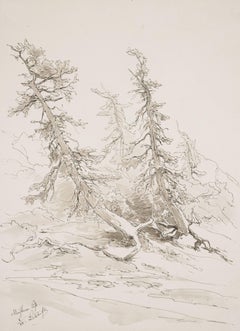
View AllWoodland / - The Inner Drama of the Landscape -
Located in Berlin, DE
Eduard Peithner von Lichtenfels (1833 Vienna - 1913 Berlin), Woodland, 1884. Watercolor and pen and ink on drawing paper, 30.4 cm x 22.5 cm, signed, dated and inscribed by the artist...
Category
1880s Landscape Drawings and Watercolors
Materials
Paper
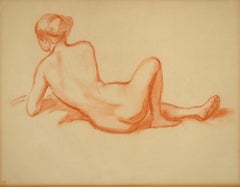
Female Nude from the Back, around 1900 / - The contour of the Art Nouveau -
By Ludwig von Hofmann
Located in Berlin, DE
Ludwig von Hofmann (1861 Darmstadt - 1945 Pillnitz), Female nude from the back, around 1900. Red chalk drawing on watermarked drawing paper, 36 cm x 44 cm (sheet size). Artist's liga...
Category
Early 1900s Art Nouveau Nude Drawings and Watercolors
Materials
Paper
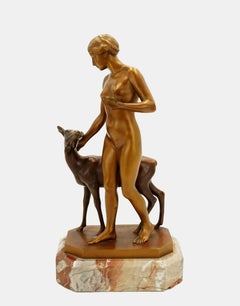
Forest idyll / - Soulmate -
By Rudolf Kaesbach
Located in Berlin, DE
Rudolf Kaesbach (1873 Gladbach - 1955 Berlin), Forest idyll, around 1915. Bronze, gold and golden brown patina, with cast plinth, mounted on a marble base (5 cm high), total height 36 cm, dimensions of the bronze: 31 cm (height) x 17 cm (length) x 12 cm (width). Weight 4,6 kg, signed on the plinth "R.[udolf] KAESBACH".
- a few rubbed areas, overall in excellent condition for its age
- Soulmate -
The bronze sculpture depicts a young woman in an intimate exchange with a deer that accompanies her. The animal pauses to turn toward her, while the nude beauty slows her pace to look into the deer's eyes and tenderly caress it with her hand. The woman and the deer are in inner harmony. Even though her lips remain motionless, she speaks the language of the animal with which she is deeply connected.
The golden patina, which contrasts with the more naturalistic coloring of the deer, gives the young woman the appearance of a saint, even if she cannot be identified as such. At the same time, she evokes memories of Diana, the goddess of the hunt, or a nymph. But she lacks the ferocity. In her innocent naivety, she is more like a vestal virgin, who is not at home in the solitude of the forest. And yet, the young beauty, moving unclothed in the heart of nature, looks like a priestess with her hair tied up and a carefully carried bowl on her way to a sacred grove.
In order to open up the above-mentioned associations, Kaesbach deliberately designed the female figure in such a way that she cannot be identified as a specific person. He has created an allegory of natural femininity, characteristic of Art Nouveau, in which the deer is far more than a companion animal. It displays the same gracefulness as the young woman, and the inner resemblance between the two makes the deer appear as her other self. In animal terms, it embodies her inner being, which also gives the deer an allegorical character.
About the artist
Rudolf Kaesbach studied sculpture at the Hanau Academy and worked in a bronze foundry in Paris in 1900. In order to work as an independent artist, he opened a workshop in Düsseldorf, where he cast bronzes from models he designed. In 1902 he made his debut at the German National Art Exhibition in Düsseldorf. The following year Kaesbach went to the academy in Brussels. There he was inspired by contemporary Belgian sculpture, especially the work of Constantin Meunier. He moved to Berlin, where he opened a studio in the villa district of Grunewald and devoted himself to life-size marble sculptures and the design of bronzes. From 1911, he regularly presented his works at the major art exhibitions in Berlin, as well as in Düsseldorf and Malmö. Between 1936 and 1939, he also created models for the Rosenthal porcelain factory. From 1939 to 1944, Kaesbach was represented at the major German art exhibitions in Munich.
GERMAN VERSION
Rudolf Kaesbach (1873 Gladbach - 1955 Berlin), Waldidyll, um 1915. Gold und goldbraun patinierte Bronze mit gegossener Plinthe, auf einem Marmorsockel montiert (5 cm Höhe), Gesamthöhe 36 cm, Maße der Bronze: 31 cm (Höhe) x 17 cm (Länge) x 12 cm (Breite). Gewicht 4,6 kg, auf der Plinthe mit „R.[udolf] KAESBACH“ signiert.
- vereinzele beriebene Stellen, insgesamt in einem altersgemäß ausgezeichneten Zustand
- Seelenverwandtschaft -
Die Bronzeplastik veranschaulicht eine junge Frau im innigen Austausch mit einem sie begleitenden Reh. Das Tier hält inne, um sich zu ihr hochzuwenden, während die nackte Schönheit ihren Schritt verlangsamt, um dem Reh ebenfalls in die Augen zu schauen und es zärtlich mit der Hand zu liebkosen. Die Frau und das Reh sind in einem inneren Gleichklang. Auch wenn ihre Lippen unbewegt bleiben, spricht sie die Sprache des Tieres, mit dem sie auf eine tief empfundene Weise verbunden ist.
Die im Kontrast zur naturalistischeren Einfärbung des Rehs aufstrahlende goldfarbene Patina lässt die junge Frau wie eine Heilige erscheinen, auch wenn sich nicht als Heilige identifizierbar ist. Zugleich ruft sie Erinnerungen an die Jagdgöttin Diana oder eine Nymphe hervor. Dafür fehlt ihr allerdings die Wildheit. In ihrer unschuldigen Naivität gemahnt sie vielmehr an eine Vestalin, die freilich nicht in der Waldeinsamkeit zu Hause ist. Und doch wirkt die sich unbekleidet im Herzen der Natur bewegende junge Schönheit wie eine Priesterin, die sich mit hochgebundenem Haar und der vorsichtig getragenen Schale und dem Wege zu einem Heiligen Hain befindet.
Um die gennannten Assoziationen zu eröffnen, hat Kaesbach die Frauenfigur bewusst so gestaltet, dass sie nicht als konkrete Person identifizierbar ist. Damit hat er eine für den Jugendstil charakteristische Allegorie natürlicher Weiblichkeit geschaffen, bei der das Reh weit mehr als ein Begleittier ist. Es weist dieselbe grazile Anmut wie die junge Frau auf und der innere Gleichklag der beiden lässt das Reh als ihr anderen Ich erscheinen. Es verkörpert – ins Animalische übertragen - ihr inneres Wesen, wodurch auch dem Reh ein allegorischer Charakter zukommt.
zum Künstler
Rudolf Kaesbach studierte an der Akademie Hanau Bildhauerei und war im Jahr 1900 in einer Pariser Bronzegießerei tätig. Um sich als eigenständiger Künstler betätigen zu können, eröffnete er in Düsseldorf eine Werkstatt, in der er Bronzen nach selbstentworfenen Modellen goss. 1902 debütierte er auf der Deutschen Nationalen Kunstaustellung in Düsseldorf. Im Folgejahr ging Kaesbach an die Akademie nach Brüssel. Dort wurde er von der zeitgenössischen belgischen Bildhauerei, insbesondere vom Werk Constantin Meuniers, inspiriert. Zurückgekehrt zog er nach Berlin, wo er im Villenviertel Grunewald ein Atelier eröffnete und sich neben dem Entwurf für Bronzen der lebensgroßen Marmorbildhauerei widmete. Ab 1911 präsentierte er seine Werke regelmäßig auf den Großen Berliner Kunstausstellungen, aber auch in Düsseldorf und Malmö. Zwischen 1936 und 1939 fertigte er zudem Modelle für die Porzellan-Manufaktur Rosenthal an. Von 1939 bis 1944 war...
Category
1910s Jugendstil Nude Sculptures
Materials
Bronze
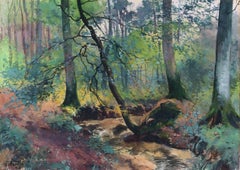
Summer Forest Landscape, 1915 / - The Forest Walk -
Located in Berlin, DE
Stanislas Warnie (1879-1958), Summer Forest Landscape, 1915. Watercolor, 31.5 cm x 45 cm (passepartout), 50.5 cm x 63.5 cm (frame), signed "S. Warnie" at lower left and dated "1915"....
Category
1910s Art Nouveau Landscape Drawings and Watercolors
Materials
Watercolor
Southern German summer landscape / - The profile of the landscape -
Located in Berlin, DE
Hans Thoma (1839 Bernau - 1924 Karlsruhe), Southern German summer landscape, around 1897. Algraph on strong wove paper, published by Breitkopf und Härtel in Leipzig as ‘Zeitgenössisc...
Category
1890s Realist Figurative Prints
Materials
Paper
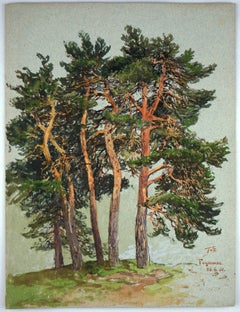
Norwegian Pine Grove - The inner glow of the trees -
Located in Berlin, DE
Themistokles von Eckenbrecher (1842 Athens - 1921 Goslar), Norwegian pine grove, 1901. Watercolor on blue-green paper, 30 x 22 cm. Signed, dated and inscribed in his own hand "TvE. Fagermes [i.e. Fagermes]. 26.6.[19]01."
- Slight crease throughout at left margin, otherwise in good condition.
About the artwork
Themistokles von Eckenbrecher often traveled to Norway to study the nature that fascinated him there. On June 26, 1901, near the southern Norwegian town of Fagernes, in the summer evening sun, he saw a small pine grove, which he immediately captured in a watercolor. He exposed the trees growing on a small hill in front of the background, so that the pines completely define the picture and combine to form a tense motif. The tension comes from the contrast of form and color. The trunks, growing upward, form a vertical structure that is horizontally penetrated by the spreading branches and the pine needles, which are rendered as a plane. This structural tension is further intensified by the color contrast between the brown-reddish iridescent trunks and branches and the green-toned needlework.
Themistokles von Eckenbrecher, however, does not use the observed natural scene as an inspiring model for a dance of color and form that detaches itself from the motif and thus treads the path of abstracting modernism. Its inner vitality is to be brought to light and made aesthetically accessible through the work of art.
It is precisely in order to depict the inner vitality of nature that von Eckenbrecher chooses the technique of watercolor, in which the individual details, such as the needles, are not meticulously worked out, but rather a flowing movement is created that unites the contrasts. The trees seem to have formed the twisted trunks out of their own inner strength as they grew, creatingthose tense lineations that the artist has put into the picture. The inner strength continues in the branches and twigs, culminating in the upward growth of the needles. At the same time, the trunks, illuminated by the setting sun, seem to glow from within, adding an almost dramatic dimension to the growing movement.
Through the artwork, nature itself is revealed as art. In order to make nature visible as art in the work, von Eckenbrecher exposes the group of trees so that they are bounded from the outside by an all-encompassing contour line and merge into an areal unity that enters into a figure-ground relationship with the blue-greenish watercolor paper. The figure-ground relationship emphasizes the ornamental quality of the natural work of art, which further enforces the artwork character of the group of trees.
With the presentation of Themistokles von Eckenbrecher's artistic idea and its realization, it has become clear that the present watercolor is not a study of nature in the sense of a visual note by the artist, which might then be integrated into a larger work context, but a completely independent work of art. This is why von Eckenbrecher signed the watercolor. In addition, it is marked with a place and a date, which confirms that this work of nature presented itself to him in exactly this way at this place at this time. At the same time, the date and place make it clear that the natural work of art has been transferred into the sphere of art and thus removed from the time of the place of nature.
About the artist
Themistocles' parents instilled a life of travel in their son, who is said to have spoken eleven languages. His father, who was interested in ancient and oriental culture, was a doctor and had married Francesca Magdalena Danelon, an Italian, daughter of the British consul in Trieste. During a stay in Athens - Gustav von Eckenbrecher was a friend of Heinrich von Schliemann and is said to have given him crucial clues as to the location of Troy - Themistokles saw the light of day in 1842.
After an interlude in Berlin, where Themistokles was educated at the English-American School, the journey began again. From 1850 to 1857 the family lived in Constantinople, after which the father opened a practice in Potsdam, where Themistokles, who wanted to become a painter, was taught by the court painter Carl Gustav Wegener.
In 1861 the von Eckenbrechers left Potsdam and settled in Düsseldorf. There Themistokles received two years of private tuition from Oswald Aschenbach, who greatly admired the talented young artist. After his artistic training, he undertook extensive travels, often accompanied by Prince Peter zu Sayn-Wittgenstein, which took him to northern and eastern Europe, but above all to the Middle East and even to South America. The paintings that resulted from these journeys established his artistic reputation and led to his participation in large panoramas such as the 118 x 15 metre Entry of the Mecca Caravan into Cairo, painted for the City of Hamburg in 1882.
1882 was also the start of a total of 21 study trips to Scandinavia, most of them to Norway, and the unique Norwegian landscape with its rugged fjords became a central motif in his work. Along with Anders Askevold and Adelsteen Normann...
Category
Early 1900s Naturalistic Landscape Drawings and Watercolors
Materials
Watercolor
You May Also Like
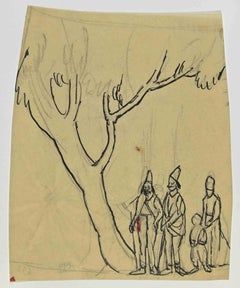
Under the Tree - Drawing by Gabriele Galantara - 1910s
By Gabriele Galantara
Located in Roma, IT
China ink drawing realized by Gabriele Galantara in the 1910s.
Not signed.
Very good condition.
Category
1910s Modern Figurative Drawings and Watercolors
Materials
Paper, Ink
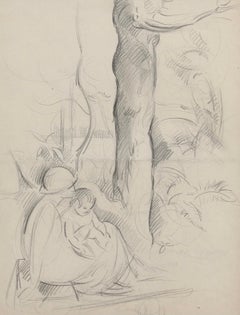
Mother with Child Under a Tree
By Guillaume Dulac
Located in London, GB
'Mother with Child Under a Tree', pencil on art paper, by French artist, Guillaume Dulac (circa 1920s). An artist known for his exquisite drawings - many are sketches for his larger ...
Category
1920s Portrait Drawings and Watercolors
Materials
Paper, Pencil
$674 Sale Price
30% Off
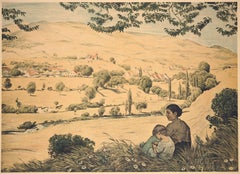
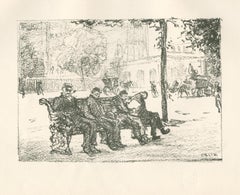
"In the Park" original lithograph
By Emil Orlik
Located in Henderson, NV
Medium: original lithograph. This Emil Orlik lithograph is also known as "On the Victoria Embankment, London". This impression on wove paper was printed in 1900 and published in Lond...
Category
Early 1900s Prints and Multiples
Materials
Lithograph
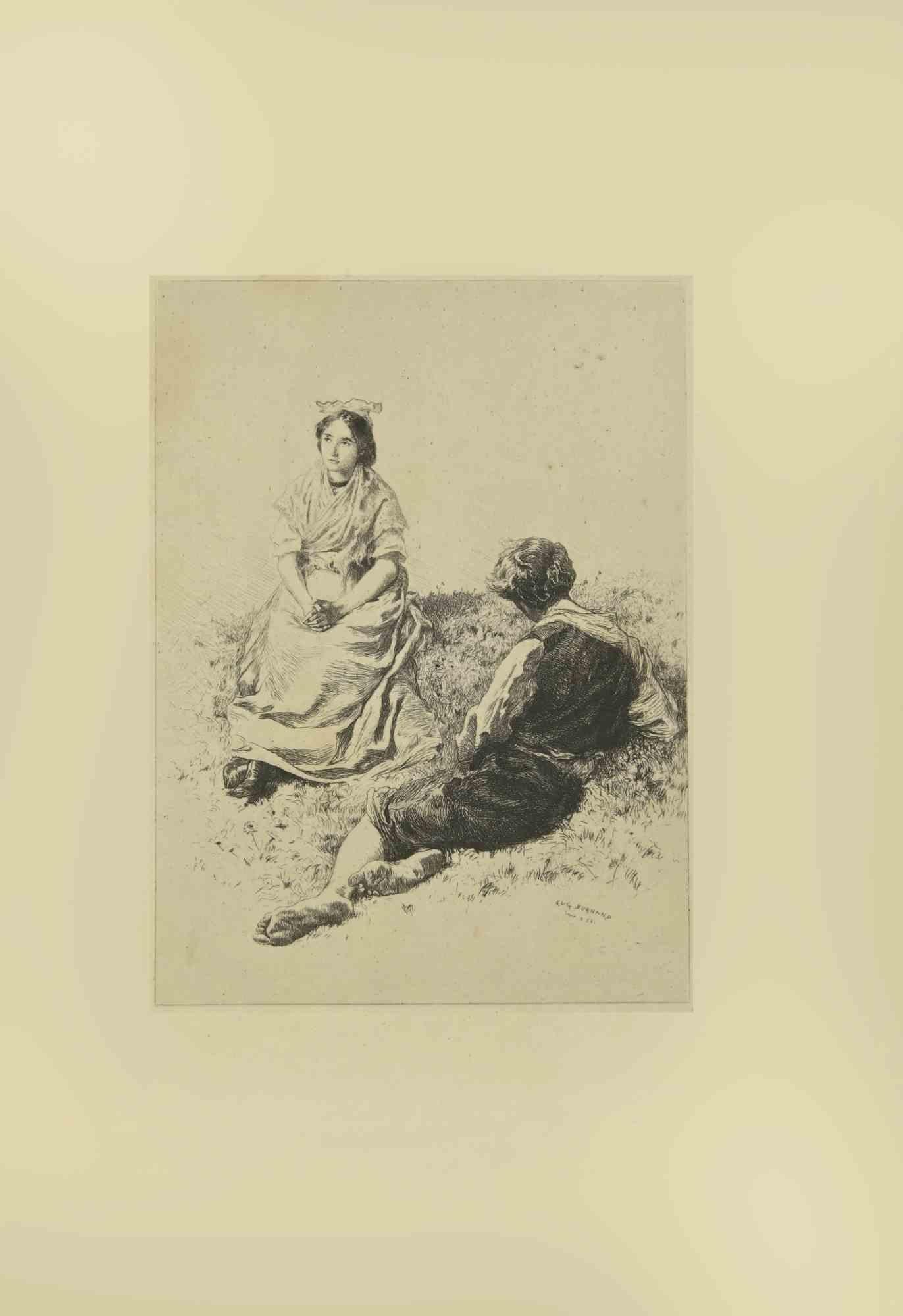
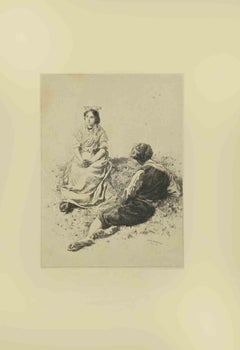
Lovers in Meadow - Etching by Eugène Burnand - Late 19th century
Located in Roma, IT
Lovers in Meadow is an etching realized by Eugène Burnand (1850-1921) in the Late 19th century.
Signed on the plate.
Good conditions with foxing.
The artwork is realized through ...
Category
Late 19th Century Modern Figurative Prints
Materials
Engraving, Etching
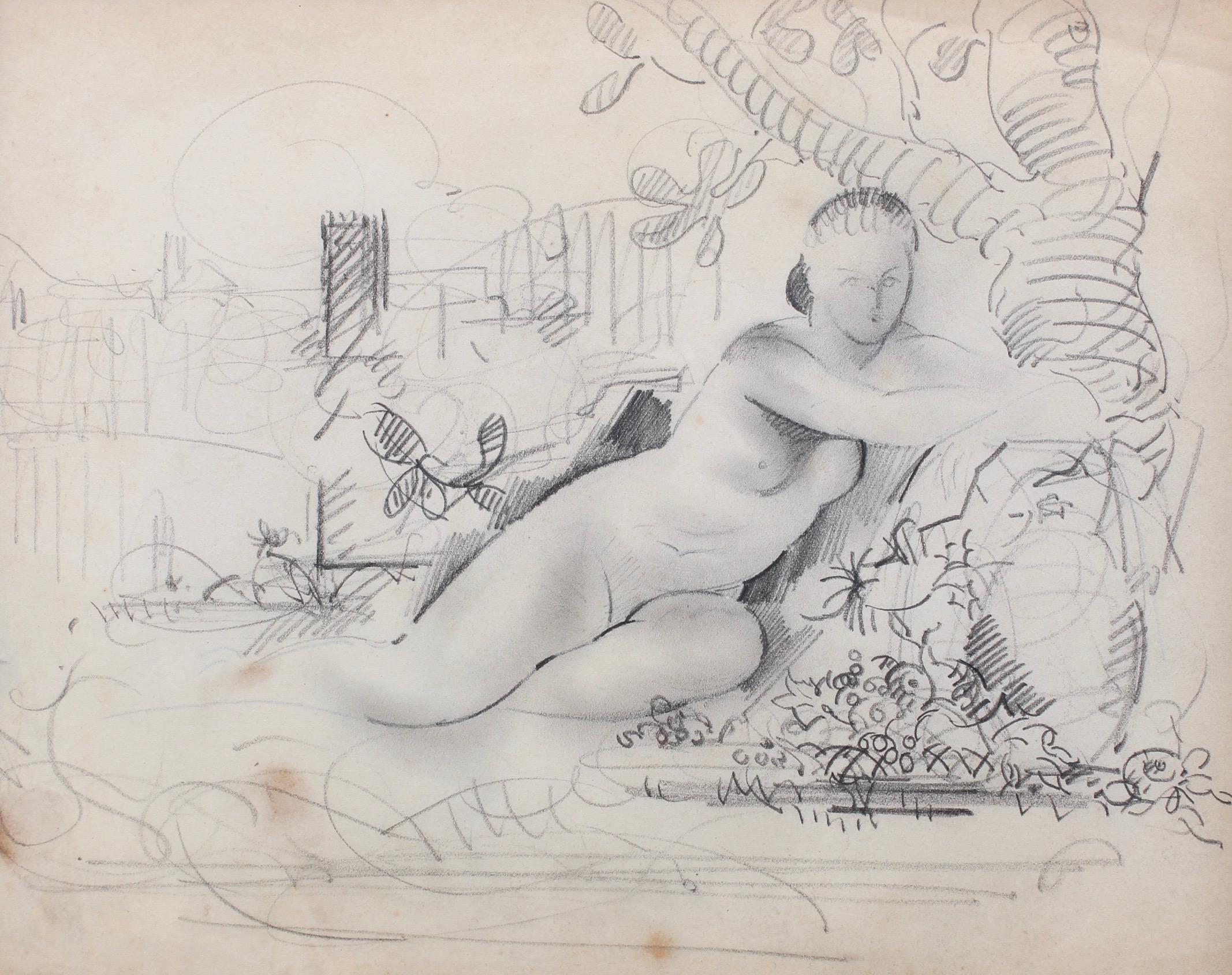
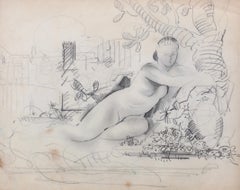
Reposing Nude and Tree
By Guillaume Dulac
Located in London, GB
'Reposing Nude and Tree', pencil on art paper, by French artist, Guillaume Dulac (circa 1920s). An artist known for his exquisite drawings - many are sketches for his larger oil pain...
Category
1920s Nude Drawings and Watercolors
Materials
Paper, Pencil
$440 Sale Price
20% Off
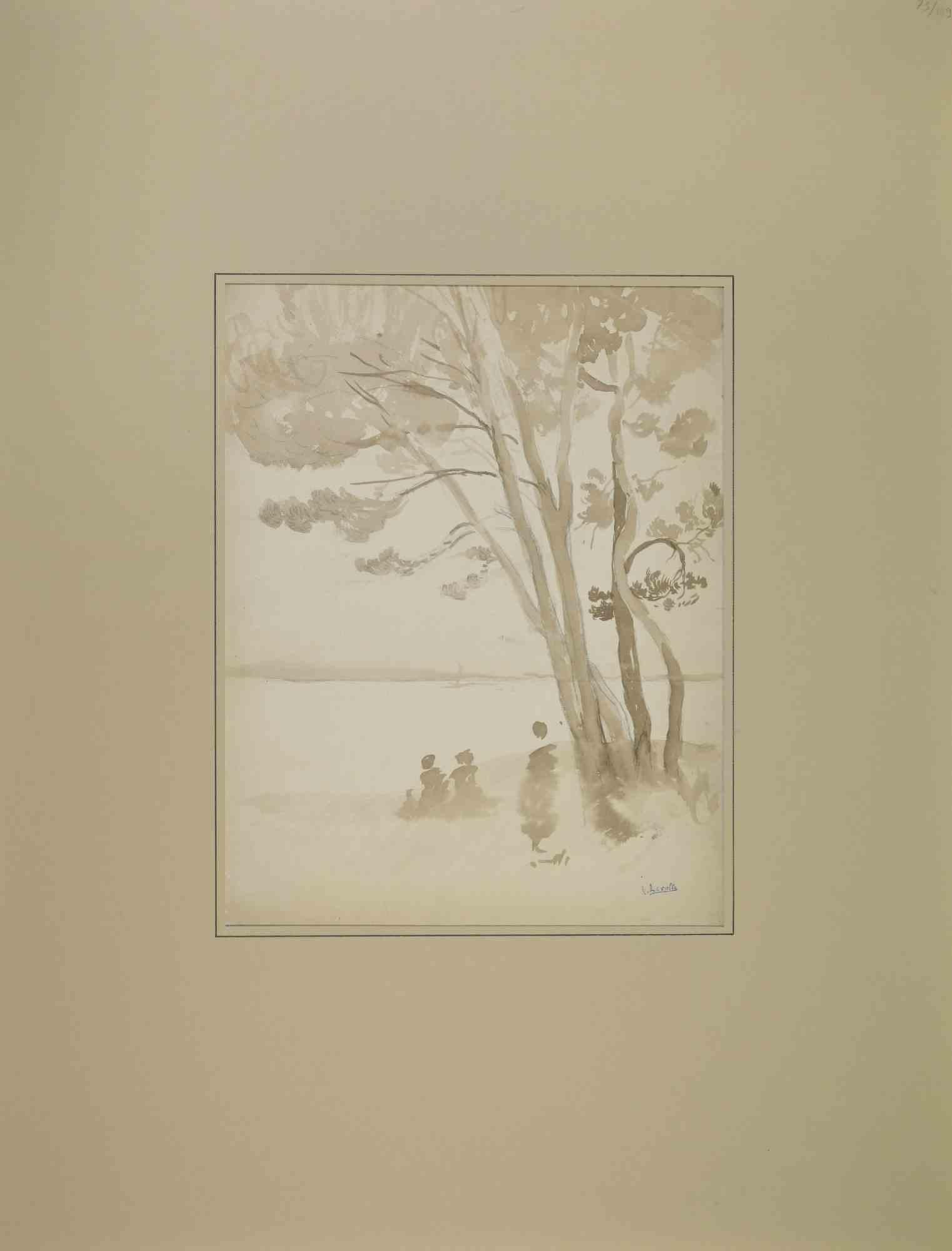
The Tree - Drawing by Henry Lerolle - Early-20th Century
By Henry Lerolle
Located in Roma, IT
The Tree is an drawing realized Henry Lerolle in the Early-20th Century.
Watercolor.
Good condition.
Hand-signed.
Category
Early 20th Century Modern Figurative Drawings and Watercolors
Materials
Watercolor