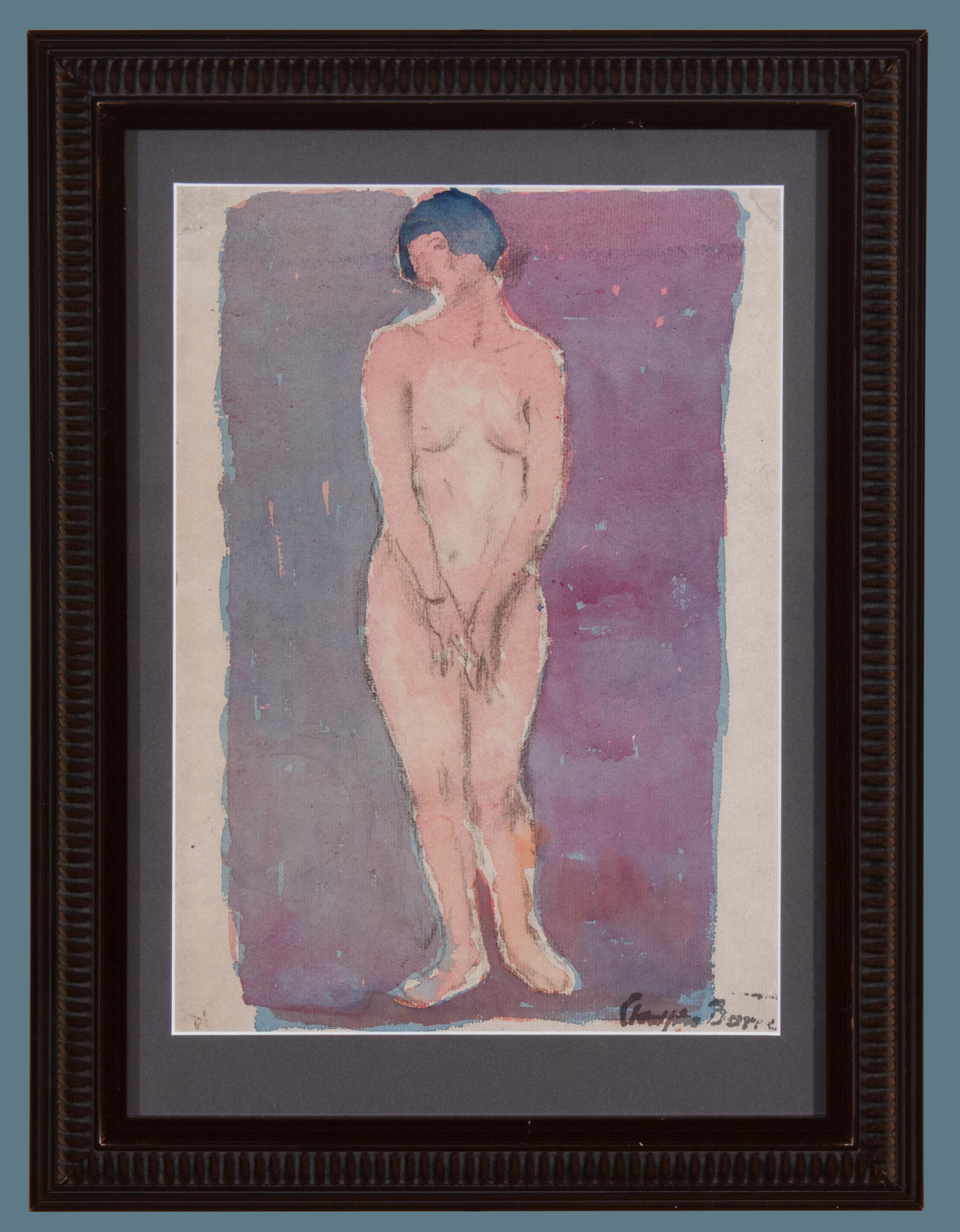
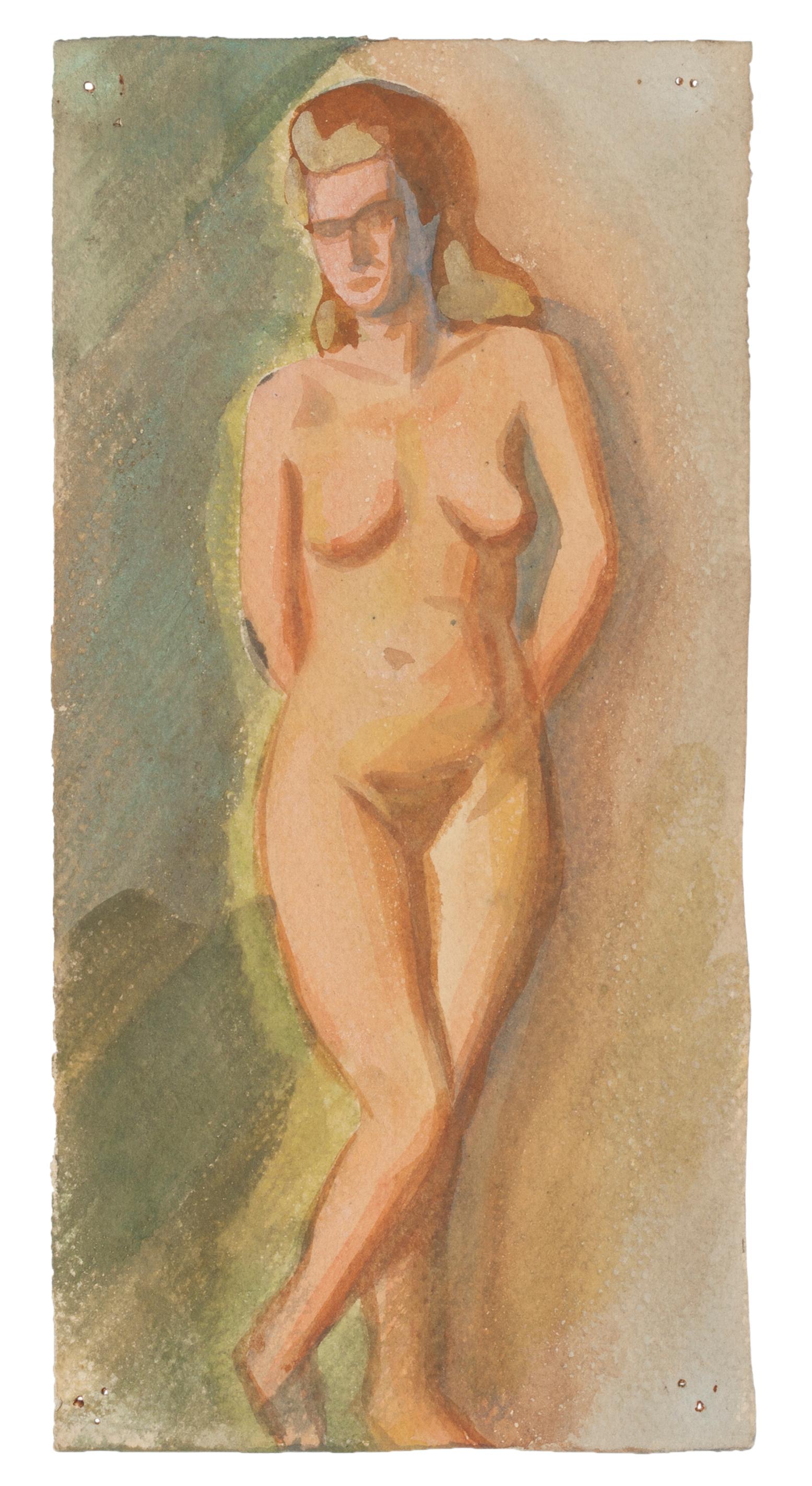
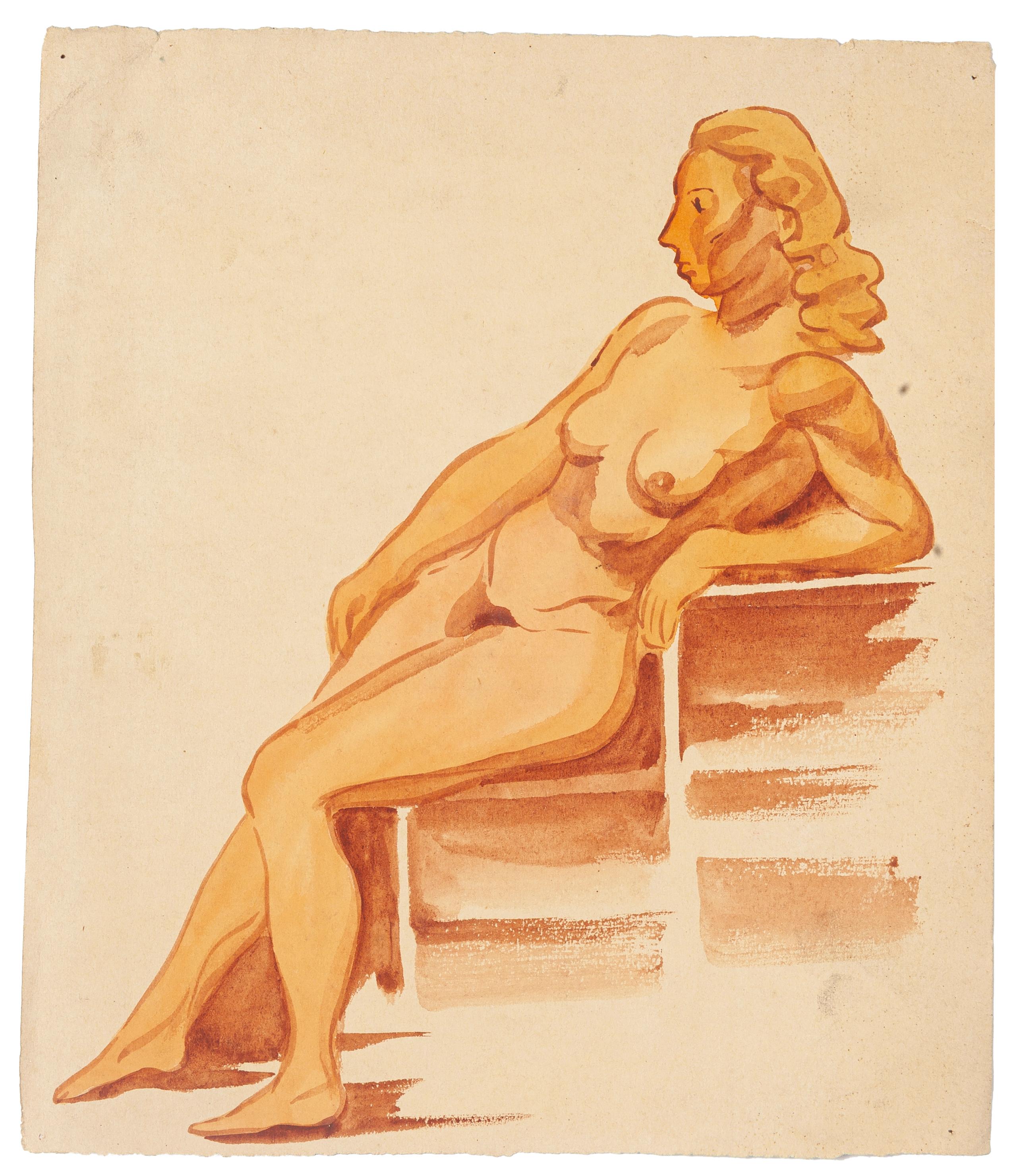
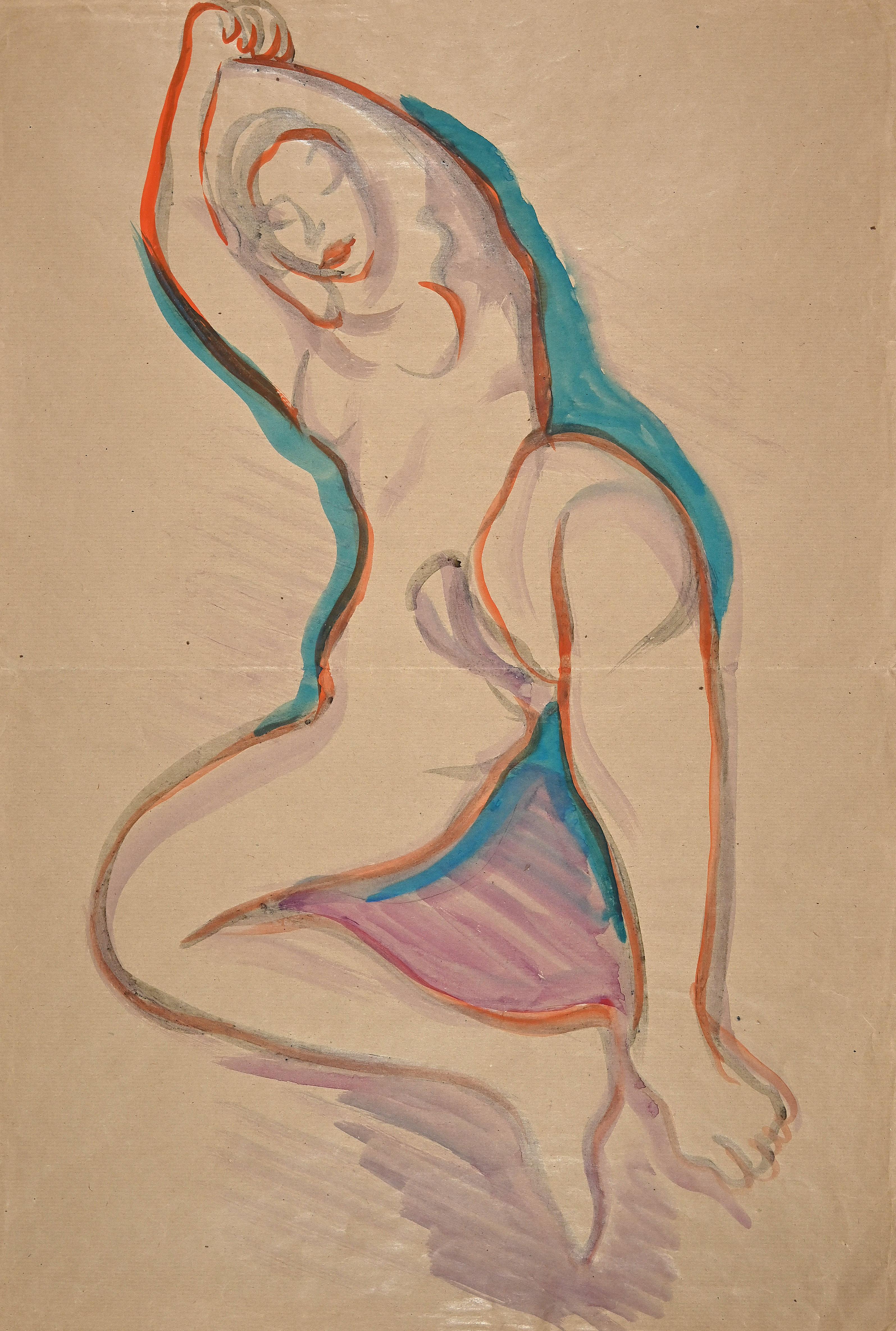
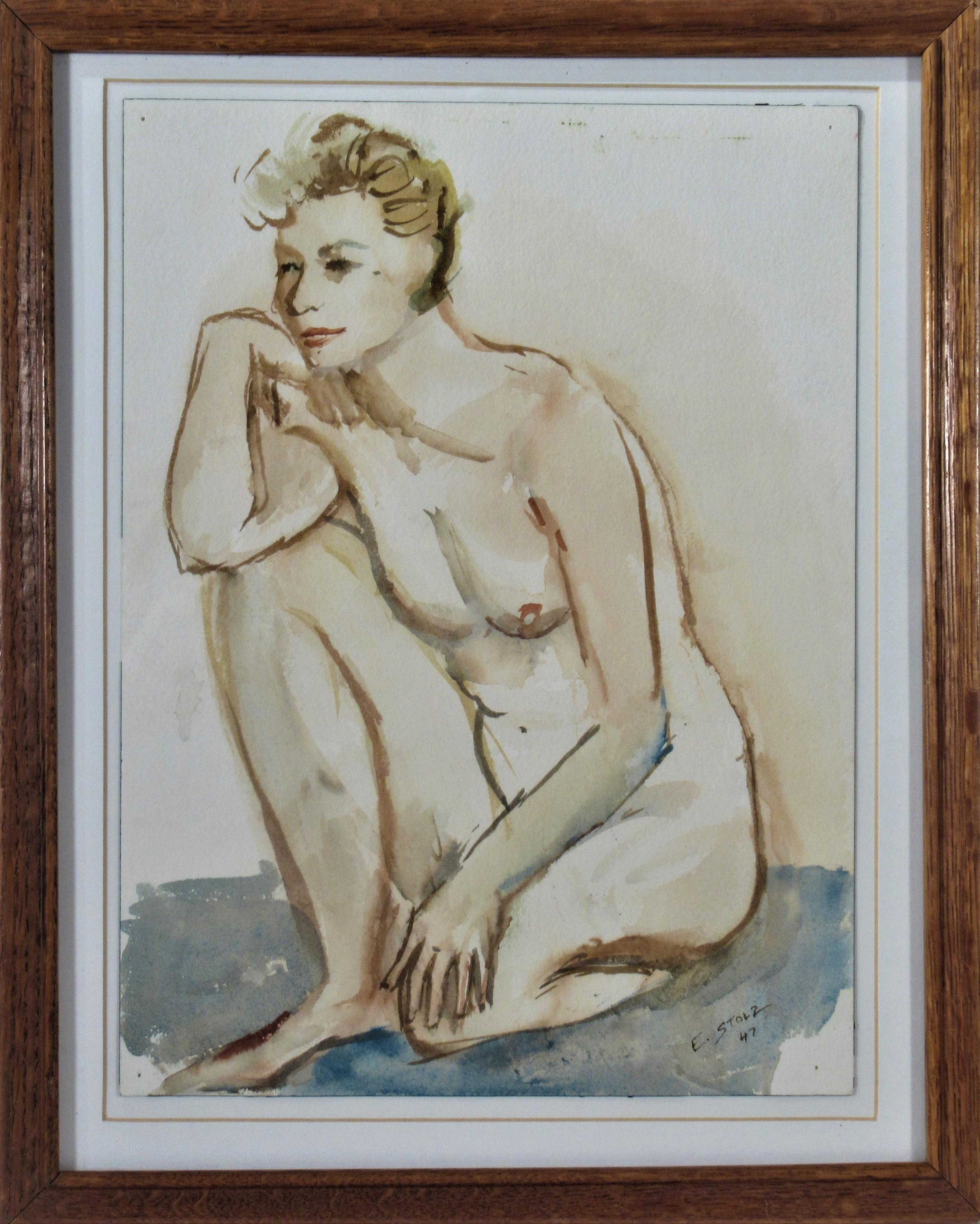
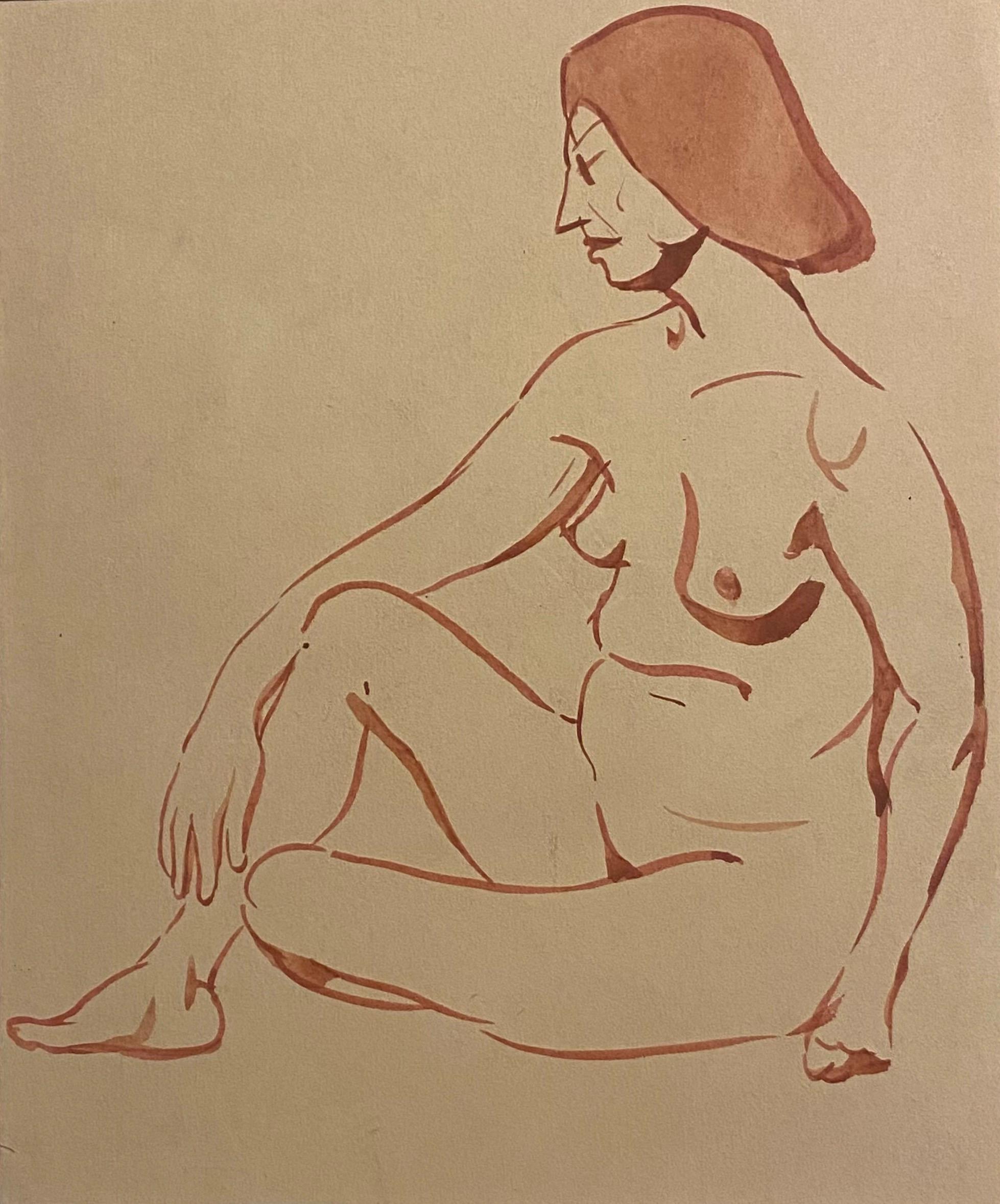
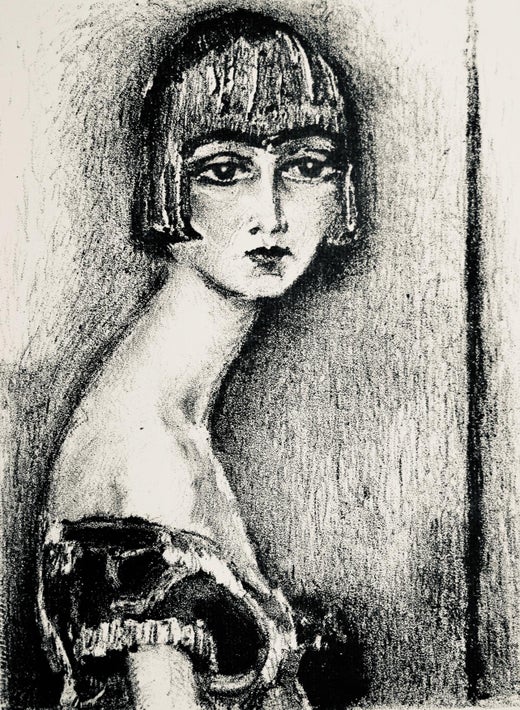
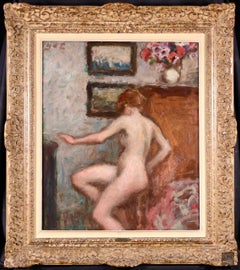
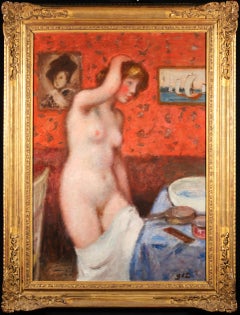
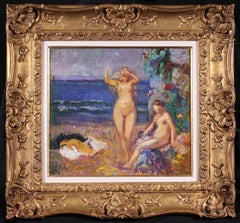
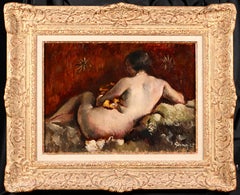
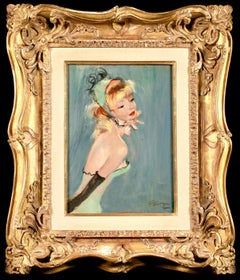
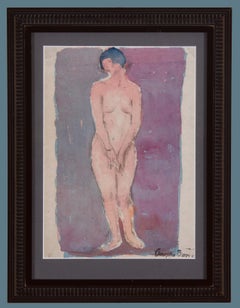
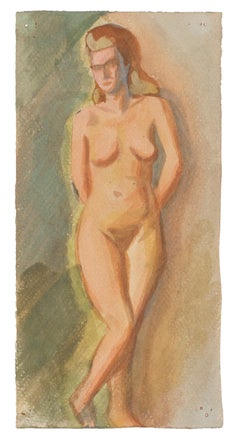
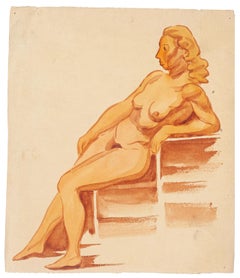
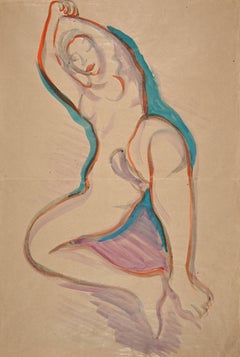
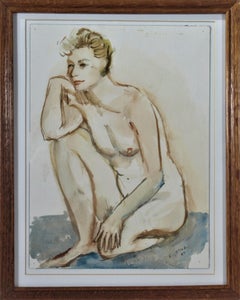
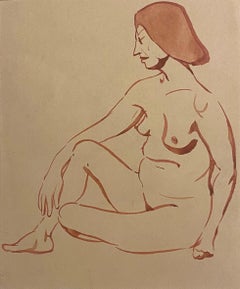
Signed nude watercolour on paper circa 1900 by Kees van Dongen. The piece depicts a standing nude woman with her hair tied up facing away from the artist. This superb work can be directly compared to a horizontal watercolour of a female nude by Van Dongen which was sold at Sothebys London on the 5th December 1985 depicting likely the same model.
Signature:
Signed lower right
Dimensions:
Framed: 20.5"
Unframed: 16"
Provenance:
Private collection - Germany
Kees van Dongen's father first placed him in a school of industrial design and decorative art in Rotterdam. Later, in 1894-1895, he became a pupil of J. Striening and J.G. Heyberg at the academy of fine arts in Rotterdam. His first paintings of this period were signed C. Van Dongen and from 1896 he published drawings, often of street women, in local newspapers, notably the Rotterdamsche Nieuwsblad where they created a scandal. After a trip to New York in July 1897, he spent time in Paris, living with Siebe Ten Cate, who introduced him to the art dealers Le Barc de Bouteville and 'le père Soulier'. However, lack of resources obliged him to resort to menial work as a porter at Les Halles, a furniture remover, a portrait painter on the terraces of cafes and a professional wrestler. In March 1900 he settled in Paris for good and in 1901 he married his comrade at the École des Beaux-Arts Augusta Preitinger, called Guus. In 1905 his daughter Augusta was born and nicknamed Dolly. In 1905-1906 he joined up with Picasso, though this friendship had no influence on his own artistic development, and settled at the Bateau-Lavoir where Pierre Mac-Orlan, André Salmon and Max Jacob also lived, and where Apollinaire, who disliked him, and Dérain, Vlaminck and others were regular visitors. He often went with Picasso to the Médrano circus, where he made pictures of clowns and acrobats. Fernande Olivier, then Picasso's companion, often modelled for him.
From 1910 to 1912 he made several trips to Spain, Italy, Morocco, Tunisia and Egypt. In 1916, separated by the war from his wife and daughter, Van Dongen set himself up at the Villa Saïd, which soon became the place to be for those who mattered in Paris and, more importantly, the studio where the greatest number of large society portraits were painted. He had been introduced into so-called 'high society' by his new companion, Leo Jasmy Jacob. Between 1920 and 1930 Van Dongen divided his time and activity between Cannes, Deauville, Venice and Paris. In 1921 he made a visit to Venice and in 1922 he settled in a luxurious private mansion in Paris at 5 rue Juliette-Lamber. The studio on the first floor was his working area. He was made a Chevalier of the Légion d'Honneur in 1926. In 1935 he transferred his Paris studio to 765 rue de Courcelles and in 1938 he entered into a relationship with Marie-Claire Huguen, who gave him a son, Jean-Marie. His activity was intense up to World War II; it then slowed down. After the war he abandoned large works and painted new portraits, among which was one of the actress Brigitte Bardot. He divided his time between Paris, Deauville and the Midi, where he set up home with his new companion and their son in Monaco.
The personal difficulties of his youth had put him in a position to understand the social misfortunes brought about by the industrial period, and he dedicated part of his work to representing those excluded from society. On his arrival in Paris he contacted Félix Fénéon, editor of the Revue blanche, who introduced him to the pointillist painters Maximilian Luce, Edmond Cross and Signac, who influenced him in his pictorial technique. During this period, in part occupied with making rapid sketches of typical street characters in Paris, he was particularly influenced by the incisive lines of Steinlein, Forain and Toulouse-Lautrec, influences that contributed to the apparent simplification of his drawing. From 1901 to 1903, he contributed to the illustrated publications of the time: Rabelais; Le Rire; L'Indiscret; Gil Blas; Frou-Frou and of course the Revue blanche. From 1901 a special issue of L'Assiette au Beurre: Petite histoire pour petits et grands nenfants (sic) was given over totally to his drawings, which earned him 800 francs. Between 1895 and about 1912, part of his work, mainly large drawings on paper, seemed completely taken up with denouncing poverty, alcohol and prostitution.
In spite of all this, it is to his Fauvist period that he owes his place in history. This period was relatively long in his case, covering about eight years, during which he remained indifferent to the Cubist phenomenon. From his Self-portrait and Pipe Dream of 1895, the violence of his palette placed him as a pre-Fauvist. George Duthuit, a historian of Fauvism and son-in-law of Matisse, wrote: 'Van Dongen has followed the Fauves at a distance, he might even have moved ahead of them from 1895, without noticing it'. During the Fauve period, his sensual nudes, modelled often by 'Anita, the Gypsy', drew the attention of critics including Félix Fénéon and Louis Vauxcelles, who inappropriately called them 'the most radiant, the warmest since Renoir', with whom he had nothing in common. One of two paintings that figured in 1905 in the Fauvist area of the Salon d'Automne was a Torso based on his wife Guus, 'bestial and resplendent' according to Élie Faure. In a nice turn of phrase, Gustave Coquiot wrote that Van Dongen had discovered that a woman was the most beautiful of landscapes. During 1905, when he had exhibitions at the Berthe Weill and Druet galleries, the creation of some of these paintings was marked, from 1903, by the separated brushstroke of the Neo-Impressionists: '... in a retrospective of Seurat, I was able to copy his style and to add to it', an influence which he rejected for a long time, only coming back to it in his last years. As well as nudes, he also painted characters in drama, clowns and dancers, and later, a number of portraits.
After the birth of his daughter in 1905, he created many very tender portraits such as The Birth of Dolly and Guus and Dolly in the Nude. At Venice in 1921 he painted a series of 21 tableaus, among which were An American Woman in Venice and The Gondolier. After 1922, in the studio at rue Juliette-Lamber, he continued the series of large portraits: The Countess of Noailles; President Louis Barthou; President Paul Painlevé; The Aga Khan; King Leopold III; the actors Maurice Chevalier, Jules Berry and Arletty, whose splendid cheeky humour lent itself particularly to Van Dongen's studies of character types; and many more. He also painted landscapes in Paris, Versailles, Venice, Deauville, Cannes and Egypt, and flowers. Having given up the stippling brushstroke, he had substituted optical sparkle for the pure, high colour of Fauvism. During the years when he was faithful to Fauvism, using only basic colours, he rejected shading of colours, shaping of forms and depth of field, and instead favoured violent, chromatic contrasts and drawings partitioned by long, sinuous arabesques. In these extremes of flattened arabesques, and of pure flat colour, Van Dongen revealed himself much more violent in his Fauvism than Matisse, who at the same time was engaged in refining his work, starting with his Joy of Life and his Luxury. In this period, the observance of Fauvist rules concerning 'plastic form' in itself did not prevent him from continuing to be the cutting moralist, heir of Daumier and Toulouse-Lautrec, nor from sometimes casting a sideways glance at Klimt, as in his Portrait of Guus in Blue, Seated in 1910, now in a private collection in Lausanne. It could be said that he was one of the Fauves because Fauvism exactly fitted his earlier, natural inclination. He easily lined up with the Fauves because he was first and foremost an Expressionist, and remained so after Fauvism had become diluted and dispersed in the diversity of its interests.
After his true Fauvist period, Van Dongen's style developed gradually, the colour range becoming more refined, greys appearing, the arabesques in his design drawn out to the point of being Mannerist. From 1918, orders for portraits flooded in from diplomats, political figures and aristocrats. In 1925, Paul Gsell said of his society portraits: 'some of these portraits are expressive of ferocious mockery. So much the worse for the sitters, but Van Dongen is powerfully ironic and a shrewd moralist...'. In 1920, he painted Anatole France, accentuating the marks of ageing on the academician, and Boni de Castellane, stressing the worn-out fast-liver rather than the enduring dandy that Cocteau described as a combination of 'the pride, the magnificence and the grandiose shallowness of a twilight of the gods'. He painted his portraits of women with large brushstrokes, spreading the black of the kohl and the blue of the eyelids thickly on skin tones with green and violet shadows, causing breasts, hips, and legs to show through the indiscreet tulle. Nor did he resist the cartoonist's trick of giving shape to the sparkle of the pearl necklaces worn by his models, by using intense beams of white to contrast with the coloured background, drawn with a single line, and projected far beyond the jewels. Far from flattering his models, he overloaded them, letting vulgarity show through their air of sophistication. The prestige of his name in snobbish Parisian society achieved what his misunderstood talent would not have obtained from his clients: the satisfaction of seeing them ridiculed. At the same period, the Deauville seascapes and Parisian scenes again open a caustic eye on a society as garish as it was doubtful in taste, and have the same pictorial talent and vigour.
In the latter part of his life, Van Dongen illustrated three stories by Kipling, and some novels, as well as La princesse de Babylone by Voltaire, Les fleurs du mal by Baudelaire and all of In Search of Lost Time by Marcel Proust.
Women continued to flock to him to have their portraits painted. He gave them the same enormous eyes, fringed with black lashes, the same sensual mouth slightly open to reveal shining teeth, the same slim body, stretched, moulded, divined through insubstantial garments and set off by gaudy jewels. Mannerism had replaced psychological acuity. Right to the end of a long life he repeated his familiar themes, women, portraits, society scenes and flowers, with less and less conviction and more and more conformity.
He took part in group exhibitions and on his arrival in Paris showed several canvases at 'le père Soulier'; in February 1904 he showed six paintings at the Salon des Artistes Indépendants which were immediately noticed by the critics; he joined up with Vlaminck and Dérain and in November of the same year exhibited two paintings at the Salon d'Automne. In 1905 he appeared at the Salon d'Automne with two paintings in the famous room devoted to the work what came to be called the Fauves. He signed a contract with Kahnweiler in 1907 and with the gallery Bernheim Jeune, directed by Félix Fénéon, in 1908. Kahnweiler had publicised his painting in Germany, and had introduced him to the painter Pechstein, who in turn introduced him to the painters of Die Brücke. In 1908 he was invited to take part in an exhibition of Die Brücke, probably in Munich, and perhaps in other exhibitions. This was a recognition, apart from his membership of Fauvism, that he belonged, as a man of the north, to Expressionism. He exhibited in 1908-1909 in Moscow with the Golden Fleece group; in 1909-1910 in Odessa, Kiev, St Petersburg and Riga and at the Salon Izdebsky and at Salon d'Automne of 1913. One of his paintings, innocently entitled Picture ( Tableau), was judged obscene by the Prefect of Police and withdrawn from the exhibition. The painting in question was a large nude, modelled by his wife Guus, successively called Nude with Pigeons, Beggar of Love, The Spanish Shawl and Nude with Yellow Shawl. In 1928 he took part in the exhibition of contemporary French painting in Moscow and up to World War II he continued to exhibit in annual Parisian Salons and to show in numerous countries.
His work benefited most of all from solo exhibitions: in 1904, Ambroise Vollard organised for him a real retrospective exhibition, gathering together 105 works dating from 1892 to 1904, which was probably a success in spite of his exaggerated colouring style; in 1905, solo exhibitions at the Berthe Weil and Druet galleries; 1913, 1921, 1925, Galerie Bernheim Jeune, Paris; 1914, Gallery Cassirer, Berlin; 1918, Galerie Paul Guillaume, Paris. In 1922 he broke with all the galleries and became his own dealer, organising exhibitions in his ground floor studio, visited by the Parisian elite, a combination of crowned heads, anarchists, hard-up painters and millionaires. During World War II he held a large retrospective exhibition at the Galerie Charpentier. After the war he began to exhibit all over the world. In 1967, a year before his death, the Museum Boijmans van Beuningen in Amsterdam and the Musée d'Art Moderne de la Ville de Paris organised a huge retrospective exhibition of the whole of his work.
Group Exhibitions:
1979, Paris-Moscow, Centre Georges Pompidou, Paris
1999, Fauvism or 'Trial by Fire': The Eruption of Modernity in Europe (Le Fauvisme ou 'L'Épreuve du Feu': Éruption de la Modernité en Europe), Musée d'Art Moderne de la Ville de Paris
Solo Exhibitions
1990, Museum Boijmans van Beuningen, Amsterdam and the Musée d'Art Moderne de la Ville de Paris
1997, Van Dongen Rediscovered, Musée des Beaux-Arts, Lyons and at l'Institut Néerlandais in Paris
2002, Fondation Pierre Gianadda, Martigny (retrospective)
2002, Kees van Dongen. Elegant Lines: Lithos, Pochoirs and Paintings, Kunsthal, Rotterdam (a presentation of all the graphic work in relation to his paintings)
2008, Nouveau Musée National de Monaco (retrospective)
2009, Van Dongen: A Fauve in the City, Musée des Beaux-Arts, Montreal
Museum and Gallery Holdings
Amsterdam (Rijksmus.): Still-life with Flowers
Amsterdam (Stedelijk Mus.): Old Clown (1910); Portrait of Countess Anna de Noailles (1926)
Angers (MBA): Spanish Dancer
Antwerp (Koninklijk Mus. voor Schone Kunsten): Monsignor Gerassimos Messara
Brussels (French Embassy): Sunday in the Bois de Boulogne
Brussels (Mus. royaux des Beaux-Arts de Belgique): Louis Barthou
Chicago (AI): Woman in front of a White Window (1910-1914); Rue de la Paix (1910-1914); Tea in my Studio (1910-1914)
Cologne (Wallraf-Richartz Mus.): Portrait of a Swiss Woman Painter
Copenhagen (Statens Mus. for Kunst): Head of a Woman (1913)
Geneva (Petit Palais): Portrait of D.H.Kahnweiler; Old Clown; Village Square; Beach at Deauville
Grenoble (Mus. de Grenoble): Amusement (1914); Woman with a Fan (1922); Woman at the Hearth
Le Havre (Mus. Malraux): Montmartre (1903); Horseriders in the Bois de Boulogne (1906); Parisian Woman of Montmartre (1910); Bouquet
Lyons (MBA): Woman in Front of a Door
Montpellier (Mus. Fabre): Fernande Olivier (1908)
Montreal (MAC): Drizzle, Normandy; Young Girl
Moscow (Pushkin MFA): Woman with Black Gloves (c. 1910)
Nantes (MBA): Honest Pastime
New York (Brooklyn Mus.): Dr. W.S. Davenport
New York (MoMA): Madame Modjesko, soprano (1908)
Nice: Ambassador of Haiti, Auguste Cassius
Nice (MBA Jules-Chéret): Blue Man and Red Woman (c. 1918)
Paris (MAMVP): Two Women (1908); Flowered Bowl (c. 1925); Portrait of Paul Guillaume
Paris (MNAM-CCI): Acrobat with Bare Breasts (c. 1910); Railings of the Elysée Palace (c. 1912); Lake in the Bois de Boulogne (c. 1912); Fellahs (1913); Spanish Dancer (c. 1913); Deauville, Boat for Le Havre and Trouville (c. 1920); Couple (1920); Portrait of the Artist as Neptune (1922); Portrait of Madame Jasmy-Alvin (1925); Portrait of Madame Jenny (1926); Portrait of the Actress Paulette Pax (1928)
Rome (Gal. Nazionale d'Arte Moderna): Woman in White (c. 1910)
Rotterdam (Mus. Boijmans Van Beuningen): House at Montmartre (1903); Interior with Yellow Door (1910); Portrait of Dr Charles Rappoport (1913); Finger in the cheek
San Francisco (California Palace of the Legion of Honor): At The Folies Bergeres (1909, oil on canvas); Portrait of a Young Woman (1920, oil on canvas)
San Francisco (MA): Black Shirt (1906)
St Petersburg (Hermitage): Woman with a Black Hat (before 1910); Red Dancer (c. 1907)
St-Tropez (Mus. de l'Annonciade): Women at the Balustrade (1907-1910); In the Square (1910); Gypsy Girl; Little Donkey on the Beach (c. 1930)
The Hague (Gemeentemus.): Flowers; Harbour Girls (1920)
The Hague (Rijksverspreide Kunstvoorwerpen): Grand Canal in Venice (1921)
Tourcoing: Couple (1912)
Troyes (MAM, Pierre and Denise Lévy donation): At the Moulin Rouge (1904)
Tucson (MA, University of Arizona): Fisherman Mending his Net (1892); Polo Players (1947)
Wuppertal (Von der Heydt Mus.): Portrait of the Baron Auguste von der Heydt; Young Girl on the Beach