1 of 1

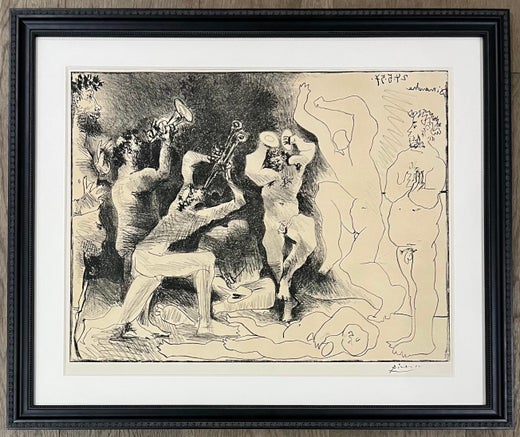
Pablo Picasso
Pot et Compotier avec Fruits

1919

You May Also Like

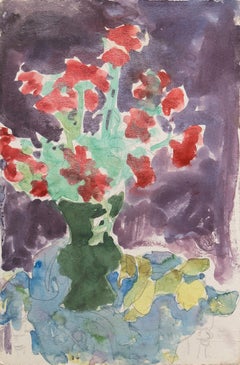
Sweet Peas , Louvre, Paris, Académie Chaumière, LACMA, SFAA, Carmel, California
By Victor Di Gesu
Located in Santa Cruz, CA
Painted circa 1955 by Victor Di Gesu (American, 1914-1988) and stamped, verso, with Victor Di Gesu estate stamp. Winner of the Prix Othon Friesz, Victor di Gesu first attended the L...
Category

1950s Still-life Drawings and Watercolors

Materials

Watercolor, Laid Paper, Pencil, Gouache
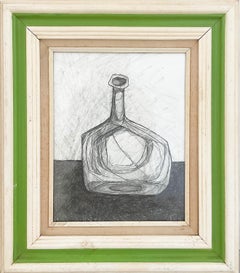
Single Bottle IX: Abstract Morandi Bottle Still Life Pencil Drawing, Framed
By David Dew Bruner
Located in Hudson, NY
Abstract cubist style still life graphite drawing inspired by Giorgio Morandi's bottle paintings “Single Morandi Bottle IX” by Hudson Valley artist, David Dew Bruner, made in 2022 G...
Category

2010s Abstract Still-life Drawings and Watercolors

Materials

Paper, Graphite

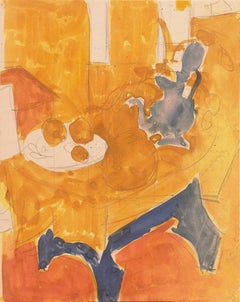
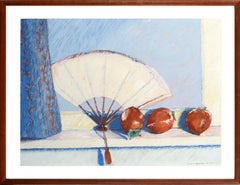
Hachiya Persimmons Fan, Modern Still Life with Red-Orange and Blue
Located in Soquel, CA
Hachiya Persimmons & Fan, Modern Still Life with Red-Orange and Blue Lovely modern still-life of a fan and persimmons by Santa Cruz, California artist Anita Heckman (American, b.20th Century). This 1987 mixed media work on paper depicts three vivid Hachiya persimmons on a windowsill beside an elegant paper fan with a tassel. A decorative window drape...
Category

1980s American Impressionist Mixed Media

Materials

Gouache, Color Pencil, Paper, Oil Pastel
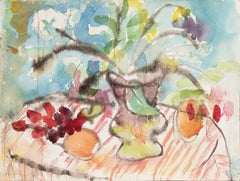
Still Life , Louvre, LACMA, Académie Chaumière, California Post-Impressionist
By Victor Di Gesu
Located in Santa Cruz, CA
Victor Di Gesu (American, 1914-1988) estate stamp verso and painted circa 1960. Winner of the Prix Othon Friesz, Victor di Gesu first attended the Los Angeles Art Center and the Cho...
Category

1950s Still-life Drawings and Watercolors

Materials

Paper, Watercolor, Graphite

Study of horse and ox bones
By Salvator Rosa
Located in Middletown, NY
Graphite, ink wash and watercolor on handmade laid paper with a large, indistinguishable ovoid watermark with a bunch of grapes, 8 7/16 x 12 5/8 inches (225 x 320 mm), signed in brown ink in the lower left. With the Henry Scipio Reitlinger oval stamp in brown ink on the verso (Lugt 2274a). The condition of the image and paper is consistent with age, there is minor toning on the recto and some attenuation of the green pigment. The drawing is laid down to an 18th century laid paper support and has a small pencil notation in the lower right corner (modern), and scattered notations in pencil on the verso of the support (also modern, perhaps auction/accession notes). On the paper support is an ink drawing in red and black of what appears to be the floor plan for the wing of a large building. The drawing is top-up, adhered facing the verso of the drawing. The architectural drawing on the support is visible through to the recto of the composition when the sheets are viewed through raking light. There is a small area of stipple point spotting in brown ink on the verso of the support. Examination under black light shows no indication of repairs or additions, expert or otherwise. Provenance: Henry Scipio Reitlinger was born in either 1882 or 1885, attended Kings College...
Category

Mid-17th Century Old Masters Figurative Drawings and Watercolors

Materials

Ink, Handmade Paper, Laid Paper, Graphite
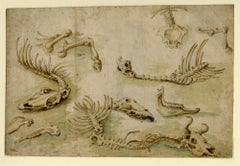
Study of horse and ox bones
$8,500
H 8.44 in W 12.63 in
Still Life with a Pewter Jug , Paris, Louvre Académie Chaumière, LACMA, SFAA
By Victor Di Gesu
Located in Santa Cruz, CA
Stamped, verso, with estate stamp for Victor Di Gesu (American, 1914-1988) and created circa 1950. Winner of the Prix Othon Friesz, Victor di Gesu first attended the Los Angeles Art...
Category

1950s Interior Drawings and Watercolors

Materials

Paper, Gouache, Graphite

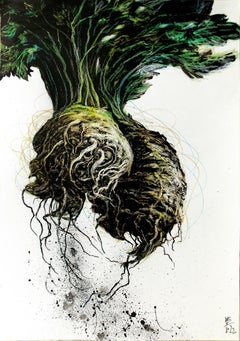
Celery
Located in Edinburgh, GB
Every year a miracle harvest grows from a small seed.
Category

2010s Still-life Drawings and Watercolors

Materials

Paper, Ink, Color Pencil

Celery
$500
H 25.2 in W 17.72 in D 0.08 in
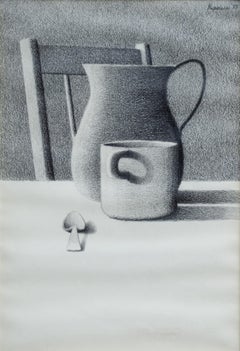
At Dawn - Graphite Drawing by Robert Kipniss
By Robert Kipniss
Located in New York, NY
Robert Kipniss (American, b. 1931) At Dawn, 1975 Pencil on paper 10 1/2 x 7 1/4 in. Framed: 14 2/3 x 11 1/3 in. Signed upper right: Kipniss '75 Verso bears Hirschl & Adler Galleries Label Robert Kipniss, painter and printmaker, was born in New York City in 1931. He creates essentially monochromatic*, stylized vistas with natural and architectural elements intended to evoke an elegiac, nearly surrealistic mood in haunting, silent landscapes; the melancholy of nostalgia. Trees, in mid and far-distance, form clusters or act as misty individuals containing a haunted, indefinable presence, witnesses to the foreground drama of more specific shape, form and detail, often a close-up tree. Kipniss studied at the Art Students League* in 1947; Wittenberg University in Springfield, Ohio, 1948-50; and the University of Iowa, receiving a BA degree in English literature in 1952, and an MFA in painting and art history in 1954. The artist employs a meticulous technique combining a multiplicity of specific strokes, whether with brush, pencil or print-maker's needle and burin*, to create the essence of his generalized, non-specific forms. Light and darkness are clearly Kipniss' compositionally constructive elements. They also exist as contestants in the emotional drama at the heart of each work of art. The contrast, and sometimes combat, between these two opposites, symbolically represent with blackness -- ideas of threat, fear, trouble, evil; with whiteness safety, redemption, fulfillment and good. In Kipniss' 1995 mezzotint*, Clear Vase and Landscape, with a foreground image of precisely leafy stalks, the vase holding them, nearly invisible in its transparency, suggests an almost Salvador Dali-like surrealist device. This central image dominates but seems to invite association with, and commentary from, the surrounding clumps and individual round-topped, yet cedar-like trees. His mezzzotint, For Stella," 1997, depicts a gently twisting, curving, pale and smoothly-barked foreground, leafless tree limb or trunk, like a female human body, suggesting weakness, fatigue, an inability to deal with the staccato background screen of textured bush that seems to uncomfortably impinge upon it. This print is arguably a metaphor for a delicate soul struggling to overcome the prickly difficulties of domineering life. The classic mezzotint process, invented in the middle of the 17th Century, is the reverse of most of the other print-making media, since the artist works from a black ground to increasingly lighter areas. The copper plate is first roughened by a "rocker," creating a burr over the entire surface (the more burr left intact, the more ink it holds, the darker the final finished print). The artist, Robert Kipniss, in this instance, gradually burnishes, smoothes down the burr in varying degrees to produce the gradations of lights and darks of the final design. The deepest darks in the final picture are those areas on the plate that have been little touched after the initial roughening. Mezzotint relies on shade and tone rather than outline for its effect, which fits the Kipniss style of atmospheric* masses of value. A recent oil painting by Robert Kipniss, Hillside Silhouettes, 2001, 40 x 29, is somewhat more complex in composition than many, with four cubically-constructed houses each set in their own zones, seemingly unrelated to one another, with receding hills and similarly isolated, increasingly misty trees beyond. In his career, Robert Kipniss has had over 40 one-man shows since the first in New York in 1951, including an important retrospective exhibition at the Associated American Artist Gallery, New York in 1977. Many of these one-man exhibitions have been mounted by over 50 museums in the United States, South America and Europe, including the Chicago Art Institute, Metropolitan Museum of Art, Museum of Modem Art, Whitney Museum of American Art, Library of Congress and British Museum in London. Robert Kipniss is represented in the permanent collections of the institutions above, among many others, as well as the Philadelphia Museum of Art; New York Public Library; Museum of Fine Arts, Boston; Detroit Art Institute; Yale University Museum; National Collection of Fine Arts, Smithsonian Institution; Museum of Fine Arts, Houston; Los Angeles County Museum of Art; Portland Art Museum; and the New Orleans Museum of Art. He was elected to the National Academy of Design* in 1980, and to the Royal Society of Painter-Printmakers, London in 1998 Robert Kipniss can be referenced in numerous publications, including Who's Who in American Art from the 1950s to the present, and multiple reviews in periodicals like Art News, Art in America and Art Forum. There are also three important catalogues raisonne published on his work. Robert Kipniss has received many awards: 1965 - Ohio University National Drawing Show, Purchase Prize 1976 - National Academy of Design, New York City, The Ralph Fabri Prize 1978 - The Print Club of Philadelphia, Charles M Lea Prize 1979 - Charlotte Printmakers Society, Purchase Award 1979 - Society of American Graphic Artists, Printmaking Award 1979 - Wittenberg University, Springfield, OH, Honorary Doctorate 1980 - Elected to the National Academy of Design, New York City 1980 - Audubon Artists, New York City, Silver Medal 1980 - National Academy of Design, New York City, The Leo Meissner...
Category

1970s American Realist Still-life Drawings and Watercolors

Materials

Paper, Pencil

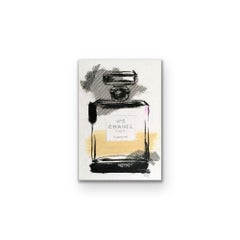
Homage to Chanel No. 5 - #2, 4"x6", Original Art, Perfume, Black, White, Yellow
By Andrea Stajan-Ferkul
Located in Mississauga, Ontario
An homage to the iconic Chanel No. 5 perfume. Textured elements add visual interest to this mixed media artwork on board. With delicate detail, this piece combines paint, pencil and ...
Category

2010s Contemporary Still-life Drawings and Watercolors

Materials

Paper, Mixed Media, Acrylic, Pencil

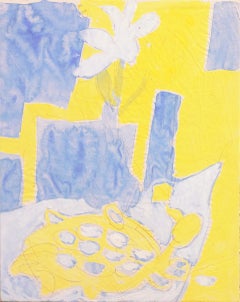
Still Life with Tiger Lily , Paris, Académie Chaumière, LACMA, SFAA, Louvre
By Victor Di Gesu
Located in Santa Cruz, CA
Stamped, verso, with estate stamp for Victor Di Gesu (American, 1914-1988) and created circa 1950. Winner of the Prix Othon Friesz, Victor di Gesu first attended the Los Angeles Art...
Category

1950s Interior Drawings and Watercolors

Materials

Paper, Gouache, Graphite

Still Thinking About These?

All Recently Viewed