Early 19th Century Drawings and Watercolor Paintings

to
82
268
44
22
4
1
Overall Width
to
Overall Height
to
441
3,006
21,338
15,086
354
399
731
1,134
1,040
1,667
1,804
1,732
1,426
1,108
320
43
36
4
2
1
1
187
150
1
247
130
85
68
65
44
41
41
24
19
19
17
16
15
15
14
13
10
9
8
251
248
68
57
45
46
3
2
2
2
181
64
256
44
Period: Early 19th Century
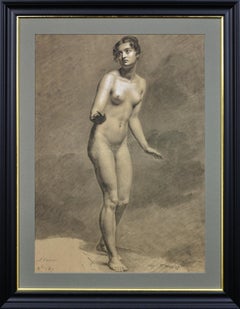
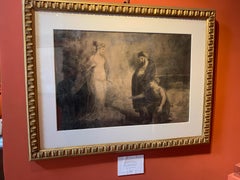
Early 19th Century Neoclassical French Study Of A Standing Female Nude Framed
Located in Sutton Poyntz, Dorset
Jean Croizier. French ( fl.1812 - 1827 ). Standing Female Nude, 1819. Watercolor & Chalks On Paper. Signed & Dated 1819 Lower Left. Paper size 22 inches x 15.8 inches ( 56cm x 40cm )...
Category

Romantic Early 19th Century Drawings and Watercolor Paintings

Materials

Paper, Chalk, Watercolor

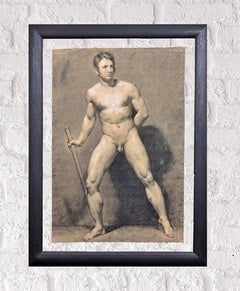
Biedermeier Period Academic Life Study Male Nude Carrying A Staff Circa 1826
Located in Sutton Poyntz, Dorset
Eduard Braun. German ( b.1798 - d.1876 ). Academic Life Study Of A Male Nude Carrying A Staff. Pencil & Charcoal On Paper With Heightening. Annotation (presumably a dedication) Lower Left. Paper size 24 inches x 16.5 inches ( 61cm x 42cm ). Frame size 30.1 inches x 22.2 inches ( 76.5cm x 56.5cm ). Available for sale; this academic life drawing of a male nude is by the German artist Eduard Braun and dates from around 1826. The drawing is presented and supplied in an interesting configuration with a modern twist (which is shown in these photographs). The drawing has been float mounted between two sheets of Tru Vue Museum Glass® UV99 so that the wall or setting behind the hanging is visible and therefore provides the surround for the artwork. This antique drawing is in very good condition, commensurate with its age. It wants for nothing and is supplied ready to hang and display. The drawing is not signed but came from a portfolio of drawings by Eduard Braun. This drawing has a later annotation and presumably a dedication in red ink in the bottom left hand corner. The annotation is the monogram HL within a heart. The configuration of the HL resembles the format used by the French artist Henri Laurens 1885 – 1954 where the downstroke of the L is merged with the second downstroke of the H. This stunning original pencil and charcoal drawing on paper is by a German artist called Eduard Braun. He was born in 1798 and died in 1876, but little else is known about him apart from the fact that he was active in the Paris art salons and rooms. This drawing is from a portfolio by this artist on a similar theme and is typical of the type of academic study undertaken by serious art students throughout the nineteenth century. One of the other drawings in this portfolio is annotated as being created in 1826 and there is every reason to think that this drawing is contemporaneous with that. The drawing is of a very high standard, capturing both strength and sensitivity, showcasing the artist’s ability to reproduce a lifelike image of a nude model. The subject of this drawing is a young man, possibly in his mid-twenties, with a toned and muscular body. He is standing with his weight on his right leg, which is slightly bent, and holding a wooden staff in his right hand. His left foot is raised slightly with the toes pointed, and his left hand is placed behind his back. Although he is facing fully towards the viewer, his gaze is to his left. He has pleasant, serene expression on his face. The background is bare, save for the shadow cast by the model. This original antique drawing...
Category

Academic Early 19th Century Drawings and Watercolor Paintings

Materials

Paper, Charcoal, Pencil

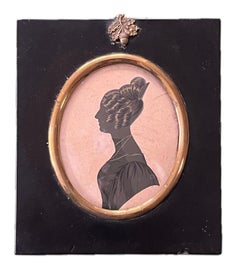
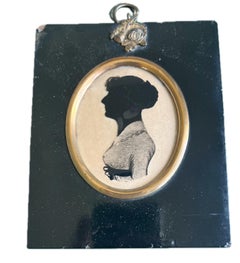
Peter Skeolan mid 19th Century English silhouette portrait of a lady
Located in Harkstead, GB
A finely detailed silhouette of a Victorian lady Attributed to Peter Skeolan (1815-1871) Portrait of a lady, profile to the right Watercolour with gold highlighting on paper/card 3¼...
Category

English School Early 19th Century Drawings and Watercolor Paintings

Materials

Paper, Watercolor

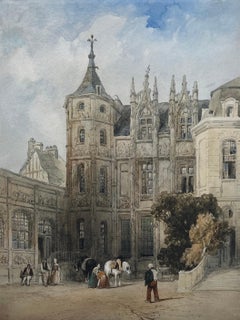
Cotman, Norwich School, Early English Watercolor of Rouen, France
Located in Harkstead, GB
A beautiful composition capturing one of the well known buildings of Rouen, a city that was very popular with early 19th century watercolour painters. John Sell Cotman painted this v...
Category

Victorian Early 19th Century Drawings and Watercolor Paintings

Materials

Paper, Watercolor

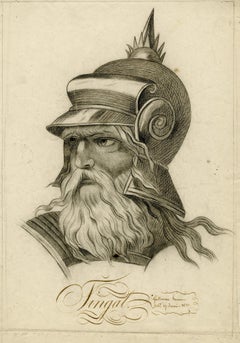
Portrait of Fingal / Finn MacCool - A moving portrait of an Irish literary hero
Located in Middletown, NY
Black chalk and graphite on light weight cream wove paper, 16 1/8 x 11 1/4 inches, (410 x 286 mm), the full sheet. Signed, titled, and dated in sepia ink in the lower-center sheet area. With horizontal folds approximately 1-inch from the sheet edge at each of the four sheets. The drawing appears to have been folded at the sheet edges to fit into a frame. Finn mac Cumail (or mac Umaill), often anglicized Finn McCool or MacCool, is a hero in Irish mythology, as well as in later Scottish and Manx folklore. He is the leader of the Fianna bands of young roving hunter-warriors, as well as being a seer and poet. He is said to have a magic thumb that bestows him with great wisdom. He is often depicted hunting with his hounds Bran and Sceólang, and fighting with his spear and sword. Fionn MacCumhail was transformed into the character "Fingal" in James Macpherson's poem cycle Ossian (1760), which Macpherson claimed was translated out of discovered Ossianic poetry written in the Scottish Gaelic language. Fionn MacCumhail features heavily in modern Irish literature. Most notably he makes several appearances in James Joyce's Finnegans Wake...
Category

French School Early 19th Century Drawings and Watercolor Paintings

Materials

Handmade Paper, Chalk, Graphite

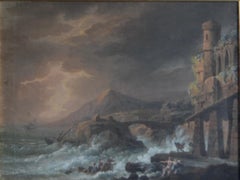
Gouache Of A Shipwreck In A Storm With Gothic Ruins. Early 19th Century
Located in Firenze, IT
Gouache of a Shipwreck in a Storm with Gothic Ruins, Early 19th Century Technique: Gouache on paper Period: Early 19th century Description: This romantic painting depicts a dramatic ...
Category

Romantic Early 19th Century Drawings and Watercolor Paintings

Materials

Paper, Tempera, Gouache

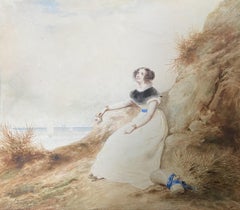
Francois Grenier de Saint Martin (1793-1867) Lady on the beach, 1829, watercolor
Located in Paris, FR
Francois Grenier de Saint Martin (1793-1867) A Young Lady on the beach, 1829, signed and dated on the lower left watercolor on paper 17 x 19.5 cm F...
Category

Romantic Early 19th Century Drawings and Watercolor Paintings

Materials

Watercolor

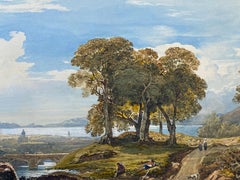
Early 1830 s Scottish Victorian Painting Figures in Highland Loch Landscape
Located in Cirencester, Gloucestershire
A Day out in the Highlands Scottish School, circa 1830's period original watercolour painting on paper unframed painting: 12.75 x 16.5 inches A lovely tranquil scene of figures enj...
Category

Victorian Early 19th Century Drawings and Watercolor Paintings

Materials

Watercolor

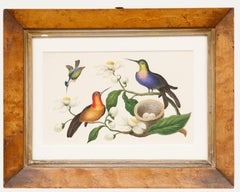
Sophia Katherine Charleton (1789-1844) - Watercolour, Hummingbirds
Located in Corsham, GB
A charming and vividly detailed early 19th-century ornithological study by artist Sophia Katherine Charleton (1789–1844), depicting brilliantly coloured hummingbirds. Unsigned. Beaut...
Category

Early 19th Century Drawings and Watercolor Paintings

Materials

Watercolor

Miniature portrait of a British officer by Henry O Shea
Located in Middletown, NY
Limerick: Henry O'Shea, c1800. Dual process photogravure on cardstock, 4 x 2 1/2 inches (102 x 64 mm), the full sheet. Framed handsomely in the original handmade wood frame with a ...
Category

French School Early 19th Century Drawings and Watercolor Paintings

Materials

Gold

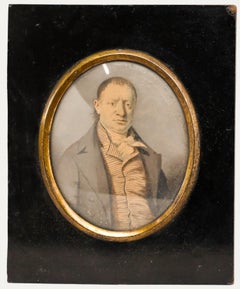
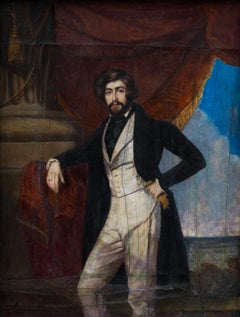
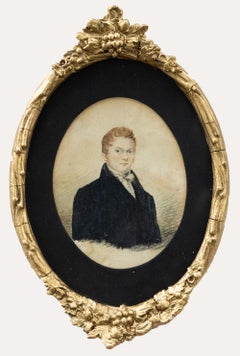
Miniature Early 19th Century Watercolour - Portrait of a Gentleman
Located in Corsham, GB
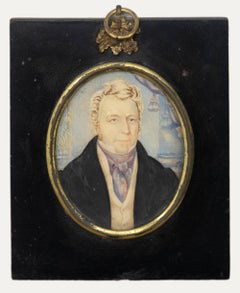
A very fine early 19th-century watercolour portrait of a gentleman wearing a striped waistcoat and dark overcoat. Finely painted with great attention given to the facial features. We...
Category

Early 19th Century Drawings and Watercolor Paintings

Materials

Watercolor

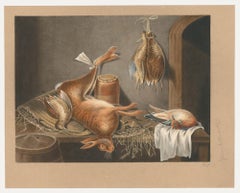
Thomas Remnant Charleton (1756-1849) - Watercolour, Still Life with Dead Game
Located in Corsham, GB
An original watercolour painting by Thomas Remnant Charleton (1756-1849) depicting a still life of dead game in a kitchen larder. Executed in the manner of British master painter Ben...
Category

Early 19th Century Drawings and Watercolor Paintings

Materials

Watercolor

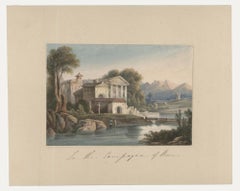
Thomas Remnant Charleton (1756-1849) - Watercolour, In the Campagna of Rome
Located in Corsham, GB
This exquisitely executed watercolour depicts a historic temple in Campagna with rolling mountains in the distance. The work is inscribed in pencil on the backing card. Unsigned. On ...
Category

Early 19th Century Drawings and Watercolor Paintings

Materials

Watercolor

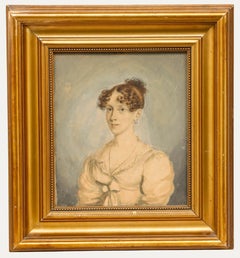
Early 19th Century Watercolour - Regency Woman
Located in Corsham, GB
A charming depiction of a Regency woman dressed in white. The artist uses a delicate hand to capture the fine details of her features and clothing. Unsigned. Illegibly inscribed vers...
Category

Early 19th Century Drawings and Watercolor Paintings

Materials

Watercolor

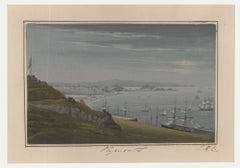
Thomas Remnant Charleton (1756-1849) - Early 19th Century Watercolour, Plymouth
Located in Corsham, GB
This exquisitely executed watercolour depicts a picturesque view over Plymouth with ships in the bay. The work is signed with the artist's initials on the backing paper and inscribed...
Category

Early 19th Century Drawings and Watercolor Paintings

Materials

Watercolor

Early 19th Century English Victorian silhouette portrait
Located in Harkstead, GB
A finely detailed silhouette of a Victorian young lady. Attributed to Hinton Gibbs (1783-1839) Portrait of a young lady, bust length, turned to the right watercolour, reverse painte...
Category

English School Early 19th Century Drawings and Watercolor Paintings

Materials

Glass, Watercolor

Early 19th Century English Victorian silhouette portrait
Located in Harkstead, GB
A finely detailed silhouette of a Victorian young man. Circle of Hinton Gibbs (1783-1839) Portrait of a young man, bust length, turned to the right, wearing coat and cravat watercol...
Category

English School Early 19th Century Drawings and Watercolor Paintings

Materials

Glass, Watercolor

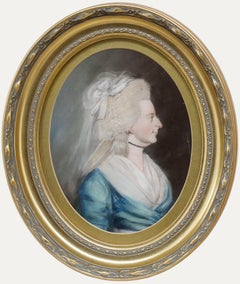
English School Early 19th Century Pastel - Lady in Profile
Located in Corsham, GB
A charming early nineteenth-century pastel study of a lady in a blue dress. Part of a pair of portraits depicting a man and woman in profile, the companion piece is also listed on ou...
Category

Early 19th Century Drawings and Watercolor Paintings

Materials

Pastel

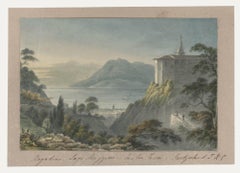
Thomas Remnant Charleton (1756-1849) - Watercolour, View of Magadion
Located in Corsham, GB
This exquisitely executed watercolour depicts a picturesque view of Magadion, a town in the Canton of Ticino, Switzerland, with Lake Maggiore in the background. The work is signed wi...
Category

Early 19th Century Drawings and Watercolor Paintings

Materials

Watercolor

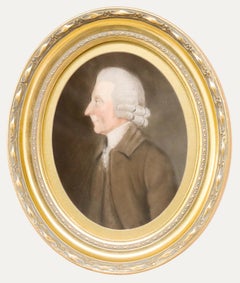
English School Early 19th Century Pastel - Gentleman in Profile
Located in Corsham, GB
A charming early 19th-century pastel study of a gentleman in a formal wig. Part of a pair of portraits depicting a man and woman in profile, the companion piece is also listed on our...
Category

Early 19th Century Drawings and Watercolor Paintings

Materials

Pastel

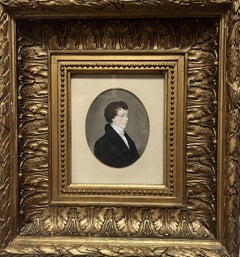
Early 19th Century, Portrait of a young man wearing glasses, gouache
Located in Paris, FR
Early 19th Century, Portrait of a young man wearing glasses, gouache on paper 13 x 10.5 cm oval view In a vintage frame : 41.5 x 39 cm, accidents and lacks in the gilding but but...
Category

Old Masters Early 19th Century Drawings and Watercolor Paintings

Materials

Gouache

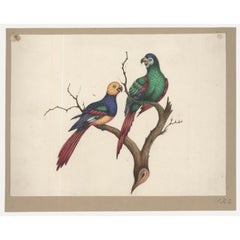
Sophia Katherine Charleton (1789-1844) - Watercolour, Perching Parrots
Located in Corsham, GB
A richly detailed early 19th-century ornithological study by artist Sophia Katherine Charleton (1789–1844), featuring brilliantly coloured parrots perched on winding branches, with d...
Category

Early 19th Century Drawings and Watercolor Paintings

Materials

Watercolor

Thomas Remnant Charleton (1756-1849) - Watercolour, Whitehaven, Cumbria
Located in Corsham, GB
An unfinished watercolour sketch of Whitehaven in Cumbria. Signed with initials to the lower right. On paper.
Category

Early 19th Century Drawings and Watercolor Paintings

Materials

Watercolor

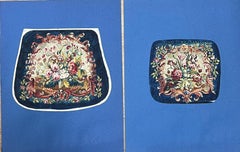
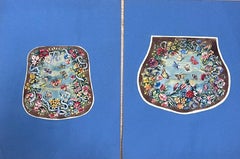
Rococo-Inspired Pair of Watercolor Paintings with Elaborate Floral Arrangements
Located in Cirencester, Gloucestershire
Rococo-Inspired Pair of Watercolor Paintings watercolor on artist paper, stuck on blue paper painting: 12.75 x 10 inches provenance: private collection condition: very good and soun...
Category

Rococo Early 19th Century Drawings and Watercolor Paintings

Materials

Watercolor

Pair of Rococo-Inspired Watercolors Featuring Ornate Floral Wreaths Butterflies
Located in Cirencester, Gloucestershire
Pair of Rococo-Inspired Paintings watercolor on artist paper, stuck on blue paper painting: 12.75 x 10 inches provenance: private collection condition: very good and sound condition
Category

Rococo Early 19th Century Drawings and Watercolor Paintings

Materials

Watercolor

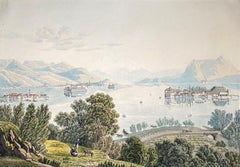
Lake landscape - Aquatint 20x28 cm
Located in Geneva, CH
Aquatint from the beginning of the 19's century Illegible signature gold frame with glass, total size with frame: 38x48x3 cm
Category

Realist Early 19th Century Drawings and Watercolor Paintings

Materials

Aquatint

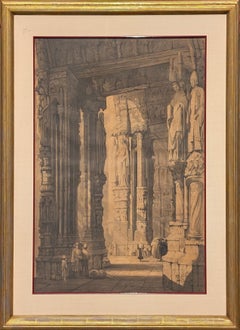
"Entrance to Chartres Cathedral" Early 19th Century Architectural Ink Drawing
Located in Houston, TX
Early 19th century ink drawing of Chartres Cathedral by English artist Samuel Prout. The work focuses on the large scale architectural elements of the cathedral with small figures st...
Category

Naturalistic Early 19th Century Drawings and Watercolor Paintings

Materials

Ink, Paper

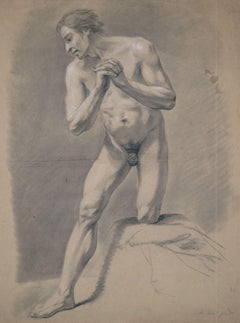
Male Nude / - The Drama of the Nude -
Located in Berlin, DE
Johann Heinrich Meil (1730 Gotha - 1820 Berlin), Male Nude, 1807. White heightened, occasionally wiped charcoal drawing on brownish paper, 51 cm x 39.5 cm, signed “J.[ohann] H.[einri...
Category

Rococo Early 19th Century Drawings and Watercolor Paintings

Materials

Paper

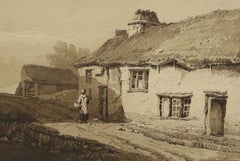
Cottages in Devon
Located in Middletown, NY
An early Devonshire landscape, ex-collection West Collection of British Watercolors & the Fine Art Society, London. Circa 1800 Ink and brown wash on paper, 7 1/8 x 10 1/4 inches (...
Category

Realist Early 19th Century Drawings and Watercolor Paintings

Materials

Ink, Watercolor, Graphite

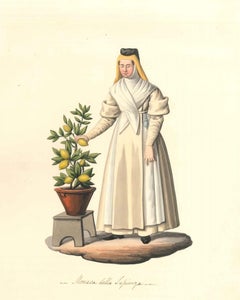
Monaca della Sapienza - Watercolor by M. De Vito - 1820 ca.
Located in Roma, IT
The original artwork Monaca della Sapienza is a beautiful watercolour on ivory-colored paper made by the virtuous artist Michela De Vito in 1820 ca. Hand-titled "Monaca della Sapien...
Category

Modern Early 19th Century Drawings and Watercolor Paintings

Materials

Watercolor

A Tailor Working at his Desk
Located in Stockholm, SE
Gerhard Ludwig Lahde (Bremen 1765–1833 Köpenhamn) A Tailor Working at his Desk Ink and wash on paper, mounted on a 19th-century backing inscribed “G. L. Lahde del.” unframed: 14.2 ...
Category

Early 19th Century Drawings and Watercolor Paintings

Materials

Ink

Early 19th Century English watercolour of woodland near Croxdale Hall
Located in Harkstead, GB
A very attractive and meticulously executed view of a rocky landscape within the woods dating to 1823. This would suit a library or study with its muted tones and skifull draughtsmanship. William Nicholson (1781-1844) Near Croxdale Hall Signed with initials and inscribed with title and date 1823 Pen, ink and grey wash 11 x 8 inches, image only 17 x 13 inches without frame The portrait-painter and etcher William Nicholson was born in Ovingham-on-Tyne, Northumberland, on Christmas Day 1781. His family transferred to Newcastle when his father was appointed Headmaster of the city's Grammar School. At an early age, though, Nicholson appears to have moved to Hull where he made his artistic debut, painting miniatures of officers garrisoned there. He was almost entirely self-taught, learning his craft through the close study of artworks in private and public galleries. He subsequently returned to Newcastle where he received many commissions to paint portraits of the old families of Northumberland. In 1808, he began to exhibit at the Royal Academy, continuing to do so until 1822. By 1814, Nicholson, whose mother was a Scot, had moved to Edinburgh where he set up as a miniaturist and painter in oils. Soon, however, he began to specialize in watercolour portraits. Early subjects included the actor Daniel Terry and the poet and novelist James Hogg. In 1818 he began to publish a series of Portraits of Eminent Scotsmen, etched from his own portraits and those of other painters. Besides Scott and Hogg, the subjects included the writers Robert Burns, John Wilson ('Christopher North'), and Lord Jeffrey, the painters Sir Henry Raeburn, the divines Alexander Carlyle and Alexander Cameron, the engineer James Watt, the architect John Playfair, and the song-collector and composer George Thomson...
Category

Academic Early 19th Century Drawings and Watercolor Paintings

Materials

Paper, Watercolor, Ink, Pen

Framed Early 19th Century Watercolour - Landscape with Cottage Dwellings
Located in Corsham, GB
A charming early 19th century watercolour depicting rural dwellings on a quiet lakeside with men in boats and cattle to the foreground. Presented in a modern gilt-effect frame. Unsig...
Category

Early 19th Century Drawings and Watercolor Paintings

Materials

Watercolor

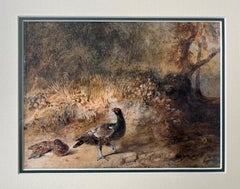
Early English watercolour of pheasants in a woodland setting
Located in Harkstead, GB
A very attractive images of pheasants in a woodland setting with strong colour and composition. Newton Smith Limbird Fielding (1799-1856) Cock pheasant and hen against a sandy bank ...
Category

Victorian Early 19th Century Drawings and Watercolor Paintings

Materials

Paper, Watercolor

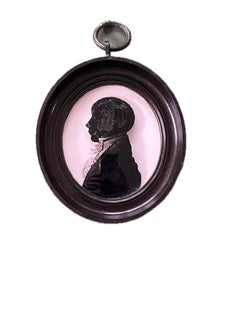
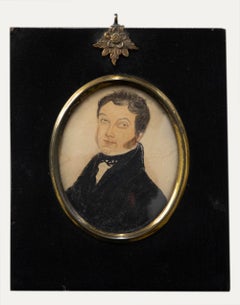
Early 19th Century Watercolour - Miniature Portrait of a Victorian Man
Located in Corsham, GB
A charming early 19th Century miniature portrait of a kindly looking gentleman in a smart black jacket and wing collar shirt. The portrait is unsigned and presented in a traditional ...
Category

Early 19th Century Drawings and Watercolor Paintings

Materials

Watercolor

Portrait of a French Gentleman By Portrait Miniature Artist Daniel Saint
By Daniel Saint
Located in Stockholm, SE
Daniel Saint was a prominent French miniaturist who lived between 1778 and 1847. Born in Paris, Saint was the son of a jeweler and initially began his career as an apprentice in his father's workshop. However, he soon discovered his passion for painting and turned his attention to miniatures, which were highly popular in 18th and 19th-century Europe. Saint was a highly skilled artist and quickly gained a reputation for his miniature portraits, which were characterized by their delicate detail and fine brushwork. His works often featured prominent figures from French society, including members of the royal family and high-ranking officials. He also painted portraits of wealthy patrons, many of whom commissioned him to create highly personalized works. Saint's style was highly influenced by the neoclassical movement, which emphasized clarity, simplicity, and rationality. He often used a limited color palette, focusing on soft pastels and muted tones, which helped to accentuate the delicate features of his subjects. His compositions were typically centered around the face, with little background or context to distract from the subject. Despite his success as a miniaturist, Saint was not immune to the changing tastes of the art world. In the mid-19th century, photography began to gain popularity, and many artists who specialized in portraiture found themselves struggling to compete with the speed and accuracy of this new medium. However, Saint continued to work and develop his craft, adapting his style to the changing tastes of his clients and experimenting with new techniques and materials. In addition to his work as a miniaturist, Saint was also a skilled draftsman and created a number of highly detailed and intricate drawings and sketches. He was also known for his use of unconventional materials, such as hair, which he would incorporate into his miniature portraits to add texture and depth. Today, Saint's works are highly prized by collectors and are held in museums and private collections around the world. His legacy as a master of miniature portraiture lives on, and his influence can still be seen in the work of contemporary artists who specialize in this unique and challenging medium. More information: Artist: Daniel Saint (1778-1847) France Title: Portrait of a French Gentleman...
Category

Early 19th Century Drawings and Watercolor Paintings

Materials

Gouache

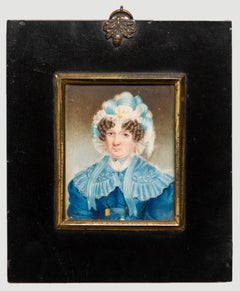
Early 19th Century English School Portrait Miniature - Georgian Lady in Blue
Located in Corsham, GB
An exquisite Georgian portrait miniature in watercolour, depicting a lady in a blue dress and elaborate ribbon and lace bonnet. Her gold jewellery and finely detailed lace denotes her affluence and status. Unsigned. Well presented in a period black papier mache frame with upper acorn hanging...
Category

Early 19th Century Drawings and Watercolor Paintings

Materials

Watercolor

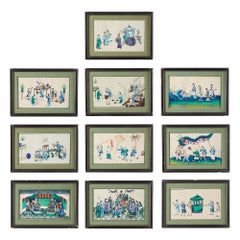
Ten Framed 19th Century Chinese Pith Paintings of Courtly Entertainment
Located in London, GB
Ten Framed 19th Century Chinese Pith Paintings of Courtly Entertainment Chinese, 19th Century Height 29cm, width 41cm, depth 2cm This striking suite of ten Chinese watercolours is p...
Category

Early 19th Century Drawings and Watercolor Paintings

Materials

Watercolor, Rice Paper

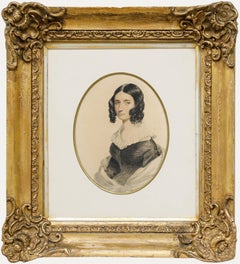
English School Early 19th Century Watercolour - Dark Haired Beauty
Located in Corsham, GB
This elegant oval portrait captures a young woman in 19th century attire, her dark curls framing a delicate face turned slightly towards the viewer. The subject's elegant gown and co...
Category

Early 19th Century Drawings and Watercolor Paintings

Materials

Watercolor

Double-sided Horse Studies by Théodore Géricault
Located in PARIS, FR
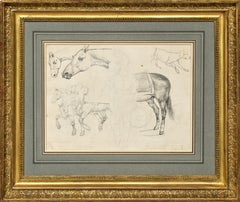
Recto: two horses, preparatory study for the lithograph "Les Boueux" ("The Muddy Ones") Verso: four studies of horse heads (including two preparatory studies for the watercolor "Plowing in England"), a study of a life guard with the rump of his horse (preparatory to the lithograph "A Party of Life...
Category

Old Masters Early 19th Century Drawings and Watercolor Paintings

Materials

Carbon Pencil

English School Early 19th Century Watercolour - Portrait of a Gentleman
Located in Corsham, GB
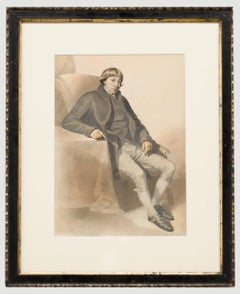
A finely painted full length portrait of a 19th century gentleman, seated in a high back armchair with a slightly perplexed expression. The artist has enhanced the portrait with deli...
Category

Early 19th Century Drawings and Watercolor Paintings

Materials

Watercolor

18th to 19th Century "Art Presentation" Old Master Drawing
Located in San Francisco, CA
18th to 19th Century "Art Presentation" Old Master Drawing Remarkable old master pen, ink and wash drawing of an art presentation Dimensions 14" wide x 8.5" high The lightly distr...
Category

Early 19th Century Drawings and Watercolor Paintings

Materials

Ink, Watercolor

Thomas Martin - 1835 Watercolour, The Gentleman
Located in Corsham, GB
Signed and dated verso. Presented in a black wooden frame with gilt detailing and an oak clasp. On paper.
Category

Early 19th Century Drawings and Watercolor Paintings

Materials

Watercolor

Sophia Katherine Charleton (1789-1844) - Watercolour, Morning Glory
Located in Corsham, GB
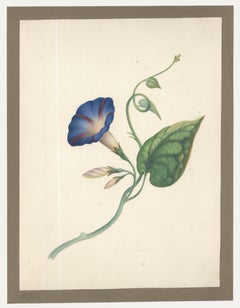
A charming early 19th century botanical study by the artist Sophia Katherine Charleton (1789-1844) depicting 'Ipomoea Tricolor', commonly known as 'Morning Glory'. Signed with a mono...
Category

Early 19th Century Drawings and Watercolor Paintings

Materials

Watercolor

Framed Early 19th Century Watercolour - Portrait of John Harrington
Located in Corsham, GB
A striking watercolour portrait of young John Harrington in a fine black jacket with white linen shirt and regency brummel. The miniature study has been well presented in a period ov...
Category

Early 19th Century Drawings and Watercolor Paintings

Materials

Watercolor

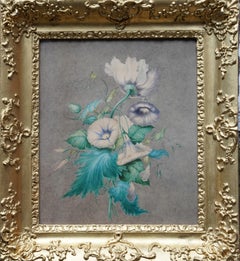
Morning Glory and Poppy Floral - British art Old Master flower painting W/C
Located in Hagley, England
This charming Old Master circa 1800 water colour painting is of morning glory flowers and tendrils entwined with a poppy. The foliage has a metallic green tone and the white morning ...
Category

Old Masters Early 19th Century Drawings and Watercolor Paintings

Materials

Watercolor

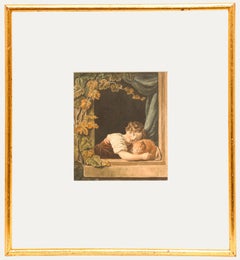
Early 19th Century Watercolour - Little Girl with Orange Cat
Located in Corsham, GB
A truly charming early 19th-century watercolour study depicting a young girl reaching tenderly toward her sleeping cat, curled peacefully on a sunlit windowsill. Framed by traditiona...
Category

Early 19th Century Drawings and Watercolor Paintings

Materials

Watercolor

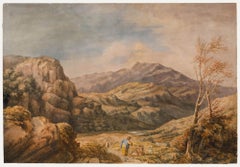
Samuel Brough RSA - 1810 Watercolour, Rest Stop in the Highlands
Located in Corsham, GB
A delightful 19th-century landscape depicting figures resting on a path in the Scottish Highlands. The artist guides the viewer's eye over the dramatic mountaintops as dusk closes in...
Category

Early 19th Century Drawings and Watercolor Paintings

Materials

Watercolor

Disegno neoclassico mitologico inglese del XIX secolo
Located in Florence, IT
Disegno matita su carta, 45 x 68 cm; con cornice dorata 72 x 94 cm. La scena si svolge sulla costa, nel punto in cui il mare tempestoso lambisce la terraferma, che si presenta rocci...
Category

Romantic Early 19th Century Drawings and Watercolor Paintings

Materials

Paper, Pencil

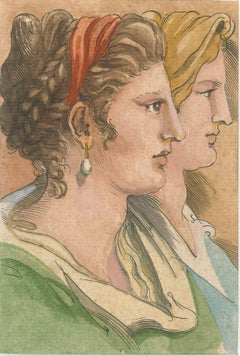
Women Profiles - China Ink and Watercolor
Located in Roma, IT
Women profiles is a china ink and watercolor on paper realized by an anonymous Italian artist of the end of XVIII-XIX century. Representing two portrait...
Category

Modern Early 19th Century Drawings and Watercolor Paintings

Materials

Ink, Watercolor

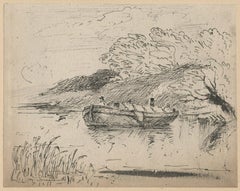
The River Barge
Located in Fairlawn, OH
The River Barge Pen and ink on paper on laid paper, mounted in English drum mount , c. 1810 Unsigned Condition: Slight sun staining to sheet and mount in the window (see photo) Image/sheet size: 5 1/4 x 6 11/16 inches Sight: : 5-3/4 x 7-1/4" Frame: 13-3/8 x 14-3/8" Provenance: Colnaghi, London (see photo of label) David Cox (29 April 1783 – 7 June 1859) was an English landscape painter, one of the most important members of the Birmingham School of landscape artists and an early precursor of Impressionism. He is considered one of the greatest English landscape painters, and a major figure of the Golden age of English watercolour. Although most popularly known for his works in watercolour, he also painted over 300 works in oil towards the end of his career, now considered "one of the greatest, but least recognised, achievements of any British painter. His son, known as David Cox the Younger (1809-1885), was also a successful artist. Early life in Birmingham, 1783–1804 Cox's birthplace in Deritend, Birmingham, illustrated by Samuel Lines Cox was born on 29 April 1783 on Heath Mill Lane in Deritend, then an industrial suburb of Birmingham. His father was a blacksmith and whitesmith about whom little is known, except that he supplied components such as bayonets and barrels to the Birmingham gun trade. Cox's mother was the daughter of a farmer and miller from Small Heath to the east of Birmingham. Early biographers record that "she had had a better education than his father, and was a woman of superior intelligence and force of character." Cox was initially expected to follow his father into the metal trade and take over his forge, but his lack of physical strength led his family to seek opportunities for him to develop his interest in art, which is said to have first become apparent when the young Cox started painting paper kites while recovering from a broken leg. By the late 18th century Birmingham had developed a network of private academies teaching drawing and painting, established to support the needs of the town's manufacturers of luxury metal goods, but also encouraging education in fine art, and nurturing the distinctive tradition of landscape art of the Birmingham School. Cox initially enrolled in the academy of Joseph Barber in Great Charles Street, where fellow students included the artist Charles Barber and the engraver William Radclyffe, both of whom would become important lifelong friends. At the age of about 15 Cox was apprenticed to the Birmingham painter Albert Fielder, who produced portrait miniatures and paintings for the tops of snuffboxes from his workshop at 10 Parade in the northwest of the town. Early biographers of Cox record that he left his apprenticeship after Fielder's suicide, with one reporting that Cox himself discovered his master's hanging body, but this is probably a myth as Fielder is recorded at his address in Parade as late as 1825. At some time during mid-1800 Cox was given work by William Macready the elder at the Birmingham Theatre, initially as an assistant grinding colours and preparing canvases for the scene painters, but from 1801 painting scenery himself and by 1802 leading his own team of assistants and being credited in plays' publicity. London, 1804–1814 In 1804 Cox was promised work by the theatre impresario Philip Astley and moved to London, taking lodgings in 16 Bridge Row, Lambeth. Although he was unable to get employment at Astley's Amphitheatre it is likely that he had already decided to try to establish himself as a professional artist, and apart from a few private commissions for painting scenery his focus over the next few years was to be on painting and exhibiting watercolours. While living in London, Cox married his landlord's daughter, Mary Agg and the couple moved to Dulwich in 1808. David Cox Travellers on a Path, pencil and brown wash. In 1805 he made his first of many trips to Wales, with Charles Barber, his earliest dated watercolours are from this year. Throughout his lifetime he made numerous sketching tours to the Home Counties, North Wales, Yorkshire, Derbyshire and Devon. Cox exhibited regularly at the Royal Academy from 1805. His paintings never reached high prices, so he earned his living mainly as a drawing master. His first pupil, Colonel the Hon.H. Windsor (the future Earl of Plymouth) engaged him in 1808, Cox went on to acquire several other aristocratic and titled pupils. He also went on to write several books, including: Ackermanns' New Drawing Book (1809); A Series of Progressive Lessons (1811); Treatise on Landscape Painting (1813); and Progressive Lessons on Landscape (1816). The ninth and last edition of his series Progressive Lessons, was published in 1845. By 1810 he was elected President of the Associated Artists in Water Colour. In 1812, following the demise of the Associated Artists, he was elected as associate of the Society of Painters in Water Colour (the old Water Colour Society). He was elected a Member of the Society in 1813, and exhibited there every year (except 1815 and 1817) until his death. Hereford, 1814–1827 In the summer of 1813 Cox was appointed as the drawing master of the Royal Military College in Farnham, Surrey, but he resigned shortly afterwards, finding little sympathy with the atmosphere of a military institution. Soon after that he applied to a newspaper advertisement for a position as drawing master for Miss Crouchers' School for Young Ladies in Hereford and in Autumn 1814 moved to the town with his family. Cox taught at the school in Widemarsh Street until 1819, his substantial salary of £100 per year requiring only two-day's work per week, allowing time for painting and the taking of private pupils. Cox's reputation as both a painter and a teacher had been building over previous years, as indicated by his election as a member of the Society of Painters in Water Colours and his inclusion in John Hassell's 1813 book Aqua Pictura, which claimed to present works by "all of the most approved water coloured draftsmen". The depression that accompanied the end of the Napoleonic Wars had caused a contraction in the art market, however, and by 1814 Cox had been very short of money, requiring a loan from one of his pupils to pay even for the move to Hereford. Despite its financial advantages and its proximity to the scenery of North Wales and the Wye Valley, the move to Hereford marked a retreat in terms of his career as a painter: he sent few works to the annual exhibition of the Society of Painters in Water Colours during his first years away from London and not until 1823 would he again contribute more than 20 pictures. Between 1823 and 1826 he had Joseph Murray Ince as a pupil. London, 1827–1841 He made his first trip to the Continent, to Belgium and the Netherlands in 1826 and subsequently moved to London the following year. He exhibited for the first time with the Birmingham Society of Artists in 1829, and with the Liverpool Academy in 1831. In 1839, two of Cox's watercolours were bought from the Old Water Colour Society exhibition by the Marquis of Conynha for Queen Victoria. Birmingham, 1841–1859 Greenfield House in Harborne, Birmingham – where Cox lived from 1841 until his death in 1859 . In May 1840 Cox wrote to one of his Birmingham friends: "I am making preparations to sketch in oil, and also to paint, and it is my intention to spend most of my time in Birmingham for the purpose of practice". Cox had been considering a return to painting in oils since 1836 and in 1839 had taken lessons in oil painting from William James Müller, to whom he had been introduced by mutual friend George Arthur Fripp. Hostility between the Society of Painters in Water Colours and the Royal Academy made it difficult for an artist to be recognised for work in both watercolour and oil in London, however, and it is likely that Cox would have preferred to explore this new medium in the more supportive environment of his home town. By the early 1840s his income from sales of his watercolours was sufficient to allow him to abandon his work as a drawing master, and in June 1841 he moved with his wife to Greenfield House in Harborne, then a village on Birmingham's south western outskirts. It was this move that would enable the higher levels of freedom and experimentation that were to characterise his later work. The elderly Cox pictured by Samuel Bellin in 1855. In Harborne, Cox established a steady routine – working in watercolour in the morning and oils in the afternoon. He would visit London every spring to attend the major exhibitions, followed by one or more sketching excursions, continuing the pattern that he had established in the 1830s. From 1844 these tours evolved into a yearly trip to Betws-y-Coed in North Wales to work outdoors in both oil and watercolour, gradually becoming the focus for an annual summer artists colony that continued until 1856 with Cox as its "presiding genius". Cox's experience of trying to exhibit his oils in London was short and unsuccessful: in 1842 he made his only submission to the Society of British Artists; one oil painting was exhibited at each of the British Institution and the Royal Academy in 1843; and two oil paintings were exhibited at the Royal Academy in 1844 – the last that would be exhibited in London during his lifetime. Cox showed regularly at the Birmingham Society of Arts and its successor, the Birmingham Society of Artists, becoming a member in 1842. Cox suffered a stroke on 12 June 1853 that temporarily paralysed him, and permanently affected his eyesight, memory and coordination. By 1857 however, his eyesight had deteriorated. An exhibition of his work was arranged in 1858 by the Conversazione Society Hampstead, and in 1859 a retrospective exhibition was held at the German Gallery Bond Street, London. Cox died several months later. He was buried in the churchyard of St Peters, Harborne, Birmingham, under a chestnut tree, alongside his wife Mary. Work Early work In the spring of 1811 Cox made a small number of notable works in oils during a visit to Hastings with his family. It is not known why he didn't continue working in this medium at the time, but the five known surviving examples were described in 1969 as "surely some of the most brilliant examples of the genre in England". Mature work Cox reached artistic maturity after his move to Hereford in 1814. Although only two major watercolours can confidently be traced to the period between Cox's arrival in the town and the end of the decade, both of these – Butcher's Row, Hereford of 1815 and Lugg Meadows, near Hereford of 1817 – mark advances on his earlier work. Later work Cox's later work produced after his move to Birmingham in 1841 was marked by simplification, abstraction and a stripping down of detail. His art of the period combined the breadth and weight characteristic of the earlier English watercolour school, together with a boldness and freedom of expression comparable to later impressionism. His concern with capturing the fleeting nature of weather, atmosphere and light was similar to that of John Constable, but Cox stood apart from the older painter's focus on capturing material detail, instead employing a high degree of generalisation and a focus on overall effect. The quest for character over precision in representing nature was an established characteristic of the Birmingham School of landscape artists with which Cox had been associated early in his life, and as early as 1810 Cox's work had been criticised for its "sketchiness of finish" and "cloudy confusion of objects", which were held to betray "the coarseness of scene-painting". During the 1840s and 1850s Cox took this "peculiar manner" to new extremes, incorporating the techniques of the sketch into his finished works to a far greater degree. Cox's watercolour technique of the 1840s was sufficiently different from his earlier methods to need explanation to his son in 1842, despite the fact that his son had been helping him teach and paint since 1827. The materials used for his later works in watercolour also differed from his earlier periods: he used black chalk instead of graphite pencil as his primary drawing medium, and the rough and absorbent "Scotch" wrapping paper for which he became well-known – both of these were related to his development of a rougher and freer style. Influence and legacy By the 1840s Cox, alongside Peter De Wint and Copley Fielding, had become recognised as one of the leading figures of the English landscape watercolour style of the first half of the 19th century. This judgement was complicated by reaction to the rougher and bolder style of Cox's later Birmingham work, which was widely ignored or condemned. While by this time De Wint and Fielding were essentially continuing in a long-established tradition, Cox was creating a new one. A group of young artists working in Cox's watercolour style emerged well before his death, including William Bennett, David Hall McKewan and Cox's son David Cox Jr. By 1850 Bennett in particular had become recognised as "perhaps the most distinguished among the landscape painters" for his Cox-like vigorous and decisive style. Such early followers concentrated on the example of Cox's more moderate earlier work and steered clear of what were then seen as the excesses of Cox's later years. During a period dominated by sleek and detailed picturesque landscape, however, they were still condemned by publications such as The Spectator as "the 'blottesque' school", and failed to establish themselves as a cohesive movement. John Ruskin in 1857 condemned the work of the Society of Painters in Water-colours as "a kind of potted art, of an agreeable flavour, suppliable and taxable as a patented commodity", excluding only the late work of Cox, about which he wrote "there is not any other landscape which comes near these works of David Cox in simplicity or seriousness". An 1881 book, A Biography of David Cox: With Remarks on His Works and Genius, was based on a manuscript by Cox's friend William Hall, edited and expanded by John Thackray Bunce, editor of the Birmingham Daily Post. There are two Blue Plaque memorials commemorating him at 116 Greenfield Road, Harborne, Birmingham, and at 34 Foxley Road, Kennington, London, SW9, where he lived from 1827. It can also be seen at the David Cox exhibition in Birmingham. His pupils included Birmingham architectural artist, Allen Edward...
Category

Romantic Early 19th Century Drawings and Watercolor Paintings

Materials

Ink

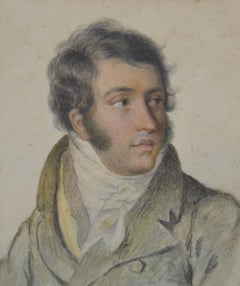
France circa 1820, Portrait of a gentleman, black chalk and pastel drawing
Located in Paris, FR
France circa 1820 Portrait of a gentleman Black chalk and pastel on paper 12 x 10 cm In its original mount, modern oak frame : 25 x 22.5 cm
Category

Romantic Early 19th Century Drawings and Watercolor Paintings

Materials

Chalk, Pastel

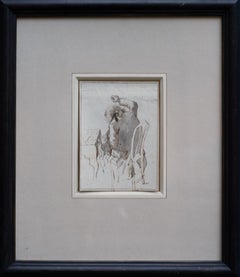
Circa 1830 Charcoal Drawing - Elegance
Located in Corsham, GB
A striking early 19th Century portrait in charcoal, showing an elegant young woman. Her dress and the style of her hair date this portrait around 1830. Her soft, sloping shoulders an...
Category

Early 19th Century Drawings and Watercolor Paintings

Materials

Charcoal

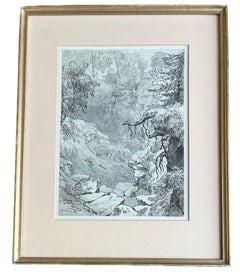
W.R.P - Framed 1815 Watercolour, The Castle Inn
Located in Corsham, GB
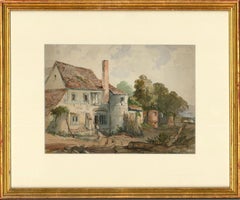
Built on the ruins of an old medieval castle, this intriguing watercolour depicts a large guest house with rooms. In the foreground a figure can be see...
Category

Early 19th Century Drawings and Watercolor Paintings

Materials

Watercolor

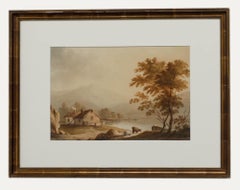
Portrait of a Man in a Red Turban, Early 19th Century Orientalist Watercolour
By Carl Leopold Müller
Located in London, GB
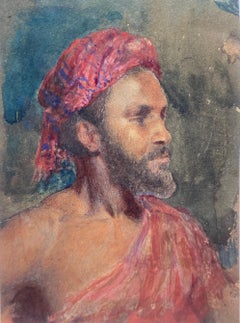
Watercolour on paper Image size: 4 1/2 x 3 1/2 inches (11.5 x 9 cm) Mounted and framed This is an arresting image featuring a head and shoulders portrait of a bearded man wearing a ...
Category

Victorian Early 19th Century Drawings and Watercolor Paintings

Materials

Watercolor

English School early 19th century, Portrait of two children, drawing
Located in Paris, FR
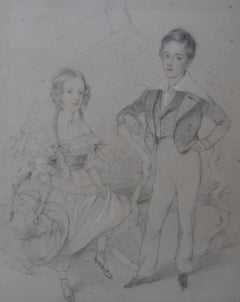
English School early 19th century, Portrait of two children, Pencil and light heightenings of white and red gouache 29.5 x 23 cm In quite good condition : the pape is yellowed by t...
Category

Old Masters Early 19th Century Drawings and Watercolor Paintings

Materials

Pencil

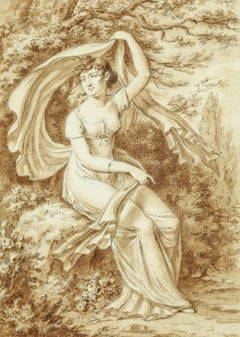
Jean-Henri Cless (1774-1812) Portrait of a young woman, signed drawing
Located in Paris, FR
Jean-Henri Cless (1774-1812) Portrait of a young woman in a landscape signed "Cless fec" for fecit on the lower left Brown ink and brown ink wash on paper Size of the sheet : 31.5 x 22 cm Size of the motive : 24.5 x 17 cm very simply framed under glass without actual frame 32 x 22.5 cm This pre...
Category

Old Masters Early 19th Century Drawings and Watercolor Paintings

Materials

Ink, Pencil

French School, early 19th century - Battle Scene between Greeks and Ottomans
Located in Paris, Île-de-France
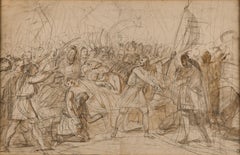
French School, early 19th century Battle Scene between Greeks and Ottomans, circa 1820–1830 Pencil and brown wash on paper, 30 × 46 cm Unsigned Provenance: Former collection of P...
Category

Old Masters Early 19th Century Drawings and Watercolor Paintings

Materials

Chalk, Crayon

Vanity Fair Illustration High Brow Types with Relationship Issues
Located in Miami, FL
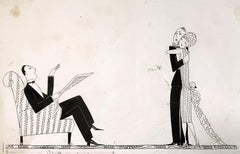
Hight brow couple having relationship issues rendered in a black and white stylized Art Deco fashion. In pencil the caption reads "Are you willing to divorce your wife the minute sh...
Category

Art Deco Early 19th Century Drawings and Watercolor Paintings

Materials

Paper, Ink, Graphite

The King s Camelopard
Located in Amsterdam, NL
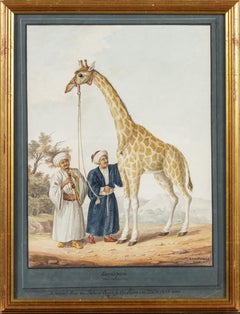
Charles Frederick de Brocktorff (1775–1850) ‘Camelopard – a present from the Pacha of Egypt to the King – at Malta on its way to England’ Signed and dated C.F. de Brocktorff. / 1827. lower right, inscribed as titled in the painted margins lower centre. Pencil and watercolour heightened with gold paint and gum arabic on paper, 36.8 x 27.9 cm A gift so majestic, it made kings blush, and a gift so grand, it would startle Europe into a craze. Pasha Muhammad Ali of Egypt (1805-1848) did it in 1827: he sent to Europe three magical spotted, horned creatures, each with a neck reaching the skies and legs as long as a house is high. One giraffe to King Charles X of France, one to Francis I of Austria and the most fabled one to King George IV of England. A curious sight for Europeans, who had not seen such a beast since the Medici giraffe in 1487. Few animals created more of a stir in Europe than these royal...
Category

Naturalistic Early 19th Century Drawings and Watercolor Paintings

Materials

Gold

Still Thinking About These?

All Recently Viewed