Items Similar to Japanese Art Ukiyo-e Figurative Painting, Woman reading a letter, Edo period
Want more images or videos?
Request additional images or videos from the seller
1 of 8
Mario B. GilJapanese Art Ukiyo-e Figurative Painting, Woman reading a letter, Edo period2014
2014
$2,621.81
£1,960.67
€2,190
CA$3,612.73
A$3,941.39
CHF 2,086.94
MX$47,229.07
NOK 26,578.36
SEK 24,303.94
DKK 16,679.45
About the Item
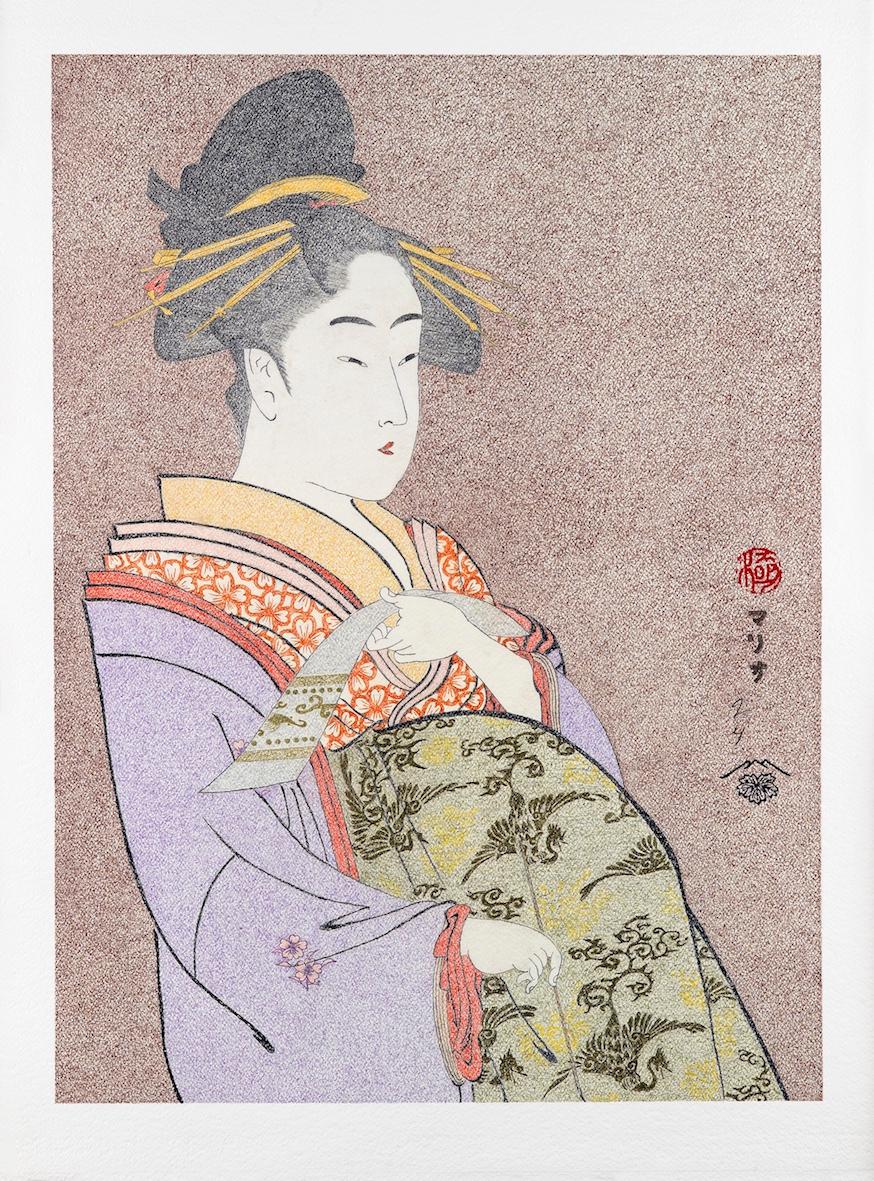
WOMAN READING A LETTER
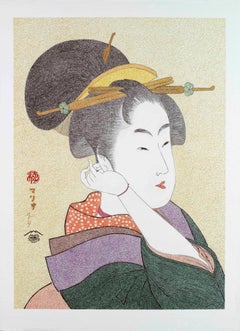
Three-quarter portrait of an Edo period Japanese courtesan caught reading a letter. Her clothing is simple: an inner pink kimono peeks out from the collar and short sleeves of the outer gray kimono with black trim. The note of color is provided by the obi tied at the waist at the front, the ribbon around the bow and the light turquoise background.
This image is part of the bijin-ga series (“Pretty women”) drawn by Mario BGil, based in the Kitigawa Utamaro woodblock print “Woman reding a letter” (1792-17993).
The artist reproduces also the seal of the censor (Kiwame) and the original publisher's seal (Tsutaya, climbing leaf), as it appears in the woodblock print used as a model; between the two, the signature of Mario BGil written in Japanese, with the date 14 (2014).
The measurements of the woodblock print are 37,2 x 24,5 cm., the drawing made by Mario BGil is 76 x 56 cm. / 29,92 x 22.05 in.
With his work on the bijing-ga series, Mario BGil wanted to embellish, give brilliance and volume to the images presented by japanese artist Kitigawa Utamaro in those beautiful engravings, ennobled with the patina of time, which have served as inspiration. The result obtained is almost life-size portraits, endowed with strong chromaticism and valuable contrasts, all enhanced, in turn, with the volume provided by the weight and rigidity of the paper, and its thick texture (Fabriano Artistico “grana grosso”, 640g/m2); the thickness and hardness of the paper makes it necessary to transport it without rolling).
In this way, Mario BGil pays tribute to his admired artist and offers us a new and enriched vision of this popular facet of oriental art from the 18th and 19th centuries.
ABOUT THE ARTIST
Mario BGil is a self-taught artist who for years has combined his creative activity with his work in the family business, away from commercial art galleries. In 2012, a deep interest in oriental art was awakened in him and he began to study the great masters of Japanese Ukiyo-e prints, who had such an influence on the European avant-garde of the late s. XIX.
The discovery of Kitagawa Utamaro (1753-1806), a key figure in the metropolitan culture of Edo (now Tokyo), and a point of reference in the history of Japanese engraving, meant for Mario a change of course caused by the imperative need to study his images, recreate them and recreate himself in them, incorporating certain changes in both the format and the technique used.
The technique used by MBG is very different from that used in engravings with wooden blocks impregnated in inks of intense colors that serve as a model. On a paper of heavy weight and thick texture, Mario BGil outlines with a black pencil, and colors the spaces with pencils and watercolors. Faced with the intensity of color of the prints (already very lost in some of them due to their age and exposure to the sun), their drawings are sifted by the streaky white, due to the thick texture of the paper, showing more lines, soft and warmer tones, giving color to the backgrounds but leaving all the volumes corresponding to the skin blank, thus giving the figures a classic serenity that transcends their oriental character.
Between 2014 and 2015, Mario BGil made more than 35 drawings based on prints selected from the huge amount of work produced by the master Utamaro that shows images of courtesans in different attitudes and poses that highlight the subtle delicacy of oriental feminine beauty.
Kitagawa Utamaro was a faithful representative of the tastes of the Japanese bourgeoisie of its time, which had transformed the life of the cities giving birth to a culture parallel to the official and aristocratic.
The activity of the new rising group took place in special neighborhoods of Edo (Tokyo) and Osaka and its banality, inconsistency and frivolity earned it the name of Ukiyo: "floating world"; a world that will give priority to a series of cultural manifestations much more popular and less intellectualized than those preferred by the nobility. The new neighborhoods are filled with brothels and shows that the upper classes will consider vain, and a new breed of heroes: sumo wrestlers, singers, actors and courtesans will come to reign in this "floating world."
In front of the traditional painting the stamp arises with images of this new world. The courtesans of the pleasure districts of Edo that Utamaro portrays, do not always appear perfectly dressed to receive the client, but are surprised while getting ready, or during the day. He observes them without being seen, spy on them in their daily and intimate work. All of them are women drawn in a similar style, with elongated faces, straight delicate noses (almost a single line) and other features reduced to a mere suggestion (the mouth, a tiny butterfly of red).
The importance that it has had in later European artists (Degas, Toulouse-Lautrec, Bonnard, Gauguin, Van Gogh ...) has been great and Mario BGil has not been able to escape the recreation of those images so classic and, at the same time, so current, paying clear tribute to its original creator.
- Creator:Mario B. Gil (1962)
- Creation Year:2014
- Dimensions:Height: 29.93 in (76 cm)Width: 22.05 in (56 cm)Depth: 0.08 in (2 mm)
- Medium:
- Movement Style:
- Period:
- Condition:
- Gallery Location:Segovia, ES
- Reference Number:1stDibs: LU74437581802
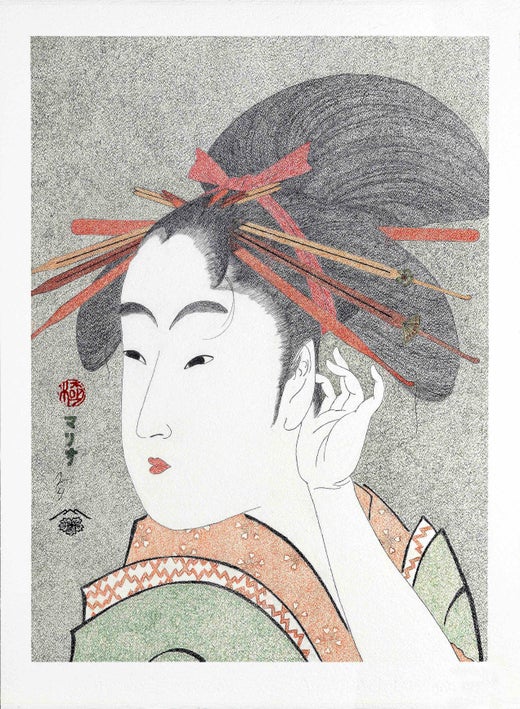
BIOGRAPHY Mario BGil is a self-taught artist who for years has combined his creative activity with his work in the business world, away from commercial art galleries. Man of very diverse interests and great artistic sensitivity, studied Art History and in 2012, a deep interest in oriental art was awakened in him so that he began to study the great masters of Japanese Ukiyo-e prints, who had such an influence on the European avant-garde of the late 19th century. The discovery of Kitagawa Utamaro (1753-1806), a key figure in the metropolitan culture of Edo (now Tokyo), and a point of reference in the history of Japanese engraving, meant for Mario a change of course caused by the imperative need to study his images, recreate them and recreate himself in them, incorporating certain changes in both the format and the technique used. The technique used by MBG is very different from that used in engravings with wooden blocks impregnated in inks of intense colors that serve as a model. On a paper of heavy weight and thick texture, Mario BGil outlines with a black pencil, and colors the spaces with pencils and watercolors. Faced with the intensity of color of the prints (already very lost in some of them due to their age and exposure to the sun), their drawings are sifted by the streaky white, due to the thick texture of the paper, showing more lines, soft and warmer tones, giving color to the backgrounds but leaving all the volumes corresponding to the skin blank, thus giving the figures a classic serenity that transcends their oriental character. Between 2014 and 2015, Mario BGil made more than 35 drawings based on the prints selected from the huge amount of work produced by the master Utamaro that shows images of courtesans in different attitudes and poses that highlight the subtle delicacy of oriental feminine beauty. Kitagawa Utamaro was a faithful representative of the tastes of the Japanese bourgeoisie of its time, which had transformed the life of the cities giving birth to a culture parallel to the official and aristocratic. In front of the traditional painting, the stamp arises with images of this new world. The courtesans of the pleasure districts of Edo that Utamaro portrays, do not always appear perfectly dressed to receive the client but are surprised while getting ready, or during the day. He observes them without being seen, and spies on them in their daily and intimate work. All of them are women drawn in a similar style, with elongated faces, straight delicate noses (almost a single line), and other features reduced to a mere suggestion (the mouth, a tiny butterfly of red). The importance that it has had in later European artists (Degas, Toulouse-Lautrec, Bonnard, Gauguin, Van Gogh ...) has been great and Mario BGil has not been able to escape the recreation of those images so classic and, at the same time, so current, paying clear tribute to its original creator.
About the Seller
5.0
Gold Seller
Premium sellers maintaining a 4.3+ rating and 24-hour response times
Established in 2002
1stDibs seller since 2017
71 sales on 1stDibs
- ShippingRetrieving quote...Shipping from: Bilbao, Spain
- Return Policy
More From This Seller
View AllJapanese Art Ukiyo-e Figurative painting, Courtesan Hanaôgi, Edo period
Located in Segovia, ES
Bijin-ga Series XXVI (Nº 26)
Title: Hanaôgi of the Ôgiya House
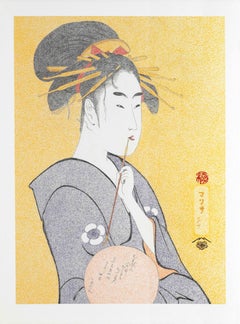
Hanaôgi, one of the most famous courtesans of the Edo period working in the Ôgiya House, an exclusive brothel in the Yoshiwara appears beautifully dressed holding a writing brush on her right hand and a decorated piece of paper in the shape of a “cartuche”, maybe to write a message of love for a client.
This image is part of the bijin-ga series (“Pretty women”) drawn by Mario BGil, based in the Kitigawa Utamaro woodblock print...
Category
2010s Edo Figurative Drawings and Watercolors
Materials
Paper, Crayon, Oil Crayon, Graphite
$4,779 Sale Price
31% Off
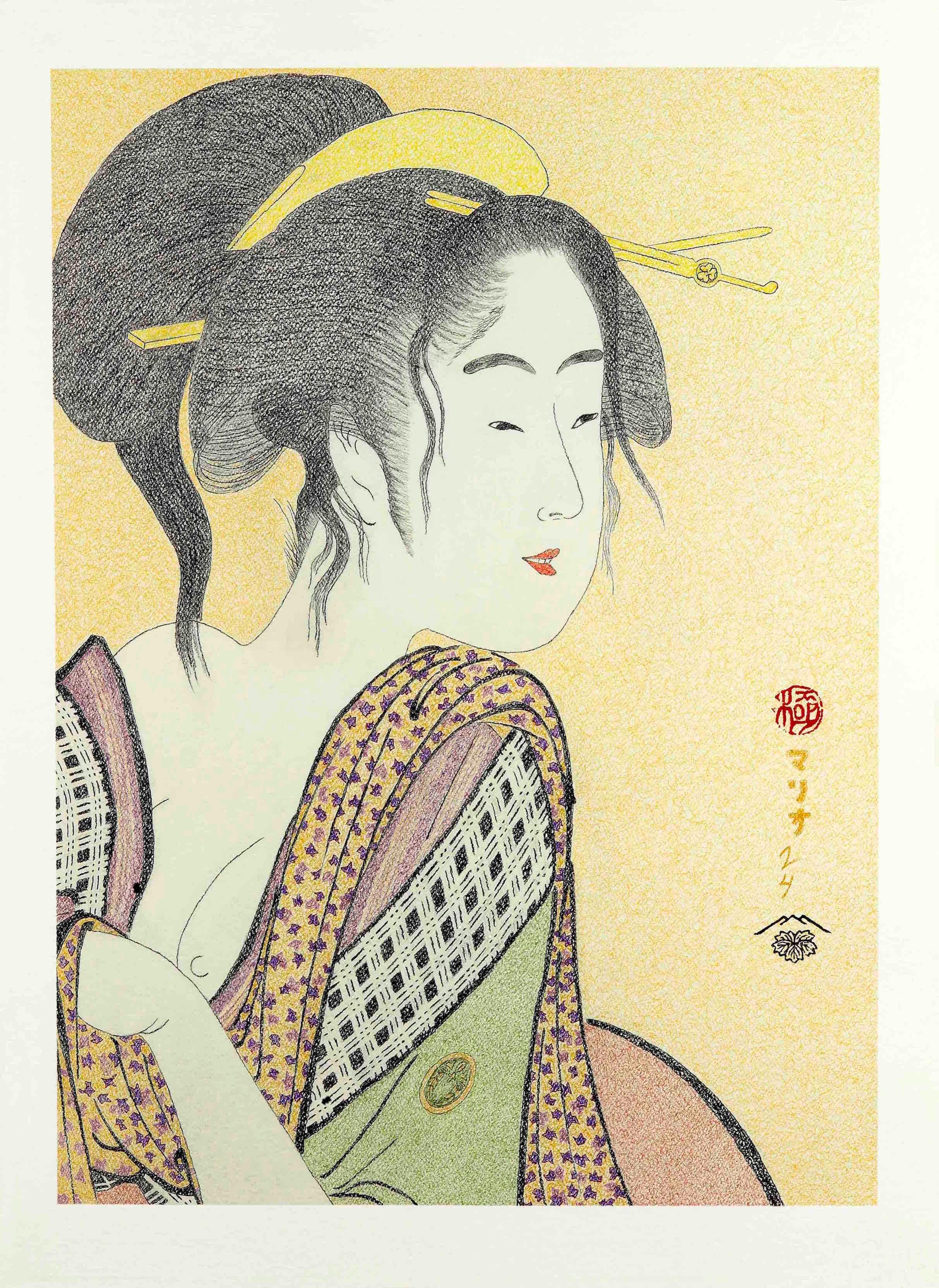
Japanese Art Ukiyo-e Figurative Painting, Hanamurasaki of the Tamaya, Edo period
Located in Segovia, ES
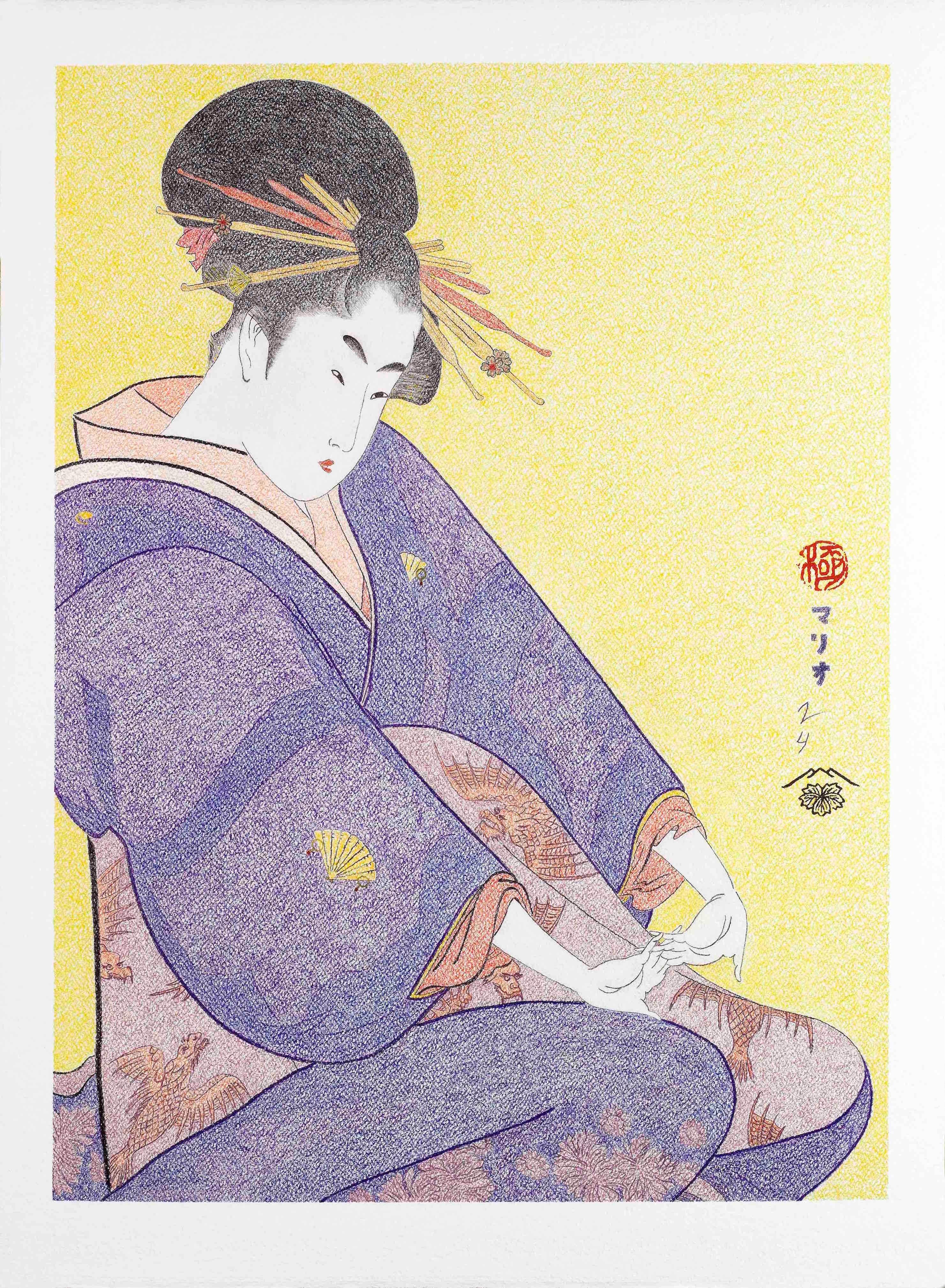
Portrait of the top-class courtesan Hanamurasaki elegantly combed, and dressed in a simple formal kimono and obi, adorned with symbols of her okiya. She is sitting on her knees in a graceful pose, stretching her arms forward and crossing her fingers with a delicate movement of the wrists.
This image is part of the “bijin-ga series” (Pretty women) drawn by Mario BGil, based in the Kitigawa Utamaro woodblock print “Hanamurasaky of the Tamaya”, (from the series: “Array of supreme beauties of the Present Day”, 1794), 36,2 x 25 cm. Museum of Fine Arts. Boston, USA.
The artist reproduces the seal of the censor (Kiwame) and from the original publisher ("Tsutaya", climbing leaf)), between the two, the signature of Mario BGil written in Japanese, with the date 14 (2014).
The mesaurements of the drawing are 76 x 56 cm. (29,92 x 22,05 in.), with a painted surface of 67 x 49,5 cm.
With his work on the "bijing-ga series", Mario BGil wanted to embellish, give brilliance and volume to the images presented by japanese artist Kitigawa Utamaro in those beautiful engravings, ennobled with the patina of time, which have served as inspiration. The result obtained is almost life-size portraits, endowed with strong chromaticism and valuable contrasts, all enhanced, in turn, with the volume provided by the weight and rigidity of the paper, and its thick texture (Fabriano Artistico “grana grosso”, 640g/m2; the thickness and hardness of the paper makes it necessary to transport it without rolling).
In this way, Mario BGil pays tribute to his admired artist and offers us a new and enriched vision of this popular facet of oriental art from the 18th and 19th centuries.
ABOUT THE ARTIST
Mario BGil is a self-taught artist who for years has combined his creative activity with his work in the business world, away from commercial art galleries. Man of very diverse interests and great artistic sensitivity, studied Art History and in 2012, a deep interest in oriental art was awakened in him so that he began to study the great masters of Japanese Ukiyo-e prints, who had such an influence on the European avant-garde of the late 19th century.
The discovery of Kitagawa Utamaro (1753-1806), a key figure in the metropolitan culture of Edo (now Tokyo), and a point of reference in the history of Japanese engraving...
Category
2010s Edo Figurative Drawings and Watercolors
Materials
Paper, Crayon, Oil Crayon, Graphite
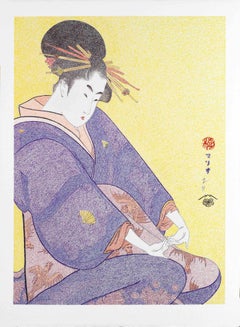
Japanese Art Ukiyo-e Figurative Painting, The courtese Hinakoto, Edo period
Located in Segovia, ES
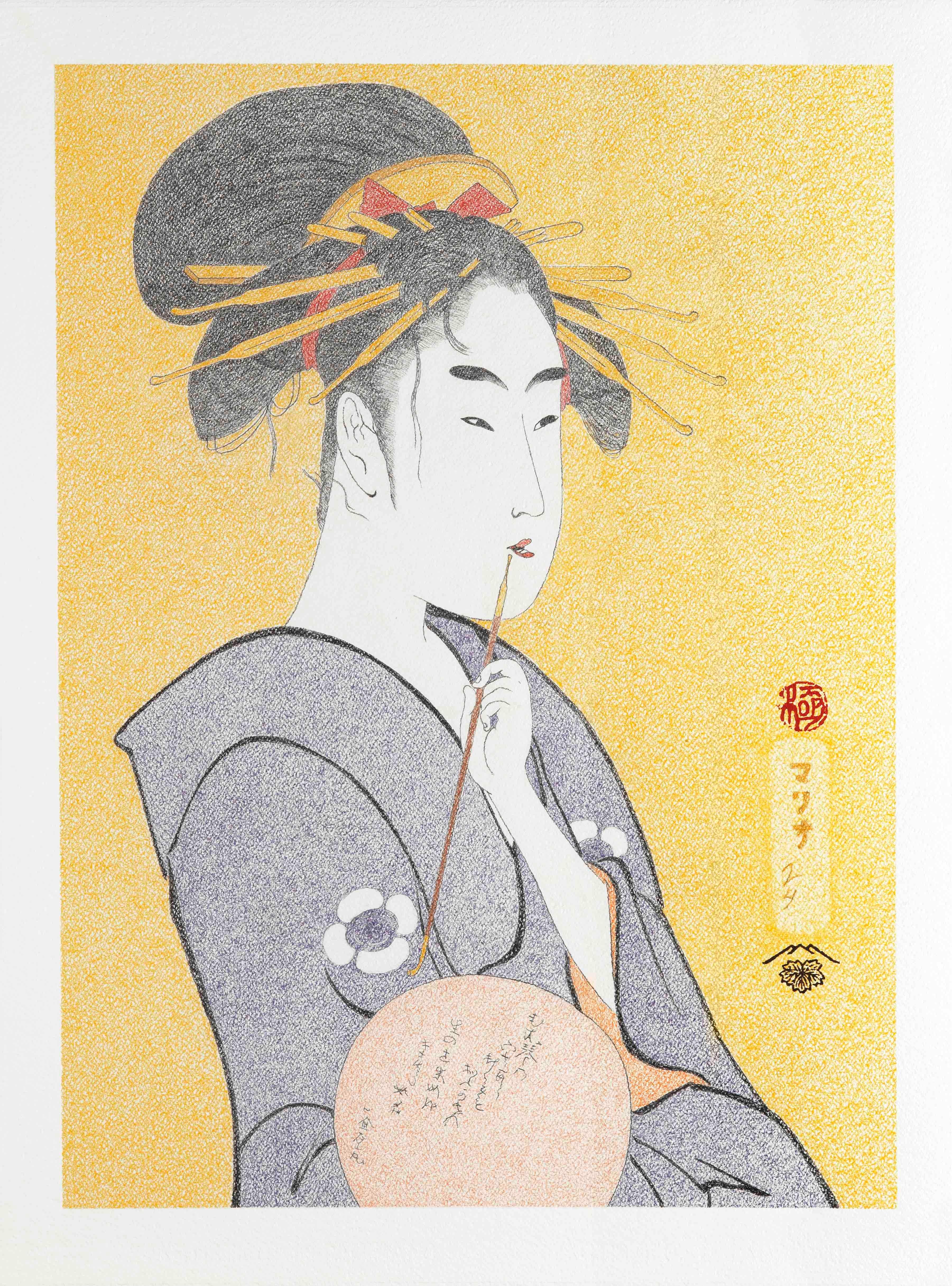
Bijin-ga series XXI (Nº 21)
Title: The courtese Hinakoto of the Hyôgorô House of Edo
The courtesan Hinakoto is depicted by smoking tobacco. She takes the pipe delicately in her left hand and, in her right hand, she seems to be holding a “uchiwa” (rigid hand fan) that comes out from the bottom of the drawing, decorated with written calligraphy. Some strands of hair that fall on her temple and her scant clothing show that the painter has surprised her in a relaxed moment in which she does not lose her elegance and slenderness.
This image is part of the bijin-ga series (“Pretty women”) drawn by Mario BGil, based in the Kitigawa Utamaro woodblock print...
Category
2010s Edo Figurative Drawings and Watercolors
Materials
Crayon, Paper, Oil Crayon, Graphite
$2,097 Sale Price
43% Off
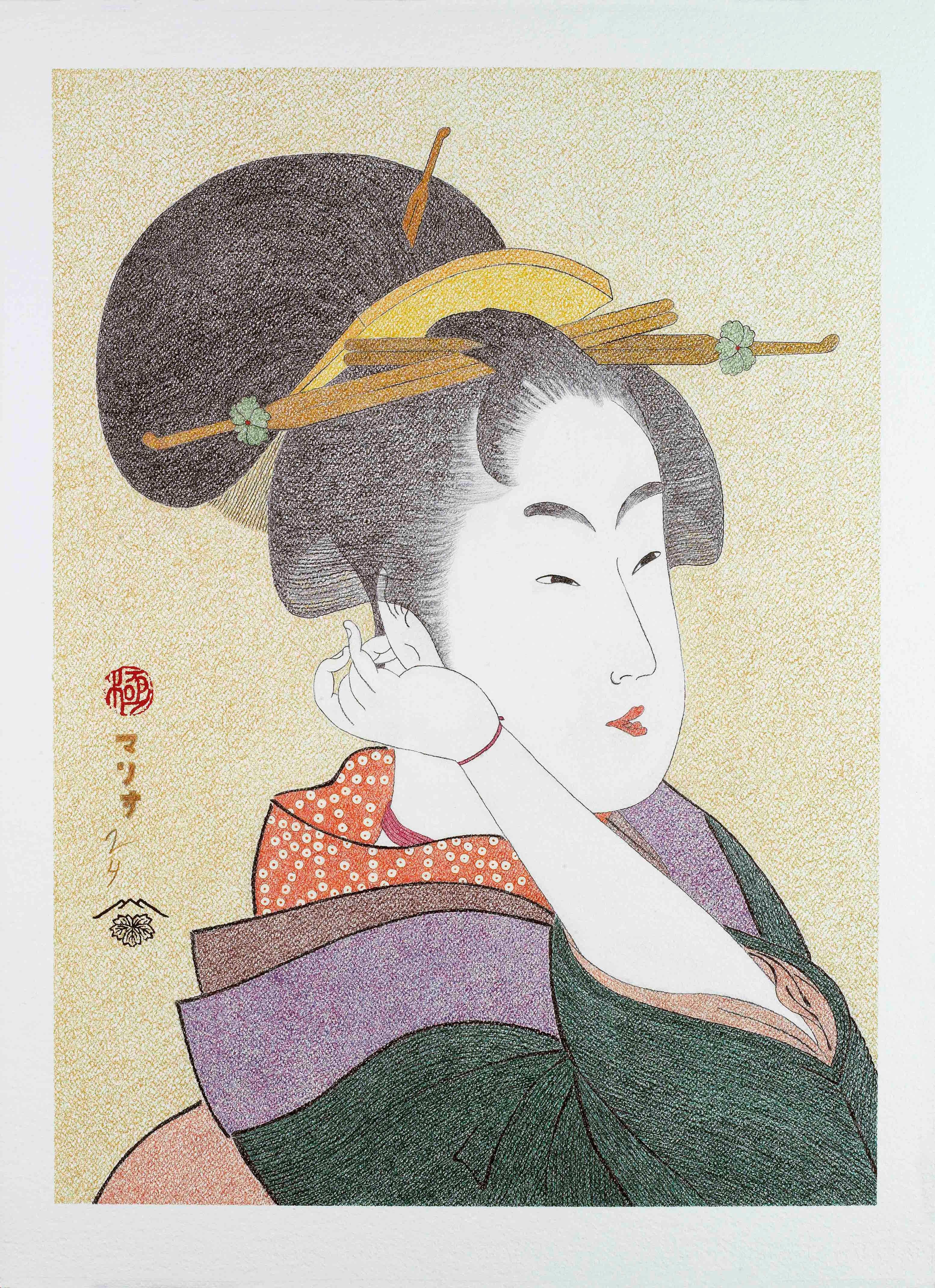
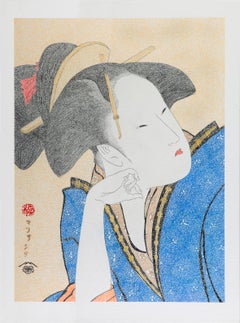
Japanese Art Ukiyo-e Figurative painting, Reflective Love, Edo period
Located in Segovia, ES
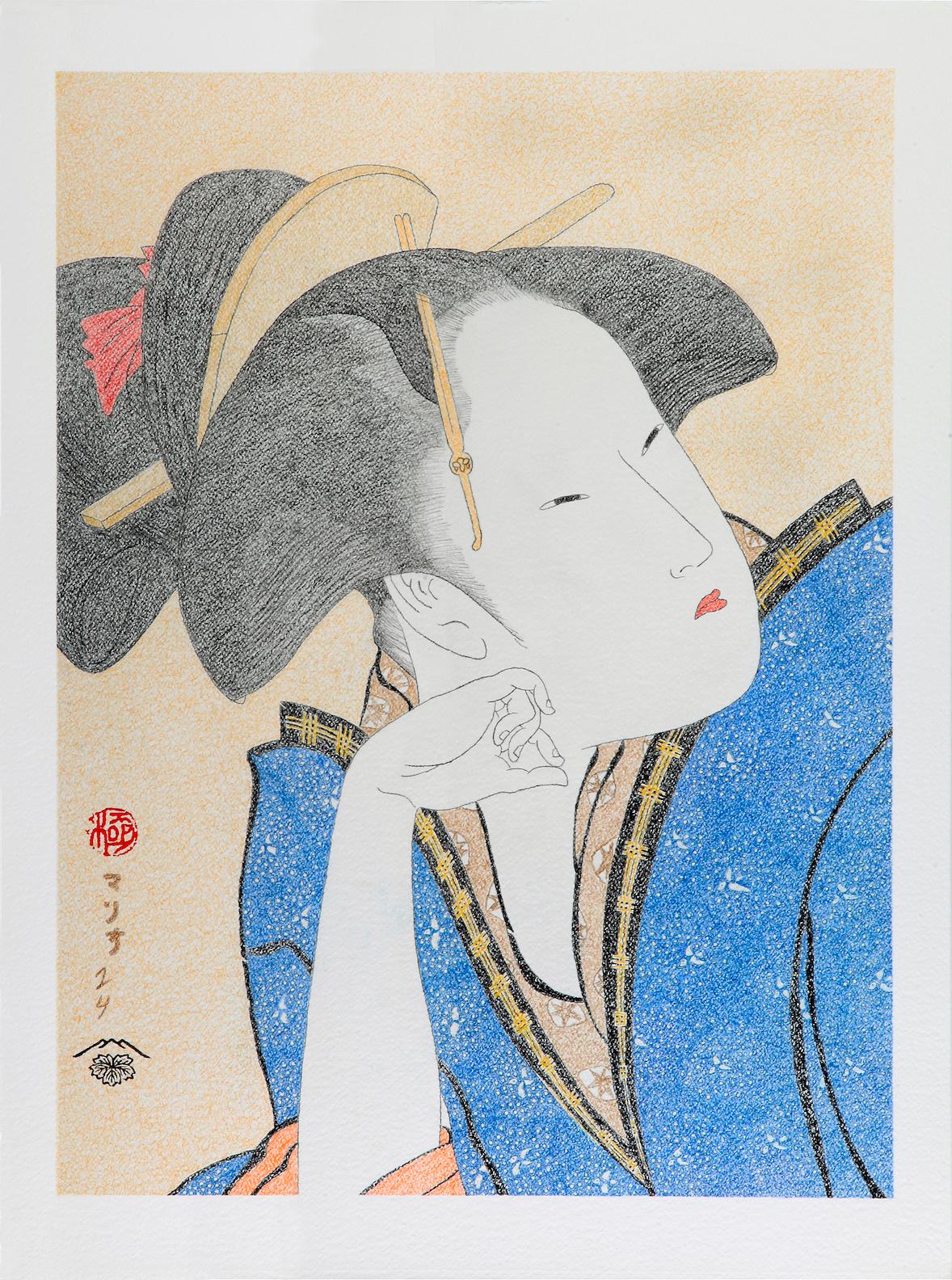
Bijing-Ga Series XII (Nº 12)
Title: Reflective Love.
Lovely portrait of a beauty looking over her shoulder.
In Reflective Love (from the Utamaro...
Category
2010s Edo Figurative Drawings and Watercolors
Materials
Crayon, Paper, Oil Crayon, Graphite
$4,779 Sale Price
28% Off
Japanese Art Ukiyo-e Figurative painting, Love for a farmer´s wife, Edo period
Located in Segovia, ES
Bijin-ga Series XVII (nº 17)
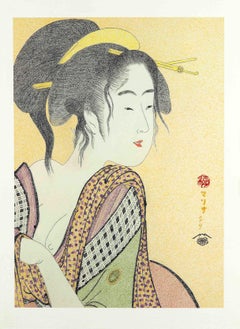
Title: Love for a farmer´s wife
Sensual portrait of a young and beautiful farmer´s wife. Her cheerful and careless gesture, showing her chest between the open folds of the neckline of his humble dress; the strands of hair falling on her temples, and her smiling gesture denote the state of happiness enjoying love, in a well-deserved break from her hard work.
This image is part of the bijin-ga series (“Pretty women”) drawn by Mario BGil, based in the Kitigawa Utamaro woodblock...
Category
2010s Edo Figurative Drawings and Watercolors
Materials
Paper, Crayon, Oil Crayon, Graphite
Japanese Art Ukiyo-e Figurative Painting, Tatsumi Roko, Edo Period
Located in Segovia, ES
Bijin-ga series XXVIII (Nº 28)
Title: Tatsumi Roko
Portrait of Tatsumi Roko, a geisha of the pleasure quarters in the Edo period. The image belongs to the series Renowed Beauties Likened to the Six Inmortal Poets.
The popular top-class geishas of the day , known as “oiran”, were depicted in this type of print. In ukiyo-e woodblock prints, this close-up portrait view of the upper body is known as an okubi-e (bust portrait).
This image is part of the bijin-ga series (“Pretty women”) drawn by Mario BGil, based in the Kitigawa Utamaro woodblock print...
Category
2010s Edo Figurative Drawings and Watercolors
Materials
Paper, Crayon, Oil Crayon, Graphite
You May Also Like
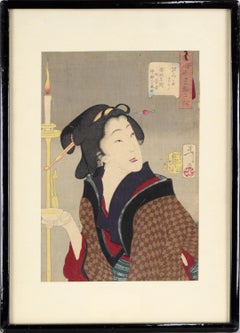
"Thirsty: the appearance of a town geisha in the Ansei era" - Woodblock on Paper
By Tsukioka Yoshitoshi
Located in Soquel, CA
"Thirsty: the appearance of a town geisha in the Ansei era" - Woodblock on Paper
From the series "Thirty-two Aspects of Customs and Manners" (Fuzoku sanjuniso)
Lively woodblock of a...
Category
1880s Edo Figurative Prints
Materials
Paper, Ink, Woodcut
Scribe and Personal Assistant to the Shogun - Japanese Woodblock Print on Paper
Located in Soquel, CA
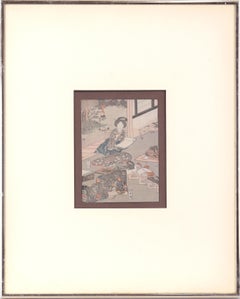
Scribe and Personal Assistant to the Shogun - Japanese Woodblock Print on Paper
Detailed woodblock print by an unknown artist, In the style of Suzuki Harunobu. There are two women i...
Category
19th Century Edo Figurative Prints
Materials
Paper, Ink, Woodcut
19th century color woodcut Japanese ukiyo-e print female geisha figure signed
By Utagawa Kuniyoshi
Located in Milwaukee, WI
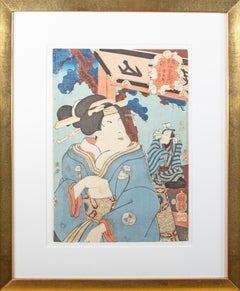
This print is from a highly regarded series by the Edo woodblock artist Utagawa Kuniyoshi: in the period, there were at times prohibitions in depicting a...
Category
1850s Edo Figurative Prints
Materials
Paper, Pigment, Woodcut
"Young Woman of the Meiji" by Yoshu Chikanobu, Lithographic Print.
By Yoshu Chikanobu
Located in Chesterfield, MI
Published by Portal Publications.
Printed in USA
Good Condition
24 x 18
Category
20th Century Portrait Prints
Materials
Lithograph
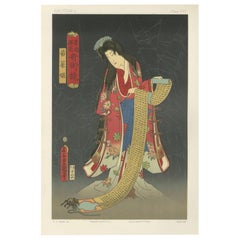
Antique Japanese Kabuki Print: Enigmatic Woman with Scroll and Spider, ca.1882
Located in Langweer, NL
Title: Antique Japanese Kabuki Print: Enigmatic Woman with Scroll and Spider, 19th Century
Description: This stunning 19th-century Japanese print depicts a striking scene from kabuki theater or folklore, rendered with vivid color and dramatic elegance. Published by Sampson Low & Co. and lithographed in Paris by Imp. Lemercier & Cie under the direction of G. A. Audsley, this piece captures a moment of intense narrative and refined artistry.
The print features a woman dressed in an elaborate kimono adorned with intricate floral patterns, her flowing hair and serious expression hinting at a story of mystery and transformation. She holds an impossibly long scroll covered with fine calligraphy, unspooling to the ground where a small spider lurks—an ominous presence that likely alludes to the famous kabuki tale of Jorogumo, the spider spirit that takes the form of a beautiful woman to ensnare her victims.
The color palette of deep blacks, rich reds, and soft greens enhances the print’s sense of drama, while the finely rendered spiderweb background reinforces the supernatural atmosphere. The precision of the linework and the texture of the print exemplify the best of late 19th-century Japanese color printing, merging traditional Japanese themes with European lithographic techniques.
For collectors of kabuki art...
Category
Antique 1880s Prints
Materials
Paper
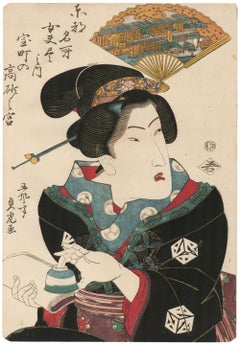
Portrait of a Woman
Located in New York, NY
Sadatora, Utagawa (active 1818-1844).
[Portrait of woman].
Japan, ca. 1825.
Original woodblock print.
Category
1820s Portrait Prints
Materials
Paper
More Ways To Browse
Japanes Art
Ukiyo E
Japanese Ukiyo E
Edo Period Japanese Art
18th Century Portrait Of Woman
18th Century Portrait Of A Woman
Portrait Of A Woman Reading
Black Woman In Red Dress Painting
Period Portraits
Japanese Prints Ukiyo E
Edo Period Japanese Painting
Life Size Portrait
Japan Engraving
Sumo Wrestler
Sumo Wrestling
Painting Woman Reading
Utamaro Kitagawa
Japanese Woman Paintings