William Henry Hunt OWS (1790-1864) (attrib.)
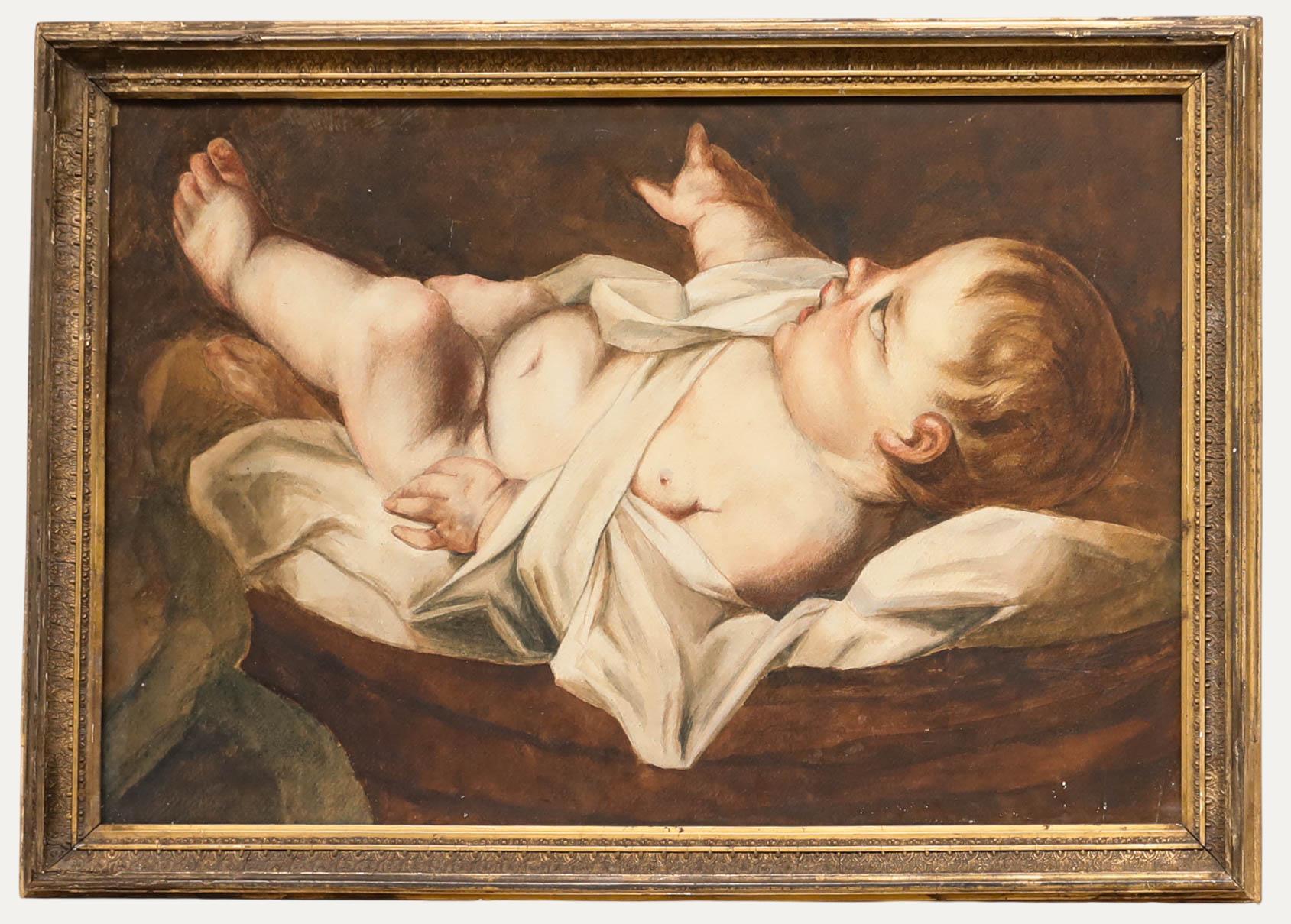
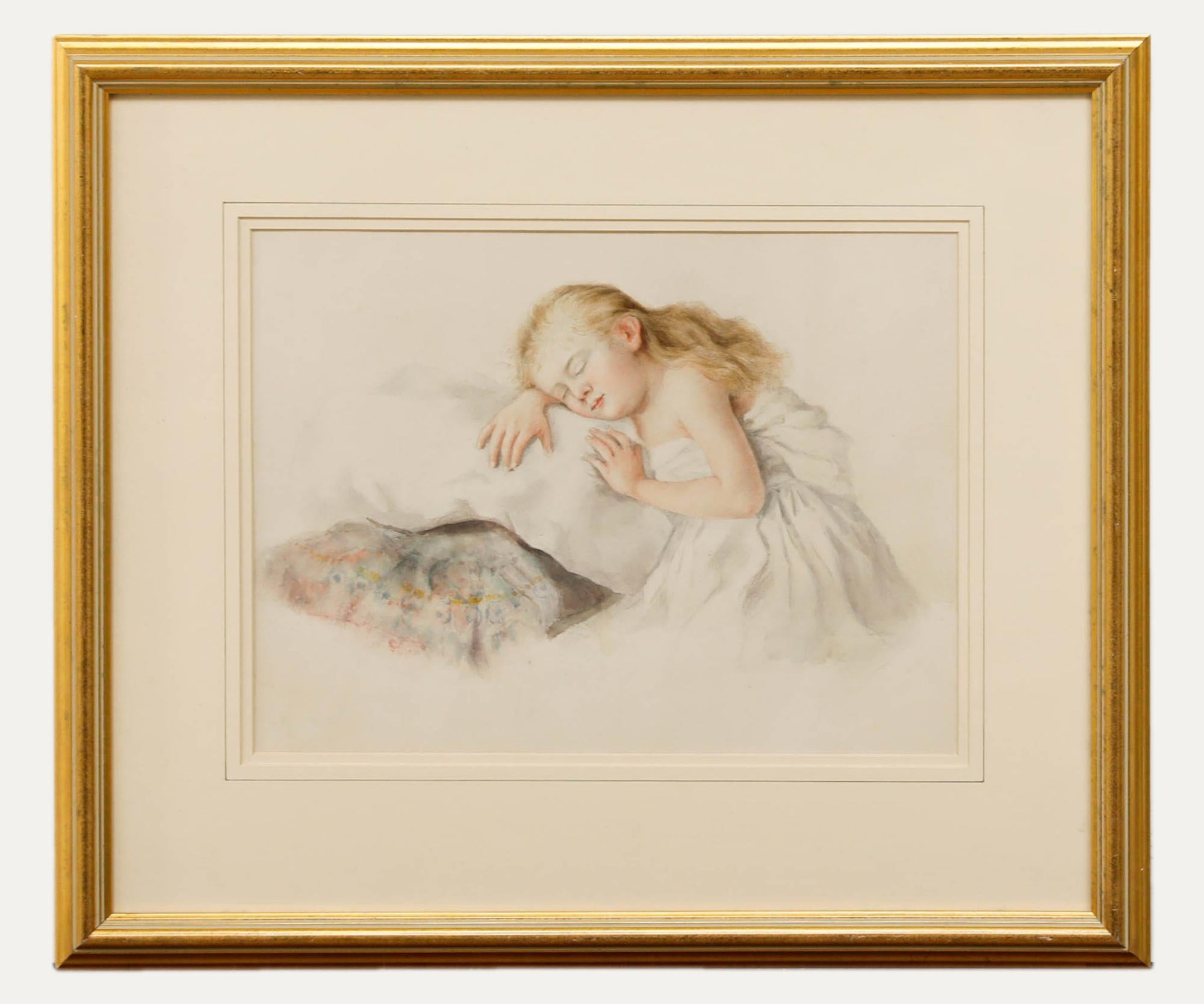
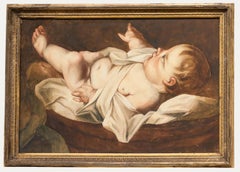
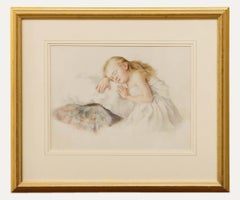
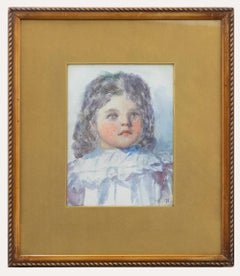
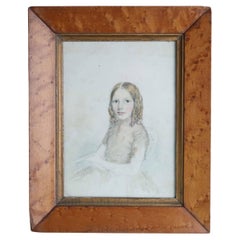
Study of a resting infant
Watercolour and graphite heightened with zinc oxide on paper
13.9 x 18.5 cm.; (within frame) 31.1 x 25.6 cm.
Unsigned
Provenance:
Private collection, United States;
Bonhams, 15 June 2010, lot 142;
Private Collection, United Kingdom.
This beautifully worked study of a resting infant is a particularly sensitive example of William Henry Hunt’s observational and technical sophistication. Gently reclining, the young child gazes upward with a benign restfulness, its blue eyes and lace cuff subtly coloured the same pale blue. The child’s form emerges restfully from a mass of creased white fabric, with short fingers stemming from a fleshy hand, and delicate features. This unfinished drawing provides a pleasing study of Hunt’s approach, with layers of wash applied over an instinctual outline of the figure, afterwards heightened with generous touches of opaque white pigment to brighten the gown and forehead. The stippled colour around the child’s head is typical of Hunt’s technique, as is the white medium, which is most certainly zinc oxide, or ‘Chinese white’. Hunt experimented with the new pigment during the 1830s, and would introduce gum to produce a thick primer, or the bright highlights seen in the present drawing.
Where Hunt’s drawings of children (often working class) possess a humorous or didactic quality, the sensitivity of the present work is indicative of an important personal connection. It is plausible that the child is a member of Hunt’s own family. His daughter Emily Effie was born in 1832, and is known to have modelled for numerous works. Hunt’s sister-in-law Maria also had two children who acted as models for their uncle. Since Hunt insisted on painting from life, and never from visual memory, he relied on family members to save himself the difficulty of finding models patient enough to sit for extended lengths.
William Henry Hunt was one of the most renowned and productive watercolourists of his period, regarded for his heightened naturalism and technical inventiveness. His admirers included John Ruskin, who took lessons from Hunt in 1854 and 1861, and whose description of Hunt’s stippled technique in his 1854 Elements of Drawing was an influence on the pointillists. He was born in 1790 to John Hunt, a tin-plate worker and japanner, and his wife Judith. He was baptised on 28 March 1970 at 8 Old Belton Street, London. Hunt was born with a congenital deformity of his legs, and suffered from ill health that prevented him from following into his father’s trade. An uncle observed that his ‘nevvy, little Billy Hunt […] was always a poor cripple, and as he was fit for nothing, they made an artist of him’ (Witt, p. 31). By sixteen Hunt was apprenticed to the landscape painter John Varley for seven years, with whom he lived for a time at 8 Broad Street, Golden Square, London. In 1807 Hunt exhibited three oils at the Royal Academy, and entered the Royal Academy Schools in 1808. He was at the same time enrolled at the ‘Monro Academy’ of Dr Thomas Munro, a patron of watercolourists who paid Hunt 7s. 6 d. a day for his pictures. Hunt soon after received a commission from the Earl of Essex to paint views of his estate and interiors of Cassiobury, and likewise for the Duke of Devonshire.
Between 1807 and 1825 Hunt showed 14 works at the Royal Academy, and in 1824 was elected to the Society of Painters in Water Colours (the Old Watercolour Society), becoming a full member in 1826. Hunt followed contemporary fashion and developed a great human interest, producing studies of rural and domestic characters. He married his eighteen-year-old cousin Sarah Holloway in 1830, with whom he had his daughter Emma Effie. In 1845 Hunt established a studio at 62 Stanhope Street, Hampstead Road, London, which was later described by Walter Sickert as ‘a little box lit from above that cannot have measured more than seven foot square’ (Witt, p. 56). He worked from sunrise to dusk, though a single drawing could take a fortnight to complete. Hunt was awarded a certificate of merit following his exhibition of eleven works in the Paris Universal Exhibition of 1855, where the French poet Charles Baudelaire noted his stubborn realism. In 1857 thirty of Hunt’s works were included in the Manchester Art Treasures Exhibition, exceeded in number only by Turner and David Roberts. By the end of his lifetime, Hunt had exhibited 791 works at the Old Watercolour Society. He left some £60,000 to be divided in annuities for his family – a considerable sum considering that the annual earnings of a skilled worker were £150 (Jones, p. 5).
Bibliography and further reading:
Englund, Craig W., ‘Constructed Naturalism in the Watercolors of William Henry Hunt’, Huntingdon Library Quarterly, 53, no. 1 (Winter, 1990) pp. 67-85
Jones, Tom, William Henry Hunt, 1790-1864 (Wolverhampton: Wolverhampton Art Gallery and Museum, 1981)
Witt, Sir John Clermont, William Henry Hunt, 1790-1864, Life and Work, With a Catalogue (Wallop: Barrie
Jenkins, 1982)